
The next night he attended a soiree held by Madame la Marquise du Deffand. Her guests were the most important personages in Europe. The Marquise was known to be strongly pro-British. Everyone expected that Monsieur Franklin from Philadelphia would be put in his place. How could he compete in this brilliant company? He was much too clever to try. All evening he sat quietly smiling, waiting for others to do the talking, listening with interest to everything that was said, even by the ladies. The company was enchanted. They had believed all Americans to be bold and rude-mannered and self-assertive. This Monsieur Franklin, who dressed like a Quaker, was a sage, a patriarch! They had never known anyone like him. From then on, the aristocracy gave him their adoration, as did the scientific world and the common people.
A few days later there was a gift of two million livres, not connected with the funds at Hortalez, presented for the American cause in the name of the French King. Franklin had, without resort to bullying or conniving, scored his first victory in French diplomacy.
For fear of British retaliation, Vergennes dared not openly sponsor him. Privately he was doing all in his power to convince Louis XVI that the American rebellion, even though against another king, should be supported to the hilt. This was not easy, for the French ruler was not yet ready to show more than a token interest in the Americans. Franklin understood Vergennes’ position and did not press him for what he had really come to get, an open alliance. His most important task, from Vergennes’ viewpoint, was to win French public opinion to his side. This he did without half trying.
His popularity mounted daily. For the French he was a man of reason, like their Voltaire, and an advocate of the equality of man and the virtues of rustic living, like their philosopher Jean Jacques Rousseau. They saw him as the man who had singlehandedly fomented the American Revolution, a rumor carefully nourished by the British Ambassador in Paris, Lord Stormont.
He was given credit for the Declaration of Independence and the Pennsylvania Constitution. Not knowing yet of Thomas Paine, people took it for granted that he was the author of that marvelous pamphlet “Common Sense,” which was reprinted in French with the omission of its attacks on royalty. They admired him alike for his scientific achievements and for “The Way of Wealth,” the proverbs of Poor Richard as cited by Father Abraham, which they praised to the skies as “sublime morality.”
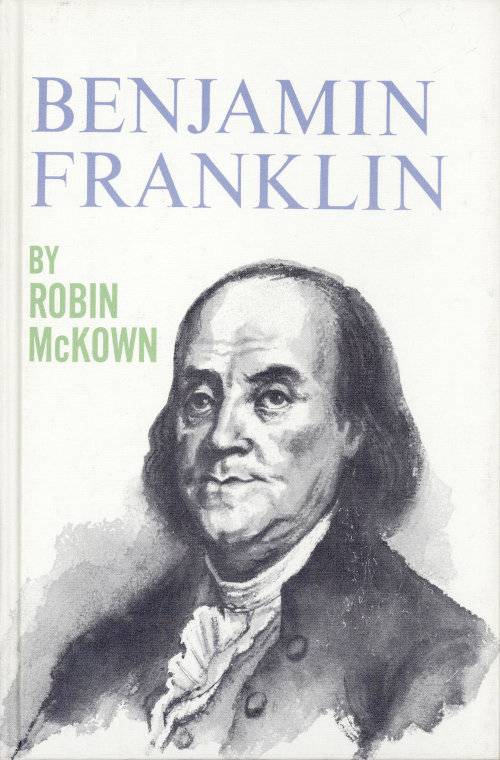
It became the fashion of every home to have an engraving of him above the mantel. Medallions with his image in enamel adorned the lids of snuffboxes, and tiny ones were even set in rings, selling in incredible numbers. In time his portrait was reproduced on watches, clocks, vases, dishes, handkerchiefs, pocket knives. There were paintings of him without end, and busts in marble, bronze and plaster. “These,” Franklin wrote to his daughter Sally, “with the pictures, busts, and prints (of which copies upon copies are spread everywhere), have made your father’s face as well known as that of the moon.”
The first of March he moved from the Paris hotel where he and his grandsons had been staying to Passy, a beautiful spot half a mile from Paris, less a village than a group of villas set amidst forests and vineyards. Their house was on the great estate of Le Ray de Chaumont, an ardent partisan of the United States, who refused to accept rent from his distinguished guest.
The grounds of the Chaumont estate were laid out in formal gardens around an octagonal pond, with alleys of linden trees. Often Franklin and his grandsons ate at the lavish Chaumont table, or had their meals sent from the Chaumont kitchen for a minimum charge. When he gave a large dinner party in his own quarters, everything would be sent over by the Chaumont staff. He had his own servants, including a coachman, and kept a carriage and a pair of horses. Benjamin Bache went to boarding school in the village, coming home for Sunday. Temple acted as his secretary.
The British, who had spies everywhere, were well aware of the reason for his presence in France. Vainly did British Ambassador Lord Stormont try to belittle him or his country. He could not match Franklin’s wit. Once Franklin learned that Stormont was spreading a rumor that 4,000 Americans had been lost in a battle and their general killed. “Truth is one thing. Stormont is another,” he commented dryly. In Parisian slang, the verb “to Stormont” became a synonym for “to lie.”
In truth, with the exception of Washington’s victory over the Hessians at Trenton, the Christmas of 1776, news from America was discouraging. Franklin refused to show any sign of worry. “Ça ira,”—“it will go on”—he would say to anyone who asked how the American Revolution was faring. In the years of France’s own revolution, Franklin’s famous Ça ira became the catchword of a popular war song.
Some time that summer, or so it is said, Franklin passed a night at the same inn as Edward Gibbon, author of Rise and Fall of the Roman Empire. Franklin sent up a note requesting the pleasure of his company. Gibbon answered that though he admired Franklin as a philosopher he could not, as a loyal English subject, converse with a Rebel. Franklin promptly sent him a second note. He had the greatest respect for the historian, he wrote, and when Gibbon decided to write the Rise and Fall of the British Empire, he would be happy to supply all the needed data.
The revolt in America had enormous glamour for innumerable European officers who were eager to offer their services, for money, for the thrill of adventure, and perhaps less often because they believed in the American cause. Franklin was besieged with their requests for him to recommend them to the American army. “My perpetual torment,” he called them:
People will believe, notwithstanding my continually repeated declaration to the contrary, that I am sent hither to engage officers. You have no conception how I am harassed.... Great officers of all ranks, in all departments; ladies, great and small, besides professed solicitors, worry me from morning to night.... I am afraid to accept an invitation to dine abroad, being almost sure of meeting some officer or some officer’s friend who, as soon as I am put in good humour with a glass of champagne, begins his attack upon me.
Only partly in jest, he composed a form letter:
The bearer of this, who is going to America, presses me to give him a letter of recommendation, though I know nothing of him, not even his name. This may seem extraordinary, but I assure you is not uncommon here. Sometimes, indeed, one unknown person brings another, equally unknown, to recommend him; and sometimes they recommend one another. As to this gentleman, I must refer you to himself for his character and merits, with which he is certainly better acquainted than I can possibly be. I recommend him, however, to those civilities which every stranger of whom one knows no harm has a right to; and I request you will do him all the good offices, and show him all the favour, that on further acquaintance you shall find him to deserve.
Temple later claimed that he actually used this letter on occasion, though it has never been proved.
There was, however, one officer whom Franklin recommended to George Washington without ever having met. This was the nineteen-year-old Marquis de Lafayette, an ardent youth set on revenging a father killed by the English. “He is exceedingly beloved,” he wrote Washington early in August after Lafayette had already left France, “and everybody’s good wishes attend him; we cannot but hope he may meet with such a reception as will make the country and his expedition agreeable to him.”
Another valuable recruit Franklin sent to America was the former Prussian officer Baron von Steuben, whose rigid training of American troops at Valley Forge raised morale at a moment when it had sunk to a new low.
In England, he still had friends in high places. Lord Rockingham was praising his courage in crossing the Atlantic, risking capture and being brought to an “implacable tribunal.” Charles James Fox, a member of Lord North’s cabinet, was quoting to his fellow cabinet members Franklin’s remark that England’s war on America would be as costly and useless as the Crusades. While to George III he had become “that insidious man from Philadelphia,” Sir John Pringle, now president of the Royal Society, supported him in one of the few comic episodes of wartime.
During Franklin’s stay in England, he had given advice on installing lightning rods on St. Paul’s Cathedral and other important buildings. One member of the Royal Society, Benjamin Wilson, an artist who had painted Franklin’s portrait, argued that blunt lightning rods would be more effective than pointed ones, but he had been over-ruled. The battle between “the sharps and the flats” raged briefly and then subsided.
It was revived when the war was under way by George III, who felt that since pointed lightning rods had been invented by a Rebel, they must certainly be subversive. He ordered that the rods on his palace and throughout the United Kingdom be replaced by the blunt type and commanded Sir John Pringle to back him. Sir John boldly retorted that the laws of nature were not changeable at royal pleasure. He was thereupon informed that the royal authority did not believe that a man of his views should occupy the presidency of the Royal Society. Sir John, loyal to Franklin to the end, promptly resigned.
As for Franklin, he remained an objective observer: “I have never entered into any controversy in defense of my philosophical opinions,” he wrote in October 1777. “I leave them to take their chances in the world. If they are right, truth and experience will support them; if wrong, they ought to be refuted and rejected. Disputes are apt to sour one’s temper, and disturb one’s quiet.”
In November a visitor to Passy informed him that General Howe had taken Philadelphia. (Congress had fled to York, Pennsylvania, which became temporarily the capital of the United States.) Calm and smiling, Franklin countered, “I beg your pardon, sir. Philadelphia has taken Howe.”
Inwardly, he was gravely concerned. His daughter and her family, his home, those he loved, and everything he owned was in Philadelphia. But he could not afford to let his anxiety show.
He considered at this time telling Vergennes that unless America could count on a French alliance, they would have to make terms with England, but decided the threat might boomerang and force the French to abandon them. Best wait until the news was better. It so happened he had not long to wait.
On December 4, a messenger from Boston arrived at Passy, to announce that General John Burgoyne, whom the British had sent to Canada to lead an army to invade the colonies from the north, had been defeated at Saratoga. Beaumarchais, who was present when this news came, drove off to Paris so recklessly that his carriage upset and his arm was broken.
Franklin and his two commissioners promptly drew up a dispatch for Vergennes. Two days later Conrad-Alexandre Gérard of the foreign office arrived at Passy with Vergennes’ congratulations—and a request that the Americans renew their proposal for an alliance.
Franklin drafted the proposal on December 7 and Temple delivered it the next day. On the 12th, the commissioners met secretly with Vergennes. Franklin hoped the matter could be settled there and then but the French minister said France could not agree to an alliance without Spain. It took three weeks for a courier to make the trip and bring back an answer from Spain. It was negative. Temporarily negotiations were at a standstill.
In the meantime England had sent an envoy named Paul Wentworth to parley with the Americans. He passed himself off as a stock speculator though he was actually chief of the British espionage. Silas Deane saw him several times. Wentworth told him that the British ministry was ready to return to the imperial status of before 1763, suggested a general armistice with all British troops withdrawn except those on the New York islands, and added, insinuatingly, that any Americans who helped to bring about an understanding would be rewarded with wealth and titles and high administrative posts.
Franklin knew about Wentworth but refused to see him until January 6, a week after the news of Spain’s rejection of the alliance. That day he conferred two hours with Wentworth, devoting the whole time to a recital of England’s crimes against America. After that he and Wentworth had dinner with Silas Deane and his assistant Edward Bancroft (who was also an English spy).
The results of this dinner were exactly what Franklin anticipated. It was duly reported to Vergennes, who could only judge that negotiations for a reconciliation between England and America were under way, which was the last thing in the world he wanted. The very next day the French King’s council voted formally on a treaty and an alliance with the United States of America.
The signing of the treaty took place on Friday, February 7, 1778, at the office of the ministry for foreign affairs in the Hotel de Lautrec, Paris. For this all important occasion Franklin donned an old costume, somewhat old-fashioned and rather too tight for him, of figured Manchester velvet. Someone asked him why. “To get it a little revenge,” Franklin said. “I wore this coat on the day Wedderburn abused me.”
The ceremony was simple. Gérard signed first, then Franklin, after which Arthur Lee and Silas Deane added their names. A magnificent diplomatic campaign had been won.
On March 20, Louis XVI avowed the treaty by receiving the three commissioners in his private quarters at Versailles. Franklin wore a brown velvet suit, white hose, and carried a white hat under his arm. He had neither wig nor sword, and his spectacles were on his nose. The courtiers claimed they had never seen anything so striking as this “republican simplicity.”
To the commissioners, the King said, “Firmly assure Congress of my friendship. I hope that this will be for the good of the two nations.”
Franklin responded for his fellow envoys. “Your Majesty may count on the gratitude of Congress and its faithful observance of the pledges it now takes.”
That evening Vergennes gave a great dinner in their honor at Versailles. Later they made a call on the royal family. The charming and beautiful Marie Antoinette, who was at her gambling table, insisted that Franklin stand by her, and talked to him in between making her bids at exceedingly high stakes. It was certainly the first time in history that the son of an American candlemaker kept company with a queen.
15
AMERICA’S FIRST AMBASSADOR
In the spring after the signing of the treaty with France, Silas Deane was recalled to America. John Adams was sent to take his place. Franklin invited him and his wife Abigail to stay with him at Passy, and arranged for their ten-year-old son John Quincy to go to school with Benjamin Bache.
The comfortable life at Passy made Puritan-minded Adams uncomfortable. Though Franklin’s taste in dress and food was exceedingly simple compared to the French aristocrats with whom he had to keep company, Adams found him extravagant. He felt it a waste of money that Arthur Lee should have separate quarters in Paris. At the same time he objected that no rent was paid at Passy and vainly tried to get Chaumont to accept payment.
He could not help himself. Basically it was simply impossible for him to approve of someone like Benjamin Franklin: “He loves his ease, hates to offend, and seldom gives any opinion till obliged to do it.... Although he has as determined a soul as any man, yet it is his constant policy never to say yes or no decidedly but when he cannot avoid it.”
John Adams was a man who always said yes or no decidedly, never having, like Franklin, learned from Socrates that if you wish to convince people, making them think for themselves is more effective than bludgeoning them.
But as he was essentially honest, Adams did not deny that Franklin was beloved by the French as he would never be: “His name was familiar to government and people,” he wrote later, “to king, courtiers, nobility, clergy, and philosophers, as well as plebeians, to such a degree that there was scarcely a peasant or a citizen, a valet de chambre, coachman or footman, a lady’s chambermaid or a scullion in a kitchen who was not familiar with it and who did not consider him a friend to human kind.... When they spoke of him they seemed to think he was to restore the golden age....”
In one of the many elaborate ceremonies organized in Franklin’s honor, a crown of laurel was placed on his white hair by the most beautiful of three hundred women admirers. At another, a walking stick with a gold head wrought in the form of a cap of liberty was presented to him. A poem, composed for the occasion, was read.
The wood of the cane, it said, had been seized on the plains of Marathon by the Goddess of Liberty before she abandoned Greece. It had been transported to Switzerland, where the valiant mountaineers fought against invading Austrians. More recently it had been seen at Trenton, where Washington defeated the British. By possession of this symbol of victory, Benjamin Franklin was assured of a place in the “Temple of Memory.”
Franklin’s French friends had long been hoping for a meeting between him and Voltaire, considered the two most enlightened men of the eighteenth century. In February 1778, after an exile of more than twenty-eight years, Voltaire returned to spend the last four months of his life in Paris. With his grandson Temple, Franklin called to pay his respects to the great philosopher. Voltaire was then eighty-four, lean and emaciated, but he still had the fiery spirit that had kept all Europe in an uproar over the major part of his life. He insisted on greeting the “illustrious and wise Franklin” in English, and held his hand over Temple’s head in blessing, pronouncing the words “God and Liberty.”
There was a more publicized meeting in April at the Academy of Sciences. The audience, seeing both present, clamored to have them introduced to each other. Obligingly, they stepped forward and bowed to each other. The spectators were not yet satisfied. They wanted them to embrace each other in the French manner. Only when Franklin and Voltaire put their arms around each other and kissed each other’s cheeks did the tumult subside.
That year the French sculptor Jean-Antoine Houdon, who had immortalized Voltaire in marble, did his bust of Franklin, catching his likeness better than any other had done. And that Baron Turgot, the French Minister of Finance, made his most famous epigram about Franklin: “He snatched the lightning from the sky and the sceptre from the tyrants.” Vainly Franklin protested that other Americans, “able and brave men,” deserved credit for the Revolution.
On September 14, 1778, Congress revoked the commission of three and elected Franklin sole plenipotentiary to France—America’s first official ambassador to a foreign land. With only Temple and a clerk to help him with detail work, he was in actual fact consul-general, consultant on American affairs, propagandist for America, and, the part which pleased Franklin least but which he performed expertly, official beggar to the Court of Versailles for the ever increasing sums of money which Congress instructed him to procure for their costly war.
With his other duties, he was director of naval affairs, Judge of the Admiralty, and in effect if not in name, overseas Secretary of the Navy. In this capacity in March of 1779 he wrote a “passport” for the Pacific explorer Captain James Cook, instructing commanders of American ships that Cook and his crew should be treated as “common friends to mankind” and allowed to go on their way. The sad news had not reached Europe; a month before Franklin’s instructions, Cook had been killed by natives on the Hawaiian Islands.
Ever since his arrival in France, he had been concerned with the plight of captured American seamen, whom the English kept in foul prisons and treated not as prisoners-of-war but as traitors, charged with high treason and subject to execution. To Lord Stormont, the British ambassador, he had sent a formal plea requesting the exchange of American prisoners for English ones, man for man. It was ignored. A second came back unopened with a note: “The King’s Ambassador receives no Letters from Rebels but when they come to implore his Majesty’s Mercy.”
Through an English friend, David Hartley, Franklin sent money for the relief of the American prisoners, and generous Englishmen added to the fund. That was all that could be done until some nine months after the signing of the treaty with France, when he received reluctant consent from the London ministry for prisoner exchange.
There was still the problem of getting sufficient English prisoners for the exchange. Before the treaty, British seamen on the “prizes” which American ships brought into French ports had to be set free by maritime law. With France now officially at war with England, the ban no longer applied, but there were still far fewer English prisoners in France than American ones in England.
In May 1779, as Minister of the United States at the Court of France, Franklin signed a commission for Captain Stephen Marchant of Boston, on the privateer, the Black Prince, to operate off the north coast of France. The Black Prince was so named for her sleek lines, her black sides, and her reputation as one of the swiftest vessels ever to run a cargo.
Franklin’s instructions to the captain were brief and explicit. He was to bring in all the prisoners possible “to relieve so many of our countrymen from their captivity in England.” He only found out later that Captain Marchant was a figurehead. The real commander of the Black Prince was a twenty-five-year-old Irishman named Luke Ryan, with a dazzling record as a smuggler—an honorable profession in an Ireland reduced to starvation by repressive English trade regulations.
The success of the Black Prince was phenomenal—twenty-nine prizes, including a recapture, in the space of two months and eleven days. Franklin gave commissions to two sister privateers, the Black Princess and the Fearnot. Their combined efforts produced a total of 114 British vessels of all descriptions, brought into free ports, burned, scuttled or ransomed. They created havoc with coastal trade in the English, Irish and Scotch seas, embarrassed the British Admiralty, caused marine insurance rates to soar.
Franklin was proud of his three privateers and must have had a vicarious thrill in their exploits. His own role in the affair became increasingly worrisome. Each prize was judged in the local marine court of the port where it was brought. Sometimes there were delays, resulting in the loss of perishable cargo and voluble cries of protest from the crews who saw their prize money diminishing daily. In due time Franklin, as Judge of the Admiralty, received the bulky and voluminous report, handwritten and of course in French. It was up to him and Temple to appraise the contents if the venture was to be kept going.
Unfortunately, much as the privateers disrupted English shipping, the number of prisoners was far fewer than Franklin had hoped. Sometimes there was no room for prisoners on shipboard, or, when there were captive ships to man, not enough men to guard prisoners. Franklin proposed that the privateer captains get sea paroles from those they set free, but the British stubbornly refused to honor the paroles in prisoner exchange. There were also numerous British seamen who gladly joined the privateer crews, finding their free life far preferable to the cruel discipline of the British Navy.
Aside from his privateers, Franklin pinned his hope on a Scottish-born American seaman with a colorful past, named John Paul Jones. In 1778, Jones had captured the Drake, the first British warship to surrender to a Continental vessel. He had come to Brest from America in the Ranger, which had raided English and Scottish coasts, taking seven prizes. Red tape kept Jones idle for some months after that but at length he was given an aged and decrepit French forty-gun ship, which he renamed the Bonhomme Richard—the French translation of “Poor Richard.”
In September 1779, the Bonhomme Richard closed in on the superior British frigate, the Serapis, in a battle which lasted three and a half hours. When the hull of the Bonhomme Richard was pierced, her decks ripped, her hold filling with water, and fires destroying her, the British captain asked if they were ready to surrender.
“Sir, I have not yet begun to fight,” Jones reportedly replied.
While his ship was sinking, he and his men boarded the Serapis and took her captive.
Exultantly, Franklin prepared his dispatch to Congress, announcing “one of the most obstinate and bloody conflicts that has happened in this war.” With even greater pleasure he reported three weeks later that John Paul Jones was safe in Texel, North Holland, with some 500 British prisoners! In Paris soon afterward the welcome given the hero of the Bonhomme Richard rivaled only Franklin’s reception there.
At home the war was going drearily. Combined American forces failed to win Savannah from the British. A British expedition took Charleston. The British General Cornwallis, marching inland, routed General Horatio Gates. England, now at war with Holland, captured tiny St. Eustatius, thus cutting off America’s chief West Indian source of supplies. Benedict Arnold had turned traitor, and the British had moved their army from Philadelphia to New York.
The Bache family, who had been living in the country, returned to find that the officers who had occupied their house had carried off some of Franklin’s musical instruments, Temple’s school books, and some electrical apparatus. The portrait of Franklin done by Benjamin Wilson had also vanished. It turned out that it had been taken by the English spy Major John André. (It reached England but was later restored to the White House in Washington in 1906.)
In the spring of 1781, Franklin received two American visitors at Passy, young Colonel John Laurens, son of the former Congress president Henry Laurens, and Thomas Paine. There was another financial crisis in Congress and they had come to request a loan of a million pounds sterling each year for the duration. Franklin had foreseen the need and could tell them he already had a promise of an outright gift of 6 million livres. Since July 1780, General Rochambeau and 6,000 fully equipped French regulars were in America, waiting for the auspicious time to join the conflict. France had its own to protect now.
The tide turned that year. The valiant General Nathanael Greene (nephew by marriage of Franklin’s friend, Catherine Ray Greene) together with Daniel Morgan, “Light-Horse Harry” Lee, and Francis Marion (known as “The Swamp Fox”) harassed Cornwallis into Virginia, where General Lafayette, in charge of his first command, forced him onto the peninsula of Yorktown. To Lafayette’s aid came two armies, the American one led by Washington, and the French one led by Rochambeau. The siege lasted just nine days. Cornwallis surrendered on October 18, 1781. The news reached Franklin at eleven o’clock on the night of November 19, just one month later.
The defeat of Cornwallis at Yorktown marked the unofficial end of the war, though George III refused to believe it. In his disordered mental state, he could not face the reality of the enormous budget asked from an empty treasury. Nearly everyone else knew that the former American colonies were lost to the British Empire forever.
Franklin wrote Congress offering his resignation, planning that if it were accepted he would take his grandsons on a tour in Italy and Germany. Congress had other plans for him. Along with John Adams and John Jay of New York, he was chosen a commissioner to negotiate the formal peace with Great Britain.
“I have never known a peace made, even the most advantageous,” Franklin wrote John Adams, “that was not censured as inadequate.... I esteem it, however, an honour.”
John Jay and his family came to stay at Passy, as the Adams family had done. Maria Jay, age one and a half years, formed a “singular attachment” to the ancient philosopher, which he claimed he would never forget.
The peace negotiations dragged on month after month, seemingly interminable. In April 1782, in the midst of them, Franklin was stricken with a kidney stone, which disabled him the rest of his life. From then on even the jolting of his carriage over the cobblestone streets was unbearably painful. He refused either to have an operation or take drugs. “You may judge that my disease is not very grievous,” he wrote John Jay, “since I am more afraid of the medicine than the malady.”
The preliminary Anglo-American peace terms were finally signed on November 30, 1782, and on September 3, 1783, came the signing of the Treaty of Paris, in which Great Britain at last acknowledged the independence of the United States. The achievement of this treaty, by Franklin with John Adams and John Jay, would be labeled “the greatest triumph in the history of American diplomacy.”
“May we never see another war!” wrote Franklin to Josiah Quincy. “For in my opinion there never was a good war or a bad peace.”
“The times that tried men’s souls are over,” wrote Thomas Paine in America.
Franklin was seventy-seven, sick with gout, dropsy, and half a dozen minor ailments besides his dreadful stone, but his mind was as keen and his soul as full of fun as a youth of twenty. No one ever had a more glorious old age than he was having.
16
A GLORIOUS OLD AGE
On August 27, 1783, just a few days before the signing of the peace treaty with England, a balloon ascension was held at the Champ-de-Mars. It was the first in Paris; the first in history had taken place near Lyons in the previous June. For four days preceding the event, the great balloon of varnished silk had been filling up with hydrogen gas under the direction of the physicist Jacques-Alexandre-César Charles. Paris was agog with excitement. Some 50,000 gathered to watch.
Franklin, who was present, reported that the balloon rose rapidly “till it entered the clouds, when it seemed to me scarce bigger than an orange and soon after became invisible.”
“What good is it?” a skeptic asked.
“What good is a newborn baby?” Franklin retorted, a remark that went around the world.
He saw the first free balloon ascend with human passengers on November 20, at the Château de la Muette in Passy. The passengers, scientist Pilâtre de Rozier and the Marquis d’Arland, were lifted some 500 feet, floated over the Seine, and landed in Paris. A few weeks later he witnessed a balloon soar upwards from the Paris Tuileries, taking its human cargo to the incredible height of 2,000 feet.
He could not resist speculating as to what man’s triumph over space might mean to the future. Would the balloon perhaps become a common means of transportation? How delightful that would be for one like himself for whom riding in a carriage had become such agony. But he could hardly hope for such comfort in his lifetime.
More to the point was the possibility that the actuality of balloon flight might convince “sovereigns of the folly of wars”:
Five thousand balloons, capable of raising two men each, could not cost more than five ships of the line; and where is the prince who can afford so to cover his country with troops for its defense as that ten thousand men descending from the clouds might not in many places do an infinite deal of mischief before a force could be brought together to repel them?
Not even the wealthiest and most powerful ruler could guard his dominions against such an air raid. The terrible threat would mean an end to warfare. So Franklin reasoned, happily unable to peer into the future.
Following the Treaty of Paris, Congress had retained his services as ambassador to France for two years longer. He served unofficially as United States ambassador for all of Europe, and new honors rained down on him. He was elected a member of Madrid’s Royal Academy of History, of Manchester’s Literary and Philosophical Society, of the Academies of Sciences and Arts in the French towns of Orléans and Lyons. Through Admiral Lord Richard Howe, a staunch friend still, the British Admiralty sent him Captain Cook’s Voyage to the Pacific Ocean, a tribute to his instructions to American cruisers to refrain from interfering with the explorer and his crew.
His real and solid pleasures came not from such tokens of recognition but from the circle of good friends he had acquired in his years at Passy. He was on good terms with the parish priest, the village tradesmen, and all the children of the town. The Chaumont family, on whose estate he lived, were deeply devoted to him, including the young daughter Sophie whom he called “my little wife.”
He established strong bonds of friendship with his neighbor, the lovely and talented young Madame Brillon, wife of an elderly treasury official. For several years he called on her nearly every Wednesday and Saturday, to play chess or to idle on her terrace in the sun. Sometimes he played for her on his armonica.
Once he spent a summer day with Madame Brillon and some other companions on Moulin-Joli, an island on the Seine. Over the river hovered a swarm of tiny May flies, known as ephemera since their life span is but a few hours. As a souvenir of this holiday, he wrote the “Ephemera,” one of his most charming fables, a delicate satire about the trivia which make up the thoughts and actions of many human souls during their own comparatively brief period on earth.
“Papa,” Madame Brillon called Franklin. After she and her husband left Passy, she sent him a plaintive note. “How am I going to spend the Wednesdays and Saturdays?” Might they perhaps be united in paradise? “We shall live on roast apples only; the music will be made up of Scottish airs ... everyone will speak the same language; the English will be neither unjust nor wicked ... ambition, envy, pretensions, jealousy, prejudices, all these will vanish at the sound of the trumpet.”
Young and old, French women lavished attention on the American philosopher. In return, he gave them affection both fatherly and gallant, told them amusing stories, and showed that combination of respect for their mental capacities and appreciation of their womanly charms which had won over Catherine Ray Greene so many years before.
Among his many close women friends the most celebrated was the elderly Madame Helvétius, widow of a wealthy landowner and philosopher, who lived with her two daughters at Auteuil, a village next to Passy, in the midst of a little park planted with hortensias and rhododendron, and over-run with cats, dogs, chickens, canaries, pigeons, and wild birds. “Our Lady of Auteuil,” Franklin called her, while her daughters were “les étoiles,” the stars.
Her salon was frequented by philosophers, statesmen, poets, scientists, and mathematicians. Franklin first met her through the French minister Turgot. When she knew him better she told him she wished she had welcomed him as she had Voltaire, whom she had greeted at her gate like a king.
One of the many scholars Franklin met at her salon was a talented young doctor named Philippe Pinel. Franklin advised him to come to America where doctors were badly needed. Pinel was tempted but refused—and became famous for his courage and wisdom in removing chains from the insane at the Paris hospitals of Bicêtre and Saltpêtrière.
While John Adams and his wife Abigail were at Passy, Franklin invited Madame Helvétius to dinner. The worthy Abigail was horrified when Madame Helvétius kissed Franklin’s cheeks and forehead in greeting. Even more shocking in her eyes, the guest held Franklin’s hand at dinner and now and then let her arm rest on the back of John Adams’ chair.
“I should have been greatly astonished at this conduct,” Abigail wrote afterwards, “if the good Doctor had not told me that in this lady I should see a genuine Frenchwoman, wholly free from affectation or stiffness of behaviour, and one of the best women in the world. For this I must take the Doctor’s word; but I should have set her down for a very bad one.”
Whatever Abigail Adams thought, there is no doubt of Franklin’s devotion. Sometime—no one knows just when—he proposed marriage to Madame Helvétius. She refused him. Perhaps she was too accustomed to her own way of life to want to make a change. Perhaps she felt that his proposal was only a form of gallantry. Neither the proposal nor her refusal interfered with their friendship, which lasted as long as he stayed in France and by correspondence afterward.
Since 1777 he had his own private press at Passy and a foundry to cast his own type. His excuse was that the press was useful with so many official forms to be prepared, but it was also true that printing was still in his blood and always would be.
One of the pamphlets that came off the Passy printing press was “Information to Those who would Remove to America.” He thought too many of the wrong people wanted to emigrate to America for the wrong reasons, and he wanted to correct their misapprehensions. He discouraged artists and scholars who expected they would receive free transportation, land, slaves, tools and livestock from a rich but ignorant America. In America, a man who did not bring his fortune “must work and be industrious to live.”
The chief resource of America was cheap land, he pointed out. Farm laborers were needed. Skilled artisans could make a good living and “provide for children and old age.” But “those Europeans who have these or greater advantages at home would do well to stay where they are.”
To answer those who besieged him with questions about the Indians, he wrote “Remarks Concerning the Savages of North America,” perhaps the first fair appraisal of America’s original inhabitants to be printed:
The Indian men, when young, are hunters and warriors; when old, counsellors; for all their government is by counsel of the sages; there is no force, there are no prisons, no officers to compel obedience or inflict punishment.... The Indian women till the ground, dress the food, nurse and bring up the children, and preserve and hand down to posterity the memory of public transactions. These employments of men and women are accounted natural and honourable. Having few artificial wants they have abundance of leisure for improvement by conversation. Our laborious manner of life, compared with theirs, they esteem slavish and base; and the learning on which we value ourselves they regard as frivolous and useless....
So he continued, by illustration and by example, to show that while Indian ways and customs were quite different from those of the white men, there was much to be said for them, and they were by no means always inferior. In fact, there was much which men who called themselves civilized could learn by studying the nature of those called savages.
Some pieces in lighter vein were also run off his press, which Franklin wrote partly as an exercise in French, partly to entertain himself and his friends. In one of these bagatelles, as such pieces are known, he told Parisians of a discovery he had made whereby they could make great savings in the cost of candles and oil lamps. He had gone to bed one night, as usual at three or four hours after midnight, and had been awakened by a sudden noise at six, to find that his room was flooded with light! His servant had forgotten to close the shutters before he retired. Looking into his almanac, he learned what few others could know—that the sun rises early and “that he gives light as soon as he rises.”
Another of his bagatelles was “Dialogue between Franklin and the Gout,” in which Gout explains his frequent and unwelcome visits as due simply to Franklin’s indolence; he plays chess too much and exercises too little. The “Ephemera” was printed as a bagatelle, and so was “The Whistle,” an expanded version of the little story he had once told his son William.
His intellectual curiosity had not slackened during his years in France. War or no war, he continued to observe natural phenomenon, write and reflect on scientific matters, and keep up with the newest discoveries and inventions.
He attended meetings of the Royal Society of Medicine, to which he had been elected in 1777, and of the French Academy of Science. In 1782, he watched Antoine-Laurent Lavoisier perform an experiment with the gas he had named oxygen—Joseph Priestley’s “dephlogistated air.” He wrote to Jan Ingenhousz, a Dutch scientist, about differences between the Leyden jar and Volta’s new electrophorus, and to Edward Nairne, an English friend, about the comparative humidity of the air in London, Philadelphia and Passy.
To a French friend, Count de Gebelin, he discoursed on the characteristics of the various Indian languages. When de Gebelin commented that some Indian words sounded Phoenician, Franklin dived into archaeological speculations:
If any Phoenicians arrived in America, I should rather think it was not by the accident of a storm but in the course of their long and adventurous voyages; and that they coasted from Denmark and Norway over to Greenland, and down southward by Newfoundland, Nova Scotia, etc., to New England; as the Danes themselves certainly did some ages before Columbus.
He wrote a paper on the phenomenon of the aurora borealis (the northern lights) for the French Academy of Science, sent notes to Marie Antoinette’s physician, Felix Vicq d’Azyr, on the length of time infection could remain in the body after death, and investigated a story of some workmen in the Passy quarry who claimed to have found living toads shut up in solid stone.
In a letter to another friend, the Abbé Soulavie, he pondered on why there were coal mines under the sea at Whitehaven and oyster shells in the Derbyshire mountains—indications of great geological changes in the past. Was it possible that the surface of the earth was a shell “capable of being broken and disordered by the violent movements of the fluid on which it rested?” Admittedly, this was only a guess: “I approve much more your method of philosophizing, which proceeds upon actual observations....”
He still tinkered with inventions, and for his own comfort devised the first bifocal glasses, so he could see both near and far without changing his spectacles.