
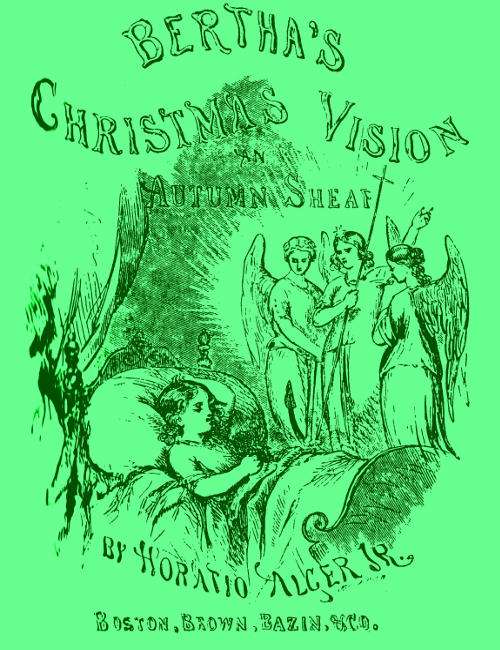
BERTHA’S CHRISTMAS VISION.
It was the night before Christmas. Snow was falling without; and the wind dashed the cold flakes, in eddying whirls, into the faces of those wayfarers whom business or pleasure kept out thus late. They drew their warm garments more closely about them, and hurried onward; little heeding the pelting of the storm while the vision of a cheerful hearth and a merry family circle danced before their eyes and warmed their hearts. Merry St. Nicholas, too, the patron saint of children, was abroad. It was a busy night with him. Thousands of parcels must be made up, and showered down as many chimneys into expectant stockings, before the morrow’s dawn. So he gives the reins to his coursers, and speeds swiftly along,—
In a large and pleasant room sat little Bertha, gazing thoughtfully into the fire. The fire crackled and burnt; and shadows, cast by its flickering light, danced on the wall. But little Bertha’s thoughts were far away, and she heeded them not. For many weeks, she had been looking forward to this very night; and now she was trying to conjecture what gifts good St. Nicholas had in store for her. At length she grew weary of conjecture, took a lamp from the table, and went up stairs to bed. It was a neat little chamber; and the counterpane on Bertha’s bed rivalled in whiteness the falling snow without. Bertha looked out of the window, against the panes of which the snow was beating noisily.
“It is a cold night,” thought she. “St. Nicholas will have a hard time of it. What if he should not come at all?”
Bertha’s apprehensions were soon dispelled; for, as she looked out, the sound of silvery bells came nearer and nearer, till at length it paused under her window, and, a moment afterwards, was heard in an opposite direction. Bertha rubbed her eyes, and strove to distinguish the sleigh from which these sounds proceeded; but she could distinguish nothing.
“Can it be St. Nicholas?” thought she.
Even as she spoke, mingling with the sound of the retreating bells, she thought she could distinguish the words of a song. She listened attentively; and these were the words which the wind bore to her:—
“That must certainly be Santa Claus,” thought Bertha. So she carefully hung up her stockings before the fire, and went to bed. She soon became tired of waiting for St. Nicholas to come; and, in a few minutes, she was asleep. But the thoughts of Christmas had taken fast hold of her mind, and, as she slept, shaped themselves into the following dream:—
She thought, that, as she was lying awake in her chamber, there appeared suddenly before her three figures, clad in white. Slowly they advanced, hand in hand, till they stood before her bedside. Then, with united voices, they chanted the following lines:—
They ceased; and Bertha, in great astonishment, inquired,—
“What! are you St. Nicholas? Or,” she added, recollecting herself, “perhaps you are his sisters?”
The visitors resumed their chant:—
The visitors ceased; and one of their number, coming forward, commenced anew:—
The second came forward, and repeated:—
Smiling graciously on the wondering Bertha, Hope drew back, and gave place to her sister, who commenced as follows:—
Again the sisters joined hands, and, with united voices, chanted, as at first,—
Their voices died away, and they were gone. Bertha opened her eyes, and, lo! it was all a vision that had come to her on this Christmas night. The morning sun was shining brightly through the window-panes. Noisily over the frozen snow dashed the sleighs; and their bells rang a merry peal in honor of Christmas Day. Bertha glanced at the well-filled stockings that hung in front of the fire, and then she knew that St. Nicholas had been there with his budget of gifts; and the words sung by the sisters came into her mind:—
“I will not forget the gifts of the good sisters,” she murmured softly. “Doubtless it is my heavenly Father who has sent them to me.”
So it was that little Bertha, attended by the three sisters, walked peacefully and happily through life.
The ways of God’s providence, so dark and mysterious to many, became plain and clear to her; for she saw with the eye of Faith. Clouds sometimes gathered about her path; but Hope waved her wand, and they were at once dispelled. Jealousy and envy and angry thoughts disturbed her not; for her heart was filled with the heavenly spirit of Charity.
Would that we all might be blessed with Bertha’s Christmas vision!
WIDE-AWAKE.
Many years ago, in a city whose name I cannot now recall, there lived a poor woman, whose husband had died, leaving nothing but a little son. For some time, she continued to support herself, and her son, whom she dearly loved, by working early and late at the spinning-wheel. But, after a while, a heavy misfortune fell upon her: it was no less than the loss of eyesight. So she was obliged to give up her spinning; for now she could distinguish neither the web nor the woof. You can imagine her distress at being deprived so suddenly of seeing the great and beautiful spectacle of fields, flowers, and sky, which every day presents to our gaze. Still, she would not have heeded all this; but she found herself cut off, at the same time, from all means of subsistence.
Meanwhile, her son had grown up into a stout, active boy of twelve. He was full of life and animation; and that, I suppose, was the reason he had received the name of “Wide-awake.” Now, little Wide-awake had a kind heart as well as manly spirit; and when he saw that his mother, who had worked so hard and so long for him, had become blind, he said to himself, “Now it is my turn to work.”
So he told his mother that he was going to seek for work, and that, after three months, he would faithfully return. But first he sold the spinning-wheel, which was no longer of any use, and one or two other articles, and gave the money to a neighbor, who promised to spend it for his mother as she had need. Then he took a cheerful leave of his mother, and went off with a light heart, though his pockets were empty.
He had not walked far when he overtook an old woman, who was bending beneath the weight of a heavy burden. She was homely, and appeared very tired. Wide-awake was passing by, when she called out to him, “Come here, little boy: help me to carry this bundle. I am old, weak, and tired; you are young and strong.”
Wide-awake was very obliging; and, though the old woman’s tone was not the pleasantest in the world, he very willingly took one side of the bundle, and helped her to carry it. The day was hot, and the bundle heavy; but he bore up stoutly, so that the old woman began to get over her ill humor, and to ask him some questions. So he told her his whole story,—how his mother was blind and unable to work, and he was seeking his fortune.
“Well,” said the old woman, “if that is the case, I think you had better come and live with me. I live in a little cottage not far off, and am in want of a boy to go on errands and do other little things for me. If you will come and stay with me three months, I will reward you as you deserve. But I will warn you that I am very particular, and shall require you to obey me in every thing.”
Of course, Wide-awake was only too glad to accept the old woman’s offer. He was quite sure that he should be able to suit her; and he could not help picturing to himself how glad his mother would be to have him return with perhaps a piece of gold; for this seemed a great sum to Wide-awake, and a very generous compensation for three months’ labor.
After a while, they came to the old woman’s cottage. It was a small house, containing three rooms. One of these was a kitchen, in which the old woman did all her cooking; another was her chamber; and the third she told Wide-awake he should have to sleep in.
Early the next morning, the old woman came to his bedside, and shook him roughly.
“Up! up!” said she. “Is not the sun up? and you are lying here asleep! What is your name?”
“Wide-awake,” said he, rubbing his eyes.
“Then,” said the old woman, “hereafter, be sure to be wide awake before the sun. Dress yourself as quickly as possible, and I will give you your breakfast; and then to work.”
Wide-awake was up and dressed in a moment. The old woman set before him a bowl of bread and milk for his breakfast. After he had eaten this, she took him to a fold near by, where he saw ten beautiful sheep.
“These,” said she, “will be your care. You will drive them to the great meadow a mile hence, and watch them, taking care that none stray away. Three times a day—at morning, noon, and night—you will drive them to the spring, and let them drink; and, at seven o’clock, you may bring them back.”
Wide-awake promised faithfully to obey her in every respect. He found the great meadow without difficulty. He watched the sheep, and watered them, as he had been directed, and, at nightfall, drove them home. The old woman counted the sheep, and, finding them all there, was well content, and gave Wide-awake his supper.
So time passed on. Every day the old woman became better satisfied with Wide-awake, who, on his part, was looking forward to the time when he might go home.
One morning about this time, as Wide-awake was about to drive out his sheep as usual, the old woman stopped him.
“They have grown quite fat,” said she; “so I shall carry them to the city and sell them. I shall be gone a week, and shall leave you here to take care of the house while I am gone. You will not have much to do. But there is one thing I must warn you against: you must not, on any account, open the door of the closet which is in your chamber. If you do, you will repent it.”
Wide-awake was not troubled with curiosity; and so he found no difficulty in making this promise.
The old woman departed, and Wide-awake was left alone. Having nothing else to do, he began to think of home and his mother. Then he began to wonder how much his mistress meant to give him for his services. He determined that he would buy a nice arm-chair for his mother, and a great many other things, if his money only held out. But they were all for his mother’s comfort, and not for his own, as I have already explained that Wide-awake was far from being selfish.
On the fourth day after the old woman’s departure, a stout man came to the door, and asked leave to rest a little while. Wide-awake knew that his mistress would have no objection; so he gave him permission, and, moreover, placed before him some bread and milk. The man ate heartily, and, in the mean time, contrived to draw out of Wide-awake all the particulars of his situation, and the old woman’s prohibiting him to open the door of the closet.
“I have no doubt,” said he, “that it is there where she keeps her money. If I were in your place, I would look and see. It wouldn’t do any harm.”
“But,” said Wide-awake, in astonishment, “she told me not to do it on any account.”
“Never mind that,” said the man, winking: “it’ll do no harm; and she’ll never know it.”
“But,” said Wide-awake, firmly, “I have promised; and I never break my promise.”
“Well, then, if you won’t, I will,” said the stranger, rising; “for I’m determined to know what there is in that closet.”
But Wide-awake sprang to the door, set his back resolutely against it, and said,—
“Never! while I live.”
“Poh!” was the contemptuous reply. “What is your strength against mine? Don’t you know that I can kill you?”
“That may be,” said Wide-awake, firmly,—though the thoughts of his mother came over his mind; and he could not help sighing for her, if he should die,—“but I will not yield.”
“Are you quite determined you will not let me in?” said the stranger.
The voice seemed altered; and, looking up, Wide-awake beheld, to his great surprise, that it was the old woman who addressed him.
“Where is the man who was here a minute since?” asked he in surprise.
The old woman smiled, and explained to him that she was a fairy, and had taken a man’s figure to test his sincerity. She said she was quite satisfied with the result, and, as she had no further need of his services, would let him return home.
“But I owe you something for your past fidelity. What shall it be? I leave it to your choice. Wealth, happiness, and long life: I will confer either of these upon you. Choose.”
“And may I choose any thing I like?” said Wide-awake, with eyes sparkling.
“Yes,” said the fairy (for so we must now call her).
“Then I will choose that my mother be restored to sight.”
“You have chosen well, my child,” said the fairy, kindly: “it shall be as you say; and, to reward you for your affection to your mother, I will freely bestow upon you the three gifts which you did not choose. You shall be rich; and your life shall be both long and happy.”
Wide-awake found his mother fully restored to sight. With the wealth which the fairy bestowed upon him, he built a neat cottage for his mother, who was long spared to him. The fairy’s promise was verified in every particular.
THE FIRST TREE
PLANTED BY AN ORNAMENTAL TREE SOCIETY.
THE ROYAL CARPENTER OF AMSTERDAM.
The superintendent of the Dock Yard in Amsterdam was seated in his office one afternoon, indulging himself in smoking a rude pipe; a luxury then recently imported from the colony of Virginia, in the New World.
His reflections, whatever they were, were broken in upon by a knock at the door,—not a timid, hesitating knock; but a bold, authoritative summons. The superintendent, judging it must proceed from some person of consequence, hastily laid aside his pipe, and quickly threw open the door, to admit his unknown visitor.
Instead of the high personage he anticipated, he beheld standing before him a stout man, of commanding person, and dressed in the attire of a workman.
He was a little vexed to think he had been so much deceived; and perhaps it was natural that he should accost the intruder in a somewhat peevish manner.
“Well, my good man, what do you want, that you come thumping at the door as if you were really a man of mark? What would you have?”
“I seek employment,” said the stranger in a deep voice, not at all intimidated at his reception.
At the same time, he presented a letter to the superintendent.
“Ha!” said the latter, glancing at it with considerable surprise; “from the Russian ambassador!”
He read aloud as follows:—
“Sir,—The bearer, a countryman of mine, is desirous of obtaining employment in the Dock Yard under your superintendence. He is not altogether unacquainted with this description of labor, but wishes to perfect himself in it. I feel assured that nowhere can he do so to greater advantage than under your instruction.”
The compliment implied in the concluding sentence served to moderate the vexation occasioned by his recent misapprehension; and he turned with a milder mien to his visitor.
He was a little surprised to find, that, quite unconscious of the great distance between the superintendent of the Dock Yard and a common workman, he had, without ceremony, seated himself. “Humph!” thought he; “I suppose that’s the way they do in Russia.”
“So you are from Russia, my good man?” said he, in a half-patronizing tone.
The visitor inclined his head in the affirmative.
“It’s a barbarous place, I’ve heard: the people are not half civilized; you did wisely in coming here. You must see a great difference between it and Holland?”
“Yes,” said the Russian, “we have much to learn. Other nations are greatly in advance of us in many respects; but that will pass away, and Russia will take her place at the head of them all.”
The superintendent shrugged his shoulders. He evidently did not believe it.
“So you wish employment?” he continued, after a pause. “What is your name?”
“Peter Timmerman,” was the reply.
“Very well; you may set to work to-morrow. Your wages will be a florin a day. You may report yourself at six o’clock.”
Thus terminated the interview. The Russian made a bow of acknowledgment, and left the office, leaving the superintendent more puzzled than enlightened at the insight into Russian character with which he had been favored.
The next morning, at the appointed time, Peter Timmerman presented himself at the Dock Yard. He set to work with an intelligence and earnestness which evinced that he was far from being a novice, and by no means inclined to be a drone. A week had not passed before he was acknowledged to be the ablest workman in the yard.
His fellow-workmen looked upon him with a little natural curiosity, and would have been very glad of his confidence. It was soon found, however, that, although asking many questions in regard to the details of his occupation, he preserved a uniform silence respecting his own family and past life, carefully evading any inquiries which the curiosity of his companions prompted. On one occasion, when some one of them pushed it to an indiscreet extent, the eyes of the Russian blazed with anger, and he lifted the tool he had in his hand in a threatening manner; but apparently reflection came to his aid, and, lowering it, he proceeded with his work. This little incident convinced his comrades, that, whatever mystery there might be connected with his past history, it would be both useless and dangerous in them to endeavor to extort it from him. Henceforth, then, he was not troubled with inquiries, but was treated with an involuntary and perhaps unconscious deference by those with whom he was brought in daily contact.
If occasionally it might be thought that he was greater than he seemed, there was nothing to confirm this idea in his mode of life.
The florin which he daily earned was the utmost limit of his expenses. No workman lived more frugally. He had secured board and lodgings at the house of a poor widow woman, the mother of one of his companions in the yard, where he paid a small price, and lived accordingly. The whole family consisted of the mother and son. This son, who was a lively and well-looking young man of one and twenty, was, next to Peter, the most skilful workman in the yard. He worked intelligently, and did not suffer his eyes to remain idle. It was his ambition to rise from the position of a mere workman, and become a master-builder.
Perhaps one thing which contributed to heighten his ambition was the fact that the superintendent of the Dock Yard possessed, among the items of his wealth, a fair, cherry-cheeked damsel, whose beauty had set half the hearts of the young men in Amsterdam on fire. Trust me, friendly reader! young men are pretty much alike all the world over; and the current of youthful feeling is just as likely to effervesce in the Hollander, phlegmatic as he is generally supposed, as in the residents of more southern climes.
But, after all, was it not foolish in the young ship-carpenter to aspire to an object so generally admired and sought after as the Fraulein superintendent? for such she was designated, out of respect for her father’s office. Perhaps it was; and yet Heinrich Dort did not think so. After all, he was the best judge in what concerned himself.
He had observed the young Fraulein’s eyes wandering toward the side of the church on which he sat, and he could not mistake the object that attracted them. Whenever the maiden saw that he was returning her gaze, she always cast down her eyes; and then, of course, she looked ten-fold as beautiful in the eyes of Heinrich Dort.
After all, the eye is more eloquent than the tongue. Heinrich thought he could not mistake it in this instance. It was certainly rather singular that the two should meet in the walk one pleasant Sabbath afternoon; and no less so, perhaps, that, precisely at the moment, the Fraulein should drop a brooch which she held in her hand. Of course, she searched for it diligently in every place but the right one; and, of course, Heinrich was required, by the claims of politeness, to volunteer his assistance. The lost ornament was soon found; but Heinrich, probably fearing it might be lost again, did not leave the Fraulein, but accompanied her, by a very round-about way, to her home. Perhaps it might have been absence of mind that made them miss the direct way,—at least, so we will conjecture, since we can do nothing more.
At all events, such was the commencement of Heinrich’s acquaintance with the Fraulein. They used to meet every Sabbath afternoon; and Heinrich, acknowledging his presumption all the time, ventured to confess that his whole hope of happiness rested upon her answer to a little question which he had to propose.
What that question was, I may as well leave to be surmised. The answer was conditionally favorable. The maiden intimated that no opposition need be anticipated from her, provided he should obtain her father’s consent. Heinrich felt very happy until he began to consider that this qualification might prove a very formidable one; and he feared that the superintendent might think the young workman altogether an inadequate match for his daughter, whose dowry would be twenty thousand florins at the very least. But there is an old saying,—“Faint heart never won fair lady.” Whether Heinrich had ever heard of this, or whether, indeed, it had ever been translated into Dutch at all, I am quite unable to say; but, at all events, he was resolved that such a prize should not pass from his hands without a struggle.
Although the young workman was far from being constitutionally timid, preserving an undaunted front in the face of danger, it must be confessed that his heart beat audibly and his hand trembled perceptibly as he knocked at the door of the superintendent’s office; not that there was any thing particularly suited to inspire fear in the rotund figure of that personage.
The latter perceived that the young man was disturbed. He was rather flattered to find it so, as he attributed it solely to the effect of his presence, which he privately considered not a little imposing. It was, therefore, with an approach to affability that he motioned him to be seated, and inquired,—
“Well, my good fellow, how goes business? Have you come for any instructions?”
“No, your excellency,” replied Heinrich. “Business goes well enough; but it is on another subject that I wish to trouble you.”
“Well, out with it, man. No parleying,—that’s my way.”
“You have a daughter.”
“Donder and blitzen! So I always have supposed. And is it to impart this precious piece of information that you have come here?”
“No, your excellency,” hesitated Heinrich; “but the fact is, that—that—in short, an attachment has sprung up between your daughter and myself; and I am here to crave your permission to marry her.”
“Well, that is coming to the point with a vengeance!” exclaimed the testy little superintendent. “And may I beg to know whether my daughter sanctioned this visit on your part?”
“She did.”
“Then she has less wit than I thought for. She—the daughter of the superintendent of the royal Dock Yard of Amsterdam—to stoop to be the wife of a common workman! The girl must be out of her senses. But if she chooses it to be so, I shall not. Young man, you have been presumptuous. For once, I will pass over it; but beware of offending a second time.”
The little great man made an imperious gesture of withdrawal, which Heinrich could not do otherwise than obey. He returned home in great depression, as might be anticipated of one whose dearest hopes had been crushed out. Sitting at the door, he perceived his mother’s lodger and his own fellow-workman, Peter Timmerman.
The latter, contrary to his custom, opened a conversation with Heinrich, whose manner he could not avoid noticing.
“What has befallen you, comrade,” he said, “that you should look so woe-begone?”
“And if I tell you,” returned Heinrich, whose disappointment had made him somewhat testy,—“if I should tell you, how could you help me?”
“Perhaps not at all,—perhaps very much. At all events, it will relieve your mind to unburden it of sorrow, if any weighs upon it.”
“You may be right,” said Heinrich, after a pause. “At all events, it will do no harm. You must know, then, that I have been foolish enough to fall in love with the superintendent’s daughter, who favors my suit. But because I am not wealthy, and am only a workman” (the young man emphasized the last words in a bitter tone), “her father rejects my suit.”
“But how if you occupied as high a position as himself?”
“Oh! then there would be nothing to fear.”
“Listen, then, in your turn. I may help you to what you seek. Did you ever hear of Russia?”
“I have,” said Heinrich. “It is a great country, but a barbarous one.”
“That is true; at least, it is not so far advanced as its neighbors. But, if I live to accomplish all my plans, it shall yet equal any of them.”
“You! Who, then, are you?” exclaimed the young man, in astonishment at such language from such a source.
“I am Peter, the reigning czar,” said the Russian, composedly. “I could trust no one but myself to carry out a plan I had formed for supplying the chief defect of Russia,—an efficient navy. Accordingly, I have entered myself here as a common workman. I have gained what I sought; I have made myself familiar with the construction of vessels; and I shall, after a brief visit to England, return to my kingdom, and take measures to build a fleet. I have thought of you as one competent to superintend their building. You shall have a handsome salary, and I will confer upon you an order of nobility.”
“Then I can marry the Fraulein superintendent after all!” And Heinrich leaped to his feet in exultation. “But how shall I thank your ex— I mean your majesty, for such a load of favors?”
“By fidelity to my interests,” said Peter. “But I am tired, and must go in. Whatever arrangements you make must be completed within three days. Good night.”
The next morning, Heinrich paid another visit to the superintendent. When he left, at the end of half an hour, the superintendent accompanied him to the door in the excess of his affability. No more opposition was made to his suit. Heinrich Dort, the workman, was quite a different person from Heinrich Dort, general superintendent of the Russian navy.
The events which followed are known to history. Peter, with the assistance of his superintendent, laid the foundation of a flourishing marine; and the latter, through all the mutations of the Russian dynasty, succeeded in retaining the confidence of the government until Death gathered him to his fathers at a ripe old age.
OUR GABRIELLE.
THE VEILED MIRROR.
The old year was fast drawing to a close. But a few hours, and the advent of its successor would be hailed by merry shouts and joyful gratulations, mingling with the merry chime of bells ringing out a noisy welcome from church-towers and steeples.
Adam Hathaway, a wealthy merchant, sat in his counting-room, striking a balance between his gains and losses for the year which had nearly passed. From the smile that lighted up his countenance, as he drew near the end of his task, it might safely be inferred that the result proved satisfactory.
He at length threw down his pen, after footing up the last column, and exclaimed joyfully,—
“Five thousand dollars net gain in one year! That will do very well,—very well indeed. If I am as well prospered in the year to come, it will indeed be a ‘happy New Year.’”
His meditations were interrupted by a knock at the door. He opened it, and saw standing before him a man of ordinary appearance, bearing under his arm something, the nature of which he could not conjecture, wrapped up in brown paper.
“Mr. Hathaway, I believe?” was the stranger’s salutation.
“You are correct.”
“Perhaps, if not particularly engaged, you will allow me a few minutes’ conversation with you?”
“Yes, certainly,” was the surprised reply; “though I am at a loss to conjecture what can have brought you here.”
“You are a wealthy man, Mr. Hathaway, and every year increases your possessions. May I ask what is your object in accumulating so much property?”
“This is a very singular question, sir,” said the merchant, who began to entertain doubts as to his visitor’s sanity,—“very singular. I suppose I am influenced by the same motives that actuate other men,—the necessity of providing for my physical wants, and so contributing to my happiness.”
“And this contents you? But your gains are not all devoted to this purpose. This last year, for example, the overplus has amounted to five thousand dollars.”
“I know not where you have gained your information,” said Mr. Hathaway, in surprise. “However, you are right.”
“And what do you intend to do with this?”
“You are somewhat free with your questions, sir. However, I have no objection to answering you. I shall lay it up.”
“For what purpose? I need not tell you that money, in itself, is of no value. It is only the representative of value. Why, then, do you allow it to remain idle?”
“How else should I employ it? I have a comfortable house well furnished: should I purchase one more expensive? My table is well provided: should I live more luxuriously? My wardrobe is well supplied: should I dress more expensively?”
“To these questions I answer, No. But it does not follow, because you have a good house, comfortable clothing, and a well-supplied table, that others are equally well provided. Have you thought to give of your abundance to those who are needy,—to promote your own happiness by advancing that of others?”
“I must confess that this is a duty which I have neglected. But there are alms-houses and benevolent societies. There cannot be much misery that escapes their notice,” said Mr. Hathaway.
“You shall judge for yourself.”
The stranger commenced unwrapping the package which he carried under his arm. It was a small mirror, with a veil hanging before it. He slowly withdrew the veil, and said, “Look!”
A change passed over the surface of the mirror. Mr. Hathaway, as he looked at it intently, found that it reflected a small room, scantily furnished; while a fire flickered in the grate. A bed stood in one corner of the room, on which reposed a sick man. By the side of it sat a woman, with a thin shawl over her shoulders, busily plying her needle. An infant boy lay in a cradle not far off, which a little girl called Alice, whose wasted form and features spoke of want and privation, was rocking to sleep.
“Would you hear what they are saying?” asked the stranger.
The merchant nodded acquiescence. Immediately there came to his ear the confused noise of voices, from which he soon distinguished that of the sick man, who asked for some food.
“We have none in the house,” said his wife. “But I shall soon get this work finished; and then I shall be able to get some.”
The husband groaned: “Oh that I should be obliged to remain idle on a sick bed, when I might be earning money for you and the children! The doctor says, that, now the fever has gone, I need nothing but nourishing food to raise me up again. But, alas! I see no means of procuring it. Would that some rich man, out of his abundance, would supply me with but a trifle from his board! To him it would be nothing; to me, every thing.”
The scene vanished; and gradually another formed itself upon the surface of the mirror.
It was a small room, neatly but not expensively furnished. There were two occupants,—a man of middle age, and a youth of a bright, intellectual countenance, which at present seemed overspread with an air of dejection.
Mr. Hathaway, to his surprise, recognized in the gentleman Mark Audley, a fellow-merchant and formerly intimate friend, who, but a few months before, had failed in business, and, too honorable to defraud his creditors, had given up all his property. Since his failure, he had been reduced to accept a clerkship.
“I am sorry, Arthur,” said he to his son, “very sorry, that I could not carry out my intention of entering you at college. I know your tastes have always led you to think of a professional career; but my sudden change of circumstances has placed it out of my power to gratify you. It is best for you to accept the situation which has been offered you, and enter Mr. Bellamy’s store. It is a very fair situation, and will suit you as well as any.”
“I believe you are right, sir,” said Arthur, respectfully; “though it will be hard to resign the hopes that I have so long cherished. I met Henry Fulham to-day. He was in my class at school, and is to enter college next fall. I couldn’t help envying him. How soon will Mr. Bellamy wish me to enter his store?”
“Day after to-morrow, I believe,—that is, with the beginning of the year; New Year’s Day being considered a holiday.”
“Very well; you may tell him that I will come at that time.”
The scene vanished as before. A change passed over the surface of the mirror. Again the merchant looked, and, to his surprise, beheld the interior of his own store. A faint light was burning, by the light of which a young man, whom he recognized as Frank Durell, one of his own clerks, was reading a letter, the contents of which seemed to agitate him powerfully.
The scene was brought so near, that he could, without difficulty, trace the lines, written in a delicate, female hand, as follows:—