
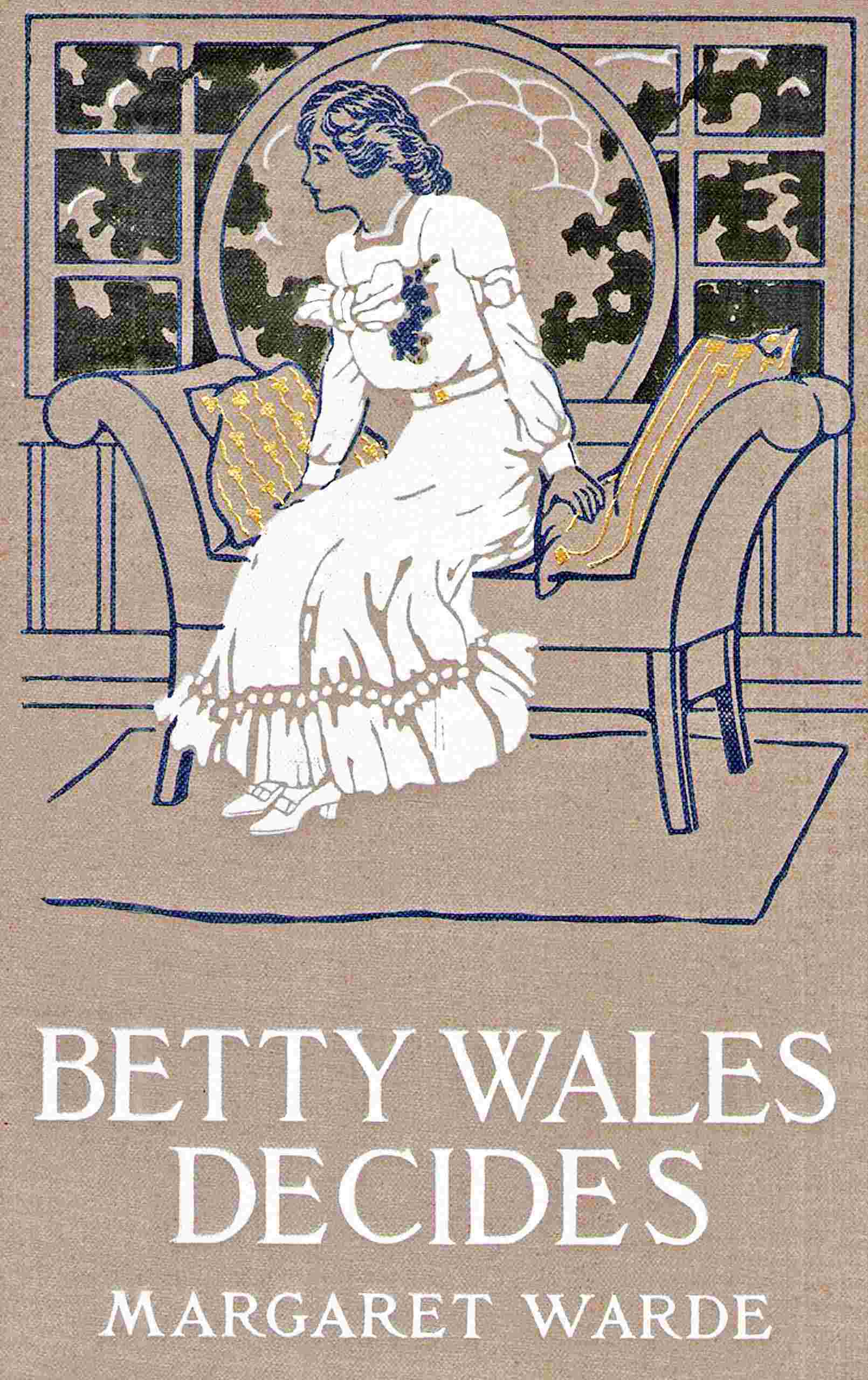
CHAPTER IV
MONTANA MARIE TAKES A RIDE
Georgia Ames had missed Montana Marie’s initiation party, having been engaged that evening in helping to console Mary Brooks Hinsdale for the temporary loss of her husband.
“Clever husbands are so intermittent,” Mary had sighed plaintively. “Now you have them to provide tea for, and other amusements, and now they’re off to the ends of the earth to deliver a lecture. And mine won’t ever take me along, because my frivolous aspect rattles him when he gets up to speak. I presume,” Mary smiled serenely, “that he also thinks said frivolous aspect would queer him with his learned friends; only he’s too polite to put it to me so baldly. And the moral of all this, Georgia, my child, is: Don’t marry a professor, unless you are prepared to take the consequences. The immediate consequence is that you’ve got to be Georgia-to-the-Rescue for me this time, and come up to spend Saturday night.”
“And so,” Georgia explained to Betty later, “I wasn’t on hand to be Georgia-to-the-Rescue for your freshman. But then she didn’t need me. She really didn’t even need rescuing. And just to show her how I admire her pluck, I’ve made the riding-party I’m going off with ask her to come on our Mountain Day trip.”
“But she can’t possibly get a horse so late in the day,” objected Betty.
“Belle Joyce has sprained her ankle and gone home, so somebody else can have the Imp.”
Betty looked anxious. “But, Georgia dear, you know the Imp is a pretty lively horse. Are you sure that Marie rides well enough to go off on him with your experienced crowd?”
“Oh, I guess so,” Georgia answered easily. “She’s ridden a lot out West, she says. She’s telegraphed to Montana for her own saddle and her riding things, and they ought to be here to-day. When they come, I’ll take her out on a practice trip to be sure that she can ride. Nobody wants to kill off your amusing freshman, Betty; so don’t look so awfully solemn.”
Betty laughed heartily. “Well, you know I had a nice spill here once myself, and so I believe in being careful. But I think it was ever so nice of you to include Marie in your party, Georgia.”
“There isn’t a freshman in college who wouldn’t give her best hat for the chance of going off with our crowd,” Georgia declared modestly. “It’s funny, isn’t it, Betty, how much the girls care about getting in with the right college set?”
Betty nodded. “And I’m afraid it’s not because the right college set, as you call it, generally has the most fun. It’s very often only because they are silly enough to want the name of being popular.”
“Snobs!” muttered Georgia scornfully. “Well, Montana Marie is no snob, and thanks mostly to you there aren’t nearly so many snobs in Harding as there were when I first came up.”
“Really? Do you notice a difference?” demanded Betty eagerly.
“Yes, and lots of it,” declared Georgia, “so don’t work too hard this year creating the proper college spirit, because you don’t need to. And don’t worry about our killing off your freshman. Unless I see that she’s a very good rider on our trial trip, I’ll make her swap off the Imp with one of the girls who can surely manage him, and take old Polly. Old Polly wouldn’t hurt a fly.”
Montana Marie’s pet saddle and riding clothes did not come until just in time for Mountain Day, but Georgia took her, according to promise, for the practice ride, borrowing Straight Dutton’s skirt for her, and explaining that it was Harding custom not to bother about hats.
Montana Marie listened graciously to Georgia’s sage advice about being very careful until you knew your horse; and she made no objection to starting out on Polly, who was a meek-looking, gentle-gaited bay with one white foot,—the idol of timid beginners in Harding riding circles. But before they had gone a mile, Montana Marie drew rein and announced pleasantly that she couldn’t ride Polly a step further.
“I suppose I must be too heavy for her. She seems so tired, and she lags behind so. Would you be willing to change with me, Miss Ames? You are lighter, and you are used to Polly’s ways. You don’t blame me, do you, for hating to use up a horse?”
So Montana Marie rode Georgia’s favorite Captain, who single-footed by choice but would canter if crowded to it. He cantered with Montana Marie all the way to Far-away Glen, the destination of the party. There they dismounted to drink out of a mountain spring, and Montana Marie somehow settled it that the groom from the stables should go back on Polly, Captain being restored to Georgia, and the skittish roan named Gold Heels left for herself. Georgia protested anxiously, but Montana Marie smiled and reassured her.
“Why, you can’t worry about me, Miss Ames. I’ve ridden all my life,” she said, making the roan curvet and prance on purpose. “I guess I rode before I walked. But these pancake saddles are the limit, I think. Just you wait till my own outfit comes, and then I’ll show you some real riding. My, but it seems like old times to be on a horse! I had just one ride all the time we were in Paris. Riding in a park is too slow for me, and besides I hate side-saddles—you can’t use anything else over there, you know—as I hate—select schools for girls,” added Montana Marie in an unwonted burst of confidence.
“So you’re glad to be back in America?” asked Georgia idly.
“I should say I am, Miss Ames. Some day you’ll know, maybe, just how glad I am.”
Georgia was too busy keeping Captain from imitating the roan’s pernicious tactics in the matter of shying at dead leaves to wonder exactly what Montana Marie was driving at so earnestly.
“She will be perfectly safe on the Imp,” Georgia reported later to Betty. “At least I think so, and anyhow she is perfectly set on riding him, and she said she’d never ride old Polly again, if there wasn’t another horse in the world. So we shall just have to let her decide about the risks for herself. Your freshman has a mind of her own, hasn’t she, Betty?”
Betty agreed laughingly. Montana Marie, when approached by her official tutor about her freshman class work, particularly freshman math., had reported easily that she guessed everything was going all right.
“But anyway, I’m planning to get my entrance conditions off first,” she announced. “Then I can devote my whole time to regular work. I believe in being systematic, don’t you, Miss Wales?”
Betty tried to explain that the entrance conditions were regarded by the Powers as extras, not to take the place or time of regular work. Montana Marie listened good-naturedly.
“I never could do but one thing at once, Miss Wales,” she explained at last. “In Germany I forget every word I know of French, and in dear old Paree I actually almost forget my English. If I could only cut classes entirely for a week or so and get this entrance history and Latin prose off my mind!”
“Well, you can’t,” Betty told her decidedly. “Your having so many conditions will make all your teachers specially particular. The very least you can do, when President Wallace stretched a rule to let you in, is not to cut a single, single class, unless you are too ill to go, of course.”
Montana Marie sighed plaintively. “I never was ill in my life. I think I am doing fairly well in my studies, Miss Wales. I certainly try hard enough. After all the fuss I had about getting in, I don’t want to get out again yet a while. The great trouble is that there are so many social affairs all the time. When I’m looking forward to a dinner on the campus or a dance in the gym. or a walk with that cute little Miss Hart, why I just can’t settle down to study. It was lucky Miss Hart had an impromptu initiation for me. I shouldn’t have been able to learn a single lesson with an initiation to look forward to.”
“Then if it diverts your mind to go to things, you simply mustn’t go to so many, Marie.” Betty tried to look severe and to speak sternly. “You must refuse some of your invitations. Or else you must learn to concentrate your mind on whatever you’re doing, work as well as play. Being able to jump straight from Greek to the sophomore reception and from chemistry lab. into managing a basket-ball team is one of the most valuable things you can learn at this college. And you’ve got to learn it early in freshman year, or you won’t ever get comfortably through your mid-years.” Betty surveyed Montana Marie’s unruffled calm rather despairingly.
Montana Marie smiled comfortingly back at her tutor, and then sighed faintly. “I’m not sure, Miss Wales, that I have any mind to concentrate. You see in the convent your soul was the most important thing, and in Miss Mallon’s Select School for American Girls your manners and the pictures in the Louvre were the most important. But I promise you that I won’t go everywhere I’m asked—not anywhere until I’ve passed off my history. And I promise not to cut, and I’ll ask my teachers right away if my work is satisfactory.”
Betty wrote her mother that night that Marie was developing wonderfully, quite as Mrs. Wales had prophesied, and that taking charge of her was really no trouble at all, because she was so anxious to carry out her part of the bargain she had made with Betty, to do her best.
“So tell Will to tell Tom Benson,” Betty wrote, “that Miss O’Toole isn’t a handful. I’m almost afraid she’ll turn out a dig or a prig or something of that kind, she seems so anxious to do good work. But all the nicest girls like her, so I guess I needn’t worry about her not having a good time.”
The day before Mountain Day the history condition was removed from Miss Montana Marie O’Toole’s record of scholarship, and Betty congratulated her freshman warmly and went off to spend the holiday in Babe’s wonderful house on the Hudson feeling as care-free and irresponsible as if she were a freshman herself.
Georgia’s riding-party was to take horse—this knowing expression was also Georgia’s—at the Belden at nine o’clock sharp. At a quarter before the hour Montana Marie, the only off-campus member, arrived at the rendezvous. Her habit was brown corduroy, her hat a flapping sombrero, her lovely hair was coiled in a soft knot in her neck. It looked as if it would fall down before she had mounted, but not a lock was out of place that night, when Montana Marie rode the dripping, drooping Imp into his stable-yard half an hour ahead of the others, and sweetly asked the liveryman if he would mind giving her a real horse the next time she hired one.
“Because if you can’t, I guess I’ll ask my father to send one of his East to me,” she explained, reaching down to unbuckle her big saddle before she slipped easily out of it. “I don’t mean to compare this horse with old Polly or that silly roan,” she added politely. “But I do like a little real excitement when I go for a ride.”
If Montana Marie had found her Mountain Day tame, the rest of the party had not lacked for “real excitement” in generous measure. Montana Marie had ridden decorously enough between Georgia and Susanna Hart out of the town and up Sugar Hill to White Birch Lane. At the turn into the woods she had produced a magenta silk bandana and knotted it coquettishly at the back of her neck.
“Now I’m a real cow-girl,” she explained. “Ma can educate me all she wants, but she can’t educate the West out of me. She’d never have sent me this wild and woolly outfit. She’d have written her New York tailor to come right up here and fit me out. But I like these things best, so I just telegraphed to Dad, and he did as I said. He always does. Now why don’t we race up the next hill?” Montana Marie started off the Imp with a yodeling shout and a wildly waving arm that made even sedate old Polly take a keen interest in following. Susanna Hart’s horse reared, and Fluffy Dutton shrieked hysterically. Then the skittish roan Gold Heels bolted down a side-path with the groom from the stable, and before he could get back to his charges’ assistance, a Belden House sophomore, who was always unlucky with horses, carelessly fell off the Captain’s back. True to his training the big horse stopped dead in his tracks, and Montana Marie, having seen the accident over her shoulder, rushed the Imp back, dismounted, and assisted the unlucky sophomore to her feet with the sincerest apologies for having “made any one any trouble.”
“If you’d had a saddle like mine you wouldn’t have fallen off,” she ended regretfully. “You can’t enjoy a real wild ride on those little flat seats.”
“We’re not out for a wild ride,” Georgia rebuked her sternly. “If you want to race and make a general disturbance you must ride way ahead alone. But if I were you——”
“Oh, I shouldn’t think of stirring up anything more,” declared Montana Marie demurely, pulling the Imp into a decorous park-trot beside the unlucky sophomore, who was luckily not a bit the worse for her tumble. “I’m only a little freshman, and I want to learn the college ways in riding as in other things.” She secreted her magenta neckerchief again, and “rode like a perfect lady,” to quote from Georgia’s account of the matter, all the way to Top Notch Falls, and all the way back against the sunset, until——
Little Eugenia Ford’s horrified description of what happened next was perhaps the most vivid of those furnished to eager inquirers.
“When we were down on the meadow-road,” Eugenia began that evening to an attentive audience of her house-mates, “it got a little bit dusky. We heard some horses coming fast behind us, and it was my Cousin John Ford, who is a senior at Winsted, and three men from his frat-house. They stopped to speak to me, and I introduced them to Fluffy and Montana Marie, who were riding beside me. We happened to be quite a little ahead of the others. John said something about Montana Marie’s queer Mexican saddle, and that freshman put on her awful magenta handkerchief again, and asked him if he liked cow-girls and ‘real exciting’ rides, and of course John said yes. And she said to come on then, and hit his horse with her whip, and they just tore off in the dark.” Eugenia’s big brown eyes were round with horror. “John is a splendid rider or he wouldn’t have stayed on, because his horse—it’s one of his own and a thoroughbred—had never been touched with a whip before, and it nearly went crazy when Montana Marie whacked it. So his horse flew and the Imp flew too, and John tried to stop, but she just shouted again and again, and egged both the horses on. John telephoned me as soon as I got home, to say that his neck wasn’t broken, and to inquire for hers. He seemed to think it was a joke, but for my part”—Eugenia looked as severe as so small and so pretty a young lady was able to look—“for my part I think it was unladylike and dangerous, and I hope Georgia will never want to ask her to go riding with us again. My horse almost ran too.” Eugenia grew a shade more haughty. “She asked John to call and to bring his three friends. I—I’m afraid he’ll come.”
“I shouldn’t be much surprised if he did,” agreed a caustic senior, who roomed next door. “Montana Marie O’Toole is not exactly a lady, and she—well, I don’t know that she is ever exactly inconsiderate except on horseback. But she’s always interesting, foot or horseback. Were your crowd—were you thinking of dropping her because she messed up your ride?”
Eugenia flushed. “She’s asked the Mountain Day party to dinner to-morrow night at the Vincent Arms. She boards there, you know. She seems to be—very rich. I don’t know much about her family, but Betty Wales has met her mother and liked her. I—I do want to see the inside of that wonderful boarding-house.”
“Millionairesses’ Hall, isn’t it called?” asked the senior. “Yes, I’ve wanted to go there too, for dinner, but I don’t know anybody who’ll ask me. They have flowers on the tables every night, and seven courses. You’d better go.”
Eugenia considered. “It would be fun. Only—she was really horrid—racing off that way with John.”
“Maybe he won’t call on her, after all,” consoled the senior. “If he does—eat her dinner first, drop her afterward. But whether you drop her or not, she’s bound to stay in fashion here. She’s interesting, lady or no lady. Don’t go riding with her, if you don’t like her Western style. But for my part, I think she’s really too good to miss. Now isn’t it just like that lucky Betty Wales to have the most entertaining freshman, as well as the most fascinating tea-room, to amuse herself with?”
At the very moment when the caustic senior was making this remark, Betty Wales sat at her desk in the fascinating tea-shop. The entertaining freshman sat beside her. For once she was not smiling. Spread out on the desk before Betty were three distinct and separate warnings, in freshman math., freshman Latin, and freshman lit., respectively. Betty Wales had seen a few warnings before, but she did not remember any that were quite so frank and unqualified in their condemnation of the recipient’s scholastic efforts and attainments as the three euphemistically addressed to Miss M. M. O’Toole.