
WeRead Powered by ReaderPub
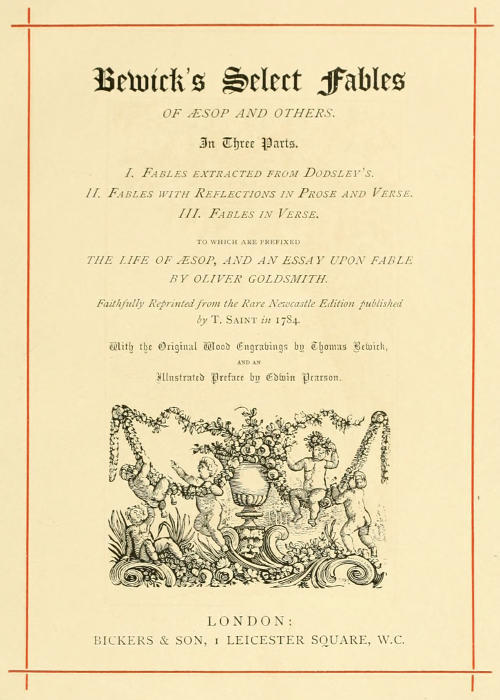
Bewick's Select Fables of Æsop and others. / In three parts. 1. Fables extracted from Dodsley's. 2. Fables with reflections in prose and verse. 3. Fables in verse. cover

Bewick's Select Fables of Æsop and others. / In three parts. 1. Fables extracted from Dodsley's. 2. Fables with reflections in prose and verse. 3. Fables in verse.

Chapter 162: FOOTNOTES
Open in WeRead

Explore more books like this:

About This Book

A curated collection of short allegorical tales attributed to Aesop, presented in three parts that group prose fables, narratives accompanied by reflective commentary in prose and verse, and versified retellings. The pieces use animal characters and simple scenes to illustrate human follies, practical maxims, and ethical lessons, each closed by an explicit or implicit moral. The edition includes a prefatory life of Aesop and an essay on the fable form, and is embellished with Thomas Bewick’s wood-engraved illustrations that punctuate and illuminate the concise anecdotes.

Fable XXII.
The Four Bulls.

Friendship! source of bliss sedate,
Best balm for all the wounds of fate!
’Tis thine the sinking heart to raise,
When love retires, and health decays;
Unmix’d with thy sublimer fire,
Love’s but a fev’rish low desire,
And ill the self-destroying flame
Deserves that soft angelic name.
Oh! could this verse, this fabling lay,
Extend or but confirm thy sway!
Or, warn’d by this, if only one
Thy foes’ destructive arts shall shun!
Since dangers rise with every sun,
With ev’ry sand united run;
Four Bulls, by mutual vows ally’d,
The morrow’s unknown ills defy’d;
As one they mov’d, they fought, they fed,
And safety rose by union bred,
Nor this alone the good they found,
The private bliss of each went round;
Hence doubly bless’d the gen’rous heart,
Which scorns the bliss it can’t impart.
From day to day the Lion came,
But matters still appear’d the same:
This smote his inmost soul with grief,
For much he long’d for fav’rite beef;
What can he do? he fears to wage
Unequal war, and four engage.
Thought follows thought—he finds in vain:
Yet thought to thought succeeds again.
Half-form’d resolves, and embryo schemes,
And all the train of statesmen’s dreams,
With conflict rude disturb his mind,
To this nor that success inclin’d.
Suspense presides with fluttering wings,
From which she shakes a thousand stings.
In this disastrous doubting case,
The Fox appears—with thinking face;
On him his royal master laid
His load of care, secure of aid;
Who paus’d a while with sober grace,
Then thus refin’d upon the case:—
Not things of moment most, I find,
Have broke the union of the mind;
Ev’n mere mistakes, that pet or pride
Have made, the sacred band divide,
And deepest enmities arise.
From trifling things among the wise.
In friendship, slight’s the deepest wound,
And that is fancy’d more than found.
These hints improv’d, our ends may gain,
The Bulls divided, count ’em slain;
The Lion, pleas’d, reply’d, he knew
The Fox could forge a lie—or two;
Which he opin’d, in points like this,
Would not be very much amiss.
Here wiser Reynard shook his head,
And this would never do, he said:
’Tis ours to make these foolish elves,
My lord, be liars to themselves:
Suspicion rais’d, the very eye
Will unsuspected gravely lie,
And, when a friend it shall survey,
Th’ idea of a foe display,
As you shall see—— Away he flew,
And, to the friends as near he drew,
He smooth’d his brow, he coin’d a smile,
And put on all the masks of guile.
Then whispers one with friendly nod,
“Mark, is not yon behaviour odd?
The Bull must surely mean affront,
His tail is next you—fie upon’t!
How slighting that! and there’s another
Can scarce some high resentment smother;
He snorts, he paws, and fain would shew
By vengeance whence his troubles flow.
The third, how dull! regardless still,
What fate you prove, or good or ill.”
Appearance (treach’rous witness) here
Confirms the sounds that cheat his ear;
Suspicion soon alarm’d, and pride,
At once, to self the whole apply’d.
The Bull withdraws, resolv’d as due,
They first for his return should sue.
The Fox returns, and boasts his arts,
And to his liege the truth imparts:
“The Bull who turn’d his tail so rude,
Meant only not his ear t’ intrude;
And he that spurn’d so fierce the ground
With anguish felt a hornet wound.
The third, the downy turf who prest,
Sought but the sweets of peaceful rest.
But come, to his remote retreat
I’ll guide my royal master’s feet.”
They go; the victim mourns too late
His absent friends and helpless state.
And slain, the Fox exulting cries,
“Not one but all shall be our prize.”
Away he goes, and thus again
Infus’d soft flatt’ry, deadly bane!
“Great sir (says he to one), I swear
Your friends are rude, indeed they are;
Friendship a decent due respect
Should, rather than destroy, protect.
Superior far to these you rise,
The wise affirm: we trust the wise;
Your nobler port, your finer wit,
All with united voice admit;
And yet no just distinction’s made
No deference shewn, no homage paid.
I wonder at your choice, but here
’Tis silence best becomes my sphere,
Tho’ might your slave presume to tell
What all the forest thinks as well,
These are perhaps the only Two
With whom your worth would lose its due.”
The Bull (how easy praise deceives!)
With pleasure hears, with pride believes;
Puts on the lofty looks and airs
Which humble merit never wears.
To treat him as an equal now
Inflames his heart, contracts his brow
’Tis envy, or, ’tis worse, ’tis hate,
Denies due honour to his state;
He could not bear th’ affronts they gave,
They break his peace, they make him rave;
They lov’d and they rever’d, he thought,
Less than the wretches knew they ought;
And (as is usual) storm’d and swore
That they might love and rev’rence more.
His friends, alarm’d, in deep amaze
On him, and on each other, gaze,
Disgust, in either’s bosom bred,
Was shewn as diff’ring tempers led,
One bold and warm the taunts returns,
And with contagious anger burns,
Than this, not plagues are sooner caught,
Nor with more dreadful evils fraught,
The other, meek, in secret pines,
And friends he could not keep resigns;
Resigns, tho’ late, with yearning heart,
And mourns persuasion’s useless art.
Retiring now he leaves the fray,
The Fox still mark’d his pensive way,
The Lion found and seiz’d his prize,
And, like the first, the second dies.
The two who yet alive remain,
In dreadful conflict shake the plain;
The Fox observes the doubtful fight,
One drops—he smiles with fell delight;
Flies with the joyful news, and brings
The King to take what’s now the King’s.
Faint, breathless, bleeding on the ground,
The hapless victor soon they found;
He falls an unresisting prey,
And crowns the triumphs of the day.
This tale a sage once told his son,
And thus apply’d it when he’d done:—
“Do you, my child, with unsuspecting eye,
O’erlook what others labour to descry;
Kind to all faults, and to all failings blind,
Be you the last to think affronts design’d.
Cold seems thy friend?—by the severest laws
Thy conduct try, to find the latent cause.
Let thy heart pant for universal praise,
Such as, unbrib’d, to virtue, virtue pays.
Is this withheld? try ev’ry winning art
To melt the hard, to soothe the froward heart.
Sue for esteem—to all but fawning bend,
Whom this will purchase is a worthless friend;
But scorn the thought as vainest of the vain,
That what good-nature loses, pride will gain.
Less than your merit does your friend approve?
Still merit more—his love constrain with love.
This conduct try’d remains he still the same?
Learn you to pity what the world will blame.
The gen’ral censure, his neglect ensures,
Thy honour brightens and thy praise secures.”

Fable XXIII.
The Pepper-Box and Salt-Cellar.

The ’squire had din’d alone one day,
And Tom was call’d to take away:
Tom clear’d the board with dextrous art:
But, willing to secure a tart,
The liquorish youth had made an halt,
And left the pepper-box and salt
Alone upon the marble table:
Who thus, like men, were heard to squabble.
Pepper began, “Pray, sir,” says he,
“What business have you here with me?
Is’t fit that spices of my birth
Should rank with thee, thou scum of earth?
I’d have you know, sir, I’ve a spirit
Suited to my superior merit—
Tho’ now, confin’d within this caster,
I serve a Northern Gothic master;
Yet born in Java’s fragrant wood,
To warm an Eastern monarch’s blood,
The sun those rich perfections gave me,
Which tempted Dutchmen to enslave me.
“Nor are my virtues here unknown,
Tho’ old and wrinkled now I’m grown.
Black as I am, the fairest maid
Invokes my stimulating aid,
To give her food the poignant flavour,
And, to each sauce, its proper savour.
Pasties, ragouts, and fricassees,
Without my seasoning, fail to please:
’Tis I, like wit, must give a zest,
And sprightliness to ev’ry feast.
“Physicians too my use confess;
My influence sagest matrons bless;
When drams prove vain, and cholics teaze,
To me they fly for certain ease.
Nay, I fresh vigour can dispense,
And cure ev’n age and impotence:
And when of dulness wits complain,
I brace the nerves, and clear the brain.
“But to the ’squire here, I appeal—
He knows my real value well:
Who, with one pepper-corn content,
Remits the vassal’s annual rent—
Hence then, Sir Brine, and keep your distance,
Go lend the scullion your assistance;
For culinary uses fit,
To salt the meat upon the spit;
Or just to keep our meat from stinking—
And then—a special friend to drinking!”
“Your folly moves me with surprise,”
The silver tripod thus replies,
“Pray, Master Pepper, why so hot?
First cousin to the mustard-pot!
What boots it how our life began?
’Tis breeding makes the Gentleman;
Yet would you search my pedigree,
I rose like Venus from the sea:
The sun, whose influence you boast,
Nurs’d me upon the British coast.
“The chymists know my rank and place,
When nature’s principles they trace:
And wisest moderns yield to me
The elemental monarchy.
By me all nature is supply’d
With all her beauty, all her pride!
In vegetation I ascend;
To animals their vigour lend;
Corruption’s foe, I life preserve,
And stimulate each slacken’d nerve.
I give jonquils their high perfume;
The peach its flavour, rose its bloom:
Nay, I’m the cause, when rightly trac’d,
Of Pepper’s aromatic taste.
“Such claims you teach me to produce;
But need I plead my obvious use,
In seasoning all terrestrial food;
When heaven declares, that Salt is good.
“Grant then, some few thy virtues find;
Yet Salt gives health to all mankind:
Physicians sure will side with me,
While cooks alone shall plead for thee:
In short, with all thine airs about thee,
The world were happier far without thee.”
The ’squire, who all this time sat mute,
Now put an end to their dispute:
He rung the bell—bade Tom convey
The doughty disputants away—
The Salt, refresh’d by shaking up,
At night did with his master sup:
The Pepper, Tom assign’d his lot
With vinegar, and mustard pot:
A fop with bites and sharpers join’d,
And, to the side-board, well confin’d.

Fable XXIV.
The Sheep and the Bramble-Bush.

A thick-twisted brake in the time of a storm,
Seem’d kindly to cover a sheep:
So snug, for a while, he lay shelter’d and warm.
It quietly sooth’d him asleep.
The clouds are now scatter’d—the winds are at peace,
The sheep’s to his pasture inclin’d;
But ah! the fell thicket lays hold of his fleece,
His coat is left forfeit behind.
My friend, who the thicket of law never tried,
Consider before you get in;
Tho’ judgment and sentence are pass’d on your side,
By Jove, you’ll be fleec’d to your skin.

Fable XXV.
The Blackbird and Bullfinch.

Perch’d on a poplar’s verdant spray,
A Blackbird sung the hours away;
Charm’d all around, and seem’d to call
On echo from his Lordship’s hall.
Confin’d in state a Bullfinch there,
The melting music chanc’d to hear—
Bursting with envy, silence broke,
And thus from gilded cage he spoke:—
“Cease, bungler, thy discordant noise,
Untun’d thy throat, and harsh thy voice;
How dar’st thou, vagrant, as thou art,
To me thy dissonance impart?
Know’st thou I sing by studied rules,
And brag the learning of the schools?
Soft rapture to the heart convey,
And charm the list’ning soul away?
To please my Lord, and soothe his cares,
I warble soft Italian airs;
Which he in gratitude repays
With costly food, and gen’rous praise:
Whilst thou, condemn’d through air to rove,
Or hide thee in the gloomy grove,
To feebly suck thy beverage scant,
And pine in endless care and want;
To rocks and woods thy tale belongs,
Fit audience for thy stupid songs!
Away! no more my palace dun,
Or Dick, or Tom, shall fetch the gun.”
He ceas’d—The fable bird returns
(With rising scorn his bosom burns),
“Thou little lordling, void of sense,
Dar’st thou, imperious, warn me hence?
Know, parasite, thy threats are nought,
Nor boast thy cage too dearly bought:
Above the frigid rules of art,
’Tis nature’s dictates I impart;
Nor ever prostitute my lays,
But grateful sing my Maker’s praise;
Whilst echoing o’er the hills and plains,
I cheer the nymphs and lab’ring swains;
Whether the rising notes I swell,
Or lightly load the passing gale;
With bolder music fill the grove,
Or gently call my mate to love:
Whether the joys of summer sing,
Or chant the beauties of the spring;
The varied notes still new appear,
And sweet transition charms the ear:
Whilst thou, puff’d up with self-conceit,
And idle thoughts of being great,
Nor freedom canst thyself allow,
Nor give to others what is due;
But pedant-like, in pride, elate
(With notions, as thy prison, strait),
Think’st thou alone can urge the strain,
Thy boasted learning then, how vain!
Attend this truth, and know for once,
That learning ne’er unmade the dunce.”

Fable XXVI.
The Conceited Fly.

’Twas in the charming month of May
(No matter, critics, for the day),
When Phœbus had his noon attain’d,
And in his blaze of glory reign’d;
A Fly as gay as e’er was seen,
Clad o’er in azure, jet, and green;
Gay, for his part, as birthday beau,
Whose soul is vanish’d into show;
On Paul’s famed temple chanc’d to light,
To ease his long laborious flight:
There, as his optics gaz’d around
(An inch or two their utmost bound),
He thus began:—“Men vainly tell
How they in works of skill excel:
This edifice they proudly show
To prove what human art can do;
’Tis all a cheat—before my eyes
What infinite disorders rise!
Here hideous cavities appear,
And broken precipices There:
They never us’d the plane or line,
But jumbled heaps without design.”
He ceas’d contemptuous;—and as Flies
Discern with microscopic eyes,
From what he saw he reason’d right,
But how inadequate the sight!
To mark the building from its base,
The pillar’d pomp, the sculptur’d grace,
The dome, the cross, the golden ball,
Much less the grand result of all!
So impious wits, with proud disdain,
Redemption’s hidden ways arraign,
Deem it beneath a being wise,
And, judging with their insect eyes,
View but a part, and then deny
Th’ eternal wisdom of the sky.
But can thy ken, presumptuous man,
Unfold this deep and wondrous plan?
As well might insect organs see
Th’ harmonious structure rais’d by thee,
As thine imperfect tube explore
This wise and gracious system o’er.

FINIS.


FOOTNOTES

[1] An impression is given in “Jackson,” at page 477 (Edition 1861, Bohn). See also next page.

[2] Suidas.

[3] Alsop.

[4] Philostratus.

[5] Pliny.

[6] Priscian.

[7] Institut. Orat. i. c. 9.

[8] De Repub. Lib. ii.

[9] This alludes to the well-known Fable of The Fox and the Grapes, which, however absurd it may appear in this part of the world, is not so in the East, for Dr Hasselquist, in his Travels, p. 184, observes, that “the Fox is an animal common in Palestine, and that there is plenty of them near the convent of St John in the Desert about vintage time; and they destroy all the vines unless they are strictly watched.” To the same effect Solomon saith in the Canticles, ii. 15, “Take us the Foxes, the little Foxes that spoil the vines: for our vines have tender grapes.” Therefore this ancient Apologue is very properly restored, without prejudice to nature or common sense.

[10] The Lion.


THE INDEX.

PAGE
PART I.
Ass and his Master 25
Ant and Caterpillar 52
Bee and the Fly 11
Bear and the Bees 31
Bear and Two Friends 33
Belly and the Limbs 37
Beggar and his Dog 61
Blind Man and Lame 47
Boy and the Nettle 60
Butterfly and the Rose 4
Clock and the Dial 5
Country Maid and the Milk-Pail 8
Daw with borrowed Feathers 40
Dog and the Crocodile 23
Eagle and the Crow 27
Eagle and the Owl 43
Fortune and School-boy 36
Fox and the Bramble 3
Fox and the Stork 63
Genius, Virtue, and Reputation 15
Hermit and the Bear 18
Huron and Frenchman 12
Industry and Sloth 16
Jupiter’s Lottery 54
Lion and the Gnat 22
Lion, Bear, Monkey, and Fox 48
Lion and the Ass 29
Lion, Tiger, and Fox 28
Miller, his Son, and Ass 1
Mock-bird 51
Oak and the Willow 32
Partial Judge 20
Passenger and Pilot 19
Sick Lion, Fox, and Wolf 45
Snipe Shooter 56
Spider and Silkworm 10
Sun and the Wind 59
Tortoise and Two Crows 7
Trees and the Bramble 65
Trumpeter 30
Two Horses 49
Two Dogs 57
Trouts and Gudgeon 58
Two Lizards 53
Wasps and the Bees 35
Wolf in Disguise 24
Wolf and the Lamb 39
Wolf and Shepherds 42
PART II.
Age to be Honoured 164
Ant and Fly 79
Ants and Grasshopper 130
Ass, Ape, and Mole 76
Bald Cavalier 132
Boar and Fox 140
Boy and False Alarms 91
Boy and his Mother 218
Brother and Sister 172
Cat and Fox 201
City Mouse and Country Mouse 69
Cock and the Jewel 67
Cock and Fox 161
Collier and Fuller 216
Countryman and Snake 100
Countryman and Ass 148
Crow and Pitcher 180
Discontented Ass 142
Dog and the Shadow 87
Dog, Cock, and Fox 128
Dog and Cat 134
Dog and Sheep 209
Dog and Bee 214
Eagle, Cat, and Sow 158
Father and his Sons 93
Fir and Bramble 106
Fox and the Crow 73
Fox and Countryman 109
Fox and Ass 138
Fox and Ape 153
Fox and Grapes 182
Fox that had lost his Tail 117
Gnat and Bee 102
Hares and the Frogs 76
Hercules and Carter 192
Horse and Ass 82
Husbandman and Stork 85
Impertinent and Philosopher 136
Joy and Sorrow 150
Jupiter and Herdsman 224
Mercury and Woodman 104
Mice in Council 175
Mountains in Labour 186
Old Man and Death 177
Old Hound 204
One-eyed Stag 111
Peacock and Crane 89
Proud Frog 211
Satyr and Traveller 155
Seamen Praying to Saints 115
Sick Father and Children 95
Sick Kite 195
Scoffer Punished 120
Shepherd and Young Wolf 119
Sparrow and Hare 199
Splenetic Traveller 166
Stag looking into the Water 97
Swan and Stork 123
Swallow and Spider 126
Thief and Dog 190
There’s no To-morrow 226
Two Frogs 188
Two Pots 197
Two Young Men and Cook 206
Undutiful Young Lion 146
Viper and File 184
Wanton Calf 221
Young Man and Swallow 169
PART III.
Angler and Philosopher 276
Ant and Grasshopper 231
Bears and Bees 269
Beau and Butterfly 267
Blackbird and Bullfinch 304
Butterfly and Boy 239
Camelion 250
Caterpillar and Butterfly 257
Cuckoo Traveller 229
Four Bulls 293
Conceited Fly 306
Goat and Fox 284
Hounds in Couples 241
King-Dove 247
Kite and Nightingale 290
Lion and other Beasts in Council 278
Pepper-box and Salt-cellar 299
Philosopher and Glow-worm 274
Sheep and Bramble-bush 303
Sow and Peacock 244
The Nightingale 235
Two Foxes 237
Three Warnings 253
Trees 271
Two Doves 263
Wolf and Dog 233

PRINTED BY BALLANTYNE AND COMPANY
EDINBURGH AND LONDON