
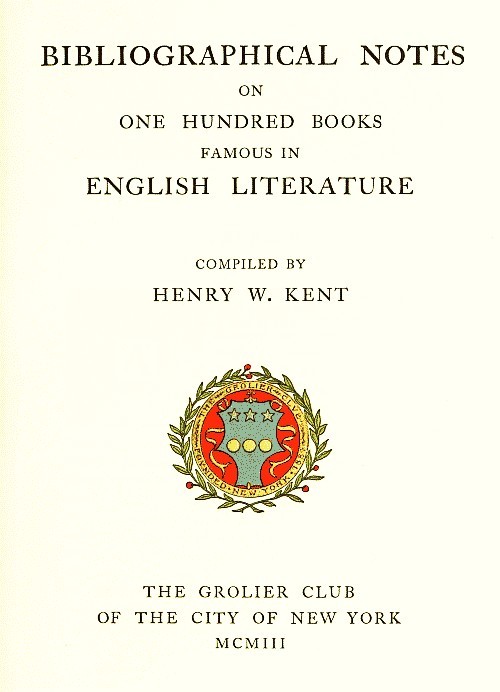
14. The | Principal Navi- | Gations, Voiages, | Traffiques And Disco- | ueries of the Engliſh Nation, made by Sea | or ouer-land, to the remote and fartheſt di- | ſtant quarters of the Earth, at any time within | the compaſſe of theſe 1500. yeeres: Deuided | into three ſeuerall Volumes, according to the | poſitions of the Regions, whereunto | they were directed. | [Thirteen lines] And laſtly, the memorable defeate of the Spaniſh huge | Armada, Anno 1588. and the famous victorie | atchieued at the citie of Cadiz, 1596. | are described. | By Richard Hakluyt Maſter of | Artes, and ſometime Student of Chriſt- | Church in Oxford. | [Printer's ornament] Imprinted at London by George | Bishop, Ralph Newberie | and Robert Barker. | 1598. [-1600].
The year 1589 had seen the publication of a small folio volume entitled:
The Principall | Navigations, Voia- | ges, And Discoveries Of The | Engliſh nation, made by Sea or ouer Land, | [Twenty-seven lines] By Richard Hakluyt Maſter of Artes, and Student ſometime | of Chriſt-church in Oxford. | [Printer's ornament] Imprinted at London by George Bishop | and Ralph Newberie, Deputies to | christopher Barker, Printer to the Queenes moſt excellent Maieſtie. | 1589.
The book presents a handsome appearance in the matter of type and ornament: the archer head-band appears, and there are two large pictorial initials at the beginning signed . It contains also "one of the beſt generall mappes of the world onely, untill the comming out of a very large and most exact terreſtrial Globe, collected and reformed according to the neweſt, ſecretest, and lateſt diſcoueries ... compoſed by M. Emmerie Mollineux of Lambeth, a rare gentleman in his profeſſion...." This map was a close copy of one engraved by Francis Hogenberg for Ortelius's Theatrum Orbis Terrarum, published first in Antwerp in 1570. Like the original it is called Typus Orbis Terrarum, but Hogenberg's name is erased, and no other appears in its stead.
This volume is usually called the first edition of the amplified work in three volumes, here facsimiled, which Hakluyt began to issue nine years later. The British Librarian of William Oldys, that "oddest mortal that ever wrote," gives a full synopsis of the contents of the latter work, "this elaborate and excellent Collection, which redounds as much to the Glory of the Engliſh Nation, as any Book that ever was publiſhed in it." He says:
"Tho' the firſt Volume of this Collection does frequently appear, by the Date, in the Title Page to be printed in 1599. the Reader is not thence to conclude the ſaid Volume was then reprinted, but only the Title Page, as upon collating the Books we have obſerved; and further, that in the ſaid last printed Title Page, there is no mention made of the Cadiz Voyage; to omit which, might be one Reaſon of reprinting that Page: for it being one of the moſt proſperous and honorable Enterprizes that ever the Earl of Eſſex was ingaged in, and he falling into the Queen's unpardonable Displeaſure at this time, our Author, Mr. Hakluyt, might probably receive Command or Direction, even from one of the Patrons to whom theſe Voyages are dedicated, who was of the contrary Faction, not only to ſupreſs all Memorial of that Action in the Front of this Book, but even cancel the whole Narrative thereof at the End of it, in all the Copies (far the greateſt Part of the Impreſſion) which remained unpubliſhed. And in that caſtrated Manner the Volume has deſcended to Poſterity; not but if the Caſtration was intended to have been concealed from us, the laſt Leaf of the Preface would have been reprinted alſo, with the like Omiſſion of what is there mentioned concerning the Inſertion of this Voyage. But at laſt, about the middle of the late King's Reign, an uncaſtrated copy did ariſe, and the said Voyage, was reprinted from it; whereby many imperfect Books have been made complete."
The cancellation "in the Front" refers to the title-page. In the new page of the castrated edition the clause "And laſtly, the memorable defeate of the Spaniſh huge Armada, Anno 1588. and the famous victorie acheiued at the citie of Cadiz, 1596." is made to read: "As alſo the memorable defeat of the Spaniſh huge Armada, Anno 1588."; and the date is changed to 1599. But, as Oldys remarks, through oversight or indifference the reference in the preface still remains to show that the edition is doctored, and not a new one. It reads: "An excellent diſcourſe whereof, as likewiſe of the honourable expedition vnder two of the moſt noble and valiant peeres of this Realme, I meane, the renoumed Erle of Eſſex, and the right honorable the lord Charles Howard, lord high Admirall of England, made 1596, vnto the ſtrong citie of Cadiz, I haue set downe a double epiphonema to conclude this my firſt volume withall...." The reference also remains in "A Catalogue of the Voyages," "39 The honourable voyage to Cadiz, Anno 1596. [p.] 607." and at page 606 the catchword "A briefe" still bears witness to the curtailment of "A briefe and true report of the Honourable voyage vnto Cadiz, 1596." The original leaves ended on page 619, with a large woodcut representing two winged figures supporting a crown and rose. They have been twice reprinted, but both reprints are easily distinguishable from the early work.
The second volume was issued by the same printers in 1599, and the third in 1600. Hakluyt is characterized on the title-page of the first volume, as on that of the first edition, as "Master of Artes, and sometime Student of Christ-Church in Oxford," but in the second and third volumes he is called "Preacher, and sometime student of Christ-Church in Oxford." He had been made rector of Wetheringsett in Suffolk in 1590.
In its general make-up, the new work resembles the old one. The archer head-bands have not been used, and only one of the pictorial initials signed ,—that at the beginning of the Dedication,—is retained in volumes one and two. These pictorial initials belong to an alphabet illustrating stories from Greek mythology. Mr. Pollard, in a chapter on Pictorial and Heraldic Initials, states that the first appearance of any of the set known to him occurs in a proclamation printed by Berthelet, and dated 1546. He finds that a similar monogram was used by Anton Sylvius, who worked for Plantin from 1550 to 1573, but he is doubtful about ascribing these initials to that artist.
The first and third volumes have the "The" of the title in a long panel (made of type-metal ornament in the first case, and a woodcut cartouche in the last one); the printer's ornaments on the title-pages of the second and third volumes are alike, and are the same as that in the first edition. "A Table Alphabetical," printed at the end of the first edition, was not undertaken for the second; but a new, engraved map of the world, unsigned and without a title, is found in some copies of the third volume. It was used also in two states.
This map is exceedingly rare, and interest attaches to it for two reasons. It is the first map of the world engraved in England, on Wright's (Mercator) projection, having been published the year after Wright had explained the principles of the projection in his Certain Errors in Navigation. A legend in a cartouche on the engraving says: "Thou hast here gentle reader a true hydrographical description of ſo much of the world as hath beene hetherto diſcouered, and is comme to our knowledge: which we have in ſuch ſort performed, yt all places herein ſet downe, haue the ſame poſitions and diſtances that they haue in the globe...." The second source of interest is this: the map is, without much doubt, the one Shakespeare referred to in Twelfth Night when he made Maria say of Malvolio, "he does ſmile his face into more lynes then is in the new Mappe, with the augmentation of the Indies."
A curious error has existed with regard to the map. The reference in the 1589 volume, already quoted, has been taken to mean that Hakluyt intended to issue a map by Molineux with that work, but, that map not being ready in time, he used the one from Ortelius. What more natural than that the new map in the 1598 edition should be supposed to be Molineux's, now at length finished? This was the conclusion jumped at, and the plate is usually called "Molineux's map." As a matter of fact, Hakluyt did not refer to Molineux as a map-maker, but as a globe-maker. He was a friend of that rare gentleman, and he knew that the mathematician was at work on a large terrestrial globe embodying all the very latest geographical information in the most exact way, according to Mercator's projection. He used the Ortelius map in his book only until the globe should be ready, when it could be easily adapted to the plane surface of a map by the engraver.
The globe, measuring two and a half feet in diameter, was issued in 1592, and is now preserved in the Library of the Middle Temple.
Folio. Black letter.
Collation: Volume I, *, six leaves; **, six leaves; A-Fff4, in sixes.
Volume II, *, eight leaves; A-Ccb, in sixes; Aaa-Rrrb, in sixes.
Volume III, (A), eight leaves; A-I, in sixes; K, eight leaves; L-Cccc, in sixes.