
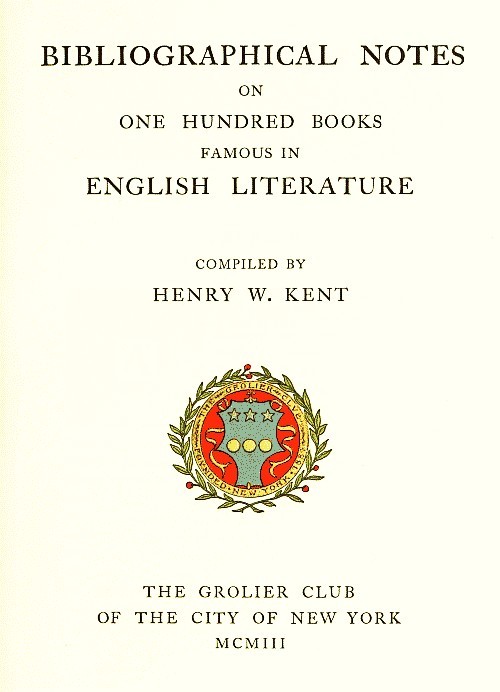
28. Comedies | And | Tragedies | Written by | Francis Beaumont | And | Iohn Fletcher | Gentlemen. | Never printed before, | And now publiſhed by the Authours | Originall Copies. | [Quotation] London, | Printed for Humphrey Robinſon, at the three Pidgeons, and for | Humphrey Moſeley at the Princes Armes in St Pauls | Church-yard. 1647.
These two dramatists, between whom "there was a wonderfull consimility of phancy," and who shared everything in common, were inseparably connected in their writings. No collected edition of their plays appeared before this posthumous one, which is dedicated to Philip, Earl of Pembroke, by ten actors, and is introduced to the reader by James Shirley, the dramatist, who speaks of the volume as "without flattery the greatest Monument of the Scene that Time and Humanity have produced." This, too, notwithstanding the fact that Shakespeare's Works had appeared twenty-four years before.
This edition appears to have been due to Moseley's enterprise. He tells us in a frank address called "The Stationer to the Readers":
"'T were vaine to mention the Chargeableneſſe of this VVork; for thoſe who own'd the Manuſcripts, too well knew their value to make a cheap eſtimate of any of theſe Pieces, and though another joyn'd with me in the Purchaſe and Printing, yet the Care & Pains were wholly mine...."
Commenting upon the fact stated on the title-page that the plays had not been printed before, he says: "You have here a New Booke; I can ſpeake it clearely; for of all this large Uolume of Comedies and Tragedies, not one, till now, was ever printed before...." "And as here's nothing but what is genuine and Theirs, ſo you will find here are no Omiſſions; you have not onely All I could get, but all that you muſt ever expect. For (beſides thoſe which were formerly printed) there is not any Piece written by theſe Authours, either Joyntly or Severally, but what are now publiſhed to the VVorld in this Volume. One only Play I muſt except (for I meane to deale openly) 'tis a Comedy called the VVilde-gooſe-Chase, which hath beene long lost...."
Nothing which throws light upon the history of printing at this time is more interesting than the Postscript added at the end of the commendatory verses by Waller, Lovelace, Herrick, Ben Jonson and others, and immediately after a poem by Moseley himself ending, "If this Booke faile, 'tis time to quit the Trade." ...
"... After the Comedies and Tragedies were wrought off, we were forced (for expedition) to ſend the Gentlemens Verſes to ſeverall Printers, which was the occaſion of their different Character; but the Worke it ſelfe is one continued Letter, which (though very legible) is none of the biggeſt, becauſe (as much as poſſible) we would leſſen the Bulke of the Volume."
This matter of size seems to have been the cause of no little solicitude and care. Speaking of adding more plays to the volume, he says:
"And indeed it would have rendred the Booke ſo Voluminous, that Ladies and Gentlewomen would have found it ſcarce manageable, who in Workes of this nature muſt firſt be remembred."
There are thirty-six plays in the collection: as the stationer tells us in the preface to the reader quoted above, all those previously printed in quarto are included, except the Wild Goose Chase, which had been lost. It is added at the end of the volume with a separate title-page dated 1652.
The following epigram by Sir Aston Cockain, addressed to the publishers, the two Humphreys, is not without interest in this connection as showing that the difficulties arising from the joint authorship were early sources of perplexity:
"In the large book of Plays you late did print
(In Beaumonts and in Fletchers name) why in't
Did you not juſtice? give to each his due?
For Beaumont (of thoſe many) writ in few:
And Maſſinger in other few; the Main
Being ſole Iſſues of ſweet Fletchers brain.
But how come I (you ask) ſo much to know?
Fletchers chief boſome-friend inform'd me ſo.
. . .. . . . . .. . . . . .
For Beaumont's works, & Fletchers ſhould come forth
With all the right belonging to their worth."
Moseley, in his address as stationer, says of the portrait of Fletcher by William Marshall, which bears the inscriptions, "Poetarum Ingeniosissimus Ioannes Fletcherus Anglus Episcopi Lond: Fili." "Obijt 1625 Ætat 49": "This figure of Mr. Fletcher was cut by ſeveral Originall Pieces, which his friends lent me; but withall they tell me, that his unimitable Soule did ſhine through his countenance in ſuch Ayre and Spirit, that the Painters confeſſed it, was not eaſie to expreſſe him." The nine lines of verse beneath the portrait are by Sir John Birkenhead. The portrait is found in two states, distinguishable by the size of the letters in Birkenhead's name. Although he was very ambitious to get a portrait of Master Beaumont, his search proved unavailing.
There are a few woodcut head-bands, varied with others made of type metal, in the front part of the book, but the last part is severely plain.
Folio. The first collected edition.
Collation: Portrait; A, four leaves; a-c, in fours; d-g, in twos; B-L2, in fours; Aa-Ss, in fours; Aaa-Xxx, in fours; 4A-4I, in fours; 5A-5X, in fours; 6A-6K, in fours; 6L, six leaves; 7A-7G, in fours; 8A-8C, in fours; *Dddddddd, two leaves; 8D-8F, in fours.