
Sources
The basic source work for this pamphlet is the Marine Corps’ official monograph, The Assault on Peleliu, by Maj Frank O. Hough, published by the Government Printing Office in 1950, while LtCol Gordon D. Gayle was serving as deputy director of Marine Corps history, and editor of the monograph series. Other books used in this narrative were: George W. Garand and Truman R. Strobridge, Western Pacific Operations, vol IV, History of U.S. Marine Corps Operations in World War II (Washington: Historical Division, HQMC, 1971); George P. Hunt, Coral Comes High (New York: Harper & Brothers, 1946); E. B. Sledge, With the Old Breed at Peleliu and Okinawa (Presidio Press, 1981); Edward S. Miller, War Plan Orange: The U.S. Strategy to Defeat Japan (Annapolis: Naval Institute Press, 1991); Edward Behr, Hirohito: Behind the Myth (New York: Vantage Books & Random House, 1989); Bill D. Ross, Peleliu: Tragic Triumph, The Untold Story of the Pacific War’s Forgotten Battle (New York: Random House, 1992); James H. Hallas, The Devil’s Anvil: The Assault on Peleliu (Westport, Connecticut: Praeger, 1944); Harry A. Gailey, Peleliu 1944 (Annapolis, Maryland: Nautical & Aviation Publishing Inc., 1983); Masataka Chihaya, Fading Victory: The Diary of Admiral Matome Ugaki, 1941–45 (University of Pittsburg Press, 1962); Larry L. Woodward, Before the First Wave: The 3rd Armored Amphibian Tractor Battalion—Peleliu and Okinawa (Manhattan, Kansas: Sunflower Univ. Press, 1944); Burke Davis, Marine: The Life of Lieutenant General Lewis B. (Chesty) Puller, USMC (Ret) (Boston: Little, Brown Company, 1962).
The Oral History and Personal Papers Collections in the Marine Corps Historical Center, Washington Navy Yard, Washington, D.C., hold a number of interviews and diaries of participants in the Peleliu operation. These documents from the following were particularly useful: LtGen Oliver P. Smith; BGen Harold D. Harris; BGen Harold O. Deakin; and LtGen Lewis J. Fields, along with numerous personal interviews with campaign veterans—officers and enlisted men.
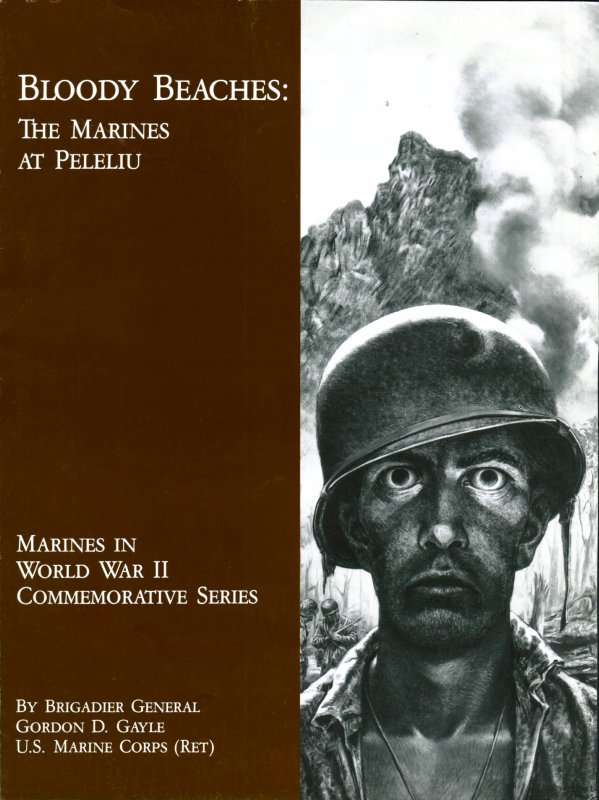
The author wishes to thank the Army Center of Military History for the loan of the photographs of Tom Lea’s artwork appearing in this pamphlet. He also wishes to thank Phillip D. Orr for permitting use of the interesting photographs of Peleliu as it appeared in 1994.