
This first lisping of an almost infant muse produced an electric effect, and seemed the proximate instrument to inspire a degree of resolution which till then had been denied to my prayers; for God does his work in our hearts by secondary means and not by miracles. From that hour my mind appeared gradually to receive strength. I began to feel that solitude was too selfish an enjoyment; that I had active duties which claimed a share of my thoughts. I prayed earnestly, I exerted myself unceasingly, recovered health, and then determined on the great sacrifice of re-visiting Glenalta. The anguish, which that effort cost me, it would be as impossible for me to express, as it would be painful to you to conceive. Enough of this! Your request for assistance in your new character has led me back through a labyrinth of past time, and my pen has almost unconsciously pursued the train.
The excellent tutor who was procured for me by my invaluable friend Edward Otway, seemed as if formed expressly for my purpose. I could not have borne the society of any mortal who expected to be made a companion, nor could I have allowed my children to associate with a person who did not deserve to be made a friend. Mr. Oliphant, old enough to be my father, yet cheerful enough to be the play-fellow of my children when he was not their teacher, religious, benevolent, learned, simple in his manners, enthusiastic both in acquiring and imparting knowledge, and never desiring other company than that of his pupils and his books, was the man whom I found at Lisfarne under the roof of my friend, and waiting the arrival of my family at Glenalta. A few dreadful struggles over, we commenced upon the "noiseless tenor of our way." I read every volume of which I had ever heard upon education, and found instruction in a short paper upon the subject, written by the late Mrs. Barbauld, whose pen was called upon to direct the conduct of a father and mother who found themselves the parents of a darling only son, and possessed of such affluence as to induce them to give a carte blanche for whatever might be suggested as most likely to succeed in making this object of their common affection all that they fondly desired to see him.
Her letter in reply to their solicitations for advice, was published many years ago in a periodical work entitled "The Inquirer," and contains more strong good sense in a few pages than I have ever met with in the many ponderous quartos which maternal anxiety induced me to wade through. Mrs. Barbauld tells her friends to be themselves in daily life, in all their habits of speaking and acting, that which they desire to impress upon their son. The quantity of Greek and Latin, logic, and mathematics, which he might attain in the progress of his studies, or the place in which such knowledge should be acquired, she wisely leaves in a great measure to other advisers; and resting on what is surely of far higher consequence in the human compound, namely the principles, the sentiments, the opinions which it is desirable should actuate the conduct of the future man, she admirably remarks that the moral atmosphere by which youth is surrounded, is the real teacher—not the tutor or governess who lays down precepts in the closet.
We are told in holy writ, that "the children of this world are wiser in their generation than the children of light," and we may fairly draw a similar comparison between the young and the more advanced of our fellow creatures upon earth. The whole strength of a child lies in his sagacity, which accounts for all the acuteness employed by young people in observing looks and actions, and in developing the secret motives of those in whose conduct they are interested. In low minds this acuteness degenerates into cunning, but in all children there is a quickness of intellect, a readiness in deducing effects from causes, and marking inconsistencies between theory and practice, which ought to operate as a powerful incentive with those who undertake the care of youth, to make singleness of heart and a broad bold integrity the rule of every act in life. It is in vain that we talk of the beauty of truth, while we employ dissimulation in our intercourse with society; or descant on the advantages of occupation, while our own days are passed in idleness and sloth. Words go for very little, whilst it is what we are doing that secretly determines the bias of our children either to imitate or avoid. Powerfully impressed with this leading truth, I endeavoured to act upon my conviction. My rules were simple, few, and determined. I avoided as much as possible the multiplication of decrees, and, where it was practicable, rather sought to shew my little flock the path in which I wished them to walk by accompanying their steps, than to point out by prohibition that which was to be avoided. The success with which a merciful Providence has blessed my humble efforts is not granted to all in the same degree; but all must try for the goal, though it may not be given to reach it in every case. The original structure of the human mind is after all the great thing, and our best endeavours can but improve or restrain; but will never create. That belongs to higher influence. You know my feelings, and how much I prize one unselfish movement of the heart above all the intellect that ever adorned the greatest philosopher; and therefore it is that I have tried with such incessant care to cultivate the affections of my children. Here again nature must co-operate; for there are characters so phlegmatic, so cold, so inclined to contradiction, that no kindness will warm them into confidence and love. But though we do not make sufficient allowance for the vast variety of constitutional temperament, and too frequently expect equal results from different soils, which will always disappoint our hopes; a careful study of the materials upon which we are to act, and a judicious application of culture according to the grain and character of those materials, will seldom fail of repaying our labours by such harvest as it is reasonable to anticipate.
I have, you see, only attempted here to give you a loose sketch of my ground plan. You must ask specific questions, to which you shall have the best replies in my power to give: but if I go on tacking my thoughts together generally upon the subject of education, I may be giving you what you do not want. Tell me, then, all your difficulties as they arise, and as far as my experience can remove them you may rely upon my inclination to assist your virtuous resolution of supplying a parent's place to your poor brother's orphans.
The many volumes devoted to the subject of education are frequently written by people who have, like the spider, spun out the web of their theories from within, and then applied those tissues to creatures of their own imagination, fitting and conforming the one to the other as nicely as Cinderella's slipper was found to suit the princess for whose foot it had been made. Such books remind me of a fine contrivance which should be devised with mathematical precision by one wholly unacquainted with practical operations. The machine is set going, and the influence of friction alone, upon which our philosopher had never calculated in his closet, is sufficient to overset the entire speculation.
I must now employ the remainder of my paper in mentioning the arrival of my nephew Arthur Howard. His health is far from being robust: but I flatter myself already that our balmy breezes from the sea, and fragrant gales from the heath-covered mountains, which nearly surround this little glen, have been of use to him. Nothing could be more delightful to my heart than his perfect recovery, if I might hope that, with renewed health, he were to inhale amongst us some better notions (for I cannot dignify his nonsense with the title of opinions) than the silly society of his poor mother, and those vapid votaries of fashion with whom her hours are passed, have infused into his youthful mind. Arthur is not more than twenty, and has so good an understanding, combined with a remarkably open, candid nature, that I cannot bear to think of his being misled by vanity and folly. He is very engaging, though in the high road to be spoiled, if we cannot, by some necromancy, contrive to make him love our peaceful pleasures at Glenalta.
It is to me a source of great amusement as well as delight to be a silent observer of the group by which I am encircled. I had prepared my dear Frederick and his sisters to find their cousin frank and amiable, but sadly led astray by the tyranny of fashion; and it is really more interesting than I can express, to behold the sweet assiduities of these beloved children in administering to his wants, endeavouring to promote his amusement, and softening his prejudices by the most endearing kindness, and gentle, judicious opposition. So nice is the tact which singleness of heart, and affection inspire, that I have not had once to animadvert upon any part of their manners towards our young guest since he came amongst us, and as all their innocent projects for his reformation, and delicate remarks upon the progress or failure of their little schemes are imparted with the glow of confiding sympathy to me, I am charmed with the discoveries which I am thus enabled to make in the dispositions of my children, through circumstances calculated to place them in new lights to my view.
My mind undergoes variety of emotion in considering Arthur, whose conflicts of spirit I can clearly penetrate. Sometimes diverted beyond measure by his rising indignation, I can scarcely preserve my gravity when I see his choler ready to burst into furious invective against the many pursuits in which my girls are occupied so new to him; then checked ere it has exploded by some sprightly sally on their part, or by his own evidently growing attachment to their pleasant society. Emily reasons with him, Charlotte expostulates, and Fanny banters so playfully with her cousin, that her merriment seems always with a magic touch to restore his temper to its equipoise. Arthur you know has been bred up in the school of the world, and holds all its doctrines with tenacity. Accomplishments make up all his idea of female education. To sing, play on the harp and piano-forte, speak French, and know enough of Italian to quote a line from Metastasio, are the utmost extent to which he would permit a woman's lore to extend. Any thing more than this, every degree of literary information beyond the poems of Lord Byron or an Album, is voted blue, and Arthur's eloquence is in continual exercise upon the absurdity, inutility, and vulgarity of learning in a lady. His tirades are met with such perfect good humour, and he is so frequently indebted to those resources in his cousins which he affects to despise for varying the pleasures of his day, that I prophesy a change in his opinions, but it will not be wrought all at once. We must patiently endure some more reproach, ere our young man of fashion will declare himself a convert, but such is the charm of mind over matter, that I think we shall conquer in the end.
My dears all unite in most affectionate loves to you and yours with my Elizabeth's
Attached friend,
Caroline Douglas.
Mr. Oliphant returns from his northern trip next week.
LETTER V. Arthur Howard to Charles Falkland.
My dear Falkland,
Here comes the day for sealing my promised packet, which you will find to contain the last week's register of matters and things as time glides on at Glenalta.—Well; shall I begin by giving you this day's impression, or travel, like a crab, backwards, in order to get forward? As the latter will be in the Irish style, and also conformable to my promise, I suppose that I must give it the preference. To return then—I made up my budget on Wednesday night, went to bed, tossed about rather feverishly for an hour or two, partly from this plaguy cough, which was, I conclude, excited by my journey, and partly, no doubt, from the irritation of my temper. Sleep, however, that "sweet restorer," as our poet so beautifully calls it, came ere long to my aid, and my eyes were closed until they opened at once upon Lewis, and the most brilliant sunshine I ever beheld!
"Lewis, I will get up before the family are stirring—I want to look about me, and see something of this place before breakfast." "Lord, sir," replied my squire, "the people of this house I believe live without sleep, at least if I may judge by what I have seen as yet. I was up myself at half past six, and the young ladies were coming then from the sea when I went down stairs. They are off upon some other prank now, for I saw two of them on donkies, and Mr. Frederick is, I know not where, but certainly not in his room, for the door and windows of it are wide open."
I jumped up, and at eight o'clock sallied forth in quest of adventures. The Glen, in which my aunt's dwelling is situated, is most assuredly quite lovely; and this time of the year is so charming in itself, that it is provoking that all things here should not be in harmony. Just conceive a set of Blue Stockings in a scene fit for nothing but love-music and romance,—faith it is mortifying; not that I am near so angry as I was when I last wrote. No; they are all very prudent, I must own; but the accursed thing is there, and only waiting for an opportunity to overwhelm me;—but to my diary.
I had not gone ten yards from the hall door, along a winding pathway that leads through a wood to the sea, when, fascinated by the beauty of every thing around me, I thought that I would run back for my sketch-book, and try if I could not at least take notes of the view near the house, particularly as I shall leave it so soon, before I joined the family party. Just as I regained my own room, I met pretty Fan, looking like a rose-bud. "Fred. and I have been searching every where for you, Arthur, to give you your little dose of milk warm from the cow, which I am determined shall cure your cough, and make you as fat as my Flora." So saying, off she skipped, desiring me to wait for her return, and in a few seconds she came back in the character of Hebe, bearing a goblet of high-frothed milk instead of nectar, not for Jupiter, but your humble servant. Never having been paid such an attention in all my life before, I felt rather at a nonplus. Not a line from Scott, Byron, or any of our British bards!—no, not even the "Thought upon new milk," at which you and I have laughed in the Rolliad, came to my relief. Not intimate enough to be thus served by a princess of the castle, without returning some acknowledgment, and nothing either chivalric or poetical starting to my rescue, I was completely at fault, and looked, perhaps for the first time, something like Simon Pure. Fanny, however, did not seem to observe any thing but the main point of whether the draught were honestly dregged to the very bottom.—"Drink it all; the conserve of roses, I dare say, will reward the last gulp,—there, that is a dear boy—it will do you good;" and away flitted my nymph of the mountain, saying, as she sped along, that she would come and walk with me in a moment. Scarcely had I lost sight of her, before she was back again; and all animation, with youth, health, and good humour, she ran up to me and said—"Old Lawrence does not treat me so formally as you do; he does not look surprised when I offer him a glass of milk; but smiles kindly, with a 'bless you, missy,' as my reward."
"What," answered I, "have you been meting out your favors this morning to a set of pensioners, amongst whom I have the honour to be classed? If that be the case, my gratitude might be taken from the general tribute, and hardly missed."—"Oh, then, I see how it is," replied my little coz, "you are offended at me for having taken care of a helpless old man in company with a smart and fashionable young one; but you will not be angry when I tell you, that this dear old soul is the precious mother's foster-father." "And pray, my amiable Fan, what is the meaning of foster-father, for in my life I never happened to hear of such a relation."—"Well, you astonish me, Arthur; I find that you have a great deal to learn. Old Lawrence, or Lorry, as you will soon be taught to call him, was husband to mamma's nurse. Nanny is dead, and much did we grieve for her; but it is a great consolation for her loss, that we are enabled to make her excellent and aged partner so happy and comfortable as he is at Glenalta. Remember, too, that the blessed sun does not shine less brightly upon you, dear Arthur, because it warms our poor old man: and when you think of this, you will never grudge him a share of Drimindhu's milk."
"And who, may I ask, is Drimindhu?" rejoined I. "A favourite cow. Our Kerry cows are beautiful, and not unlike those of Alderney; but Drim is my own property, and her milk is better than any other; at least, I think so, or I would not give it to you and Lorry. Have your sisters pets of this kind at Selby?" "No, indeed, my sisters know very little of cows; and I question whether they ever heard that it is these animals which supply us with milk. Louisa and Adelaide live for a great part of every year in town, and when they go down into Buckinghamshire, or to Brighton, or elsewhere, they ride and drive, but never take any part in domestic affairs."—"Well, then," answered Fanny, "I am sorry for it—they lose a very great pleasure by not cultivating a love for the country and its pursuits. The act of loving is so delightful, that it always seems like the soul's sunshine; and I never understand the character of the Deity so well as when I think of Him as a God of Love."
Though I could not refrain from smiling, I felt for the time that Fanny's view of things was very contagious. The splendor of a May morning, the freshness of Nature, and the concert of singing birds, had put me into a disposition to be pleased, and the simplicity of this dear little girl had all the stimulating effect of novelty on my senses.
At this moment, turning round a wooded knoll which we had been skirting while thus engaged in a sort of conversation so unlike what I had ever been accustomed to, a group of three donkies appeared in view. "Here they come," exclaimed Fanny; and, darting with the fleetness of a greyhound, she flew to meet her sisters, who were attended by a peasant-boy, carrying a basket before him. Nothing could be more picturesque than the scene, and it was much heightened by the approach of these rustic equestrians. While I was moving towards them, a fine pointer passed me by at full speed, and a tap on my shoulder announced Frederick, who came running across the grass to join the party. A few moments brought us together, and, to my amazement, the brother and sisters met with as much demonstration of gladness at sight of each other as Louisa, Adelaide, and I could have mustered after a year's separation. The effect was pleasant; and, if sincere, this affection which the people here discover towards each other has something very comfortable in it; but it is only calculated for this sort of place, and, like hospitality, naturally flies into these recesses of the earth, where the objects are scarce upon which one's practice can be exercised. Politeness is necessary to a certain degree in the world, and even that may be overdone; but beyond this how little of the heart does one see brought into play, and indeed on a great theatre the thing would be impracticable, if it were not such a bore as to render an attempt to love every one that a man meets as absurd as it is impossible. But I digress.—Large coarse straw hats shaded my pretty cousins from the sun, which shone brightly. The eldest has a peculiar expression, made up of the intellectual and pensive, which is singularly agreeable, though her features are not regular enough for what requires no periphrasis to describe, but is at once called beauty. Charlotte is very pleasing also; her countenance is less strongly marked than Emily's by reflection, but it is quick as lightning—and full of sensibility; while Fanny's face exhibits a mixture of all the varied characteristics of both her sisters', or may perhaps be more properly denominated a mirror, in which every movement of their minds that makes it way to the surface, is shadowed with fidelity.
All were in a hurry to get home lest my aunt should be kept waiting a moment; and so quick were the subsequent operations, that Frederick has assisted the two damsels from their donkies, the riding costume was doffed, as if by magic; and ere it seemed possible to have gone through half the preliminary work of preparation for breakfast, a bell tingled, and hastily pocketing my sketch-book, I quitted my station near the house, where I had lingered to make a memorandum of the spot, and was met at the door by Fred. who stopped my entrance, saying, "Arthur, my mother fears it may not be agreeable to you to attend family prayers; and, as you are an invalid, I am desired to say, that you are not to consider yourself bound to our hours, or observances; therefore, my dear fellow, as you have of course said your own prayers, do not think it necessary to join us; but Lewis has been asked, and as it is pleasant to be sure of religious instruction for the servants, I came to mention the circumstance, lest you should want your valet."
Now the fact was, that though you know I do say my prayers generally, and think the practice a right one, I had not knelt down on that morning. The stimulus of a new place, the vexation of the preceding evening, and a sort of restless curiosity to look about me, and make my observations while I had an opportunity of being alone; all excited me to quit my room as fast as I could, and I did so without a syllable of devotion: behold me, then, again caught in the trap; and having blundered out something of being "very happy, &c. &c." Frederick led the way, and in a small room where there was no appearance of eatables, I found Mrs. Douglas and her daughters.
My aunt, who is about forty, is a heavenly looking being, without being handsome in the common sense of the word. Her character of countenance, manner, dress, is entirely and exclusively her own, without conveying in any thing the idea of eccentric. Her smile is lovely, and seems to warm into life and serenity whatever it rests upon.
The exquisite lines, written by I know not whom, from which I have made this extract, seem to have been drawn for my aunt. The portraiture is perfect; but I must not forget that we are all fasting. I was received with "welcome, my Arthur," which I do not know why, gave me a lump in my throat—a mixed sensation of pain and pleasure, which I have very seldom experienced. The servants, neatly dressed, and decorously arranged, lined the room. Fanny placed old Lawrence's cushion, and a psalm, which was read by Frederick, was succeeded by a prayer from his mother, pronounced with such a thrilling pathos, that I felt it "knock at my heart," as our friend Russell said one day of an Irish melody. I admire not only my aunt's selection, but since she must have family devotion, her judgment in limiting the time which it occupies to so short a period. Nobody seems either tired or inattentive; but the petition is so simple, so energetic, and so reasonable in point of duration, that really one cannot say much against the practice, after all: custom, too, familiarizes one in a day or two to kneeling down among the servants, so that on the whole I have no right to complain; and as I shall not describe our genuflections again, you may fancy me performing my matins and vespers with monastic regularity. The Roman Catholic servants here attend as punctually as the Protestants, and of their own free will, as my aunt dreads hypocrisy, and therefore deprecates the idea of compelling her household to a mere lip-worship; but her prayers include all who require divine assistance, of whatever kind; and the people seem to feel that she is truth itself.
Well, we went to breakfast, and a very nice one it was. The soil of this country and its humid atmosphere appear favourable to grass, and all the dairy department is much better managed than in England, at least as to the excellence of the milk, cream, and butter, when brought upon the table; for I do not profess to be acquainted, as yet, with the manipulations which they undergo.
"My children, have you been fortunate in your ramble this morning? What plants have you brought me?" asked Mrs. Douglas. I now expected a first dissertation upon stamens and pistils—felt myself starching my countenance involuntarily into a most repellent expression, and was hastening to swallow a bit of toast that I might turn to Frederick while the Linnæan lecture continued, when Emily quickly, but joyously answered, "Oh, I am delighted to tell you, that we found every thing you want except the club-moss."
Much pleased, as well as surprised, I ventured now to hint about the botanical books which I had glanced at, adding, "I thought that you were all learned in botany as well as the whole circle of sciences." A hearty laugh went round the table, and Emily replied, "We know a few plants, and it is very amusing to go in search of them in our mountain walks."—"And pray," I asked, "have they not all long Latin teeth-breaking names? I dare say you know some scientific title for club-moss." "I do know another name," said Emily, "but the English is always the easiest and pleasantest, when one does not want to be precise." "Then, Emmy, we may set about our recipe to-day, I think," half whispered little Fan. Growing bold, now that I had broken the ice, I proceeded to say, "So then you are doctors, too. Upon my word, it is somewhat formidable to come into the midst of an academy in this unprepared manner. You should all put on wigs, and write treatises; and you should inform your friends what course is necessary to be read before they come to examination."
What answer I should have received to this sally, I cannot tell, for in the moment of uttering it, the door opened, and my aunt's dear friend, Mr. Otway, made his appearance. The vivid joy with which he was greeted was quite unlike any thing that I had ever seen, before my acquaintance here; but it was neither noisy nor overwhelming, and though certainly very unfashionable, I could not for the life of me help feeling how very delightful it must be to excite so much lively emotion of a pleasurable kind by one's presence. Mr. Otway's presence was welcomed with rapture by the whole group, though in the expression of each bien venu there was something individually characteristic. My aunt's reception of a person for whom she feels affection, is touchingly kind; and while the bright glow of hospitality lights up her whole manner and appearance, the gleam is accompanied by a sort of tender melancholy, which would evidently conceal itself were it possible, but which, when interpreted, seems to say, "there was a time when you would have been doubly welcome, for then I was not alone."
Her smile brings that beautiful image in Ossian to my mind, which you and I have admired, "It was like a sun-beam on the dark side of a wave." Fanny's exclamation, upon Mr. Otway's entrance, was, "Oh, dearest Phil. can this indeed be you?" To expound this extraordinary salutation would have been difficult when first I heard it; but I am now enabled to say, that this gay assembly christened him "The Philosopher," because of his extensive knowledge, to which all the family are in the habit of appealing as to a great bank of deposit; and it appears, that no letter of credit drawn upon it has ever been dishonored. Phil. then, is short-hand for philosopher, and my ear is now familiar with this playful abbreviation.
The first effervescence over, I was presented to, and met with a cordial shake of the hand by Mr. Otway, to whom I must now introduce you. He is about five-and-fifty, tall, and striking in his appearance, with a fine forehead, remarkably intelligent eyes, and splendid teeth. His manners are easy and polished: and though the first coup d'[oe]il was a little in the Robinson Crusoe style, yet, when he put off a large and shaggy looking cloak, laid by a prodigious staff, like that of a watchman, which he held in his hand, and got rid of a cap, the laps of which were folded over his cheeks when he first came in, I perceived that he was a remarkably well-looking man; perhaps I should say distingué most decidedly, and thereby hangs a tale, for my evil genius was at hand, and I got into a scrape on account of him ere an hour elapsed after his introduction; but not to anticipate, it seems that a long illness had confined him for some time, and this was the first visit that he had made on foot, which was the reason of his being unusually muffled, and also of the more than common happiness expressed at sight of him. He sat only a few minutes, but promised to dine on the following day; and immediately after his departure my aunt, addressing herself to me, said, "Arthur, my love, we are a home-spun set of people here, very unlike the world to which you are accustomed, and instead of passing our mornings in amusement, we go to our several occupations till two o'clock, at which hour you will always find luncheon in the breakfast-parlour, and your cousins ready to ride or walk; but as you must not be expected to drop all at once into our old-fashioned ways, Frederick and Emily shall be your companions to-day, Charlotte and Fanny to-morrow. In this manner, you will be acquainted with our walks, and introduced to our sunny bowers. When Fred.'s next examinations are over, he will be a free man; and in the mean time you will, I know, bear with our stupidity."—So saying, she pressed my hand, and left the room, followed by the younger girls.
"Shall we walk or ride to-day?" said Emily. "We are your attendant knights," answered Frederick, "and wait your decision." "Oh, oh!" quoth I, "Sir Charles Grandison upon our hands:" I did not, however, say so aloud; I thought it better to feel my way a little, and only replied, "Certainly."—Emily, with perfect ease, rejoined, that she thought we might perhaps do both, and, turning to her brother, added, "Suppose that we take him first through the Glen, then round the coppice to Lisfarne Wood; and after luncheon, if Arthur is not tired, we may ride up the mountain, and shew him the bay." Matters were arranged in a moment, and forth we sallied, Frederick presenting one arm to his sister and the other to me. "Pooh! what a piece of ceremony you are," said I. "How so?" eagerly asked Emily; "Fred. is so affectionate, that he cannot be formal: his heart always serves with him in the place of etiquette, by suggesting all that the most genuine politeness could dictate: his attentions are not confined to strangers; but, unlike those of cold mannerists, are bestowed upon the people whom he loves best."
This savoured of a sting, and I felt my colour rising; but in a second I found that none could have been designed; indeed, how should it, for they knew nothing of my conduct with my sisters, and therefore could never have intended a stab in the dark. "Plague on these retirements," thought I to myself, "where there is no standard for good manners but people's own crude notions of what is right and wrong! This ponderous machinery of morals, brought to bear upon every trifle, is as difficult to be at ease with, as the heavy cross-stitch, long-backed chairs of antiquity which are just suited to such buckram, and it is a pity that the furniture at Glenalta is not in keeping with these straight-laced puritans who are its inhabitants."—Thoughts are rapid, and these flew over my mind so fleetly as not to be fashioned into any sort of utterable form, when the gay cheerfulness of my companions dispelled the passing cloud, and we took a delightful walk, which was enlivened by a great deal of pleasant conversation. We talked of Killarney, which they tell me I must visit when I cease to bark. We planned some boating parties, which, by the bye, will be just the thing, and kill two birds with one stone; for the physicians, my mother tells me in her last letter, desire me to go upon the water, and as I like it excessively I shall have the credit of being a very docile patient. They tell me that there are some curious remnants of antiquity, which I am to see; and, in short, we cut out work enough to occupy some time, which, if I can spin out in this back settlement of mankind, tant mieux.
Well, but now for my scrape, and a devil of a one I can tell you it was. While we were jogging on as merrily as possible, Fred. made a hop, step, and jump into the bottom of a ditch, "Emily, what is this?" as he snapped at something growing near the bottom. I do believe, answered she, that it is a leaf of the parnassia; but to make sure, we will keep it for dear Phil. This unlucky Phil. was my stumbling block. "By the bye," I said, "he is a very fine looking man of his age," and totally forgetting where I was, Old Nick put it into my head to add, "pray, is he one of aunt's aspirants?" If I had fired a pistol at Emily, she could not have been more amazed. For a second she stood motionless, and then burst into tears. I begged a thousand pardons, and asked how I had offended, while Frederick, exactly as if he had been her lover, pressed her hand with the most affectionate solicitude, and leading his sister towards the bank, we were all seated by a sort of tacit consent in a moment. A silence while you could reckon ten, ensued, and I felt foolish enough, as well as vexed, at such a contre tems in the midst of our good humour. Again I mentally cursed botanists, philosophers, and precieuses, though I must own they were not to blame upon the present occasion, when it was my own confounded folly in forgetting what a Ninette à la Cour I had to deal with that produced this vexatious kick up. But while I was biting my lip, and thinking what I should say next, Emily brushed off her tears, and seizing my hand in the kindest manner, gently implored my forgiveness, as if she had been the offender, and with as much naïveté and tenderness, as if she had never read a word of Greek or Latin in her life, said with energy, "Arthur, will you pardon me. I know that you could never have meant the least degree of unkindness; I was very foolish not to recollect in the instant when you spoke, that you were only jesting; but I am so jealous for my beloved mother, and feel such love and respect for her valued friend, that unaccustomed to any other sentiments than those of reverence and affection, I was quite unprepared for your joke, which I know you will not repeat: say that you forgive me." I felt really grateful for this good-natured address, because I had certainly distressed her, and I therefore said very sincerely that I was sorry for having inadvertently touched a chord that vibrated so sensitively, adding, "but you do me only justice in believing that nothing was further from my intentions than to wound your feelings. I live in a world where such things are said every day with impunity, and in fact (if you will not be angry with me for explaining) I meant simply to say, that Mr. Otway and my aunt seem well suited to each other. She is still a very attractive woman, and he seems to feel that she is so. Now dear Emily is not this 'the very head and front of mine offending?'" "I will try and not again expose myself," said Emily, "by giving way to impulses which should be under better control; it is very wrong, as well as silly I know, to judge all things and people by the same standard; and therefore I ought to have remembered, that the gay circle of fashion in which you live, must of necessity be governed both in habits and opinions by a rule as different as possible from any that guides our simple hearts in the Kerry mountains. Now then, here is my bargain,—I will not be angry any more, and you will not draw conclusions, till you are better acquainted at Glenalta. When you are, you will not be inclined to repeat the treason; you will then see clearly how much you mistake the characters of the persons who surround you: when the subject may be more interesting than it can be while you are a mere stranger here, I will give you a sketch of Mr. Otway's history; till then, you are to be a calm observer."
All this was said with an air that partook of playful and serious; and while it conveyed the most cheerful pardon to me, intimated as clearly, that the error I had committed was not a slight one. Frederick gave an encouraging look at his sister, and merrily turning to me, finished, by saying, "We shall all be intimate by and by, and see each other as we really are; till then, we must obey our little mistress." Frederick and Emily appear quite devoted to one another. We recovered our fracas very speedily; and after a walk through some of the most beautiful scenery I ever saw, returned home. Just as we were leaving a coppice that joins with the shrubbery grounds, a poor woman without shoes or stockings, and one of the most grotesque figures I ever beheld, popped upon her knees while we were crossing a stream; recollecting suddenly that I was now in the island of saints, I expected to hear an ave at least from this poor disciple of St. Patrick; but with uplifted hands, streaming eyes, and county of Kerry whine, she invoked the "'blessed Virgin' to shower down her best gifts on Emily's head" "Oh Miss, mavourneen, Jem is well again, and going to work; and I made bould to come over the mountain with a bit o' fish and a little hen for ye." "Eileen, I thank you heartily," said Emily, "and am very glad to hear that your husband is better; but where are your shoes and stockings?" "Honey, I left 'em at home, a fear I'd be wearing 'em out too soon; but the flax you gave me is a'most spun, and when I gets the price of it, I'll have another pair of stockings, and then, plase God, I'll not come to your honor any more bare-footed."
How strange is this sort of thing! and yet this creature, scarcely human, had a kind of natural grace about her which I believe to be the offspring of enthusiasm: she was not at all abashed by my presence, but tripped lightly along with us, as if assured that she was welcome to Emily, who seemed her principal object, though turning to Fred. presently, she exclaimed "Och, then Maisther Frederick, how low my poor Jem was the last day that your honor comed to see him! sure he called to little Tade, and tould him to bring down the priest, and not tell me, a fear I'd be fretted; and sure enough, Father Clancy come to us afore night fall, and said a dail over him in gibberish like, that Jem did'nt know a word of; why then, ever since, he's growing better every day; God bless Father Clancy, and the physicks that I gets from Miss Emly."
I was much amused: this was worthy a place in Miss Edgeworth's Absentee; but we were now opening a little wicket into the shrubbery, and Eileen stopping, told Emily that she would go round, it not being fit for "the likes of her to come in front of the house." Emily's answer was, "you should come this way my good Eileen, if it was the shortest, but you shall go round by those trees, because you will get rid of your load directly by doing so, and I will go with you to keep Carlo from barking at you." How new to me is all this attention to the feelings of mere peasants; and yet my mother's family are all zealous reformists, and of course talk much of the people. The reason no doubt of all this is to be found in the total ignorance of the world which prevails here. We had now come within a few paces of the verandah, when Fanny, with a delighted face, flew up to her brother and me, "Pray do look! the warm sunshine of this day is bringing out my grubs, and I shall have butterflies before the usual time." "Aye, Fan, said Frederick, but you will not prevail on this day's warmth to last, and your early butterflies may be killed by frost, if you force them out before their time." This was a new idea, and abated Fanny's joy, who now ran off to consult her mother and Emily upon this matter of importance. I find my obedience to your commands, will involve me in quires of paper, so if you do not desire a stationer's bill of large amount to be brought in to you, upon your return, you must let me skip now and then, after giving you these peeps into character.
Imagine now a nice luncheon furnished with fine apples that have outlived the winter, milk, honey, and sandwiches. Suppose us all met, and an arrangement entered upon, for the mountain ride. Charlotte, Fanny, Fred. and I, mounted, and my aunt setting out in a little donkey cart with Emily, upon some of their inventions. We took a charming ride, and I certainly feel this air quite a balsam in itself. These dear little girls; think of their having prepared Iceland moss, and made up the finest stuff you ever tasted for a cold, which they have left in my room. At every turn I find some mark of kind attention, and all this without fuss, or the slightest demand upon my gratitude.
Brother and sisters were gay and agreeable during our excursion.
Frederick is a very fine fellow, with excellent abilities and noble spirits; and in short, what with sunshine, soft air, fine views, and good society, I came back to Glenalta in monstrous good humour, notwithstanding that I was put in mind of my morning's annoyance by the sight of Phil. driving up to the door in a gig just as we reached home. The bell rang, (for I do assure you that we do things here secundum artem, and dress for dinner), and we separated after greeting Mr. Otway en passant. A very good repast, at which Eileen's fish made a figure, as also some extraordinary sea-kale which is a matter of rivalry between the houses of Glenalta and Lisfarne, Emily trying one mode of culture and Mr. Otway another, came to an end in due season without the least stagnation, such as one so often witnesses in the country.
Mr. Otway is decidedly a very superior man, his conversation displays extensive information, and, what is singular enough, though I am given to understand that Killarney is now the limit of his excursions from home, there is nothing awkward about him. He is accounted by all, except this family, a great oddity, for he does not mix in society with the neighbourhood, and is given to solitary walks and musing, which people, less cultivated than he is, do not understand. He is not an idler however, as they tell me that his life is a continued series of active beneficence.
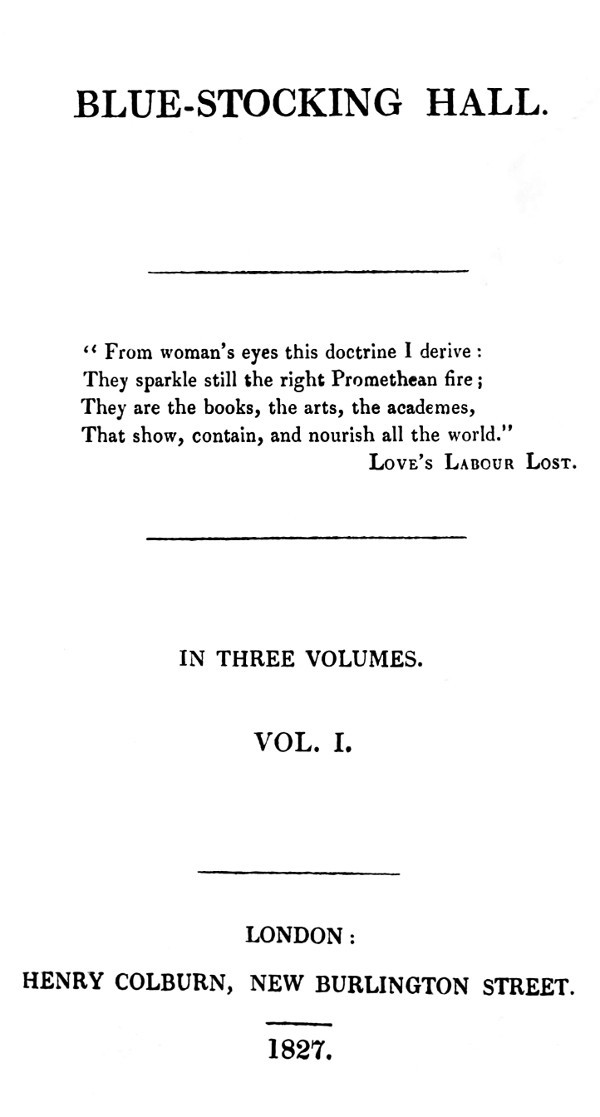
When the dessert was put upon the table, and the servants gone, we drew our chairs very snugly round a blazing billet, which the evenings are just chilly enough still to render as comfortable as it is a social sight; and just as we had formed a crescent about the fire, that sly-boots, little Fan, looking over at me, with the most innocent archness imaginable, made an appeal, for which I was not quite prepared, and addressing herself to Mr. Otway, suddenly asked him, "What is the meaning, dear Phil. of calling people Blue-stockings, whose stockings are really white?"
Mr. Otway smiled, and answered, "Blue-stockings, my Fan, is a vulgar slang for learned ladies."
"Why not for learned gentlemen too?" replied Fanny.
"That is more than I can tell you, unless for the reason, that those who have given this nickname to your sex, are of the other themselves, and there are not many men who like ridicule, when it is brought home."
"Then I am to understand that the appellation Blue Stocking implies a taunt."
"Certainly, a learned lady is the terror of all ignorant men, and to cover their own idleness, or incapacity, they never fail to under-value what they do not possess, particularly if they find knowledge and ability in those, whom, as females, they consider their inferiors; but you ought to apply to your cousin, who can give you the latest edition. I am an old square-toes you know, and words change their meaning every day. Howard, unde derivatur, modern Blue-stockings if you please?"
I felt a little awkwardly, but answered, "Mr. Stillingfleet, I believe, is the origin. At least his Blue-stockings at Mrs. Montagu's soirées are the only parentage that I have heard of for the term, and you have defined it."
"Well," said Fanny, "this is odd enough, for it appears that a gentleman wore the blue-stockings, which are transferred to the ladies; but now Phil. I want to know why learned ladies are disliked. I always thought that people were esteemed in proportion to their knowledge, if they made a right use of it."
"There," answered Mr. Otway, "you have yourself told the whole secret; if they make a right use of it. Now it has happened that some ladies have made a wrong use of their talents and attainments, and thus have drawn reproach upon the whole sex to which they appertain."
"What is this wrong use which which has been so heavily punished, may I enquire," interposed Charlotte, while my aunt, Emily, and Frederick, seemed quite delighted with this curious catechism.
"The word display, includes the whole charge," said Mr. Otway. "Some women have foolishly destroyed the ease of society by an unseasonable introduction of their acquirements, and a pedantic exhibition of the variety and extent of them in pompous expression, unsuited to mixed companies, and uncalled for by the occasion."
"But why visit the faults of a few on the whole sisterhood," interrupted Fanny, with eagerness, "Mr. Otway?"
"Because men are very uncandid in their judgments, and find it easier to get rid of a vexation by annihilating the cause, than by regulating the effects."
Emily here begged to know "whether men were never vain-glorious, and if they were, why they too were not nicknamed."
"In fact," said Mr. Otway, "dunces and fools hate in men, as well as women, whatever they cannot understand or appreciate; and the terms Bookworm, Philosopher, Quid-nunc, &c. are frequently employed to designate persons of superior erudition; but men are simply avoided as bores; women are contemned as rivals."
At this moment I chanced to look at Fanny, and saw a tear gliding down her cheek. In the instant of being observed, she started up, and throwing her affectionate arms around Mr. Otway's neck exclaimed, "Oh never, never, will I call you Phil. again, which is the short name with us for philosopher. Why did you not tell me before that it was a term of derision? I love you as our dear friend, and I thought it the most delightful thing possible, to know so much as you do, and to be so like the Encyclopedia as you are."
It was not in nature to resist this sally. We all laughed heartily, though I saw a responding tear glitter in my aunt's eye, and Mr. Otway impressing a parental kiss on Fanny's cheek, explained in a few words, assuring her that however he might feel undeserving of the title which she had bestowed upon him, yet, as being her gift, it was so valuable that he would not exchange the appellation of Phil. for the most beautiful name in the English language.
Fanny's gaiety was immediately restored, and as the conversation hit my fancy very much, I was glad that Mr. Otway resumed it by saying, "the reason why display of a little learning is not so common amongst men as women, is not that they are less subject to vanity than the latter, but because their vanity is differently directed. Learning being the business of all educated men, there is nothing on which to plume themselves in knowing a little Greek, Latin, and mathematics. Every school-boy does the same, and it is only pre-eminence in these studies which renders a man remarkable. Now real knowledge, extensive learning, and powerful intellect, of the highest class, preclude boasting for two reasons, first because I believe that it may be asserted of such minds, that they are most sensible to the great truths of religion, which, above all monitors with whose influence we are acquainted, inspires genuine humility; and secondly, because it is the nature of knowledge to render those who have made the greatest progress in its attainment most keenly alive to the deficiencies of all human intellect. 'A little learning is a dangerous thing,' and flippancy is ever the offspring of superficial information."
"Now unfortunately some of the female sex having just tasted of the Pierian springs, have become stimulated to intoxication, without proceeding to the sobering draught recommended by the poet. Then, as a woman's education does not usually comprehend either classical or scientific literature, a very slight proficiency in either will make a great shew, just as a solitary candle will do in a dark place; but there are silly people to be found in every country as of every age, and both sexes." "Pray then," said Emily, "would not the abuse of learning be remedied in a manner kind as well as efficient, by making knowledge fashionable, rather than by condemning half the creation to ignorance? If girls were generally allowed to acquire more information than it is customary to teach them, there would be an end of what you call blue-stockings, and women would not boast of a little reading any more than they do of drawing or music."
"You are perfectly right, Emily," answered Mr. Otway, "the best gifts may be abused, and the improper use of any good that we possess can never be considered as a sound argument for relinquishing it. Neither do men argue in this way when the question relates to money, power, rank, or any of those advantages which they desire to achieve. Now, my own opinion is, that much of the unhappiness of married life, as well as the insipidity of mixed society, results from the present style of female education. Accomplishments are ornamental, yet they are only the acanthus that decorates the pillar, not the pillar itself. The most empty mind, the worst regulated temper, may be the portion of a young lady who plays and sings like a professor, who draws and models, who can take casts, and sculpture marble. All these things, however pretty, occupy neither the highest nor the best powers of the human mind; and, generally speaking, they are pursuits which suppose exhibition. There are few who cultivate them on their own account; and thousands arrive at excellence in several branches of polite education without natural taste, merely to attain certain ends, and when they are compassed, the scaffolding is thrown aside altogether; the fingers are given a holyday, and the unfurnished understanding stands confessed in all its vacuity. If the vessel be not valuable from what it contains, it naturally follows that the external fashion will determine its estimation; and thus a short-lived grace comes to be the pearl of price; and when the bloom of youth is past, there is no fund to support the long evening of life. A sleepy animalized existence at home, or a perpetual search after excitement abroad, succeeds. Both sexes degenerate, society grows more vapid, and more vulgar, every day, till reduced to its coarse elements of mere sensual attraction, folly ends in vice, and things are worse and worse, till some new impetus arises to change the entire system. If companionship be the charm of social intercourse, why should not both sexes cultivate those qualities and attainments which, besides being most intrinsically excellent, promise durability?"
"Arthur," said my Aunt, "you must represent the world, and reply to Mr. Otway." "Well then, with deference to his opinion," said I, "let it be remembered that there is no necessary connection between the amiable qualities of heart which we admire in woman, and book knowledge. On the contrary, I should say that reading is a selfish pleasure; shut up in a library, surrounded by grammars and lexicons, people are not likely to improve their tempers half so much as in the endeavour to please by proficiency in music, dancing, drawing, sculpture, and all the list of elegant accomplishments which every mother in the fashionable world procures with the utmost anxiety for her daughters. In fact, the establishment of a girl who has no fortune, absolutely depends upon her power of attraction; and when you reflect that men seek society to unbend their thoughts, and to get rid of the studies, as well as the cares which oppress them in the several walks of busy occupation, whether in the field, or the closet, the senate, or the court, I cannot help feeling that matters are very happily adjusted in the division of labour, which the general sense of mankind has adopted, and that women have no business whatsoever with any thing but the agrémens of life, and should leave to us the whole toil of reading and thinking."
"Well I am sure," said Fanny, "the motive is so kind that the arrangement ought to be a good one. What do you think, Mamma?" "My love," answered her Mother, "I shall lie by and be a listener. The argument is in very good hands, and I shall keep my opinion in reserve, for a single combat with Arthur, when he is inclined 'to fight the battle o'er again.'"
"We will take Emily's judgment upon this question," said Mr. Otway: "Emily, what think you of the gallantry which Fanny conceives to be deserving of such praise?" "Indeed," ingenuously answered Emily, "a kind motive, I should say with Fan, is so sweet, that it inclines one to find fault with great moderation; but, however amiable the desire to save our sex all trouble, I must own that I do not at all admire the expedient, nor think that it seems to be a judicious one. Reading is a great pleasure to me, and if books were denied me, I should feel a void in my life which I do not believe it would be easy to fill; besides, the day is so long, if one rises early that I do not see why there should not be time for many things as well as music and drawing."
"Come, come," said Mr. Otway, "it is not generous to profit by the simplicity of our panegyrists. If the motive for denying, or, at least, grudging to women the advantages of a sound and a literary education, be analyzed, I fear that it will turn out but little creditable to our sex, and the proof that it is so, may rest on the circumstance that the cleverest and really best informed men are those who encourage female ambition to soar above the common standard. These men delight in superior talents, and cultivation wherever they find them. They are not afraid of rivalry, and their minds are too large to take pleasure in any supremacy which is produced by exclusion. The lazy, and the tyrannical, would fence in their privileges, and not permit to women a participation in what they choose to call their inherent rights; the former to save themselves the trouble of acquiring knowledge, and the latter because they would depress and enslave the sex to which they would allot no higher calling than that of administering to their amusement? Is not this a true bill?" I could not deny that there was some force in the statement, but urged the general voice as being considered the best criterion of what is good in itself, and then advanced the necessity of making some difference between two sets of beings destined to such dissimilar offices. "Men are born to action. They live in public, they preside in the councils of nations; they provide for the families that look up to them for protection; they labour in the field with their hands, and in the closet with their brains. When the toil of life is suspended, they desire relaxation, and to be gratified by the charms of beauty, grace, sweet music, and good manners."
"And these are all compatible with much higher and more dignified powers, and purposes," rejoined my antagonist. "Some writer, whose name I forget, has said, 'tell me your amusements, and I'll tell you what you are.' There is a great deal of wisdom in the idea, and it holds good in forming an estimate both of nations and individuals. The love of gain, the dread of poverty, desire of fame; in short, a thousand motives may, and do, constrain men to engage in pursuits which make the business of life. A set of shoemakers, or a privy council, merely as such, are brought to a level with each other, the one party as tradesmen, the other as ministers, and the only difference that we perceive in contemplating the body, in either case, resides in the superior or inferior skill of the workman or the statesman, compared with his fellows; but when the low occupation of the one, or the high employment of the other, is brought to its close, and the man retires from his labours to unbend in the enjoyment of the social hour, it is then that we find of what materials he is made."
"We will suppose first of the humble artizan, that one takes the fruit of his toil to the public-house, where it is spent in company with the idle and the vicious; that from thence he proceeds to the pugilistic ring, and gambles away the remainder of his earnings, while his mind is brutalized by the nature of the sport, and his wife and children are left to starve. Here you have no hesitation in condemning such an appropriation of time and money; nor do I believe that you would find any greater difficulty in bestowing your praise upon the industrious father who, gathering his children round the evening fire, can participate with the goodly partner of his cares in the task of rearing a young family to virtuous principles and prudent habits as his best happiness. Trust me, my young friend, that in the higher classes of society we may trace as much variety of character as in the humbler walks; and vice is both as vulgar, and unholy, when varnished over by fashion, as it is in those situations that present its deformity to view unveiled by the gloss of rank and fortune. Why should recreation be found only in the inanity of sloth, or the stimulus of dissipation? Is such recreation worthy of a rational creature? I do not mean to say that music and merriment are not very agreeable, but are these less pleasing because they are not the sole resources? Here are my dear little nurses, whose kindness during a long and painful illness I shall never forget. Do you think that I dreaded poison in my cup, because Emily can translate Lucian, and Charlotte is not perplexed by a quotation from Virgil?"
"Pray, pray, dear Phil." exclaimed Fanny, "say nothing about Greek and Latin, lest Arthur, adopting the language of fashion, should call the peaceable inhabitants of Glenalta, Blue-stockings." "Indeed but I will," quoth Phil. "and, as I design to enlist Howard as the champion of his cousins, I think it fair to tell him all that he will have to defend."
Here was a pretty loop-hole for a civil speech, such as I did not neglect, but declared my readiness to enter the lists, provided that I was not to be considered a Don Quixote, prepared cap-à-pé, to fight the battles of every distressed Blue, who might chance to be attacked by an uncourteous enemy. "But, my good Sir," said I, "since we have gone so far in this discussion, let me soberly and seriously ask what is the use of learning in a woman? Is she handsomer, more lively, more attractive, for having her head crammed with strange languages? If I am to be a champion, I must begin my service by what may appear perhaps rather ungallant, though I hope that the present company will acquit me of any design to do otherwise than afford my best service, provided that you succeed in converting me from opinions which I have been brought up in a belief are founded in nature and good sense."
"My dear fellow," replied Mr. Otway, "do not profane the names of nature and good sense by identifying the one or the other with fashion. I would appeal to your understanding, and if that is not convinced of error, I would leave you to the prejudices which you have imbibed. Let us then now fairly meet each other. You ask, will women be made more beautiful, more lively, more attractive, by being more instructed? Perhaps I may encounter a laugh, if I answer yes; first, I always consider intelligence as the greatest beautifier of a face, which, if handsome, is lit up by an additional ray in every new exercise of the mental powers; and if ugly is at least prevented from being stupid by cultivation. But this will not satisfy you, because I assume the very thing that you deny; so I will ask you, have men a right to consider women as objects merely of gratification to their eyes and ears? Are not women endowed with sense and feeling; with high powers of intellectual energy, and immortal spirits like men? Were these gifts, think you, conferred for nothing but to be employed in the arts of catching butterflies? No, no—