
CHAPTER II
THE GENERAL ORGANIZATION OF THE VISCERAL NERVES CONCERNED IN EMOTIONS
The structures of the alimentary canal which are brought into activity during the satisfactions of appetite or are checked in their activity during pain and emotional excitement are either the secreting digestive glands or the smooth muscle which surrounds the canal. Both the gland cells and the smooth-muscle cells differ from other cells which are subject to nervous influence—those of striated, or skeletal, muscle—in not being directly under voluntary control and in being slower in their response. The muscle connected with the skeleton responds to stimulation within two or three thousandths of a second; the delay with gland cells and with smooth muscle is more likely to be measured in seconds than in fractions of a second.
The Outlying Neurones
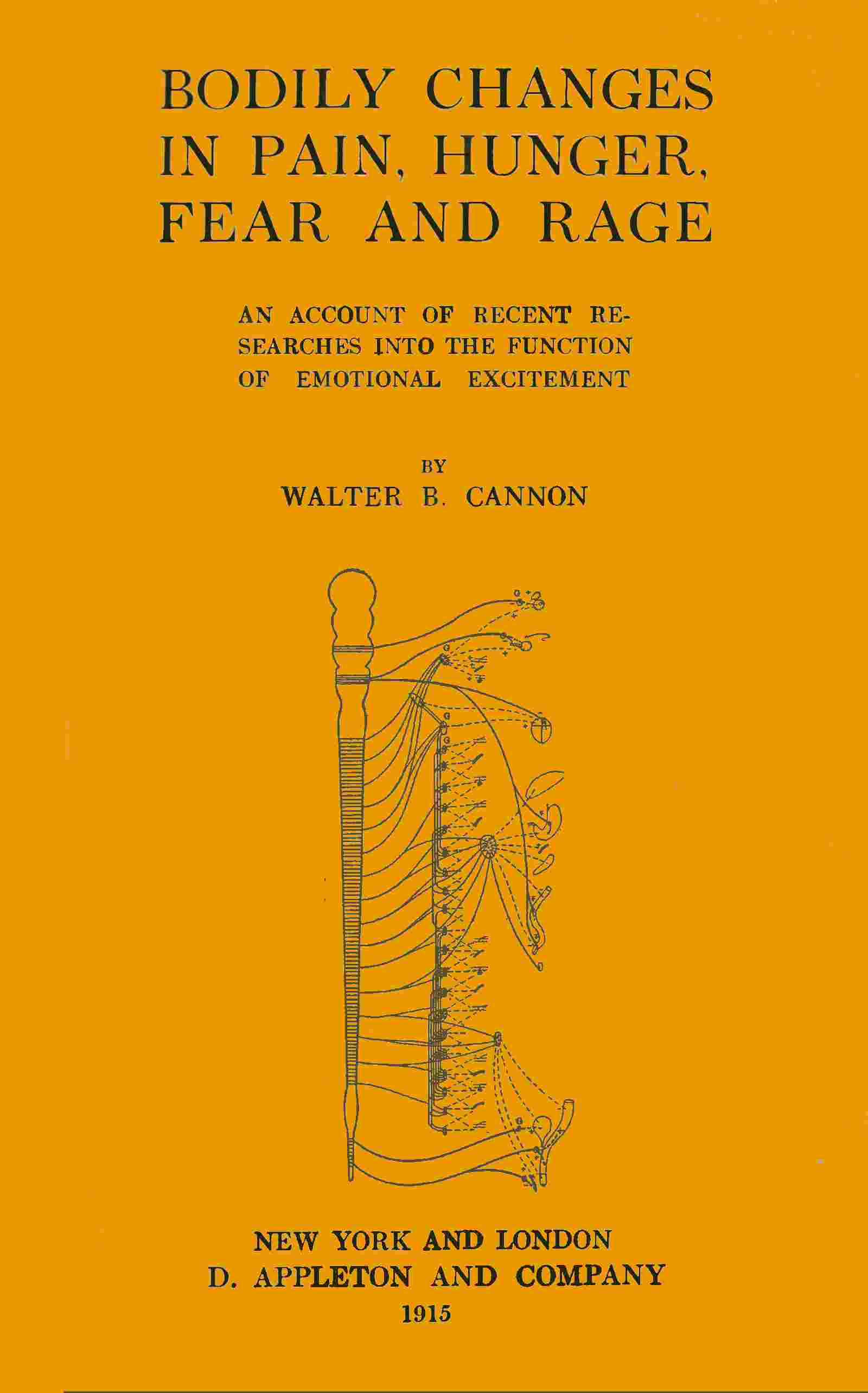
The skeletal muscles receive their nerve supply direct from the central nervous system, i. e., the nerve fibres distributed to these muscles are parts of neurones whose cell bodies lie within the brain or spinal cord. The glands and smooth muscles of the viscera, on the contrary, are, so far as is now known, never innervated directly from the central nervous system.[*] The neurones reaching out from the brain or spinal cord never come into immediate relation with the gland or smooth-muscle cells; there are always interposed between the cerebrospinal neurones and the viscera extra neurones whose bodies and processes lie wholly outside the central nervous system. They are represented in dotted lines in Fig. 1. I have suggested that possibly these outlying neurones act as “transformers,” modifying the impulses received from the central source (impulses suited to call forth the quick responses of skeletal muscle), and adapting these impulses to the peculiar, more slowly-acting tissues, the secreting cells and visceral muscle, to which they are distributed.[1]
*The special case of the adrenal glands will be considered later.
The outlying neurones typically have their cell bodies grouped in ganglia (G’s, Fig. 1) which, in the trunk region, lie along either side of the spinal cord and in the head region and in the pelvic part of the abdominal cavity are disposed near the organs which the neurones supply. In some instances these neurones lie wholly within the structure which they innervate (see e. g., the heart and the stomach, Fig. 1). In other instances the fibres passing out from the ganglia—the so-called “postganglionic fibres”—may traverse long distances before reaching their destination. The innervation of blood vessels in the foot by neurones whose cell bodies are in the lower trunk region is an example of this extensive distribution of the fibres.
The Three Divisions of the Outlying Neurones
As suggested above, the outlying neurones are connected with the brain and spinal cord by neurones whose cell bodies lie within the central nervous organs. These connecting neurones, represented in continuous lines in Fig. 1, do not pass out in a continuous series all along the cerebrospinal axis. Where the nerves pass out from the spinal cord to the fore and hind limbs, fibres are not given off to the ganglia. Thus these connecting or “preganglionic” fibres are separated into three divisions. In front of the nerve roots for the fore limbs is the head or cranial division, between the nerve roots for the fore limbs and those for the hind limbs is the trunk division (or thoracico-lumbar division, or, in the older terminology, the “sympathetic system”); and after the nerve roots for the hind limbs the sacral division.
This system of outlying neurones, with postganglionic fibres innervating the viscera, and with preganglionic fibres reaching out to them from the cerebrospinal system, has been called by Langley, to whom we are indebted for most of our knowledge of its organization, the autonomic nervous system.[2] This term indicates that the structures which the system supplies are not subject to voluntary control, but operate to a large degree independently. As we have seen, a highly potent mode of influencing these structures is through conditions of pain and emotional excitement. The parts of the autonomic system—the cranial, the sympathetic, and the sacral—have a number of peculiarities which are of prime importance in accounting for the bodily manifestations of such affective states.
The Extensive Distribution of Neurones of the “Sympathetic” Division and Their Arrangement for Diffuse Action
The fibres of the sympathetic division differ from those of the other two divisions in being distributed through the body very widely. They go to the eyes, causing dilation of the pupils. They go to the heart and, when stimulated, they cause it to beat rapidly. They carry impulses to arteries and arterioles of the skin, the abdominal viscera, and other parts, keeping the smooth muscles of the vessel walls in a state of slight contraction or tone, and thus serving to maintain an arterial pressure sufficiently high to meet sudden demands in any special region; or, in times of special discharge of impulses, to increase the tone and thus also the arterial pressure. They are distributed extensively to the smooth muscle attached to the hairs; and when they cause this muscle to contract, the hairs are erected. They go to sweat glands, causing the outpouring of sweat. These fibres pass also to the entire length of the gastro-intestinal canal. And the inhibition of digestive activity which, as we have learned, occurs in pain and emotional states, is due to impulses which are conducted outward by the splanchnic nerves—the preganglionic fibres that reach to the great ganglia in the upper abdomen (see Fig. 1)—and thence are spread by postganglionic fibres all along the gut.[3] They innervate likewise the genito-urinary tracts, causing contraction of the smooth muscle of the internal genital organs, and usually relaxation of the bladder. Finally they affect the liver, releasing the storage of material there in a manner which may be of great service to the body in time of need. The extensiveness of the distribution of the fibres of the sympathetic division is one of its most prominent characteristics.
Another typical feature of the sympathetic division is an arrangement of neurones for diffuse discharge of the nerve impulses. As shown diagrammatically in Fig. 1, the preganglionic fibres from the central nervous system may extend through several of the sympathetic ganglia and give off in each of them connections to cell bodies of the outlying neurones. Although the neurones which transmit sensory impulses from the skin into spinal cord have similar relations to nerve cells lying at different levels of the cord, the operation in the two cases is quite different. In the spinal cord the sensory impulse produces directed and closely limited effects, as, for example, when reflexes are being evoked in a “spinal” animal (i. e., an animal with the spinal cord isolated from the rest of the central nervous system), the left hind limb is nicely lifted, in response to a harmful stimulus applied to the left foot, without widespread marked involvement of the rest of the body in the response.[4] In the action of the sympathetic division, on the contrary, the connection of single preganglionic fibres with numerous outlying neurones seems to be not at all arranged for specific effects in this or that particular region. There are, to be sure, in different circumstances variations in the degree of activity of different parts; for example, it is probable that dilation of the pupil in the cat occurs more readily than erection of the hairs. It may be in this instance, however, that specially direct pathways to the eye are present for common use in non-emotional states (in dim light, e. g.), and that only slight general disturbance in the central nervous system, therefore, would be necessary to send impulses by these well-worn courses. Thus for local reasons (dust, e. g.) tears might flow from excitation of the tear glands by sympathetic impulses, although other parts innervated by this same division might be but little disturbed. We have no means of voluntarily wearing these pathways, however, and both from anatomical and physiological evidence the neurone relations in the sympathetic division of the autonomic system seem devised for widespread diffusion of nervous impulses.
The Arrangement of Neurones of the Cranial and Sacral Divisions for Specific Action
The cranial and sacral autonomic divisions differ from the sympathetic in having only restricted distribution (see Fig. 1). The third cranial nerves deliver impulses from the brain to ganglia in which lie the cell bodies of neurones innervating smooth muscle only in the front of the eyes. The vagus nerves are distributed to the lungs, heart, stomach, and small intestine. As shown diagrammatically in Fig. 1, the outlying neurones in the last three of these organs lie within the organs themselves. By this arrangement, although the preganglionic fibres of the vagi are extended in various directions to structures of quite diverse functions, singleness and separateness of connection of the peripheral organs with the central nervous system is assured. The same specific relation between efferent fibres and the viscera is seen in the sacral autonomic. In this division the preganglionic fibres pass out from the spinal cord to ganglia lying in close proximity to the distal colon, the bladder, and the external genitals. And the postganglionic fibres deliver the nerve impulses only to the nearby organs. Besides these innervations the cranial and sacral divisions supply individual arteries with “dilator nerves”—nerves causing relaxation of the particular vessels. Quite typically, therefore, the efferent fibres of the two terminal divisions of the autonomic differ from those of the mid-division in having few of the distributed connections characteristic of the mid-division, and in innervating distinctively the organs to which they are distributed. The cranial and sacral preganglionic fibres resemble thus the nerves to skeletal muscles, and their arrangement provides similar possibilities of specific and separate action in any part, without action in other parts.
The Cranial Division a Conserver of Bodily Resources
The cranial autonomic, represented by the vagus nerves, is the part of the visceral nervous system concerned in the psychic secretion of the gastric juice. Pawlow showed that when these nerves are severed psychic secretion is abolished. The cranial nerves to the salivary glands are similarly the agents for psychic secretion in these organs, and are known to cause also dilation of the arteries supplying the glands, so that during activity the glands receive a more abundant flow of blood. As previously stated (see p. 13), the evidence for a psychic tonus of the gastro-intestinal musculature rests on a failure of the normal contractions if the vagi are severed before food is taken, in contrast to the continuance of the contractions if the nerves are severed just afterwards. The vagi artificially excited are well known as stimulators of increased tone in the smooth muscle of the alimentary canal. Aside from these positive effects on the muscles of the digestive tract and its accessory glands, cranial autonomic fibres cause contraction of the pupil of the eye, and slowing of the heart rate.
A glance at these various functions of the cranial division reveals at once that they serve for bodily conservation. By narrowing the pupil of the eye they shield the retina from excessive light. By slowing the heart rate, they give the cardiac muscle longer periods for rest and invigoration. And by providing for the flow of saliva and gastric juice and by supplying the muscular tone necessary for contraction of the alimentary canal, they prove fundamentally essential to the processes of proper digestion and absorption by which energy-yielding material is taken into the body and stored. To the cranial division of the visceral nerves, therefore, belongs the quiet service of building up reserves and fortifying the body against times of need or stress.
The Sacral Division a Group of Mechanisms for Emptying
Sacral autonomic fibres cause contraction of the rectum and distal colon and also contraction of the bladder. In both instances the effects result reflexly from stretching of the tonically contracted viscera by their accumulating contents. No affective states precede this normal action of the sacral division and even those which accompany or follow are only mildly positive; a feeling of relief rather than of elation usually attends the completion of the act of defecation or micturition—though there is testimony to the contrary.
The sacral autonomic fibres also include, however, the nervi erigentes which bring about engorgement of erectile tissue in the external genitals. According to Langley and Anderson[5] the sacral nerves have no effect on the internal generative organs. The vasa deferentia and the seminal vesicles whose rhythmic contractions mark the acme of sexual excitement in the male, and the uterus whose contractions in the female are probably analogous, are supplied only by lumbar branches—part of the sympathetic division. These branches also act in opposition to the nervi erigentes and cause constriction of the blood vessels of the external genitals. The sexual orgasm involves a high degree of emotional excitement; but it can be rightly considered as essentially a reflex mechanism; and, again in this instance, distention of tubules, vesicles, and blood vessels can be found at the beginning of the incident, and relief from this distention at the end.
Although distention is the commonest occasion for bringing the sacral division into activity it is not the only occasion. Great emotion, such as is accompanied by nervous discharges via the sympathetic division, may also be accompanied by discharges via the sacral fibres. The involuntary voiding of the bladder and lower gut at times of violent mental stress is well known. Veterans of wars testify that just before the beginning of a battle many of the men have to retire temporarily from the firing line. And the power of sights and smells and libidinous thoughts to disturb the regions controlled by the nervi erigentes proves that this part of the autonomic system also has its peculiar affective states. The fact that one part of the sacral division, e. g., the distribution to the bladder, may be in abeyance, while another part, e. g., the distribution to the rectum, is active, illustrates again the directive discharge of impulses which has been previously described as characteristic of the cranial and sacral portions of the autonomic system.
Like the cranial division, the sacral is engaged in internal service to the body, in the performance of acts leading immediately to greater comfort.
The Sympathetic Division Antagonistic To Both The Cranial and the Sacral
As indicated in the foregoing description many of the viscera are innervated both by the cranial or sacral part of the autonomic and by the sympathetic. When the mid-part meets either end-part in any viscus their effects are antagonistic. Thus the cranial supply to the eye contracts the pupil, the sympathetic dilates it; the cranial slows the heart, the sympathetic accelerates it; the sacral contracts the lower part of the large intestine, the sympathetic relaxes it; the sacral relaxes the exit from the bladder, the sympathetic contracts it. These opposed effects are indicated in Fig. 1 by + for contraction, acceleration or increased tone; and by - for inhibition, relaxation, or decreased tone.[*]
* The vagus nerve, when artificially stimulated, has a primary, brief inhibitory effect on the stomach and small intestine; its main function, however, as already stated, is to produce increased tone and contraction in these organs. This double action of the vagus is marked thus, ∓, in Fig. 1.
Sherrington has demonstrated that the setting of skeletal muscles in opposed groups about a joint or system of joints—as in flexors and extensors—is associated with an internal organization of the central nervous system that provides for relaxation of one group of the opposed muscles when the other group is made to contract. This “reciprocal innervation of antagonistic muscles,” as Sherrington has called it,[6] is thus a device for orderly action in the body. As the above description has shown, there are peripheral oppositions in the viscera corresponding to the oppositions between flexor and extensor muscles. In all probability these opposed innervations of the viscera have counterparts in the organization of neurones in the central nervous system. Sherrington has noticed, and I can confirm the observation, that even though the sympathetic supply to the eye is severed and is therefore incapable of causing dilation of the pupil, nevertheless the pupil dilates in a paroxysm of anger—due, no doubt (because the response is too rapid to be mediated by the blood stream), to central inhibition of the cranial nerve supply to the constrictor muscles—i. e., an inhibition of the muscles which naturally oppose the dilator action of the sympathetic. Pain, the major emotions—fear and rage—and also intense excitement, are manifested in the activities of the sympathetic division. When in these states impulses rush out over the neurones of this division they produce all the changes typical of sympathetic excitation, such as dilating the pupils, inhibiting digestion, causing pallor, accelerating the heart, and various other well-known effects. The impulses of the sympathetic neurones, as indicated by their dominance over the digestive process, are capable of readily overwhelming the conditions established by neurones of the cranial division of the autonomic system.
Neurones of the Sympathetic Division and Adrenal Secretion Have the Same Action
Lying anterior to each kidney is a small body—the adrenal gland. It is composed of an external portion or cortex, and a central portion or medulla. From the medulla can be extracted a substance, called variously suprarenin, adrenin, epinephrin or “adrenalin,”[*] which, in extraordinarily minute amounts, affects the structures innervated by the sympathetic division of the autonomic system precisely as if they were receiving nervous impulses. For example, when adrenin is injected into the blood, it will cause pupils to dilate, hairs to stand erect, blood vessels to be constricted, the activities of the alimentary canal to be inhibited, and sugar to be liberated from the liver. These effects are not produced by action of the substance on the central nervous system, but by direct action on the organ itself.[7] And the effects occur even after the structures have been removed from the body and kept alive artificially.
* The name “adrenalin” is proprietary. “Epinephrin” and “adrenin” have been suggested as terms free from commercial suggestions. As adrenin is shorter and more clearly related to the common adjectival form, adrenal, I have followed Schäfer in using adrenin to designate the substance produced physiologically by the adrenal glands.
The adrenals are glands of internal secretion, i. e., like the thyroid, parathyroid, and pituitary glands, for example; they have no connection with the surface of the body, and they give out into the blood the material which they elaborate. The blood is carried away from each of them by the lumbo-adrenal vein which empties either into the renal vein or directly into the inferior vena cava just anterior to the openings of the renal veins. The adrenal glands are supplied by preganglionic fibres of the autonomic group,[8] shown in solid line in Fig. 1. This seems an exception to the general rule that gland cells have an outlying neurone between them and the neurones of the central nervous system. The medulla of the adrenal gland, however, is composed of modified nerve cells, and may therefore be regarded as offering exceptional conditions.
The foregoing brief sketch of the organization of the autonomic system brings out a number of points that should be of importance as bearing on the nature of the emotions which manifest themselves in the operations of this system. Thus it is highly probable that the sympathetic division, because arranged for diffuse discharge, is likely to be brought into activity as a whole, whereas the sacral and cranial divisions, arranged for particular action on separate organs, may operate in parts. Also, because antagonisms exist between the middle and either end division of the autonomic, affective states may be classified according to their expression in the middle or an end division and these states would be, like the nerves, antagonistic in character. And finally, since the adrenal glands are innervated by autonomic fibres of the mid-division, and since adrenal secretion stimulates the same activities that are stimulated nervously by this division, it is possible that disturbances in the realm of the sympathetic, although initiated by nervous discharge, are automatically augmented and prolonged through chemical effects of the adrenal secretion.
REFERENCES
1 Cannon: The American Journal of Psychology, 1914, xxv, p. 257.
2 For a summary of his studies of the organization of the autonomic system, see Langley: Ergebnisse der Physiologie, Wiesbaden, 1903, ii2, p. 818.
3 See Cannon: American Journal of Physiology, 1905, xiii, p. xxii.
4 See Sherrington: The Integrative Action of the Nervous System, New York, 1909, p. 19.
5 Langley and Anderson: Journal of Physiology, 1895, xix, see pp. 85, 122.
6 Sherrington: Loc. cit., p. 90.
7 Elliott: Journal of Physiology, 1905, xxxii, p. 426.
8 See Elliott: Journal of Physiology, 1913, xlvi, p. 289 ff.