
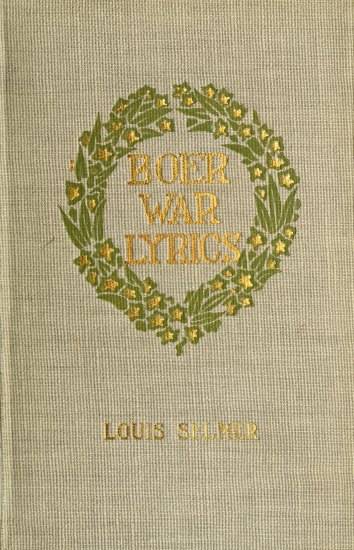
The Project Gutenberg eBook of Boer War Lyrics
Title: Boer War Lyrics
Author: Louis Selmer
Release date: January 10, 2014 [eBook #44641]
Most recently updated: October 23, 2024
Language: English
Credits: Produced by Charlene Taylor, Chuck Greif and the Online
Distributed Proofreading Team at http://www.pgdp.net
BOER WAR LYRICS
BY
LOUIS SELMER
THE
PUBLISHERS
114
FIFTH AVENUE
London
NEW YORK
Montreal
CONTENTS.
PREFACE.
MOST of the verses in this little volume were conceived and written, if not quite finished, at the time of Cronje’s surrender at Paardeberg.
A certain doubt, however, as to any message of theirs, though modestly set off by a belief in their polemic and literary value, has, I think now, unduly delayed their advent into the crowded world of print; and, though the present juncture of a heralded, but, by no means, perfected peace, be perhaps not a very opportune moment for their publication, I have yet thought well to give them forth; the more, since what so be the outcome of the negotiations pending, and whichsoever be the motive of the stronger party thereto—whether a bitter, though slowly realized necessity, or, a trick of pure heart, or, say, tardy insight and charity, both—be this as it may—the long, though fruitless attempt on England’s part to compel a surrender by the South African republics of their political existence, illustrating and upholding, as no modern exhibition of this kind has done, how rampant is still in Man, and collective Man especially, a tacit faith in the bigger fist, or, euphemistically speaking, the predatory law of nature—this, I repeat it, can never, it seems to me, be sufficiently reprehended; and a hearty condemnation of it may, therefore, fitly form the theme of conscientious, if necessarily, censorious verse: with which contention the following pieces are frankly submitted, even at this late day of a stupendous struggle of moral Right—whatsoever its intellectual grounds and equipment—against an aggressive and overweening Might, whose partial defence allowed, rests, after all, and as already maintained, its wider base on purely material force, on that callous and objective expediency, which History, in her account of human odds, evermore reveals, and, far too often, glaringly condones.
New York, May, 1902.
Since the above was set down, Peace has at last gone forth, and of a pace with the better drift and traditions of England; but even so, there seems no valid ground why these Lyrics should not be heard, as an exponent in brief—inadequate, if you like, yet human no less—of a, for a long time, not to be forgotten broil, if, indeed, the sad imp of Contention has had his last say about it.
November, 1902.
PRELUDE.
Primer than thought-spring founts,
Upward, ’gainst vaster knowing,
Lightsome the Song-word mounts.
From Being’s deep-violed strings,
Draweth, to heaves that burn,
The advent and sooth of things.
The Spirit’s immutable law.
BOER WAR LYRICS.
ON THE TRAIL OF THE LION.
(History in Verse.)
INTRODUCTION.
A span or two to Eastward, then Southward by a streak,
Was heard to blare of tomtom a shameless epic wail,
At fancy of some Lion who had whisked his blooming tail
Plumb thro’ a nest of hornets, nor never dreamt the hive
Had such a trick to mind him how were that tail alive.
And it seems the skies were blathering while every wind-god swore
The Pities would have curdled to hear the Beastie roar.
All offered salve and comfort, said never done was Wrong,
But some requiting Themis should venge it to her song;
Should smite the pesting dwarfies and heal the giant’s bruise,
See paw and toothie peak not for lack of worthy use.
And, O, the strain fell whopping to thunder—drip of sooth,
A lamb-like lyric slopping its pace with bleary ruth;
Nay, in sober last, an epic, outworking thro’ the fact,
Through blaze of hostile numbers, its own and bitter act.
And it shook us to the Westward—a touch of kin and near—
We banged our shoppy hatches: we had a right to hear.
Which Father Wicked, the Old, for his child, the New,
He, and that cherub of rowdy fist,
Who’ll blithely shake it where erst he kissed—
That covered Holy, the unctuous Wrong—
With his blushing bouncer, St. Meek, the Strong;
Set jointly down (while in crafty doubt
A wilful Muse turned it inside out,
Bared hide and heart of the stalking lore,
Its bluff and cant to their dismal core—)
Set down, I say, to mock-halcyon cheers,
As, with knife at throat of the suckling years,
They bled the weans, lest with peaceful bear,
Or, for other virtues in hiding there,
The gods, who winnow all mortal stock,
Should nurse the goats while they weed the flock—
Let for lack of pasture the true herd pine:
And all for what? For a humping quibble on Mine and Thine!
Nay, lest Rue, the babbler, with saucy dare,
Should sit in judgment twixt Foul and Fair;
Should slaver worse, if she came of age,
With inglorious snivel wise Clio’s page:
Lest all of this, with what sousing tact
They niced her the diverse of whim and fact;
How glowed their zeal as they raked the Rue,
Broke font and tablet and put her through
Such drench of penance and convert-course,
Such Christian baptism from Truth, the Source:
Sure text nor ritual made never doubt,
Nor seasoned clerks, as with wary snout,
Each subtle wealsman stood sly at bay:
For leet or laurel—let wise Time say.
* * * * * * *
Well—this was the Song of the Sorrowful True:
A rip of a Muse—but it gives her view.
Curt and clear tho’, did the touches fall,
Such pithy halves as outspeak the Whole:
Are you with me still? Can you check a flout?
Then stretch a will to hear it out?
(Hour before Dawn—The Muse brooding.)
As if grim Darkness ’pon herself had bred,
To make a second and a direr gloom?
What wrestles so the advent of the Light,
Whence from yon paths the white stars tread
Should visioned peer its orient bloom?
Then urge anew against the serried Dark,
At such beseech, their silent suit?
What muttered rolls half-halting cleave
These omened airs that still hang stark,
As big with what they dare not bruit?
The eager Light. Lo, Day saddles the white Dawn,
At heel his troop, close-wheeling, spurs,
Unto his banner world-wide thrown,
Each waft, his way. Close Night unhoods;
No more beneath her grim gaze shrinks,
But featured fair, in tribute ruds
Each nether thing, and lifesome drinks.
Dim-figured tho’, what grim play breeds?
Troy’s second act? Where Hector stout, some Thetis’ son,
The deadly phalanx girds and leads?
With strumpet’s lure this sore divide?
For lo, her brow, to venal brand,
Reads fierce with lust of worldly pride!
What things o’ Night do rouse for prey,
Confound with grim and loathsome reek
The balmy breath of youngling Day?
Why drags white Peace yon gory pall?
I see great Mars in flame-knit mail,
I hear the fierce god’s buglers call.
War’s every hound is red at mouth,
No belching throat but havoc cries,
Would drench in blood the Summer’s drought.
These clamors wind no human breath,
But ghostly haunt yon winsome light
The phantom shades of legioned Death.
The Land re-speaks him, and his glass, the sea;
All tongues at one, no witness stays,
But owns his line observantly.
Behind, before, Light’s lofty welcome burns,
Whose cheer wide-spread for Most and Least,
Repledged, alone, his host-call earns.
They spill the sweet and lifesome wine;
They fool the sense with sightless greed,
The knife their law twixt yours and mine.
And those have rid the hurly sea,
Whence towering fair great Albion stands,
His brow writ broad with Liberty;
The gracious board whose never mess
Lets these to pine, so those may cloy
And glut his maw, the Hog, Excess—
Here may her buckler rusting hang,
Where, still at beat, thro’ throbbing yores,
Oppression’s slave-blows dying rang.
As if each patient light stood mute,
May ripping talons deal the Dove
This branding scan—a prostitute!
Whose fires feed the Piaerian Spring,
If Truth for right to scoff at Wrong,
In thy fair flame a gall-nut fling!
But where is the banneret of the Free?
What fouling touch of harpy hands
Has smirched his shield and panoply?
What gross embrace for Freedom’s kiss:
These are the sheets of Abbadon,
The bastard clasp high Furies hiss!
As Phœbus spans twixt East and West?
His, not the haunts thy fortune trode,
Right burly tho’, an honored guest?
The plainer house thy Brother built—
This text deem, foolish, out of shot:
“That Have, for greed, shall sure be spilt?”
“Who dons the Might, but leaves her crown,
Shall stand her dupe; nay, all his wear
Shall never hide the thievish clown.”
With mortal sense for needful prog;
But this?—here any scab had led the hound,
Had smelt foul fare the noseless hog!
Their bosom’s rank with self-sick stuff—
The Devil’s shufflers when he goads
And packs with Nice the Ne’er Enough—
Who knows how deep sits sordid lust;
How near all power lies to will,
Our wills to the damned Unjust.
Or under-helmsman to that crew
Who at no faith-breach blush to stick,
So but their grist come safely through;
Quite out of mind his Elder’s lease,
And for a brief from fame-fee’d days,
Would wash his hands in bleeding peace.
The brazen, roystering, gingo-sheet,
Who serves his vomit tricked with nard,
Thro’ flattering brag, the bloodfiend’s heat.
To tearing wolves in shepherd’s cowls,
Then to his sore heart lays this stupe—
That there were innings to the howls—
Look down, proud pile, at thine own feet!
Do not, thro’ knell, the ages sing
How tainted base, the top-strong seat
And blaze this line on Story’s page—
That Fill thro’ Foul may never dam,
Or check the course her Vengers wage.
With tempered glow each brutish fire,
Shall lack of pith to fame the True,
Unlaureled stand before the Sire.
For bounden due and bitter scan;
The compt and trust he shrank to fill,
To bate the sum of answering Man.
Be sick awhile with honest doubt!
Best heart still doffs to wholesome Fear:
Revise thy list—leave spongers out!
“Thou bits’t a stiff and rough-back mare,
Unblest, unbroke to right obey,
Lest as she catch the trumpet’s flare.”
Each fisty Brave that wearies Time,
Who ’ld headlong rush the brazen yoke,
Than share a pace, so all may climb.
Thy nicer o’er thy nobler star
Than bring to eye what tho’ it blur,
Yet, warning, sheens the misty Far.
There is sore push for forward seats:
We quake at taunts from ride-hard Thrift,
Then late her pace with churlish heats—
This paltry shift of truckling breed,
That veering Trade or waning marts—
All drift that swerves with human need—
With crafty lead, its artless youth,
While Just, a bawd to brazen Right,
New bastards bear the groaning Truth.
Past years as yet scarce out o’ moulds:
You, from your near-illumined Book,
I—whence no home-trick holds.
Since at its head War whets his sword,
While Justice puts her ægis by,
And eats his brag and bully’s word—
What glamored fierce the bridging sea,
Each flary crest at push to tell
How the white stones shone in Kimberley—
And juggled Right with wheedling Wrong;
Gave Cant new stand—this privilege:
To rest all cause on proof of Strong.
The hush you paid to still a twinge,
All snugged within this lofty view—
“He steers the moke who holds the cinch.”
Might sleep, kept not this line awake—
“That meddling pasts, ne’er done, somehow,
Assess for quits all present stake.”
The yellow Devil in the Rand,
As Dame Empire, O, so high suave,
Took bleary Mammon by the hand—
And scan o’ map and leer of eye:
“How came our wits so wide of this—
It lay so near and tempting by?”
For catch is life to brotherhood;
Each tribesman bent, thro’ clean or draff,
To swing his carp from out the mud.
As sure it ought, where sleek and trim,
At scoop and dive for wriggling gold,
The big Mouths join and steer the Swim.
As fadged with tooth of safer breed,
Smug Power yet found crumbs to fry,
While sampling Chefs gave dainty heed.
The Home-cook swore the stuff was fine:
“Why should such plums be ladled out
To grunting clod and boorish swine?”
This crowd at board keeps coming still:
Suppose we shift, à son insu,
To nab his joint, and eke the bill?
Put such a sauce in broth and dish—
Such plausive snap and tang o’ True—
That none shall dream we came to fish;
Till, less in doubt each lode-star gaze,
At Heaven’s clear, tho’ mute intent,
By as we head, to hold her pace.
To take a word from wiser mouths,
Who has stretched his crib and smoky roof
Whence North-from, down, the zone-line souths;
A scare at top, a threat, below;
An ugly tuck that scrimps the bag
We meant to fill as harvests grow.
Were it not that craft o’ his pert make
With too much head have come to grief,
Strew bottom up our rushing wake.
But no. That strains a bit the proper zest:
He shall have due of grounds and house,
We’ll dish for him as for the rest.
Till, on a breath, he vent his stare:
‘Such doors as these had best be tried,
Ere back to thatch and homely fare.’
What does he care who carves the meat?
So fill of fodder strew the bin,
Who rules the loft, or heads the treat?
Give simple ‘rob’ a double sense;
But loyal strain shall well accord
With leave of thrift and competence.
The sleek slut, Trade, trots close at heel,
’Gainst whose hard sense how fares the saw,
The musty fib—‘Thou shalt not steal!’
Till lust of Have like gospel read,
And his backbone in the general spine
Does merge its hump and dogged breed.
To shield his hearth with freehold fence,
And rather wear the homely wove
Than rig to suit our lofty sense.
The foot he plants ’gainst sudden New,
Whose golden tilth and reap of grace
Holds furrowed snug the only True.
For simple lambs. His wolfish doubt,
When, stung and wrung with sore his cares,
They flocked to help friend Hodges out—
And warped his truth with keen despair,
That the large rights for which he chored
Should never greet a lineal heir.
His blood paid down for desert lands,
Should snap its lease, be lightly set
A hawker’s trust in stranger hands—
Cribbed-in this band of saintly Peace;
Played wary host to all their trove,
Made yare go ’round the golden fleece—
Who, fearing thieves, would chance no charm,
But gag the spoiler ’fore he grew
To oust their rights with legal arm.
To size him up, then pare him down,
Till, as to cure the treatment grows,
We snug him hale within the Crown.
And dapper fit to lofty plan
He’ll soon see clear thro’ his amaze,
With contrite heart—the leal man.
With social wash to status brought
His lowly breed and rustic sweat:
O, God of Thrift! What happy thought!”
* * * * * * * *
When hard upon this longish muse,
Which, if it fail of absolute mold,
Is yet what, at a close peruse,
A muddled act does broadly hold—
That pious child, the hungry League
Was christened snug and gospeled through,
Anoint with salve of high intrigue;
Who gripped at throat the better hope
While Right, with due, past caution rang
How every neck was worth a rope.
“Since Neighbor Near seem Neighbor Pike,
’Twere time small fry made fast the house,
Girt fence and gate with double spike.”
* * * * * * * *
Since when, what other brood of kindred grace,
Which, true to stock, the devil yeans,
Joined trick and tooth and darksome ways
To work the bolts by subtler means!
What balm, tho’ gross with clumsy tape,
What quacks’ set-up in surgeon’s guise
Came foisting, fuddling from the Cape!
What blind invoke past doubt of suit,
What sowings thrust with iron heel,
Whose yet no half has bore its fruit!
It still repeats the old-time game,
How brother Weak met brother Strong,
Who saw, and took, and felt no shame.
Could graft on soul this chastening sense—
That endless widening circles Law,
Rules nations’ hopes as single mens’.
Let smiling Nears hide frowning Fars,
Whose then approach twice ruthless write,
To hastening pace, fulfilling Stars.
This shrift o’ theirs to coming times:
“He minded not the silent leers,
The steady sooth the Sybil rhymes.”
’Mong graven gems this baser stone,
Which, from low seat tho’ crude it flare,
Twice sorry dims the blazoned throne—
“I tithe no blench to higher Wills,
But hold it cardinal ’mong creeds
’Tis love of self that all fulfills.”
Their sum-up Clerks need not be told
By one grim page to set this quizz—
“So little wise and yet so old.”
Such toper there where hard heads brew
Against some Guest that sobering nears,
From draff o’ old the cleaner New.
To sum of Why the sweet Reply,
Than cyphered Fate of clearer breed,
And purge to text she teacheth by—
What crowns his raw and groan-fed Stars;
With olived light the vulture’s span
That gores as yet all warding bars;
O’er sanguine sore, but fading seas,
Marks lift, and girt with nobler mail,
As sturdy rise, white-bucklered Peace.
* * * * * * * *
But I have had my little say:—
The Muse is such a taunting lass;
She grips your hand, and will or nay,
’Tis bear her tongue ere brooked to pass—
O’erhead a prim and foolish Moon,
In trappings borrowed from the Sun,
Flaunts gay her frock and silver shoon.
Its took-on crest and glittering gear,
What are but glancings as they glide
From off the Truth’s all-spanning sphere.
Beneath this mystic, myriad Arch,
Hear faint thro’ rush of whirling days
Time’s silent roundsmen file and march—
Those footsteps yare that warning fall
And charge each hand to bide the meet,
Account his watch, or void the Roll.
Perhaps their song, perhaps the jars;
Through sting and throb, at strain to match
Their measures to some boundless Star’s.
Must have her jog at slug-slow Time:
How far it rouse his hard-bound hide—
Ah! there’s the test of quickening rhyme!
THE GIBBET-SONG.[1]
[1] The onus of the South African War seems, in the main, to have rested on three pairs of shoulders—those of Rhodes (who has now excused himself), Chamberlain and Milner.
The Gallows is a composite something—a sort of trio-also—known to assume burdens, likewise, to-wit: the Beam, the Trap, and the Rope.
While at gate of mind no sentry sat,
But such blithe watch and ward whereat
The Fancy laughs, more tricksy sports her airy gleams—
Had dipped—unrobed, immersed, for all she fought,
In the bath, each leaden limb of weary Thought.
When, hark! Came phantomed not upon the misty air,
At hum and buzz, some quaint palavering there—
Some spell—which, ere the tranced ear could sort and try,
Took vision, too, put up, made free,
Where Reverie’s haunts and workings be.
That cows sweet Song, harsh-tunes her chime,
Thick-mists the heights she fain would climb,
Yet, e’en so, their sad defence and privilege plead:
Rude differences, of mark and poise,
That, ’gainst all manners, prompt her voice:
And hardy Mirth—yon gamy stuff that seeks no bush,
Which Muse will start when, at a push,
She sports the string of hoot and jibe;
Tho’ God help! as many a licensed rascal knows,
A proper chord, for all its ring of lashing prose.
Had made them three—some treble pink, or clover there—
Tho’, sooth to say, I never saw the threefoil wear
The weird wild grace they conjured by.
But then, what can’t Illusion shadow forth,
That shames the needle, souths the north?
Of linking arms, a hang-together sort of look,
Which how to severalize and separate book
Comes hard, save unto whom, among Life’s pick
Of strange acquaintance, she makes free
Shall have close dealings with these Corporate Three.
Clean-timbered, straight as pine-grain flows,
Or frank heart feels, yet now, for, certes, some heinous cause,
His way was curt, his speech came grim—some hanged surmise
His gaunt frame feels, which, as it shouldering brings
To view his level top, spoke curious things
Say, to the others beam as boards of clap,
Showed yet his ilk—a jaw alive as any trap;
Tho’ one, who backed his sense with feeling, too;
For the way he would warm up, take on, and lead,
When as some new light broke, was sight indeed.
You’ld never ha’ dreamt how’s his gag was bound,
In the end, to clinch a subject, coil it round,
As he let out that twisting trick of him;
Which, till erring Man and Time debate no more,
Shall still leave points for Master Rope to score.
A doubt stood out, heard Heart say, “Brother Brain,
Good Sir, have you been chumming with the Wine again?”
When, “No,” flung back the Head, “I wasn’t there
This many a day; since when my kindling deities are
But a cup of Oolong and a mild cigar.”
The stuff came fierce. Some blaze seemed on,
And, tho’ with no clear ground to go upon,
I thought I said, “Let come what may,
I’ll hear it out,” tho’ ’ts trick for strange now topped the score,
For by Grab and Stab! they spoke of War.
The foul use to which a giant’s sword
Had long been put, ’gainst some young ward
Of freedom’s there. How the gallant tho’ forlorn band,
Compeers of Fame, made ring her page
With wonder of the strife they singly wage.
What good to ponder how these Councillors three
Came to speak so tactic-deep, so judgingly
’Bout how that bully’s brawl might not have been,
Had they, on strength of prospect, in their wholesome way,
From forth the tingling cheek of modern Day,
Made knavery uncloak, ere treason flew
Her couriers flaunting of their liveried True,
And with craft of covert mired a goodly name;
No good to ponder this, now the vile flood has broke,
Yet fact, or no—it was the way these worthies spoke.
They becked me on, and, edging ’round,
As in some magic circle held me bound,
When, “now,” cried they, “it fits us tell,
’Less thou be one of those, too apt by far,
Who, shuffling, try to shape their star,
By tale, lined smug with pleasing sooth,
And, like world-wise husbands, till and farm
No lease that tinge with thought of harm—
We doubt you sore—than sweat at back of rugged Truth;
Who expound all fact by textman Strong,
Glibbed ne’er so smooth with fine-spun Wrong.”
When, as with sense of proper cue,
The Beam—the fellow of the sturdy thew—
Spoke singly out: like tongue of rousing bell
That on still deeps of vasty midnight falls,
To doom of raging flood, or fire calls,
“Had I been there, on Afric’s shore,
Where homes mid toil the hardy Boer;
Or, there where erst was laid the train
And cunning fuse, whose rowdy charge
Set War’s deep-mouthed hounds at large—
Proud Cecil’s hunger for more Earth,
To swell a tottering empire in the girth,
No thought for ’ts feet, those props of clay,
Should for its fill, or nearways bound,
Have had a six foot some of Christian ground.
Quite twists, the way his craving came;
That a wider mark went roves with Fame:
E’en so—the fatuous head he gave his star
Balked still true rise, yon warier climb,
Which must match foot with patient Time.
Some voice to each; yet some base touch no merit downs,
Sinks born kings to range with clowns,
Wreaked here its curse thro’ human law,
And, deriving whence no issue sleep,
Would have had yon stern verdict keep.
Blazed wide to men, “I know ye all;
Lo, here my truck, lo, there your soul!
And, what devil doubts, but damned files
For lasting count, scores twice this creed:
“Fair ends must bear what foul means breed.”
No brave mens’ blood, no blasted home
Made sick the times, sensed fierce the stars, past where they dome
Shrilled wildly forth “this is the husbandry whose tilth,
When gathered full its ghastly sheaf,
Shall blight with shame each laureled leaf,
Well—this topped, I thought, all patient sense,
And it seemed I said “Now pray you whence
This dire bode? What glass be yours that it should show
What veils all view,”—here, while my lip still quivering hung,
Their wizard spell had tied my tongue;
This time that other’s grim, now boding voice
I thought so sleek, yet full of poise,
And, tho’ still you traced the snap it bore,
’T had now an eager, vast, nay, solemn sound,
As if chiming with the sky-paths ’round.
As lo, he dire spoke, “and had I been there,
Where southward down the Capelands bear,
Had I not quenched with my good cap,
O’er-topped his crest, that Milner man,
Whose swell of head to the Imperial plan
Nor patient Night, tho’ joining chore,
Retrieves the base that rose before;
But as sad Fates their grim plots lay,
Nor scorn no aid from scheming Breath,
Shall, waning, sink t’ward leveling Death.”
The Will—my safer self—tho’ cowed and pent
Within their witching grip, I roused and bent
The tongue to hot retort, and spoke:
“Who’re you, that spurs so fierce the instant Right,
Who’ld wage conclusions with the patient Light?”
There sate a gleam, that still, clear gaze,
By which dim Destiny all opposite weighs,
Nay, her least owing brings to book—
I faltered forth: “What? him they’ve frilled a lord?
You’ld from your great good heart have spared a cord?”
Or bee’st thou then?”—Here fell again, past pen to tell,
On tongue and will that gruesome spell,
Tho’ heart and brain seemed steeped in light;
As in voice, whose vast no star-deep girds,
’Rose grim, I thought, that eerie Thirds;’
To suit to trick of verbal range
What boundless garbs past millioned change,
Yet here, in humble guise of him, the Rope,
Spoke valiant out, tho’ slept each sense-watch there,
Unvoicing very thunder by compare:
Confederate, girt, with bulwark tides,
Fair Albion, on proud leave, divides,
With Ocean’s state, his empery;
On his white bastion fearless stands,
While lift with light the beaconed hands;
All tribute once, now scarce a heed,
Some trick, at best, sad memories breed,
When the large well, whence Honor drinks,
He fierce pollutes, the loath cup drains,
Inglorious pledged to siren gains;
Now winnows Night no never more,
Blasphemes its trust, the spacious charge it missioned bore,
And all his anchored pride be overthrown,
While up from heaving seas comes brooding cast,
To moan of threnody, his vanished past.
Could, hounding, snatch at brooding Peace;
Ere her wild brother’s bugle shook the seas:
Had I not ta’en a reef in Joseph’s sail—
The Crest and Swell, which false at source,
Pluck whelm and blast to path their course;
Man’s will, ’gainst very Fate is bound
To probe and check, but which he, callous, failed to sound:
Had I not made his tacks go wide,
Charmed lasting ’round with my good noose
The brazen throat that poohed the truce,
Save where with pupil’s grace you tend her school,
Sought shuffling plea, acclaimed for Rule,
Yon vaunted policy, whose flattering rot
Outwits itself, aborts all plan
Thro’ fierce array of brawling man;
Might never yet a neutral stand, did witness bear—
Yon hosting skies no plainer there—
Than that Nations’ lives may not endure,
But shall buoy up dark things of Night,
That, at issue, watch the orient Light;
Be as brief posts twixt here and hence,
Time, the user-of-them-for his haste,
Their barred entail what feeds his waste,
Slaves his command, confounds all whence;
When Aggression evermore fierce yokeman go,—
Cries ’s rage no halt,—with Nature’s grim and blood-red law.
So substanced to their dour pith,
Tho’ the pen, at push for its wherewith,
May, chance, interpreting the rousing chords,
And, as becomes an instrument of Breath,
Be scanting what their phrenzy saith,—
Mark, manner, privilege of Thought,
Trite limit of the time-bound brought,
Rang his appeal, whose fierce discourse,
Lest Truth, sore tossed, succumb despair,
Exhort no more, inspiring tongued the womby air.
Fuse straying motive, pledge them one,
Have, whence ’mid blaze of myriad sun,
The Theme enacts, or, where trite performs the meanest fact,
Some prompting Light declare, “this scene spake true,
Broad-based on Just to climax grew.”
“Tho’ wrath with ruth perplex my theme,
And thro’ pall of cloud my pathways gleam,
And truckling augurs bode them nay;
Yet came ne’er so lost my omened sooth,
But some light broke dim with warning truth.”
Now blent, as they were one, those Voices three:
Their mingled strains, consonantly,
Took jointly up this general score,
Whose burden—scale and pace to utmost star—
Did, rounding, swell their awful bar:
Laid on the rod, nor spared the hand,
But that dim Fates did baffling stand,
Called out: “Leave off, forbear, till we fulfill,
While etern Purpose, evermore at large,
Abeyant files your bitter charge!”
Hadn’t we laid low, by his ruffian heel,
This ogred Wrong—his mealy trick his bloat appeal—
Cramped hell to hold his felon’s length?
Her warders been, saved England’s shame,
Ere Execration he her other name?
Match their sad spirits, hopelessly compare
Who takes the crown for vileness there,
Hang shameful heads, as Infamy points out,
This imp, cross of Greed and lewd Complot,
His human sires monstrously begot,
Young, timid traits of Peace that grew,
And as from some struggling dawn, glad-messaged, flew
With this—that God to man, howso He came,
Mote ne’er fulfill His sacred call,
Ere wisdomed lift, while sink each thrall,
Exact to a jot what brags his lease,
And Breath blind-pays for his appease:—
Ere lift, willed forth this dauntless rhyme—
“Spite bonds that cling, nor seem to bate,
Some Free may war gainst him and Fate.”
To dash this rank-envenomed Cup,
Adulterous Policy holdeth up,
Pledged cunning deep with serpent sooth—
“That the lie which in the Weak be breach of trust,
In the Strong, may hollow drape and play the Just.”
For fellowship with him the roysterer, Sword,
Shut out her cheer, the gentle Word,
Profane her wreath, its laurel ape;
Steel twice the heart, glass dark this law:
“There be no Truth: one bitter blank the Heavens go.”
At his mad pleasure, whelmed the skies,
Whose purpose carried, all his wild mood dies,
His course accounted, and his wake the peace:
So happy sank—fast curtained now, each ghost-film laid—
From sight and sound, that threefold Shade.
Of yon close web which nets all Thought,
To final plat its loomwork wrought;
Its crowning braid—the instant tint, the fervent ground—
What deep worked in some veiled hand,
And bade both woof and pattern stand.
Deny it not its lease of wear,
Spite what coarse thread of Earth it bear,
All warp that fames the needy sod!
But, suffered, let its touch unfold
Some seed of Truth’s anumb with cold.
But as they still prevail with tardy man,
And, differing, derogate Thy vast of plan,
Would bettering eke its bountied. What—
All strange which holds, past Thought, that waits,
The shrouded edicts of unmeasured Fates!
What strove to bare the covered fault,
The tort, whose gross, to top assault,
Would brazen mask its borrowed face,
Derive intent, refer its course
To Thine clear will and prompting source.
That bitter cry; at rude division pierce the ear,
As Sight thickens, to eclipse of Fear,
My ghostly Speakers cast their pall,
Break bounds twixt this and some yet Hence,
Perturb, once more, the sequences of Sense;
While eerie lifts, at fresh loom there—
When unnatural trespass stalks the mind,
Invokes the equity it fails to find—
Those juried Three; as the empaneled air
Repeats, that wanton power hallows Wrong,
Those aweful measures of the Gallows’ Song.