
The Project Gutenberg eBook of Book about Animals
Title: Book about Animals
Author: Rufus Merrill
Release date: January 1, 2004 [eBook #10737]
Most recently updated: December 20, 2020
Language: English
Credits: Produced by Ben Courtney and PG Distributed Proofreaders
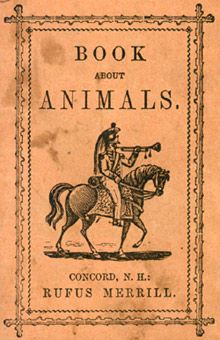
BOOK
|
|
ABOUT ANIMALS.
Is the biggest of all land animals. He is more than five times as big as an ox. But he is a harmless creature, for all that. When he is wild, and lives in the woods, he will run away, if you attempt to go near him. When he is tame, he will take a piece of cake out of your pocket, and let you ride upon his back.
The Ourang Outang is a species of the ape; it has long arms and hands, with very long fingers. It is much larger than the ape, and some have been found about six feet high, when standing erect. It is capable of walking nearly erect; but the usual gait on the ground is like a cripple who supports himself on his hands, and draws his body forward. Its home, like the monkey family, seems to be on the trees. The hair is of a brownish red color, and covers his back, arms, legs, and the outside of his hands and feet. The face has no hair except whiskers on its side. He inhabits Malacca, Cochin China, and particularly the island of Borneo.
The Opossum is an American animal, having a head like the fox, and large eyes. The head is mostly white, and the body is covered with long black-and-white hairs. He climbs up trees with great facility, hides himself in the leaves to catch birds, or hangs himself by the tail from a branch. It seeks its food in the night, and lives on fruit, insects, and birds' eggs. Its teeth are fifty in number. The most remarkable circumstance in the natural history of this animal is the pouch which is formed under the belly of the female, in which it carries its young ones when they are small. If the little creatures are frightened when absent from their mother, they scamper to this asylum as soon as possible.
Of this numerous tribe of animals, there is perhaps no species so truly elegant in its appearance as this, and although it is one of the most common, yet its habits are but little known. It is very numerous in all the northern parts of Africa. In size, it is rather smaller than the fallow deer. Its color is a dusky brown, mixed with red; the tail is short; the horns, which are about sixteen inches long, are black, distinctly annulated almost to the top, and have three curves. The brachia, or sides of the lyre, were frequently made of these horns, as appears from ancient gems. The female is destitute of horns, and has a white stripe on the flanks.
The Rabbit is a very pretty animal, and loves to live about the house and barn, in a state of friendship with all around it. It has no defence, but to run away; and so harmless and innocent is it, that nobody can have the heart to do it injury. It feeds upon clover, apples, and other fruits, and will often sit for hours in some snug covered place, quietly chewing its cud, with the greatest satisfaction. There is another kind of rabbit, which runs wild in the woods and fields. He is remarkably swift of foot, and no dog can overtake him in a race, but a grey-hound. His fur is very soft, and is used in making coarse hats.
These animals are found in the Alpine mountains of Asia and Siberia. Their favorite haunts are the tops of mountains covered with pines, where they delight to wander in places the most difficult of access. They are hunted for the sake of their well-known perfume, which is contained in an oval bag about the size of a small hen's egg, hanging from the abdomen. This receptacle is found constantly filled with a soft, unctuous, brownish substance, of the most powerful and penetrating scent, and which is the perfume in its natural state. When close, and in large quantities, the smell is very powerful and injurious.
The Polar Bear is distinguished for his tremendous ferocity. They are very numerous in the polar seas. There it is seen not only on land and fixed ice, but on floating ice several leagues out at sea. At sea, the food of this animal is fish, seals, and the carcases of whales; on land, it preys upon deer and other animals, and will, like the Black Bear, eat many kinds of berries. In winter, it beds itself deeply under the snow or eminences of ice, and awaits, in a torpid state, the return of the sun.
The Black Bear lives in the woods of the United States, and is not as large as the Polar or Brown Bear, but lives very much like the Polar bear.