
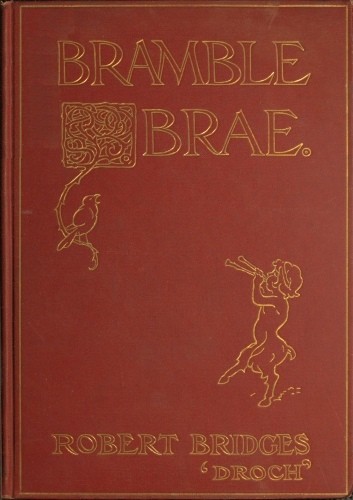
The Project Gutenberg eBook of Bramble Brae
Title: Bramble Brae
Author: Robert Bridges
Release date: July 5, 2017 [eBook #55052]
Most recently updated: October 23, 2024
Language: English
Credits: Produced by Larry B. Harrison, Chuck Greif and the Online
Distributed Proofreading Team at http://www.pgdp.net (This
file was produced from images generously made available
by The Internet Archive)
Books in Prose by
ROBERT BRIDGES
(Droch)
OVERHEARD IN ARCADY
Dialogues about Howells, James, Aldrich, Stockton, Davis, Crawford, Kipling, Meredith, Stevenson, Barrie. Illustrated, Fourth Edition, $1.25.
SUPPRESSED CHAPTERS,
AND OTHER BOOKISHNESS
Contents: Suppressed Chapters—Arcadian Letters—Novels that Everybody Read—The Literary Partition of Scotland—Friends in Arcady—Arcadian Opinions. Third Edition, $1.25.
Bramble Brae
By
Robert Bridges
(Droch)
New York
Charles Scribner’s Sons
1902
Copyright, 1902, by
Charles Scribner’s Sons
———
Published March, 1902
The De Vinne Press
To my Father
And loved it till your hair was gray
And footsteps faltered while you trod
The sloping upland bright with sod.
It blossomed in your quiet life
With gowans from the Neuk of Fife;
And while you walked the waving wheat
You dreamed of heather and the peat.
You’ve gane awa! My spirit yearns
To hear you read the songs of Burns;
The melody I’ve faintly caught
Is just the lesson that you taught.
If any hear your gentle voice
In verse of mine, then I’ll rejoice
And sing along my stumbling way,
“He’s home again in Bramble Brae!”
CONTENTS
BETWEEN TWO WORLDS
verge between the two worlds.
George Meredith.
THE UNILLUMINED VERGE
TO A FRIEND DYING
That under the shade of a cypress you’ll find him,
And, struggling on wearily, lashed by the goad
Of pain, you will enter the black mist behind him.
And we’ll talk of the way we have come through the valley;
Down below there a bird breaks into a trill,
And a groaning slave bends to the oar of his galley.
“Poor soul, how fate lashes him on at his rowing!
Yet it’s joyful to live, and it’s hard to be brave
When you watch the sun sink and the daylight is going.”
I must bid you good-by at that cross on the mountain.
See the sun glowing red, and the pulsating light
Fill the valley, and rise like the flood in a fountain!
We are comrades as ever, right here at your going;
You may rest if you will within sight of the goal,
While I must return to my oar and the rowing.
FROM ONE LONG DEAD
Is it you, O my comrade, who laughed at my jest?
But you wept when I told you I longed to be free,
And you mourned for a while when they laid me at rest.
There’s a stir of emotion, a vision that slips—
It’s my face in the moonlight that gives you a start,
It’s my name that in joy rushes up to your lips!
A mere child that is learning to walk and to run;
While I grasp at the shadows that wave to and fro
I am dazzled a bit by the light of the Sun.
But at night I am baffled and worn by the strife;
I am humbled, and then there’s an impulse to rise,
And a voice whispers, “Onward and win! This is Life!”
That inspires me and thrills me,—each day a new birth,—
Is the Force that to Chaos said, “Let there be Light!”
And it gave us sweet glimpses of Heaven on Earth.
For you love me in spite of the grave and its bars.
And it moves the whole Universe on to its goal,
And it draws frail Humanity up to the stars!
FATHER TO MOTHER
Here is the end of our youth, and now we begin to atone.
Now we do feel what their love was—those who have reared us and taught;
Now do we know of the treasures that neither are sold nor bought.
Here is the joy of the Race—joy that must grow out of pain;
Here is the last of our Self—now we are links in the chain.
Body of yours and mine no more is the measure of grief—
All that he suffers is ours—and increased while we cry for relief;
Yea, for our boy, our Beloved, we’ll yearn through the beckoning years—
Toil for him, laugh with him, struggle, and pour out the fountain of tears!
THE CHILD TO THE FATHER
Always it’s around me, night and day;
It shelters me, and soothes, but never chides me:
Yet, father, there’s a shadow in my way.
Under trees where sunbeams dance and dart—
But often just at night when I am praying
I feel this awful hunger in my heart.
I’ve felt it through my little days and years;
And even when you petted me and kissed me
I’ve cried myself to sleep with burning tears.
I caught a gentle shining in her eye,
And music in her voice when she was talking—
Oh, father, is it that that makes me cry?
Or never cuddle closer in the night;
Mother, oh, my mother! I’ve not found her—
I look for her and cry from dark to light!
A PRAYER OF OLD AGE
Throughout Thy devious world,
The little hill-paths, yea, and the great highways
Where saints are safely whirled!
And there are crooked ways, forbidden pleasures,
That lured me with their spell;
But there I lingered not, and found no treasures—
Though in the mire I fell.
The beauties of Thy work,
I catch faint glimpses of the shadows fleeing
Through valleys in the murk;
Yet I can feel my way—my mem’ry guides me;
I bear the yoke and smile.
I’m used to life, and nothing wounds or chides me;
Lord, let me live awhile!
Of Nature in the Spring—
The uplift of Thy hills, the song-birds trilling,
The lyric joy they bring.
I’m not too old to see the regal beauty
Of moon and stars and sun;
Nature can still reveal to me my duty
Till my long task is done.
The march of States and Kings!
I keenly watch the human race advancing
And see Man master Things:
From him who read the secret of the thunder
And made the lightning kind,
Down to this marvel—all the growing wonder
Of force controlled by Mind.
Lord, let me live and see
Fulfilment of our fathers’ aspiration,
When each man’s really free!
When all the strength and skill that move the mountains,
And pile up riches great,
Shall sweeten patriotism at its fountains
And purify the State!
And make me long to stay
And linger in the dusk where Death may find me
On Thine own chosen day;
There’s one who walks beside me in the gloaming
And holds my faltering hand—
Without her guidance I can make no homing
In any distant land.
And wearied drop our toys—
When all the work and burden of our staying
Has mingled with our joys—
With those we love around—our eyelids drooping,
Too spent with toil to weep—
Like some kind nurse o’er drowsy children stooping,
Lord, take us home to sleep!
THE RHONE GLACIER—SUNSET
From out the sky. The light of heaven shines
Upon its wrinkled brow, that seems a part
Of that stupendous dome of boundless blue
Where, like a pebble in the ocean depths,
This little world is lost. The sparkling sun
Plays gently in the deep green, icy clefts
Like moonlight in the tender eyes of one
Who looks to heaven to find her lover’s face.
Silent, serene, implacable it stands—
A mighty symbol of the Force that moved
Across the surface of the youthful earth
And scored the continents with valleys deep,
As children write upon the yielding sand.
Back to the dawn of things its lineage runs—
Countless ages back to that bleak time
When frightful monsters played upon the hills—
Always the same, yet moving slowly onward,
In heaven its head, its feet upon the world.
The Rhone that trickles from the glacier’s edge—
Makes valleys smile with grain and flower and fruit
And turns the wheels that forge the tools of trade—
Is but the lash with which the giant plays
And spins the tops that swarm with struggling men.
“What is Man, that Thou art mindful of him?”—
This pleasure or this pain, this wealth or want,
This tragic comedy we call our life!
A shepherd drives his sheep, and fondly bears
Above the rocky stream the weakling lamb;
The children hear the father’s kindly voice
And run to greet and cheer his late return,
While from his humble cottage gleams a light.
The door springs open to a welcome cry,
And all at last are safe within the Home.
Against the darkening sky,—Force without warmth,
Strength without passion.
But at the touch
Of homely human ways its terrors flee
And Force is swallowed up in Life with Love.
JAMES McCOSH
1811-1894
Gray man of learning—champion of truth!
Direct in rugged speech, alert in mind,
He felt his kinship with all humankind,
And never feared to trace development
Of high from low—assured and full content
That man paid homage to the Mind above,
Uplifted by the “Royal Law of Love.”
Have worked, at last, to veil from us his face;
The dear old elms and ivy-covered walls
Will miss his presence, and the stately halls
His trumpet-voice; while in their joys
Sorrow will shadow those he called “my boys”!
LE BONHEUR DE CE MONDE
(Copie d’un sonnet composé par Plantin au XVIe siècle.)
Un jardin tapiſſé d’eſpaliers odorans,
Des fruits, d’excellent vin, peu de train, peu d’enfans,
Poſſeder ſeul, ſans bruit, une femme fidéle.
N’avoir dettes, amour, ni procés, ni querelle,
Ni de partage à faire avecque ſes parens,
Se contenter de peu, n’eſpérer rien des Grands,
Régler tous ſes deſſeins sur un juſte modéle.
S’adonner ſans ſcrupule à la dévotion,
Domter ſes paſſions, les rendre obéiſſantes.
Conſerver l’eſprit libre, & le jugement fort,
Dire ſon Chapelet en cultivant ſes entes,
C’eſt attendre chez ſoi bien doucement la mort.
THE HAPPINESS OF THIS WORLD
FROM THE FRENCH OF PLANTIN
With fragrant fruit-walls in a garden fine,
Some children, some retainers, and rare wine;
To live serenely with thy faithful wife;
To have no debts, nor quarrels, nor legal strife,
Nor separation from dear kin of thine;
Expecting nothing from the Great, to shine
With modest light and just, where greed is rife.
Ruling thy well-curbed passions—and without
Ambition’s scourge to thwart thy regnant will;
Truly to worship God with ardent breath
Among His shrubs and trees on plain and hill—
Thus pleasantly shalt thou at home wait Death.
R. L. S.
To the doorway of the dead.”
All the way you followed her
Tripping through the palms and fir;
All the way around you flew
Splendid spirits from the blue—
Dreams and visions lightly caught
In the meshes of your thought.
What a glorious retinue
Made that arduous chase with you!
Half the world stood still to see
Song and Fancy follow free
At the waving of your wand—
While the echoing hills respond
To your voice.
Ends with your averted face;
At full effort you have sped
Through that doorway of the dead—
But the hills and woods remain
Peopled from your teeming brain!
All that stately company
Linger where their eyes may see
Beauty fling the laurel o’er,
At the closing of the door!
McGIFFEN
THE HERO COMING HOME
His body was clad in his uniform of Captain in the Chinese Navy,
and sent home to his mother at Washington, Pennsylvania.
Associated Press.
And he wore the Navy blue;
I bade him do his duty,
And he said he would be true.
And it’s home you came to me
When you wore your first blue jacket
At the old Academy.
And the neighbors said, “How handsome!
What a sailor he will be!”
But I only drew him closer
In my coddling mother’s joy,
And said, “Well, what’s a sailor?
He’s my brave boy!”
Of his courage in the fight—
How he ruled a heathen war-ship
And fought it with his might.
When the smoke had cleared away:
“I can see—so don’t you worry—
Though I’m riddled by the fray.”
And the neighbors said, “How glorious!
What a Hero is your son!
The world is all a-talking
Of the battle that he won!”
I said, “Well, what’s a Hero?
He’s my brave son!”
And he wears a Captain’s bars;
It’s a foreign nation’s uniform,
But wrapped in Stripes and Stars.
And it’s home at last to me.
You’re a hero and immortal,
And you fought to make men free.
But your heart is cold within you
And your dear eyes cannot see!
They say, “Be strong, O mother;
Proud laurels crown his head!”
Alas, what’s left of glory?
My boy, my boy is dead!