
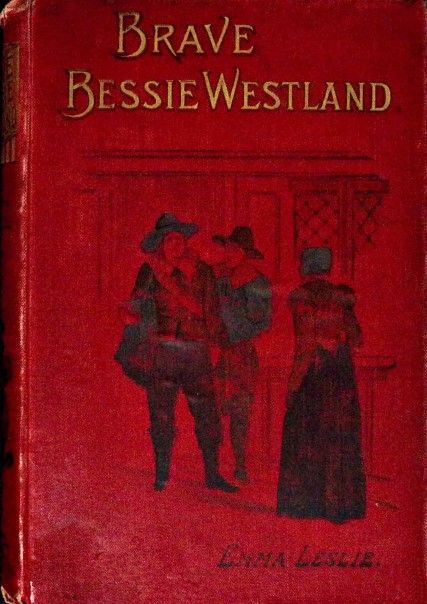
The Project Gutenberg eBook of Brave Bessie Westland
Title: Brave Bessie Westland
A story of Quaker persecution
Author: Emma Leslie
Release date: August 24, 2023 [eBook #71477]
Language: English
Original publication: London: Religious Tract Society, 1893
Transcriber's note: Unusual and inconsistent spelling is as printed.
BRAVE
BESSIE WESTLAND
A Story of Quaker Persecution
BY
EMMA LESLIE
AUTHOR OF
"AUDREY'S JEWELS," "AT THE SIGN OF THE BLUE BOAR,"
"FOR FRANCE AND FREEDOM," ETC. ETC.
LONDON
THE RELIGIOUS TRACT SOCIETY
56 PATERNOSTER ROW AND 65 ST. PAUL'S CHURCHYARD
MORRISON AND GIBB, PRINTERS, EDINBURGH.
CONTENTS.
CHAP.
BRAVE BESSIE WESTLAND.
CHAPTER I.
A QUAKER HOUSEHOLD.
"HUSH, hush, Dorothy! Thee must not cry, for fear they should hear thee, and come and look for us. The Lord will take care of us, now He hath called mother and father to witness for the truth."
These words were spoken in a whisper to the little sister who lay trembling in her arms, but there was something like a gasping sob in Bessie Westland's voice, though she tried to speak bravely and calmly, for fear the two younger sisters should grow more frightened.
But the mention of their mother brought back all the trouble, and in spite of the warning words both burst into tears, while Dorothy sobbed out—
"Oh, where have the cruel soldiers taken mother? Will they burn her, think ye, Bessie?"
"Nay, nay, the Smithfield burnings are ended; there have been none of late. King Charles—"
"Down with the Quakers!" shouted a hoarse voice close to their hiding-place, and Bessie, who was holding the string of the cellar door, felt her whole body shake with terror, for if the mob should find them there was no telling what they might do. So with the cellar door string in one hand, she held the frightened children close to her with the other, as they sat cowering in the dark, and listening to the angry threats of their rude neighbours, whom her father had so often warned to flee from the wrath to come.
"Turn out the rats' nest!" called another voice; and it was clear, from the sound of trampling feet and the breaking of furniture, that the mob were doing their best to fulfil the threats of vengeance against the unfortunate Quakers.
"King Charles has let us see now who are the law-breakers, and who gets their ears slit off," said a man who had posted himself close to the cellar door, while the rest ransacked cupboards and chests for what they could find, as nobody was likely to bring them to account for sacking the house of a convict Quaker.
They seemed to have forgotten the children who were hiding in the cellar, for this man stood with his back against the door and talked, while the rest searched every room and corner, evidently thinking that it was their lawful spoil, now that the owners had been carried off to prison.
How long they sat huddled together in the damp dark cellar, listening to the destruction of their home, and the threats against father and mother, they never knew; but to Bessie and her frightened sisters it seemed hours and hours before the people began to go away, and they were in constant terror lest some one should pull the door open and reveal their hiding-place.
At last the house began to grow more quiet. The man moved away from the door, and little Rose Westland ventured to lift her head from her sister's lap.
"How long shall we have to stay here?" she asked in a trembling whisper.
"Hast thou forgotten mother's words already? how she bade us stay close in the cellar until the Lord sent His messenger to deliver us?"
"But it is so dark," objected Dorothy; for now that the house was left in peace, the child thought she might peep out and see what mischief had been done, and she said so.
"Nay; nay," replied Bessie in a solemn whisper; "we must obey mother, and wait here for the Lord's messenger."
Her fingers were stiff and cramped, and her arm ached from holding the string so tightly, but she would not let it fall. "We are safe here; mother said they would not come to the cellar, and thee seest she was right. Now we must wait; the Lord will nathless send His messenger soon." And then Bessie relapsed into silence, to listen for the messenger who should come to their rescue.
The day before, their father had been carried off while preaching a few yards from his own house, and at sunrise that morning a party of soldiers had knocked at the door with a warrant to take their mother to gaol also, for she had been preaching and teaching, in spite of the warnings issued to all Quakers and seditious persons against unlawful assemblies.
Before she went away, she bade Bessie take her younger sisters and hide with them in the cellar. And here they, had been crouching in one corner ever since, too frightened to feel hungry, and sick and faint from terror and exhaustion, yet confidently expecting that God would send help to them, though who would be brave enough to come to the rescue of poor Quaker children, Bessie did not know.
Meanwhile, the prisoner, as she was hurried along the streets by the soldiers, was recognised by one and another she knew, so some of the little Society of Friends soon heard that one of their number had been arrested, and several went to the court where the prisoner was first taken, and there contrived to get a word with her, and to these she said, "The children are in the cellar."
It would be sufficient, she knew, for the committee of suffering formed for the relief of distress would help them somehow, and the brave-hearted woman felt she could go to prison cheerfully if her children were taken care of.
An hour later there was a meeting at the house of one who knew the Westlands, to consider the case of the children, and there it was decided that a messenger should fetch them by water from the Tower Stairs, and they would be quartered upon three Friends living near, one of their number undertaking to manage this delicate business.
At the corner of Soper Lane he met one of those he was in search of, and told him his errand.
"It is thought likely that Friend Westland may be sent out to Jamaica or His Majesty's plantation of Virginia, or he may escape with a fine and the loss of his other ear, so that he may be able to maintain his family again by and by."
"True, friend; but none can tell how soon thy home and mine may also be desolated, and therefore should we be careful how we take charges we are not able to fulfil," said the other, hastily looking round lest any one should overhear what they were talking about, and suspect them of being Quakers.
"But surely we may trust the Lord to provide for us and our little ones?" returned the other in a tone of protest.
"Yea, yea, I doubt it not, friend; but still I hold that we should not run needlessly into danger, and this affair of Westland's is becoming the town talk, and to bring his children among our own just now will be to invite persecution. Wait awhile, and then we shall see."
"See them starving," interrupted the other, with most un-Quaker-like haste and heat; for the thought of this family of little children being left to the tender mercies of a world that was so cruel to Quakers, made his naturally quick temper rise against the extreme caution of his companion, and without waiting to say another word he turned and walked in the direction of his own home.
It was not far from where they had been standing, and in a few minutes he reached the door, which was almost instantly opened by his wife, who had been waiting and watching for his return for nearly an hour.
"Now the Lord be praised for bringing thee back to me in safety once more," said Dame Drayton in a glad whisper, as she closed the street door, while her husband hung up his cloak and tall steeple-shaped hat on the peg in the entry.
"What news?" she asked.
"Bad enough, Martha. Westland is condemned to lose his ears and then be banished to the plantations of Jamaica or Virginia—I am not certain which—and his wife is to be imprisoned in Bridewell until she has earned sufficient to pay the charge of her own transport to join him."
"And they have children, Gilbert," said his wife in a pitying tone, lifting her eyes wistfully to her husband's face, as if mutely asking what they were to do for these.
He understood the look.
"We will ask counsel of the Lord first, and the inner voice will teach us what we ought to do," he said gravely. And as he spoke he turned down a passage leading to his workshop, while his wife went into the kitchen to superintend the preparation of dinner.
As they silently pursued their daily tasks, each lifted their heart to God for guidance, and then listened for the voice of the Holy Spirit to show them what they ought to do.
Two little girls were being taught meanwhile how to help in chopping suet, washing currants, and pounding savoury herbs, which would all be required for dinner. They understood, when they saw their mother close her eyes for a moment, that they were not to talk or ask questions; but before the morning tasks were over, they were startled by being asked whether they would like some brothers and sisters to come and live with them.
"Will they be 'prentices?" inquired the elder, a girl of ten or twelve.
"Why dost thee ask that, Betty?" said her mother.
"Because 'prentices eat so much bread. Deb says she will have to bake and brew again to-morrow, they eat so much."
"Poor Deb is nathless weary, or she would not grudge the labour, since the Lord hath sent meal and malt sufficient for all our wants. That is why thee must learn to do what thee can in the kitchen when thou art not learning from the horn book—that must by no means be neglected. Now, Betty, if thou bast finished those currants, thee may take Hannah and help her with her lesson until I can come to thee."
"But thou hast not told us about the new brothers and sisters," said the younger, a little fair-haired girl whose curls could not be persuaded to lie hidden under the close linen cap, but would peep out all round neck and face, in a fashion that annoyed Dame Drayton sometimes.
"Go with Betty to the keeping-room and learn the spelling task; it may be thee will hear and learn something more than the horn book can teach thee if thou dost ponder over my question. Think of it well, and all it will mean to thee—about the extra baking and brewing. Thee may leave Deborah and I to think," added the mother with a gentle smile on her lips, as the two little girls left the room.
For her own part she had no doubt as to the voice within her, and she longed for dinner time to come, to know what her husband would say. Of course she would wait and hear what he should propose first, but she would contrive to let him know that the Spirit had spoken with no uncertain voice to her.
Master Drayton was a hatter, working with two apprentices at the back of the house, in pasting and pressing the various shaped hats that at present found favour with the London public.
A glance at Master Drayton's workshop would have told the stranger that the country was in a period of transition, for there were tall steeple-crowned hats such as were fashionable in the time of the Lord-Protector Cromwell, but there were quite as many low and broad-brimmed, that would be adorned with a long ostrich feather before they were placed in the fashionable shop window; and Master Drayton often thought of the changes he had seen during the last few years.
But Puritan and Cavalier alike were united in their hatred of Quakers, and it seemed as though they would surely be exterminated between the two. Yet they all worshipped the same God and Father in heaven, and professed to love and serve the same Lord and Saviour who had died to redeem them.
Some such thoughts as these were passing through the hatter's mind as he stood silently directing the labours of one of his 'prentice lads; for even in the workshop the Quaker rule of silence, where words were not actually needed, held full sway, and so, except for the movement of fingers and tools, and the slight noise thus caused, this hat factory was as silent as a church.
"Thee must be more careful not to waste," was Master Drayton's only word of reproof to a clumsy lad who had just spoiled a hat he was making; but the words were so gravely spoken, that the lad reproved felt heartily sorry for his stupidity, and wished he could repair the mischief he had wrought.
When the dinner bell rang, master and apprentices took off their aprons, washed their hands at the pump outside the door, and then went to the fresh sanded dining-room, where Dame Drayton and the two little girls had already taken their seats, with Deborah, the matronly maid-of-all work.
There was a silent pause before the meal was served, but no spoken words of prayer broke the silence.
The plain but bountiful repast was eaten without a word being spoken beyond what was needful, and yet it was by no means a dull and gloomy family gathering.
Dame Drayton, from her place at the foot of the table, beamed upon her husband and his apprentices as though they had been honoured guests, and the little girls smiled gravely but sweetly, seconding their mother's welcome. There were little courteous nods and smiles too, as the bright pewter plates were passed to the master to be filled, the boys forgetting their hunger in their eagerness to see their mistress served first. Deborah might sometimes grudge the labour of making up so much bread, but as she looked at the boys and noted how they enjoyed their meals, she felt content. Mistress and maid often interchanged looks of amused interest, as pies, puddings, and pasties vanished before the healthy appetites.
An atmosphere of peace and content pervaded this household, that needed no words, for it found expression in acts of kindness and courtesy, and looks and smiles of tender love. Indeed, it seemed as though the very repression of all utterance filled the silence with a power of peace and restfulness that no one desired to break.
When the meal was over, the two lads helped Deborah to carry the plates and dishes to the kitchen, the little girls went to walk round the garden, and husband and wife drew together at the window.
"Thou hast thought of my words this morning, dear heart, I can see," said Master Drayton with a smile, as he took his wife's hand.
"Thee knowest it would be grievous to part these little children, Gilbert. The voice of God to me is, that we bring them to dwell here with our little ones."
"But, Martha, hast thou thought what this will mean to thee and Deborah? Three children are no light charge, my wife."
"True, Gilbert; but if the Lord send them, He will natheless give grace and strength to bear with them."
"But the committee of suffering have not apportioned them all to thee, one only to—"
"The committee are natheless wise men," said his wife quickly; "but the Lord's voice can be heard by a woman in the stillness of her home, more clearly, concerning the welfare of little children, and the voice to me is, 'Part not these little ones.' If another would fain receive them, even so let it be; but add not grief to grief, by laying a further burden upon these tender witnesses for the truth. It is enough that their parents are torn from them; let them have the comfort of abiding together, wherever their home may be."
For gentle Dame Drayton to make such a long speech as this, made her husband open his eyes in silent amazement; but it was sufficient to convince him that she felt very strongly about the matter, and this was doubtless the Lord's voice in her heart, or she would not thus have spoken. So after a minute's pause he said, "I will see what Friend Briggs thinks of thy word, and if he wills to take the three children he will natheless tell me. If not, I will fetch them hither at sundown."
There was no further need of words about the matter, and none were spoken. The hatter returned to his workshop, and the busy housewife took out her spinning-wheel; for if these children came to her poorly provided with clothes, she would need to draw upon her store in the linen-press, and so there would be the more need for its replenishment.
But while Dame Drayton's spinning-wheel hummed to the pleasant measure of her thoughts and plans for the children she was ready to welcome to her home, her husband was revolving the same matter in his mind, but in a fashion his wife had never glanced at. He was wondering what the committee of suffering would think of his wife's proposal, in view of the fact that she was not held to be a good Quakeress by the leaders of their district meeting. The cause of this was that she refused to give up entirely her attendance at "a steeple-house," as the Quakers called a church. She was born in Maiden Lane, and had attended All Hallow's Church in Bread Street since she was a child, and there she still took her own children sometimes, since they had been roughly driven out of White Swan Court, where their own meeting-house stood.
Now, the leaders among this little company of Quakers maintained that, for a woman to take her children to "a steeple-house," in preference to a Friends' meeting-house, because a party of rough soldiers had driven back the worshippers in the name of the king two or three times lately, was a weak compliance to the enemy, that must be strongly condemned. Dame Drayton had pleaded that her elder child was a weak and nervous girl, who had been unable to sleep without terrifying dreams, after the encounter with the soldiers, especially as they had the pain of seeing one of their friends carried off to prison by them. These sturdy witnesses for the truth, as it was held and taught by George Fox, thought the best way to overcome such nervous terror on the part of a child, was to accustom her to the sight of thus witnessing to the truth, and she was commanded to attend her district meeting-house, and bring her children with her, each First Day that it was open for worship.
Now Dame Drayton was as devout a Quakeress as any among them, but she had not so learned the truth either from the lips of George Fox or from the Bible, which she diligently studied.
"I am a child of God, and therefore I may not be in bondage to any man," she pleaded. "God can speak to me by the weak voice of my little child as well as by the committee of discipline," she said, when her husband reluctantly brought her the message passed at their monthly meeting, commanding her attendance at worship whenever the leaders should deem it safe to hold such a meeting, for this was not always possible at the present time of persecution.
That one so gentle, and seemingly so timid and compliant, should dare to disobey this command, was a great surprise to many; but Dame Drayton's love for her weakly child was stronger than her fear of those in authority, and so she held on her way, going herself to the meeting-house occasionally, but always taking her children to All Hallow's Church, where, as she said, they could worship God with other servants who were striving to do His will, though they were not Quakers.
This breach of discipline on the part of one of their number was a sore fret to many among the little company, for in all else Dame Drayton had proved a most exemplary member, one who was ever ready to help and succour the distressed, either among themselves or the poor who were often dependent upon them.
Now as the hatter mused over his work, he feared that when he made his appeal to be allowed to have Westland's three children, his wife's breach of discipline would be remembered against her, and they would view this demand on her part as another impeachment of their wisdom in selecting homes for them; and so it was by no means an easy or pleasant task that he had undertaken, for he felt sure his request would be refused as soon as it was made. However, as the children were to be fetched that evening, there was little time for him to ponder over the matter, and so soon as his work for the day was finished, and the apprentices dismissed, he put on his hat and cloak, and hurried off to the house of one of the committee, to consult him upon the matter, for he had agreed to meet the messenger at Triggs' Stairs, who was to bring the children by water from Southwark that evening.
It was by no means a simple business in the times of which we write, for to give shelter and help to one who was known to be a Quaker would bring suspicion and espionage; and, therefore, to take in the children of such a well-known Quaker as Westland might entail a good deal of inconvenience upon those who were brave enough to do it, even if they escaped positive persecution from the authorities.
It was doubtless this that made it difficult to find homes for those who had been practically orphaned, for well-to-do citizens, who could afford to add to their responsibilities in this way, had much to forego in the way of fines and business losses, if their connection with the despised people were thus publicly asserted.
So, when the hatter reached the house of his friend, he found him in great perplexity over this matter, for each of those to whom the Westland children had been assigned had some special reason for asking to be excused the service; and when he saw Drayton, he made up his mind that he had come to him on a similar errand.
"I know what thou past come to say to me, friend, for thou art not the first visitor I have had concerning this business. Of course, Dame Drayton is fearful for her own children, and hath sent thee to say she cannot take these, though—"
"Nay, nay; the word of the Lord to my wife is, that these little ones should not be separated the one from the other, and she desires me to say to thee that she would prefer to have them all, an it so please thee."
"She will take all these children!" exclaimed the Quaker in a tone of astonishment.
"Even so, friend; for she deems it but adding to their burden of sorrow at this time to be parted the one from the other."
"And what sayest thou to this?" asked the other, looking keenly at the hatter; for he was not a wealthy man, but had to work hard for the maintenance of his family, and to add thus to his burden was no light matter.
"I can but follow the word of the Lord in me, and that is that I take these little ones until their parents can claim them at my hand."
"Be it so, then; and the Lord bless thee in thy work, for thou hast lifted a heavy burden of care from my mind anent this matter. I have chosen a discreet messenger to bring them from their home, lest one of us being known should draw the attention of the authorities to what we were doing, and that might end in our being lodged in gaol with our brother Westland."
"But how shall I know this messenger?" asked the hatter. "I can go at once to Triggs' Stairs and meet him."
"Nay, it is a woman who hath chosen this difficult service; and if thou art in doubt concerning who it is, by reason of other passengers being near, ask her the way to the Dyers' Garden; for by that signal was she to know to whom she might deliver the children."
"I will not fail thee," said the hatter. "And when I have taken charge of these little ones, I will bid her come to thee and give a due account of how she hath sped on her errand."
And, saying this, Master Drayton bade his friend farewell, and went at once to the waterside, where he feared the messenger would be waiting for him.
CHAPTER II.
DAME DRAYTON.
THE Thames in the reign of Charles the Second was the great highway of traffic for the city of London. There were no steamboats, it is true, but watermen, duly licensed by the city authorities, and wearing badges,—much as cabmen do at the present time,—were always ready with their boats to take passengers wherever they might want to go; then there were wherries, and splendidly decorated barges for pleasure parties; so that the river was always a scene of busy traffic, and especially towards dusk on a summer evening, for then people would be returning home, or hastening to embark; so that the time had been well chosen for the coming of the Westland children, for they were more likely to escape observation now than earlier in the day.
Triggs' Stairs was a well-known landing-place, not very far from his own home; and the hatter went by the shortest cuts, through the busy narrow streets leading to the river, for fear of keeping the messenger waiting, and thus attracting the attention of watermen and passengers alike.
But just as Master Drayton reached the top of the landing-stairs a boat touched the platform below, which the hatter felt sure had brought those he was seeking. The children were neatly clad, but there was a sad woe-begone look in their faces, and two of them seemed to shrink behind the young woman who sat between them. She too looked anxious, until she caught sight of the hatter, and then she seemed to gain more confidence, and led the children up the steps as briskly as their wet and dangerous condition would permit.
"Thee are sent to us by our brother Staples," she said, almost before the question of identification could be asked.
"Yea, I am here to take charge of the little ones; but thou wilt come and see my wife, and tell her what is needful to be told," returned Master Drayton; for he noticed that only a very small bundle had been brought with them, and this was carried by the elder girl. She was about thirteen, he judged, and singularly like her father, as he had seen him a day or two before, when he stood in the court of the Lord Mayor, and was condemned to lose his ears, and then be transported as an obstinate schismatic, dangerous to the king and his authority.
It was not the habit of Quakers to talk in the streets, and so they walked towards Soper Lane, which was close to the river, without asking any further questions, for fear of being overheard by some one passing.
Deborah opened the street door, and received them with a smile of welcome, as she explained that her mistress was in her own room; which Master Drayton knew how to interpret, and went himself to tell her the children had come.
"And none have dared to make them afraid, since the Lord had them in His keeping," said his wife with a pleasant smile; and she hastened to the keeping-room to welcome these strangers to their new home.
"My own little girls, who are to be your sisters, you know, were obliged to go to bed, they were so sleepy, but you will see them in the morning;" and as she spoke she kissed each of the shy, frightened little strangers, putting an arm around each, while she spoke to the Friend who had brought them.
"They were hiding in the cellar when I reached the house; for it seems that our brother hath given great offence to his neighbours by his plainness of speech when he preached and denounced their wickedness, and so they had revenged themselves upon him, by well-nigh stripping his dwelling as soon as he and his wife were taken to prison. Even the clothes seem to have been stolen, for I could find none but these," she said, touching the little bundle that had been placed on the table.
"I think the soldiers took some of the things," said the elder girl at this point; "but mother had said, 'Thee stay with thy sisters in the cellar,' just before they dragged her away, and Dorothy was so frightened when we heard the people running up and down stairs, that I could not go and see what they were doing."
"That was wise of thee, dear child," said Dame Drayton with a sigh; for she could not help wondering what would happen to her own darlings if she and her husband should ever fall into similar trouble. Sometimes it seemed impossible that they could long escape suspicion, and then anyone might denounce them who happened to bear them any ill-will.
The messenger who had brought the children did not stay long, for the streets of London were no fit place for a woman after dusk, even though she might be staid and discreet; and so, as soon as the necessary particulars had been given, Master Drayton put on another hat and coat, to go with her to the Friend who had undertaken to manage the affair for the committee of suffering.
While her husband was gone, Dame Drayton took the children to the little bedroom she had prepared for them near her own, and the nervous, frightened manner of the two younger girls fully justified what her fears had been concerning them.
They clung to their elder sister, trembling even at the kind attentions of their friend, lest she should attempt to tear them from this last protector.
"Thee will let us sleep together," said the little mother, as she took a hand of each of her younger sisters, and led them upstairs. "We are not hungry now, only a little tired with the fright," she explained, when Dame Drayton would have had supper brought into the keeping-room for them.
"Certainly ye shall sleep together, and to-morrow I hope we shall learn to know each other better;" and she shut the children in to themselves, for she could see that it would be kinder to leave them now, than to press any attentions upon them, or to ask them any further questions. Before she went to bed, however, she gently opened the door and looked in, but found to her relief that they were sound asleep in each other's arms; and they did not rouse the next morning until all the house was astir, and the sun peeping in at their windows.
"This is Bessie Westland, and these are her little sisters, Rose and Dorothy," said Dame Drayton the next morning, introducing the new-comers to her own children and the family assembled at the breakfast table.
One of the apprentices had just raised his horn of small ale to drink, but at the name of Westland he paused, and looked first at the new-comers, and then at his companion; for the name of Westland had been heard of a good deal during the last few days, and the lads were not likely to forget it.
The hatter noticed the look that passed between the two boys, and it did not tend to make him feel more comfortable; for although it was known that he was a strict and godly citizen, the fact of his being a Quaker he desired to keep secret as far as possible, but he feared now that the coming of these children might be the means of its discovery.
Dame Drayton had also noticed the surprised looks in the lads' faces; but she felt sure they might be trusted not to mention what they had heard out of the house, for they were steady, quiet, reliable lads, and their occupation kept them out of touch with many of the more turbulent of their class. Their parents were steady God-fearing people; and so Dame Drayton put aside all fear of mischief coming to them through the apprentices.
The children were naturally shy of each other at first; but by degrees this slipped off like a garment there was no further need to use, and the first question Bessie asked was about her mother and father.
"When can I go and see them, Martha Drayton?" she asked.
There was no disrespect in the girl's tone; but she came of a more stern and uncompromising family of Quakers, and would have looked upon it almost as a sin to use any title of courtesy, however much she might revere the individual. Dame Drayton knew all this, but it came upon her with something like a shock, to be addressed as "Martha Drayton" by this child, and she paused for a minute before answering her question.
Then she said, slowly and cautiously, "Dear child, thou hast been placed in our care by the committee of suffering. They will nathless see to it that ye see your father in due time; but thou must not run into needless danger, or bring suspicion upon this household."
"Art thou ashamed of being a Quaker, then, as our enemies call us?" asked the girl rather severely. "To tremble and quake because of sin was a mark that we were children of the Highest, my father said, and should we be ashamed of that?"
"Nay, nay, we should be unworthy of our high calling if we were to despise the work of the Spirit in our hearts; but dost thou not see, Bessie, that if we were to prate in the streets of these things, we should bring trouble and sorrow upon those whom God hath given us to protect?"
"But the trouble and sorrow would be good for them an it came to them," said Bessie Westland.
"Even so; but if I could not offer thee and thy sisters a safe abiding-place now, the trouble and sorrow of thy father and mother would be increased tenfold."
The girl loved her father very dearly, and would have suffered anything herself to lessen his affliction, and so this view of the matter touched her a little; and Dame Drayton took this opportunity of pressing upon her the need of caution.
"We are not called to raise up to ourselves enemies needlessly. It is only when some truth is to be held firmly and unflinchingly, that we may thus brave the law and the mob who alike are against it."
"But my father held that it was the duty of a true friend of sinners to preach the truth to them at all times, whether they would hear, or whether they would forbear," said Bessie after a minute or two.
"Then, my dear child, if that was the voice of God to him, he could do no other than obey it, and God hath honoured him in calling him to witness to that truth. If the same word came to me, I too must obey; but the voice of the Spirit in my heart was, that I should shield and protect thee and thy sisters, and thus comfort the heart of those called to suffer for His name's sake."
"But—but if thee art a true Friend, would not the word of the Lord be the same to thee as to my father?" said Bessie after a pause.
"Nay, that is where thee makest so grave a mistake," said Dame Drayton, sitting down by Bessie's side, and drawing little Rose close to her. "The Lord hath a word of guidance for each if we will but listen and obey it, without seeking to follow what He may say to another. See now, He hath made me the mother of tender children, and given to thee the care of little sisters, which is next in honour to that of being their mother. Now His word to us will be in accord with this, to guide and direct us in our duty, how to walk before them in love."
"But my mother—?" began Bessie.
"Thy mother is a brave and true Friend, following the word of the Lord, I doubt not," said Dame Drayton quickly; "but because she did that which the Lord, bade her do, it doth not follow that thee should do the same, for the voice of the Spirit may have altogether another word for thee, and thou must listen to that word and follow it, though it lead thee in the way thou wouldest shun. Just now, thou art longing to proclaim to all London that thou art of the despised sect of Quakers, and by this thou wouldest bring grave trouble upon all this household, for the Lord Mayor would not send to arrest a girl like thee, but the man and woman who harboured thee, and so we should be sent to the Bridewell, and thou and my own little ones become an added burden to our brethren."
"Would they not send me to prison?" said Bessie, in a disappointed tone.
"I trove not; though King Charles may profess to think men and women are plotting against his throne, he would scarcely accuse a child like thee, and so thou and thy sisters would but be cast forth upon the world again. Wilt thou try to think of this, Bessie; and to remember that the Lord ever speaks to us of the duty that lies nearest to our hand, if we will but listen and obey, instead of seeking to follow the word He may have given to another? This is how so many mistakes are made, dear child. We think that the word spoken to another must be for us also, and so our ears are deafened to the true message that the Spirit is trying to make us hear and understand."
"But dost thou not think my father obeyed the voice in his heart?" asked Bessie quickly.
"Yea, verily, dear child. Nought but the strength that God alone can give can help even a Friend to bear testimony to the truth before such cruel enemies; but dost thou not see that, while some are called to be martyrs for the truth, others are commanded to take up the cross of everyday life, and bear it meekly and patiently, though it lead not to such honour and renown as the martyr may claim? This is what we are called to, dear child. Thou and I must take care of the little ones at home, not denying our faith if any ask us concerning it, but seeking not to thrust it before the eyes of men; content to be unnoticed and unknown, but ever listening to the voice that will not fail to make itself heard in our hearts, if we will but listen with a simple mind."
Bessie bowed her head, but she was only half convinced of the truth her friend had spoken. Her father had declared again and again that they had no right to sit calmly doing the everyday work of life, while sinners were perishing for lack of the word of life.
He had not scrupled to denounce his neighbours who went to church as formalists and hypocrites, and even in the church itself had stood up and warned parson and people alike, telling them that God could be worshipped in the open fields, in the house or shop, better than in a steeple-house; and he had gathered crowds around him in the fields beyond Southwark, and taught them the truth as he had received it from the lips of George Fox, the founder of their Society.
He was a true and ardent disciple of Fox, counting nothing dear so that he might proclaim the truth, the whole truth—as he thought—for in the tenacity with which he held to the little bit he had been able to grasp, he failed to see that he could not grasp the whole. That those whom he denounced so unsparingly also held the truth as they perceived it, or at least another facet of the precious gem, casting its inspiring light upon them, was dark to him.
This had not been heeded by the authorities at first, and Westland, like many another earnest man, was allowed to preach and teach sinners the error of their ways, and warn them of the wrath to come. For to make men tremble and quake, and cry to God for mercy through the Lord Jesus Christ, was the object of all the Quakers' preaching, and the term "Quaker" had been given them in derision on account of this.
For a time these people had been allowed to follow their own way without much interference from the authorities; but their unsparing denunciation of vice and wickedness, whether practised by rich or poor, doubtless raised the resentment of the king, though a political reason was the one put forward for their persecution. The safety of the throne, it was pretended, called for the suppression of these illegal meetings, as sedition was being taught under cover of religion.
So Westland was an early victim, and suffered the loss of his goods, for everything he possessed had to be sold to pay the fine inflicted upon him. But so far from deterring him from doing what he conceived to be his duty, this did but make him the more determined to teach and preach upon every occasion possible.
The next time, a short term of imprisonment, and one ear was cut off by way of punishment. But almost before the place was healed he was preaching again, and denouncing steeple-houses, and those who put their trust in them.
This time the authorities were determined to silence him, and so he had been condemned to lose his other ear, and then be sent as a slave to one of His Majesty's plantations in America, and all London was ringing with the name of Westland, and the punishment that had been dealt out to him as an incorrigible Quaker.