
The Project Gutenberg eBook of British Canals: Is their resuscitation practicable?
Title: British Canals: Is their resuscitation practicable?
Author: Edwin A. Pratt
Release date: November 23, 2014 [eBook #47435]
Most recently updated: October 24, 2024
Language: English
Credits: Produced by Chris Curnow, MWS and the Online Distributed
Proofreading Team at http://www.pgdp.net (This file was
produced from images generously made available by The
Internet Archive)
The cover image was created by the transcriber and is placed in the public domain.
BRITISH CANALS
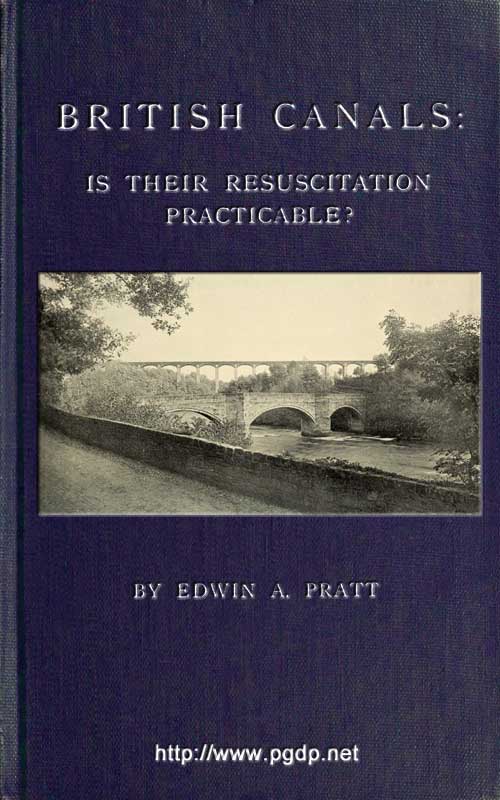
AQUEDUCT AT PONTCYSYLLTE (IN THE DISTANCE).
(Constructed by Telford to carry Ellesmere Canal over River Dee. Opened 1803. Cost £47,000. Length, 1007 feet.)
[Frontispiece.
BRITISH CANALS:
IS THEIR RESUSCITATION PRACTICABLE?
BY EDWIN A. PRATT
AUTHOR OF "RAILWAYS AND THEIR RATES," "THE ORGANIZATION
OF AGRICULTURE," "THE TRANSITION IN AGRICULTURE," ETC.
LONDON
JOHN MURRAY, ALBEMARLE STREET, W.
1906
PREFACE
The appointment of a Royal Commission on Canals and Waterways, which first sat to take evidence on March 21, 1906, is an event that should lead to an exhaustive and most useful enquiry into a question which has been much discussed of late years, but on which, as I hope to show, considerable misapprehension in regard to actual facts and conditions has hitherto existed.
Theoretically, there is much to be said in favour of canal restoration, and the advocates thereof have not been backward in the vigorous and frequent ventilation of their ideas. Practically, there are other all-important considerations which ought not to be overlooked, though as to these the British Public have hitherto heard very little. As a matter of detail, also, it is desirable to see whether the theory that the decline of our canals is due to their having been "captured" and "strangled" by the railway companies—a theory which many people seem to believe in as implicitly as they do, say, in the Multiplication Table—is really capable of proof, or whether that decline is not, rather, to be attributed to wholly different causes.
In view of the increased public interest in the general question, it has been suggested to me that the Appendix on "The British Canal Problem" in my book on "Railways and their Rates," published in the Spring of 1905, should now be issued separately; but I have thought it better to deal with the subject afresh, and at somewhat greater length, in the present work. This I now offer to the world in the hope that, even if the conclusions at which I have arrived are not accepted, due weight will nevertheless be given to the important—if not (as I trust I may add) the interesting—series of facts, concerning the past and present of canals alike at home, on the Continent, and in the United States, which should still represent, I think, a not unacceptable contribution to the present controversy.
EDWIN A. PRATT.
London, April 1906.
CONTENTS
| CHAP. | PAGE | |
| I. | INTRODUCTORY | 1 |
| II. | EARLY DAYS | 12 |
| III. | RAILWAYS TO THE RESCUE | 23 |
| IV. | RAILWAY-CONTROLLED CANALS | 32 |
| V. | THE BIRMINGHAM CANAL AND ITS STORY | 57 |
| VI. | THE TRANSITION IN TRADE | 74 |
| VII. | CONTINENTAL CONDITIONS | 93 |
| VIII. | WATERWAYS IN THE UNITED STATES | 104 |
| IX. | ENGLISH CONDITIONS | 119 |
| X. | CONCLUSIONS AND RECOMMENDATIONS | 142 |
| APPENDIX—THE DECLINE IN FREIGHT TRAFFIC ON THE MISSISSIPPI | 151 | |
| INDEX | 157 |
LIST OF ILLUSTRATIONS AND MAPS
| HALF-TONE ILLUSTRATIONS | ||
| AQUEDUCT AT PONTCYSYLLTE (in the distance) | Frontispiece | |
| WHAT CANAL WIDENING WOULD MEAN: COWLEY TUNNEL AND EMBANKMENTS | To face page | 32 |
| LOCKS ON THE KENNET AND AVON CANAL AT DEVIZES | " " | 42 |
| WAREHOUSES AND HYDRAULIC CRANES AT ELLESMERE PORT | " " | 48 |
| WHAT CANAL WIDENING WOULD MEAN: SHROPSHIRE UNION CANAL AT CHESTER | " " | 70 |
| "FROM PIT TO PORT": PROSPECT PIT, WIGAN | " " | 82 |
| THE SHIPPING OF COAL: HYDRAULIC TIP ON G.W.R., SWANSEA | " " | 88 |
| A CARGO BOAT ON THE MISSISSIPPI | " " | 110 |
| SUCCESSFUL RIVALS OF MISSISSIPPI CARGO BOATS | " " | 114 |
| WATER SUPPLY FOR CANALS: BELVIDE RESERVOIR, STAFFORDSHIRE | " " | 128 |
| MAPS AND DIAGRAMS | ||
| INDEPENDENT CANALS AND INLAND NAVIGATIONS | " " | 54 |
| CANALS AND RAILWAYS BETWEEN WOLVERHAMPTON AND BIRMINGHAM | " " | 56 |
| SOME TYPICAL BRITISH CANALS | " " | 98 |