
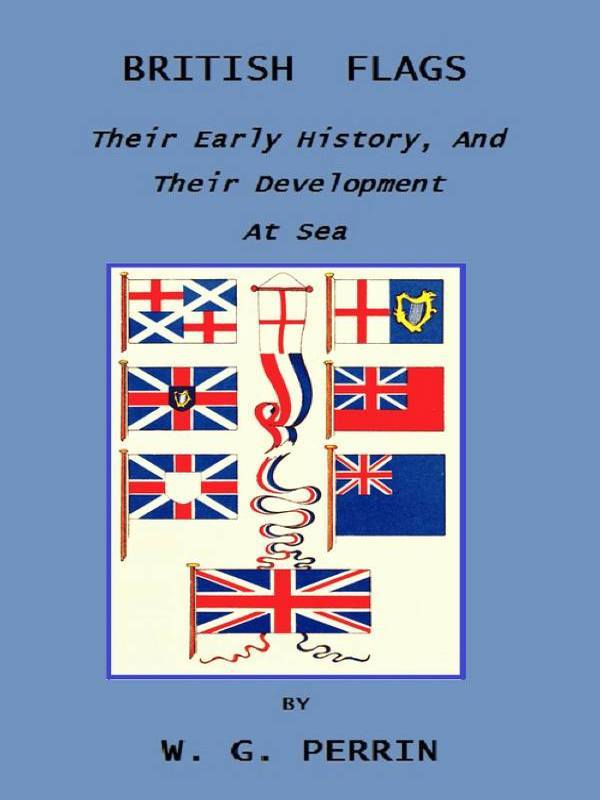
(ii) SCOTLAND
The history of the national flags of Scotland is much less complicated than that of the flags of England, for the northern nation had decided upon their patron saint at a much earlier date than their neighbours south of the Tweed. There was a similar struggle for supremacy among competing saints, but the issue was decided in the eighth century and appears to have remained unchallenged ever since. In the words of Wm Forbes Skene, the Scottish historian,
With the departure of the Columban Clergy, the veneration of St Columba as the apostle of the northern Picts seems to have been given up, at least by the southern portion of that people, and St Peter now became the patron saint of the kingdom and continued to be so till the year 736, when Angus the son of Fergus established his power by the defeat of Nectan himself, and the other competitors for the throne. As the king rapidly brought the territories of the other Pictish families under his sway, and even added Dalriada to his kingdom, he seemed desirous to connect a new ecclesiastical influence with his reign, for in the same year that he completed the conquest of Dalriada he founded a church at St Andrews, in which he placed a new body of clergy, who had brought the relics of St Andrew with them, and this apostle soon became the more popular patron saint of the kingdom, while the previous patronage of St Peter disappeared from the annals[117].
It is probable that the cross-saltire was adopted by the Scots as a national ensign at a very early period, but there seems no direct evidence of this before the fourteenth century. The earliest Scottish records were unfortunately lost at sea in the ship that was sent to return them to that country, whence they had been carried off, with the Stone of Destiny, by Edward I.
In the summer of the year 1385 the Scots planned a raid into England, in which they were assisted by a considerable contingent of French. The Ordinances for the allied army drawn up by the Council for this occasion and promulgated on the 1st July contained the following proviso:
Item every man French and Scots shall have a sign before and behind, namely a white St Andrew's Cross, and if his jack is white or his coat white he shall bear the said white cross in a piece of black cloth round or square[118].
It will be noted that the field on which the cross-saltire was to be placed was immaterial, but if the coat happened to be white the field was to be black. There is other evidence that the ground colour was not an essential part of the design, although the prevailing colour at a later date seems to have been blue. In the Accounts of the Lord High Treasurer of Scotland[119] for the year 1512 there is recorded a payment for a roll of blue say for the banner of a ship "with Sanct Androis cors in the myddis." In 1513 the ground colour was also blue. In 1523, however, when orders were again issued for each man to bear the white saltire before and behind, no ground was mentioned, while in 1540 and 1542 the ground colour of the ensigns was yellow and red (the Stuart livery colours) or red, as the following entries show:
1540
Item, the x day of Junii deliverit to Thomas Arthur to be iii anseƷeis[120] to the schippis xvj elnis reid and Ʒallow taffites of cord, price of the elne xviij s.
Summa xiiij li. viij s.
Item, deliverit to him to be the croces thairof iiij elnes half elne quhyte taffites of Janis[121] price the elne xv s.
Summa iij li. vij s. vj d.[122]
1542
Item, the vij day of August, deliverit to Charles Murray to be and ansenƷe, x elnis raid and Ʒallow taffitis of cord, price of the elne xviij s. and twa elnis quhite taffites of Janis to be croces thairto, price of the elne xiiij s.
Summa x li. viij s.[123]
There is a similar entry on the 12th for 8 ells red, and 2½ ells white for the cross.
Cleirac, in his Explication des Termes de Marine, etc.[124], gives for the Scotch flag a ground of red or blue, and also a ground of red, yellow and green, with the saltire in a canton or overall[125]. It is probable, however, that he was relying on obsolete information, for there seems no other evidence of a parti-coloured field so late as 1670[126], though a red ensign for ships, with white saltire in a blue canton[127], was in use until the Legislative Union of 1707.
It remains to say a few words about the royal banner, which may be considered in a sense national although it is the personal heraldic flag of the sovereign and ought not to be used by any subject. The rampant lion with a tressure fleur-de-lisé first appears in a seal of Alexander II appended to a Charter dated 1222[128]. Except for the period during which Mary Queen of Scots, after her marriage with the Dauphin, impaled the French Arms with her own it has remained unaltered, in the form in which we now see it quartered in the Royal Standard, since the thirteenth century.
The Raven and the Dragon Standards found their way into Scotland, but are not met with after the twelfth century. In the early years of the eleventh century Sigurd, Earl of Orkney, who afterwards carried the Raven standard against the Irish at Clontarf, was challenged by Finleic, Earl of the Scots, to battle at Skedmire.
Sigrod sought his mother that she might divine unto him upon the matter, for she was a wise woman. The earl told her that the odds in number between his foeman and his own men would not be less than seven to one. She answered, "I would have brought thee up all thy life in my wool-basket, if I had known that thou wert bent upon living for ever; but 'tis Fate that settles a man's days whatever he is. It is better to die with honour than to live with shame. Now take this banner, which I have wrought for thee with all my skill! And I say, by my knowledge, that the victory shall be to them before whom it is borne, but deadly shall it be to them that bear it." The banner was made with much fine needle-work, and with exceeding art. It was wrought in the likeness of a raven, and when the wind blew upon the banner it was as if the raven flapped his wings in flight. Earl Sigrod was very angry at his mother's words; and gave the Orkneymen their ethel-holdings free to raise a levy for him; and went to Skedmire to meet Earl Finleic, and each of them set his host in array. And as soon as the battle was joined, Earl Sigrod's standard-bearer was shot to death. The Earl called upon another man to carry the standard, and he bore it for a short while and then fell also. Three of the Earl's standard-bearers fell indeed, but he won the victory[129].
The Dragon appeared as the Scottish Royal Standard at the Battle of the Standard (1138). According to the contemporary "Relatio de Standardo[130]," written by St Aelred, Abbot of Rielvaulx Abbey in Yorkshire, when the Scots broke and fled those in flight saw from the position of the royal standard, which was in the likeness of a dragon[131], that their king was not slain, and gathering themselves to him they renewed the fight. On this occasion the Scottish king's son made use of the following ruse. Finding himself cut off with a few companions, he told them to throw away the banners by which they were to be recognised from the English and then, mixing with the latter as though fighting on their side, they reached his father in safety.
Except for a short period during the reign of James IV (1473-1513) a Scots navy was either non-existent or of little importance, and it is therefore not to be expected that any great development took place in its flags; nevertheless, from the Lord High Treasurer's accounts it appears that no less a sum than £72. 7s. 6d. was expended upon the "mayn standert" of the "Great Michael" in 1513. This flag appears to have had a St Andrew's cross on a blue ground at the head, and a fly of red and yellow on which the royal badges of the red lion and white unicorn appeared. Other flags of this period were the banners of St Andrew and St Margaret, and a banner and standards with the red lion upon a yellow field.
(iii) IRELAND
In St Patrick the Irish possess a patron saint who is in the truest sense national. Although a native of Scotland, the best of his life and work was devoted to the people among whom in early youth the fortune of war placed him. He seems, moreover, never to have had a serious competitor for their favour[132], and they have been unwavering in their allegiance to him. Nevertheless, there is no ancient flag, and no symbol except the shamrock, associated with his name.
Flags do not seem to have been in use at a very early period among the celtic nations, and when we meet with them in Irish literature in the eleventh century the terms used for them are not native Irish words but had apparently been borrowed from the Danish invaders who wrought such havoc to the ancient Irish civilisation from the ninth to the eleventh centuries. The word used by the author of the Cogadh Gaedhel re Gallaibh is "mergi[133]," which is believed to be borrowed from the Scandinavian "merke" (mark), while the other word met with, "confingi," seems to be derived from the Norse "gunfana."
At the great battle of Clontarf fought in the year 1014 between the Irish under their king Brian Borumha and the Danish invaders of Ireland under the Earl Sigurd, assisted by the revolted king of Leinster, the Irish under Brian had many banners, but these banners were known by their colours rather than by any particular device in them.
Brian looked out behind him and beheld the battle phalanx ... and three score and ten banners over them, of red, and of yellow, and of green, and of all kinds of colours; together with the everlasting, variegated, lucky, fortunate banner that had gained the victory in every battle and in every conflict, and in every combat ... namely the gold-spangled banner of Fergal Ua Ruairc[134].
These banners appear to have been personal to the chiefs and to have been taken down when they were slain, even if their forces still remained undefeated. During the conflict Brian, who on account of his age took no part in the battle and was engaged in prayer at a little distance, enquired repeatedly of his attendant whether the banner of his eldest son, Murchadh, still remained aloft. Towards the end he asked once more, and the attendant reported that it was far from Murchadh but still standing. Brian said "The men of Erinn shall be well while that banner remains standing because their courage and valour shall remain in them all, as long as they can see that banner." At length Murchadh was mortally wounded, and although the enemy were defeated his banner was taken down. When his father asked again, the attendant answered, "... the foreigners are now defeated and Murchadh's banner has fallen." "That is sad news," said Brian, "... the honour and valour of Erinn fell when that banner fell and Erinn has fallen now indeed."
It may be concluded from this narrative that the Irish of the eleventh century had no national flag common to the whole people. This, together with the fact that after the death of Brian no Irish king arose great enough to secure the allegiance of the whole nation, may explain why the Irish never developed a national flag as did the English and Scots.
The red saltire on white ground which represents Ireland in the Union flag had only an ephemeral existence as a separate flag. Originating as the arms of the powerful Geraldines, who from the time of Henry II held the predominant position among those whose presence in Ireland was due to the efforts of the English sovereigns to subjugate that country, it is not to be expected that the native Irish should ever have taken kindly to a badge that could only remind them of their servitude to a race with whom they had little in common, and the attempt to father this emblem upon St Patrick (who, it may be remarked, is not entitled to a cross—since he was not a martyr) has evoked no response from the Irish themselves.
The earliest evidence of the existence of the red saltire flag[135] known to the author occurs in a map of "Hirlandia" by John Goghe dated 1567 and now exhibited in the museum of the Public Record Office. The arms at the head of this map are the St George's cross impaled with the crowned harp, but the red saltire is prominent in the arms of the Earl of Kildare and the other Geraldine families placed over their respective spheres of influence. The red saltire flag is flown at the masthead of a ship, possibly an Irish pirate, which is engaged in action in the St George's Channel with another ship flying the St George's cross. The St George's flag flies upon Cornwall, Wales and Man, but the red saltire flag does not appear upon Ireland itself, though it is placed upon the adjacent Mulls of Galloway and Kintyre in Scotland. It is, however, to be found in the arms of Trinity College, Dublin (1591), in which the banners of St George and of this saltire surmount the turrets that flank the castle gateway.
The Graydon MS. Flag Book of 1686 which belonged to Pepys does not contain this flag, but gives as the flag of Ireland (which, it may be noted, appears as an afterthought right at the end of the book) the green flag with St George's cross and the harp, illustrated in Plate X, fig. 3. The saltire flag is nevertheless given as "Pavillon d'Ierne" in the flag plates at the commencement of the Neptune François of 1693, whence it was copied into later flag collections.
Under the Commonwealth and Protectorate, when England and Scotland were represented in the Great and other Seals by their crosses, Ireland was invariably represented by the harp, and in the Union flag of 1658, as will be seen later, it was the harp that was added to the English and Scottish crosses to form a flag representative of the three kingdoms. At the funeral of Cromwell the Great Standards of England and Scotland had the St George's and St Andrew's crosses in chief respectively, but the Great Standard of Ireland had in chief a red cross (not saltire) on a yellow field[136].
When the Order of St Patrick was instituted in 1783 the red saltire was taken for the badge of the Order, and since this emblem was of convenient form for introduction into the Union flag of England and Scotland it was chosen in forming the combined flag of England, Scotland and Ireland in 1801.
Ireland has been represented in the royal standard since 1603 by the golden harp on a blue field, but it would seem that this is not the original arms of that country, for the augmentation of arms granted by Richard II to his favourite Robert de Vere, Earl of Oxford, whom he created Duke of Ireland in 1386, was azure, three crowns, or, and these are said to have been confirmed as the true arms of Ireland by a commission of enquiry under Edward IV. The harp, which appears to have been an ancient badge of Ireland, was formally adopted as the arms of that country by Henry VIII in the year when he changed the royal style from "Dominus Hiberniae" to "Rex Hiberniae." The change in the colour of the field from blue to green, as is commonly seen in the flags of Irishmen in rebellion against English rule, is believed to have originated with Owen Roe O'Neill in 1642.
There is very little information as to the flags flown in Irish ships. From a date at least as early as the thirteenth century certain of the Irish ports were accustomed to supply ships for the king's service[137]. Such ships would have flown the English or Cinque Ports flag. There is indeed a mention in the State Papers of 1586[138] of an Irish ship attacking an English merchantman under the Scots flag, "showing forth a Skottish ensigne," and a passage in Dudley's voyage in 1594[139] from which it may be inferred that there was no recognised Irish flag at that date. In Feb. 1785, a brig from Dublin hoisted at Antigua a green ensign with the harp and crown in the centre, which was seized by Collingwood's orders, and later in the same year another ship from Belfast, flying a similar ensign, was detained until the master had gone ashore and bought proper colours for the vessel[140].
FOOTNOTES:
[65] Historia Anglorum: "Aciebus igitur dispositis, cum in directum tendentes appropinquarent, Edelhun praecedens West sexenses, regis insigne draconem scilicet aureum gerens, transforavit vexilliferum hostem."
[66] Probably Combwich, vide Major, Early Wars of Wessex, 1913.
[67] Under the Devon earldorman Odda, Alfred being then in hiding at Athelney.
[68] "Vexillum quod Reafun nominant." Cf. the A. S. Chronicle, "þær wæs se guðfana genumen þe hie Hraefn."
[69] Asser, Life of King Alfred.
[70] Emmae Reginae Anglorum Encomium, lib. ii.
[73] Anlaf seems to have lived alternately in Ireland, Scotland, and Northumbria, and to have been King of Dublin in 945. On his final expulsion from Northumbria in 952 he returned to Ireland, and after the battle of Tara in 980 became a monk at Iona. See Todd, War of the Gaedhil with the Gaill (Rolls Series).
[74] William of Malmesbury, De Gestis Regum Anglorum: "Vexillum Mauricii beatissimi martyris Thebae legionis principis, quo idem rex in bello Hispano quamlibet infestos et confertos inimicorum cuneos derumpere et in fugam solitus erat cogere."
[75] Henry of Huntingdon, Historia Anglorum: "Cum enim Dacos solito acrius pugnare videret (Edmund) loco regio relicto, quod erat ex more inter draconem et insigne quod vocatur 'Standard,' cucurrit terribilis in aciem primam."
[77] Gesta Regum Anglorum: "Rex ipse pedes juxta vexillum stabat cum fratribus...vexillum illud post victoriam papae misit Willelmus, quod erat in hominis pugnantis figura, auro et lapidibus arte sumptuosa intextum."
[78] There is a smaller figure of a man in the act of striking with a club on the downs near Cerne Abbas in Dorset. Possibly both these figures are pre-Saxon. The horse, a favourite subject for treatment in this manner, is almost certainly pre-Saxon; yet it was adopted by the Saxons of Kent.
[79] Roger de Hoveden, Chronica "cum ... rex Angliae fixisset signum suum in medio, et tradisset draconem suum Petro de Pratellis ad portandum contra calumniam Roberti Trussebut, qui illum portare calumniatus fuit de jure praedecessorem suorum."
[81] Dart, Westmonasterium, 1742.
[82] See especially Elliot Smith, The Evolution of the Dragon, 1919.
[84] Liber quotidianus Contrarotulationis Garderobae 29 Edward I. This was printed by the Society of Antiquaries in 1787.
[85] Rites of Durham (Surtees Society), 1903.
[89] It is usually taken as 303 but the Rev. Baring Gould in his Lives of the Saints shows good reason for believing the actual date to be 285.
[90] Decline and Fall of the Roman Empire, chap. xxiii.
[91] Baring Gould, Curious Myths, 1872.
[92] Exchequer Accounts, 349/2.
[93] Bail, Summa Conciliorum.
[94] Wilkins, Concilia Magnae Britanniae et Hiberniae.
[95] Ibid.
[96] Keyser, Norman Tympana and Lintels, 1904; Sussex Archeological Collections, xliv.
[97] Benedict Abbas, Gesta Regis Henrici Secundi: "Praedicti vero reges in susceptione crucis ad distinguendam gentem suam signum evidens providerunt. Nam rex Franciae et gens sua cruces rubeas susceperunt, et rex Angliae et gens sua cruces albas susceperunt, et comes Flandriae cum gente sua cruces virides suscepit."
[98] Les Us et Coutumes de la Mer.
[99] Exchequer Accounts, 3/15. Rotulus forinsecus de guerra Walliae anno regni regis Edwardi quinto.
"Flind. Die martis in Festo Sancti Laurentii [pro tribus peciis de Buckeram et tribus peciis telae de Aylesham emptis per manus Admeti cissoris ad faciendum C Braceria et xx*xj penuncella de Armis sancti Georgii et pro emendendum et sudendum eorundem Bracerium et penuncellorum. ci s vi d. Item pro sex peciis telae de Aylesham emptis ad faciendum Braceria et penuncella pro peditibus Regis per manus eiusdem A. xx s. Item pro cl ulnis telae tinctae emptis pro eodem c s. Item pro custura cxx penuncellorum de Armis sancti Georgii per manus eiusdem A. xxiij s] (other similar entries for material for Bracers) ... pro tribus Stemeris emptis ad fracandum intus arma Regis vij s. vj d.
[100] Vide Nicolas, Siege of Carlaverock.
[101] Prologue to the Canterbury Tales, II. 108 et seq.
[102] Nicolas, Roll of Carlaverock.
[103] Henry Chicheley.
[104] I.e. fighting against ghostly enemies.
[105] Wilkins, Concilia, iii, 375: "Hujus itaque dispositionis ex clementissima et benignissima Dei Salvatoris nostri misericordia procedentis consideratione, nationis Anglicanae plebs fidelis, etsi Deum in sanctis suis omnibus laudare ex debito teneatur, ipsum tamen, ut orbis affatus, ipsaque gratiae desuper concessae experientia, rerum cunctarum interpres optima, attestantur, in suo martyre gloriosissimo, beato Georgio, tanquam patrone et protectore dictae nationis speciali, summis tenentur attollere vocibus, laudibus personare praecipuis et specialibus honoribus venerari. Hujus namque, ut indubitanter credimus, interventu, nedum gentis Angligenae armata militia contra incursus hostiles bellorum tempore regitur, sed et pugna cleri militaris inermis in sacrae pacis otio sub tanti patroni suffragio celebriter roboratur."
[106] In the ms. they are dated xvii July, but this is apparently an error for xxvii.
[107] Twiss, The Black Book of the Admiralty, i, 456.
[108] Ibid. i, 464.
[109] Exchequer Accounts, 4/26.
[110] Rymer, Foedera, ii, 759 and Marsden, Law and Custom of the Sea (N.R.S.), i, 46.
[111] Printed in Lettres des Rois, etc. (Documents inédits sur l'histoire de France) i, 392, and in part by Mr Marsden (op. cit. i, 50). See also p. 160.
[112] Exchequer Accounts, 30/16.
[113] Exchequer Accounts, 49/29.
[114] B. M. Cott. Aug. i, ii, 57b.
[116] Cott. Julius E. iv.
[117] Chronicles of the Picts, Chronicles of the Scots and other early Memorials of Scottish History (Rolls Series), Preface, clix.
[118] The Acts of the Parliaments of Scotland, i, 191: "Item que tout homme francois et escot ait un signe devant et derrere cest assauoir une croiz blanche saint andrieu et se son Jacque soit blanc ou sa cote blanche il portera la dicte croiz blanche en une piece de drap noir ronde ou quarree."
[119] Accounts of the Lord High Treasurer of Scotland (Rolls Series), edited by Sir Jas. B. Paul, iii, 90.
[120] Ensigns.
[121] White taffety of Genoa (jean).
[122] Op. cit. vii, 189.
[123] Ibid. ix, iii.
[124] Rouen 1670, bound with his Les Us et Coutumes de la Mer.
[125] Escosse le Sauteur d'argent qui est la Croix des Chevaliers Saint Andre, au drap de gueles ou d'azur: portent aussi face de gueles d'or et de Synope qui est verd, le Sauteur au quanton ou sur le tout.
[126] The work appears, however, to have been written in 1634.
[128] Dunbar, Scottish Kings, p. 89.
[129] Orkney Saga, xi.
[130] Chronicles of the Reigns of Stephen, etc. (Rolls Series), iii, 181.
[131] Regale vexillum, quod ad similitudinem draconis figuratam facile agnoscebatur.
[132] Except possibly in St Brigit and St Columcille.
[133] Elsewhere "meirge."
[134] War of the Gaedhill with the Gaill (Cogadh Gaedhel re Gallaibh). Ed. with translation by J. H. Todd (Rolls Series), p. 156.
[136] Prestwich, Respublica.
[137] E.g. Nicholas quotes an example in 1233, when the inhabitants of Dublin were directed to prepare their new great galley for the king's service, and ships from Waterford, Dublin, Youghal, Ross and Drogheda were supplied for the Flanders expedition in 1304. Some, perhaps all, of these ports were affiliated to the Cinque Ports, as, for instance, Youghal, which became "one of the Petylymmes of the Cinque Ports in Ireland" in 1462. (Cal. Pat. Rolls.)
[138] S. P. D. Eliz. clxxxvii, 13.
[140] It may be pointed out, however, that under the present Merchant Shipping Act the flying of such a flag, if it did not imitate the British or other national colours, would not be illegal, but the ship must show the red ensign when required under Art. 74 of that Act.