
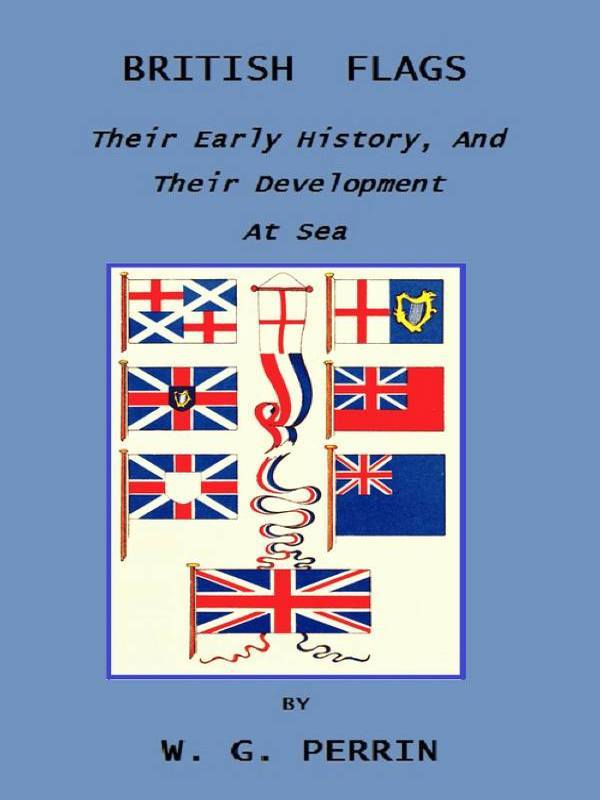
(iv) PENDANTS OF COMMAND
(a) The Commodore's Broad Pendant
Although the use of a specially large pendant to denote the presence of the officer in command of a squadron was not unknown in early days[283], the custom was not adopted in the English fleet until the latter part of the seventeenth century. Introduced first in 1674 simply to denote the ship of the officer in command for the time being of that important roadstead the Downs, the natural rendezvous of all ships going to and from the Thames and Medway, the custom was extended in 1690 to embrace the case in which a small squadron was sent abroad under a captain for whom there was no room on a Flag List which had become restricted to the nine admirals of the red, white, and blue colours.
On 14th November, 1674, in the course of a debate by the King and the Admiralty Board concerning the flying of pendants by foreign men-of-war in the Downs, the question was raised as to the desirability of marking the ship of the officer in command there, when that officer was not of flag rank. The summary of this discussion, recorded by Pepys in the Admiralty "Journal," contains so many points of interest that it seems desirable to reproduce it in full.
14 Novr 74
Present
The King
| Prince Rupert | Mr Secy Coventry |
| Lord Treasurer | Mr Secy Williamson |
| Mr Vice Chamberlaine | |
| Navy Offrs attending |
Upon readeing another Lre from Capt Dickinson in ye Hunter, Commandr in Cheife in ye Downes, disireing direction how to demeane himselfe in reference to any forreigne Men of Warr which shall come into and remaine in ye Downes with ye Pendant in ye Mainetop, while his Mats ship at ye same time Comanding there shall ride without other Marke or distinction then that of a Pendant in ye Maintop, vizt whether hee shall suffer ye said forreigne Man of Warr to continue rideing with his Pendant up, or cause it to be taken downe; and it being, upon discourse thereon, observed first that Pendants originally were not at all designed as a mark or distinction, but only ornament. Next, That at this day ye weareing of a Pendant at ye Maintopp is yt which is everywhere become ye Marke of distinguishing a Man of Warr from a Mercht man. Thirdly, That our Ensigns and Jacke, together with their lyeing in ye Admls Birth, will sufficiently informe as well straingers as his Mats Subjects which is ye Comandr in Cheife without ye helpe of ye Pendants, soe as noe mistake can arise from ye want of it either on occasion of applications to be made or respect to be paid to her. Lastly, That noe difficulty has at any time heretofore been made of permitting Straingers Men of Warr to weare their Pendants in presence of ye Comandr in Cheife in ye Downes, noe more than elsewhere. The respect challenged by his Maty lying not in ye lowreing of ye Pendant but ye fflagg or Topsaile which was now avered by Mr Vice Chamberlaine and Sr Jeremy Smith, as it had lately been to Mr Pepys by ye body of ye Trinity House of whom hee had on this occasion lately inquired after the knowledge and observation of ye Eldest Seamen there. Whereupon it was resolved by his Maty and their Lordps, that ye loureing of ye Pendant and kepeing of it downe is not in this case to be exacted, and yt Capt Dickinson should be accordingly directed therein, But in case upon further inquiry into this matter (wch Mr Pepys was ordered to make wth ye Offrs of the Navy) it should be found needfull (with respect either to decency or use) that some distinction be observed betweene his Mats Ship Commanding in Cheife (and not beareing a Flagg) and others of his Mats Ships or his Subjects rideing in ye Downes at ye same time, some convenient marke or distinction be by them Propounded to his Maty & my Lords on that behalfe in order to their further determination thereon.
On the 18th Pepys sent the Navy Board a memorandum
to put them in mind of considering how far it may be necessary for the ship which shall command in chief there, and which from her quality and the saving of charge shall not be allowed to wear a flag, be appointed to bear some mark of difference, and if so what may be proper to be established without exposing the King to the extraordinary charge of a flag[284].
After a week's consideration the Navy Board replied that
in case the evills that may arise from the want of this distinction are such as shalbee thought necessary to bee prevented, wee doe humbly acquaint yor Lopps that in our opinion severall inconveniences fitt to be prevented may accrew in case severall of his Maties Shipps doe at one and the same tyme ride in the Downes and it bee not knowne which of the said shipps doeth command there in cheife[285].
They therefore humbly conceived it expedient to appoint, as a mark of distinction, a Red Pendant, somewhat larger than ordinary, on a small flagstaff at the main topmast head. With a view to saving expense they were careful to suggest that the
Flaggstaff & Pendant when the shipp by whome it was worne happens to leave the Downes shall bee delivered to such other shipp there as shall bee appointed to succeed in the roome of the former, or if there bee noe such shipp there, then that the same bee sent on shore to Deale and lodged there with his Maties Muster Master[286]
until it was again wanted. Their fear that they might have to supply every likely ship with a staff and distinction pendant is perhaps the reason of the hesitating reluctance which their letter displays.
The Admiralty approved their proposals, and on the 12th December issued the necessary order, being careful to add that it was done "without any extra wages to be allowed for the same[287]."
The arrangement seems to have been viewed with some apathy by those concerned, probably because there were no extra wages attached, for in June, 1676, Pepys wrote to his brother-in-law, the Muster Master at Deal, reminding him that it was his duty to see the order complied with, and at the same time informing Captain Sir R. Robinson, then Commander-in-Chief in the Downs:
I am to note to you that his Majesty's last orders authorised you to wear the pendant of distinction which was some time since established ... the wearing which pendant I fear hath been for some time neglected, but the King's said orders will remedy it by your calling for it from his Agent at Deal and putting it up according to the establishment ... which will abundantly I hope distinguish you[288].
Pepys in his Miscellanea has given us a drawing and description of this pendant, from which it appears that it had the St George's cross in a white field in chief and was five breadths (4 ft 7 ins.) broad at the head, and 21 yards in length, whereas the ordinary pendants were only three breadths (2 ft 9 ins.) at the head and varied in length from 22 to 32 yards according to the size of the ship. Both were "swallow-tailed" (i.e. slit at the end of the fly).
In 1683 the Navy Board had again to be reminded that this distinction pendant was to be used, but by 1692 it had become so popular that "some Commanders of their Mats ships do take the liberty to wear distinction pendants without order for the same[289]," and they were strictly forbidden to do so.
In 1695 the use of this pendant was extended to the senior captain of ships cruising in the "Soundings" at the entrance to the Channel.
In the meantime another form of distinction pendant was introduced, in which the St George at the head was replaced by the Union. This form was for use abroad, in analogy with the practice by which Admirals sent abroad were ordered to wear the Union flag when out of the Channel, instead of their squadronal flag. As early as 1687 Pepys had noted the use abroad of a red ensign with the Union instead of the St George in its canton. At this date the St George's flag was still being flown by Genoese ships, and it was doubtless the desire to avoid any misunderstandings on this account that led to the disuse, before 1707, of the St George's flag by English men-of-war outside home waters. For some unexplained reason this form of ensign had become known as the Budgee flag, and this name was later transferred to the Union Broad Pendant, which became known as the Budgee Pendant[290] and was no doubt the parent of the modern word "Burgee."
The first instance of the use of the Budgee Pendant occurs in December, 1690, when Captain Aylmer, appointed Commander-in-Chief of the squadron intended for the Mediterranean, was ordered to be supplied with a distinction pendant "made with ye Union Crosses in place where other Distinction Pendants have only St Georges Crosse[291]."
Three years later the Earl of Danby, Captain of the 'Royal William' in the fleet under the three joint-admirals, was ordered to wear this same pendant and given precedence next to the Flag Officers[292], and in 1697 Captain J. Norris was appointed Commander-in-Chief of a squadron bound to Newfoundland and ordered, when out of the Channel, to "wear such a swallow tail pendant as Mr Aylmer had when he commanded a squadron in the streights, and which was afterwards worne by the Earle of Danby[293]."
All these officers, whether commanding-in-chief like Aylmer or in subordinate command like Danby, were serving in a position afterwards known as that of "Commodore." This title, derived from the Dutch "Commandeur" (originally the senior officer of a merchant fleet) which had been adopted in the Dutch navy from their merchant service at the end of the sixteenth century, was introduced into the English navy about 1695, no doubt as a consequence of the close connection between the two navies under "Dutch William." It was, however, not yet officially recognised; in their official orders the officers were simply "Captain" or "Captain and Commander in chief." They received a special allowance, usually 10s. a day, while so acting. Later on the importance of some of these positions was enhanced by the introduction, in certain cases, of a second captain into the Commodore's ship. This practice, which was in vogue at least as early as 1720, does not seem at first to have entailed any difference in flag or pay, but it made an important difference in prize money, for those Commodores who had Captains under them were treated in this respect as though they were flag officers.
In 1731 the Admiralty attempted to establish the rank of Commodore by providing for three posts of this rank in the Regulations and Instructions for his Majesty's service at sea, then for the first time gathered together in one book, but the Privy Council struck out all the articles relating to this proposal before recommending the book for the king's approval. The title was, however, formally recognised in 1734 by an Order in Council which, in laying down the relative precedence of Sea and Land Officers, provided "That Commodores with Broad Pendants have the same respects as Brigadiers-General," but the rank remains to this day a "temporary" one, carrying special pay and privileges but giving the captain holding it no authority over captains senior to him on the list.
Regulations governing the rank first appeared in the King's Regulations of 1806. The Broad Pendant was to be of the squadronal colour and was to have the further distinction of a white ball if the Commodore had no second captain in his ship.
There shall be a temporary rank of Commodore which shall be distinguished by a Broad Pendant, Red, White or Blue....
If the Commodore commands the ship himself the Pendant shall have a large white Ball near the staff and he shall not rank as a Rear Admiral.
Prior to 1806, Commodores appear to have kept their pendants flying in all circumstances. The new regulations, however, directed that if the Commodore met a senior captain, that captain was also to hoist a broad pendant, but if there were more than one senior to him then the Commodore was to strike his broad pendant instead.
This anomalous arrangement was altered in the Regulations of 1824, which provided that no Commodore should fly his broad pendant, or even hold the rank, while in the presence of a senior captain; but the difference in the two positions, dependant on the presence or absence of a second captain in the commodore's ship, was accentuated by dividing the commodores into two distinct classes on this basis; the first class flying the red or white pendant and the second the blue only.
A plain Red Broad Pendant, or a White Broad Pendant with a Red Cross in it, is to be worn by Commodores of the First Class; but when more than one such Commodore shall be present, the Senior only shall wear the Red Pendant, and the other, or others, the White Pendant.
A Blue Pendant is to be worn by Commodores of the Second Class.
With the abolition of the squadronal colours in 1864, the red and blue broad pendants disappeared. Commodores of the first class were to wear the white broad pendant at the main and those of the second class the same pendant at the fore. In boats the latter were to have a red ball in the upper canton of their pendants. From the same cause as that which affected the admirals' flags, this form with the ball soon became the only one in use for the second class.
Originally fourteen times as long as it was wide at the head, the broad pendant became gradually shorter. By the time the red and blue forms were abandoned it had reached its present proportions, in which it is only twice as long as its greatest breadth.
In 1913 the provision that Commodores should strike their broad pendant while in the presence of a senior captain was deleted from the King's Regulations. Commodores take rank and command of each other according to their seniority as captains and without regard to the class to which they belong, so that a Second Class Commodore flying a Broad Pendant with a ball might be the superior officer of a First Class Commodore flying the pendant without the ball, normally the superior flag, and the relative precedence of these flags would thereby become inverted while these two Commodores were in company or in the same port.
(b) The Senior Officers' Pendant
Ten years after the institution of the Distinction Pendant to denote a Commander-in-Chief who did not hold flag rank, Lord Dartmouth, then in command of an expedition against Algiers, hit upon the idea of granting a similar pendant to the senior captain of three or more ships that might casually happen to be in company. His orders, dated 1st January, 1684[294], contain the following provisions:
1. That every younger captain, upon his meeting with an elder Captain at sea or in port (though the rate of the ship which he is in be superior to the other) pay all fitting respect and obedience by taking in his Pendant....
3. That (abroad) wheresoever more than 2 ships happen to be or meet together the eldest Captain shall put up and wear a Pendant of distinction and the other captains shall wear the Ordinary Pendant.
4. That the said Pendant of distinction in this Fleet shall be red with a large Cross at the head and double the breadth of the ordinary Pendant, two thirds the length of it, and cut with a long and narrow swallow tayle.
It was within the competence of Dartmouth to give such an order to the squadron serving under him, but the practice seems to have been kept up after he had left the Mediterranean, for Captain Sir Roger Strickland, writing to Pepys from the Bay of Bulls in September, 1686, complained
Had I wore a Flag in this Expedition, I might then have had a sight of Capt. Priestman's orders for his keeping the King's Ships under his command so long here, at so extra an expence, & I am no less surprised at his wearing a swallow-tail'd flag at his main topmast head much broader than his ensign, having a St Andrew's Cross in it as well as St George's, being indeed such a thing as I never saw, seeming to turn the King's flag & Pendt into ridicule when at ye same time ye D. of Mortmar rides by him wh only a small Pendt...[295].
From a "particular draft" of this pendant given to Pepys it appears that it was very broad and short, with a red swallow-tailed fly, and a blue saltire, surmounted by a red cross, on a white ground at the head. Captain Priestman was brought to book and had to apologise to the king for his action.
The practice of wearing a senior officers' pendant, although never officially recognised, appears to have extended and to have been put down by the following order issued in July, 1692:
Whereas we are informed that some of the Comanders of their Mats ships do take the liberty to wear Distinction Pendants without any order for the same, contrary to the Rules of the Navy: We do hereby strictly charge & require all Captns & Comanders of their Mats Ships & Vessels & others hired into their service That they do not presume upon any pretence whatsoever to wear any other Pendants in the Ships they comand, then the Ordinary Pendants wh have by the constant practice of the Navy been worne in their Mats Ships of Warre without particular order in writing from this Board for soe doeing[296].
After this we hear no more of this pendant until the great change of 1864, when the following provision was made in the regulations promulgated on that occasion:
When two or more of Her Majesty's Ships are present in Ports or Roadsteads, a small Broad Pendant (White, with the St George's Cross) is to be hoisted at the mizen-top-gallant-mast-head of the Ship of the Senior Officer.
A slight modification was introduced in the King's Regulations of 1906, which ordered that in ships with less than three masts this pendant should be hoisted at the "starboard topsail-yard-arm." This was again modified in 1913 when the senior captain at a port, if the senior naval officer there present, was instructed to hoist this pendant at the masthead while any Commodore junior to him on the list of captains was also present in that port.
FOOTNOTES:
[215] The art of Heraldry was not established until the thirteenth century, and the armorial bearings associated with the names of our kings before Richard I are the inventions of the mediaeval heralds, who, in their anxiety to give their art a foundation in the past, did not hesitate to assign arms even to the psalmist David.
[216] Or leopards. See Ency. Brit. s.v. "Heraldry."
[217] The claim was renounced by the Treaty of Bretigny in 1360, to be renewed again at the suggestion of Parliament in 1369: presumably the French Arms were not used between these years.
[218] E.g. seal of the Exchequer of Ireland (Commonwealth).
[221] Fox-Davies, Complete Guide to Heraldry, 1909, p. 607.
[222] Its use was discontinued on the official adoption of Howe's Signal Book in 1790.
[223] Froissart, i (MS. de Rome).
[224] eux.
[225] Froissart, i.
[226] Hakl. Voy. vii, 141.
[227] S. P. Henry VIII, ccv, 160. Instructions drawn up by Sir John Hawkins in the latter part of Elizabeth's reign contain the same provision. "Item the Ld. Admirall shall beare a flagg of the Armes of England upon the Top of his Mayne-mast. And a flagg of St. George one the foretopmast."
[228] Rawlinson MS. A 192.
[229] Buckingham flew the standard during the Ile de Ré expedition of 1627.
[230] Cal. S. P. D. 15th June, 1624.
[231] Penn, Memorials of Penn, i, 262.
[232] S. P. D. Chas. I, dxviii, 120: "I desire you to provide and send downe twenty Pendents of my Colours viz. Yellowe and Tawny for the ships that accompany mee to sea. And I shall n(ee)d a newe Standard for the St George."
[233] Clarendon S. P. ii, 468, 9.
[234] These arms and device were also used on Proclamations issued in January, 1689.
[235] This is especially seen in the case of the Earl of Lindsey, who had nevertheless been granted the extraordinary privilege of pardoning penalties inflicted by Martial Law in his fleet, a power that did not appertain even to the Lord High Admiral.
[236] I.e. the anchor flag; this is confirmed by a sketch of the flags ordered on 20th March, 1702, in Rawlinson MS. C 914.
[237] Adm. Sec. Out Lrs. 182.
[238] I.e. H.M.S. Prince.
[239] This is perhaps due to the fact that the English Lord Admirals adopted a ship in full sail upon the obverse of their seals. We have no specimen of the reverse or counter-seal earlier than that of Nottingham. As the anchor is found on the reverse of this seal it is possible that it was upon the reverse in the earlier seals.
[240] The author is indebted to Mr R. G. Marsden for this reference.
[241] Reproduced in Hakluyt Society's edition of Hakluyt's Voyages, iv, 208. The engraving may be dated circa 1600.
[242] A conventional design of an anchor and cable, in which the cable is entwined about (or, as seamen say, foul of) the stock and shank.
[243] The seal of the Royal Commissioners for the High Admiralty of England.
[244] A variation of it, in which the cable passes loosely through the ring and ends in extravagant flourishes on either side, was in use by Pepys in 1673.
[245] Plate VIII, fig. 1. On the seals the anchor was vertical, but in the flags it was usually placed horizontally. The foul anchor in the Admiralty seal since 1725 has, however, been of a design similar to that on the York Water Gate.
[246] S. P. D. Chas II. lxvi. 74.
[247] Pepys MSS. Miscellanea, ix.
[248] Pepys MSS. Miscellanea, ix.
[249] Ibid. Naval Minutes.
[250] Throughout the sixteenth and seventeenth centuries the term "Admiral" was used of the ship as well as of the officer in command. The rank, moreover, until the latter part of the seventeenth century, was purely local and temporary, and simply denoted the senior officer for the time being of the ships in company.
[251] See lists in Nicolas, History of the Royal Navy, i, 435, and ii, 524. It is a curious circumstance that in nearly all these cases the fleet was directed against Scotland. One exception to the rule occurs in 1315 when John of Argyle was appointed "Captain of our fleet of ships which we are shortly about to send to the Scottish parts." Under him were placed "William de Crey and Thomas de Hewys, Admirals of the fleet of the King's ships," who were "commanded that they be obedient and responsive to the same John."
[252] Vide Nicolas, History of the Royal Navy, i, 178.
[253] Ensign, in the original sense of insignia; the modern "ensign" does not appear to have been used in the English navy before the latter part of Elizabeth's reign.
[254] Froissart, i, 255.
[255] Harl. MS. 309, fol. 4.
[256] I.e. in both the main-mizen and the bonaventure (or after) mizen tops; the large ships of this period were four-masted.
[257] S. P. Henry VIII, ccv, 160.
[258] "Though the use of a Rear Admiral is but a late invention in comparison with the other two and is allowed but the ordinary pay of a Captain" (Naval Tracts of Sir Wm Monson (N. R. S.), iv, 1).
[259] The French employ the term "contre-amiral" and the Dutch the curious locution "Schout-bij nacht," i.e. "Bailiff by night." The offices of Lord High Admiral, Admiral, and Vice-Admiral were adopted by England from the French.
[260] Pepys MS. and Rawlinson MS. c, 846.
[261] Edited by Sir Julian Corbett and published by the Navy Records Society in 1902 (Miscellany, vol. i) with facsimiles of the diagrams.
[262] Pipe Off. Dec. Acc. 2232.
[263] Corbett, op. cit. Descriptions of flags are very rarely given in the accounts; usually only the size and price appear.
[264] These flags would be about 6 yards long by 5 yards deep.
[265] S. P. D. Chas I, v, 31.
[266] A ship not bearing an admiral's flag was called a "private ship"; but before 1650 the term "private man-of-war" almost invariably denotes a merchant ship having letters of marque, afterwards called a "privateer."
[267] Cf. Boteler Dialogue, 5: "The use of them is in Fleets to distinguish the Squadrons, by hanging of them out in the Tops; as all those Ships of the Admirals Squadron hang them out in the Main-top; those of the Vice Admirals in the Fore-top; and those of the Rere Admirals in the Missen-top; and here also they are of different Colours." See also Monson, Book iii.
[268] A Relation Touching the Fleet and Army of the King's most excellent majesty King Charles, set forth in the first year of his highness's reign, and touching the order, proceedings and actions of the same fleet and army, by Sir John Glanville, secretary to the Council of War (Camden Soc. N. S. vol. xxxii, p. 83).
[269] Op. cit. "The Rere Admirals place with the white flagg to be borne in the mayne topp was assigned ... to my Lord Denbigh."
[270] Corbett, Fighting Instructions, 1530-1816 (N. R. S.), p. 49.
[271] S. P. D. Inter. xxxii, 39.
[272] Rawlinson MS. A 227. Cf. also the Instructions of Goodson to Penn 21st June, 1655. "You shall wear the jack-flag upon the maintopmasthead" (Memorials of Penn, ii, 116).
[273] Strictly speaking, the "chief" embraced the whole of the hoist. In the ensigns the cross occupied only the upper part of it, being placed in a white canton in the red and blue ensigns. See Plate IX, figs. 10, 11, and 12.
[274] Pepys MS. Miscellanea, ix. Pepys proposed also to restrict the number of admirals' flags flown, according to the number of ships in a fleet.
[275] Admiralty 2/5.
[276] Admiralty 2/11.
[277] Admiralty 2/182.
[279] The rank of Admiral of the Red was not created until Nov. 1805. The Admiral of the Red Squadron was either the Lord High Admiral, flying the anchor flag, or the Admiral of the Fleet, flying the Union.
[280] See Plate VIII, fig. 4.
[281] Admiralty 2/182.
[283] A broad green pendant was used by Doria at Lepanto (see p. 112), and Drake was noted by the Spaniards for the inordinate size of the pendant he displayed.
[284] Catalogue of Pepysian MSS. (N. R. S.), ii, 400.
[285] Admiralty 1/3546.
[286] Admiralty 1/3456.
[287] Admiralty 2/1.
[288] Catalogue of Pepysian MSS. (N. R. S.), iii, 210.
[289] Admiralty 2/9.
[290] In 1710 Captain Warwick was refused permission to use the "Bugee Pendant"; Admiralty 2/453. Millan's Signal Book (1746) contains an illustration of the "Budgee Broad Pendant."
[291] Admiralty 2/171.
[292] Admiralty 2/11. Orders of 31st March and 1st May, 1693.
[293] Admiralty 2/23, 15th March, 1697.
[294] Pepys MS. 2867.
[295] Pepys MSS. Miscellanea, ix.
[296] Admiralty 2/9.
Chapter V
Colours of Distinction
Boteler, in his Dialogues, reminds us that "Flaggs (to speake properly) are only those which are borne out in the Topps of Shyps, and they serve as Badges, and that as well for the distinguishing of Nations as Commanders ... the others are named the Colours or Ensigns and Pendants." To these was added in 1633, while he was writing these Dialogues, the jack, or small Union flag flown at the bowsprit, which, with the ensign and pendant, completed the "suit of colours" for a ship of war. The differentiation by this means of the various classes of public and private ships reached its culminating point by the middle of the nineteenth century. At that period British ships were divided into five categories, each with its own special flags of distinction, according to their employment, as:
1 Public ships of war.
2 Private men-of-war.
3 Public ships for uses other than war.
4 Merchant ships.
5 Pleasure craft.
Since that date the "colours" of the first of these five classes (and incidentally those of the third and fourth classes) have been simplified by the abandonment of the squadronal colours in 1864, while the second class has disappeared in consequence of the abolition of privateering by the Declaration of Paris in 1856.
(i) PUBLIC SHIPS OF WAR
The Distinction Colours proper to a British ship of war are the Pendant, Ensign and Jack. Of these three flags the pendant (or streamer, as it was originally named) is by far the most ancient, dating back to the days when there was no rigid distinction between public and private men-of-war, when every ship owned by an Englishman was, in the eyes of the law, the king's ship, and might be requisitioned for his use at a moment's notice and, with the aid of a few planks and balks of timber, be converted into an efficient ship-of-war, with fore and after castle and fighting-top complete. Besides such "castles" a ship, devoted for the time being to warlike purposes, whether in a national or semi-private quarrel, had as a distinctive mark, from the end of the thirteenth century onwards (and probably from an even earlier date) a huge streamer displayed from the masthead, or hung from the fighting-top, and often reaching down to the water.
These colours, first the pendant, then from 1634 to 1864 the pendant and jack, and finally all three of them together, have served to distinguish ships "of war" from ships not fitted out for war, but the pendant and ensign, with occasional assistance from a masthead flag, have also served for a secondary distinction within the main category "of war," namely, that tactical distinction of lesser groups among a collected body of ships of war which may be termed squadronal distinction.
Squadronal distinction colours were the outcome of the development of naval tactics. So long as a battle between two opposing fleets of any size is to be fought pell mell, like a gigantic football scrimmage, there is obviously no need for other flags than such as mark out the two opposing parties, with perhaps the addition of special flags of command to denote the ships of the two leaders. But directly the attempt is made to bring intelligence to bear as well as courage and brute force, to derive advantage from superior skill in manoeuvring, and to use the ship itself as an actual weapon instead of a mere transport to carry opposing warriors into touch with each other, it becomes necessary to co-ordinate the movements of the various ships under the direction of some master mind. If these ships are few in number their movements can be readily directed from one centre; but if they are many, experience shows that the whole fleet must be divided into distinct parts (called squadrons) of which the principal one will remain under the direct control of the commander of the whole fleet, while each of the others is placed under the immediate control of a subordinate commander, who is directly in touch with the Commander-in-Chief and acquainted with his intentions and wishes.
It then becomes necessary to furnish the ships comprising the various squadrons with some means whereby they may be readily distinguished should they become separated, or should the fleet fall into temporary disorder.
Among the ancient Egyptians, Greeks, and Romans this appears occasionally to have been provided for by painting some part of the ship in a distinctive colour[297], but this method has the disadvantage that the ships of the various squadrons are not readily interchangeable, and it appears to have gone out of use before the Christian era.
With the passing of the great days of the Greek states the art of sea warfare suffered an eclipse from which it did not recover for many centuries, and we meet with no further indication of the existence of fleets organised in squadrons until the thirteenth century of our era. The proper stimulus for the development of the art of fleet tactics can only be supplied by the collision of two maritime powers of fairly equal intelligence and resources. This condition was first supplied by the rivalry of Genoa, Pisa, and Venice for the sea-borne trade of the Mediterranean.
The great fleet fitted out by Genoa in 1242 affords one of the earliest recorded instances (perhaps the earliest) of a tactical division into squadrons by means of flags. The circumstances have already been related, and it will be remembered that the squadron leaders were then distinguished by flags appropriate to the district from which they had been selected. This method is evidently insufficient, for although it enables the individual ships of a squadron to recognise their leader, it does not enable that leader to distinguish his own ships in the confusion of battle. The next step is to distinguish the individual ships by suitable flags according to their squadrons. We do not know when this step was taken, but it appears from the Instructions issued by Amadeo of Savoy in 1366 to the combined fleet under his orders[298] that each galley then carried the standard of the Commune whence it came, so that it is possible that the galleys were at that time organised in squadrons according to their respective Communes. At the great Battle of Lepanto in 1571, which marked the culmination of galley tactics, the combined fleet under the command of Don John of Austria was divided into squadrons with distinguishing pendants.
The first division or right wing numbered fifty-four galleys, and was commanded by Giovanni Andrea Doria, whose galley was distinguished by a broad green pennant at the peak of the mainyard, smaller pennants of the same colour being displayed in the same position by the other vessels of the division. The centre, under Don John of Austria, consisted of sixty-four galleys, with blue pennants flying at the masthead. The left wing of fifty-three galleys was commanded by Agostino Barbarigo, and was marked by yellow banderoles on the foreyard, that of the leader flying at the peak of the mainyard. A rearguard or reserve followed the line of battle, and was composed of thirty galleys under the Marquis of Santa Cruz. They displayed white pennants from a flagstaff over the stern lamp[299].
But in the stormy seas of northern Europe the galley never became naturalised, and it was long before the teaching of the school of tactics that had grown up in connection with it came to be applied to the larger vessels required for the navigation of these waters. The fleet under Hubert de Burgh, which in 1217 put an end to Lewis the Dauphin's hopes of adding the Crown of England to that of France, made use of only elementary tactics, though indeed these proved amply sufficient, and very little advance had been made three centuries and a half later, when the Spanish Armada was crushed and driven away from the shores of England[300].
No attempt appears to have been made to divide an English fleet into squadrons with distinctive signs until the reign of Henry VIII. After the rather unsatisfactory battle with the French fleet off Portsmouth in July, 1545, Henry, who was of no mean ability in naval affairs[301], had evidently seen the need for better organisation, for when the fleet put into the Channel to deter the French from raiding the Sussex coast it was divided into three divisions distinguished by having the English flag at different mastheads, as is shown by the orders issued for the occasion:
... every ship appoynted to the battaill shall beare one flag of saint George's crosse in his mayne toppe ... and every ship appoynted to the vanward shall beare one flag of sainte George's crosse in his fore toppe ... and every Shipp Galliasse pynnesse and Shalupe appoynted to the wyng shall have in ther mesyn toppe one flag of saint George's crosse[302].
This seems to have been the only occasion on which an English fleet was divided into squadrons distinguished by means of the same flag flown at different mastheads. In two years from that date Henry was dead, and the organisation of the navy sustained a set-back from which it took many years to recover. It was not until the results of the first day's fighting against the Spanish Armada in 1588 had shown the necessity for better organisation that any further attempt was made to divide the fleet into squadrons. There is no indication in the State Papers of the steps then taken to mark the squadrons, but from the fact that the arrangement was impromptu and that there was no time available for providing special colours it is probable that only the squadron leaders were distinguished by their flags.
In his expedition against Lisbon in the following year Drake made an attempt to remedy the prevailing want of method.
The Armada campaign, as we have seen, had taught the sailors the danger of entirely discarding the old military methods; they had learnt the strength that the Spaniards gained by their squadronal system, and under the soldiers' influence we find an elaborate scheme for "squadronising" the fleet that is something entirely new, and obviously founded on the existing military system[303].
Here, again, we know nothing of the method adopted to distinguish the squadrons, but it seems to have been largely a paper one.
Such was the first attempt to remedy the vices of the radical revolution which the sailor-admirals had brought about. That it smacked too much of the camp to please the seamen is not to be doubted. Excellent as it looked on paper, for some reason it took no hold; and for a thorough and lasting fleet system the English navy had to wait till half a century later, when the exploits of the new school of soldiers had so entirely weaned the country from its "idolatry of Neptune" that Cromwell and his soldier-admirals were able to force their ideas upon the seamen[304].
It is evident that the plan took no hold upon the navy, for the Instructions for a fleet at sea drawn up by Sir John Hawkins some time between this date and his departure on his and Drake's last voyage in 1595 contain no provision for any such division by squadrons[305].
The first instance, after 1545, of the systematic division of the fleet into squadrons occurs in the Cadiz Expedition of 1596. There were four English squadrons and one Dutch. The squadronal colours of the admirals have already been fully described, but, unfortunately, we have no record of the colours worn by the private ships. There were in this fleet sixteen ships belonging to the Crown: these were supplied with 145 flags and ensigns at a cost of £371. 8s. 4d., but although the size and price of each flag is given, the colours are never once mentioned in the accounts[306]. From the variations in the prices of flags of the same size, it is clear that they were of many different patterns. Possibly each ship wore an ensign of the same colours as the squadronal flags of the admirals; if so it was the first occasion on which this method was used.
One thing alone is clear; the distinction was not made by the pendants, which appear all to have been white[307] and hung only from the mizen yards. Yet it was the pendant which was ultimately adopted as the squadronal distinction colour. The first definite proposal to this end occurs in the "Notes on Sea Service"[308] submitted by Captain John Young to the Earl of Essex, probably just before the Cadiz Expedition of 1596. Young, who commanded merchant ships in the naval operations of 1588, 1589, and 1596, writes:
That the Lord High Admiral, or any of the Admirals having charge of their several squadrants or quarters, and companies unto them appointed, and if they would know which of all their companies or squadrants so appointed do come into the fight or no. Then it is very convenient and very necessary to know who doth or doth not come in, and that every Admiral and all his own company must wear upon their mizen yardarms pendants, and look how many Admirals you have—so many several colours of pendants you must have also, unto the full complement of your ships, barks, and pinnaces. By which means and being accomplished you shall easily see and perceive who doth come into the fight or not, which without these sundry colours of your pendants it cannot be otherwise perceived, for that divers ships being something afar off may resemble one another and not be known the one from the other for these sundry coloured pendants[309].
This proposal was not adopted in 1596, but in the Algiers Expedition of 1620 the fleet was divided into three squadrons, the ships of which were distinguished by pendants at the main, fore, and mizen tops respectively.
... the Admirall Squadron was kept sixe leagues from the shore with pendants in the maine toppes for their signes: the Vice Admiral's squadron three leagues without him, on his bowe, with pendants on his foretops, the Rear Admirall three leagues within him, on his quarter, with pendants on their mysentops.
The colours of these pendants are not stated, but from the pictures of the homecoming of the Prince of Wales in 1623, now at Hampton Court and Hinchinbrook, it appears that the pendant was still white, as in 1596, with the St George's cross at the head. The same arrangement of pendants was employed for the fleet which transported the Queen from Boulogne in June, 1625[310].
For the great expedition to Cadiz which set forth in October, 1625, the pendants, while still displayed at the three different mastheads according to the squadron, were further distinguished by being made of different colours. The Admiral's Squadron had red pendants at the main; the Vice-Admiral's, blue pendants at the fore; and the Rear-Admiral's, white pendants at the mizen.
The field of the ensign had, since its introduction about 1574, been of striped design[311]. In 1621 a large red ensign was manufactured at a cost of £4. 16s., and a few more were made in the following years. The suggestion for a general change to this colour emanated from Sir F. Stewart, the Rear-Admiral of the fleet, who had been nominated Admiral of the White Squadron for the Cadiz Expedition. Writing to Sir John Coke from the 'Lion' on 2nd July, 1625, he says: "A red ancient would become every one of the King's ships." Owing to the defective state of his ship, Stewart did not accompany the expedition when it finally sailed, but his suggestion was evidently adopted, for the surveys of ships' rigging made in January of the following year contain several entries of red ensigns, "serviceable" or "decayed," but as these are accompanied by other entries for the same ships of "ancients" which are not particularised, it is clear that the older ensigns were not all immediately withdrawn from service. Probably, from motives of economy, they were retained in use until worn out.
The flags flown by the Admirals of the various squadrons of the fleet that sailed to the Ile de Ré in 1627 have already been described; no record has, however, been preserved of the method (if any) by which the private ships of those squadrons (which were composed largely of merchantmen) were distinguished. The probability is that they did not wear any special ensigns or pendants.
A survey of the stores at Deptford carried out in April, 1633, gives the following flags:
| Standard for the maintop | 1 | |
| Red Ensigne for ye mainmizen | 1 | |
| White Ensigne with ye kings armes | 1 | |
| Red and White Ensigne with ye St George's crosse | 1 | |
| fflower de luce & roase | 1 | |
| Standard for the barges head | 1 | |
| White ensigne with ye guilded lyon | 1 | |
| White ensigne guilded lyon & crowne | 1 | |
| White ensigne guilded unicorne | 1 | |
| White ensigne with rose and crowne | 1 | |
| White ensigne flower de luce & crowne | 1 | |
| White ensigne with ye Scotch armes | 1 | |
| Red ensigne with ye Lo. Admiralls badge | 1 | |
| Brittaine Flagge | 1 | |
| Pendants | 26 | |
| * * * * * * | ||
| fflags of 18 breadthes | 1 | |
| 16 " | 1 | |
| 12 " | 5 | |
| Ensignes 18 " | 1 | |
| 14 " | 6 | |
| Striped ensignes | 4 | new but unsbl. |
| Red ensignes returned from sea | 2 | unsbl. |
| Chest to put fflaggs in | 1 |
As the four striped ensigns are reported "new but unserviceable" it may be inferred that the old striped form had now been definitely abandoned. Moreover, a similar survey carried out the month before at Portsmouth contains entries of four new "White Ensignes" and two new "Blew Ensignes," so that the white and blue ensigns had by 1633 made their appearance in the fleet. Unfortunately, the almost complete disappearance of the naval records of this period prevents us from ascertaining the precise occasion of the birth of these two ensigns; but they do not appear to have been yet in general use for distinguishing the private ships of squadrons, for Boteler, in his Six Dialogues written at this date, states that pendants were employed for that purpose.
Admiral. Colours and Ensignes I take to be all one, but wher are they to be placed and wherefore serve they?
Captain. They are placed in the Sternes or Poops of Ships; and very few Ships there are, whether Men of Warre or Merchantmen, that are without them. And their especial Service is, that when any strange Shypps meet one with another at Sea, or fynde one another in any Harbour or Rode, by the shewinge abroade thes Ensigns or Colours, it is knowne one to another of what country they are and to what place they belong.
Adm. Serve thes Colours or Ensigns for noe other employments but only this?
Capt. Yes to many other, by waye of direction[312], as shall be sett downe largely in our next dayes discourse.
Adml. What are the Pendants you mentioned even now, and wherefore serve they?
Capt. A Pendant is a long Piece of silk or other stuff, cut out pointed wise towards the end in form of a streamer, wher they are slit into two partes, and the use of them, to distinguish the Squadrons of great fleetes by hanging them out in the topps of suche shyps as carry noe flaggs. As, for example, all suche Shypps as are of the Admiralls Squadron are to hang them out in their maine topps, thoes of the Vice Admiralls Squadron in their Fore-tops and thoes of the Reare Admiralls in their Missen-tops. And here alsoe they are to be of severall Colours. But besides this use, in great ships and especially suche as belong to the King, they are often used by way of trimme and braverye, and are then hung out att every Yarde-arme and att the heades of the Masts. And thes only are their uses and employments.
It was not until the crucial period of the First Dutch War that the practice of supplying all the ships of a squadron with ensigns of the squadronal colour became established. The proposal to divide the fleet into three squadrons, one under each of the three "Generals at Sea," with red, blue and white ensigns and pendants respectively, was first made in January, 1653. This was apparently one of the results of the attempt then being made to improve the fleet tactics in view of the unsatisfactory results of the earlier actions of the war[313]. It was, however, not until early in March that definite steps were taken for this purpose. The Navy Commissioners then gave orders for the urgent manufacture of a number of pendants and ensigns, forty of each colour, all having the "red crosse in chief," the order of precedence of the colours being at the same time changed from red, blue, white, to red, white, blue. This new order of precedence remained unchanged until squadronal colours were abandoned in 1864.
The circumstances in which the St George's cross was introduced into the fly of the white ensign in May, 1702, have already been detailed. The old form with plain fly was, however, not immediately superseded; both forms were in use as late as 1717, but by 1744 the older form had entirely disappeared. It is difficult to understand why the two forms should have been allowed to continue after the short time requisite for wearing out any ensigns of the earlier pattern that might be in existence when the change was ordered in 1702, but the surveys of stocks and orders for stores establish the fact that it was so, and that the form with the cross through the fly, known as the "St George's ensign," was at first issued only to ships which were appointed to serve outside home waters.
On the legislative union of England and Scotland in 1707 the tiny Scots navy came to an end as a separate force, and the "Union" colours, invented on the union of the two crowns a hundred years before, were inserted in all ensigns, naval and mercantile. An Order in Council of 21st July, 1707, established as naval flags the royal standard, the Union flag and "the ensign directed by her Majesty since the said Union of the two Kingdoms," which from the coloured draughts attached to the order is seen to be the red ensign. The white and blue ensigns are not mentioned in this Order; evidently the red ensign was alone regarded as the legal ensign of Great Britain and the others as merely variations of it for tactical purposes. In conveying this Order to the Navy Board, the Lord High Admiral instructed that body
to cause the several ships and vessels of the Royal Navy to be with all possible dispatch furnished with Colours accordingly, and for the speedier and cheaper doing the same ... to order St George's Cross to be taken out of all the ensigns and a Union Jack Flagg put into them in the roome thereof, or to alter the said Colours in such other manner as you shall judge best for the Service.
It was found that the jacks in store were not of the same shape as the old canton, so finally all the ensigns were returned to the contractor "to be made Union."
Except for the slight change caused by the insertion of the Irish Saltire in accordance with the Royal Proclamation of 1st January, 1801, on the legislative union of the Irish Parliament with that of Great Britain, no further change in the design of the three ensigns has taken place, though the shape has been gradually altered from a proportion of roughly 5 by 4 to that of 2 to 1. By Order in Council of 9th July, 1864, the squadronal use of the ensigns in the navy was abandoned, and the principal ensign, the red, was made the exclusive property of the Mercantile Marine, which had shared it in common with the navy since the time of Charles I. The second ensign, the white, was retained for H.M. ships, and the third—the blue—assigned to the Naval Reserve, then recently formed, and to ships belonging to the Civil Departments of the navy and other departments of State.
The reason for this change is set forth in the Memorial of the Admiralty Board to the Council in the following words:
The Flag Officers of the Fleet, whether Admirals, Vice-Admirals or Rear-Admirals, are classed in Squadrons of the Red, White and Blue, and are (with the exception of the Admiral of the Fleet) authorised to fly their Flags of the colour of the Squadron to which they belong, this regulation necessitating the adoption of ensigns and pendants of a corresponding colour in every ship and vessel employed under their orders, each vessel is therefore supplied with three sets of colours, and the frequent alterations that have to be made when the Fleet is distributed as at present, under the orders of many Flag Officers, is attended with much inconvenience from the uncertainty and expense which the system entails.
The increased number and size of merchant steamships render it a matter of importance to distinguish on all occasions men-of-war and private ships by a distinctive flag; the latter vessels bearing at present the same Red Ensign as Your Majesty's Ships when employed under an Admiral of the Red Squadron. It also appears to us to be desirable to grant (under such conditions as we may from time to time impose) the use of a distinguishing flag to such ships of the Merchant Service as may be employed in the public service, whose Commanding Officer (with a given portion of the crew) may belong to the Royal Naval Reserve. We therefore most humbly submit that Your Majesty may be pleased by Your Order in Council to prescribe the discontinuance of the division of Flag Officers into Red, White and Blue Squadrons, and to order and direct that the White Ensign with its broad and narrow pendant be henceforward established and recognised as the colours of the Royal Naval Service, reserving the use of the Red and Blue colours for such special occasions as may appear to us or to officers in command of Fleets and Squadrons to require their adoption.
It will be seen that the reasons for the change given in this memorial are, first, the inconvenience and expense of keeping up the three sets of colours, and then (apparently as an afterthought) the need of a distinctive flag for the mercantile steamship. But in fact the man-of-war was already clearly distinguishable from the merchantman by its pendant and jack, a distinction that had been found sufficient for a period of two hundred years; a period during which the merchantman was, for the most part, much more like the man-of-war in outward appearance than it was in 1864. The real reason undoubtedly was that the squadronal organisation of the days when squadronal colours were first invented had become obsolete, and changes in tactics had rendered the squadronal colours unnecessary.
Before the change was made the opinions of a number of the leading admirals were taken. The majority agreed that the squadronal colours were no longer necessary and that their abandonment would be for the good of the Service. There were one or two, however, who thought otherwise, and it was pointed out that it had been found convenient during the Russian war of 1854-5 to divide the fleets in the Baltic and Black Sea by means of these colours. When Vice-Admiral Sir Charles Napier took command of the Baltic fleet he found that he and his two Rear-Admirals were all "of the Blue," and he therefore told one of them to hoist the red colours and the other the white, retaining the blue for himself, so that for this occasion the blue was the principal colour. Similarly, both Rear-Admirals in the Black Sea being "of the Red," one temporarily hoisted the white colours.
The fact that the division of fleets into red, white and blue squadrons was no longer a tactical necessity had been to some extent recognised before the end of the eighteenth century, for Howe concluded his fighting instructions, issued in 1782, with the following article:
In action, all the ships in the fleet are to wear red ensigns.
Probably this was inspired largely from fear of the inconvenience that might arise from the white ensign being mistaken for the French national flag, but the fact that Howe issued such an instruction would seem to indicate that he did not regard the squadronal colours as indispensable. Nevertheless, in the battle of the "Glorious First of June" in 1794 his fleet was divided by squadronal colours, and the 'Marlborough' suffered through having her white ensign mistaken for the French national flag, then white with a tricolour canton[314].
Shortly after this the French fleet began to fly the new tricolour flag (as at present used) which had been adopted in February, 1794, but was not supplied to the fleet until October. Thereafter there was no danger of confusing it with the white ensign, and as that was now the ensign most unlike the French flag, it was usually ordered to be flown in action by the Admiral in command. Thus on the 10th October, 1805, Nelson issued the following memorandum:
When in presence of an Enemy, all the Ships under my command are to bear White Colours, and a Union Jack is to be suspended from the fore-topgallant stay[315].
And when the enemy opened fire at Trafalgar, Collingwood (who was a Vice-Admiral of the Blue) hoisted his blue flag, but all the fleet, including his own flagship, hoisted white ensigns. Nelson's device of displaying an extra Union flag to ensure that no mistake should arise as to nationality is of interest, for the same course was at first adopted in the recent war, the British and German ensigns being very much alike at a distance. Early in the war the red ensign was substituted for this Union flag, and the practice of hoisting additional red ensigns on H.M. ships was followed to the end.
By the Colonial Naval Defence Act of 1865 it became lawful for any colony, subject to certain conditions, to provide and maintain its own vessels of war, and these were authorised to wear the blue ensign with the seal or badge of the colony in the fly and a blue pendant. In 1913, as an outcome of the Imperial Conference of 1911, the ships of the Naval Forces of the Dominion of Canada and the Commonwealth of Australia were further authorised to
wear at the stern the White Ensign as the symbol of the authority of the Crown, a White Pendant at the masthead, and at the jack-staff the distinctive flag of the Dominion, viz: the Blue Ensign with the badge or emblem of the Dominion in the fly.
The ships of the Royal Indian Marine occupy a somewhat ambiguous position. Some of them—the floating defences—may be regarded as a Colonial Navy, others might more properly be included in class (3), Public Vessels. The old Indian marine took its rise in 1613, when the East India Company found it necessary to fit out for use only in Indian waters small vessels, which although employed to a certain extent in local carrying trade were sufficiently well armed to be of use in keeping in check the numerous native pirates who sought to prey upon the East Indiaman in those waters, and also to afford protection to the Company's vessels and factories against the ill-will of their European rivals, particularly the Portuguese. After the transfer of Bombay to the Company in 1668 that town developed into the principal seat of the Company's power, and the Indian Marine became known as the Bombay Marine. This gradually rose to such importance locally that from 1759 to 1829 a Captain of this service was annually appointed, as a deputy of the Company, to the post of Admiral of the Mogul Emperor, flying the flag of the Mogul at the main-mast-head and the Company's colours at the stern of his flagship.
From the earliest years the Company's ships were in the habit of flying pendants, and the proclamations of 1694 and subsequent years that forbade the use of these flags by other than H.M. ships were not obeyed—perhaps their existence was not known—in Indian waters. From the beginning of the eighteenth century it became customary to describe the senior officer of the Bombay Marine as "Commodore," and for him to fly a broad pendant. This practice had never received the sanction of the home authorities, though Admiral Watson, who was in command of H.M. ships in the East Indies station from 1754 to 1757, appears to have approved of the use of a common pendant[316] by the Company's armed ships.
In 1764, while carrying out arrangements connected with the evacuation of Manilla, Captain Brereton arrived at Batavia in H.M.S. 'Falmouth' and found there Commodore Watson, of the Bombay Marine, in the Company's ship 'Revenge' flying a red broad pendant. On the approach of the 'Falmouth' this was hauled down and a common pendant substituted. Brereton ordered this to be struck, and Watson thereupon hoisted the Company's colours and a broad distinguishing pendant. Brereton then sent an officer on board to demand that this also should be struck, and after a stormy scene it was done, but the pendant was again hoisted a short time afterwards. A second officer was sent to the 'Revenge,' but Watson positively refused to strike it. The next morning the 'Revenge' was seen clearing for action, with a number of armed men in her maintop to repel any attempt to touch the pendant. A third officer was then sent to the 'Revenge,' and when the junior officers of that ship realised what the result of proceeding to extremities was likely to be they gave up the pendant to him.
This example illustrates well the anomalous position in which the Indian navy stood; on the one hand it was recognised as a Colonial naval force, on the other it was treated as though it were merely a part of the British merchant service.
The position does not appear to have been regularised until 1827, when the Admiralty issued a warrant that granted the ships of the Bombay Marine
the privilege of wearing in addition to the Red Ensign, which all ships belonging to His Majesty's subjects should legally wear, the Union Jack and a long pennant having St George's Cross on a white field in the upper part next the mast with a red fly.
The curious expression "should legally wear" seems to have reference to the fact that the legality of the old striped ensign of the Company had recently been called in question, and its use, except as a jack, had in consequence been abandoned. It will be observed that the Warrant makes no mention of a broad pendant, but the Bombay Marine (or Indian navy as it was called after 1830) evidently still made use of it, for in 1848 the officer acting as commander-in-chief of H.M. ships on the East Indies Station objected to the flying of the red broad pendant, and as a result it was decided that the Commander-in-Chief of the Indian navy should fly a broad pendant, red with a yellow cross, and the Company's cognisance of the yellow lion rampant, holding a crown, in the upper quarter next the staff, the Commodore of the Indian navy serving in the Persian Gulf being allowed a similar flag with a blue field[317].
In 1858, when the Government of India was transferred to the Crown, the military and naval forces were transferred with it, but the Indian navy did not find favour in the eyes of its new masters, and it was abolished. This took place in 1863, when the following ceremony was observed:
At noon on the 30th inst. the broad pennant of Commodore Frushard will be saluted by eleven guns from the battery at the Apollo Pier. The flag of the Indian Navy, long known as "the Company's Jack," will then be hoisted at the Castle flagstaff and saluted by twenty-one guns. At the close of the salute the Indian Jack will be hauled down, the broad pennant of Commodore Frushard and the pennants of all the Indian Naval vessels in harbour will be struck, and the Indian Navy will cease to exist as an effective service[318].
A new "Bombay Marine," consisting of a few small vessels engaged in the local transport and pilotage service of that port, similar to one that had already come into existence at Calcutta, was thereupon instituted. The Indian Marine Service Act of 1884 made provision for placing the vessels belonging to the Government of India under the Naval Discipline Act in time of war, and for constituting such ships vessels of war in the Royal navy. At the same time a warrant was issued authorising the vessels of the Indian Marine (to which the Prefix "Royal" was added in 1892) to fly a blue ensign with a badge of the Star of India in the fly, and a Union jack with a blue border. These vessels were in November, 1921, authorised to fly a red pendant when in commission.