
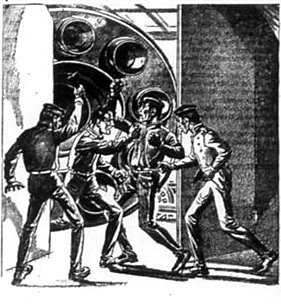
One, swifter than the rest, dashed upon him.
It was red—vividly, dazzlingly red! The body of a reptile—a wild phantasm of distorted dreams—was supported by short, quivering wings. The body was some five feet in length, and it was translucent.
A shell, like the dried husk of some creature long dead!—yet here was something alive, as its quick attack proved. It had a head of dry scales which ended in a projecting black-tipped beak that came like a sword, straight and true for Chet's heart. It seemed an age before he could bring his pistol up and fire.
Detonite, as everyone knows, does not explode on impact; the cap of fulminate in the end of each bullet sets it off. But even this requires some resistance—something more than a dry, red husk to check the bullet's flight. There was no explosion from the tiny shell that Chet's pistol fired, but the bullet did its work. The creature fell plunging to the rocky ground, and its transparent wings sent flurries of dust where they beat upon the ground. There were others that went down, for the bullet had gone on and through the great swarm.
And then they attacked.
The very fury of the assault saved the huddle of humans. So close were the red things pressed together that their vibrating wings beat and locked the swarm into a mass. They were almost above their prey. Chet knew that he was firing upward into the swarm, but the sound of his pistol was lost. The red cloud hung poised in a whirling maelstrom; and the pandemonium of clashing wings whipped down to them not only the sound of their dry scraping but a stench from those reptile bodies that was overpowering.
Sickly sweet, the taste of it was in Chet's mouth; the sound of the furious swarm was battering at his ears as he knew that his pistol was empty.
There were red bodies on the bare rock before him. A scaly, scabrous thing was pressing against his upflung hands that he raised above his head—a loathsome touch! A beak that was a needle-pointed tube stabbed his shoulder before he could flinch aside: the quick pain of it was piercingly sharp....
Other red horrors dropped from the main mass overhead; he saw Harkness beating at them wildly while he made a shelter of his body above the crouched figure of Diane. Two of them—two incredible, beastly, flying things! He saw them so plainly where they hovered, and Harkness striking at them with a useless, empty gun, while they waited to drive home their lance-like beaks.
The picture was so plain! His brain was a photographic plate, super-sensitized by the utter horror of the moment. While the red monster stabbed its beak into his shoulder, while he drove home one blow against its parchment body with his empty pistol, while the wild, beating wings lifted the creature again into the air—he saw it all.
Here were Diane and Harkness! Nearby Schwartzmann was on the ground! His man—the one who had not yet descended with the others—was running stumblingly forward. He was wounded, and the blood was streaming from his back. Chet saw the two monsters hovering above Harkness' head; he saw their thick-lidded eyes—and he saw those eyes as they detected an easier prey.
The fleeing man was half-stooped in a shambling run. The winged reptile Chet had beaten off joined the other two and they were upon the wounded man in a flurry of red.
Chet saw him go down and took one involuntary step forward to give him aid—then stopped, transfixed by what he beheld.
The man was down crouching in terror. Above him the three monstrous things beat each other with their wings; then their long beaks stabbed downward. The man's body was hidden, but through those transparent beaks there mounted swiftly a red stream. Plainly visible, Chet saw that vital current—the living life-blood of a living man—drawn into those beastly bodies; he saw it spread through a network of canals! And he was held rigid with horror until a harsh scream from Harkness reached his brain.
"The trees!" Harkness was shouting. "The trees! Down, Chet, for God's sake! You can't save him!"
Walt was half carrying Diane. Even then Chet was vaguely thankful that their bodies were between the girl and this gruesome sight. And Walt was leaping madly down the lava slope.
Beyond him, already on the lower level, was the racing figure of Schwartzmann. A whirring flash of red pursued him. Another made a crimson streak through the air toward Walt's back. Chet came with startling abruptness from the frozen rigidity that held him, and he crashed his empty pistol in well-directed aim through the body of the beast. Then he, too, threw himself in great leaps down the slope.
Kreiss was firing from below; Chet knew dimly that this was checking the attack of the swarm. He saw Walt stagger; saw blood flowing from a slash on the back of his head, and knew that Kreiss had got the monster just in time. He sprang toward the stumbling man and got his arms under the unconscious figure of the girl to help carry the load.
And now it was Kreiss who was shouting. "The trees! We'll be safe in the trees!" He saw Kreiss drop his pistol and dash headlong for the white trunks of ghostly trees.
His arm was pierced by a stinging pain; cold eyes, with thick, leathery lids, were staring into Chet's as he cast one horrified glance over his shoulder. Then he crashed against the white trunk of a tree and helped Harkness drag the body of the girl between two twin trunks. He pulled himself to safety in the shelter of the protecting trees, and held weakly to one of them.... And the crimson lace-work of the sap-wood that showed through the white bark was no brighter red than the mark of his blood-stained hands where they clung for support.
CHAPTER VIII
Doomed
The sun was high when they ventured forth. Diane would have come, but the two men would have none of it. They remembered the sight they had seen; they knew what was left of a man's body lying on the rocks above; and they ordered the girl to stay hidden while Kreiss remained with her as a guard.
There were only the four who lay hidden in the woods; Schwartzmann and Max, with the remaining three men, were gone. Harkness' calls were unanswered, and he ceased the halloo.
"Better keep quiet," he advised himself and the others. "We are out of ammunition, though they don't know it. And they have got away. They will keep on going, too, and I am not any too well pleased with that. I wanted to put Schwartzmann where I could keep an eye on him.... Oh, well, he isn't very dangerous."
But Chet Bullard made a few mental and unspoken reservations to that remark. "That boy is always dangerous," he told himself, "and he won't be happy unless he is making trouble. Thank the Lord he hasn't got that gun!"
He came out cautiously from among the trees, but the red horde was gone. The reptiles' wings had rasped and clashed furiously for a time; they had darted in fiery flashes before the protecting trees: and the fitful breeze had brought gusts of nauseous odors—until a thin haze formed in the higher air and the red things were gone.
"There will not be any more for a while," said Harkness.
He pointed toward the fumerole they had seen from the lookout earlier in the day: again it was emitting jets of thin, steamy vapor that did not disappear like steam but floated up above their heads. "The gas has driven them off," he added.
The two men climbed slowly up the slope that had been the wave front of molten rock. Chet found his pistol by the path and picked it up.
"We'll get more ammunition up top," he told Harkness, "and we will toss some down to Kreiss. He can have the extra gun you brought for Schwartzmann, too."
He stopped suddenly. He had reached the level top of the lava flow. Here was where they had stood when the beasts attacked; where Harkness had dropped the boxes of ammunition and the pistol—and except for a few scattered bodies of unbelievable reptiles and for a stain of blood where his own wound had bled, there was nothing to show where they had been.
"He got 'em!" Chet exclaimed. "That son-of-a-gun Schwartzmann got the gun and shells. I saw him scrambling around on the rock. I thought he was just scared to death; but no, he wasn't too frightened to grab the gun and the ammunition while one of his own men was being killed. And that's not so good, either!"
A dozen paces beyond was a huddle of clothing that stirred idly in the breeze. "The poor devil!" exclaimed Chet, and moved over beside the body of the man who had gone down under the red swarm's attack.
It lay face down. Chet stooped to turn the body over, though he knew there was no hope of life. He stopped with a gasp of dismay.
Two eyes still stared in horror from a face that was colorless—a drained, ghastly white face! No tint remained to show that this ever had been a living man. More dreadful than the waxen pallor of death, here was a bleached, bloodless flesh that told of the nameless horror that had overwhelmed this man, beaten him down and drained him of every drop of blood.
"Vampires!" Chet heard Harkness saying in a horrified whisper. "Those beaks that were like tubes! And they—they—" He stopped as if in fear of the words that would tell what they themselves had escaped.
Chet turned the body to its former position; that dreadful face beneath a pitiless sun was a sight no other eyes should see. "Let's go on to the ship," he said. "We'll get some ammunition, go back and get Diane—"
He did not finish the thought. Before him he saw the lifeless body moving; it rolled and shuddered as if life had returned to this thing where no life should be. Chet raised one hand in an unconscious gesture as if to ward off some new horror that the body might disclose. It was a moment before he realized that the rock was shaking beneath his feet, that he was dizzy and that from no great distance a rumbling growl was sounding in his ears.
The moving body had shaken Chet's mental poise as had the earthquake his physical equilibrium. Harkness had not seen it; he was looking off across the level plateau.
"Look!" he exclaimed; "another vent has opened! See it spout?"
Some hundred yards distant were clouds of green vapor that rolled into the air. At their base a fountain of mud sputtered and spouted and fell back to build up a cone. The green cloud whirled sluggishly, then was caught by the breeze and began its slow, rolling progress across the flat rock. It was coming their way, rolling down toward the ship, and Chet gripped suddenly at his companion's arm.
"Come on!" he said! "I'm going away from here, and I'm going now. We'll get Diane and Kreiss: remember what a whiff of gas did to him this morning."
He was drawing Harkness toward the face of the rock; he wondered at his slowness. Walt seemed fascinated by the oncoming cloud.
"Wait!" Harkness paused at the top of the descending slope. Chet turned, to look where Harkness was watching.
The green cloud moved slowly. As he turned to stare it touched the bow of their ship; it flowed slowly, sluggishly, along the sides, and then swept up and over the top. The lookouts of the control room were obscured, and the port from which they had come!
"Cut off!" breathed Harkness, his voice heavy with hopeless conviction. "We can't get back! And now we're on our own past any doubt!"
"It may not last," Chet was urging an hour later, when, with Kreiss and Diane, they stood on high ground to look down on the ship.
The sparkling sheen of the metal cylinder had changed from silver to pale green. The cloud that enveloped it was not heavy, but it was always the same. Yet still Chet insisted: "It may not last."
"Sorry to disappoint you," replied Kreiss, "but there is little ground for such a belief." Again he was the professor instructing a class. "These fumeroles, in my opinion, are venting a region far below the surface. It is possible that further seismic disturbances may alter conditions; a rearrangement of the lower rock strata may close existing crevices and open others like this you have seen; but, barring that, I see no reason for thinking that this emission of what appears to be chlorine with other gases may not continue indefinitely."
Chet looked at Diane. Was it a twinkle that appeared and vanished in her eyes as Herr Professor Kreiss concluded his remarks. She would laugh in the very face of death, Chet realized, but her tone was entirely serious as she offered another suggestion.
"If this wind should change," she said, "and if it blew the gas in another direction, the ship could be cleared. One of us could go in long enough to switch on the air generators full."
But now it was Chet who shook his head in a negative. "Remember," he told her, "when we were here before? All of the time while Walt was gone for the ship—how did the wind blow then?"
"The same as now," she admitted.
"And it never changed."
"No,"—slowly—"it never changed."
Chet turned to Walt and Kreiss. "That's that," he said shortly. "Any other good ideas in the crowd? Can anyone go through that gas and get to the ship? I'll make a try."
"Suicide!" was Kreiss' verdict, and Harkness confirmed his words.
"I saw things that moved up in the trees," he said. "Lord knows what they were; Birds—beasts of some sort! But they were alive till the gas touched them. I saw it drift among the trees when we left, and those things up there came plopping down like ripe apples."
Diane Delacouer looked up at Harkness with wide, serious eyes. "Then," she shrugged, "we are really—"
"Castaways," Harkness told her. "We're on our own—off on a desert island—shipwrecked—all that sort of thing! And you might as well know the worst of it; you, too, Kreiss.
"Our good friend, Schwartzmann, is at large, and he has the pistol and ammunition we brought out from the ship. He is armed, and we are not; he has food, and we have none. And I'll have to admit that I didn't have any breakfast and could use a little right now."
"There are seven shells left in my pistol," said Diane. She held the weapon out to Harkness; he took it carefully.
"Seven," he said; "it is all we have. We must kill some animals for food, my dear, but not with these; we must save these for bigger game."
"But we cannot!" expostulated Kreiss. "To kill game with our bare hands—impossible! We are doomed!"
And now Chet caught Diane's glance brimming with mirth that was undisguised. Truly, Diane Delacouer would have her laugh in the face of death.
"Doomed?" she exclaimed. "Not while Chet and I know how to make bows and arrows!... Do you suppose we can find any of their old spears, Chet? They made gorgeous bows, you remember."
And Chet bowed low in an exaggeration of admiration that was not entirely assumed. "Lead on!" he said. "You are in command. The army is ready to follow."
CHAPTER IX
A Premonition
Fire Valley had been the home of the ape-men. On that earlier journey Walt and Chet had seen them, had fought with the tribe, and had lived for a time in their caves that made dark shadows high on the rock wall. And they knew that the wood the ape-men used for their spears was well suited for bows.
Back in the caves they found discarded spears and some wood that had been gathered for shafts. Tough, springy, flexible, it was a simple matter for the men to convert these into serviceable weapons. Sinews that the ape-men had torn from great beasts made the bowstrings, and there were other slim shafts that they notched, then sharpened in the fire.
Yet, to Chet as he worked, came an overwhelming feeling of despondency. To be fashioning crude weapons like these—preparing to defend themselves as best they could from the dangers of this new, raw world! No, it could not be true.... And he knew while he protested that it was all in vain.
He asked himself a score of times if his impulsive, desperate act had not been a horrible mistake. And he found the same answer always: it was all he could have done. Had he attacked Schwartzmann he would have been killed—and Walt, too! Schwartzmann would have had Diane. Only some such stupefying shock as the effect of the shattered control could have checked Schwartzmann. No, there had been no alternative. And the thing was done. Finally, irrevocably done!
Chet walked to the cave-mouth to stare down at the ship below him in the valley. From the fumerole's throat came a steady, rolling cloud of shimmering green; the ship was immersed in it. The voice of Herr Kreiss spoke to him; the scientist, too, had come forward for another look.
"If it were at the bottom of the sea," he said, "it would be no more inaccessible. It is, in very fact, at the bottom of a sea—a sea of gas. We could penetrate an aqueous medium more easily."
"And," Chet pondered slowly, "if only I could have returned.... With time—and metal bars—and tools that I could improvise—I might...."
His voice trailed off. What use now to speculate on what he might have done. The scientist concluded his thought:
"You might have reconstructed the control—yes, I, too, had thought of that. But now, the gas! No—we must put that out of our minds, unless we would become insane."
Chet turned back into the black and odorous cave. He saw Harkness who was flexing a bow he was making for Diane; he was showing her how to grip it and let the arrow run free.
"Towahg was the last one I instructed," Walt was saying; and Chet knew from the deep lines in his face that his attempt at casual talk was for Diane's benefit; "I wonder how long Towahg remembered. He was a grateful little animal."
"Towahg?" queried Kreiss. "Who is Towahg?"
"Ape-man," Harkness told him. "Friendly little rascal; he helped us out when we were here before. He saved Diane's life, no question about that. I showed him the use of the bow; jumped him ahead a hundred generations in the art of self-defense."
"And offense!" was Kreiss' comment. "There are certain drawbacks to arming a potential enemy."
"Oh, Towahg is all right," Harkness reassured the scientist, "although he may have taught the trick to others of the tribe who are not so friendly."
"Where are they? In what direction do they live?" Kreiss continued.
"Want to make a social call?" Chet inquired. "You needn't mind those little formalities up here, Doctor."
But in the mental makeup of Herr Doktor Kreiss had been included no trace of humor; he took Chet's remark at face value. And he answered in words that echoed Chet's real thoughts and that took the smile from his lips.
"But, no," said Herr Kreiss; "it is the contrary that I desire. Here we are; here we stay for the rest of our lives. I would wish those years to be undisturbed. I have no wish to quarrel with what primitive inhabitants this globe may hold. There is much to study, to learn. I shall pass the years so.
"And now," he questioned, "where is it that we go? Where shall be our home?"
Chet, too, looked inquiringly at Harkness. "You saw more of this country than I did," he reminded him; "what would you suggest?"
And, at sight of the serious, troubled eyes of Diane Delacouer, he added:
"We want a site for a high-grade subdivision, you understand. Something good, something exclusive, where we can keep out the less desirable element. Dianeville must appeal to the people who rate socially."
At the puzzled look on the scientist's face, Chet caught Diane's glance of unspoken amusement, and knew that his ruse had succeeded: he must not let Diane get too serious. Harkness answered slowly:
"I saw a valley; I think I can find it again. When Towahg guided me back to the ship, when we were here before, I saw the valley beyond the third range of hills. We go up Fire Valley; follow the stream that comes in from the side—"
"Water?" Chet questioned.
"Yes; I saw a lake."
"Cover? Trees? Not the man-eating ones?"
"Everything: open ground, hills, woods. It looked good to me then; it will look a lot better now," said Walt enthusiastically.
"Walk faster," said Chet; "I'm stepping on your heels."
They reached the valley floor some distance above the fumerole and the clouds of poison gas; and the march began. The attack of the flying reptiles had taught them the danger of exposure in the open, and they kept close to the trees that fringed the valley.
Once Chet left them and vanished among the trees, to return with the body of an animal slung over one shoulder.
"Moon-pig!" he told the others. "Ask Doctor Kreiss if you want to know its species and ancestry and such things. All I know is that it has got hams, and I am going to roast a slice or so before we start."
"Bow and arrow?" asked Harkness.
Chet nodded. "I'm a dead shot," he admitted, "up to a range of ten feet. This thing with the funny face stood still for me, so it looks as if we won't starve."
The sun had swung rapidly into the sky; it was now overhead. One half of their first short day was gone. And Chet's suggestions of food met with approval.
"I can't quite get used to it," Diane admitted to the rest; "to think that for us time has turned back. We have been dropped into a new and savage world, and we must do as the savages of our world did thousands of years ago. Now!—in nineteen seventy-three!"
Chet removed a slab of meat from the hot throat of a tiny fumerole. "Nineteen seventy-three on Earth," he agreed, "but not here. This is about nineteen thousand B.C."
He called to Kreiss who was digging into a thin stratum of rock. The scientist had a splinter of flint in his hand, and he was gouging at a red outcropping layer.
"Old John Q. Neanderthal, himself!" said Chet. "What have you found, silver or gold? Whatever it is, you're forgetting to eat; better come along." But Doctor Kreiss had turned geologist, it was plain.
"Cinnabar," he said; "an ore of hydrargyrum!" His tone was excited, but Chet refused to have his mind turned from practical things.
"Is it good to eat?" he demanded.
"Nein, nein!" Kreiss protested. "It is what you call mercury—quicksilver!"
"Ladies and gentlemen," said Chet dryly, "I see where this man Kreiss is to be a big help. He has discovered the site for the thermometer factory. He will be organizing a Chamber of Commerce next."
He left out a portion of the cooked meat for Kreiss' later attention, and he and Harkness rolled a supply into leaf-wrapped packages and stowed them in the pockets of their coats before they started on. Again the little procession took up the march with Harkness leading.
"Leave as little trail as possible," Harkness ordered. "We don't want to shout to Schwartzmann where we have gone."
They left the Valley of the Fires to follow the stream-bed in another hollow between great hills. Chet found himself looking back at the familiar flares with regret. Here was the only place on this new world which was not utterly strange to his eyes. He continued to glance behind him, long after the smoky fires were lost to sight; but he would not admit even to himself that it was for another reason.
Nineteen seventy-three!—and he was a man of the modern civilization. Yet deep within him there stirred ancient instincts—racial memories, perhaps. And, as he splashed through the little stream and bent to make his way through strange-leafed vines and leprous-spotted trees, a warning voice spoke inaudibly within his own mind—spoke as it might have whispered to some ancestor scores of centuries dead.
"You are followed!" it told him. "Listen!—there is one who follows on the trail!"
CHAPTER X
A Mysterious Rescuer
Their way led through tangled growths of trees and vines that were like unreal things of a dream. Unreal they were, too, in their strange degree of livingness, for there were snaky tendrils that drew back as if in fear at their approach and stalks that folded great, thorny leaves protectingly about pulpy centers at the first touch of a hand. The world of vegetation seemed strangely sentient and aware of their approach. Only the leprous-white trees remained motionless; their red-veined trunks towered high in air, and the sun of late afternoon shot slantingly through a leafy roof overhead.
Twice Chet let the others go on ahead while he slipped silently into some rocky concealment and watched with staring, anxious eyes back along their trail. But the little stream's gurgling whisper was the only voice, and in all the weird jungle there was no movement but for the unfolding of the vegetation where they had passed.
"Nerves!" he reproached himself. "You're getting jumpy, and that won't do." But once more he let the others climb on while he stepped quickly behind a projecting rock over which he could look.
Again there was silence; again the leaves unfolded their thorny wrappings while vermiform tendrils crept across the ground or reached tentatively into the air. And then, while the silence was unbroken, while no evidence came through his feeble, human senses, something approached.
Neither sight nor sound betrayed it—this something, that came noiselessly after—but a tell-tale plant whipped its leaves into their former wrapping; a vine drew its hanging clusters of flowers sharply into the air. The unseeing watchers of the forest had sensed what was unheard and unseen, and Chet knew that his own inner warning had been true.
He waited to see this mysterious pursuer come into view; and after waiting in vain he realized the folly of thinking himself concealed. He glanced about him; every plant was drawn tightly upon itself. With silent voices they were proclaiming his hiding place, warning this other to wait, telling him that someone was hidden here.
Chet's face, despite his apprehension, drew into a whimsical, silent grin. "No chance to ambush him, whoever he is or whatever it is," he told himself. "But that works two ways: he can't jump us when we're prepared; not in daylight, anyway."
And he asked himself a question he could not answer: "I wonder," he whispered softly, "—I wonder what these plants will do at night!"
Almost they could see the swift descent of the sun. Each flashing glint of light through the dense growth came from lower down toward the invisible horizon. It shone at last where Chet cast anxious glances about upon a mound of rocks.
Rough blocks of tremendous size had been left here from some seismic disturbance. Like the ruins of a castle they were heaped high in air. Even the tree growths stopped at their base, and above them was an opening in the roof of tangled branches and leaves—a rough circle of clear, blue sky.
"How about making camp?" Chet asked. "This place looks good to me. I would just as soon be up off the ground a bit."
Harkness looked at the pile of rocks; glanced once toward the sun. "Right!" he agreed. "This will do for our first camp."
"You've named it," Chet told him as he scrambled to the top of a great block. He extended a hand to Diane, standing tired and breathless at its side.
"Welcome to First Camp!" he told her. "Take this elevator for the first ten floors."
He drew her up to the top of the block. Harkness joined them, and Diane, though she tried to smile in response to Chet, did not refuse their help in making the ascent; the day's experiences had told on all of them.
Thirty or forty feet above the ground was Chet's estimate. From the top of their little fort they watched the shadows of night sweep swiftly down. Scrub tree growths whose roots had anchored among the rocks gave them shelter, while vines and mosses softened the hard outlines of the labyrinth of stones.
Chet undid the package of meat and passed it out freely. There had been scurryings and rustlings in the jungle growth that had reassured him in the matter of food. Darkness fell as they ate; then it gave way to a new flood of light.
Golden light from a monstrous moon! It sent searching fingers through rifts in the leafy roof, then poured itself over the edge of the opening above in a cascade of glory. And, though each one of the four raised his eyes toward that distant globe and knew it for the Earth, no word was said; they ate their food in silence while the silent night wrapped them about.
Still in silence they prepared for the night. Chet and Harkness improvised a bed for Diane in the shelter of a sheer-rising rock. They tore off pieces of moss and stripped leaves from the climbing vines to make a mattress for her; then withdrew with Kreiss to a short distance while Chet told them of his suspicions.
"Six hours of night," he said at last; "that means two hours for each of us. We'll take turns standing guard."
Harkness insisted upon being first. Chet flipped a coin with Kreiss and drew the last turn of guard duty. He stretched himself out on a bit of ground where vegetation had gained a foothold among the rocks.
"It's going to take me a while to get used to these short days," he said. "Six hours of daylight; six hours of night. This is a funny, little world—but it's the only one we've got."
The night air was softly warm; the day had been hard on muscles and nerves. Chet stared toward the glorious ball of light that was their moon. There were men and women there who were going about their normal affairs. Ships were roaring through the air at their appointed levels; their pilots were checking their courses, laughing, joking.
Chet resolutely withdrew his eyes. Think? Hell, no! That was one thing that he must not do. He threw one arm across his eyes to shut out the light that brought visions of a world he would never see again—that emphasized the utter hopelessness of their position.... His next conscious sensation was of his shoulder being shaken, while the hushed voice of Doctor Kreiss said:
"Your turn now, Herr Bullard; four hours have you slept."
From Kreiss, Chet took the pistol with its seven precious shells. "All quiet," Kreiss told him as he prepared to take Chet's place on the soft leaves; "strange, flying things have I seen, but they do not come near. And of your mysterious pursuer we have seen nothing. You imagined it, perhaps."
"I might have imagined it," Chet answered, "but don't try to tell me that the plants did. I'll give this vegetation credit for some damned uncanny powers but not for imagination—I draw the line there."
He looked toward the highest point of rock and shook his head. "Too plain a target if I'm up there," he argued, and took up his position in the shadows instead.
Once he moved cautiously toward the place they had prepared for Diane. She was breathing softly and regularly. And on the rock at her side, with only his jacket for a bed, lay Harkness. Their hands were clasped, and Chet knew that the girl slept peacefully in the assurance of that touch.
"They don't make 'em any finer!" he was telling himself, and at the same moment he stiffened abruptly to attention.
Something was moving! Through and above the hushed noises of the night had come a gliding sound. It was an indescribable sound, too elusive for identification; and Chet, in the next instant, could not be sure of its reality. He did not call, but swung alertly back on guard and slipped from shadow to shadow as he made his way across the welter of rocks.
He stopped at last in strained listening to the silent night. One hand upon a great stone block at his side steadied his body in tense, poised concentration.
From afar came a whistling note whose thin keenness was mingled with a squeal of fright: some marauder of the night had found its prey. From the leafy canopy above him voices whispered as the night wind set a myriad leaves in motion. The thousand tiny sounds that blend to make the silence of the dark! These he heard, and nothing more, while he forced himself to listen beyond them. He followed with his eyes the creeping flood of Earth-light that came slantingly now through the opening above to half-illumine this rocky world; and then, in the far margin of that light he found something on which his eyes focused sharply—something that moved!
Walt!—Kreiss—he must arouse them! A shout of alarm was in his throat—a shout that was never uttered. For, from the darkness at his back—not where this moving thing had been disclosed by the friendly Earth-light, but from the place he had just left—came a scream of pure terror. It was the shocking scream of a person roused from sleep in utter fright, and the voice was that of Diane.
"Walter!" she cried! "Walt!" There were other words that ended in a strangling, choking sound, while a hoarse shout from Harkness merged into a discord that rang horribly through the still night.
Chet was racing across the rocks; the pistol was in his hand. What fearful thing would he face? What was it that had attacked? He forced his leaden feet to carry him on in a succession of wild leaps. Forgotten was the menace behind him, although he half saw, half sensed, a shadow that moved faster than he along the upper rocks. He thought only of the unknown horror that was ahead, that had drawn that despairing shriek from the brave lips of Diane. The few seconds of his crossing were an age in length.
One last spring, one vivid instant while the Earth-light marked in sharp distinctness the figure of a leaping man! It was Harkness, throwing himself into the air, trying vainly to reach the struggling form of Diane Delacouer. She was held high above his head, and she was wrapped in the coils of a monster serpent—coils that finished in a smoothly-rounded end. And Chet knew in that instant of horror that the thing was headless!
He was raising his pistol to fire; the long moments that seemed never to end were in actuality an instant. Where should he aim? He must not injure Diane.
From the high rocks beside him came a glint of light, a straight line of reflected brilliance as from a poised and slender shaft. It moved, it flashed downward, it hissed angrily as it passed close to Chet's head. It went on, a spear like a flash of light—on and down, to drive sharply into the body of that serpent shape! And the coils, at that blow, relaxed, while the figure of Diane Delacouer fell limply to the outstretched, cushioning arms of the man below....
Had the weapon been thrown with uncanny accuracy, or had it been meant for him? Chet could not be sure. But he knew that before him Walt Harkness was bending protectingly above the unconscious figure of a girl, while above and about the two there flailed a terrible, headless thing that beat the rocks with sledge-hammer blows. It struck Harkness once and sent him staggering, and once it came close to Chet so that his hands closed upon it for an instant. And with the touch he knew that this serpent was no animal shape, but worse—a creeping tendril from some flesh-eating horror of the vegetable world.
He dashed in beside Walt; he saw Kreiss hurrying across the rocks. They had Diane safely out of reach of the threshing, striking thing before the scientist arrived.
The spear that had passed close to Chet had pinned this deadly thing to earth; it tore loose as they watched, and the wounded tendril, with the spear still hanging from its side, slid swiftly down the slope and into the darkness at the foot of the rocks.
Even the calm preciseness of Herr Kreiss was shattered by the attack. In a confusion of words he stammered questions that went unanswered. Chet thrust his pistol into Harkness' hands and was off down the rocky slope toward the springs where they had got water for their evening meal. A rolled leaf made a cup that he held carefully while he climbed back. A few minutes later the pallid face of Diane showed a faint flush, while she drew a choking breath.
Harkness held the girl's head in his arms; he was uttering words of endearment that were mingled with vicious curses for the thing that had escaped.
"Never mind that," argued Chet; "that one won't bother us again, and after this we will be on guard. But here is something to wonder about. What about this spear? Where did it come from?"
Harkness had eyes only for Diane's tremulous smile. "I am all right, truly," she assured him. Only then did he turn in bewilderment to Chet.
"I thought you threw it! But of course not; you couldn't; we didn't have any spears."
"No," said Chet; "I didn't throw it. I saw something moving over across there"—he pointed toward the farther rocks where he had been—"I was going to call when Diane's scream beat me to it. But what I saw wasn't the thing that attacked her. And if it was the same one who threw that spear he must have come across here in a hurry. And that spear, by the way, came uncomfortably close to my head. I'm not at all sure but it was meant for me."
Harkness released his arms from Diane, for she was now able to sit erect. He picked up the crude bow that had been beside him and fitted an arrow to the string.
"I'll go and have a look," he promised grimly. But Chet held him back.
"You're not thinking straight; this shock has knocked you out of control. If that little stranger with the spear meant to help us there's no need of hunting him out; he doesn't seem anxious to show himself. And if he meant it for me, he's still too good a shot to fool with in the dark. You stick here until daylight."
"That is good advice," Herr Kreiss agreed. "The night, it will soon be gone." He was looking at the leafy opening overhead where the golden light of a distant Earth was fading before the glow of approaching day.
CHAPTER XI
The Sacrificial Altar
"I am off the trail," Harkness admitted. "Towahg guided me before; I wish he were here to do it now."
They had pushed on for another short day, Harkness leading, and Chet bringing up the rear and casting frequent backward glances in a vain effort to catch a glimpse of some other moving figure.
Smothered at times in a dense tangle of vegetation, where they sweated and worked with aching muscles to tear a path; watching always for the flaming, crimson buds on grotesque trees, whose limbs were waving, undulating arms and from which came tendrils like the one that had nearly ended Diane's life, they fought their way on.
They had seen the buds on that earlier trip; had seen the revolting beauty of them—the fleshy lips that opened above a pool of death into which those reaching arms would drop any living thing they touched. They kept well out of reach when a splash of crimson against the white trees flashed in warning.
Again they would traverse an open space, where outcropping rocks would send Kreiss into transports of delight over their rich mineral contents. But always their leader's eyes were turned toward a range of hills.
"It is beyond there," he assured them, "if only we can reach it." Harkness pointed to a scar on a mountainside where a crystal outcrop in a sheer face of rock sparkled brilliantly in the sunlight. "I remember that—it isn't so very far—and we can look back down the valley from there and see our ship."
"But we'll never make it to-night," said Chet; "it's a case of making camp again."
They had gained an altitude of perhaps a thousand feet. No longer did the jungle press so hard upon them. Even the single file that had been their manner of marching could be abandoned, and Harkness drew Diane to his side that he might lend her some of his own strength.
Again the soft contours of the rolling ground had been disturbed: a landslide in some other century had sent a torrent of boulders from the high slopes above. Harkness threaded his way among great masses of granite to come at last to an opening where massive monoliths formed a gateway.
It was an entrance to another valley. They did not need to enter, for they could skirt it and continue toward the high pass in the hills. But the gateway seemed inviting. Harkness took Diane's hand to help her toward it; the others followed.
The fast sinking sun had buried itself behind a distant range, and long shadows swept swiftly across the world, as if the oncoming night were alive—as if it were rousing from the somnolence of its daytime sleep and reaching out with black and clutching hands toward a fearful, waiting world.
"No twilight here," Chet observed; "let's find a hide-out—a cave, by choice—where we can guard the entrance and—"
A gasp from Diane checked him. "Oh!" she exclaimed. "It is not real! C'est impossible!"
Chet had been busied with the matter of a secure footing; he looked up now and took a step forward where Harkness and Diane stood motionless in a gateway of stone. And he, too, stopped as if stunned by the weird beauty of the scene.
A valley. Its length reached out before them to end some half mile away. Sides that might once have sloped evenly seemed weathered to a series of great steps, and an alternation of striations in black and white made a banding that encircled the entire oval. Each step was dead-black stone, each riser was snow-white marble; and the steps mounted up and up until they resembled the sides of a great bowl. In the center, like an altar for the worship of some wild, gargantuan god, was a stepped pyramid of the same startling black and white. Banded like the walls, it rose to half their height to finish in a capstone cut square and true.
An altar, perhaps; an arena, beyond a doubt, or so it seemed to Chet. He was first to put the impression in words.
"A stadium!" he marvelled; "an arena for the games of the gods!"
"The gods," Diane breathed softly, "of a wild, lost world—" But Chet held to another thought.
"Who—who built it?" he asked. "It's tremendous! There is nothing like it on Earth!"
Only Kreiss seemed oblivious to the weird beauty of the spectacle. To Professor Kreiss dolomite and black flint rock were dolomite and black flint; interesting specimens—a peculiar arrangement—but nature must be permitted her little vagaries.
"Who built it?" He repeated Chet's question and gave a short laugh before answering in words. "The rains, Herr Bullard, and the winds of ages past. Yes, yes! A most remarkable example of erosion—most remarkable! I must return this way some time and give it my serious attention."
Harkness had not spoken; he was shaking his head doubtfully at Kreiss' words. "I am inclined to agree with Chet," he said slowly. "But who could have built a gigantic work like this? Have there been former civilisations here?"
He straightened up and shook himself free from the effects of the wild, barbaric scene.
"And you needn't come back," he told Kreiss; "you can have a look now, to-night, by moonlight. We can't go on. I think we'll be safest on that big altar rock; nothing will get near us without our knowing."
Chet felt Diane Delacouer's hand on his arm; her other hand was gripping at Harkness. The shiver that passed through her was plainly perceptible. "I'm afraid," she confessed in a half-whisper; "there's something about it: I do not like it. There is evil there—danger. We should not enter."
Walt Harkness gently patted the hand that trembled on his arm. "I don't wonder that you are all shot to pieces," he assured her. "After last night, you've a right to be. But I really believe this is the safest spot we can find."
He stepped forward beyond the great stones that were like a gateway from one wildly impossible world to another. A rock slide, it seemed, had smoothed off the great steps from where they stood, for there was a descending slope that gave easy footing. He took one step, and then another, to show the girl how foolish were her fears; then he started back. In the fading light something had flashed from the jungle they had left. Across the rocky expanse it came, to bury itself in the loose soil and rubble, not two paces in advance of the startled man. An arrow!—and it stood quivering in silent warning on the path ahead.
Chet quietly unslung his bow where he had looped it over one shoulder, but Harkness motioned him back. The pistol was in his hand, but after a moment's hesitation he returned that to his belt. His voice was low and tense.
"Listen," he said: "we're no match for them with our bows. They are hidden; they could pick us off as we came. And I can't waste a single detonite shell on them while they keep out of sight. We can't go back; we must go ahead. We will all make a break for it and run as fast as we can toward the big altar—the pyramid. From there we can stand them off for a while. And we will go now and take them by surprise."
He seized Diane firmly by one arm and steadied her as they dashed down the slope. Chet and the professor were close behind. Each spine must have tingled in anticipation of a shower of arrows. Chet threw one hasty look toward the rear; the air was clear; no slender shafts pursued them. But from the cover of the jungle growth came a peculiar sound, almost like a human in distress—a call like a moaning cry.
They slackened their breath-taking pace and approached the great pyramid more slowly. As they drew near, the great steps took on their real size; each block was taller even than Chet, and he had to reach above his head to touch the edge of the stone.
They walked quickly about; found a place where the great blocks were broken down, where the slope was littered with debris from the disintegrating stone that had sifted down from above. They could climb here; it was almost like a crudely formed set of more normally sized steps. They made their way upward while Chet counted the courses of stone. Six, then eight—ten—and here Harkness called a halt.
"This—will do," he gasped between labored breaths. "Safe enough here. Chet, you and Kreiss—spread out—watch from all—sides."
The pilot was not as badly winded as Harkness who bad been helping Diane. "Stay here," he told Harkness; "you too, Kreiss; make yourselves comfortable. I will go on up to the top. The moon—or the Earth, rather—will be up pretty soon; I can keep watch in all directions from up there. We've got to get some sleep; can't let whoever it is that is trailing us rob us of our rest or we'll soon be no good. I'll call you after a while."
The great capstone projected beyond the blocks that supported it; that much had been apparent from the ground. But Chet was amazed at the size of the monolith when he stood at last on the broad step over which this capstone projected like a roof.
The shadows were deep beneath, and Chet, knowing that he could never draw himself to the top of the great slab whose under side he could barely touch, knew also that he must watch from all sides. The shadowed floor beneath the big stone made a shelter from any watchful eyes out there in the night; here would be his beat as sentry. He walked slowly to the side of the pyramid, then around toward the front.
It was the front to Chet because it faced the entrance, the rocky gateway, where they had come in. He did not expect to find that side in any way differing from the first. Each side was twenty paces in length; Chet measured them carefully, astounded still at the size of the structure.
"Carved by the winds and rains," he said, repeating the opinion of Professor Kreiss. "Now, I wonder.... It seems too regular, too much as if—" He paused in his thoughts as he reached the corner; waited to stare watchfully out into the night; turned the corner, and, still in shadow, moved on. "Too much as if nature had had some help!"
His meditation ended as abruptly as did his steady pacing: he was checked in midstride, one foot outstretched, while he struggled for balance and fought to keep from taking that forward step.
In the shelter of the capstone was a darker shadow; there was a blackness there that could mean only the opening of a cave—a cavern, whose regular outlines and square-cut portal dismissed for all time the thought of a natural opening in the rock. But it was not this alone that had brought the man up short in his stealthy stride: it had jolted him as if he had walked head on into the great monolith itself. It was not this but a flat platform before the cave, a raised stone surface some two feet above the floor. And on it, pale and unreal in the first light of the rising Earth was a naked, human form—a face that grimaced with distorted features.
Chet had known the ape-men on that earlier visit: he knew that while most of them were heavily covered with hair there were some who were almost human in their hairlessness. The body before him was one of these.
It lay limply across the stone platform, the listless head hanging downward over one edge. It had high cheekbones, a retreating forehead, glassy, staring eyes, and grinning teeth that projected from between loose lips. And the evening wind stirred the black, stringy hair while it touched lightly upon the ends of a short length of vine about the ape-man's neck, where only the ends could be seen, for the rest of the pliant vine was sunk deeply into the flesh of the neck. It had been the instrument of death; the ape-man had been strangled.
Chet tore his fascinated eyes from the revolting features of that purple face; he forced himself to look beyond at what else might be on this sacrificial stone. And, as he saw the assortment of fruit that was there on a green mat of leaves, the surprise was even greater than would have followed a repetition of the first discovery.
A naked, murdered man!—and ripe fruit! What was the meaning of this? Chet asked himself a score of questions and found the answer to none. But one thing he knew now beyond a doubt: Herr Professor Kreiss had been wrong. This was truly an altar for the performance of unknown and savage rites, and the altar itself and the whole encircling arena had been created by some intelligence. People—things—embodied intelligences of some sort had carved these stones. Chet was oppressed by a feeling of impending danger.
His thoughts came back sharply to the things on the stone: the absurdly contrasting exhibits: a naked body and fruit! But were they so different? he asked himself, and knew in the same instant that they were not. They were one and the same; they differed only in kind. They were both food!
From the darkness beyond came a shuffling of feet. From the black passage someone was coming—drawing near to the portal—and coming slowly, steadily through the dark. The pad of animal feet would have been unnerving—or the stealthy footfalls of an approaching savage—but this was neither; it was a scuffing, shuffling sound. The sweat stood out in beads on Chet's forehead and a trickle of it reached his eyes. He dashed it away with the back of his hand while he drew silently into the shadow of the overhanging stone. He held his breath as he watched in the darkness.
His pistol came noiselessly from his belt. Yet, how could he fire it? he asked himself in a moment of frantic planning. Only seven cartridges left!—they would need them all; and to fire now would bring more enemies upon them. He returned the gun to his belt and stooped to weigh a fragment of stone in his hand: this must serve him as a weapon.
The dragging footsteps were near, where the passage mouth loomed black. The light of a distant Earth, struck slantingly across to leave this face of the pyramid in half-darkness. From that far and peaceful world the light poured floodingly down; it shone in under the projecting capstone; it struck upon the raised altar and revealed in ghastliest detail the gruesome offering there. And surely the strangest sight of all that that Earth-light disclosed was when it shone golden upon a black and hairy body of a beast that was half man, half ape. The creature moved slowly forward, walking erect, with its furry arms stretched gropingly ahead. In the full light it went shuffling on like one who is blind or who walks in the dark, until it stopped before the altar stone and stood rigidly waiting.
Waiting for what? Chet was making demands upon his reason that was already taxed beyond its capacity. He heard nothing, and he knew with entire certainty that there was no audible call, yet he sensed the message at the instant the ape-man moved.
"Flesh!" said the message. "Bring flesh! Bring it now!"
And, with glazed, wide-open eyes which plainly saw, but could not comprehend, the ape-thing stared at the altar-stone. It bent forward, took the fresh-killed body by the throat, and slung it across one shoulder as easily as a child might handle a doll; then it turned and vanished once more into the waiting dark.
"God!" breathed Chet when the vision had passed. "God help us! What does it mean?"
He took one backward step, then another, and made his way in silence along the path he had come. He must get back to the others to tell them of what he had seen; to help them to flee from this place of horror that was more terrible for its qualities of the unknown.
He gave his companions the story in staccato sentences. "And the ape-man was unconscious," he concluded; "he was an automaton only, directed by another brain. I know it. I got that message, I tell you; it was radioed by someone or by something—sent direct to that big ape's brain.
"Now let's get out of here. Diane had it right when she said that the place was evil. But she didn't make it strong enough. It's foul with evil! It's damned! Come on, I'm leaving now!"
Chet's whispered words were uttered with all the emphasis that horror could instill. He knew that he spoke truth. But he could not know how mistaken was his last positive assertion.
"I'm leaving now!" Chet had said, and how desperately he wanted to put this place behind him only he himself could know. He took one step toward the place where they could descend; then Harkness' hand pulled him roughly to his knees.
"Down!" Harkness was commanding; "get down, Chet! They're coming—a swarm of them—through the gate!"
The pilot heard them before he saw them. They began a chant as they poured through the entrance, a weird, wailing note like the cry of a stricken animal that cries on and on. Then he saw the swarm.
They came in a cataract of black bodies that spilled through that stone portal and down the long slope. They formed a ragged column on the ground and came on toward the pyramid, where, unseen, three men and a girl from another world were crouching.
"Back!" Chet ordered in a whisper. "Keep low—in the shadow! Get around in back of the pyramid. We can make a run for it!"
They crept swiftly along the rocky step where the deep angle was in shadow. They reached the rear slope where Chet had climbed. And each one knew without the speaking of a word that retreat was not to be considered. The open arena!—the high bank of great steps in their bold markings of black and white! They could never hope to scale them; they would never even reach them alive, for the savage horde would overwhelm them before they had crossed the Earth-lit ground.
"All right," said Chet in acceptance of their unspoken thoughts, "up it is! Here's a hand, Diane—up you go! Now watch your step, and climb as if a thousand devils were after you, for there's all of that!"
The wave of bodies was washing against the pyramid's base when Chet drew Kreiss, the last of the four, into the shadow of the huge capstone. The noise of their climbing had been covered by the wailing cry that came piercing shrilly from the throng far below. And they had been unseen, Chet was sure; unless the one furtive shadow that he had seen draw away from the crowd and slip around toward the rear of the pyramid meant that some one of the tribe had found their trail.
From the front of the shadowed top came the shuffling of heavy, dragging feet on the stone. It was the same as before. Chet had held some vague idea of fighting off the horde from the top of the steps, for here was the only place where they could ascend. He had forgotten this other one for the moment, and he realized in a single flashing instant that here was a worse menace than the pack.
Only one, it was true, one ape-man who would be no match for them! But Chet remembered those blind, staring eyes and the message that had come to him. Those eyes had seen the horrible food upon the altar; some other brain had seen it too. The ape-man was an instrument only; there was some hidden horror in back of him, something that saw with his eyes, something that must never see them, cowering and huddled in the shadow of that great stone.
The shuffling was coming from the right; Chet clutched silently at the others to draw them away and toward the left. They retreated to the corner, turned it, and went on toward the front; then stopped in silent waiting where the shadow ended. The front, where the altar stood, was in the full glare of Earth.
For the moment they were safe, but what of the time when the ape-man returned? He had descended to the ground; when he climbed back again would he retrace his steps? Or would he come this side and trap them here where the light of their own Earth made any forward step impossible?
Below them the wailing ceased. Chet leaned forward to see the black horde, silent and motionless. Approaching them was the "big ape" he had seen at the altar. His hands were reaching blindly before him and he moved as would a human when entranced.
He reached the huddled blacks; his groping hands hovered hesitantly above a cowering, hairy form. Presently the ape-man passed on to the next, and his hands rested on the creature's face. From the massed figures there rose a moan, and Chet felt poignantly the animal misery of it. Suddenly all emotion was transformed to startled attention. From the slope at the rear had come the rattle of loose stones!
Far below, in plain view, was the one who had descended—Chet knew that his eyes could never mistake that blind, groping figure—but from the slope they could not see, from around the far edge of the pyramid, a clicking stone sent a repeated warning.
Chet laid a hand on Harkness' arm. "Get set, Walt!" he warned. "Get ready for trouble. There's something coming: it may come this way!"
CHAPTER XII
In the Shadow of the Pyramid
They waited, unbreathing, listening to the occasional stealthy sounds. The pistol was still in Chet's belt; the three men were crouched before Diane, in their hands the crude weapons that they had made.
And then the sounds ceased. The menace seemed to have passed, or to be withheld; the men had been tensely prepared for some minutes when Diane spoke softly.
"Look below," she whispered; "the savages! That big one seems to be choosing them—selecting some from among them."
Chet forced himself to look away from that corner of the rocky step where he had been expecting an unknown enemy to appear, and he stared below them where the Earth-light from the fully risen globe swept across the arena.
He was amazed at the numbers of the savages that the full light disclosed. There were hundreds—yes, thousands—of them, he estimated. And they were standing in black, clotted masses, standing awed and silent in a world that was all black and white in a dazzling contrast, while there passed among them one with outstretched arms.
The black, hairy hands would hover over a cowering head; the eyes, Chet knew, were staring widely, blindly, at the shivering creature before him. And if Chet's surmise was correct, there was another—a hidden, mysterious something—who was taking the message of those eyes as the ape-man's brain transmitted it; taking it and sending back instructions as to which victims should be selected.
Often the hands passed on; but soon they would descend to touch the savage face of another in the assemblage. At the touch the selected one jerked sharply erect, then walked stiffly from the ranks to join a group that was waiting.
At last there were nearly a hundred savage figures in that group, all grown men, young and in the full flood of their savage strength. No women were chosen, nor children, though there were countless little black bodies huddled with the others.
A prolific race, indeed, Chet thought, and this human automaton down there was leaving the women to produce more victims; leaving the children till they were fully grown, taking only the best and strongest of the pack—for what?
His question was answered in part in the next instant. While the wailing cry quivered again upon the air, the chosen hundred took up their somnambulistic walk. The messenger from the pyramid came after like a herdsman driving cattle to the slaughter. They passed from Chet's view as they rounded the rear of the pyramid, and then he heard the scuff and clatter of their ascent.
No need to explain to the others; each of the four saw all too clearly their predicament. From the rear, coming steadily on, was the savage throng; before them, plainly visible from below, was the lighted edge where the altar rock stood. To step out there in full view would bring the whole pack upon them; to drop down to another level would expose them as plainly. Only in the dark shelter of the projecting capstone were they hidden from the upturned faces now massed solidly about.
Their problem was solved for them by the sight of a savage body, black, ragged with unkempt tufts of hair—another!—a score of them! They were rounding the corner of the pyramid and walking stiffly toward them, pressing upon them.
And the arrow on the drawn bow in Chet's hand was never loosed, for each savage face was wide-eyed and devoid of expression; the ape-men neither saw nor felt them. They were hypnotized, as Chet was suddenly aware; they knew only that they must follow the mental instructions that were guiding them on.
The black, animal bodies were upon them. Chet came from the stupefying wonder that had claimed them all and sprang to shield the group from the steady advance. Harkness was beside him, and an instant later, Kreiss; Diane was at their backs. And the weight of the advancing bodies swept them irresistibly backward, out into the light, along the wide step toward the passage that yawned darkly under the projecting cap.
There was no checking the avalanche of bodies—no resisting them: the men were carried along; it was all they could do to keep their footing. Harkness sprang backward to take Diane in his arms and retreat with her before the advancing horde. Chet was waiting for an outcry from below, for some indication that despite the mass of bodies that smothered them, their presence had been observed. But only the wailing cry persisted.
There was another advancing column that had circled the other side, and now both groups were meeting at the passageway. Chet gripped at the figure of Kreiss who was being swept helpless toward the dark vault and he dragged him back. The two fought their way out toward the front and saw Harkness doing the same.
"The altar," gasped Chet; "up on the altar!" And he saw Harkness swing Diane up on the stone, then turn and extend a helping hand toward the two men.
Safe in the sanctuary of this altar dedicated to some deity that they could never imagine, they crouched close to its blood-clotted surface, and still there was no change in the cry from below.
"Let them all go in," Harkness whispered. "Then follow them into the shadow. There will no more come up here, I imagine. We will make our escape after a bit."
The black mouth of the passage had swallowed the ape-men by solid scores, and now only some stragglers were left. Harkness was speaking in quick, whispered orders:
"Follow the last ones. Keep stooped over so they won't spot us from below. Wait in the darkness of the entrance."
Chet saw him crouch low as he crept from the stone. Diane followed, then Kreiss; and Chet next, close behind a shambling ape-figure that slunk into the darkness of the passageway.
That it was a passage Chet had not the least doubt. It had taken in these scores of savage figures, taken them somewhere; but where it led or why these poor stunned creatures had been chosen he could not know. Yet he remembered the one message he had caught: "Flesh! Bring flesh!" It had meant only one thing: it was food that was wanted—human food! And the fetid stench that was wafted from the darkness of this place of mystery and horror, that made him reel back and put a hand to his revolted lips, would not have encouraged him, even had he had any desire to learn the answer to the puzzle.
Diane was half-crouching; she was choking with the foul air. Harkness spoke gaspingly as he took her by the arm:
"Outside, for God's sake!... Horrible!... Get Diane outside—try lying down—we may be out of sight!"
But this time he did not follow his own instructions. He rose erect, instead, and stood swaying as if dazed; and Chet saw that before him, outlined against the lighted opening in the rock, was the messenger he had seen.
Black against the bright Earth-light, his features were lost; no expression could be seen. But his eyes, that were dead and white like the upturned belly of a fish, came suddenly to life. They glared from the dark face with a light that came almost visibly from them to the staring eyes of Walt Harkness. Chet saw Harkness stiffen, one upraised hand falling woodenly to his side; a cry of warning was strangled in his throat, and then the glaring eyes passed on to the face of Diane.
Chet had forgotten this messenger from the pyramid's hidden horror. If he had thought of him at all he had assumed that he had passed in with the other crowding ape-men; he was one like them, undistinguishable from the rest. And now the savage figure was before them in terrifying reality.
The eyes passed on to Kreiss. Then the ugly face swung toward Chet, and, as their eyes met, it seemed to Chet that a blow had crashed stunningly upon his brain. He tried to move—he knew that he must move. He must reach for his bow, must leap upon this hulking brute and beat at the glaring eyes with his bare fists. And his muscles that he tried to rouse to action might have changed to stone, so unresponsive were they, and unmoving.
The hairy hands reached out and touched Harkness. They passed on and lingered upon the blanched features of the girl, and Chet raged inwardly at his inability to resist and her utter helplessness to draw away. Then Kreiss; and again Chet's turn. And, with the touching of those rough animal hands, he felt that a contact had been established with some distant force—a something that communicated with him, that sent thoughts which his brain phrased in words.
"Curious!" said those thoughts. "How exceedingly curious! We shall be interested in learning more. We shall learn all we can in one way and another of this new race. We shall dismember them slowly, all but the woman: we find her strangely attractive.... You will bring them to us at once."
And Chet knew that the instructions were for the messenger whose hands came stiffly upward to point the way; while, with a portion of his mind that was functioning freely, Chet raged as he saw Diane take the first stiff, involuntary step forward. Then Harkness and Kreiss! and he knew that he too must follow, knew himself to be as helpless as the driven brutes he had seen herded down below. And then, with the same mind that was still able to comprehend the messages of his own eyes and ears, he knew that from behind the savage figure there had come a sound.