
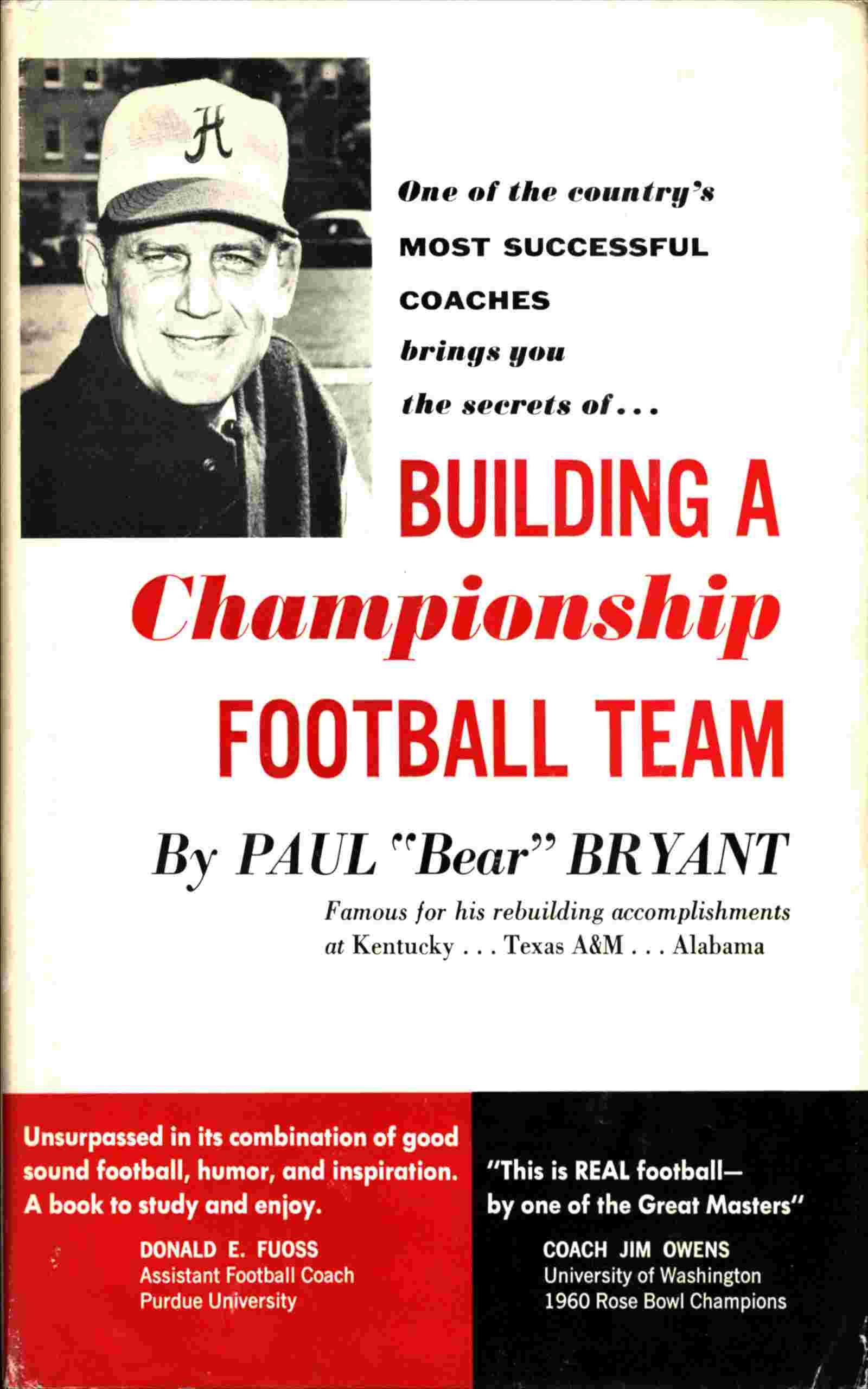
Every football team has a slogan, and each coach has his own theory as to what makes a winning team. We are no exception. Our slogan is, “Winning is not everything, but it sure beats anything that comes in second.” Our theory on how to develop a winning team is very simple—WORK! If the coaches and players will work hard, then winning will be the result.
We want to win. We play to win. We are going to encourage, insist and demand that our players give a 100% effort in trying to win. Otherwise we would be doing them a great injustice. It is very important for the boys to have a complete understanding of what they must do in order to win.
When a boy has completed his eligibility or has played four years under our guidance, I like to believe he will graduate knowing how to suck up his guts and rise to the occasion, and do whatever is required of him to get his job done. If our boys are willing to work hard, and we give them the proper leadership and guidance, then they will graduate winners and our athletic program will be a success.
HOW TO START BUILDING A WINNER
Building a winning football team is something that cannot be accomplished overnight, or even in a year or two, if the program is starting from scratch. I believe, irrespective of the time element involved, a football program has little chance of succeeding unless the following “musts” are adhered to:
1. The coach must have a definite plan in which he believes, and there must be no compromise on his part.
2. The football coach must have the complete cooperation and support of the administrators and the administration, who must believe in the head coach, his staff, and his plan.
3. The coach must have a long term contract.
4. The coach must not only be dedicated to football, but he must be tough mentally.
5. The head coach must have the sole responsibility and authority of selecting his staff of dedicated men, who must believe in the head coach and his plan.
The Administration Must Believe in Your Plan
It is vitally important that a coach build a solid foundation for his program. In order to do this he must have complete cooperation from every member of the school’s administration. In many cases the school officials will not have a complete and thorough understanding of your athletic program. It is important that you explain to them just what you are trying to accomplish, how long it will take, and why you are doing it in your particular manner. The administrators and the administration must understand the value the program has for each boy who participates, and the ways the program can benefit the entire school system. Therefore, before a coach accepts a particular position he should give considerable thought to the administration’s philosophy, attitude or point-of-view toward the football program. If the school president or principal is skeptical, consider the position seriously before accepting it. Building a championship team is difficult enough with full cooperation from everyone, but it is an impossible coaching situation without the administration’s full support and confidence.
The Coach Must Have a Long Term Contract
If a college coach is going to build a team, it is an absolute must that he have a long term contract. There is little use in believing or thinking any other way. It is very possible, and highly probable, it will take at least four or five years to shape a ball club into winning form. Without the security of a long term contract, a coach can be forced to concentrate on winning a certain number of games each year, and it is possible this can completely disrupt or disorganize a rebuilding program. I am not saying that a coach should not try to win every game, because he obviously should strive to win ’em all. I merely want to point out the fact that without the security of a job for a period of years, he might be forced to revert to certain practices which he knows are not sound principles on which to build a winning program. As an illustration, he might have to revert to such a practice as playing individuals of questionable character because of their immediate ability, rather than weeding them out and concentrating on the solid citizens. The latter group will stay with you and will eventually be winners, if you are given job security and adequate time to work with them.
The Coach Must Be Dedicated and Tough Mentally
Unless a person is dedicated to his chosen trade or profession, regardless of his field of endeavor, he is never going to be highly successful. Building a winning football team is no exception. The head coach, as well as his assistants, must be dedicated to football. All of them must be tough mentally, too.
Many times a coach’s job is unpopular and unrewarding. From time to time a coach must make decisions that are unpleasant. He cannot compromise, however, if he expects to build a winner. He must be tough mentally in order to survive.
In addition, a coach must be tough mentally in another sense. He must be able to spend numerous hours studying football all ways and always. A coach who hopes to be successful must drive himself and be so dedicated to his job that he puts it ahead of everything else in his life, with the exception of his religion and his family. One can have a tremendous knowledge of the game, but he cannot possibly make the grade unless he can stand up to the long hours and the trying times. It is not an absolute necessity for a coach to be exceptionally smart or a brilliant strategist, but he must be a hard worker, mentally tough, and dedicated to the game of football. One can only be honest with himself in determining whether or not he has these qualifications.
You Must Have a Definite Plan
As head football coach, you must give leadership and direction to your program if you expect it to be successful. Therefore, you must have a definite plan in which you and your assistants believe. In order to build winners you cannot deviate from your plan, and there cannot be any compromises.
Many factors go into the plan, such as organizing the program and the type of boys whom you have on your squad, both of which will have a great deal to do with your ultimate success or failure. These and other phases of the plan will be discussed in detail shortly, and in later chapters in this book.
You Must Have a Good Staff
In order to build winners, the head coach must surround himself with a dedicated staff of hard working coaches. While I have touched on this point briefly already, this particular must will be discussed in greater detail in Chapter 3, “Making the Most of Your Coaching Staff.”
THE TYPE OF BOY = SUCCESS OR FAILURE
The team with the best athletes will usually win the tough ball games, other things being equal. It is a well recognized fact that a coach is no better than his material. Therefore we must have the best material available in order to be a winner. I tell my coaches if they can recruit the best athletes to our school, then I can coach them. If they recruit mediocre athletes, then the assistants will have to coach them.
There are a number of qualifications that we look for in our athletes, and some of these are musts if the boys are to become champions. Football is nothing more than movement and contact. If a player has excellent movement but won’t make contact, he will never be a winner. Conversely, if a boy is mean, loves body contact, and likes to hit people, but is so slow he never gets to the ball carrier, then he will never make a winner either. There are ways to improve an individual’s quickness, but if a boy refuses to make contact, there is nothing that I know of to correct it.
The type of boy you select to play on your football team has a great deal to do with your ultimate success or failure. In order for our program to be successful, we try to select the boy with the following traits:
1. He must be dedicated to the game of football.
2. He must have the desire to excel and to win.
3. He must be tough mentally and physically.
4. He must be willing to make personal sacrifices.
5. He must put team glory first in place of personal glorification.
6. He must be a leader of men both on and off the field.
7. He should be a good student.
The Players Must Be Dedicated
A player must be dedicated to the game to the extent he is willing to work, sacrifice, cooperate and do what he possibly can to aid the team in victory. It is our duty as coaches to explain and show our boys the advantages of being winners, and to impress upon them the absolute necessity of it so they will put forth the much needed effort to accomplish the objective. It is important for the players to understand that football is not an easy game; nor is achieving fame an easy task. However, anything worth doing, is worth doing right. Therefore let’s do it right and be winners.
We refer to “the little extras” a boy must give in order to be a winner. These little extras really make the difference between good and great, whether it be on an individual or a team basis. When a boy puts into practice what you have been preaching about giving that extra effort when he is dog tired, going harder, rising to the occasion and doing what is necessary to win, then you are making progress and he is on the way to becoming a winner both individually and for his team.
There is nothing else I would rather see than when our boys are in their goal line defense, and they have supreme confidence they will keep the opposition from scoring. Every boy is taking it upon himself personally to do what is necessary to stop the ball carrier from scoring. When a coach has a team thinking like this, he will have a winner, and the boys will be winners when they get out of school.
Our Boys Must Have the Desire to Excel
We talk about the importance of particular aspects of coaching, such as full cooperation, long contracts, and other phases connected with coaching, but in the final analysis the success or failure of your program depends on the performance of the boys on the playing field. The game is generally won by the boys with the greatest desire. The difference in winning and losing is a very slight margin in a tough ball game. The same applies to two players of equal ability, except that one is great and the other is average. What is this slight margin? It’s the second and third effort, both individually and as a team. The boy who intercepts a pass or blocks a punt, or who gets his block then goes and knocks down another opponent is the individual who wants to excel. He will make the “big play” when it counts the most. He and others will give us “the winning edge.” These are the deciding factors in a tough ball game.
You Must Beat Your Opponent Physically
The teams that win consistently are the ones in the best physical condition. As a result they can play better football than their opposition in the fourth quarter. We also believe and teach our boys they must be more aggressive and “out-mean” our opponents if they expect to win consistently.
We may not be as smart and as tricky as our opposition, so we have to out-work ’em. If our boys are in top physical condition, if we “out-mean” and physically whip our opponents by hard blocking and tackling, and we are consistent in doing it, we’ll win a lot of football games. Football is a contact sport, and we must make the initial contact. In order to be a winner a boy must whip his man individually, and the team must beat the opponent physically.
Genuine All-Out Desire for Team Victory
Unity is the sound basis for any successful organization, and a football team is no exception. Without team unity you cannot have winners. We believe and coach team victory. Our goal is to win every game we play. We go into every game believing we will win it. Obviously we don’t win all of them, but we never go into a game believing we cannot come out of it the winner.
In order to have a winner, the team must have a feeling of unity; every player must put the team first ahead of personal glory. The boy who plays for us must be willing to make sacrifices. Victory means team glory for everyone. Individual personal glory means little if the team loses.
Must Be a Leader and a Good Student
In order to have winners your boys must be leaders both on and off the field. They should be good students, too. As was indicated previously, if your contract will give you sufficient time to work with the “solid citizens,” they will stay with you even if the going gets tough, and eventually they will be winners.
You Can’t See Into the Heart of a Boy
Most coaches take pride in their ability to pick out boys with athletic ability. I am no exception. However, you can never be absolutely certain about a boy because you cannot see what is inside of his heart. If we could do this, we would never make a mistake on a football player. We have seen it occur frequently where a player was pitiful in his freshman year, and the coaches almost give up on his ever improving. However, through determination, hard work, pride and desire the boy would finally develop and would play a lot of football before he graduated.
My assistant coaches have a favorite story they like to tell about a player we had at the University of Kentucky. We had started our first practice session in the fall of 1948 when a youngster walked out on the field. His appearance literally stopped practice. He had on a zoot suit with the trouser legs pegged so tightly I am certain he had difficulty squeezing his bare feet through the narrow openings. His suspenders drew up his trousers about six inches above his normal waist line. His long zoot coat extended almost to his knees. His “duck tail” hair style looked quite unusual. He was standing in a semi-slump, and twirling a long chain around his finger when one of my assistants walked over and asked him if he wanted someone. His answer, “Yeah. Where’s the Bear?”
He found me in a hurry. Our first impression was that he would never be a football player, but he was issued a uniform anyway. I figured he wouldn’t have the heart for our type of football and would eliminate himself quickly from the squad. To help him make up his mind in a hurry I instructed one of the coaches assisting me to see that he got plenty of extra work after practice. The boy’s name was difficult to pronounce, so we started calling him “Smitty.”
Despite “Smitty’s” outward appearance, he had the heart of a competitor and the desire to show everyone he was a good football player. He worked hard and proved his point. In his senior year he was selected the outstanding player in the 1951 Sugar Bowl game when we defeated the University of Oklahoma. After graduation he played for several years with the New York Giants as a fine defensive end. I shall always have the greatest respect for him.
Other coaches probably have had similar experiences where a boy with questionable ability has made good. If a boy has a great desire to play football, regardless of his ability, and you work with him, he is likely to make tremendous progress toward fulfilling his objective.
GOOD ORGANIZATION—A BIG FACTOR IN BUILDING WINNERS
Without good organization our thoughts or plans of any kind would be absolutely useless. Good organization is a must if a team is to operate at maximum efficiency. There are many plans of organization that are good, and I am not saying mine is the best, but I believe my plan is sound and this is what really counts.
It always has been my practice to observe people who are successful in a particular field, and try to determine what makes their operation successful. There is little originality remaining in the field of coaching. Consequently we have gotten many of our ideas from other people. As Frank Howard of Clemson College put it, “If we get something from one team, it’s called stealing; but if we get ideas from several different teams, it’s called research.”
Use the Ant Plan
I borrowed my plan of organization from some ants in Africa. I realize this sounds ridiculous and far fetched; nevertheless, it’s the truth. It is interesting how it all came about.
While I was in the Navy in Africa, one hot, humid afternoon I was sitting under a tree feeling sorry for myself. I started to watch some ants building an ant hill. At first I was amused, but as I watched I became very interested. What at first appeared to be confusion was actually a carefully organized plan as the ants all worked toward their objective of building a home. The longer I watched the more obvious it became that all of the ants were working, many in small groups here and there. There was no inactivity, no wasted motion. There was unity and there was a plan. It appeared the ants had planned their work and they worked their plan.
With the ant plan in mind, we try to organize our practice sessions so that we have everyone working and no one standing around idle. We work in small groups and this eliminates inactivity. As a result we feel that we can get more work done in a shorter period of time. Consequently we believe the less time a player spends on the practice field, the higher will be his morale.
I did not have to watch the ants to learn the value of teamwork and cooperation, although this was evident in their activity. The main lesson I learned from them was the value of small group work in order to keep everyone busy.
There are many other factors that must be taken into consideration when organizing the program, and I shall discuss the subject more fully in Chapters 3 and 10. Planning and organization are the backbone of a successful team. Planning a practice so that you get maximum results from the players and the assistant coaches requires a great deal of time. The importance of this cannot be emphasized too greatly.
CONCLUSION
Winning theories vary from coach to coach, but our philosophy toward building a winner consists of the following factors: (1) a hard working staff that is dedicated to football; (2) players with a genuine desire to excel, to “out-mean” the opponent, and be in top physical condition; (3) a strong organization and a sound plan; (4) mental toughness in both staff and players; and (5) the full confidence of the school administration. In addition, you must teach sound football. Your boys and your staff must have confidence in your type of football. I shall discuss our methods fully in later chapters.