
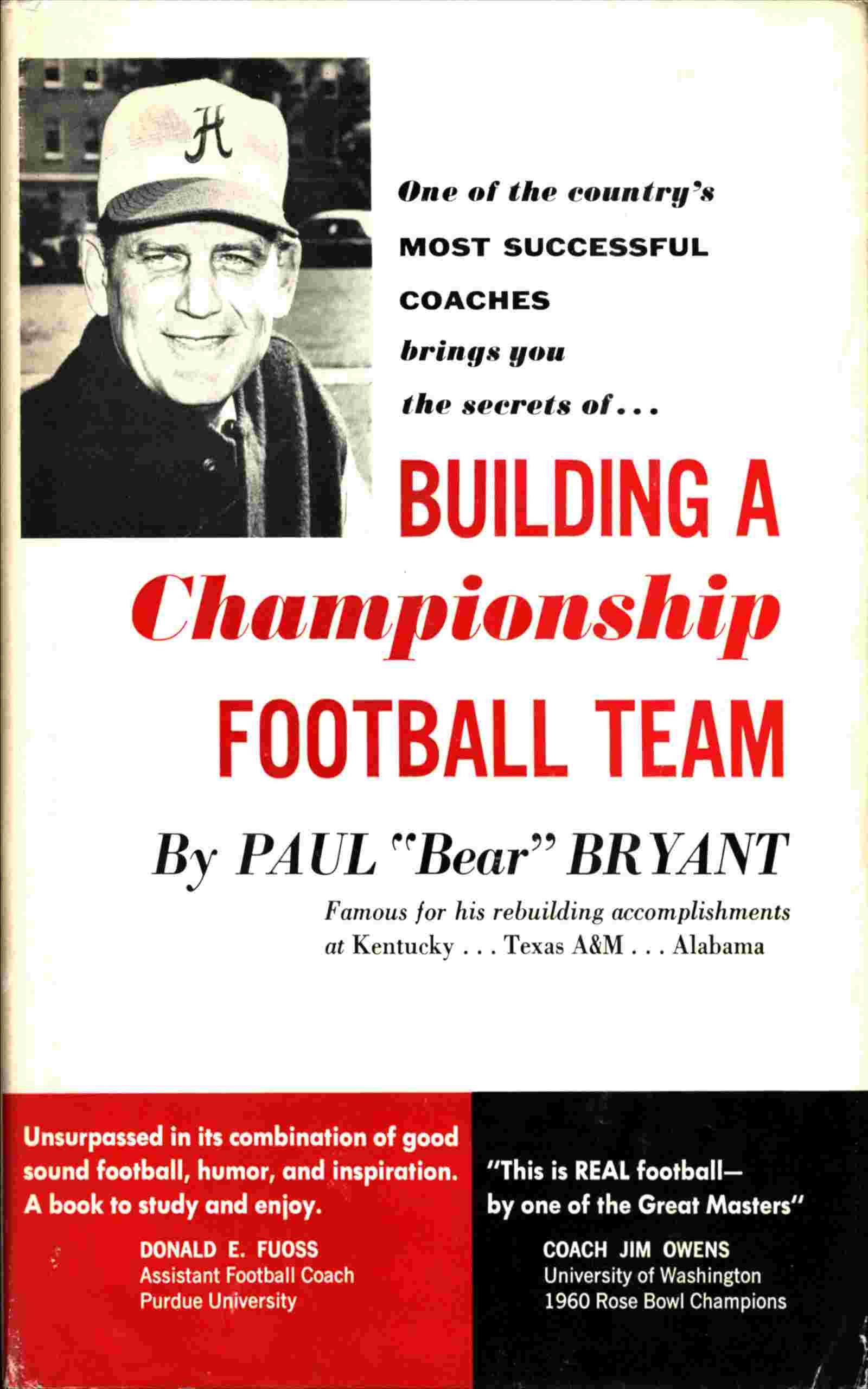
I am a firm believer in the old saying, “A head coach is no stronger than his assistant coaches.” In order for any head coach to have a good program he must surround himself with a staff of good assistant coaches. This does not mean that every coach must have six or eight assistants. In some cases the head coach may not have more than two or three assistants. The principles are the same, however, regardless of the number of assistant coaches. I have been fortunate in having an excellent group of assistants every place I have coached, and I want to give credit to them for any measure of coaching success I may have had in the past.
ASSISTANT COACH: TYPE OF MAN
There are many characteristics I am seeking in an assistant coach. I shall not attempt to list them in the order of importance because I think they all belong at the top of the list. Briefly, the desirable traits and characteristics I am seeking in an assistant are as follows:
1. He should be dedicated to the game of football.
2. He should be willing to work hard and to make personal sacrifices.
3. He should be an honest person.
4. He should have a sound knowledge of football.
5. He should have a great deal of initiative.
6. He should be a sound thinker.
7. He should be tough mentally.
A Dedicated Person, Hard Worker, Loyal
The first trait, “Be dedicated to the game of football,” is a must for all coaches, assistants as well as head coaches. Don’t ever try to fool yourself or anyone else. If you are not truly dedicated to your work, and you dread spending many hours every day working and planning on building a good football team, then you are in the wrong business. I’ll guarantee there is no easy way to develop a winning team. If it were an easy task, all of us would be undefeated and “Coach of the Year.” Unfortunately one team generally wins and the other loses, and if it is the latter it doesn’t make a coach’s job any easier. If you will look at the consistent winners, you will find behind them a group of coaches who are dedicated 100% to their work.
Regardless of whether it’s the college or high school level of competition, there are coaches and teams that win year after year. The real reason for this success, other than good material, is the coaches of these particular teams are dedicated to the extent that they “want” to do what is necessary to win. There is a big difference between “wanting to” and “willing to” do something to be a winner. Frankly, I don’t like the word “willing” in connection with an assistant coach. First, if the coaches are not willing, they should not be coaching. Coaching is not an 8 A.M. to 5 P.M. job. The assistant who is “willing” to work a little extra is not the one I want on my staff. The assistant who “wants” to do what is necessary in order to get the team ready to play, regardless of the time element involved, is the man whom I want to assist me.
A head coach cannot expect his assistants to be dedicated to their work, unless he leads by example. The head coach must work harder, longer, and be more dedicated to his work than any of his assistants, if he expects to have a good, hard-working staff and winners.
Another qualification I consider a must for all assistant coaches is their 100% loyalty to the head coach’s plan. It is very important for a coach and his staff to know they have mutual trust and loyalty to each other. These characteristics are obvious, and an assistant coach who does not possess them commits professional suicide.
Initiative and Ambition
An assistant coach should have a great deal of initiative and ambition. I prefer to have my assistants study the game all ways and always. They should constantly try to improve themselves. There is no corner on the brain market and a person advances in his field through hard work and his own initiative.
It is a must that all coaches be good “mixers.” They must be able to get along with each other, the head coach, the players, and the people in the community. On the college level a coach must know how to recruit, and most of the time the successful recruiter is a good mixer. He must sell your product—the school, the team, the coaching staff, etc.—to athletes and their parents, and his job will be easier if he has this type of personality.
Honesty and Integrity
It is an absolute must that all coaches be honest with themselves, the people for whom they work, and the others with whom they come in contact. If I cannot trust a person, I do not want him around. Along this same line, we like our coaches to be active in their church work. We emphasize to our players the value of attending church, and we like our coaches to set a good example for everyone.
A Sound Thinker With a Good Understanding of the Game
In order for a coach to be competent, he must be a sound thinker and possess a good knowledge of the game of football. I have mentioned this previously. I expect my assistants to study, plan, discuss and try to come up with ideas that might aid us in winning a football game. We are going to toss around all ideas in our staff meetings before we adopt any of them, but your brand of football can become stale and unprogressive if the coaches do not study the game.
DIVISION OF COACHING DUTIES
Morale on a squad is very important. The morale of a coaching staff is very important, too. I feel the latter group will influence the former group, consequently I am vitally concerned about my assistants having good morale. With this thought in mind, I try to delegate duties and responsibilities so the assistants enjoy their work. Each man is really a specialist, or he can do some phase a little better than another coach. Therefore it’s just common sense to permit him to work at the specialty in which he is going to excel. He will not only have more enthusiasm for his work, but his enthusiasm will be reflected in the players’ work. There is no substitute for enthusiasm. Under such conditions the players learn more quickly and the coaches are able to do a better job of coaching.
Assistant Coaches Direct Group Work
I do not think it advisable for a head coach to do group work with one of his assistants. If an assistant is directing a group and the head man comes over to help out, he takes the lead away from the assistant. As a result the assistant coach is likely to lose his initiative—the very trait you want him to develop. Secondly, the players are likely to give the head coach all of their attention, and this isn’t fair to the assistant working with the same group of boys. Thirdly, I do not think it is desirable to suggest changes, make corrections or reprimand an assistant on the field. I feel the proper time to get the matter straightened out is after practice, and not while the players are around. I always try to avoid situations which are not conducive to good team and staff morale because you’ve got to have good morale in order to build a winner.
The Coaching Specialist
I think it is important for my assistants to specialize in either offensive or defensive football. I feel they can do a better job of coaching if they devote most of their time and effort toward one aspect or the other. We still want them to be cognizant of the opposite phase, however, as the defensive coaches must understand offensive football, and vice versa for the offensive coaches. In fact, from time to time I will put an offensive coach with the defense so he can learn more about this particular phase of the game. I believe it would be advisable for a high school coach, with possibly only a staff of two, to follow the same plan—one offensive coach and the other on defense.
Immediately after practice every day during the season I meet with my staff. I have little patience with the assistant who wants to hurry away from practice immediately. I want my staff members to meet in the staff room so we can discuss all phases of the day’s practice schedule while it is still fresh in our minds. Evaluation of personnel goes on all the time. Therefore, I want my assistants to list on the blackboard the work schedule for the next day for their particular group of boys. In addition I want their suggestions and comments as to the type of teamwork needed. Now I am in a better position to do a more intelligent job of setting up the practice schedule for the next day since I have been made aware of our individual and team needs, strengths and weaknesses. We have found this procedure very helpful, and I encourage my assistants to express themselves. I shall explain our procedures more fully in Chapter 10.
Delegating Responsibility
The head coach must delegate responsibility to his assistants in order to have a more effective plan of operation. The head coach must let each assistant know what he expects from him. An explanation of duties and responsibilities in the beginning is likely to eliminate misunderstanding later on. Secondly, a person with some responsibility is likely to do a better job than the individual who doesn’t have any. I have found it gives the assistant more confidence in himself and more pride in his work if he has been given a certain amount of responsibility.
As I mentioned previously in Chapter 2, in order to get the most from your staff, they must be completely sold on your plan for building a winner. Of course, the head coach must believe in his own plan 100%, along with the assistants, and he cannot make any compromises if he expects to be successful.
A Good Coach Is a Good Teacher
We stress the point frequently that coaching is teaching of the highest degree, and a good coach is a good teacher. It is not what you and your assistants know about football that is going to win the games, but rather what you are able to teach your players. In order to give our coaches an opportunity to improve their coaching techniques, we have them get up at staff meetings and explain and demonstrate various points. The other coaches will pretend they do not understand the coach who has the floor, and he must explain and answer the questions to our satisfaction. We have found this method gives the coaches a lot of confidence and they do a better job of coaching on the field.
CONCLUSION
In order for the head coach to get the maximum from his assistants, he must set a good example. Since others will follow a leader who actually leads, rather than one who merely tells what to do, I believe a head coach must work longer, harder, and stay a jump ahead of his assistants and the other coaches in the profession. He must be dedicated to the game of football, well organized, sound in his thinking, and have the ability to delegate authority and responsibility to his assistants if he expects to build a successful program.