
The Project Gutenberg eBook of By the Aurelian Wall, and Other Elegies
Title: By the Aurelian Wall, and Other Elegies
Author: Bliss Carman
Release date: September 15, 2016 [eBook #53053]
Most recently updated: October 23, 2024
Language: English
Credits: Produced by Larry B. Harrison, Chuck Greif and the Online
Distributed Proofreading Team at http://www.pgdp.net (This
book was produced from scanned images of public domain
material from the Google Books project.)
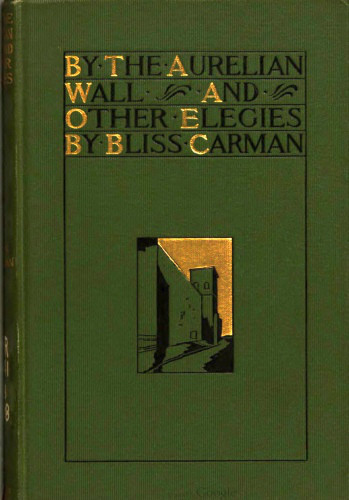
By the Aurelian Wall
By the Aurelian Wall
And Other Elegies
By Bliss Carman
Author of
Low Tide on Grand Pré, Behind the Arras,
Ballads of Lost Haven, &c.
Lamson, Wolffe and Company
Boston, New York and London
MDCCCXCVIII
Copyright, 1898,
By Lamson, Wolffe and Company.
———
All rights reserved.
Norwood Press
J. S. Cushing & Co.—Berwick & Smith
Norwood Mass. U.S.A.
CONTENTS
BY THE AURELIAN WALL
In Memory of John Keats
Where the long shadows of the centuries fall
From Caius Cestius’ tomb,
A weary mortal seeking rest found room
For quiet burial,
A book of lyrics.
Such untold amends
A traveller might make
In a strange country, bidden to partake
Before he farther wends;
The foreign reed-flute they had seen him blow
And finger cunningly,
On one of the dark children standing by,
Then lift his cloak and go.
Thoughtful beyond his fellows, grave and mild,
Treasures the rough-made toy,
Until one day he blows it for clear joy,
And wakes the music wild.
A thing first fashioned in delirious dream,
Some god had cut and tried,
And filled with yearning passion, and cast aside
On some far woodland stream,—
Found by the stranger and brought over sea,
A marvel and delight
To ease the noon and pierce the dark blue night,
For children such as he.
Wherewith the ghostly houses of gray rain
And lonely valleys ring,
When the untroubled whitethroats make the spring
A world without a stain;
With strange and unsuspected notes that plead
Of their own wild accord
For utterances no bird’s throat could afford,
Lifts it to human need.
When calling and compelling far away
By river-slope and hill,
He pipes their wayward footsteps where he will,
All the long lovely day.
“Surely the child is elvish,” murmur some,
And shake the knowing head;
“Give us the good old simple things instead,
Our fathers used to hum.”
Smile when they hear what they have hearkened for
These many summers now,
Believing they should live to learn somehow
Things never known before.
How the flute’s whisper lures him with a spell,
Yet always just eludes
The lost perfection over which he broods;
And how he loves it well.
Familiar with his piping far and wide,
Has taken for its own
That weird enchantment down the evening blown,—
Its glory and its pride.
Who left the book of lyrics and small fame
Among his fellows then,
Spreads through the world like autumn—who knows when?—
Till all the hillsides flame.
Hear it upbruited from the unresting sea;
And the small Gaspareau,
Whose yellow leaves repeat it, seems to know
A new felicity.
Walking at sundown through the plain, recall
A mound the grasses keep,
Where once a mortal came and found long sleep
By the Aurelian Wall.
THE WHITE GULL
For the Centenary of the Birth of Shelley
I
The tide comes in;
And to the idle heart to-day
The wind has many things to say;
The sea has many a tale to tell
His younger kin.
Breath of his breath;
The doom tides sway us at their will;
The sky of being rounds us still;
And over us at last is blown
The wind of death.
II
There came a soul,
A pilgrim of the perilous light,
Treading the spheral paths of night,
On whom the word and vision lay
With dread control.
And talks to me
Of all her wayward journeyings,
And the old, sweet, forgotten things
She loved and lost and dreamed of here
By the blue sea.
Bend sails and fill
From ports below the round sea-verge;
I watch them gather and emerge,
And steer for havens of the sun
Beyond the hill.
The shadows fly
Along the wind-floor at their heels;
And where the golden daylight wheels,
A white gull searches the blue dome
With keening cry.
Dares the wide morn
In that sea-rover’s glimmering flight,
As if the Northland and the night
Should hear thy splendid valiant name
Put scorn to scorn.
III
Tameless and free,
And vague as that marsh-wandering fire,
Leading the world’s outworn desire
A night march down this ghostly fen
From sea to sea!
Thy feet have passed,
As one who should set hand to rouse
His comrades from their heavy drowse;
For only their own deeds redeem
God’s sons at last.
Beneath thy hand,
As poppies in the windy morn,
Or valleys where the standing corn
Whispers when One goes forth to reap
The weary land.
Lead forth and far!
Thy toiling troopers of the night
Press on the unavailing fight;
The sombre field is not yet lost,
With thee for star.
Of clarions free
To bugle down the wintry verge
Of time forever, where the surge
Thunders and crumbles on a waste
And open sea.
IV
With haste and rest
Take thought to cheer their pilgrims on
Through trackless twilights vast and wan,
Across the failure and the strife,
From quest to quest,—
And let thee go
To tell the haunted whisperings
Of unimaginable things,
Which plague thy fellows with a trace
They cannot know?
Their house of doom,
Through the pale splendor of the night,
In vibrant, hurled, impetuous flight,
A resonant meteor of the North
From gloom to gloom.
V
With Spring for guide,
And heard the shy-born forest flowers
Talk to the wind among the showers,
Through sudden doorways left ajar
When the wind sighed;
Of blown white rain
Go volleying up the icy kills,—
And watched with Summer when the hills
Muttered of freedom in their sleep
And slept again.
Gentle and wild;
And the round sun delayed for thee
In the red moorlands by the sea,
When Tyrian Autumn lured thee on,
A wistful child,
From dale to dale;
And the great Mother took thy face
Between her hands for one long gaze,
And bade thee follow without fear
The endless trail.
Seeking its own,
Dwelt with the nomad tents of rain,
Marched with the gold-red ranks of grain,
Or ranged the frontiers of the morn,
And was alone.
VI
How couldst thou learn
The quiet of the forest sun,
Where the dark, whispering rivers run
The journey that hath no delay
And no return?
The dauntless heart,
Knowing all passion and the pain
On man’s imperious disdain,
Since God’s great part in thee gave pang
To earth’s frail part.
Deep in its core;
The wandering shadows of the sea
Called to it,—would not let it be;
The harvest of those barren rills
Was in its store.
Outcast from home,
Burning to free the soul of man
With some new life. How strange, a ban
Should set thy sleep beneath the walls
Of changeless Rome!
VII
Thy sleep would be
Where this far western headland lies
With its imperial azure skies,
Under thee hearing beat and swing
The eternal sea.
And all night long,
The far sea-journeying wind should come
Down to the doorway of thy home,
To lure thee ever the old way
With the old song.
Thy heart so dear,
Even the low surf of the rain,
Where ghostly centuries complain,
Might beat against thy door and rouse
No heartache here.
Forever reign,
Whose gloriously kingly golden throats
Regather their forgotten notes
In keys where lurk no ruin of dream,
No tinge of pain.
With the tide’s will,
The strong gray wrestler, should in vain
Put forth his hand on thee again—
Lift up his voice and call to thee,
And thou be still.
And fate and fear
And strife and rumor now no more
Vex thee by any wind-vexed shore,
Down the strewn ways thy feet have passed
Far, far from here.
VIII
The tide comes in;
And to the restless heart to-day
The wind has many things to say;
The sea has many a tale to tell
His younger kin.
The shadows fly
Along the wind-floor at their heels;
And where the golden daylight wheels,
A white gull searches the blue dome
With keening cry.
THE COUNTRY OF HAR
For the Centenary of Blake’s “Songs of Innocence”
There was a light in London town,
For an angel of the snow
Walked her street sides up and down.
He put forth his hand to smite
Songs of innocence and joy
From the crying chords of night,
Like a muttering of thunder
Heard beneath the polar star;
For his soul was all a-wonder
At the calling vales of Har.
And a pilgrim of the sun,
Took his uncompanioned way
Where the journey is not done.
His clear heart was set to climb,
To the uplands of desire
And the river wells of time.
Where the springs of morning are,
And the sea-bright cohorts rally
On the twilit plains of Har.
In the lily-garth of bliss,
Fashioned, how no man can tell,
As a white windflower is:
Uttered in the trembling grass,
When a shower is gone by,
And the sweeping shadows pass,—
Wheel them down without a jar,—
Heaving all the dappled heather
In the streaming vales of Har.
And above the rills, a voice:
“Son of mine, dost thou complain?
I will make thee to rejoice.
With confusion on thy speech;
And the worlds within thy ken
Shall not lie within thy reach.
And the daffodils unbar,
Quiet waters for their lover
On the shining plains of Har.
Shall make flowers to thy hand;
Every field thy feet have crossed
Shall revive from death’s command.
Through the corners of the earth,
Take the hounds of Spring to find
The forgotten trails of mirth;
Of a love no time can mar,
Hearing not a voice replying
From the gladder vales of Har.
Have not I prepared for thee
The king’s chambers of the East
And the wind halls of the sea?
Nowhere written through the wild,
With that gloaming call of Spring’s,
When old secrets haunt the child.
Wake no clarion of war;
For the paper reeds are blowing
On the river plains of Har.”
To the roaring dark have gone:
There is woe in London town,
And a crying for the dawn.
Ripen the dead fruit of lust,
And the sons of God remain
The dream children of the dust,
And their jeers have mocked afar,
The delirium of vision
From the holy vales of Har.
The white Herald of the North,
Faring West to ford my stream,
Passed my lodge and bade me forth;
With my shoulder in his hand;
The auroral world grew dim,
And the idle harvest land.
From its berg the Northern bar,
And eternal snows were drifting
On the wind-bleak plains of Har.
“I am drear, for I am death,”
Whispered Snow; but Wind replied,
“I outlive thee by a breath,
Dearer than all wells of dew,
One gray golden-shafted bird
Hail the uplands; so I knew
Tarrying so seeming far,
Should return with some long morrow
In the calling vales of Har.
TO RICHARD LOVELACE
In the white shadow of your heart,
Which no more measures day by day,
Nor sets the years apart?
Have taught men over, age by age,
“Stone walls do not a prison make,
Nor iron bars a cage!”—
Into the Gatehouse, well content,
Caring for nothing so you cared
For honor and for Kent.
Beat drear and blossomless and hoar
Through London, when you left Shoe Lane,
A-marching to no war!
And sunshine in the woven year,
The rain-winds loose from reverie
A lyric and a cheer.
A SEAMARK
A Threnody for Robert Louis Stevenson
And takes the heart out of the day?
What makes the morning look so mean,
The Common so forlorn and gray?
Beats on in iron mockery,
And like the roaming mountain rains,
I hear the thresh of feet go by.
Surging through alleys chill with grime,
The muttering churning ceaseless floe
Adrift out of the North of time.
The poster with its reds and blues
Bidding the heart stand still to take
Its desolating stab of news.
“Dead in Samoa.” ... Cry your cries,
O city of the golden dome,
Under the gray Atlantic skies!
Far down the latitudes of sun,
An island mountain of the sea,
Piercing the green and rosy zone,
And there the brown-limbed island men
Are bearing up for burial,
Within the sun’s departing ken,
And there where time will set no mark
For his irrevocable rest,
Under the spacious melting dark,
About him, they have laid him down
Above the crumbling of the sea,
Beyond the turmoil of renown.
In whom the truant gipsy blood,
Under the frost of this pale time,
Sleeps like the daring sap and flood
You whom the haunted vision drives,
Incredulous of home and ease,
Perfection’s lovers all your lives!
To lead by some forgotten clue
Forever vanishing beyond
Horizon brinks forever new;
Your brothers of the field and air
Before you, faithful, blind and glad,
Emerged from chaos pair by pair;
In the unvexed and fabled years
Into the country of your dream,
With all your knowledge in arrears!
Your glimpse of Beauty as she passed,
The well-head where her knee was pressed,
The dew wherein her foot was cast;
Be glorious when you are dead,
And fit the plangent words in rhyme
Where the dark secret lurks unsaid;
The mystic fellowcraft of joy,
Who tarry for the news of truth,
And listen for some vast ahoy
With eager eyes that wait the ship
Whose foreign tongue may fill the world
With wondrous tales from lip to lip;
On secret orders come to him,
Has slipped his cable, cleared the reef,
And melted on the white sea-rim.
And like green clouds in opal calms,
You anchored islands of the main,
Float up your loom of feathery palms!
A valiant earthling stark and dumb,
This savage undiscerning heart
Is with the silent chiefs who come
Who kiss his hand, and take their place,
This last night he receives his friends,
The journey-wonder on his face.
For everlasting youth is his!
Part of the lyric of the earth
With spring and leaf and blade he is.
But there will lurk a thought of him
At the street corners, gay with flowers
From rainy valleys purple-dim.
In that stern North where mystery broods,
Our mother grief has many sons
Bred in those iron solitudes.
Their coil of lightning under seas;
They are as impotent as you
To mend the loosened wrists and knees.
When the great luminous meteors flare
Along the trenches of the dusk,
The men who dwell beneath the Bear,
Float through the deep beyond their hark,
Like Arabs through the wastes of air,—
A flash, a dream, from dark to dark,—
By a dim vast and perilous way
We sweep through undetermined time,
Illumining this quench of clay,
Ah, not alone you climb the steep
To set your loving burden down
Against the mighty knees of sleep.
Where creeds are sown like rain at sea;
And leave the loveliest child of earth
To slumber where he longed to be.
To steer the daring merchant home;
His courage lights the dark’ning port
Where every sea-worn sail must come.
That strain in us which still must fare,
The fleeting migrant of a day,
Heart-high, outbound for otherwhere,
Hang on the edges of the noon,
And Northern liners trail their smoke
Across the rising yellow moon,
That beats its strength out into speed,
Until the pacing watch descries
On the sea-line a scarlet seed
To the dark selvedge of the night,
The deep blue tapestry of stars,
Then sheet the dome in pearly light,
Where men may praise him and deplore,
The place of his lone grave shall be
A seamark set forevermore,
And round whose bases, far beneath
The snow-white wheeling tropic birds,
The emerald dragon breaks his teeth.