
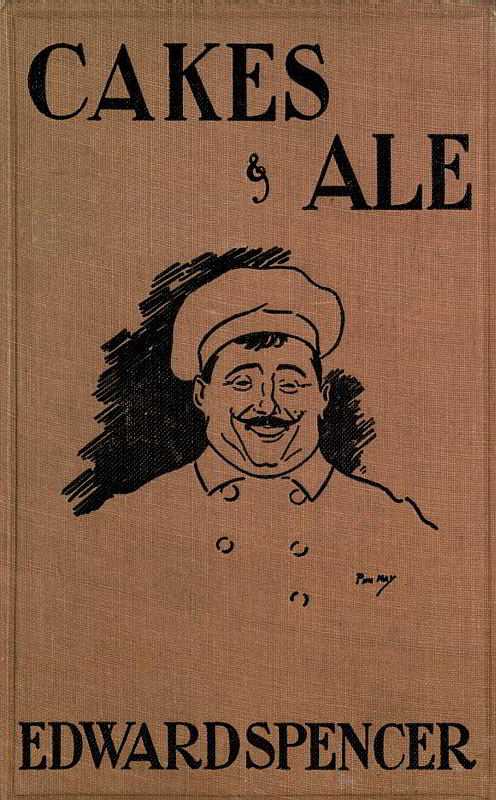
The Project Gutenberg eBook of Cakes & Ale
Title: Cakes & Ale
Author: Edward Spencer
Release date: July 22, 2013 [eBook #43278]
Most recently updated: October 23, 2024
Language: English
Credits: Produced by David T. Jones, Mardi Desjardins and the online
Distributed Proofreaders Canada team at
http://www.pgdpcanada.net
CAKES AND ALE
BY THE SAME AUTHOR |
| ———————— |
| THE FLOWING BOWL |
| A TREATISE ON DRINKS OF ALL KINDS |
| AND OF ALL PERIODS, INTERSPERSED |
| WITH SUNDRY ANECDOTES AND |
| REMINISCENCES |
| BY |
| EDWARD SPENCER |
| (‘NATHANIEL GUBBINS’) |
| Author of “Cakes and Ale,” etc. |
| Crown 8vo., cloth gilt, 2/6 net. |
SECOND EDITION. |
| With cover design by the late Phil May. |
| ———— |
| “The Flowing Bowl” overflows with good |
| cheer. In the happy style that enlivens its |
| companion volume, “Cakes and Ale,” the |
| author gives a history of drinks and their |
| use, interspersed with innumerable recipes |
| for drinks new and old, dug out of records |
| of ancient days, or set down anew. |
| London: STANLEY PAUL & CO. |
| 31, Essex Street, Strand, W.C. |
CAKES & ALE
A DISSERTATION ON BANQUETS
INTERSPERSED WITH VARIOUS RECIPES,
MORE OR LESS ORIGINAL, AND
ANECDOTES, MAINLY VERACIOUS
BY
EDWARD SPENCER
(‘NATHANIEL GUBBINS’)
AUTHOR OF “THE FLOWING BOWL,” ETC.
FOURTH EDITION
STANLEY PAUL & CO.
31, Essex Street, Strand, W.C.
First printed April 1897
Reprinted May 1897
Cheap Edition February 1900
Reprinted 1913
TO THE MODERN LUCULLUS
JOHN CORLETT
GRANDEST OF HOSTS, BEST OF TRENCHER-MEN
I DEDICATE
(WITHOUT ANY SORT OF PERMISSION)
THIS BOOK
PREFACE
A long time ago, an estimable lady fell at the feet of an habitual publisher, and prayed unto him:—
“Give, oh! give me the subject of a book for which the world has a need, and I will write it for you.”
“Are you an author, madam?” asked the publisher, motioning his visitor to a seat.
“No, sir,” was the proud reply, “I am a poet.”
“Ah!” said the great man. “I am afraid there is no immediate worldly need of a poet. If you could only write a good cookery book, now!”
The story goes on to relate how the poetess, not rebuffed in the least, started on the requisite culinary work, directly she got home; pawned her jewels to purchase postage stamps, and wrote far and wide for recipes, which in course of time she obtained, by the hundredweight. Other recipes she “conveyed” from ancient works of gastronomy, and in a year or two the magnum opus was given to the world; the lady’s share in the profits giving her “adequate provision for the remainder of her life.” We are not told, but it is presumable, that the publisher received a little adequate provision too.
History occasionally repeats itself; and the history of the present work begins in very much the same way. Whether it will finish in an equally satisfactory manner is problematical. I do not possess much of the divine afflatus myself; but there has ever lurked within me some sort of ambition to write a book—something held together by “tree calf,” “half morocco,” or “boards”; something that might find its way into the hearts and homes of an enlightened public; something which will give some of my young friends ample opportunity for criticism. In the exercise of my profession I have written leagues of descriptive “copy”—mostly lies and racing selections,—but up to now there has been no urgent demand for a book of any sort from this pen. For years my ambition has remained ungratified. Publishers—as a rule, the most faint-hearted and least speculative of mankind—have held aloof. And whatever suggestions I might make were rejected, with determination, if not with contumely.
At length came the hour, and the man; the introduction to a publisher with an eye for budding and hitherto misdirected talent.
“Do you care, sir,” I inquired at the outset, “to undertake the dissemination of a bulky work on Political Economy?”
“Frankly, sir, I do not,” was the reply. Then I tried him with various subjects—social reform, the drama, bimetallism, the ethics of starting prices, the advantages of motor cars in African warfare, natural history, the martyrdom of Ananias, practical horticulture, military law, and dogs; until he took down an old duck-gun from a peg over the mantelpiece, and assumed a threatening attitude.
Peace having been restored, the self-repetition of history recommenced.
“I can do with a good, bold, brilliant, lightly treated, exhaustive work on Gastronomy,” said the publisher, “you are well acquainted with the subject, I believe?”
“I’m a bit of a parlour cook, if that’s what you mean,” was my humble reply. “At a salad, a grill, an anchovy toast, or a cooling and cunningly compounded cup, I can be underwritten at ordinary rates. But I could no more cook a haunch of venison, or even boil a rabbit, or make an economical Christmas pudding, than I could sail a boat in a nor’-easter; and Madam Cook would certainly eject me from her kitchen, with a clout attached to the hem of my dinner jacket, inside five minutes.”
Eventually it was decided that I should commence this book.
“What I want,” said the publisher, “is a series of essays on food, a few anecdotes of stirring adventure—you have a fine flow of imagination, I understand—and a few useful, but uncommon recipes. But plenty of plums in the book, my dear sir, plenty of plums.”
“But, suppose my own supply of plums should not hold out, what am I to do?”
“What do you do—what does the cook do, when the plums for her pudding run short? Get some more; the Museum, my dear sir, the great storehouse of national literature, is free to all whose character is above the normal standard. When your memory and imagination fail, try the British Museum. You know what is a mightier factor than both sword and pen? Precisely so. And remember that in replenishing your store from the works of those who have gone before, you are only following in their footsteps. I only bar Sydney Smith and Charles Lamb. Let me have the script by Christmas—d’you smoke?—mind the step—good morning.”
In this way, gentle reader, were the trenches dug, the saps laid for the attack of the great work. The bulk of it is original, and the adventures in which the writer has taken part are absolutely true. About some of the others I would not be so positive. Some of the recipes have previously figured in the pages of the Sporting Times, the Lady’s Pictorial, and the Man of the World, to the proprietors of which journals I hereby express my kindly thanks for permission to revive them. Many of the recipes are original; some are my own; others have been sent in by relatives, and friends of my youth; others have been adapted for modern requirements from works of great antiquity; whilst others again—I am nothing if not candid—have been “conveyed” from the works of more modern writers, who in their turn had borrowed them from the works of their ancestors. There is nothing new under the sun; and there are but few absolute novelties which are subjected to the heat of the kitchen fire.
If the style of the work be faulty, the reason—not the excuse—is that the style is innate, and not modelled upon anybody else’s style. The language I have endeavoured to make as plain, homely, and vigorous as is the food advocated. If the criticisms on foreign cookery should offend the talented chef, I have the satisfaction of knowing that, as I have forsworn his works, he will be unable to retaliate with poison. And if the criticisms on the modern English methods of preparing food should attract the attention of the home caterer, he may possibly be induced to give his steam-chest and his gas-range a rest, and put the roast beef of Old England on his table, occasionally; though I have only the very faintest hopes that he will do so. For the monster eating-houses and mammoth hotels of to-day are for the most part “run” by companies and syndicates; and the company within the dining-room suffer occasionally, in order that dividends may be possible after payment has been made for the elaborate, and wholly unnecessary, furniture, and decorations. Wholesome food is usually sufficient for the ordinary British appetite, without such surroundings as marble pillars, Etruscan vases, nude figures, gilding, and looking-glasses, which only serve to distract attention from the banquet. It is with many a sigh that I recall the good old-fashioned inn, where the guest really received a warm welcome. Nowadays, the warmest part of that welcome is usually the bill.
It is related of the wittiest man of the nineteenth century, my late friend Mr. Henry J. Byron, that, upon one occasion, whilst walking home with a brother dramatist, after the first performance of his comedy, which had failed to please the audience, Byron shed tears.
“How is this?” inquired his friend. “The failure of my play appears to affect you strangely.”
“I was only weeping,” was the reply, “because I was afraid you’d set to work, and write another.”
But there need be no tears shed on any page of this food book. For I am not going to “write another.”
CONTENTS
| CHAPTER I | |
| BREAKFAST | |
| Formal or informal?—An eccentric old gentleman—The ancient | |
| Britons—Breakfast in the days of Good Queen Bess—A | |
| few tea statistics—Garraway’s—Something about coffee—Brandy | |
| for breakfast—The evolution of the staff of life—Free | |
| Trade—The cheap loaf, and no cash to buy it | Pages 1-9 |
| CHAPTER II | |
| BREAKFAST (continued) | |
| Country-house life—An Englishwoman at her best—Guests’ | |
| comforts—What to eat at the first meal—A few choice | |
| recipes—A noble grill-sauce—The poor outcast—Appetising | |
| dishes—Hotel “worries”—The old regime and the new—“No | |
| cheques”; no soles, and “whitings is hoff”—A | |
| halibut steak—Skilly and oakum—Breakfast out of the | |
| rates | 10-21 |
| CHAPTER III | |
| BREAKFAST (continued) | |
| Bonnie Scotland—Parritch an’ cream—Fin’an haddies—A knife | |
| on the ocean wave—À la Français—In the gorgeous East—Chota | |
| hazri—English as she is spoke—Dâk bungalow fare—Some | |
| quaint dishes—Breakfast with “my tutor”—A Don’s | |
| absence of mind | 22-33 |
| CHAPTER IV | |
| LUNCHEON | |
| Why lunch?—Sir Henry Thompson on overdoing it—The children’s | |
| dinner—City lunches—“Ye Olde Cheshyre Cheese”—Doctor | |
| Johnson—Ye pudding—A great fall in food—A | |
| snipe pudding—Skirt, not rump steak—Lancashire hot-pot—A | |
| Cape “brady” | 34-43 |
| CHAPTER V | |
| LUNCHEON (continued) | |
| Shooting luncheons—Cold tea and a crust—Clear turtle—Such | |
| larks!—Jugged duck and oysters—Woodcock pie—Hunting | |
| luncheons—Pie crusts—The true Yorkshire pie—Race-course | |
| luncheons—Suggestions to caterers—The “Jolly | |
| Sandboys” stew—Various recipes—A race-course sandwich—Angels’ | |
| pie—“Suffolk pride”—Devilled larks—A light lunch | |
| in the Himalayas | 44-58 |
| CHAPTER VI | |
| DINNER | |
| Origin—Early dinners—The noble Romans—“Vitellius the | |
| Glutton”—Origin of haggis—The Saxons—Highland hospitality—The | |
| French invasion—Waterloo avenged—The bad | |
| fairy “Ala”—Comparisons—The English cook or the foreign | |
| food torturer?—Plain or flowery—Fresh fish and the flavour | |
| wrapped up—George Augustus Sala—Doctor Johnson | |
| again | 59-72 |
| CHAPTER VII | |
| DINNER (continued) | |
| Imitation—Dear Lady Thistlebrain—Try it on the dog—Criminality | |
| of the English caterer—The stove, the stink, | |
| the steamer—Roasting v. baking—False economy—Dirty | |
| ovens—Frills and fingers—Time over dinner—A long-winded | |
| Bishop—Corned beef | 73-81 |
| CHAPTER VIII | |
| DINNER (continued) | |
| A merry Christmas—Bin F—A Noel banquet—Water-cress—How | |
| Royalty fares—The Tsar—Bouillabaisse—Tournedos—Bisque— | |
| Vol-au-vent—Pré salé—Chinese banquets—A fixed | |
| bayonet—Bernardin Salmi—The duck-squeezer—American | |
| cookery—“Borston” beans—He couldn’t eat beef | 82-96 |
| CHAPTER IX | |
| DINNER (continued) | |
| French soup—A regimental dinner—A city banquet—Baksheesh— | |
| Aboard ship—An ideal dinner—Cod’s liver—Sleeping in the | |
| kitchen—A fricandeau—Regimental messes—Peter the | |
| Great—Napoleon the Great—Victoria—The Iron Duke— | |
| Mushrooms—A medical opinion—A North Pole banquet—Dogs | |
| as food—Plain unvarnished fare—The Kent Road | |
| cookery—More beans than bacon | 97-110 |
| CHAPTER X | |
| VEGETABLES | |
| Use and abuse of the potato—Its eccentricities—Its origin—Hawkins, | |
| not Raleigh, introduced it into England—With or | |
| without the “jacket”?—Don’t let it be à-la-ed—Benevolence | |
| and large-heartedness of the cabbage family—Pease on | |
| earth—Pythagoras on the bean—“Giving him beans”—“Haricot” | |
| a misnomer—“Borston” beans—Frijoles—The | |
| carrot—Crécy soup—The Prince of Wales—The Black | |
| Prince and the King of Bohemia | 111-122 |
| CHAPTER XI | |
| VEGETABLES (continued) | |
| The brief lives of the best—A vegetable with a pedigree— | |
| Argenteuil—The Elysian Fields—The tomato the emblem of | |
| love—“Neeps”—Spinach—“Stomach-brush”—The savoury | |
| tear-provoker—Invaluable for wasp-stings—Celery merely | |
| cultivated “smallage”—The “Apium”—The parsnip—O | |
| Jerusalem!—The golden sunflower—How to get pheasants—A | |
| vegetarian banquet—“Swelling wisibly” | 123-133 |
| CHAPTER XII | |
| CURRIES | |
| Different modes of manufacture—The “native” fraud—“That | |
| man’s family”—The French kari—A Parsee curry—“The | |
| oyster in the sauce”—Ingredients—Malay curry—Locusts—When | |
| to serve—What to curry—Prawn curry—Dry curry, | |
| champion recipe—Rice—The Bombay duck | 134-146 |
| CHAPTER XIII | |
| SALADS | |
| Nebuchadnezzar v. Sydney Smith—Salt?—No salad-bowl—French | |
| origin—Apocryphal story of Francatelli—Salads and | |
| salads—Water-cress and dirty water—Salad-maker born | |
| not made—Lobster salad—Lettuce, Wipe or wash?— | |
| Mayonnaise—Potato salad—Tomato ditto—Celery ditto—A | |
| memorable ditto | 147-157 |
| CHAPTER XIV | |
| SALADS AND CONDIMENTS | |
| Roman salad—Italian ditto—Various other salads—Sauce for | |
| cold mutton—Chutnine—Raw chutnee—Horse-radish sauce— | |
| Christopher North’s sauce—How to serve a mackerel—Sauce | |
| Tartare—Ditto for sucking pig—Delights of making | |
| Sambal—A new language | 158-169 |
| CHAPTER XV | |
| SUPPER | |
| Cleopatra’s supper—Oysters—Danger in the Aden bivalve—Oyster | |
| stew—Ball suppers—Pretty dishes—The Taj Mahal—Aspic—Bloater | |
| paste and whipped cream—Ladies’ recipes—Cookery | |
| colleges—Tripe—Smothered in onions—North | |
| Riding fashion—An hotel supper—Lord Tomnoddy at the | |
| “Magpie and Stump” | 170-180 |
| CHAPTER XVI | |
| SUPPER (continued) | |
| Old supper-houses—The Early Closing Act—Evans’s—Cremorne | |
| Gardens—“The Albion”—Parlour cookery—Kidneys fried | |
| in the fire-shovel—The true way to grill a bone—“Cannie | |
| Carle”—My lady’s bower—Kidney dumplings—A Middleham | |
| supper—Steaks cut from a colt by brother to “Strafford” | |
| out of sister to “Bird on the Wing” | 181-191 |
| CHAPTER XVII | |
| “CAMPING OUT” | |
| The ups and downs of life—Stirring adventures—Marching on to | |
| glory—Shooting in the tropics—Pepper-pot—With the | |
| Rajah Sahib—Goat-sacrifices at breakfast time—Simla to | |
| Cashmere—Manners and customs of Thibet—Burmah—No | |
| place to get fat in—Insects—Voracity of the natives—Snakes—Sport | |
| in the Jungle—Loaded for snipe, sure to | |
| meet tiger—With the gippos—No baked hedgehog—Cheap | |
| milk | 192-205 |
| CHAPTER XVIII | |
| COMPOUND DRINKS | |
| Derivation of punch—“Five”—The “milk” brand—The best | |
| materials—Various other punches—Bischoff or Bishop—“Halo” | |
| punch—Toddy—The toddy tree of India—Flip—A | |
| “peg”—John Collins—Out of the guard-room | 206-218 |
| CHAPTER XIX | |
| CUPS AND CORDIALS | |
| Five recipes for claret cup—Balaclava cup—Orgeat—Ascot cup—Stout | |
| and champagne—Shandy-gaff for millionaires—Ale | |
| cup—Cobblers which will stick to the last—Home Ruler—Cherry | |
| brandy—Sloe gin—Home-made, if possible—A new | |
| industry—Apricot brandy—Highland cordial—Bitters—Jumping- | |
| powder—Orange brandy—“Mandragora”—“Sleep | |
| rock thy brain!” | 219-231 |
| CHAPTER XX | |
| THE DAYLIGHT DRINK | |
| Evil effects of dram-drinking—The “Gin-crawl”—Abstinence in | |
| H.M. service—City manners and customs—Useless to argue | |
| with the soaker—Cocktails—Pet names for drams—The | |
| free lunch system—Fancy mixtures—Why no cassis?—Good | |
| advice like water on a duck’s back | 232-245 |
| CHAPTER XXI | |
| GASTRONOMY IN FICTION AND DRAMA | |
| Thomas Carlyle—Thackeray—Harrison Ainsworth—Sir Walter | |
| Scott—Miss Braddon—Marie Corelli—F. C. Philips—Blackmore— | |
| Charles Dickens—Pickwick reeking with alcohol—Brandy | |
| and oysters—Little Dorrit—Great Expectations—Micawber | |
| as a punch-maker—David Copperfield—“Practicable” | |
| food on the stage—“Johnny” Toole’s story of Tiny | |
| Tim and the goose | 246-259 |
| CHAPTER XXII | |
| RESTORATIVES | |
| William of Normandy—A “head” wind at sea—Beware the | |
| druggist—Pick-me-ups of all sorts and conditions—Anchovy | |
| toast for the invalid—A small bottle—Straight talks to | |
| fanatics—Total abstinence as bad as the other thing—Moderation | |
| in all matters—Wisely and slow—Carpe diem—But | |
| have a thought for the morrow | 260-274 |
CHAPTER I
BREAKFAST
Formal or informal?—An eccentric old gentleman—The ancient Britons—Breakfast in the days of Good Queen Bess—A few tea statistics—“Garraway’s”—Something about coffee—Brandy for breakfast—The evolution of the staff of life—Free Trade—The cheap loaf, and no cash to buy it.
This is a very serious subject. The first meal of the day has exercised more influence over history than many people may be aware of. It is not easy to preserve an equal mind or keep a stiff upper lip upon an empty stomach; and indigestible food-stuffs have probably lost more battles than sore feet and bad ammunition. It is an incontestable fact that the great Napoleon lost the battles of Borodino and Leipsic through eating too fast.
When good digestion waits on appetite, great men are less liable to commit mistakes—and a mistake in a great man is a crime—than when dyspepsia has marked them for her own; and this rule applies to all men.
There should be no hurry or formality about breakfast. Your punctual host and hostess may be all very well from their own point of view; but black looks and sarcastic welcomings are an abomination to the guest who may have overslept himself or herself, and who fails to say, “Good-morning” just on the stroke of nine o’clock. Far be it from the author’s wish to decry the system of family prayers, although the spectacle of the full strength of the domestic company, from the stern-featured housekeeper, or the chief lady’s-maid (the housekeeper is frequently too grand, or too much cumbered with other duties to attend public worship), to the diminutive page-boy, standing all in a row, facing the cups and saucers, is occasionally more provocative of mirth than reverence. But too much law and order about fast-breaking is to be deplored.
“I’m not very punctual, I’m afraid, Sir John,” I once heard a very charming lady observe to her host, as she took her seat at the table, exactly ten minutes after the line of menials had filed out.
“On the contrary, Lady V——” returned the master of the house, with a cast-iron smile, “you are punctual in your unpunctuality; for you have missed prayers by the sixth part of one hour, every morning since you came.” Now what should be done to a host like that?
In the long ago I was favoured with the acquaintance of an elderly gentleman of property, a most estimable, though eccentric, man. And he invariably breakfasted with his hat on. It did not matter if ladies were present or not. Down he would sit, opposite the ham and eggs—or whatever dish it might chance to be—with a white hat, with mourning band attached, surmounting his fine head. We used to think the presence of the hat was owing to partial baldness; but, as he never wore it at luncheon or dinner, that idea was abandoned. In fact, he pleaded that the hat kept his thoughts in; and as after breakfast he was closeted with his steward, or agent, or stud-groom, or keeper, for several hours, he doubtless let loose some of those thoughts to one or the other. At all events we never saw him again till luncheon, unless there was any hunting or shooting to be done.
This same old gentleman once rehearsed his own funeral on the carriage drive outside, and stage-managed the solemn ceremony from his study window. An under-gardener pushed a wheelbarrow, containing a box of choice cuttings, to represent the body; and the butler posed as chief mourner. And when anybody went wrong, or the pall-bearers—six grooms—failed to keep in step, the master would throw up the window-sash, and roar—
“Begin again!”
But this is wandering from the subject. Let us try back.
Having made wide search amongst old and musty manuscripts, I can find no record of a bill-of-fare of the first meal of the ancient Britons. Our blue forefathers, in all probability, but seldom assisted at any such smart function as a wedding-breakfast, or even a hunting one; for the simple reason that it was a case with them of, “no hunt, no breakfast.” Unless one or other had killed the deer, or the wild-boar, or some other living thing to furnish the refection the feast was a Barmecide one, and much as we have heard of the strength and hardiness of our blue forefathers, many of them must have died of sheer starvation. For they had no weapons but clubs, and rough cut flints, with which to kill the beasts of the country—who were, however, occasionally lured into pitfalls; and as to fish, unless they “tickled” them, the denizens of the streams must have had an easy time of it. They had sheep, but these were valuable chiefly on account of their wool; as used to be the case in Australia, ere the tinned meat trade was established. Most of the fruits and vegetables which we enjoy to-day were introduced into Britain by the Romans. Snipe and woodcock and (in the north) grouse may have been bagged, as well as hares. But these poor savages knew not rabbits by sight, nor indeed, much of the feathered fowl which their more favoured descendants are in the habit of shooting, or otherwise destroying, for food. The ancient Britons knew not bacon and eggs, nor the toothsome kipper, nor yet the marmalade of Dundee. As for bread, it was not invented in any shape or form until much later; and its primitive state was a tough paste of flour, water, and (occasionally) milk—something like the “damper” of the Australian bush, or the unleavened chupati which the poorer classes in Hindustan put up with, after baking it, at the present day.
The hardy, independent Saxon, had a much better time of it, in the way of meat and drink. But with supper forming the chief meal of the day, his breakfast was a simple, though plentiful one, and consisted chiefly of venison pasty and the flesh of goats, washed down with ale, or mead.
“A free breakfast-table of Elizabeth’s time,” says an old authority, “or even during the more recent reign of Charles II., would contrast oddly with our modern morning meal. There were meats, hot and cold; beef and brawn, and boar’s head, the venison pasty, and the
Wardon Pie
of west country pears. There was hot bread, too, and sundry ‘cates’ which would now be strange to our eyes. But to wash down these substantial viands there was little save ale. The most delicate lady could procure no more suitable beverage than the blood of John Barleycorn. The most fretful invalid had to be content with a mug of small beer, stirred up with a sprig of rosemary. Wine, hippocras, and metheglin were potations for supper-time, not for breakfast, and beer reigned supreme. None but home productions figured on the board of our ancestors. Not for them were seas traversed, or tropical shores visited, as for us. Yemen and Ceylon, Assam and Cathay, Cuba and Peru, did not send daily tribute to their tables, and the very names of tea and coffee, of cocoa and chocolate, were to them unknown. The dethronement of ale, subsequent on the introduction of these eastern products, is one of the most marked events which have severed the social life of the present day from that of the past.”
With the exception of the Wardon pie and the “cates,” the above bill-of-fare would probably satisfy the cravings of the ordinary “Johnny” of to-day, who has heard the chimes at midnight, and would sooner face a charging tiger than drink tea or coffee with his first meal, which, alas! but too often consists of a hot-pickle sandwich and a “brandy and soda,” with not quite all the soda in. But just imagine the fine lady of to-day with a large tankard of Burton ale facing her at the breakfast-table.
Tea,
which is said to have been introduced into China by Djarma, a native of India, about A.D. 500, was not familiar in Europe until the end of the sixteenth century. And it was not until 1657, when Garraway opened a tea-house in Exchange Alley, that Londoners began tea-drinking as an experiment. In 1662 Pepys writes—
“Home, and there find my wife making of tea”—two years before, he called it “tee (a China drink)”—“a drink which Mr. Pelling the Pothicary tells her is good for her cold and defluxions.”
In 1740 the price of tea ranged from 7s. to 24s. per lb. In 1725, 370,323 lbs. were drunk in England, and in 1890, 194,008,000. In 1840 the duty was 2s. 2¼d. per lb.; in 1858 1s. 5d. per lb.; and in 1890 4d. per lb.
The seed of
The Coffee-Tree,
which, when roasted, ground, and mixed with water, and unmixed with horse-beans, dandelion-root, or road-scrapings, forms a most agreeable beverage to those who can digest it, was not known to the Greeks or Romans, but has been used in Abyssinia and along the north-east coast of Africa almost as long as those parts have been populated. Here, in merry England, where coffee was not introduced until the eighteenth century, it was at first used but sparingly, until it almost entirely took the place of chocolate, which was the favoured beverage of the duchesses and fine madams who minced and flirted, and plotted, during the reign of the Merry Monarch, fifty years or so before. The march of knowledge has taught the thrifty housewife of to-day to roast her own coffee, instead of purchasing it in that form from the retail shopkeeper, who, as a rule, under-roasts the berry, in order to “keep the weight in.” But do not blame him too freely, for he is occasionally a Poor Law Guardian, and has to “keep pace with the Stores.”
During the Georgian era, the hard-drinking epoch, breakfast far too often consisted chiefly of French brandy; and the first meal was, in consequence, not altogether a happy or wholesome one, nor conducive to the close study of serious subjects.
The history of
The Staff of Life[1]
would require a much larger volume than this, all to itself. That the evolution of bread-making has been very gradual admits of no denial; and as late as the Tudor and Stuart periods the art was still in its infancy. The quality of the bread consumed was a test of social standing. Thus, whilst the haut monde, the height of society, lords and dukes, with countesses and dames of high degree, were in the habit of consuming delicate manchets, made of the finest wheaten flour, of snowy purity, the middle classes had to content themselves with white loaves of inferior quality. To the journeyman and the ’prentice (who had to endure, with patience, the buffets of master and mistress) was meted out coarse but wholesome brown bread, made from an admixture of wheat and barley flour; whilst the agricultural labourer staved off starvation with loaves made from rye, occasionally mixed with red wheat or barley. The introduction of
Free Trade
—by no means an unmixed blessing—has changed all this; and the working-classes, with their wives and families, can, when out of the workhouse, in the intervals between “strikes,” enjoy the same quality of bread, that “cheap loaf” which appears on the table of the wicked squire and the all-devouring parson. In Yorkshire, at the present day, almost the worst thing that can be urged against a woman is that she “canna mak’ a bit o’ bread.”
“Just look,” wrote an enthusiastic Free Trader, a quarter of a century ago, “at the immense change that has latterly taken place in the food of the English peasantry. Rye bread and pease-pudding exchanged for wheaten loaves. A startling change, but not greatly different from what has occurred in France, where, with the abuses of the Bourbon rule, an end was put to the semi-starvation of French tillers of the soil. Black bread is now almost as much a rarity in France as on our side of the Channel; while barley in Wales, oats in Scotland, and the potato in Ireland, are no longer the food-staples that they were.”
I have no wish for anything of a contentious nature to appear in this volume; but may deliver, with regard to the above, the opinion that pease-pudding is by no means despicable fare, when associated with a boiled leg of pork; and I may add that too many of the English peasantry, nowadays, have been reduced, by this same Free Trade, to a diet of no bread at all, in place of wheaten, or any other loaves.
Wedding breakfasts, with the formal speeches, and cutting of the cake, have gone out of fashion, and the subject of the British breakfast of to-day demands a new chapter.