
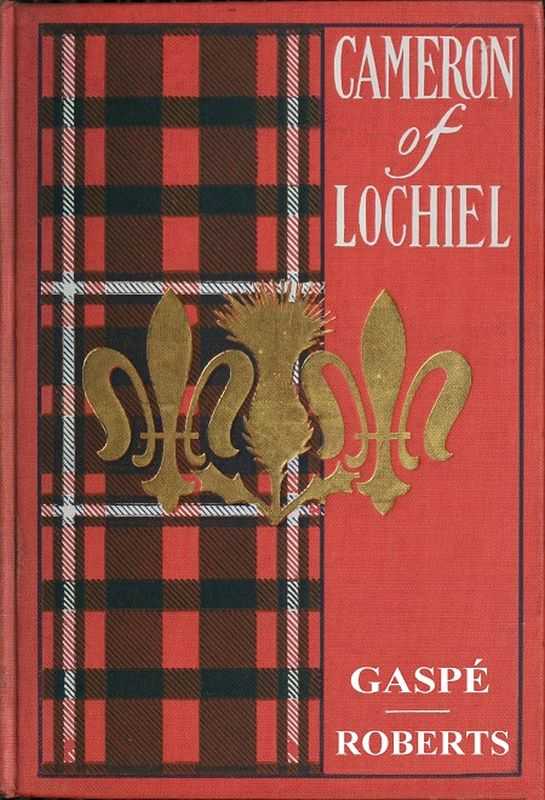
The Project Gutenberg eBook of Cameron of Lochiel
Title: Cameron of Lochiel
Author: Philippe Aubert de Gaspé
Illustrator: H. C. Edwards
Translator: Sir Charles G. D. Roberts
Release date: September 27, 2016 [eBook #53154]
Most recently updated: October 23, 2024
Language: English
Credits: Produced by Jana Palkova and the Online Distributed
Proofreading Team at http://www.pgdp.net (This file was
produced from images generously made available by The
Internet Archive)
Works of Charles G. D. Roberts
The Prisoner of Mademoiselle
The Watchers of the Trails
The Kindred of the Wild
The Heart of the Ancient Wood
Earth Enigmas
Barbara Ladd
The Forge in the Forrest
A Sister to Evangeline
By the Marshes of Minas
A History of Canada
The Book of the Rose
Poems
New York Nocturnes
The Book of the Native
In Divers Tones (Out of print)
Songs of the Common Days (Out of print)
Cameron of Lochiel
(Translated from the French of Philippe Aubert de Gaspé)
L. C. PAGE & COMPANY
New England Building
Boston, Mass.
Cameron of Lochiel.
(See page 68.)
CAMERON OF LOCHIEL
BY
PHILIPPE AUBERT DE GASPÉ
TRANSLATED BY
CHARLES G. D. ROBERTS
NEW EDITION
With a frontispiece by
H. C. EDWARDS
BOSTON L. C. PAGE & COMPANY MDCCCCV
Copyright, 1890
By D. Appleton and Company
——
Copyright, 1905
By L. C. Page & Company
(INCORPORATED)
PREFACE TO NEW EDITION
This leisurely and loose-knit romance of de Gaspé's, which he called "Les Anciens Canadiens," has for hero one who was not a Canadian, but a Scotch exile sojourning in Canada. It is on the creation of this character, consistently developed and convincingly presented, that the book must mainly base its claim to be called a work of fiction, rather than a volume of memoirs and folklore. I have ventured, therefore, at the suggestion of my publishers, to take a liberty with the author's title, and name the story after this young Scotch exile, "Cameron of Lochiel." I am the more willing to take this liberty because I feel that de Gaspé has not hitherto been granted the place he is entitled to in the ranks of Canadian fictionists. Considered purely as a romance, it seems to me that the sincerity, simplicity, and originality of this work quite outweigh its sprawling looseness of structure, and make it one of the unique ornaments of the composite literature which we are building up in Canada. If by so changing its title as to emphasize the fictional character of the work I can the better call attention to the worth of de Gaspé's achievement, I feel that I am justified, even in the face of such anticipatory protest as may seem to be implied in the author's too modest introduction.
When all this has been said, however, the fact remains that it was not its many merits as a romance that induced me to translate this work, but the riches of Canadian tradition, folk-lore, and perished customs embalmed in the clear amber of its narrative, coupled with my own anxiety to contribute, in however humble a way, to the increase of understanding and confidence between the two great branches of the Canadian people. It is a beautiful and gracious life, that of old French Canada, as depicted in de Gaspé's lucent pages,—a life of high ideals, and family devotion, and chivalry, and courage. This is an atmosphere it is wholesome to breathe. These are people it is excellent to know; and the whole influence of the story makes for trust and a good understanding.
C. G. D. R.
Fredericton, N. B., May, 1905.