
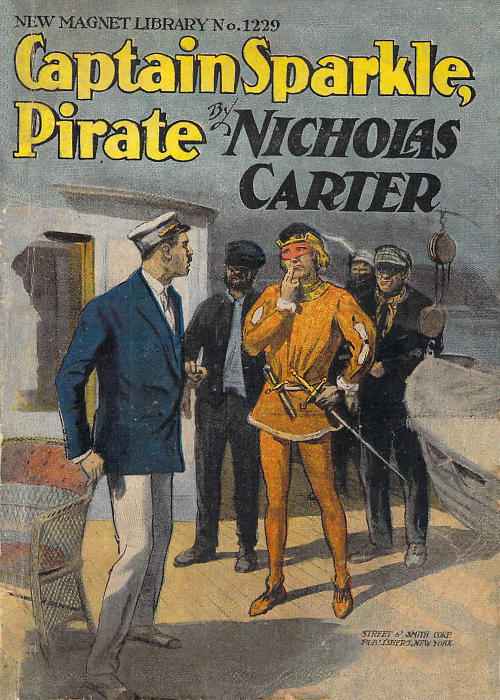
CHAPTER VIII.
BOARDING THE PIRATE CRUISER.
At midnight the three watchers put on the bathing-suits which were supplied by Maxwell Kane, and then seated themselves again on the after-deck, to await developments.
“What I want to know is, how are we going to carry any guns with us, with this rig?” asked Kane, as they seated themselves, and Nick asked Chick if he had supplied himself with weapons.
“I think that two apiece will be sufficient,” replied Nick, “and you can easily carry them.”
“But how?”
“In a belt around your body. See? Here is mine,” and he lifted his belt from another chair. “I shall buckle that around me before we go into the water.”
“But they will get wet.”
“Sure.”
“Won’t they be useless after that?”
“Hardly. Get yours, and I will load them for you with my cartridges. You could soak them in water for a week, and they would do their work just as well after that.”
For an hour and a half they talked upon random subjects, but all the time the keen eyes of the detective never wandered from the water of the cove. He had brought his watch on deck with him, and from time to time he glanced at it.
“It is two o’clock,” he announced, after an unusually long silence between them. “I think we will make a move now, if you are ready.”
“Ready,” they each replied.
“Are you a good swimmer, Max?” asked Nick.
“The best that ever was,” was the reply.
“All right. I’m going to take the lead in this affair. Chick will follow me, and you will follow behind him.”
“All right. Where——”
“You will take your cues from Chick. Whatever you see him do, you will copy without delay. Understand that?”
“Yes; it’s plain enough. Where——”
“If he dives, you are to dive, and you are to follow him under the water wherever he goes. No matter what he does, you do it, too.”
“I will. Now, confound it, tell me where you are going?”
“To the Aurora.”
“You haven’t seen any sign of the pirate, have you? I haven’t.”
“No.”
“Then what makes you so certain that the Aurora is the place to go?”
“I think, from what you have said, that she is the yacht which will be the object of attack, if an attack is made; but, anyhow, her position is much better than ours. She is farther out and she lies so that she will be first in line for attack, even if the pirate has no direct information about her.”
“But the watch will see us come aboard, and there will be the devil to pay.”
“I have just told you that you are to do as Chick and I do; however, I may as well tell you that I am not going aboard of her.”
“Oh! You are not?”
“Max, there is only one way to capture this pirate and his ship as well, if he does enter this harbor to-night, and that is to go aboard of the Shadow.”
“I’m onto that, all right.”
“I shall, therefore, not make the slightest effort to prevent him and his men from looting the Aurora from stem to stern, if they care to do so. It will be while they are up to that trick, or one like it, that we will get in our fine work.”
“You might as well tell me something about what that will be before we take to the water. I will be all the better able to obey orders in that case.”
“Very well; listen.”
“I’m listening.”
“We will swim out to the Aurora. When we get within a reasonable distance from her, we will dive, and not come to the surface again until we are under her chains. In that way we will avoid observation from her deck.”
“Sure.”
“Fortunately, it is a warm night, and the water is quite warm, also, but I don’t think it will be necessary for us to remain in the water all the time.”
“Thank goodness for that.”
“A yacht like the Aurora is not very well guarded when she is at anchor in a place of this kind.”
“Huh! I know that only too well.”
“Fortunately, the tide is coming in, and her bow points toward the open Sound. It will be high and slack in a couple of hours, so under her bow will be the best vantage ground for us, and it will be the least-guarded part of the yacht.”
“I know that. You mean to get aboard of her, don’t you, and to keep watch from there?”
“If it is practicable, yes.”
The detective buckled his belt around him, and then let himself carefully down over the side into the water. His companions did the same, and in another moment they were swimming silently toward the Aurora.
There was no moon, fortunately, for the weather had changed into one of those still, but cloudy, nights which often precede a storm; and yet there was a bright moon shining somewhere back of the clouds, and sufficient of its brilliancy penetrated them so that floating objects upon the water could be seen at a considerable distance.
At a distance of about a cable’s length from the Aurora the three men disappeared under the water, and they did not reappear until they were well under the chains of the Aurora; and there they paused a moment and held a whispered consultation.
The surface of the cove, and of the Sound out beyond it, was as smooth as glass. There was not a ripple any where to be seen, and the detective knew that if the pirate attempted to approach on the surface of the water, his craft would create a ripple which a close watcher would surely discover.
On the other hand, if he should approach under the water, as the detective had no doubt he would do, he would in all probability observe his previous program, and come to the surface close under the bow of the vessel he intended to attack.
“In that case,” he argued, “he will be right where we want him. But it is too early yet. Wait here until I climb aboard the Aurora, and if all is clear I will call you up there, and we will do our waiting on the deck.”
He found that all was clear, and in another moment the three were together on the deck of Sam Kearney’s floating palace. After that there followed another period of waiting, although it was a short one.
Scarcely half an hour had passed when Nick suddenly seized Chick by the arm and pointed toward a black object which seemed to be floating on the water, and which was plainly drifting directly toward them.
“It is the amidships turret,” he whispered. “It is the only thing about her which shows above the water, and the man who is doing the steering is doubtless looking directly at the bow of this yacht; so be careful. He will discover the slightest motion we make, if we do not keep well out of sight. Follow me.”
He turned and crawled away on his belly, wriggling along like a snake, until he was well out of sight behind the capstan. Then, rising to his knees, he made his way rapidly to the vessel’s rail and softly let himself down into the water.
There was not a splash or a sound, and his companions were equally fortunate.
As soon as the detective was in the water, one stroke took him a fathom nearer to the bow of the yacht, and he saw that the pirate craft was swinging silently, as if she were on a pivot affixed amidships, so that she would eventually lie directly across the yacht’s bow, but still with her stem pointed seaward, so that she could start ahead on the instant, and shoot away out of danger.
“She must be provided with the Kuhnstader propeller to do that,” he whispered in Kane’s ear. “It is a double propeller, and the one farthest aft works on a knuckle-joint, so that it can be made to serve as a rudder as well as a propeller. And it must be very deep in the water, too, to work so silently. Come on.”
He sank out of sight in the water, and swam with powerful strokes toward the stern of the Shadow. He had noticed how far he would have to go before he went under the water, and accordingly, when he did rise to the surface, he was about ten feet, or a trifle more, abaft of the stern of the vessel.
“See!” he whispered to Kane, who had risen to the surface close beside him. “Captain Sparkle is already climbing aboard the Aurora, and I don’t wonder that he surprised you, Kane, when he paid his visit to you. There has not been a sound made by his vessel, loud enough to wake a sleeping dog. You hadn’t a ghost of a show. By Jove! but I am anxious to see the interior of that craft.”
“How are you going to do it?”
“Follow, as I told you, and you will soon see.”
Again he sank beneath the surface, but this time he was under only a moment, and, when he reappeared, he was directly abeam of the amidships turret, and his companions were beside him.
“You see,” he whispered, treading water silently; “they won’t have occasion to make use of that machine-gun of theirs to-night, and they know it. In all probability the amidships turret is unguarded; or even if there is a man there, his eyes are intently fixed on the Aurora. He won’t think of trouble from this side. Come on, now!”
He swam quickly to the side of the vessel.
She was so low in the water that it was an easy matter for them to reach and seize hold of the rail which has already been described. In another moment the three men had hauled themselves aboard of the Shadow, and then, gliding along like so many shadows themselves, they passed through the open turret into the interior of the pirate cruiser.
CHAPTER IX.
THE PIRATE CHIEFTAIN UNMASKED.
The interior of the turret was as dark as a pocket, but the detective quickly discovered the door which communicated with the interior of the vessel proper, and he opened it. Contrary to his expectations, he found himself then inside a brilliantly lighted section of the vessel, which he recognized at a glance to be the general assembling-room—the apartment used by the pirates for their general uses.
It was, in fact, in the form of a miniature social hall of a great steamship, and even the detective was amazed to see the sumptuousness with which it was furnished and decorated. It might have done service as a compartment in the palace of a prince, so perfect were its appointments. But the thing which interested the detective most just then was the fact that there was not a human being to be seen, not a sign of one, beyond the general significance of the place itself.
“Come!” he whispered. “It will never do for us to remain here. They will be bringing their spoils aboard presently, and we must be well concealed before that time.”
“Are you going to remain here?” asked Kane also in a whisper.
“Sure! What do you suppose I took all that trouble to get here for?”
“Why, to have it out with the pirate—to have a scrap with him at once, capture his ship and cargo, and all that.”
“We will do that later. Just now we have other axes to grind.”
He glided rapidly aft toward a door he saw in the bulkhead, opened it cautiously, and peered through. But instantly he started back, and, seizing Chick and Kane with either hand, forced them underneath the long table behind them.
And they were not a moment too soon. The door which he had partially opened was thrown wide ajar this time, and a woman appeared on the threshold. She paused there for a moment, and the detective, from his position under the table, could see her plainly.
His mental comment at that moment was that it would not do to say that she was beautiful, merely because her face was too strong for that adjective; but she was certainly handsome. She was tall and well formed, and her hair and eyes were as black as night, while her skin was as white as that which you often see on people with red hair.
For a moment she stood there in the doorway, while her great, round, black eyes took in every detail of the cabin she was surveying.
“I surely thought I heard somebody here,” Nick heard her murmur. “Doubtless it was one of the men.”
Again she looked around her searchingly. Then she turned, and seemed to study the room she had quitted, as if she were undecided what to do; but, after a moment of hesitation, she came into the room where Nick and his companions were concealed under the table, closed the door after her, and walked rapidly through toward the turret door by which the detective had effected an entrance.
Nick changed his position so that he could watch her, and he saw that she hesitated again at the turret door; but it was at once evident that her curiosity was too much for her judgment, for, after an instant, she pushed the door open in front of her, and disappeared through it, closing it behind her.
“Now is our opportunity,” said Nick. “Quick! Follow me!”
He darted from under the table, glided rapidly toward the door through which the woman had first made her appearance, and in an instant, followed by Chick and Kane, passed through into the after-cabin of the vessel.
And if the other one was sumptuous in its appointments, this one put it entirely in the shade. It was veritably a palace—the palace of a queen, too; but evidently of a queen who was provided with a prince consort, for there were many evidences about of masculine uses.
There were cigarettes and cigars upon the table in the center of the room. There was a piano built into the bulkhead at one end of it. There was an electric drop light burning on the table, and there were comfortable chairs, books, papers, periodicals, and articles of various kinds and uses scattered about everywhere.
At one side of the center-table there was a chess-stand, with the ivory men in such a position as to indicate that a game had been interrupted in order that the Aurora might be looted; and there were pictures and hangings and other decorations in the compartment, which showed that it was the abode of refinement, as well as of a pirate.
All these things the detective noticed in his first searching glance around him.
“That woman was afraid to go outside, for some reason,” he said to the others. “She did not wish the captain of this craft to see her, and so it follows that she won’t be gone more than a minute or two; but there must be another cabin aft of this one—at least, there is sure to be a couple of staterooms.”
He started forward as he spoke, and, pushing aside a hanging drapery, found himself in a narrow gangway, or passage, with an open door of a stateroom on either side of him. But a glance told him that these were the rooms occupied by the two people he most wished to avoid until he had heard enough of what they might have to say to each other to determine him how to act.
Beyond these, however, there were other doors—two of them—and, as before, one on either side. These were closed, and he decided at once that they were not in constant use. He opened one of them at the same time that he pointed toward the other.
“Go in there,” he directed, and so it happened that Chick and Kane went together into one of the rooms, while Nick found himself alone in the remaining one.
And then, just as he pulled the door shut behind him—that is, he closed it all but the merest crack—the noise of the opening and closing of the door of the outer cabin apprised him of the fact that the woman had returned.
He supposed that she would return to the table and seat herself there, while she awaited the return of the pirate chief from his expedition aboard the Aurora; but in that he was mistaken. He was peering through the crack left him by not quite closing his own door, and he could see past an aperture at the side of the portière at the end of the passage that the woman was coming straight toward it.
He watched her without moving.
He hoped that she would not come to his door, or visit that of the room in which his companions had taken refuge, but he was thoroughly prepared to receive her if she should do either the one thing or the other.
The detective had seen enough already to make him wish to see and hear much more. The mere capture of the pirate vessel and those who were aboard of her was now not sufficient to satisfy him, for he realized that he would then have only a part of the explanation of the unheard-of circumstance of a pirate roaming the waters of Long Island Sound.
On the other hand, he figured that if he could remain where he was a sufficient length of time without discovery there might be an opportunity for a complete investigation—or, at least, that he would hear enough of conversation between the pirate chief and the woman to inform him.
“But,” he thought to himself, “there must somewhere be a port for this vessel. She must have some place somewhere, to lay by and rest, and to permit her crew to rest. I hardly suppose that she goes to the bottom of the Sound and rests there, and it is certain that she could not visit a frequented port without attracting attention which would be fatal. Therefore, she must go somewhere. She must have a port; and, in all likelihood, she will go directly to that port when she leaves the vicinity of this harbor.
“Now, if she does go to such a place, it is more than likely that the pirate and his wife—or whatever she is to him—will go ashore, and that is, the opportunity I want. Just give me half an hour of undisturbed opportunity aboard this vessel, and I will read every secret its owner ever had. Ah!”
All these thoughts passed through his brain while he was watching the woman’s approach, and the concluding exclamation he uttered—or thought, for he made no sound—was caused by her hastening directly to the door behind which he was concealed.
Just outside of it she came to an abrupt halt, and the detective drew back and flattened himself as closely as possible against the bulkhead, in order that if she did decide to enter the stateroom where he was concealed, he might remain undiscovered for as long a time as possible.
But whatever the thoughts were which troubled her, and gave rise to the hesitation under which she seemed to be struggling, they were of short duration; for, although she stretched out her hand until it touched the door, she withdrew it again, and then, after sighing deeply, turned and retraced her steps to the cabin.
The detective opened his door again, and stepped out far enough into the passageway to discover that the woman had resumed the reading of a book, which had been left lying open on the table, and he decided that in all probability she would not leave her chair again for some time to come; at least, not until the work of the pirates in looting the Aurora was finished and the chief returned to the cabin and to her. Satisfied on that point, and perceiving that the woman’s back was toward him, he went inside the cabin in which he had taken refuge, and without hesitation turned on the electric light.
He believed this to be as good a time as any in which to search the cabin in which he found himself, and he had already perceived that, although it was one which did not appear to be permanently occupied, it nevertheless, bore evidences of individual uses.
He knew, also, that he ran no apparent danger in turning on the light for a few moments, since the woman’s back was toward him, and he was positive that the door beyond her, which communicated with the waist of the vessel, could not be opened without his hearing it.
The stateroom was in every way as commodious as possible in the narrow space allowed, and everything within it had been arranged by a master hand, with a view to comfort and convenience.
The berth itself was a bed; in the bulkhead at one end had been built a rosewood dresser, and at the other end a writing-desk. There was a folding Morris chair, also fashioned so that it could be made to disappear in the bulkhead, under the electric light; there was a narrow and shallow wardrobe close beside the dresser, and a steamer trunk showed its front under the edge of the narrow bed.
Nick took in all these things at a glance, and with one step he approached the dresser.
The opening of the top drawer revealed an assorted collection of a gentleman’s collars, cuffs, ties, handkerchiefs, et cetera. The second drawer was filled with shirts; the third and last, with an assortment of underclothing.
He took all this into account in one rapid survey, but it was a handkerchief on top of its fellows which chiefly attracted his attention, and which nearly caused him to utter an exclamation of surprise as well as satisfaction. The handkerchief had been folded so that the marked corner was uppermost, and the detective saw at a glance that it bore a crest, and that underneath it were the initials “J. de C.”
That was a discovery worth while, he thought, but he closed the drawers quickly and crossed the stateroom to the writing-desk. In an instant he had opened that, and in another he was holding a sheet of writing-paper in his hand upon which was embossed the same crest, and the words “Château de Cadillac, Anjou, France.”
“So,” he mused, as he returned it to its place and closed the desk, “I have here a full and complete explanation of the mystery. My theory about the family characteristics and traits was the correct one, after all, for there is no doubt now in my mind that the chief of these pirates, the master of the Shadow, Captain Sparkle by name, is closely related to Jean, the Count of Cadillac—probably a brother.”
He was in the act of reclosing the desk, when he heard the sound of an opening door proceeding from the cabin, and he hastily extinguished the electric light and resorted again to the aperture he had left in closing the door, so that he might see all that took place in the apartment beyond.
And then, as he gazed past the portières, he saw the erect figure of the pirate chief as he entered the cabin, arrayed in his Hamletesque costume of red; and he saw him raise his right hand, and with one gesture remove the hat and wig of blond hair from his head; and the detective could scarcely refrain from uttering an exclamation, for the pirate chieftain stood revealed, a perfect counterpart of Count Cadillac!
CHAPTER X.
TWO COUNTS OF CADILLAC.
“If I did not know positively that Count Cadillac is at this moment ashore at the club-house, I would be willing to swear that he stands before me yonder,” was the detective’s mental comment, as he gazed upon the transformation wrought by the mere removal of the hat and wig worn by the pirate chief. “As it is, there can be no doubt now that my first idea was the correct one, and that the two men are brothers—aye, twin brothers, at that.”
“Well?” asked the woman of the pirate, permitting the book to rest upon her lap and raising her eyes to his face. She spoke in French, and he replied to her in the same tongue; but it was all perfectly intelligible to Nick Carter.
“It is magnificent,” he replied, throwing himself into a chair opposite her, and selecting a cigar, which he proceeded to light with evident relish. “It is much better than I ever dared to hope, from one affair.”
“Affair!” said the woman, with cold contempt in her voice and manner. “Why dignify your thieving operations by the use of such a word? Why not call them what they are?”
Sparkle shrugged his shoulders.
“Calm yourself, Hortense,” he said, puffing lazily at his cigar. “A few more expeditions like this one to-night will render us independent. Before the season is ended, if I continue as fortunate as I have been so far, we will have collected a million, at least—perhaps two millions; and dollars, too! Think of it! That seems between five and ten million francs. Why, do you know, petite, that Alexandre Dumas only gave the Count of Monte Cristo something like ten million francs, altogether?”
The woman sighed.
“But it is robbery,” she said—“robbery! There is no gentler term to apply to it. You call it making collections. You describe your piratical expeditions as ‘affairs,’ and you refer to our trips when we start out to accomplish this infamous work as ‘excursions.’ But they are not excursions, Jules!”
He waived his right hand deprecatingly.
“Whatever they may be, they are none the less necessary,” he said coolly. “I will thank you to regard them so, Hortense. Think of our estates in France. Think of the opportunities which will be afforded you over there for doing unlimited good with the wealth I shall secure for you. Think——”
“Bah! Think! I do nothing else but think! I think all the time. I remember that my family was one which no stain had touched until I married you, and you dragged me into this thievish business! I remember that, although we were poor, we were proud of an illustrious past, than which nobody in France could boast a better. I remember——”
“Enough! I will not hear you!”
“And how long, pray, must this continue before you will consider that you have enough to pay your debts and to live on the income of what is left to you after that of your stolen fortune?”
“How long? Who knows! As I have said, if other affairs prosper me as well as this one to-night has done, it will not be long. Think of it! To-night—to-night alone—I have collected almost a quarter of a million, in the value of dollars! To-night I have added to my store more than a million francs!”
“Aye; but much of it you will never be able to use.”
“I shall use it all. The melting-pot is ever handy; and there are other means of disposing of——”
“What, for example, shall you do with the trophy cups you have taken from some of your victims?” she demanded.
“Ah!” he replied. “They are valuable! Very valuable! I have thought out a method by which their owners can be induced to redeem them for cash at much more than their value and without danger to me. That Monsieur Kane, for example—he would gladly give fifty thousand dollars rather than lose his cups—his petted race cups. And what is fifty thousand dollars to him? Faugh! It is nothing! He would think no more of that amount than I do of the ash of this cigar, which I throw from me—so. And Monsieur Burton—oui, oui! With him it is the same. Fifty thousand? He would give a hundred thousand, so Jean tells me. And he is not as rich as Monsieur Kane! But his trophies are dearer to him. And to-night? To-night I have collected others. Ha, Hortense! It is the millennium that is at hand for us!”
“The millennium!” she exclaimed scornfully. “Say, rather, it is Cayenne, Toulon, the Château d’If, the Bastile, or the guillotine!”
The pirate shrugged his shoulders resignedly.
“You mentioned Jean,” continued the woman. “Tell me, what of him?”
“What of him? What should there be of him? He is invaluable. But for the information he gives me I could not accomplish what I do; I could have accomplished nothing of what I have already done. And he is innocent of real wrong, is he not? He tells me, merely, ‘To-morrow evening Monsieur Kane will anchor at such a place with his yacht, the Goalong. I shall be a guest.’ It is enough. He says no more than that. If I appear upon the scene and demand tribute, Jean is not to blame. Again he says to me, ‘Monsieur Burton is fond of running his yacht, the Harkaway, through the Sound by night, when the moon is full. He likes to go at half-speed. I should not be surprised if he left Newport soon after we do so, and I am quite sure that he will be due at that same anchorage where we are going the evening following our arrival.’ You see, Hortense, that is merely a comment. If I take advantage of the knowledge thus acquired, it is no fault of Jean’s, is it?”
“Bah!” she exclaimed. “Such arguments! Sophistry! Lies!”
“Well? And then what? In Anjou we have our estates—Jean and I. When he is away, I am there. When I am there, he is not. Even our own people do not understand that there are two men who are so much alike that one cannot be separated from the other by strange eyes. And who, in the end, shall have it to say that the Count of Cadillac was ever a pirate? Surely, not the American millionaires who have entertained him; surely not those men who have seen him seated beside them on their own decks while the pirate was engaged in looting their treasures. And when I have collected the five or ten million francs and taken them to France—when the fortunes of the Cadillacs are reestablished, and one or the other of us seems suddenly to reappear from far-away Peru with a story about fabulous mines owned there, which have yielded the fortune so suddenly in evidence, who will there be to say that once there was a Shadow on the water—a pirate, if you will—which collected this fortune for the twin brothers so happily reunited after a separation which has endured since childhood? Ah, Hortense, it is well planned. It is well schemed. It is perfect!”
The woman was quietly weeping now, and did not reply. Seeing that it was so, he left his seat and passed around the table to her side.
“I am sorry, petite,” he said sadly. “It is robbery, I know. But it is robbery of millionaires, who will never miss what is taken from them.”
He would have caressed her, but she repulsed him.
“No,” she said. “Leave me. I do not know even if you are Jules. You may be Jean. When one of you is beside me I never know which one it is. It is only when you approach me together, side by side, that I know which is my husband. And you can change places with each other so deftly that I never know when you do it. Return to your chair. Remain there until you go to your room.”
He laughed uneasily; but he obeyed her, and returned to his chair at the opposite side of the table.
Nick Carter witnessed this scene with varying emotions, and behind him in the passageway he knew that Chick and Kane were both standing, as deeply interested as he was. He was thinking that somewhere about the craft there were at least seven more men. No doubt they were forward in their own quarters. Perhaps they were in that general assembly-room.
The detective knew now that it was merely a question of opportunity when he would capture the pirate cruiser and all the men aboard of her. The game was in his own hands now, and he merely desired to hold back his trumps until the final play, in order to surprise his opponent the more.
The Shadow was by this time passing swiftly through the water. He knew that, because he could hear the rustling of the passing ripples along the smooth sides of the hull. But there was no motion to the craft at all. There was no jar made by machinery. The cruiser went along as silently, as swiftly, and as smoothly as if she had been a phantom.
He wondered where she was going—where the vessel was taking him and his friends—but he had no means of determining that question until she should arrive at her destination—until the hatches should be opened, and there should be an effort made on the part of the officers and crew to go on deck. But he hoped that such a time was approaching, and he believed it was, inasmuch as neither of the occupants of the cabin seemed to think of retiring. It was evident to him that they were both awaiting the arrival of the vessel at some port where she was expected to lay by and rest until the time came for her to start again upon another of her “collecting excursions.”
Presently, Captain Sparkle left his chair, and the detective drew back hastily, thinking that perhaps he intended to seek his room. But he was undeceived.
“We must be approaching our anchorage,” he said. “It is time I went to the wheel. I dare not trust Toto to take us inside the screen.”
The woman made no reply, and he left the cabin, going forward through that other cabin by which Nick and his friends had entered the vessel.
When he was gone, the woman did not move.
She remained where he had left her, with her head bowed upon her hand, and Nick turned to Chick and made a number of pantomimic gestures, which were plainly read by his assistant. They told him as plainly as words could have done that his chief wished him to approach the woman silently from behind, and to seize her, and hold her, so that she could not move. At the same time he was to wrap a towel tightly around her face, so that it would cover her mouth, and thus prevent her from crying out, and so giving an alarm.
Chick obeyed.
He crept forward silently, and the woman was not aware of his approach until he had thrown the towel across her lips and drawn it tightly against them. And then, while she struggled, trying in vain to escape, Nick Carter stepped in front of her, and said, quietly, and in the French language:
“Be calm, madame. You are in no danger, and you shall not suffer the slightest harm, I assure you.”
CHAPTER XI.
THE CAPTURE OF THE PIRATE CHIEF.
“This is not precisely the costume in which I should have preferred to present myself to you, madame,” continued the detective, with a smile. “Bathing-suits were necessary, under the circumstances, inasmuch as we were obliged to swim out to the Shadow in order to get aboard of her at all. And, in order to relieve your mind, I will tell you how we did it: We came aboard at the moment when your husband—or his brother, for, like yourself, I have no idea which one of the Counts of Cadillac the gentleman who has just left you happens to be—followed by his men, boarded the Aurora. After that we hid beneath the table in the adjoining cabin while you went forward. When you did that, we came in here; and you know the rest.
“Now, madame, I dislike exceedingly to inconvenience you, but I must ask you to point out to me which is your own stateroom, and you must go into it, and remain there until the remainder of our work is done. That work, as you no doubt guess, is to capture the captain and crew of this vessel.
“I know that you are not a pirate in your sympathies any more than you are in fact, and I can assure you that you have nothing to dread personally. I overheard your conversation with Captain Sparkle just now.
“You cannot answer me, so I will continue as though you had done so.
“We do not wish to be disturbed in the work we have to do, and you must not be permitted to give an alarm. Now, there are two ways to prevent you from doing so; one is to force that towel inside your jaws, and so to gag you so that you cannot cry out; but that would be an indignity which I dislike to commit. The other is to accept your word that you will not attempt to cry out, or in any way to communicate an alarm to any person on this vessel while you are inside that room. I am sure if you give your word you will keep it, for I have just heard you state that the honor of your own family is your greatest solicitude. Chick, you may take away the towel. Now, madame, will you make me the promise I require?”
“I will,” she replied at once, “if you will permit me to go to my room and to lock myself inside.”
“Thank you. Will you promise me that you will make no effort to leave that room until some other person releases you?”
“Yes, monsieur.”
“Very good. Stand back, Chick.”
The woman rose and turned away without a word. They watched her cross the cabin and enter her room, and then heard the click of the lock as she closed the door.
“I am sorry for that woman, Carter,” said Maxwell Kane.
“So am I. She is the victim of circumstances, like many another woman in the world, who meets with censure because of the faults of the man she loves. And now, since there is no doubt that we have sufficient time, for the vessel has not slowed down yet, and, therefore, the captain cannot return here for some time to come, I suggest that we make use of some of the wardrobe possessed by these gentlemen who own this craft, and get out of these wet bathing-suits. Come.”
When the three emerged again from the passageway into the cabin there were broad smiles on the faces of Maxwell Kane and Chick when they saw Nick Carter, and not without reason.
He had directed Kane to enter the stateroom into which he had himself first dodged, at the beginning of this last scene, and had selected for his own uses the one which was directly opposite that in which the woman had locked herself.
He believed that to be the room belonging to Captain Sparkle, and in that he was not mistaken. A short search among the effects of the room discovered to him another complete suit of the favorite costume of the pirate chieftain, blond wig and all, and he lost no time in arraying himself in them. True, there was no mustache and imperial with which to adorn his features, but neither was there need of them, since the red mask was there.
And thus it happened that when he returned to the cabin, where Kane and Chick were already awaiting him, he looked exactly as Captain Sparkle had appeared at the time when he so silently boarded the deck of the Goalong and looted the yacht.
“Now, Nick,” said Kane impatiently, “what next?”
“Wait,” replied the detective.
“Confound it! that is your inevitable reply, Carter, whenever I ask a question.”
“Well, it is usually the correct one. If Captain Sparkle returns to this cabin before he docks or anchors the Shadow, we will capture him at once, but I don’t think he will do that. Hark! The vessel is slowing down already. She has stopped. There! Do you feel that tremble through her? She is backing. And now the propeller has stopped. Good! There is a slight jar, probably made by the hull coming in contact with piling, or something like it. And there is the scraping noise she makes while she glides along against it. We have arrived, my friends. In a very few moments Captain Sparkle will be here.”
“Good!” said Kane. “I, for one, am becoming impatient.”
“Oblige me, both of you, by stepping into the passage, behind the portière, and you will not have to wait much longer.”
They did as requested, and Nick at once dropped into the chair which the captain of the pirate cruiser had so lately occupied.
And he did not have long to wait.
Ten minutes passed, and then the detective heard the sound of approaching steps along the deck of the outer cabin, and a moment later the door was thrown ajar, and Captain Sparkle stepped into the compartment and closed it behind him.
He did not perceive Nick until he was well inside the room, and then, for an instant, he stood rooted to the spot where he was, as if his powers of motion had suddenly become paralyzed by what he saw before him. But the detective did not move.
He had raised his revolver when the pirate passed through the door, and the first intimation that Sparkle had of his presence was when he discovered an image of himself, seated in his own chair, and found that he was covered by a revolver in the grasp of that image.
“What sort of fool’s play is this, Hortense?” he demanded, then. And at the same instant he took a step nearer.
It was at once plain that he supposed that the woman, during his short absence, had attempted this masquerade, but he was quickly undeceived.
“I am not Hortense,” replied Nick calmly. “Neither am I Captain Sparkle, although I do not doubt that I resemble him. Stand back, Mister Pirate, if you value your life! You are my prisoner! Chick!” he added. “Kane! Come here!”
If Sparkle had for an instant thought of throwing himself upon this daring intruder, he controlled himself. The sudden appearance of two other men upon the scene convinced him that this was no time for resistance, and he shrugged his shoulders with the utmost nonchalance, apparently, while Chick glided between him and the door through which he had entered, and Kane backed off to the opposite side of the cabin, and also covered him with a revolver.
“Which of the two Counts of Cadillac are you—Jules, or Jean?” asked Nick, still retaining his seat in the chair, but removing the mask from his face and holding it in his disengaged hand.
The pirate smiled cynically. He wore no mask, nor was there a sign of a frown upon his handsome face.
“Really, monsieur,” he replied, “we are so much alike that we frequently have difficulty in determining the answer to that question ourselves. You do not believe it? No? It is quite true, I assure you. You see, I am Jean as often as I am Jules, and Jules as often as I am Jean. What will you have, eh? I am both. I am neither.”
“At all events you are Captain Sparkle, the pirate.”
“Ah, monsieur! Am I, indeed? I might say the same of you.”
“How many men have you aboard this craft?”
“Since an hour ago, monsieur, I have not counted them. I really do not remember.”
Chick was standing behind the pirate, and now Nick Carter gave him a signal which the assistant perfectly understood. He suddenly stepped forward and seized Captain Sparkle’s arms, drawing them closely together behind his body, and while he held them there the detective rose from his chair and tossed a coil of small rope toward Kane.
“I found it in the stateroom,” he said. “Hold him, Kane, while Chick binds him with it.”
They bound his arms tightly together behind his back. Next they seated him in one of the chairs, and tied him there so securely that it was impossible for him to move, and then they drew back and regarded their work with satisfaction. Nick left his chair now, and stood in front of the pirate; and the latter, still with the utmost calmness, asked:
“Might I be permitted to inquire what disposition you have made of Madame Cadillac?”
“She is locked in her stateroom,” replied Nick. “She has not been harmed.”
For a moment after that the pirate was silent, and then, with the first show of sincerity he had manifested since the beginning of the interview, he said:
“Monsieur, I do not know who or what you are, but I suspect that you are in some manner connected with the police. If that is true, I wish to assure you that, no matter how guilty you may find me to be concerning certain events which have happened in this locality, she, Madame Cadillac, is entirely innocent.”
“I quite believe you,” replied Nick.
“Thank you, monsieur.”
“And now, will you add to that statement some further information that I desire?” asked the detective.
“No. I will tell you nothing. You seem to be quite competent to manage your own affairs. I do not even ask you how you got here, although I am extremely curious to know; but I suspect that you must have swum aboard while the Shadow was——”
“Lying across the bows of the Aurora. Exactly. You have guessed it.”
“It was a daring thing to do, monsieur; and there is still a more daring one ahead of you, for while I have been seated here I have been able to press with my foot an electric button which communicates with an alarm at the forward part of the vessel. Its constant ringing has brought my men to me on the run. They are at the door. They are here! In a moment I will be free, and you will be prisoners! Ah!”
CHAPTER XII.
THE FIGHT IN THE PIRATE’S CABIN.
Although the words of warning uttered by the pirate were deliberate and emphatic, there was not a sound while he was speaking them to denote that they were true. Nevertheless, he had spoken the truth; and he had gaged the moment of interruption so exactly that even as he ceased speaking the door which communicated with the outer cabin was burst open, and three men, followed by several others, leaped in upon them.
But short as was the warning, short as was the time of preparation on the part of the detective and his companions, they were none the less prepared.
The foremost of the men who entered the cabin thus unceremoniously was a giant in stature, and Nick saw at a glance that he could not be one of the members of the regular crew, since no mention had been made to him of a person of such gigantic proportions. And here it was that the detective gained a momentary advantage, by reason of the fact that he had arrayed himself in the costume of the pirate chieftain; and it was that moment of time which brought about the final result.
When the giant burst into the room he beheld two individuals who seemed to him to be his chief. One was seated upon a chair, to which he was tightly bound; the other was almost directly in front of him.
For one instant he halted, dismayed, not knowing what to do.
But Captain Sparkle cried out to him from his chair—a quick command in French, which was as serviceable to the giant as a full and complete explanation could have been. Nevertheless, that instant of hesitation worked his ruin, for, although it was only instantaneous, it still afforded the detective time to gather himself for the attack.
As the giant sprang toward him. Nick stooped and darted past his guard, under his extended arms, and he seized him around his massive body in a grip as powerful as the giant himself could have exerted. They were oddly matched, these two. The giant towered over the detective like a Goliath over a David. The scene had the appearance of a full-grown man fighting with a half-grown boy.
But the giant was, nevertheless, lifted bodily from his feet, and he hung there, struggling vainly to touch his toes or his heels to the deck, for, like certain animals we know about, his defensive powers were fruitless if he could not get his feet to the ground.
He bellowed like a bull at first, until the pressure of Nick’s powerful arms squeezed him into silence. He swung his arms about him like the blades of a windmill, and he kicked frantically with his feet in an effort to bring the detective down. His huge, animallike face turned red, then purple, then black. Blood oozed from his nostrils and mouth; and then, like the snapping of a whip in the distance, his ribs cracked under the awful pressure which Nick put upon them.
Instantly his hold upon the detective relaxed; his flaying arms dropped to his sides, useless; he gasped, and then, as Nick released him, he fell in a heap to the floor of the cabin, uttering howl after howl of rage and anguish. Like all brutes of gigantic strength, once conquered, he could fight no more, and he remained where he had fallen, moaning, helpless, whipped—and whipped into a bleeding mass of flesh by the mere pressure of the great detective’s muscular arms.
Then Nick turned like a flash toward the others.
Five of the attacking party were down and out, laid where they were by the hammering fists of Maxwell Kane and Chick, for there had been no time or opportunity to make use of their revolvers, which happened to be inside their pockets when the onslaught occurred. Four more men were pressing the two fighters into one corner of the cabin, and were almost at the point of getting the upper hand of them, when Nick rushed to their assistance.
But the fighting powers of the pirates was short-lived after that happened.
Nick Carter’s fist caught one of them under the ear; another went down from a blow against the side of his jaw; a third was knocked squarely into Chick’s arms by a kick in the small of his back from Nick’s foot, and the fourth, dismayed by what was happening around him, lost his head just long enough to give Kane an opening, and he received a well-directed blow on the end of his nose which finished him.
The fight was over, and there was no remnant of one left in any of the men who had entered that cabin so bravely to capture Nick Carter and his friends. There had been ten in all, against three; but now those ten men were bound and speedily rendered helpless, and the three stood over them, comparatively uninjured.
It is true that Kane wore a discolored lump on his right cheek, and that Chick was nursing the knuckles of his right hand tenderly; but otherwise they were uninjured.
And all this time Captain Sparkle had been compelled to sit idly by, a spectator of the downfall of his followers. However, when Nick Carter looked toward him he was smiling.
“Well, captain,” said the detective, “what do you think about being free now?”
“I think,” replied the pirate, with a broader smile, “that the moment will have to be postponed because of unavoidable circumstances.”
“Quite right,” said the detective.
The ten men captured by the detective, assisted by Maxwell Kane and Chick, proved to be the entire complement of the pirate crew; they included every man who acted under the orders of Captain Sparkle.
Seven of these comprised the crew of the Shadow and three were those who remained on shore at the strange harbor where she was in the habit of lying by, out of the sight and the ken of the world at large.
And this harbor was a strange one, indeed. It lies considerably to the eastward of Hempstead Bay, and any one of those who read can readily discover the spot if he will take the trouble to journey there.
There is a place where boulders and rocks and reefs jut out of the water at low tide, capped at the outer end of the fringe by one huge one, so that the general appearance of the formation has led the residents along the shore near there to name them the Sow and Pigs. Between these two projections of rocks is a deep and narrow way, through which a vessel built after the model of the Shadow may pass at certain conditions of the tides.
At the base of it, or against the shore, it dips into the bluff somewhat more than a hundred feet, with a high sand-bank on either side; a barren, abrupt, precipitous bank fringed by stunted verdure, which grows down almost to the water’s edge.
It was here that the detective discovered the Shadow to be moored. An excavation had been made in the bank on one side, and within it were found the effects taken from the Goalong and the Harkaway; on board the cruiser, of course, were still all the articles stolen from the Aurora.
And the pirate craft—the Shadow?
She was all that has been claimed for her. She had herself been stolen from her builders in France, at the very time when she was about to be delivered to a Russian prince, for whom she had been built. Operated by electricity, derived from storage batteries, which were supplied by a charging dynamo so that she never ran out of power, she was fleet and powerful, and half a submarine; that is, she could sink and rise again without remaining for a long time immersed; and she could skim swiftly along the surface of the water with only her turrets showing above it.
Madame Cadillac did not follow her husband to prison. She returned to France, a sadder and a much wiser woman. The count—he who was called Jean—disappeared from the club-house that night.
It was thought that he had somehow discovered the absence of Kane and the detective from the Goalong, and that he decided that it would be good policy to decamp. At all events, that is what he did do.
“Too bad!” murmured Nick. “That fellow will be up to mischief yet.”
CHAPTER XIII.
THE ROVER OF THE SEAS.
It was a month later. The Goalong was six hours out of Hamilton, Bermuda, bound for Newport News. The time was something after six o’clock in the evening, and the sun had just sunk below the horizon, thirteen miles away. The season was the first week in September—a month during which few if any tourists ever think of visiting the Bermudas.
But Maxwell Kane had for many years been in the habit of spending a week or two of the summer season in Hamilton, because having, on one occasion, visited the place by accident at that time of the year, he had discovered that the statement frequently made by the permanent residents of the place that Bermuda was much pleasanter in the summer than in the winter was true.
Ever since that knowledge was impressed upon him he had not lost a season of rest there, away from the hurly-burly of New York, away from the heat of Gotham, which is infinitely greater than among the islands—but, above all, away from people.
This particular day had been one of exceptional beauty, and the evening promised to excel it. The ocean was as nearly calm as it ever is, and only the long, heavy rollers, which seafaring men have named “dead swells,” suggested that such things as violent storms ever visited that portion of the world.
And these swells were so far apart, so regular in their motion and so devoid of even a ripple to mar their mirror-like aspect, that the yacht seemed scarcely to feel them at all, but met them and sailed over them with the grace and ease of a living thing.
Seated under the awning on the after-deck were four people, three of whom were women, for Maxwell Kane had left men out of his plans for that trip. He liked to take his annual trip to Bermuda without men of his own class around him; and so it happened that the passengers aboard his yacht numbered merely his wife, his wife’s sister, who was Miss Bessie Harlan, and Mrs. Starkweather, who was their mother.
“I do not see why you do not make directly for New York, Max,” his wife had said to him when the anchor was weighed, and all preparations were made for their start, and he had replied that Newport News was nearer, and that he was going to North Carolina himself for the early shooting. “From there,” he added, “you and Bessie, with your mother, can return home by rail, if you like, or you can remain on the yacht and go where you please.”
And now they were six hours out from Hamilton; the sun had dropped out of sight, and the evening was upon them. Bessie Harlan left the low wicker chair in which she had been seated and walked forward along the deck. Suddenly she paused and shaded her eyes with one hand, while she gazed steadily at some object she had discovered off the starboard bow.
“Max, come here,” she called, and her brother-in-law rose lazily from his chair and strolled over beside her.
“Hello!” he said, before she could call his attention to the object which had attracted her. “You have discovered a sail, haven’t you?”
“Hardly a sail,” she replied. “What a strange-looking craft it is.”
Maxwell Kane started. Then he raised his voice and shouted:
“Forward, there!”
“Aye, aye, sir!”
“What do you make of that craft off the starboard bow, captain?” he asked of his skipper, who now walked aft to join them.
“Well, sir,” replied the skipper slowly, “if you had asked me that question a month ago—which would be about the time we had to do with a fellow of about that cut, wasn’t it?—I should have replied that I thought she was a very good copy of the Shadow, sir.”
“The Shadow!” gasped Bessie, turning a startled gaze upon the skipper, and then removing it to Max. “Do you mean the pirate? Do you mean Captain Sparkle?”
Kane laughed aloud, although a close observer might have detected a note of uneasiness in his merriment.
“Captain Sparkle is in Sing Sing, Bess,” he said.
“He was in Sing Sing when we left New York for Bermuda,” she replied.
“That craft there certainly does look like the Shadow,” muttered the skipper. “She’s bearing down upon us, too, and coming with the swiftness of the thing she’s named after.”
“Sparkle couldn’t have escaped,” said Max uneasily; “and if he had done so, he could not very well have repossessed himself of the Shadow, could he?”
“I can’t rightly answer that question, Mr. Kane,” replied the skipper. “You see, sir, I don’t know any more about it than you do, seeing that I’ve been with you all the time, and that we left New York so soon after the capture of the pirate and his wonderful vessel, I don’t even know what was done with the Shadow. She was libeled, wasn’t she?”
“Blessed if I know,” replied Kane. “There was a whole lot of red tape about the disposition of her, and I didn’t remain around to find out how it did turn out. The Westchester County authorities claimed her; the New York police claimed her, and the United States district attorney claimed her. The last I knew of her, she was in charge of an inspector of the treasury department, and nobody seemed to know what would be done with her eventually.”
Bessie Harlan had remained very quiet during this discussion, but now she interrupted:
“You have forgotten one thing, Max,” she said.
“Well, what?”
“You have forgotten the count.”
“Oh, blast the count!” was the somewhat savage rejoinder.
“All the same,” continued Bessie, “the count escaped, did he not?”
“Escaped! I should say he did. Not a sign of him was seen after Nick Carter, with his assistant Chick and myself, captured Sparkle and the Shadow.”
“Then you may depend upon it,” she said, “that the Count of Cadillac has managed somehow to repossess himself of the Shadow. It was his craft as much as his brother’s, was it not?”
“I suppose so.”
“And, as a matter of fact, you never did know which of the brothers was the real count, and which was the genuine Captain Sparkle, did you?”
“No; I’m in doubt if they knew themselves apart, let alone the possibility of a third person being wise about it.”
The eyes of all three were still fixed upon the approaching vessel, which was now not more than half a mile away.
“Don’t you think we had better run for it?” asked Bessie now.
Kane laughed.
“Why, Bess,” he said, “if that craft is the Shadow, we would have about as much chance of running away from her as a snail would have in a foot-race with a rabbit.
“And it is the Shadow, too. I recognize her now, all right.”
“What shall you do, Max?” asked Bessie anxiously.
“Do? Nothing. What is there to do?”
“Are you going to let that pirate board you, and do as he pleases with you, without offering the slightest resistance?”
“Eh? Look here, Bess. In the first place, we do not know that he is a pirate, and the chances are about a thousand to one that he is not. The last we knew about the vessel—that is, the last I knew about her, was that she was captured, that her captain and crew were all sent to prison, and that she was herself as much a prisoner as any of her former crew.”
“And yet we see her now, directly in front of us, and bearing down upon us as if she meant business. Max, haven’t you got any revolvers or guns aboard?”
“Why, yes; there are two or three, I imagine.”
“I’ve got one,” said the skipper. “The mate has another.”
“And, Max, you have got two. Wait; I will get them.”
She was gone in an instant, and presently she reappeared with a revolver in either hand. One of these she gave to her brother-in-law, retaining the other one herself.
The skipper, who had gone to possess himself of his own weapon, and also to call the mate to his side, reappeared at the same instant; and Kane’s wife and her mother, having discovered that something out of the ordinary was happening, left their seats under the awning and added themselves to the group.
In the meantime the Shadow had drawn much nearer, and she had now changed her course so that she would lie directly across the bow of the Goalong, a maneuver which Kane remembered as one which was a favorite with her commander. And now, too, the sharp crack of a rifled gun came to their ears from the deck of the stranger, and a vaporlike smoke, which ascended from amidships, told them as plainly as words could have done that it proceeded from the turret, where they knew there had formerly been a machine gun located.
“What is it?” asked Mrs. Kane of her husband; but it was the skipper who replied.
“It’s the pirate, ma’am,” he said. “It’s the Shadow. Perhaps you’ll remember her, for this isn’t the first time we’ve been afoul of her. And that there gun from her amidships turret is an order for us to slow down and lay to. Now, Mr. Kane, what shall I do? Shall I obey it, or shall I go right along as if nothing had happened?”
Kane had entirely recovered his composure. He was thoroughly master of himself, now that he knew an emergency was at hand.
He turned coolly, and faced his skipper.
“You will keep going ahead at full speed, just as long as the wheel will turn,” he said. “And, Mr. Manning, I wish you would call down to the engine and fire rooms and give orders to crowd her to the limit. If that fellow gets aboard of me he will have to do it on the fly, I can tell you that.”
“It’s more than likely that his next cartridge won’t be a blank,” said Manning.
“I don’t care if it is loaded with dynamite; I won’t stop now till I’m obliged to,” was Kane’s reply.
Then he turned to his wife, who was standing beside him.
“Cora,” he said, “you and Bessie and your mother will have to go below. More than likely there will be bullets coming aboard of us before we are many minutes older, and I don’t want you people here to get hit.”
“Cora and mama can do as they like,” said Bessie Harlan, replying as if Kane had addressed his remark to her, “but you don’t catch me going below, Maxwell Kane.
“I’d much rather be up here where I can see things than to go down there and never know a thing about what is happening.”
“But, Bess, you’ll be—— There! Look there!”
A half-dozen sharp reports, one following another with great rapidity, came from the deck of the Shadow at that instant, and at least three of the half-pound shot fired from the machine gun knocked splinters out of the woodwork forward, and one of them went through the wheel-house and clipped off one of the spokes as deftly as if it had been a ninepin.
“That looks like business, Mr. Kane,” said Manning coolly.
“Yes,” replied Max. “That chap means business. There is no doubt of that. Hello! What is he going to do now? Sheer off, do you think?”
“No; he’s up to some new deviltry. Forward, there, at the wheel!” called the skipper.
“Aye, aye, sir.”
“Lay her off two more points to port.”
“Aye, aye, sir; off she goes.”
“The pirate is coming about, now, Mr. Kane,” said the skipper, then. “I think I can tell you what her game is now.”