
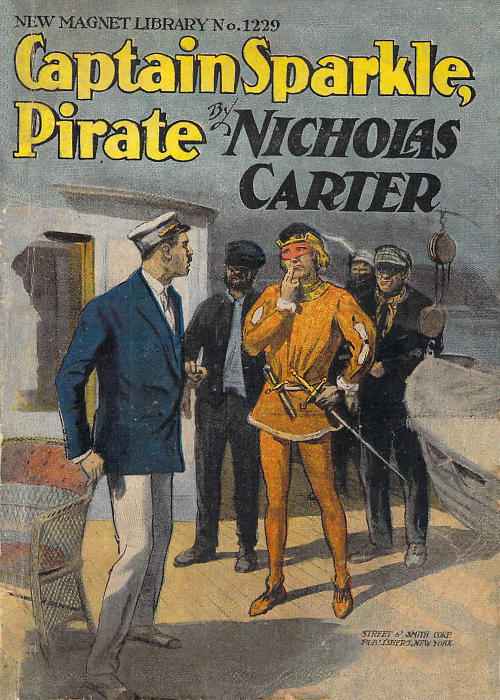
“Well, what is it?”
“Why, sir, that pirate fellow means to run up alongside of us. The Shadow is enough faster than we are for him to do that with ease, and with this smooth sea it will be like running a baby-farm. When he has done that, he’ll either make fast to us and board us, or he’ll riddle us with those half-pound shot at his leisure, sir.”
CHAPTER XIV.
THE ABDUCTION OF BESSIE HARLAN.
From the deck of the Goalong, Bessie Harlan watched the maneuvering of the pirate craft with an intensity which amounted almost to fascination.
It had not occurred to her thus far to feel personal fear. She remembered another occasion when she had met the pirate, and she recalled that she had been treated with the utmost consideration at that time, and now it did not occur to her that the rover of the sea would visit personal harm upon any of them.
She supposed that he intended merely to rob, and she did not know that, once having fired a gun from his deck, and thereby actually menacing another vessel on the high seas, he was just as amenable to capital punishment for his crime as if he had murdered the entire crew of the Goalong in cold blood.
Her ideas concerning his really harmless intention, so far as physical violence was concerned, seemed to be supported by the fact that after those six shots, some of which had found their way aboard Kane’s yacht, he did not again resort to his gun.
It was plain, however, that he had discovered that Kane did not mean to stop until he was compelled to do so; and that the rover had figured out a way to force him to stop his engines became more and more apparent as the moments passed.
It was a pretty sight, too, which Bessie Harlan and the others were watching. The long, low, narrow hull of the Shadow, funnelless, and with no deck housings of any kind save the sunbonnet-shaped turret forward, and the larger one amidships, from which the gun had been fired; and with the two masts, devoid of spars and sails, shining like silver and pointing like fingers into the air, had more the appearance of a living monster of the deep, to her eyes, than the look of a modern vessel.
The Shadow had been approaching the Goalong from a direction which was a few points off the starboard bow, but now she had altered her course so that it somewhat resembled the shape of an inverted interrogation point, and which, if pursued, would eventually swing her around so that she would come up in a parallel course with the yacht, and on the starboard side of her.
She would be running in the same direction, also, and as she was much fleeter than the Goalong, she would then have no difficulty in maintaining her position alongside and performing one of the acts which the skipper, Manning, had suggested—that is, either her men would board the yacht or they would pour in upon her the contents of that deadly machine gun.
And now, as the Shadow came about, a rod shot up from the interior of one of the steel masts, and from it there presently floated out to the breeze a blood-red flag; and at the same moment, from the amidships turret, a figure came out on the convex, turtle-back deck and stood there with folded arms, facing the yacht.
There was no mark of any kind upon the red field of the flag, and it was not more red than the costume of the pirate himself, who seemed to have taken the pattern of his costume from the tragedy of “Hamlet.”
A mask of the same color as his costume covered his face, and his left hand rested upon the gold-mounted hilt of a rapier at his side. And he stood there, calmly watching the yacht, which, although it was struggling through the water at its utmost speed, might as well have stopped its engines and waited, for the Shadow was overhauling her as swiftly and as surely as a greyhound would have overtaken a terrier.
Closer and closer the pirate craft approached, until not more than a hundred feet separated the two vessels; and then her engines slowed down until the two were running along side by side, and so near together that conversation might easily be carried on from one deck to the other. It was then that Maxwell Kane slowly and deliberately raised the revolver he held in his hand, and was taking careful aim at the pirate chief, when the quiet voice of Bessie Harlan murmured in his ear:
“Don’t shoot, Max. Wait.” she said.
But instead of desisting, Kane pulled the trigger.
The explosion followed and the bullet was sped on its way; but if those on the deck of the yacht had expected to see the pirate pitch forward to his own deck, shot through the heart, they were disappointed. He did not move from the position he had occupied ever since he made his appearance, save that he removed his plumed hat mockingly from his head and made a sweeping gesture with it toward the man who had fired. And then he called out to him.
“Don’t do that again,” he commanded coolly, “unless you wish me to riddle you with bullets, regardless of those who are standing beside you. Put down your weapon, Mr. Kane, and command all others there to do the same. Then order your engines stopped. If you do not, I will disable you.”
“You had better obey him,” said the skipper, in a low tone. “He means what he says. This is no child’s play, Mr. Kane.”
“I am beginning to realize that fact,” replied Kane.
“Shall I give the order to stop her, sir?”
“Yes; there is no use in risking the lives of everybody aboard. The fellow is a pirate, all right.”
“And he is also the Count of Cadillac,” murmured Bessie. “I remember his voice.”
“I have had no doubt of that from the first moment we discovered the Shadow,” replied Kane, with a grimace.
The bell in the engine-room rang at that moment, and the engines of the Goalong were slowed down. Then another bell, and they stopped altogether; and, although there was no sound of a bell from the pirate craft, she kept pace with the yacht in coming to a stop, so that after a moment they were forging ahead, side by side, with only their natural momentum to give them steerage way.
And after a moment this was also lost, and the two vessels were rolling almost side by side on the gentle rise and fall of the dead swell of the ocean. Then, as if by prearrangement, rather than as the result of an order just given, half a score of men suddenly appeared on the deck of the rover, beside their chief.
Either they knew exactly what they were expected to do, or their orders were already given them, for they took their places along the rail of the Shadow with the precision of automatons and waited.
A group of them went forward, another group aft, and a third remained almost amidships, near their chief. In the possession of each group there were two stout lines with grappling-irons attached to them, and Kane and his party, on the deck of the yacht, could see that the men stood ready to heave them when the proper moment should arrive.
It was then that Kane’s skipper, Manning, shook his head doubtfully.
“The Shadow is a much heavier craft than we are, Mr. Kane,” he said. “If they make fast to us with this dead swell a-running under us, and heaving our bows into the air with every rise, she’ll swamp us in no time; but——”
He paused in his pessimistic prognostication, for at that moment the grappling-irons were thrown aboard. They caught, too, as if they had been cast by well-practised hands, and then, as the men of the Shadow made fast their own ends of the lines, power was given her and she forged ahead until, with the lines drawn taut, the two vessels were brought as safely side by side as if the act had been performed on the bosom of a mill-pond.
And from that moment, too, the wheel of the Shadow was kept moving, so that the yacht to which she had made fast was towed slowly through the water, and in that way the bows of the two vessels were kept headed toward the swell with sufficient steerageway to keep them so.
“That pirate feller is a sailor, all right,” muttered Manning. “I couldn’t have done any better myself.”
In the meantime, the slack of the lines had been taken up, and now they were lashed firmly into place, so that the Shadow and the Goalong were held together exactly as if they had been one vessel. All this time the pirate chief had retained his position near the turret, with his arms folded across his breast; but now he took a few steps aft, until he was directly abreast of the group on the deck of the yacht, and then he swept them another bow.
“Ladies,” he said, ignoring Kane, “I have been lying on and off in the harbor of Hamilton for something more than a week in order, ultimately, to enjoy the pleasure of this moment. I regret that I cannot be assured that it is mutual.”
“What the devil do you want, and what have you stopped us for on the high seas?” demanded Kane angrily.
The rover turned his eyes, which shone like sparks of fire through the holes in the mask which concealed his face toward Kane. Then he made a gesture which his men evidently understood, for in an instant more Kane discovered that three wicked-looking rifles were aimed at his breast, and that behind each one of them was a masked figure in red.
“Mr. Kane,” said the pirate coolly, “you are not expected to speak at all, unless it is in reply to a question addressed to you. My men have orders to fire and to kill you if you do not obey. I trust you will have sense enough to remain uninjured, since silence on your part is all that is necessary in order to do so.”
Kane ground his teeth together in a rage; but he knew that the pirate had uttered no idle threat, and that it was useless to do other than to obey him.
“And shall I be shot, also, if I speak?” demanded Bessie boldly.
“You, Miss Harlan? I shoot you? Let me assure you that you are as safe from harm at this moment as if you were in the boudoir of your own home, surrounded by all your faithful attendants.”
“Humph!” said Bessie. “That may be true, but it doesn’t appear so. Are you not Count Cadillac?”
The pirate shrugged his shoulders, and they thought he laughed a little.
“Just now,” he replied, “I call myself the modern Red Rover—but I do that merely for the want of a better title. Captain Sparkle, who formerly commanded this vessel, is, unfortunately for him, detained elsewhere, and I have assumed his place. Perhaps it is not too much for me to admit that I was only known to you as Count Cadillac. Does that fact reassure you, Miss Harlan?”
“On the contrary, it fills me with dread.”
“Indeed! Why so?”
“Because I cannot understand how a man who possesses so many of the prerogatives of a gentleman as you do, can descend to such a vulgar calling as you have adopted.”
The pirate shrugged his shoulders again.
“It may be,” he said slowly, “that I will be able to make that plain to you—later.”
Bessie tossed her head, and was on the point of turning away, when the voice of the pirate arrested her.
“Wait!” he said sternly. “Remain where you are, Miss Harlan.”
She wheeled and faced him, with flaming cheeks and blazing eyes.
“Do you dare!” she began, and paused.
The pirate had made another gesture, which his men seemed to understand, and in obedience to it several of them stepped aboard the yacht, while the others drew up in line along the rail of the Shadow and leveled their rifles at the entire party, which included, as may now be readily understood, the crew of the yacht, as well as her owner and guests.
“Mrs. Harlan,” said the pirate coldly, then, addressing the mother of the two young women, “you will oblige me if you will go to your cabin. Not a man of my crew shall touch you if you obey, but if you refuse you will be taken there. Thank you. That is the better way.”
He turned then a little, and added:
“Now, Mrs. Kane, I will ask you to follow your mother. You, Mr. Kane, will follow the two ladies. No resistance, if you please, and no questions. Mr. Manning, follow your master.”
The pirate chief watched the four persons until they disappeared inside the cabin, and then with a bound he leaped aboard the yacht and paused within three paces of where Bessie Harlan stood. She was turning away to follow in the footsteps of her mother and sister when the pirate suddenly appeared in front of her, barring her way.
“Your way lies yonder, Miss Harlan,” he said quietly, pointing with one hand toward the deck of his own vessel.
Bessie started back in terror, and then she would have darted past him, and so sought to escape; but, with a quick bound, he was beside her, and in another instant she was lifted from her feet and carried, bodily, aboard the Shadow.
CHAPTER XV.
NICK CARTER IS THE MAN.
“If you scream or call the others to your assistance,” she heard the pirate say into her ear, as he leaped from one vessel to the other with her in his arms, “you will only succeed in having them shot, so be silent.”
So she did not scream. Even in that instant of horror, when she felt that the pirate was stealing her away for some terrible fate, she knew not what, she possessed the courage to remain silent, and so, as she believed, to save her sister and the others who were with her from instant death.
A hoarse murmur went up from the crew of the yacht when they witnessed this high-handed proceeding on the part of the pirate, for they loved Bessie Harlan. But they were powerless to help her then; and besides, the rifles of the pirate crew were aimed at their hearts. There was nothing that they could do save to stand quietly by and witness the abduction of Bessie Harlan.
Again the men of the Shadow worked as if every act of their master’s had been foreseen before they boarded the yacht.
As they left the deck of the Goalong they also cast loose the grapplings, and even as the last one stepped upon the deck of the pirate cruiser, the chief, with Bessie in his arms, disappeared through the turret into the hold of the vessel, and as if that were a signal to the engineer, the Shadow at the same instant shot ahead like a thing of life, starting away at almost full speed. And so swiftly did she move that, in the gathering gloom—and it was now almost dark—she soon disappeared entirely from view.
For a moment after her departure the crew of the Goalong to a man remained where they were standing, as if the unheard-of proceeding of which they had just been witnesses had paralyzed their energies.
Then in a body they rushed aft toward the cabin.
But the practised ear and the trained intelligence of the skipper had already told him that the pirate vessel had taken her departure, and he was on the point of coming out on the deck, followed by Kane and his companions, when the crew called to him. At first the reality of the horror that had actually occurred did not impress itself upon any of them. Not one of them realized the truth of what was told to them—that is, that Bessie had actually been taken away.
But when Mrs. Harlan, the mother, did realize that her younger daughter was gone indeed, and was now at the mercy of the pirate chief, she promptly fainted.
Kane, himself, turned white and cold. In all his conjectures concerning the pirate—and he had had many while he was a prisoner below in his own cabin—he had never once thought of this.
True, he had wondered for a moment that Bessie was not sent to the cabin with them, but he really did not give the matter any particular thought; he had certainly not dreamed of such an answer to the question as the one he now received.
His wife did not faint. She reeled against the bulkhead, white and haggard, and with her face all pinched into lines of terror, which rendered her almost unrecognizable; and for a time she could only moan her sorrow.
“Poor Bessie!” she murmured. “Poor Bessie! Rather had we all been murdered in cold blood by that pirate fiend than that this should have happened.”
Presently she started, for a hand had fallen on her shoulder. The maids had come on deck and taken charge of her mother, and in her agony she had utterly forgotten her husband.
“You, Max?” she asked, without turning.
“Yes.”
“It is awful!” she murmured, with a shudder. “What shall we do, dear?”
“Bessie had my revolver in her hand,” said Max, irrelevantly.
“God grant that she will have the courage to use it!” moaned her sister.
“She will, Cora, against him or—herself, if it comes to that.”
Mrs. Kane shivered. Then she flung her arms around her husband’s neck and sobbed as if her heart would indeed break; but after awhile she became quieter, and presently she repeated her former question.
“What shall we do, Max?” she asked.
“I don’t know,” he replied vaguely.
“There is Nick Carter,” she sobbed. “You know how quickly he accomplished something before.”
“Yes; of course, I shall go to him at once. That goes without saying, Cora. But how will even Carter be able to pursue and catch this brute of a pirate? We have no trace of him. He leaves no track behind him on the pathless ocean. Even now he is far out of sight, and we have no idea in which direction he has gone. And besides, Cora, if we do the very best we can we cannot hope to arrive in New York in less than forty-eight hours from now. Two whole days, that is; and probably that damned vil—pardon me, dear—probably that infernal scoundrel is going faster than we are, in the opposite direction. You see, don’t you, Cora, that if we knew exactly where to find the pirate we could not hope to overtake him in much less than two weeks, could we?”
“Do you mean, Max, that we cannot—cannot hope to—to save Bessie?” sobbed his wife.
“I mean this, Cora—and we might as well look the matter squarely in the face, now that it has confronted us, don’t you think so?”
“Well? Go on, Max.”
“What I was going to say was this: Bessie has got a lot of sand and pluck. You know that.”
“Yes.”
“Well, if anybody saves Bess it will be Bess herself who accomplishes it, and it wouldn’t surprise me a bit if she should find a way to do it. There is one thing dead sure, and that is that we can’t do anything—not a blessed thing—now. We’ve got to wait till we can get the right sort of a start. We can’t hope to overtake Bess, and be on hand to do her any sort of good, inside of two or three weeks, and it may be as many months. The Atlantic Ocean is a whopping big place, and there are several other oceans to take into account, too; and so, here is the face of the thing, as I wanted you to look at it a moment ago: If Bessie is not in immediate danger, she is just about as safe three months from now as she would be three days from now. If that pirate means any devil’s work, he’ll get about it before he is very much older; and if it happens that there is enough of the gentleman left in him to make him keep his hands off and respect her, why, then no actual harm will come to her. Don’t you see that?”
“Yes, and it makes me hope. Because I do think——”
“What?”
“I think that perhaps the count is still a gentleman, outwardly, at least; don’t you?”
“No, I don’t. But I do think he is in love with Bess. And if he is, that is the only one thing in the world that will save her.”
“Why, Max, that very fact—if it is a fact——”
“There, there, now! That very fact is what I’m talking about. If he is really in love with Bess, she’ll be as safe from harm when we find her as if she had been aboard the Goalong all the time.”
“But, Max! Have you thought——”
“Thought what?”
“Of the name of it.”
“Oh, confound the name of it. It’s the game, and not the name, with which we are concerned just now. Bess has got a gun; don’t forget that—and she knows how to use it, too. And Cadillac is in love with her, up to his ears, if I am any judge of human nature. When he was our guest it was as plain as the nose on your face.”
“Yes; I thought so, too.”
“Well, as I said a minute ago, Bess knows how to use a gun all right, but if there is one thing which she knows how to make use of better than any other, it is a man who is in love with her. She can twist one of ’em around her fingers like straws, and I’ll bet a million that she’ll be doing the act for the modern red rover, as he calls himself, before he’s had her a prisoner an hour. She’ll be boss of the whole shooting match before she has been a day aboard the Shadow.”
“Perhaps she is dead, even now, while we are talking about her,” said Cora, shuddering.
“She is either in no immediate danger, or somebody is dead; you can bet on that, girl!”
“If only she did not faint away,” murmured Kane’s wife; and he looked at her strangely for a moment and then shrugged his shoulders as he replied:
“Bess isn’t one of the fainting kind, Cora. And now, don’t you think you had better go to your mother?”
“Yes, dear, but what shall I tell her?”
“Tell her! There isn’t anything to tell her, is there? Tell her what we have been talking about. Tell her every idea that has occurred to us about the matter. Tell her that we are legging it back for New York and Nick Carter just as fast as this blessed old tub will carry us. Tell her that when we get there I’ll pull down stars out of the sky and dig up mountains with my two hands to save Bess. Tell her—she already knows it, but you can remind her of it, just the same—tell her that your chump husband is worth a number of millions of dollars, and that he’ll spend every last dollar he’s got to find Bess and save her, and to hunt down the fellow that stole her, no matter what has happened; and tell her if she can think of anything else that she would like done, it shall be done if there are men in the world to do it. And tell her not to cry. Crying won’t help the matter any, and it interferes with good, clear eyesight. I’d like to swear, but swearing doesn’t assist the judgment any, as I have discovered, so you see I don’t do it. Brace up, Cora, girl! Bite on the bullet. It hurts, I know. It hurts me just as much as it does you. But let me tell you this much before we part—and it means a good deal, too.”
“What, Max?”
“Nick Carter thinks a lot of Bessie, if anybody should ask you. He won’t require any seven-league boots behind him to spur him on in this matter; and if there is a man on top of earth who can figure this thing out about the way it really is, that man is Nick Carter. He will see through it like a glass, and blow me if I don’t somehow feel as if he would know at once just about where to look for Bessie and the pirate.”
CHAPTER XVI.
THE PIRATE’S BEAUTIFUL CAPTIVE.
And now we must return for a space to the pirate cruiser, the Shadow. Although Bessie Harlan did not faint when the pirate chief seized her and bore her aboard of his own craft, from the deck of the yacht, she was in reality so near to doing so that she was rendered as helpless as a babe in the arms of the man who carried her.
She was conscious only that she was borne from the deck of one vessel to the other, and that then her abductor carried her down a short flight of steps into the interior of the boat. She heard him open a door, and she was conscious then that she was in a lighted room, although she could not have opened her eyes to save her life, it seemed to her.
They traversed this room, or cabin—she did not see what it was—and presently passed through a second door. Inside this second apartment the air was cool and sweet. She could hear the bur-r-r of an electric fan and could feel the draft it created.
But still she did not open her eyes. Then she realized that her captor was putting her down, and he did it so quietly and so tenderly that she decided he must believe that she had fainted, and, in order not to undeceive him, she kept her eyes closed.
Her only thought now was to escape from his arms—to liberate herself from his immediate grasp—to get away from him, from his touch; to be out of his reach.
For she still held Max Kane’s revolver in her grasp, and she closed her fingers even more tightly around the butt of it, in order that it might not drop out of her reach, and she pushed it even farther among the folds of her dress in order that he might not by any possibility discover that she had it.
And then he put her down. She felt that she was resting upon an upholstered chair, and that the pirate was bending over her, studying her features.
She permitted herself to breathe a little—just enough to reassure him so that he would not resort to extreme measures to bring her back to consciousness. She only hoped that he would go away and leave her until she could have time to recover her senses fully—until she might think over the awful thing that had happened, and decide what to do.
She even thought calmly about the expedient of putting a bullet through her own heart the moment the pirate should leave her alone, and she regarded the idea quite calmly, as something which was not at all impracticable. He touched her hands with the tips of his own fingers, having drawn off his gauntleted gloves in order to do so. Then he touched her brow in the same manner, and she shuddered almost, lest he should use his lips.
But, if he thought of it, he did not attempt to do it.
She heard him sigh. Then she knew that he had straightened up and drawn away from her. It seemed to her that he stood there a long time, watching her, before he made a move to go away; but at last he did so.
Her sense of hearing was so acute that she could almost hear him as he breathed. She knew when he began to move away from her, and she could feel the increasing distance between them, as he went nearer to the door by which they had entered.
Then she heard the clicking of the latch, and she permitted the lids of her eyes to rise ever so little—just enough so that she could see through her drooping lashes the figure of the pirate chieftain standing on the threshold.
The mask still covered his face; evidently he had forgotten it. He was looking back upon her with an expression she could not fathom, for the reason that she could not see through the mask; but his attitude was kindly, if one can see kindness in the mere figure of a person.
Then he went out and closed the door softly behind him. For one, two, three, four, five seconds of time Bessie did not move. She counted them in order that she might make no mistake; and she waited that length of time lest the man might repent of his hasty departure and decide to return.
Then, at the end of the five seconds, she raised the revolver from under the folds of her dress and leveled it at the closed door.
She maintained that position while she counted ten more, and if the rover had opened the door during that time she would have shot him. She did not know that, when arrayed in the costume he was then wearing, he wore a steel breastplate under his shirt which would have turned her bullet just as it turned Kane’s, earlier in the evening.
But now fifteen seconds had elapsed since the pirate left her. A full quarter of a minute, and she leaped to her feet and darted toward the door. There was no ordinary lock upon it, but there was a chain-bolt, and this she at once slipped into place.
That done, she breathed a sigh of relief; and then, with an added shiver, she looked hastily around to discover if there were other means of entrance to the palatial cabin in which she was now a prisoner.
Farther aft there were portières over a doorway, and she hurried to it, but only to discover that it was the means of communication with a passage from which four staterooms opened.
There was no other way out of the cabin save through the door used by the pirate; Bessie convinced herself of that at once, and with untold relief. Then she peered into the staterooms, one after another, and she discovered with alarm that one of them was all too plainly the abode of the corsair.
And then, when she would have made further investigation, she heard the rattle of the chain on the door she had fastened, and she tiptoed her way across the cabin until she stood almost against it, listening. The pirate had returned. She knew he was there, although, from the position she occupied almost behind the door, she could not see him. After a moment, during which she knew that he turned and gave a low-toned order to some person who was standing near him, he called her by name.
“Miss Harlan!” he said. “Miss Harlan!”
She did not reply. He repeated the summons, somewhat louder than before, but she made no answer.
“Won’t you open the door?” he requested. “At least let me know that you hear me, or I will be obliged to break it down in order to assure myself that you are uninjured.”
“Yes, I hear you,” she said, then, realizing how simple a matter it would be for him to burst the door open.
“Will you not open the door?” he asked her again.
“No,” she replied.
“If I assure you that you will be as free from harm as if you were aboard your brother’s yacht?”
“No.”
“But I wish to talk with you, and this is not a pleasant attitude for conversation.”
She made no reply to this.
“Will you open the door?” he asked again.
“No,” she said. “I will not open the door.”
It was stretched, of course, to the utmost limit of the chain, which permitted an aperture of two or three inches.
She still stood behind it, out of his sight, and with the revolver tightly grasped in her right hand; but now, fearing that he might decide to break the door from its fastenings, she drew back one step more, farther into the corner. Then she saw something, she did not know what, pass through the opening between the door and the casing and touch against the chain.
That something was a pair of steel nippers, although she did not know it; and she was dismayed the next moment to see the chain fall loosely away from the catch, and to see that the door was swinging open. With one bound she reached the table in the center of the cabin, and with another she passed around it so that it was between her and the door. Then she raised the revolver and pointed it at the pirate.
He came through the doorway and closed it behind him, and then he stood there with his back against it, smiling upon her almost as if he were amused.
“If you make an effort to approach me or to touch me,” she said, and her voice was clear and strong, belying the awful terror that was wringing her heart, “if you come as much as two steps nearer to me than you are now, I will shoot you!”
For a moment he permitted his eyes to dwell upon her face, quizzically, without deigning a reply; it seemed to her that he was weighing what she had said to him, as, indeed, he was doing, though not in the manner she thought.
After a moment he shrugged his shoulders a little and laughed softly.
“Very well,” he said, “shoot me. I assure you that I should not greatly care if you did so.”
She made no reply, and presently he added:
“However, for your own sake, I should advise you not to do so. You see, Miss Harlan, it would greatly add to your present danger if I were to die. I do not express that with exact correctness, for, as a matter of fact, you are now in no danger at all, while if I were to die you might be in considerable.”
“I will not pretend to understand you,” she said scornfully.
“No? Suppose I make myself more explicit?”
“As you please,” she retorted.
“Must I remain here until I do so?”
“I have already told you that if you attempt to come nearer I will kill you. I did not deceive you when I said that.”
Again he shrugged his shoulders, and the ghost of a smile played around his handsome features, for, as the reader has guessed, he no longer wore the mask, nor the hat, nor the wig which went with it. Otherwise he was still in the costume of the corsair.
“Very good,” he said. “Perhaps you will be more lenient when I have explained.”
“If you can explain,” she replied coldly.
“Oh, yes, I can explain, Miss Harlan. There are always explanations for things, you know.”
Her reply was a haughty stare. She did not offer him so much as a gesture by way of encouragement.
“Has it occurred to you to attempt to explain to yourself why I dared to bring you to this vessel, and into this cabin, by force, and utterly against your will?” he asked.
“No.”
“Shall I tell you?”
“If you will tell me the truth about it—yes.”
“I shall tell you nothing but the truth, Miss Harlan.”
Her lips curled with scorn, but she made no reply.
“Do you recall something that I said to you once, on the deck of Mr. Kane’s yacht?”
“You have said a great many things to me there, Count Cadillac, if that be your own name, which I doubt.” There was a little frightened catch in her voice, which she strove to conceal by forcing herself to be insolent; but he heard it, and he knew that he had startled her.
“Miss Harlan,” he said rapidly, “this conversation is only the beginning of a very great deal that I have to say to you, and it is my duty to inform you, with all the emphasis at my command, before I attempt to say another word, that as long as you honor this vessel with your presence, with or against your own free will, you shall be treated in every way as an honored guest upon it. There will be no word or act said or done in your presence which can in any way offend your tenderest sensibilities. May I beg that you will believe me?”
There was so much sincerity in his voice that she believed him in spite of herself, and for a moment the conviction that she was free from the nameless horror of her position, which had already almost driven her mad, overcame her.
“Then why, why, why did you bring me here at all?” she cried.
She had forgotten the weapon she held in her hand, in that instant, and the muzzle drooped until it touched the table unheeded. It would have been an easy matter for him then, had he wished to do so, to have stepped forward and possessed himself of the weapon before she could have recovered it; but he did not move.
“Your question brings us back again to the one I just asked,” he said. “Shall I repeat it?”
If she heard him she did not heed, for she made no reply.
“Do you remember—don’t you remember that particular something I said to you at the time I refer to, when we were together as guests on Mr. Kane’s yacht?”
“You said very many things to me, Count Cadillac. I do not recall anything——”
“I told you that I loved you, Miss Harlan. I asked you to be my wife; and you did not entirely refuse me.”
She raised her head now, and her eyes were blazing with wrath—righteous wrath, so intense that it made her forget their relative positions.
“You dare to repeat that to me, now, after—after all that has happened since that time?” she demanded.
“Miss Harlan,” he said calmly, deliberately, but not unkindly, “I have brought you here by force, if you will, in order that I might say it—in order that I might continue saying it, over and over again, day after day. I am an outlaw now. I know it; but I am still a gentleman. I——”
“A gentleman, indeed!” she interrupted him. “Thank God that word has a different meaning in America than it does where you were born. A gentleman! Say rather an impostor, a swindler, a bogus count, a thief!”
The man winced as if he had received a blow, and his face went deadly white, like the waxen face of a corpse. For a moment even his lips seemed bloodless, and his fingers clinched into the palms of his hands until the manicured nails drew blood where he dug them into his flesh.
But he made no other motion.
He stood like a statue before her. He seemed scarcely to breathe; and for more than a full minute he did not speak.
“I have expected something very like that from you,” he said, at last, in a voice in which the effort to remain calm was plainly apparent. “In a measure I have schooled myself to hear it; but I did not know how hard it would be—how terrible it would sound from your lips. If I had known that, I almost doubt if I would have brought you here at all, Miss Harlan.
“At least I am not an impostor,” he resumed, after another pause. “I am the Count of Cadillac, whatever else I may happen to be. My family is among the oldest of Anjou. My ancestors count back into the Dark Ages almost, among the oldest, the best, the bravest, and the most honorable.
“Nor am I a swindler, Miss Harlan. I do not think you thought that, even when you said it.
“Nor am I a thief. Save your own person, I have never stolen a thing in my life.
“However, I do not expect you to believe all this, at least just at present. I did not suppose that you would do so when I brought you here, but it was in the hope that time would give me an opportunity to convince you of its truth, that I decided on this lawless act.
“Wait; I have not done, nor will I be done, ever, until you consent to listen to me with at least an outward show of interest.
“And I prefer to begin with you frankly. That is why I began this conversation by admitting to you that I have stolen you from your friends, and brought you here by force, because I love you; and because I have a hope, away down in my heart, that I will end by winning your consent to be my wife.”
Bessie had permitted her revolver to rest with the muzzle against the table ever since it had dropped there some time before; but now she raised it. He watched her silently, wondering if she intended to use it upon him; and, if the truth be told, caring very little if she did so. But she held it daintily in her hand; and then, with her eyes fixed searchingly upon his face, she said slowly:
“Do you see this pistol? Rather than become your wife, and rather than live to be forced to confess to my sister and my friends the insults to which you have subjected me, Count Cadillac, I would a thousand times turn it upon myself—so!”
CHAPTER XVII.
THE TIME AND THE HOUR!
The pirate chieftain—or, as we will call him for the present, Count Cadillac—had not the slightest idea of Bessie’s intention until she had succeeded in turning the weapon upon herself, and the muzzle of it was already against her temple.
If the revolver had been an ordinary one, or if the muscles of Bessie Harlan’s fingers had been firmer and stronger, she must have taken her own life then and there, before her companion could have done aught to prevent it. But the weapon was of the double-action pattern; more than that, the action was firm and strong, so that it required a considerable exertion of the muscles of the fingers to work it.
Then again, the position in which she was obliged to hold it strained the muscles of the right hand in such a position that the feat of pulling the trigger sufficiently to raise the hammer past the catch was twice difficult. Double-action revolvers are not the best in the world for the uses of people with suicidal intent.
As has already been said, the muzzle of the weapon was already against her temple, before the count fully realized her intent; but then he leaped forward with a sudden cry. Perhaps his sudden action, together with the cry he uttered, had something to do with disconcerting her; at all events, he was in time.
It is doubtful, too, if she realized what she was about to do.
A creature of impulses always, the count’s words of love spoken at such a time, and bringing to mind, as they did, that the time was not far distant in the past when she had consented to listen to him, and when she had not repulsed him—when even she had secretly convinced herself that she might some day love this man—filled her with such horror of her present position that death seemed to be the only way of escape.
It is certain that she intended to kill herself. It is certain that she intended to send the bullet through her brain and thus to escape at once and for all time the horror of her present surroundings. It is also certain that the sudden activity of the count prevented her from carrying her impulse to a fatal termination.
It will be remembered that the table was between them; that she stood facing him at one side of it, while he was half-way across the cabin from her, at the opposite side. But his leap toward her was like the spring of a panther, and the cry he uttered was so filled with horror, amazement, terror, and remorse for bringing her to such a pass, that it startled even her, wrapped up as she was in her fatal resolve.
As he leaped forward he threw himself bodily across the table, scattering the books and papers, and the electric drop-light that stood in the center of it, in every direction, and upon every side.
And he managed, somehow, to reach her arm and hand. He managed, somehow, to seize the wrist of the hand which held the weapon—to deflect it, and to knock it from her grasp with such force that it was sent hurling across the room, where it fell, clattering, against the mahogany bulkhead. It was not even discharged.
The hammer, which her tender muscles had been unable to raise, fell again into place without touching the cartridge in the chamber, and Bessie stood for an instant, abashed, before him.
The table was still between them. He remained, leaning upon it with both hands, and with his face thrust forward toward her, speechless with dismay, alarm, and with thanksgiving for his power to prevent the consummation of her terrible act.
And she stood opposite him, a few feet away, white and staring—herself speechless from the terror of the thing which had approached her so closely, and yet had passed her by.
For a moment it was a tableau which neither of them comprehended; and then the count did the only thing he could have done under the circumstances, to help her to regain her composure, and to convince her that she was not in the terrible danger she dreaded from his presence.
He straightened himself back upon his feet, calmly and slowly, until he stood upright before her. Then he folded his arms across his chest, and looked into her eyes silently. Presently he pointed with one finger toward the weapon where it was lying against the bulkhead, and he said slowly:
“Yonder is your weapon, Miss Harlan. Let me suggest that you resume possession of it, in order that you may still have the means about you to protect yourself against a danger which exists only in your imagination.”
She did not move, and after a moment he continued:
“I have assured you that you are safe here—as safe as any honored guest might be anywhere in the world. While we are aboard this vessel together, while you are a passenger upon it, I should like to have free access to this cabin—in short, I should be glad if you will consider it a common meeting-place between us. But yonder”—he pointed toward the portières which divided the cabin from the passageway—“yonder, beyond those curtains, is a portion of the Shadow which you may regard as your personal domain. Beyond that point no human being save yourself shall penetrate, so long as you are my guest.
“And there,” he continued, “you will find every convenience, and every article of wearing-apparel, which you can require. The clothing belonged to Madame Cadillac, the wife of my brother, as good and true and splendid a woman as ever drew breath. You know something about her, for you have heard Nick Carter talk about her; you have heard the husband of your sister describe her.
“You are the only woman aboard this vessel, but that need make no difference. You have but to touch the button yonder to secure the services of the steward, who will serve you, at any time, with anything you require, which he possesses.
“And now, Miss Harlan, I will bid you good night. Until some time to-morrow, at least, you will not be again intruded upon.”
He turned swiftly and would have disappeared through the door had she not held up one hand in a gesture to detain him.
“Wait,” she said simply.
“Yes?” he said, in reply.
“You have convinced me,” she said, “that you intend me no immediate personal harm.”
He bowed his head, without replying in words.
“And I doubt,” she continued, “if you realize the incalculable and terrible injury you inflict upon me with every additional moment I pass aboard this vessel.”
“I have taken that into consideration,” he replied calmly. “I know how you view it. It is too late now, however, to remedy it. If it were not too late, I would set you back aboard the Goalong. As it is——”
“As it is,” she interrupted, “permit me to doubt your word in that respect, Count Cadillac.”
Again he bowed without replying.
“I wish you to tell me where you are taking me,” she said.
“To Anjou,” he replied laconically.
“To your château in France?”
“Yes.”
“For what purpose?”
“To make you my wife, when we arrive there, if in the meantime I am permitted to win your consent.”
“You are at least frank.”
“Yes.”
“And if you do not succeed in winning my consent—what disposition do you intend to make of me in that case?”
“I intend to return you to your friends.”
“Indeed! Would it not have been better to have left me with my friends? Do you think it possible to win my regard under such monstrous circumstances as those with which you have surrounded me?”
“I think I shall at least succeed in winning your respect.”
“What! Win my respect, when you have stolen from me all the respect and esteem with which I have ever been regarded by the friends from whom you have stolen me?”
“Miss Harlan, you are as safe here as——”
“Stop, sir! You are, perhaps, positive of the truth of that statement, and I will admit that you have partially convinced me of it; but are you so ingenuous, so unsophisticated in regard to worldly matters, as to suppose for a moment that others will regard my present plight in that manner? It would have been better, much better for me, Count Cadillac, had you murdered me in cold blood before you brought me here as you have done. It would have been better for you had you permitted me to make use of that weapon which I just now turned upon myself, to end my life, and afterward used it for the same purpose upon yourself; and it would have been much better for both of us had you met the fate of your brother, who is now a convict.
“Wait, sir, I have not done. I will finish what I have to say, and then I will thank you if you will leave me to myself.
“I shall not take my own life now, Count Cadillac; I shall live. Back yonder in New York there is a man toward whom my brother is now speeding, with all the power the engines of his yacht contain. You know to whom I refer.”
“Nick Carter!”
“Aye, Nick Carter. Do you remember him, Count Cadillac? Do you doubt that he will search for me and find me? Do you doubt that he will also search for you and find you? And do you doubt, for one moment, what will happen to you when he does find you?
“Ah! sir, it does not matter now, in your case, how soon you set me at liberty—you have committed this act of wrong against me, and Nick Carter will hunt you down for it as surely as you stand there now. He will find you, if you are in France, in Anjou, in Patagonia, or at the north pole. He will find you, and he will hold you to strict account for your work this night. Be assured of that much!
“And I have said that I will not again attempt my own life. I will not. I will live and wait—live and hope for the coming of that hour when you will find yourself face to face with him—face to face with Nick Carter. And now, sir, good night. I have no doubt that you will enjoy pleasant dreams.”
CHAPTER XVIII.
THE DETECTIVE SIZES UP THE CASE.
When the Goalong passed the Narrows and was making her way rapidly through the upper harbor, it was approaching the evening of the second day after her encounter with the pirate cruiser, Shadow.
Maxwell Kane was standing near the wheel-house as they passed inside the bay, and, after glancing at his watch, he turned and walked aft, where his wife and her mother were seated, silent, under the awning. Both were sad and care-worn, for the terrible uncertainty as to the fate of the beloved sister and daughter had almost prostrated them. And yet, they had borne up wonderfully well under the circumstances.
“I am always good at picking winners,” Kane had said to them on one occasion, “and I will take Bess against the field any time. That pirate will get left at the pole, you see if he doesn’t, and he’ll never come within a thousand yards of our filly. You see!”
Just now, when he walked aft, he had another idea on his mind.
“Mother,” he said, to the elder woman, “we will be at the foot of West Twenty-third Street in something more than an hour; that is to say, in exactly forty-eight hours since we parted with the Shadow.”
“Yes, Maxwell,” she replied. “Well?”
“I was about to suggest this: An hour more or less now won’t cut much ice in this affair we’ve got on hand, will it?”
“I don’t know exactly what you mean, Maxwell; but go on.”
“I want you and Cora to remain on board when we land; see?”
“You don’t wish us to go ashore? Really, Maxwell, I feel as if I must——”
“I don’t want you to go ashore—either of you—until after we have seen and talked with Nick Carter. Just the very first moment when I can leave the yacht I will do so, and I will get him over the telephone and ask him to come to us; and we won’t any of us say a blessed word about anything that has happened on this cruise, until after we have seen and talked with him. Is that agreeable?”
“Why, yes, I suppose so.”
“I have given orders to Manning to that effect. And now, with that understanding, I’ll have myself put ashore the first moment possible. In the meantime, if anybody should happen to come out to the yacht, you will not receive them?”
“Certainly not.”
“It is not at all likely that anybody will do so, you know; but I wish to have it understood.”
“Very well, Maxwell.”
True to Kane’s prophecy, the Goalong arrived at the time he said she would, and in a very short time after that he was in communication with the detective. Their conversation was short, but very much to the point.
“Is that you, Nick?” Kane asked; and when he had received an affirmative reply he continued:
“Don’t ask me for particulars over the phone, but come down here as quickly as you can, will you? It is a matter of life and death, old man.”
“I’ll be there at once,” was the reply; and Kane heard the click of the receiver as the detective replaced it at the other end.
And he had not long to wait after that.
He did not return at once to the yacht, but lingered where he was until he saw the detective leap from a car and approach him; then he led the way directly to his launch, and the two were speedily set aboard the yacht. In as few words as possible, he then related the story of their adventure which had ended so disastrously—in the abduction of Bessie Harlan.
The very first question which Nick then asked was one which Kane had foreseen. It was:
“Who, besides yourselves, is aware of this affair?”
“Not a soul in the world, save the people aboard this yacht—and aboard the pirate, of course.”
“Then,” said Nick slowly and emphatically, “not a soul save yourselves must ever know about it.”
“Just my own idea,” said Kane.
“It is for her sake,” continued Nick Carter. “Ladies, when you go ashore, you must say not a thing about this sad occurrence. Give out—if you must make any explanation at all—that Miss Harlan has remained at Bermuda, or that you have dropped her somewhere on the route homeward. For her own sake her present predicament must never be known.”
“We realize that fully,” said Mrs. Kane.
“Can you keep your crew from talking about the pirate?” asked Nick, of Max.
“You bet I can.”
“Then see that you do so.”
“But Mr. Carter,” asked the mother, “can you not give us some hope of her rescue?”
“Hope? Certainly I can. Hope? There is no occasion for anything else save hope.”
“But think—think of her awful predicament.”
“I have thought of it. I am thinking of it now. Madam, you have often heard the expression that you cannot make a silk purse out of a sow’s ear; but has it ever occurred to you that it is quite as difficult an undertaking to make a sow’s ear out of a silk purse?”
“I do not understand you. Mr. Carter.”
“Then I will explain. We are agreed, are we not, that the captain of the Shadow is no other and no less a person than Count Cadillac?”
“Yes.”
“Very well. If Count Cadillac had been reared a pirate—if he had passed all his life before he appeared here in society among us, in the slums of the world, a scoundrel, a thief, an impostor, and a felon, his advent here would have been a parallel with making a silk purse out of a sow’s ear. Now, we all know that while he was among us, he at least appeared the gentleman, and, therefore, we are satisfied that his antecedents were and are good.”
“That is certainly true, Nick,” said Kane. “I begin to see the point you are getting at.”
“Very well. Now, on the other hand, if he has always been a gentleman until he took up this calling of a pirate, he has undertaken the proposition of turning the saying the other way ’round; eh?”
“Changing himself into a sow’s ear, when he has, heretofore, been a sort of a silk purse; is that the idea?”
“Exactly.”
“How does it apply, Mr. Carter?”
“Why, his natural proclivities are those of a gentleman. His calling as a pirate is an avocation rather than a vocation. He can play the brute, but he cannot wholly become one.”
“He is certainly acting the part of one now,” said Mrs. Kane.
“Granted; but it is only outwardly. Inherently, he is still a man of genteel tendencies. He has held you up in the middle of the ocean and robbed you of the greatest treasure you possess, but he has not done it for ransom—he has done it because he is in love with Bessie, and because he realized the utter hopelessness of his love, since we sent his brother to prison, and proved to our own satisfaction that he was as deep in the mud as his brother was in the mire.
“Don’t you understand that the moment Bessie became a prisoner aboard his craft he realized her entire helplessness? Don’t you see that he never realized the enormity of the outrage he was committing, until he saw her seated there in his cabin, absolutely at his mercy? Can’t I make you understand that, bad as he is, all the good there is in him rose to the surface at that moment, and every chivalric strain there is in him, descended from his ancestors, appealed to him then and there to protect her?”
“The point is,” said Kane, “that he started in to make a sow’s ear out of himself, and has had an opportunity to find out that it can’t be done; eh?”
“Precisely. There are some things which cannot be accomplished by a man, no matter how intent he may be upon it; and the greatest of them all is, that he cannot change his nature. The genteel blood which flows in the veins of Count Cadillac would no more permit him to offer offense to Bessie Harlan, unprotected as she is, than it would you or me, Kane.”
“By Jove, Carter! I believe you!”
“Certainly; so, you see, we must start in with the assurance that she is as safe from actual harm where she is as if she were here with us now.”
The mother sighed.
“I wish I could feel it so,” she said.
“It is as true, madam, as that you are seated there. Her position is, of course, a false one. She is in a terrible situation. But it is neither fatal nor vital. Have I convinced you, Mrs. Harlan?”
“You have more than half-done so, sir.”
“Then let us proceed. We must now arrive at the quickest and best way of rescuing her; and we must agree that when she is at last rescued—as she will be in short order—the secret of her adventure must remain with us—with only those who are concerned in it—forever.”
“By thunder! Carter, you are getting at the meat of the thing in short order. I knew that you would do it. I couldn’t think of a method to cheer these women, try as I might, and here you have accomplished it in a moment.”
“We must now get about the rescue,” said Nick, again.
“But how? How shall we get about it? You can’t trace that infernal craft of his across the waters of the ocean!”
“Why not?”
“Eh? Why not? Can you?”
“Certainly you can; or, at least, certainly we can.”
“For Heaven’s sake, how?”
“Do you recall, Kane, the night when we swam aboard the Shadow?” asked Nick, referring to the time of the first capture of the pirate cruiser, when the brother of the count had been taken prisoner and sent to his just deserts.
“I should say I do.”
“Do you remember the conversation I overheard between the count’s brother—Captain Sparkle—and his wife?”
“Yes. Of course.”
“Don’t you recall the fact that at that time we learned the whole secret of their piratical proclivities? Don’t you remember how the woman hated it all, and hated her husband, also, because he had ever gone into the venture?”
“Yes.”
“And his explanation to her of his reasons, doubtless given to her for the hundredth or thousandth time?”
“Yes; certainly.”
“Let me recall it to you, nevertheless. Over in his own country they are descendants of one of the oldest families of the oldest province of France—Anjou. There he possesses large estates, a château, and all that the heart of a Frenchman desires, save the one necessity, money. He became a pirate in order to possess himself of that necessary money. He had decided that there were hundreds of rich men in this country from whom he could purloin certain large sums which would mean a fortune to him, but which would not affect them, even after they had been robbed. His idea was that they were so rich that they would never miss at all what he took from them.”
“Yes; I remember all that.”
“His only idea in becoming a pirate was to restore his fallen fortunes; to redeem his estates; to rebuild his château; to become a grandee, as his ancestors had been for many generations before him; to settle down there at last, in quiet and in happiness, rich, admired, respected, and esteemed. And he would have accomplished it, too, if he had not run up against you, Kane.”
“Say, rather, against you, Nick.”
“Oh! well, it is the same thing. We were fortunate in cutting short his piratical career, and he is now paying the penalty for his misdeeds. Now, Kane, I am satisfied that this brother, the real count, is a better man than the one we captured. There is more of the gentility of his family in him. I have never thought that he was entirely a willing party to the pirate business. He was an accessory, of course, because he remained quiescent, and did not betray his brother, but I doubt very much if he ever willingly committed a piratical act, or stole, until he first stole the Shadow from her moorings here in the city, and then held you up in mid-ocean.”
“Well?”
“Now, we are endeavoring to trace his course across the ocean, are we not?”
“Yes.”
“Then we have to consider why he has done the things he has.”
“Sure.”
“First, then, it goes without saying that he was in love with Bessie, does it not?”
“I think so.”
“You saw it. I saw it. Your wife saw it. We all saw it. Isn’t it so?”
“Yes,” they all assented.
“Very good. Now, if you will hark back to the capture of his brother, you will see how all of the real count’s castles in the air were shattered by that event.”
“I see.”
“The brother was a married man; he could only retrieve his fortunes in some such manner as he adopted; but with the count, it was different. He was single. He had fallen in love with Bessie. If he could succeed in winning her for his wife, his fortunes would be retrieved on the spot, and after a manner entirely honorable; for Bessie is rich, in her own right, is she not?”
“Yes.”
“I think he really loved her. I think that she was attracted to him. I even think that it might have ended by her marrying him. It is certain that he thought so. Then, in an instant, the cup he was holding to his lips was shattered. His hopes were dashed to the ground. He determined to disappear. He did so. Then he began to think out some way of overcoming the difficulty that had arisen; of bridging the chasm that had suddenly been dug at his feet. And, Kane, he saw but one way—only one. There was the yacht where he could possess himself of it. Bessie was in Bermuda. He could steal the Shadow. He could hold up the Goalong and take Bessie away, bodily. Thus, at least, he would find the opportunity to plead with her—to present his side of the case exactly as it is; and, perhaps, in spite of all, to win her, for he believed she loved him. At the worst, he could not be lower in her opinion than he already was. This afforded him a chance to win, and he took it.”