
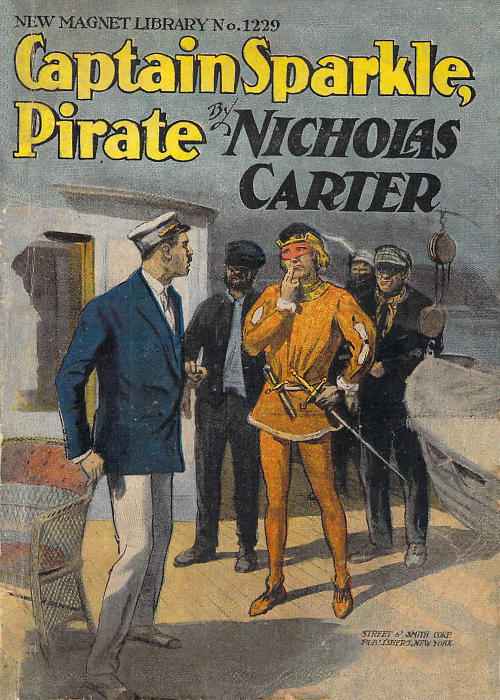
“I have taken your trophies, Mr. Kane, as you will observe, but I will give you my promise that you shall hear from me concerning them, and be given an opportunity to redeem them, if you care to do so, before they are destroyed; and for that you have the word of Captain Sparkle, of the Shadow.”
“That must be the name of his craft, the Shadow,” said Kane.
“Without doubt.”
“What do you get from the note? Anything?”
“I get a specimen of Sparkle’s handwriting, which, it is true, amounts to little or nothing; but we also get that promise, which I have no doubt he will keep, that he will communicate with you again, and in that communication will make some sort of a suggestion by which you may redeem your cups.”
“And do you think you might be able to get on the track in that way?”
“I think that such a thing is possible, although extremely improbable. We will have to wait until we receive the communication before we bank too much on what it may contain.”
“Exactly. That is what I thought.”
“Tell me, did the pirate talk to you as if he were making any effort to disguise his voice?”
“Not at all.”
“Did anything about his voice, his manner, his walk, his air, or his conduct remind you of any living person you know, or of anybody you have ever seen before?”
Kane broke out into immoderate laughter, and, turning toward the count, he exclaimed:
“What did I tell you, Cadillac?” and then to Nick he added: “Count Cadillac ought to thank his stars that he was here aboard the yacht when the pirate visited us, for, honestly, Carter, there was not a thing about him which did not in some way suggest the count himself to me.”
“Indeed!” said Nick. “That is rather remarkable, don’t you think so?”
“Highly so. I should say,” said the count.
Kane laughed on; but presently he said:
“His voice, his manner of speaking, his walk, his carriage, his general air, his height, his figure—even his courtly bow—was Count Cadillac all over. We have had a good laugh about it among ourselves, Carter. Even the count admits it to be true, and, like a good fellow, he has consented not to take offense if I forget myself and joke him about it.”
“That is very kind of you, count,” said the detective. “It can’t be very pleasant to be told that you resemble a pirate.”
“Oh, I don’t at all mind it, Mr. Carter.”
“And do you yourself recognize the logic of the suggestion?”
“I am forced to admit that I do.”
“Did the pirate, at the time he was here, remind you of yourself?”
“Oh, well, that is perhaps going too far, don’t you know. I must confess that I did not discover it at the time; but afterward, when the subject was brought to my attention——”
“You did see it, then, eh?”
“Yes, I really did, sir.”
“And were the ladies impressed by the same idea?” asked Nick, turning toward them. “I mean, of course, before it was suggested by Mr. Kane?”
“Oh, yes,” replied Mrs. Kane. “We both saw it, and spoke about it together before Max referred to it at all.”
“Did it strike you, also, Miss Harlan, before your sister spoke about it?”
“Yes, indeed. I saw it at once. That was why I took things so easy when I first came on deck. When I saw Captain Sparkle standing there beside Max, I thought he was the count. I suspected at that moment that the whole thing was an entertainment of some sort that he had gotten up for our benefit.”
“And you, Mrs. Kane?”
“You must remember that I came on deck with the count, so I could not possibly mistake the pirate for him; but it did occur to me, when I heard the man’s voice, that he might be a brother, or——”
“Who had taken that opportunity and that occasion to present himself to you, eh?”
“Why, yes; something like that. But the thought did not have time to take form before the idea was entirely driven out of my head.”
“Of course not”
“You seem to take this thing quite seriously, Carter,” said Kane.
“Certainly, Max. Don’t you understand that, while the suggestion is not at all complimentary to the count, it still gives me rather a correct idea concerning Sparkle’s appearance, with the red costume eliminated; and I don’t suppose he wears that costume in private life.”
“I see. You mean that if you should meet somebody in the corridor of the Waldorf, for example, who reminded you of the count, you would immediately jump at the conclusion that he was the pirate chief, Sparkle, eh?”
“I don’t make it so emphatic as that, Max. What do you think of it, count?” asked Nick.
“Oh, wouldn’t I like to catch him, whoever he may be! Oh, wouldn’t I give him particular fits—that fellow who looks like me!” sang the count, in reply. And then he broke into a laugh.
“This is all really so ridiculous, don’t you know,” he said; “so absurd! And yet, Mr. Carter, there is enough truth about it to give it some interest, after all.”
“Now, Max, how much property did the fellow get away with?”
“As near as I can figure it, about twenty thousand dollars’ worth. That includes the cash he took, which amounts to almost three thousand. Why, Nick, he didn’t leave us a solid silver piece of any description on the yacht. You will see that for yourself when we go down to luncheon.”
The Goalong was passing through Hell Gate at the moment, and Nick, who had been thinking deeply since Kane’s last remark, turned to him suddenly.
“I believe you said we were bound for the anchorage, where the pirate visited you, eh?” he asked.
“Yes.”
“What was your idea in doing that?”
“Well, I thought you might like to see the ground—that is, the ripples—where the thing occurred.”
“Yes, I would,” said Nick seriously. And then he added: “Do you happen to have bathing-suits aboard, Max?”
“Sure! Why? Want to take a swim?”
“Oh, I thought of it. I always feel that way when I get out on the water! and it is a very warm day, don’t you think?”
“I’ll bet it is hot enough to boil eggs along Broadway by this time.”
“How deep is the water at the anchorage, Max—I mean at the buoy where you tied up last night?”
“I haven’t an idea. Thirty feet, perhaps.”
“We’ll be there presently, and after we have anchored, if the ladies will indulge me in the desire, I will borrow one of those bathing-suits and take a dip. Who will join me?” he added, taking them all in in his question.
But Kane alone replied in the affirmative. The count shrugged his shoulders, and remarked that he would much prefer his book and a cigar under the awning, and the ladies said they would seize that opportunity to be put ashore, in order that they might make the calls in the neighborhood which they had been unable to do the preceding evening.
Thirty minutes later the Goalong was made fast to the buoy where she was floating at the time of Captain Sparkle’s unannounced visit.
CHAPTER IV.
NICK’S DEDUCTIONS.
The detective was not sorry when, a little later, he found that the ladies had prevailed upon the count to accompany them on their trip ashore; and that, therefore, he would be left alone on the yacht with Maxwell Kane. And, as soon as the yacht was deserted, save for themselves and the crew, the two friends lost no time in getting into the bathing-suits.
Before either of them dived into the depths of the water, however, Nick dropped into one of the chairs under the awning and motioned to Kane to take the seat beside him.
“We have plenty of time,” he said, “and I would like to get a few more whiffs out of this cigar before I throw it away. Tell me, Max, how do you account for that resemblance?”
“What resemblance?”
“Between the pirate and the count.”
“Why, I have not thought to try to account for it. I suppose it is one of those extraordinary coincidences which are always inexplicable.”
“Did you ever happen to run across a coincidence which was entirely inexplicable, Max?” asked Nick.
“Why, yes, I think so.”
“Well, I have not.”
“Eh? What do you mean?”
“I meant that the things we denominate by the rather vague term ‘coincidence’ inevitably have a direct relation between them, if you take the trouble to trace each one to its original source.”
“Which means—what?”
“Which means that, according to my theory, there should be something more than now appears on the surface to explain this unaccountable resemblance between the pirate and the count.”
“Surely, Nick, you don’t mean to accuse the count of——”
“I don’t mean to accuse anybody of anything. I am merely endeavoring to explain a circumstance which strikes me as being remarkable, to say the least.”
“But, Nick——”
“Wait, please. If you had been the only one to notice the resemblance, I should have paid no attention whatever to it.”
“Thanks, awfully!”
“I don’t mean my remark that way, Max. I do mean that your unsupported theory in that respect would not have been of sufficient importance to have attracted my attention. I should, in that case, have regarded it merely as a phantom of your own brain.”
“I see what you are getting at.”
“No, you don’t—yet. Not quite.”
“Well, go ahead, then, and explain.”
“Let us look at the thing calmly, candidly, and logically.”
“Certainly.”
“You have known—and so have I—circumstances where you have thought a child to exactly resemble its father, while another person would be equally strong in the belief that it hadn’t a trace of its father about it, but, on the contrary, was a picture of its mother.”
“Hundreds of them.”
“Again, we might go out some evening, and, while we were together, meet with a person of whom I would say, ‘Max, that young woman reminds me of your wife’s sister,’ and I would be surprised when you replied that they were no more alike than chalk and cheese. You know of instances of that kind, eh?”
“Loads of them.”
“And I don’t suppose it ever occurred to you to make any effort to explain this seemingly remarkable diversity of opinion upon a very simple and apparently plain subject, eh?”
“No, save that I have always let it go with the private opinion that the other fellow was not half as observant as I.”
“Exactly. But if you had chosen to investigate, you would have discovered a well-defined reason for the difference of opinion.”
“Humph! Well, I never thought about it. What is it?”
“This: No human being appears exactly the same to one acquaintance or friend as he does to another. To make it more plain, there are no two persons in the world to whom your personality, and therefore your appearance, is the same. The count does not look at you through the same glasses that I use. The captain of your yacht does not know you as your engineer knows you, and vice versa. You have as many personalities as you have associates, acquaintances, friends—what you will.”
“I will grant you that; but what has all this to do with the particular case we are discussing?”
“Much, if you will wait till I finish.”
“All right, old man; go ahead.”
“Associated with every person alive there are points of resemblance which might be denominated common property. Another person who has been introduced to the count, as I have been this morning, would recognize him as I would, also, if they happened to encounter each other on the street; but, if you should dress the count up in a costume similar to the one the pirate wore, there is not one out of ten who would even be reminded of the count at such an encounter, unless he made some gesture—not one, but several, mind you—which would bring him to mind. I don’t know if I make myself plain.”
“Oh, yes, you do—entirely so!”
“Now, if, on the other hand, it was expected that the count would appear in some such outlandish costume, the whole ten would recognize him at once—see?”
“Yes.”
“Oliver Wendell Holmes tells us that when John and Thomas encounter each other on the highway, there are six persons talking.”
“How is that? You are getting beyond me now.”
“There is John as he thinks he is, John as Thomas thinks he is, and John as God knows he is; and there is Thomas as he thinks he is, Thomas as John thinks he is, and Thomas as God knows he is. So, you see, there are six, quite plainly.”
“Well, Nick?”
“When that pirate chief came aboard this yacht, while he was standing here on the deck with you, his personality was like his face, masked.”
“Exactly.”
“When your wife’s sister came on the deck, she sought at once—as any other person would have done—to pierce that mask.”
“Yes.”
“Her impressions were not coerced in any direction by misgivings. She had not been frightened; she did not know that there was occasion for fear of any kind; her first idea of the affair was that it was some sort of a hoax.”
“Yes.”
“And in her first effort to pierce that mask which the pirate wore over his personality, if I may use the expression to convey an idea, she saw what you had already seen—a suggestion of the count.”
“That is as sure as you are born!”
“As she advanced toward you, that first impression grew upon her, and it was not until he had made some pronounced gesture, muscular or vocal, that she changed her opinion.”
“Right.”
“Now, let us go a little further. When your wife came on deck, her mind was in the same condition as Miss Harlan’s; that is, she also saw no occasion for fright. But, again, the count was with her, and, therefore, she could not mistake the pirate for him. But, notwithstanding all that, she saw the likeness, or felt it, and it was so evident to her that it was impressed as strongly upon her as upon her sister.”
“Well, gee whiz, Nick, the pirate wasn’t the count!”
“I know that. But the pirate, whose whole personality was cloaked in a disguise, and who wore a mask upon his face as well as upon his person, still possessed those attributes which every person finds it almost impossible to conceal; certain characteristics which are born with us, which we inherit, or which we assume from constant habit, and which may be found among members of the same family, almost without exception.
“Now, wait, Max. I, personally, have made it my study to know what those attributes and characteristics are, so far as I am directly concerned, in order that, in the pursuit of my profession, I may throw them aside, as far as possible, when I have occasion to assume a disguise; and I have studied them in others, in order that I may be able to recognize another person by them, when that other person has assumed a disguise.”
“I see.”
“But the average man has not done so. For example, you could not so disguise yourself that I would not recognize you on the instant; but I could so change my appearance that you would not guess my personality in a thousand years.”
“I believe that—in fact, I know it.”
“What I could perform in that particular, the average man would find impossible of accomplishment. You are an average man under the rule I am laying down, and so is the pirate chief.”
“Precisely. I follow you.”
“On the occasion of his visit to this yacht, his mask and his disguise sufficiently concealed his identity so that he had no fear, or even thought, of being recognized when he was seen again by any of you, if he ever should be.”
“Yes.”
“And, again, it is a presumption that he has never met any of you, and, therefore, there was, in his opinion, no occasion to conceal those attributes and characteristics to which I have already referred.”
“I am beginning to catch on to your idea.”
“Therefore, he brought his attributes and his characteristics with him. He did not think it necessary to put them aside with his citizens’ clothing. He wore them, just as he wore his arms, his legs, and his head—because they were a necessary part of him.”
“Precisely. I see the point.”
“Now, you, Miss Harlan and your wife had no means of identifying the man himself; you could only identify his characteristics.”
“I like attributes better; the word comprehends more.”
“All right. Let it go at that. You could only identify his attributes; that is to say, his gestures, mannerisms, the keynote of his voice, rather than the voice itself; his carriage; his step in walking, rather than the walk itself——”
“You refer to the method of putting his foot to the deck—that is what I noticed.”
“Yes; his method of putting his foot down. That is inevitably a family characteristic, and may be almost invariably recognized, whether a man is bow-legged, halt, or crippled in any way. You could only recognize the outward visible signs. Your wife and her sister were in the same category. There was no suggestion made to any one of you, or between any two of you. In each case it was an individual opinion, based upon some recognized quality.”
“By Jove, Nick!”
“With you, that recognized quality consisted in his manner of putting his feet to the deck when he walked; in the cases of your wife and her sister, the quality was doubtless a different one in each case, so we may conclude that there were at least three separate and distinct characteristics which led three people to the same conclusion; and bear in mind that not one of you three people is a close observer. Bear in mind, also, that not one of the three were expecting what was discovered, but that the thing you did discover was an unmistakable suggestion of the personality of your guest, the Count of Cadillac.”
“Great Jehoshaphat, Nick! What in the world do you mean to try to deduce from all that? Eh?”
“What do you think about it yourself?”
“I’m blessed if I know what to think! You’ve got me all tangled up, if anybody should ask you. Tell me what you think?”
“Well, Max, my profession is a strange one. I go my ways by signs. Family characteristics and personal attributes, as applied to identification, is one of my hobbies. I don’t intend, at the present moment, to cast any unkind insinuation upon your guest; but, all the same, while I am looking for this pirate, I shall also look up the family traits, characteristics, and personal attributes of Jean, Compte de Cadillac.”
CHAPTER V.
THE MARK OF THE ROVER’S KEEL.
Kane remained like a statue in his chair, staring at the detective. The suggestions thrown out by Nick Carter concerning Count Cadillac paralyzed him, so to speak. He was appalled by it, and—he could not bring himself to the belief that there was anything in it more than that strange circumstance which he had described in the beginning as circumstance. And yet, all the while, he was forced to admit to himself that there were suspicious circumstances.
Suddenly, without a word of his intention, but being already garbed in his bathing-suit, he kicked off the sandals he wore, leaped to his feet, reached the side of the yacht with one bound, and dived into the water.
Just as he poised on the rail, he shouted to the detective to “come on,” and so he had scarcely disappeared in the water before Nick was after him. But when Nick Carter dived he did not come immediately to the surface, as did Maxwell Kane. The moment he was underneath the surface he turned toward the bow of the yacht, and, continuing under the water, he passed under the vessel’s bow to the port side before coming to the top again for air.
After a moment he heard Kane calling, and, not wishing to frighten his host, he answered.
“Come along forward, Max,” he called. “I have a suggestion to make.”
“Well, what is it?” asked Kane, when he appeared.
“As nearly as I can determine from the description you have given me, the yacht is lying in relatively the same position she occupied when the pirate came aboard of her, is she not? Isn’t she headed about the same?”
“I should say that she could not be put more exactly in the same spot,” replied Max.
“In that case,” said Nick, pointing with his finger, “the pirate craft should have been lying about yonder—so, while Captain Sparkle was giving you his original impersonation of Hamlet.”
“Yes; her bow must have been about yonder, and her stern out there”—indicating with gestures the positions he described.
“And when Sparkle and his men went over the side from the yacht to their own craft, where is the point where they did that?”
“Right here—directly over our heads.”
“When the pirate craft left you, she must have gone in that direction,” continued the detective, pointing toward the Sound.
“Yes, that is about it.”
“All right. Thank you.”
Nick had been clinging to the bowsprit-stay while he was talking; but now, without more remarks, he released his hold upon it and permitted himself to sink slowly into the depths.
Kane happened to be looking away from him at that moment, and he continued, through several sentences, his description of how the pirate had sailed out of the harbor into the open Sound, where she had finally disappeared. Perceiving, presently, that his description was not received with the enthusiasm he had a right to expect, he turned his head, and for the first time discovered that the detective was no longer there.
Kane was a strong swimmer, but was not overfond of diving, and so, instead of pursuing the detective, who he expected had merely gone under the vessel in order to reach the other side, he swam away lustily toward the stern, and climbed upon the deck again, where he seated himself under the shade of the awning.
But Nick Carter had not permitted himself to sink beneath the water merely for the purpose of disappearing in order to reappear again at another spot. In fact, his request for the bathing-suit, and for the opportunity to use it, had been with a well-defined motive other than the mere pleasure to be derived from a dip in the sea.
The detective really wished to examine the bottom of the cove. The idea did not occur to him because he believed that he would discover any suggestive trace of the pirate down there, but he put the thought into words because it was his professional habit never to neglect even the most trivial and apparently unimportant item from his investigations.
The idea of examining the bottom of the Sound for traces of a vessel which had passed over that spot would be absurdly ludicrous; but, all the same, there was one idea which had been suggested to Nick by the description Kane had given him of the pirate craft, and he believed it to be more than possible that there might be an indication of the fact—if it were a fact—to be found at the bottom, not far from the buoy to which the yacht was moored.
It will be remembered that he asked Kane if he thought the pirate craft was a submarine, and it must be recorded that, notwithstanding the reply he received, he thought it more than probable that the silent approach of the vessel had been accomplished in that way.
Nick knew that the bottom of that cove was soft, and largely composed of clay, especially at points where it attained as great a depth as that where the yacht was moored.
Clay is impressionable. It will receive and hold the shape of an article which rests upon it a considerable time, and the detective argued that if the Shadow, as she was called, had at any moment rested upon the bottom at that particular point, she would have left her mark there. That she was a submarine, or at least was capable of diving beneath the surface and remaining there for some time, he had not a doubt. The very fact that she had approached the Goalong so silently that her proximity was not suspected was sufficiently satisfactory of that idea to him.
The water was, fortunately, unusually clear, and Nick had no difficulty in examining the bottom almost at his leisure. When he came to the surface again, and climbed up on the deck to a seat beside his friend, he remarked:
“Well, Max, it is as I thought. Your pirate craft is some sort of a submarine.”
“Is she? How do you know that? Have you seen her?”
“Well, not exactly.”
“I didn’t know but that was why you stayed under water so long. I thought maybe you had gone after her.”
“Well, you weren’t far wrong, at that. I figured that if she could dive, that was pretty nearly the explanation of how she approached you so silently, and, following up that idea, I decided that if she did dive, she must have left a mark of some kind on the bottom not far from that buoy.”
“And you found one, eh?”
“Yes, I found one.”
“What was it?”
“Merely the impression of her keel in the clay at the bottom.”
“And I suppose that from that impression, which would mean nothing at all to me, you have read enough facts about the pirate to fill quite a respectable book, eh?”
Nick laughed.
“No, Max,” he said. “For once you are wrong, and for once I did not find anything more than you would have discovered had you gone there in my place. All I know from what I saw there is that a vessel’s keel has rested on the bottom within the last twenty-four hours. I could tell, of course, approximately, her length, and from that could make a good guess at her breadth of beam, but you have already done that for me. Now, old chap, let’s get into our clothes.”
Fifteen minutes later, they were reclothed and seated again in their favorite chairs under the awning.
“And now, Nick, what next?” asked Kane.
“First, tell me what yacht is that one, heading in here toward the anchorage?” replied Nick, pointing over Kane’s shoulder.
“Oh, that? She is Burton’s auxiliary, the Harkaway,” replied Kane. “There will be half a dozen more of them in here before sundown. There is a regular meeting of the club to-night, and I shouldn’t wonder if there would be a score or more of yachts in here between now and midnight.”
“If the pirate only knew that, it might prove to be a harvest for him, don’t you think?” asked Nick.
“Oh, I don’t know about that. There would be too many of them for him, wouldn’t there?”
“Not if he is a submarine, and he is one. And say, Max, that thought suggests a question.”
“What is it?”
“Does the count happen to know about that meeting?”
“What meeting? Oh, you mean the club meeting?”
“Certainly. You just referred to it.”
“Why, yes. I suppose he knows about it. He has heard me say that I wished to be at the meeting to-night.”
“So he also knows that there will be a lot of craft at this anchorage to-night, and that the owners and guests from them, almost to an individual, will be ashore at the club-house, doesn’t he?”
“I have never regarded him as a fool, Nick, and he would have to be pretty near one if he didn’t know that.”
“And I suppose, Max, that you are looking forward to creating a sensation when you tell the bunch about how you were boarded by a pirate and robbed like a gentleman, eh?”
“Why, yes——”
“It is too bad to take that privilege from you, old man, but I really wish you would say nothing whatever about it, and that you would caution your wife and guests to observe the same silence. I will only hold you to that for to-night. To-morrow you can tell the whole world about it if you like.”
“But why so mighty secret about it to-night, Nick?”
“Because, Max, I expect that the pirate will make another call on the fleet to-night. It would be a splendid time for him to come; and if he happens to have any idea of putting in an appearance, I would rather not have the whole bunch of owners and their friends rush to their vessels from the club-house, after hearing your story, just in time to spoil the pirate’s plans. I would rather he’d have the coast clear for to-night, if he does intend to come, and if you yapped about the business the scene might be spoiled.”
CHAPTER VI.
CAPTAIN SPARKLE’S SECOND VICTIM.
“Max,” said Nick, after a pause, during which he had been watching the maneuvers of the Harkaway as she came to her buoy on the anchorage, “I have not asked the question before, because I thought there was no need; but have you ever heard the suggestion that there was a pirate in this part of the world, before you met with your own experience?”
“Never.”
“It is a pretty sure thing, isn’t it, that if somebody else had run afoul of him as you did, you would have heard of it?”
“I think it is; unless some other fellow has been boarded who felt about as cheap as I do about it, and has resolved to keep it to himself until somebody else speaks. That is why I had made up my mind to let out the whole thing at the club meeting to-night.”
“But, even in that case, the information would have been likely to leak out, don’t you suppose?”
“I certainly do.”
“I imagine there is a beginning to the career of a pirate, the same as there would be the beginning of a career in other professions, don’t you?”
“Naturally.”
“And has it occurred to you that the fellow was sort of getting his hand in on you?”
“Eh? What is that?”
“That he was practising on you?”
“Maybe he was. You can search me.”
“You see, if there had been other robberies, we would have heard of it. If that pirate had been doing this sort of thing for an indefinite time, somebody would have talked about it before this, so I think it is safe to suppose that you have the honor of being Captain Sparkle’s first victim.”
“I have had that idea myself, Nick. Hello! What’s the matter with Burton?”
“He seems to be wigwagging you,” remarked Nick, turning his head so he could observe the owner of the Harkaway.
“Well, I wish he would have himself put aboard here, and do his talking like a Christian. I never could get that wigwagging business into my head,” growled Kane.
“I’ll read it for you,” said Nick.
“I wish to goodness you would.”
After a moment of attentive observation, Nick rose from his chair and went to the rail, from which place he also went through with a series of pantomimic gestures, and for several moments this was kept up between him and Burton, aboard the other yacht. Then he turned again to his host.
“Your friend Burton wigwags that he has met the pirate,” he said quietly.
“The devil he does!” replied Kane.
“I have suggested to him that he say as little about it as possible for the present, and that he order his men to keep silent, also; and I have taken the liberty to ask him to come aboard here at once and tell us all about it.”
“I’m mighty glad you did that.”
“Here he comes now. He will be here in a moment.”
“I’m jolly glad we have got the Goalong to ourselves,” said Kane.
He rose then, and went to the side, where he awaited the arrival of his friend.
“Glad to make your acquaintance, Mr. Burton,” said the detective, when they were introduced. “I hope you appreciated the logic of my suggestions while we were wigwagging each other.”
“Entirely so. Like you, I think it is well to keep quiet about it for awhile. At least, until we all get together at the meeting to-night.”
“And even then, also,” said Nick. “Mr. Kane was boarded and robbed by the pirate last night, while the Goalong was lying at this very buoy. He went to the city after me this morning, and we think that we already have some ideas about the new rover of the seas—or shall we call him ‘The Pirate of the Sound’?”
“That seems to be as good a title as any. So you were robbed, eh, Kane?”
“Yes; last night. Just as Carter says.”
“Have you ever heard that anybody else has met the fellow?”
“No; I have not.”
“Nor I. We must be the first ones on his list.”
“That is what Carter and I were just saying.”
“He tackled you right here at the anchorage, eh?”
“Yes.”
“And now, if you don’t mind, I would like to put in a word,” said Nick.
“All right, Mr. Carter,” replied Burton. “Please consider that I am at your orders.”
“Where did you meet with the pirate?”
“Right out in the middle of the Sound, about off Hempstead Bay.”
“When?”
“Just at the break of day.”
“How did he approach you? How did he come aboard?”
“As for the manner in which he approached me, I have only the account of my men to rely upon, for I was asleep in my berth at the time.”
“Tell me, then, what was told you about it.”
“Simmons—he’s my captain—tells me that it was just coming daylight when he noticed a strange-looking craft lying directly across our bows, half a dozen cable-lengths ahead of us. We were going under half-speed at the time, and Simmons had just taken in his lights.
“He whistled to pass to starboard, and put his helm over for that purpose, when, much to his surprise, the stranger backed swiftly, so that he kept directly across our course.
“Simmons didn’t know what to make of that, so he whistled to pass to port, and changed his course to do that, thinking that perhaps the stranger’s engines were disabled, or something of that kind.”
“Well?”
“The strange-looking craft, instead of replying to Simmons’ signal, shot ahead, and again laid across our course, and by this time Simmons had approached so closely that he was compelled to reverse his engines in order to avoid a collision.
“He only escaped one by a hair’s breadth, too. When we came to a stop, there wasn’t more than two or three fathoms between us and the other craft.”
“A narrow shave, eh?”
“Yes. By this time I had been roused by the blowing of our whistle, and I went on deck, half-dressed. There are no ladies on board the Harkaway. And I made my appearance just in time to see the amidships turret of the stranger thrown open and half a dozen men appear on her deck.”
“Your captain’s first idea was anger at the stranger, I suppose?”
“Naturally; and he told them what he thought of their carelessness in the choicest sort of phrase, but they paid no more attention to him than you would to a honey-bee; and the next thing we knew was that we had drifted alongside, and the stranger had made fast to us.
“You see, Mr. Carter, it was all done so quickly and so deftly, and was so totally unexpected, that we had no time to prevent it, even if we had been on our guard after the first discovery of the pirate; and we had no sooner touched and they had their lines fast, than half a dozen of their men leaped aboard of us.”
“Were they masked?” asked Kane.
“Yes, masked, and armed, too, with rifles. They covered the whole lot of us in a jiffy; and more than that, their captain, who now appeared on the deck of the pirate, sang out to us, and at the same time pointed at his amidships turret—the one I mentioned a moment ago.
“Say, Kane, I’ll give you my word that I thought then that the whole thing was a huge joke of some sort that somebody was attempting to play on me. It looked like a scene out of a melodrama, or an opera. It’s a wonder I didn’t laugh; only I was too angry to do that, you know.”
“Tell me about it,” said Nick.
“Well, there were the six masked men on our own deck, with six ugly-looking rifles aimed at us. And there was the captain of the pirate vessel, standing at ease on his own deck, dressed like a revival of Hamlet who had been dipped in crimson dye, for he was as red as a poppy; and there, in the amidships turret, was the prettiest-looking brass-mouthed, rapid-fire gun you ever saw, frowning upon us.”
“Gee! That is more than he treated me to!” said Kane.
“Well, it was there, all right. There was another pirate standing at the breech, too, ready to set the thing going if he was ordered to do so.
“The pirate chief was pointing at it when he sang out to us, and what he said was this:
“‘My men have orders to fire if you make the slightest show of resistance; and, you see, that with this machine-gun, I could mow you down without mercy. Take my advice and keep quiet, and I promise you that no one shall be injured.’
“‘Who the devil are you?’ I demanded.
“He made no reply to that, but swung himself aboard the yacht and walked directly up to me.
“‘You are Mr. Philip Burton, are you not?’ he asked; and I——”
“Wait a minute, Burton,” interrupted Kane. “Did you notice anything familiar about his voice—eh?”
“Not just at that moment; but later—before he went away—I say, you know, it’s a devilish mean thing for me to say, Kane.”
“Say it all the same. Did he remind you of me, perhaps?”
“No; but he did remind me of that chap you brought aboard the Harkaway the other evening at Newport.”
“Do you mean Count Cadillac?”
“Yes, Kane, I mean the count. I suppose he is here with you, is he not?”
“Yes. He has gone ashore with the ladies just at present. But never mind all that. Go ahead with your affair.”
“I hope you will pardon me for——”
“Oh, bosh! We’ve been through all that. The count knows all about it, too. He—the pirate, I mean—reminded us of the count, too. The count saw it himself. That was why I asked you the question. He won’t be offended. Go on with your yarn.”
“Well, as I was saying, he asked me if I was Burton, and I replied that I was. Then he made me a bow that would have made Harry Lehr green with envy, and replied:
“‘Permit me to introduce myself. I am Captain Sparkle, of the pirate cruiser Shadow. I will have to trouble you to the extent of collecting such valuables and cash as you may happen to have aboard, and I trust you will understand that this is no joke; in fact, that I am very much in earnest.’
“‘You at least have that appearance—all save your costume,’ I said to him; but he paid no attention to that remark.
“‘My men will now make the collection,’ he continued; ‘and I wish to assure you that nobody will be molested unless resistance is offered, in which case I shall not hesitate to shed blood if necessary.’
“‘Well,’ I said, ‘since you seem to have the drop on me, go ahead.’
“He ordered my men aft, under the awning, after asking me if there were others below anywhere, and being assured that I was alone, save for my crew. Then two of his men stood guard over us while the others did the looting. And say, they did it to the queen’s taste, too. I haven’t got a thing left aboard which would pawn for a twenty-dollar note, so help me!
“They carted the things to the deck in sacks, and sheets, and pillow-cases, and any old thing they could discover to put them in, and they took all the silver I had, all my prize cups, half a dozen cases of that old port which I consider priceless, and, in fact, everything they could lay their hands on. Then, before they went away, one of the men lifted my watch, my pin, about seven hundred in cash which I happened to have about me, and even my links. Now, what do you think of that?”
“What next?”
“What next! What do you want next? Isn’t that enough? There wasn’t any ‘next,’ save that Captain Sparkle went aboard of his own craft, following his men, disappeared below, pulled down the turret covers after him, and sped away like a shot out of a gun. Say, Kane, that Shadow is the fastest thing I ever saw. She could go around me twice in ten miles, and I’m not taking any dust off the ocean from anybody around here, as you know. Well, that’s my story. I thought I’d take a flier over here and tell the boys about it. Just fancy! A pirate! In Long Island Sound! In the year of our Lord nineteen hundred and six! Who would believe it? Eh?”
CHAPTER VII.
WAITING FOR THE PIRATE’S ATTACK.
“Now, Mr. Burton,” said the detective, when the story was finished, “I wish you would do me a favor.”
“Certainly. What will it be, Mr. Carter?”
“I wish you would keep your men aboard the yacht for the remainder of the day and evening, for one thing.”
“I’ll do that, certainly.”
“And, in addition to that, instruct them to say nothing of what has happened to anybody, on pain of dismissal.”
“All right; and that, also.”
“Next, I wish you would keep silent yourself—until to-morrow morning.”
“Humph! Well, all right. It spoils a good story, however.”
“It is possible that we may have a better one to tell by that time.”
“How is that?”
“I suppose you are aware who I am, are you not?”
“Yes.”
“Detectives are always excusable for having theories.”
“Sure! If they had no theories, they would never have facts, would they?”
“Probably not. Now, I’ve got a theory about this matter, although it is built upon a very weak and tottering foundation. However, if my theory happens to be a good one—that is, if it amounts to anything at all, it will bring Captain Sparkle into this harbor to-night, among the fleet which will be anchored here.”
“You don’t mean it!”
“I do mean it—provided my theory is correct. If it is false, he will not come, and in that way I will know that it is false.”
“While if he does come, you will know that it is correct?”
“Not positively; but I will be pretty well satisfied on that point.”
“All right.”
“Now, if there should happen to be much talk at the club to-night about this pirate and his daring robberies, the owners of the yachts would make a rush for their craft anchored here. They would desert the club-house, go aboard their vessels, arm themselves, and wait up the whole night in the expectation of seeing the pirate. It is true that they would make more or less of a joke of it, but they would do it all the same, and in that case, if my theory still holds good, the pirate chief would receive a signal of some kind, and he would not show up.”
“I see the point, only I don’t understand about the signal.”
“That is a part of my theory.”
“Do I understand you to mean that some person connected with the club is in league with the pirate, and would notify him not to appear?”
“No; I do not exactly mean all that. But my meaning is near enough to that idea, so that I wish nothing to be said at present.”
“Very good. I’ll be mum.”
“Now, I wish you two to go ashore together. I want you, Kane, to call up my house over the telephone, and get my assistant, Chick, on the other end of the wire. Ask him to come out here as soon as possible, by rail. He can get here in about fifty minutes.”
“Yes.”
“Please arrange to meet him somewhere—at the station would be the best place—and bring him quietly to the yacht.”
“Here, you mean? To the Goalong?”
“Yes.”
“Very good.”
“Then go back to the club-house and stay there until I send for you.”
“Humph! What the devil—— I say, what are you going to do?”
“I’m going to stay here.”
“And wait for the pirate to show up?”
“Yes.”
“Alone?”
“No; I will have Chick with me.”
“Well, I register a kick, Carter.”
“Why so?”
“Because I wish to be here, too, to see the fun. If you will make that amendment to your orders, I’m your man.”
Nick shook his head negatively.
“I am afraid that won’t do,” he said. “You see, if you do that, you’ll end by having the ladies, the count, and perhaps half a dozen guests out here, and I don’t want them—particularly one of them. You understand.”
“Yes. But if I could assure you that we would not be troubled—eh? If Burton, here, will do the ashore act for me, and I can arrange it so that we won’t be bothered—eh?”
“Why, in that case I will have no objections.”
“All right. I’ll go now. Come along, Burton. We’ll stop at your yacht on the way, and give your men the necessary orders. Hello! It is about time we were doing it, too. There comes Myers with the Wyoming, and if I am not mistaken, that is Harcourt out beyond him.”
As he was about to leave the deck of the yacht to leap into the gig awaiting him, he added:
“I’ll attend to that telephone, old chap, and I will bring Chick out to you the minute he arrives. I’ll head off the women, too, and I’ll see to it that we are not disturbed out here to-night. I only hope the pirate will show up.”
“I think he will,” replied Nick.
When the detective was alone, he seated himself, with a freshly lighted cigar, to think.
“I never built up a theory upon so small a fact before,” he mused. “If anybody else suggested the like of it to me, I would not entertain it; but, all the same, I think intuition has a great deal to do with our decisions in life, and if intuition amounts to a thing, it is as sure as shooting that Count Cadillac has got something to do with that pirate. It is only a guess, pure and simple, but I have won out more than once on a guess, and, in this particular matter, I can’t hurt the count any by making it, while I may help myself a good deal. The pirate might come in here to-night, anyhow, even if the count has nothing to do with him, for if he is keeping tabs very closely on things, he must know that a lot of yachts will anchor here in the next few hours; but if, on the other hand, the count has got something to do with him, and there should be grounds for alarm, he would find a way to notify Mr. Pirate to keep off the grass for to-night.”
The afternoon waned and merged into evening. The shadows fell, and night was at hand. The stars came out, and, with them, a small boat pushed off from the shore and approached the yacht.
A few moments later Kane, accompanied by Chick, came aboard. In the meantime, many yachts and craft had entered the little harbor anchorage, until now, as darkness fell, there was at least a score of them all told, of all sizes, shapes, and designs, and there was no doubt that by ten o’clock there would be at least half as many more.
“I suppose you have figured it all out, Nick?” said Kane, when he came aboard.
“Yes; I have been figuring a little.”
“Well, I have saved you one task. I have told Chick the whole story: mine and Burton’s, too.”
“Good! I am glad of that.”
“What time do you figure that Captain Sparkle will pay us a visit, if he comes at all?”
“Not before toward morning, I imagine.”
“Why do you put it so late?”
“Well, he will suppose that many of the people here will remain at the club until late, and will still prefer to sleep aboard their yachts.”
“Sure. And some of them will do that very thing. However, I have arranged for our particular outfit to remain at the club to-night; and I did another thing, too.”
“What was that?”
“I put Burton next to that idea about the count. I had to do it, and Burton is all right, you know. If it should turn out that we are entirely mistaken about it, nobody will ever get a word about it out of Burton; you can bet your sweet life on that.”
“Very good. Well, what did you do?”
“I told Burton to stick tighter than a brother to the count all the evening, and to keep him and some of the other fellows going till the wee small hours of the morning at that. I don’t want him to get an opportunity to do any of that signaling you talked about.”
“Nor I.”
“Then I played up sick. Knocked out, you know. Said I was coming off to the yacht and turn in.”
“That was a good idea, too.”
“Now, Nick, what is the next thing?”
“The next thing is to wait.”
“That is about the hardest thing in the world to do.”
“That is what we will have to do for the present. There won’t be anything doing at the pirate’s end of the string before two o’clock—if there is then.”
“You are not as confident as you were, are you?”
“Oh, yes, I am; but we can never be certain, you know.”
“What is the game, Nick?” asked Chick quietly.
“We will put on our bathing-suits about midnight, I think,” replied the detective.
“Going to take another swim?” asked Kane.
“Why, yes; I think so; we will if the pirate shows up around here.”
“Going to swim aboard of him?”
“Just that. If he shows up, I am going aboard of his boat.”
“And then what?”
“I don’t know. Events will have to determine that for me.”
“Are you going to take me with you?”
It was Kane who asked the question, and Nick looked at him quietly before he replied.
Then he said:
“I don’t know about that, Max. I fancy that we will get into considerable of a scrap before we get out of the Shadow, if we get inside of her.”
“All the better. I’m a good man to have around in a scrap.”
“I know that; but I hardly think that Mrs. Kane would thank me——”
“Oh, bother Mrs. Kane! I’m with you to a finish in this thing, Nick. Put your dollars on that.”
“Well,” laughed the detective, “I cannot keep you from following me, if I start once. Only I have got this to say: If you do follow me, you must obey me as implicitly as Chick does. From that moment I will be boss, and if you don’t do as I say, I’ll——”
“Never mind what you’ll do. You won’t have occasion.”
“All right. Now, tell me, which one of all the yachts anchored here would provide the pirate chief with the richest haul? Can you tell me that?”
“Why, yes. There isn’t the slightest doubt about the answer to that question.”
“All the better. If there is no doubt about it, then the pirate’s information would be as good as ours—eh? Now, which one fills the bill?”
“The Aurora. She belongs to Sam Kearney, you know.”
“Yes.”
“He carries no end of all sorts of priceless things. He’s got a solid gold dinner set, and all that. Besides, just now he is entertaining a large party, and there must be a couple of hundred thousand worth of jewels aboard, at least.”
“And what about his party? Are they all ashore?”
“Every last one of them. They’ll stay ashore, too. They always do. Sam is a great fellow for getting up dinners himself. He likes to cook, and it is one of his fads to bring his parties here, oust the chef, and do the cooking for them. He’s doing it now.”
“The whole club knows that, I suppose.”
“The whole world knows it, I imagine. He makes no bones of it. One of his regrets about my supposed illness to-night was that I could not eat some new dish he has learned to prepare, but I told him I was sick enough as it was. Oh, Sam and his party are booked for the night, all right.”
“Good!” said Nick. “I think we’ll keep watch over the Aurora!”