
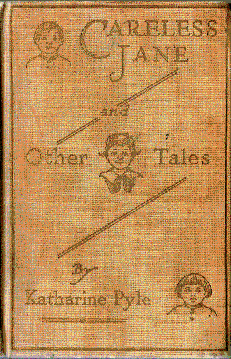
The Project Gutenberg eBook of Careless Jane and Other Tales
Title: Careless Jane and Other Tales
Author: Katharine Pyle
Release date: January 4, 2008 [eBook #24167]
Language: English
Credits: E-text prepared by Colin Bell, Huub Bakker, Joseph Cooper, and the Project Gutenberg Online Distributed Proofreading Team
E-text prepared by Colin Bell, Huub Bakker, Joseph Cooper,
and the Project Gutenberg Online Distributed Proofreading Team
(http://www.pgdp.net)
CARELESS JANE
and other Tales
By
KATHARINE PYLE
NEW YORK
E. P. DUTTON & COMPANY
681 Fifth Ave.
Published April, 1902
| First Printing | April, 1902 | |
| Second | " | November, 1904 |
| Third | " | January, 1907 |
| Fourth | " | February, 1909 |
| Fifth | " | June, 1910 |
| Sixth | " | September, 1911 |
| Seventh | " | July, 1913 |
| Eighth | " | May, 1915 |
| Ninth | " | July, 1916 |
| Tenth | " | October, 1917 |
| Eleventh | " | December, 1918 |
| Twelfth | " | February, 1920 |
| Thirteenth | " | July, 1921 |
| Fourteenth | " | April, 1923 |
| Fifteenth | " | January, 1924 |
| Sixteenth | " | November, 1924 |
| Sevent'nth | " | March, 1925 |
| Eighteenth | " | February, 1926 |
| Nineteenth | " | October, 1926 |
| Twentieth | " | August, 1927 |
| Tw'ty-first | " | March, 1928 |
Printed in the United States of America
Contents
| Page | |
| Careless Jane | 7 |
| Boisterous Ann | 15 |
| The Brother and Sister | 23 |
| Georgie Lie-a-Bed | 35 |
| Untidy Amanda | 43 |
| The Child who would not go to Bed | 49 |
| The Beet | 57 |
| The Robber Rat | 65 |
| Grandfather Stork | 73 |
| Old Mother Webtoes | 81 |
| The Rabbit Witch | 91 |
| Peter and the Ogress | 103 |
My Nephew
|
"Come Jane," said grandmamma one day, "'Tis time you learned to sew; At your age I could make a frock, And you should also know." But Jane cared little for such things; She liked to make a noise; She used to run about all day, And shout, and play with boys. |
|
So now she only tossed her head And ran with eager feet, And soon was racing up and down, And playing in the street. Once Jane was to a party asked; Her friends would all be there; She wore her best sprigged muslin frock, And ribbons tied her hair. |
|
When she was shown upstairs to lay Her hat upon the bed, She saw a little basket there, With needles, wax and thread. "I wonder," said untidy Jane, "If Mattie likes to sew; I'm glad that I have never learned; I should not care to know." |
|
With that she laughed and ran downstairs, But on the way—ah see! She's caught her skirt upon a nail And torn it terribly. If Jane had learned from grandmamma She might have mended it, But she had been a thoughtless child And could not sew a bit. |
|
So with her frock all torn, into The room she had to go, And all the children wondering stared To see her looking so; Then when Jane played it caught her feet And almost made her fall; That shamed her so she ran away And tried to hide from all. |
|
When nurse at last was sent for her, How glad was little Jane; She almost thought she never wished To romp or play again. "Oh! grandmamma, dear grandmamma, Indeed, indeed," said she, "If now you'll teach me how to sew A thankful child I'll be." |
BOISTEROUS ANN
|
A noisy boisterous child was Ann, And very far from good; She did not play the pleasant games That little children should; With rumpled hair and dresses torn She came home every day; In vain mamma said, "Ann, pray learn To be less rude at play." |
|
Now little Ann came home one time In a most piteous plight, For she had fallen in the mud; Indeed she was a sight. The housemaid standing in the door Exclaimed, "What child is this?" "Why, Hannah, can't you see I'm Ann?" Cried out the little miss. |
|
"Our little Ann in rags and dirt, Her hair all out of curl; No, no," cried Hannah; "run away, You little beggar girl. If it is scraps of bread you want Go to the kitchen door; I can't believe you're any child I ever saw before." |
|
Now Ann has to the kitchen run With tears and streaming eyes; "Oh, dear cook, please to let me in: I'm little Ann," she cries. "What little Ann?" the good cook says; "Indeed that cannot be. Our Ann would never wear such rags I'm very sure; not she!" |
|
But as Ann, weeping, turned away, Her little dog ran out, And he began to lick her hands, And bark and jump about. "Why, why," cried cook, "I never saw Dog Towzer act that way, Except when little Ann came home From school or after play." |
|
"And now I look again," she said, "You are our little Ann. Come in and wash and mend your frock, As quickly as you can." Now from that day the little miss Has played less boisterous plays, And been more tidy in her dress And quiet in her ways. |
THE BROTHER AND SISTER
|
Their mother bids them run and play, But not to wander far away. |
|
"Quick," Gretel cries, "let's catch that hare Among the bushes over there." |
|
The hare now leads them in the chase Close by the witch's lurking-place. |
|
"No use," she cries "to kick and fight, For I will pick your bones to-night." |
|
The old witch then puts on the pot, That she may boil Hans when it's hot. |
|
But while she whets her knife outside Gretel opens the cage door wide. |
|
The children see a barrel near; "Quick! into it! The witch is here!" |
|
In after them the witch goes too, But she is stuck, and can't get through. |
|
And now, ker-splash! down in the ditch They roll the barrel and the witch. |
|
And see! her little girl and boy The mother welcomes home with joy. |
GEORGIE LIE-A-BED
|
"Come, come, get up," cried nurse to George; "The breakfast table's spread; The porridge will be getting cold, And you are still in bed." George only sighed and turned about, And went to sleep once more. Now did you ever know of such A lazy child before? |
|
When little George at last arose The sun was overhead; He looked about, no clothes he saw; "Where can they be?" he said. "Nurse, nurse," he cried, "where are my clothes? I do not see them here." "Why, no," said nurse, "you will not find Your clothes to-day, I fear; |
|
Some other child has now your suit, Because I thought, indeed, If you were going to lie in bed, Your clothes you would not need. But if you really wish to dress And go to school, see there, The little dress a year ago Your sister used to wear." |
|
Now how ashamed is little George To have to dress like that; To have to wear his sister's frock, Her ribbons and her hat. Now in the street the children point And stare as he goes by; "Come look at Georgie-Lie-a-Bed, How he is dressed," they cry. |
|
Now little George is so ashamed To have them see him so, He turns about and home he runs As fast as he can go. "Oh, mother dear," he cries, "if I May have my clothes once more, I'll try to be a better boy Than I have been before." |
|
"Why," says mamma, "since that's the case, And you repent, my dear, Your little trousers, shirt, and coat— Just see—they all are here." And since that day mamma and nurse Are proud and glad to see Their little George can such a prompt And early riser be. |
|
A naughty child Amanda was;— She would not comb her hair; Though it was rough and tangled, too, Amanda did not care; And when mamma the matted locks Would fain have brushed and tied, Amanda only pushed away Her hand and stamped and cried. |
|
But listen now! It chanced one time Mamma had gone away. Amanda she had left at home All by herself that day. Then someone rattled at the latch;— Amanda heard him there;— She heard him shutting fast the door And creeping up the stair;— |
|
Someone with scissors in his hand, And dreadful gleaming eyes; "Where is that child who will not comb The tangles out?" he cries. In vain Amanda shrieks and runs, He has her by the hair; Snip-snap! the shining scissors go And leave her head quite bare. |
|
Now when mamma comes home again, Ah, what is her surprise To see Amanda's naked head And note her tearful eyes; And now lest she a cold should catch A nightcap she must wear, And when her locks have grown again I'm sure she'll comb her hair. |
THE CHILD WHO WOULD NOT GO TO BED
|
"I do not want to go to bed; I will not go!" cried naughty Fred. But it was growing very late; The clock had long ago struck eight, And so mamma, impatient grown, Went off and left him there alone. But hark! Creak, creak! upon the stair; It was the sand-man walking there. |
|
In through the door he looked, and said, "What! Frederick will not go to bed?" In vain did Frederick kick and bawl, The sand-man would not heed at all; He tumbled Fred into his sack, And off he bore him on his back; Away he went out through the door, On, on for many a mile and more. |
|
At last the sand-man, weary grown, Sat down to rest upon a stone. Then Frederick turned himself about, And quick he whipped his jack-knife out; Ke—scritchy—scritch! He cuts a slit And softly clambers out of it. And now he runs as quick as thought, And soon a heavy stone has brought; |
|
He softly slips it in the sack That hangs upon the sand-man's back. Says clever Fred, "He will not see He has a stone instead of me." And now the sand-man grunts and sighs, And slowly he begins to rise. |
|
And Frederick hears him sigh, "Alack, How that boy thumps about my back!" The stupid sand-man never sees Where Frederick crouches on his knees, Behind the rock, till out of sight The old sand-man has vanished quite. |
|
But Fred, a thankful boy is he, As home he hastens tearfully. And ah his mother! with what joy She welcomes home her little boy. "Ah always after this," cries Fred, "I will be good, and go to bed." |
THE BEET
|
"I will not wash my face I say; I will not wash," cried Jane, "to-day." In vain mamma said, "What disgrace! To go with dirty hands and face." Jane only sulked and hung her head, And so she crept away to bed. |
|
Now when the pleasant morning broke In bed the slovenly Jane awoke; She woke but could not turn in bed, Nor stretch herself, nor raise her head; She was a beet with nose and eyes, A beet of most enormous size. |
|
And in the bed the beet leaves green Instead of arms and legs were seen; And then in came mamma and nurse; They did not know her, which was worse, But Jane could hear mamma; she said, "Why, why! how came this beet in bed?" |
|
And now, by two stout boys, away They send the beet to town next day, That all the people there may see How large a beet can grow to be. They put her in a window there, Where every one can point and stare. |
|
There the poor sloven sits and cries, Till beet juice oozes from her eyes; But ah! was such sight ever seen? The beet juice tears have washed her clean; And then, the strangest thing of all, As fast and faster still they fall. |
|
The beet tears melt her back once more Into the child she was before. She does not stay to wipe her eyes, But home with eager feet she hies. "Oh mother, mother dear," cries she, "Henceforth a cleaner child I'll be." |
THE ROBBER RAT
|
A kitten once lived all alone In a little yellow house; It lived on crusts of bread and cheese, And now and then a mouse. |
|
A robber rat lived in a wood— A gloomy wood—close by; He had sharp teeth, and a pointed tail. And a wicked, restless eye. |
|
To the yellow house the rat would come, And strike the door—knock! knock! The kitten's tail would stand on end, It gave him such a shock. Then in the rat would boldly march. "What have you here?" he'd say; And then he would steal the bread and cheese, And carry it all away. |
|
At last the kitten went to ask Advice of some old cat Who lived close by, and told her all About the robber rat. The wise old grey cat scratched her ear; "I'll fix this rat," she said; So she pulled a night-cap over her ears And lay in the kitten's bed. |
|
And now in marched the robber rat; "What!" cried he, "still in bed! Quick, fetch me out what cheese you have, And all your scraps of bread." "Spit-t-t!" with her claws and gleaming eyes The cat sprang out of bed. The robber gave one dreadful squeak, And then away he fled. |
|
The old cat caught him by the tail Just as he reached the door, But snap! it broke, and out he ran, And ne'er was heard of more. But for the little kitten, He danced about with glee; "The wicked rat has fled, has fled; Meow, meow!" sang he. |