
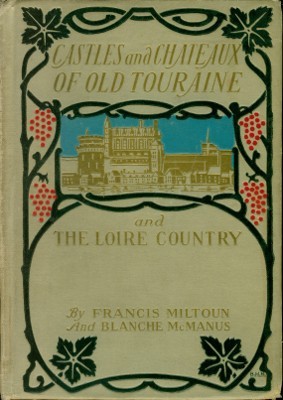
The Project Gutenberg eBook of Castles and Chateaux of Old Touraine and the Loire Country
Title: Castles and Chateaux of Old Touraine and the Loire Country
Author: M. F. Mansfield
Illustrator: Blanche McManus
Release date: August 25, 2011 [eBook #37211]
Most recently updated: January 8, 2021
Language: English
Credits: Produced by Elizaveta Shevyakhova, Juliet Sutherland and
the Online Distributed Proofreading Team at
https://www.pgdp.net (This file was produced from images
generously made available by The Internet Archive/Canadian
Libraries)
Castles and Châteaux of Old Touraine
and the Loire Country
WORKS OF
FRANCIS MILTOUN
Rambles on the Riviera
Rambles in Normandy
Rambles in Brittany
The Cathedrals and Churches of the Rhine
The Cathedrals of Northern France
The Cathedrals of Southern France
The Cathedrals of Italy (In preparation)
L. C. PAGE & COMPANY
Castles and Châteaux
OF
OLD TOURAINE
AND THE LOIRE COUNTRY
By Francis Miltoun
Author of "Rambles in Normandy," "Rambles in Brittany," "Rambles on the Riviera," etc.
With Many Illustrations
Reproduced from paintings made on the spot
By Blanche McManus
L. C. PAGE & COMPANY
By L. C. Page & Company
(Incorporated)
All rights reserved
First Impression, June, 1906
COLONIAL PRESS
Electrotyped and Printed by C. H. Simonds & Co.
Boston, U. S. A.
By Way of Introduction
This book is not the result of ordinary conventional rambles, of sightseeing by day, and flying by night, but rather of leisurely wanderings, for a somewhat extended period, along the banks of the Loire and its tributaries and through the countryside dotted with those splendid monuments of Renaissance architecture which have perhaps a more appealing interest for strangers than any other similar edifices wherever found.
Before this book was projected, the conventional tour of the château country had been "done," Baedeker, Joanne and James's "Little Tour" in hand. On another occasion Angers, with its almost inconceivably real castellated fortress, and Nantes, with its memories of the "Edict" and "La Duchesse Anne," had been tasted and digested en route to a certain little artist's village in Brittany.
On another occasion, when we were headed due south, we lingered for a time in the upper valley, between "the little Italian city of Nevers" and "the most picturesque spot in the world"—Le Puy.
But all this left certain ground to be covered, and certain gaps to be filled, though the author's note-books were numerous and full to overflowing with much comment, and the artist's portfolio was already bulging with its contents.
So more note-books were bought, and, following the genial Mark Twain's advice, another fountain pen and more crayons and sketch-books, and the author and artist set out in the beginning of a warm September to fill those gaps and to reduce, if possible, that series of rambles along the now flat and now rolling banks of the broad blue Loire to something like consecutiveness and uniformity; with what result the reader may judge.
Contents
| CHAPTER | PAGE | |
| By Way of Introduction | v | |
| I. | A General Survey | 1 |
| II. | The Orléannais | 30 |
| III. | The Blaisois and the Sologne | 56 |
| IV. | Chambord | 94 |
| V. | Cheverny, Beauregard, and Chaumont | 110 |
| VI. | Touraine: The Garden Spot of France | 128 |
| VII. | Amboise | 148 |
| VIII. | Chenonceaux | 171 |
| IX. | Loches | 188 |
| X. | Tours and About There | 203 |
| XI. | Luynes and Langeais | 221 |
| XII. | Azay-le-Rideau, Ussé, and Chinon | 241 |
| XIII. | Anjou and Bretagne | 273 |
| XIV. | South of the Loire | 301 |
| XV. | Berry and George Sand's Country | 313 |
| XVI. | The Upper Loire | 330 |
| Index | 337 |
List of Illustrations
| PAGE | ||
| A Peasant Girl of Touraine | Frontispiece | |
| Itinerary of the Loire (Map) | 1 | |
| A Lace-maker of the Upper Loire | 5 | |
| The Loire Châteaux (Map) | 9 | |
| The Ancient Provinces of the Loire Valley and Their Capitals (Map) | 15 | |
| The Loire near la Charité | 19 | |
| Coiffes of Amboise and Orléans | 21 | |
| The Châteaux of the Loire (Map) | 31 | |
| Environs of Orléans (Map) | 39 | |
| The Loiret | 42 | |
| The Loire at Meung | 46 | |
| Beaugency | 51 | |
| Arms of the City of Blois | 58 | |
| The Riverside at Blois | 59 | |
| Signature of François Premier | 60 | |
| Cypher of Anne de Bretagne, at Blois | 62 | |
| Arms of Louis XII. | 65 | |
| Central Doorway, Château de Blois | 67 | |
| The Châteaux of Blois (Diagram) | 69 | |
| Cypher of François Premier and Claude of France, at Blois | 72 | |
| Native Types in the Sologne | 89 | |
| Donjon of Montrichard | 92 | |
| Arms of François Premier, at Chambord | 99 | |
| Plan of Château de Chambord | 103 | |
| Château de Chambord | 105 | |
| Château de Cheverny | 110 | |
| Cheverny-sur-Loire | 113 | |
| Chaumont | 116 | |
| Signature of Diane de Poitiers | 118 | |
| The Loire in Touraine | 134 | |
| The Vintage in Touraine | 142 | |
| Château d'Amboise | 148 | |
| Sculpture from the Chapelle de St. Hubert | 165 | |
| Cypher of Anne de Bretagne, Hôtel de Ville, Amboise | 168 | |
| Château de Chenonceaux | 178 | |
| Château de Chenonceaux (Diagram) | 179 | |
| Loches | 189 | |
| Loches and Its Church | 192 | |
| Sketch Plan of Loches | 198 | |
| St. Ours, Loches | 199 | |
| Tours | 202 | |
| Arms of the Printers, Avocats, and Innkeepers, Tours | 205 | |
| Scene in the Quartier de la Cathédrale, Tours | 208 | |
| Plessis-les-Tours in the Time of Louis XI. | 213 | |
| Environs of Tours (Map) | 219 | |
| A Vineyard of Vouvray | 223 | |
| Mediæval Stairway and the Château de Luynes | 224 | |
| Ruins of Cinq-Mars | 229 | |
| Château de Langeais | 233 | |
| Arms of Louis XII. and Anne de Bretagne | 237 | |
| Château d'Azay-le-Rideau | 244 | |
| Château d'Ussé | 249 | |
| The Roof-tops of Chinon | 253 | |
| Rabelais | 256 | |
| Château de Chinon | 259 | |
| Cuisines, Fontevrault | 265 | |
| Château de Saumur | 277 | |
| The Ponts de Cé | 284 | |
| Château d'Angers | 289 | |
| Environs of Nantes (Map) | 297 | |
| Donjon of the Château de Clisson | 307 | |
| Berry (Map) | 313 | |
| La Tour, Sancerre | 317 | |
| Château de Gien | 318 | |
| Château de Valençay | 322 | |
| Gateway of Mehun-sur-Yevre | 324 | |
| Le Carrior Doré, Romorantin | 326 | |
| Église S. Aignan, Cosne | 331 | |
| Pouilly-sur-Loire | 332 | |
| Porte du Croux, Nevers | 335 |
Castles and Châteaux
of Old Touraine
and the Loire Country
CHAPTER I.
A GENERAL SURVEY
Any account of the Loire and of the towns along its banks must naturally have for its chief mention Touraine and the long line of splendid feudal and Renaissance châteaux which reflect themselves so gloriously in its current.
The Loire possesses a certain fascination and charm which many other more commercially great rivers entirely lack, and, while the element of absolute novelty cannot perforce be claimed for it, it has the merit of appealing largely to the lover of the romantic and the picturesque.
A French writer of a hundred years ago dedicated his work on Touraine to "Le Baron de Langeais, le Vicomte de Beaumont, le Marquis de Beauregard, le Comte de Fontenailles, le Comte de Jouffroy-Gonsans, le Duc de Luynes, le Comte de Vouvray, le Comte de Villeneuve, et als.;" and he might have continued with a directory of all the descendants of the noblesse of an earlier age, for he afterward grouped them under the general category of "Propriétaires des fortresses et châteaux les plus remarquables—au point de vue historique ou architectural."
He was fortunate in being able, as he said, to have had access to their "papiers de famille," their souvenirs, and to have been able to interrogate them in person.
Most of his facts and his gossip concerning the personalities of the later generations of those who inhabited these magnificent establishments have come down to us through later writers, and it is fortunate that this should be the case, since the present-day aspect of the châteaux is ever changing, and one who views them to-day is chagrined when he discovers, for instance, that an iron-trussed, red-tiled wash-house has been built on the banks of the Cosson before the magnificent château of Chambord, and that somewhere within the confines of the old castle at Loches a shopkeeper has hung out his shingle, announcing a newly discovered dungeon in his own basement, accidentally come upon when digging a well.
Balzac, Rabelais, and Descartes are the leading literary celebrities of Tours, and Balzac's "Le Lys dans la Vallée" will give one a more delightful insight into the old life of the Tourangeaux than whole series of guide-books and shelves of dry histories.
Blois and its counts, Tours and its bishops, and Amboise and its kings, to say nothing of Fontevrault, redolent of memories of the Plantagenets, Nantes and its famous "Edict," and its equally infamous "Revocation," have left vivid impress upon all students of French history. Others will perhaps remember Nantes for Dumas's brilliant descriptions of the outcome of the Breton conspiracy.
All of us have a natural desire to know more of historic ground, and whether we make a start by entering the valley of the Loire at the luxurious midway city of Tours, and follow the river first to the sea and then to the source, or make the journey from source to mouth, or vice versa, it does not matter in the least. We traverse the same ground and we meet the same varying conditions as we advance a hundred kilometres in either direction.
Tours, for example, stands for all that is typical of the sunny south. Prune and palm trees thrust themselves forward in strong contrast to the cider-apples of the lower Seine. Below Tours one is almost at the coast, and the tables d'hôte are abundantly supplied with sea-food of all sorts. Above Tours the Orléannais is typical of a certain well-to-do, matter-of-fact existence, neither very luxurious nor very difficult.
Nevers is another step and resembles somewhat the opulence of Burgundy as to conditions of life, though the general aspect of the city, as well as a great part of its history, is Italian through and through.
The last great step begins at Le Puy, in the great volcanic Massif Centrale, where conditions of life, if prosperous, are at least harder than elsewhere.
Such are the varying characteristics of the towns and cities through which the Loire flows. They run the whole gamut from gay to earnest and solemn; from the ease and comfort of the country around Tours, almost sub-tropical in its softness, to the grime and smoke of busy St. Etienne, and the chilliness and rigours of a mountain winter at Le Puy.
These districts are all very full of memories of events which have helped to build up the solidarity of France of to-day, though the Nantois still proudly proclaims himself a Breton, and the Tourangeau will tell you that his is the tongue, above all others, which speaks the purest French,—and so on through the whole category, each and every citizen of a petit pays living up to his traditions to the fullest extent possible.
In no other journey in France, of a similar length, will one see as many varying contrasts in conditions of life as he will along the length of the Loire, the broad, shallow river which St. Martin, Charles Martel, and Louis XI., the typical figures of church, arms, and state, came to know so well.
Du Bellay, a poet of the Renaissance, has sung the praises of the Loire in a manner unapproached by any other topographical poet, if one may so call him, for that is what he really was in this particular instance.
There is a great deal of patriotism in it all, too, and certainly no sweet singer of the present day has even approached these lines, which are eulogistic without being fulsome and fervent without being lurid.
The verses have frequently been rendered into English, but the following is as good as any, and better than most translations, though it is one of those fragments of "newspaper verse" whose authors are lost in obscurity.
Than your audacious heads, O Halls of Rome!
More than immortal marbles undecayed,
The thin sad slates that cover up my home;
More than your Tiber is my Loire to me,
More Palatine my little Lyré there;
And more than all the winds of all the sea,
The quiet kindness of the Angevin air."
In history the Loire valley is rich indeed, from the days of the ancient Counts of Touraine to those of Mazarin, who held forth at Nevers. Touraine has well been called the heart of the old French monarchy.
Provincial France has a charm never known to Paris-dwellers. Balzac and Flaubert were provincials, and Dumas was a city-dweller,—and there lies the difference between them.
Balzac has written most charmingly of Touraine in many of his books, in "Le Lys dans la Vallée" and "Le Curé de Tours" in particular; not always in complimentary terms, either, for he has said that the Tourangeaux will not even inconvenience themselves to go in search of pleasure. This does not bespeak indolence so much as philosophy, so most of us will not cavil. George Sand's country lies a little to the southward of Touraine, and Berry, too, as the authoress herself has said, has a climate "souple et chaud, avec pluie abondant et courte."
The architectural remains in the Loire valley are exceedingly rich and varied. The feudal system is illustrated at its best in the great walled château at Angers, the still inhabited and less grand château at Langeais, the ruins at Cinq-Mars, and the very scanty remains of Plessis-les-Tours.
The ecclesiastical remains are quite as great. The churches are, many of them, of the first rank, and the great cathedrals at Nantes, Angers, Tours, and Orléans are magnificent examples of the church-builders' art in the middle ages, and are entitled to rank among the great cathedrals, if not actually of the first class.
With modern civic and other public buildings, the case is not far different. Tours has a gorgeous Hôtel de Ville, its architecture being of the most luxuriant of modern French Renaissance, while the railway stations, even, at both Tours and Orléans, are models of what railway stations should be, and in addition are decoratively beautiful in their appointments and arrangements,—which most railway stations are not.
Altogether, throughout the Loire valley there is an air of prosperity which in a more vigorous climate is often lacking. This in spite of the alleged tendency in what is commonly known as a relaxing climate toward laisser-aller.
Finally, the picturesque landscape of the Loire is something quite different from the harder, grayer outlines of the north. All is of the south, warm and ruddy, and the wooded banks not only refine the crudities of a flat shore-line, but form a screen or barrier to the flowering charms of the examples of Renaissance architecture which, in Touraine, at least, are as thick as leaves in Vallambrosa.
Starting at Gien, the valley of the Loire begins to offer those monumental châteaux which have made its fame as the land of castles. From the old fortress-château of Gien to the Château de Clisson, or the Logis de la Duchesse Anne at Nantes, is one long succession of florid masterpieces, not to be equalled elsewhere.
The true château region of Touraine—by which most people usually comprehend the Loire châteaux—commences only at Blois. Here the edifices, to a great extent, take on these superfine residential attributes which were the glory of the Renaissance period of French architecture.
Both above and below Touraine, at Montrichard, at Loches, and Beaugency, are still to be found scattering examples of feudal fortresses and donjons which are as representative of their class as are the best Norman structures of the same era, the great fortresses of Arques, Falaise, Domfront, and Les Andelys being usually accounted as the types which gave the stimulus to similar edifices elsewhere.
In this same versatile region also, beginning perhaps with the Orléannais, are a vast number of religious monuments equally celebrated. For instance, the church of St. Benoit-sur-Loire is one of the most important Romanesque churches in all France, and the cathedral of St. Gatien, with its "bejewelled façade," at Tours, the twin-spired St. Maurice at Angers, and even the pompous, and not very good Gothic, edifice at Orléans (especially noteworthy because its crypt is an ancient work anterior to the Capetian dynasty) are all wonderfully interesting and imposing examples of mediæval ecclesiastical architecture.
Three great tributaries enter the Loire below Tours, the Cher, the Indre, and the Vienne. The first has for its chief attractions the Renaissance châteaux St. Aignan and Chenonceaux, the Roman remains of Chabris, Thézée, and Larçay, the Romanesque churches of Selles and St. Aignan, and the feudal donjon of Montrichard. The Indre possesses the château of Azay-le-Rideau and the sombre fortresses of Montbazon and Loches; while the Vienne depends for its chief interest upon the galaxy of fortress-châteaux at Chinon.
The Loire is a mighty river and is navigable for nearly nine hundred kilometres of its length, almost to Le Puy, or, to be exact, to the little town of Vorey in the Department of the Haute Loire.
At Orléans, Blois, or Tours one hardly realizes this, much less at Nevers. The river appears to be a great, tranquil, docile stream, with scarce enough water in its bed to make a respectable current, leaving its beds and bars of sable and cailloux bare to the sky.
The scarcity of water, except at occasional flood, is the principal and obvious reason for the absence of water-borne traffic, even though a paternal ministerial department of the government calls the river navigable.
At the times of the grandes crues there are four metres or more registered on the big scale at the Pont d'Ancenis, while at other times it falls to less than a metre, and when it does there is a mere rivulet of water which trickles through the broad river-bottom at Chaumont, or Blois, or Orléans. Below Ancenis navigation is not so difficult, but the current is more strong.
From Blois to Angers, on the right bank, extends a long dike which carries the roadway beside the river for a couple of hundred kilometres. This is one of the charms of travel by the Loire. The only thing usually seen on the bosom of the river, save an occasional fishing punt, is one of those great flat-bottomed ferry-boats, with a square sail hung on a yard amidships, such as Turner always made an accompaniment to his Loire pictures, for conditions of traffic on the river have not greatly changed.
Whenever one sees a barge or a boat worthy of classification with those one finds on the rivers of the east or north, or on the great canals, it is only about a quarter of the usual size; so, in spite of its great navigable length, the waterway of the Loire is to be considered more as a picturesque and healthful element of the landscape than as a commercial proposition.
Where the great canals join the river at Orléans, and from Chatillon to Roanne, the traffic increases, though more is carried by the canal-boats on the Canal Latéral than by the barges on the Loire.
It is only on the Loire between Angers and Nantes that there is any semblance of river traffic such as one sees on most of the other great waterways of Europe. There is a considerable traffic, too, which descends the Maine, particularly from Angers downward, for Angers with its Italian skies is usually thought of, and really is to be considered, as a Loire town, though it is actually on the banks of the Maine some miles from the Loire itself.
One thousand or more bateaux make the ascent to Angers from the Loire at La Pointe each year, all laden with a miscellaneous cargo of merchandise. The Sarthe and the Loir also bring a notable agricultural traffic to the greater Loire, and the smaller confluents, the Dive, the Thouet, the Authion, and the Layon, all go to swell the parent stream until, when it reaches Nantes, the Loire has at last taken on something of the aspect of a well-ordered and useful stream, characteristics which above Nantes are painfully lacking. Because of its lack of commerce the Loire is in a certain way the most noble, magnificent, and aristocratic river of France; and so, too, it is also in respect to its associations of the past.
It has not the grandeur of the Rhône when the spring freshets from the Jura and the Swiss lakes have filled it to its banks; it has not the burning activity of the Seine as it bears its thousands of boat-loads of produce and merchandise to and from the Paris market; it has not the prettiness of the Thames, nor the legendary aspect of the Rhine; but in a way it combines something of the features of all, and has, in addition, a tone that is all its own, as it sweeps along through its countless miles of ample curves, and holds within its embrace all that is best of mediæval and Renaissance France, the period which built up the later monarchy and, who shall not say, the present prosperous republic.
Throughout most of the river's course, one sees, stretching to the horizon, row upon row of staked vineyards with fruit and leaves in luxuriant abundance and of all rainbow colours. The peasant here, the worker in the vineyards, is a picturesque element. He is not particularly brilliant in colouring, but he is usually joyous, and he invariably lives in a well-kept and brilliantly environed habitation and has an air of content and prosperity amid the well-beloved treasures of his household.
The Loire is essentially a river of other days. Truly, as Mr. James has said, "It is the very model of a generous, beneficent stream ... a wide river which you may follow by a wide road is excellent company."
The Frenchman himself is more flowery: "C'est la plus noble rivière de France. Son domaine est immense et magnifique."