
INTRODUCTION.
The Catechism of the Locomotive is intended for a large class of readers, among whom are all kinds of railroad officers and employes, consisting of locomotive runners, firemen, and the many different kinds of mechanics employed in railroad shops and in the construction of locomotive and other kinds of railroad machinery and material. Besides these there are many amateur engineers, students, and persons interested directly or indirectly in railroads, and a not inconsiderable class who are always seeking information on all subjects whatsoever. It is evident, therefore, that the only way to adapt the book to all the classes for whom it is intended, was to make it so plain that the “wayfaring man” will have no difficulty in comprehending it. It has therefore been written in as clear language as the writer could command, and the subjects presented are treated as simply and as plainly as his ability enabled him to do, and with the least possible employment of either scientific or practical technicalities. The only deviation from this plan will be found in the use of algebraic symbols to designate arithmetical calculations. This was done to save space, and because it was thought that they could be explained so that even those without any knowledge whatsoever of algebra could easily comprehend them. To such as have no such knowledge the following explanation is given:
Suppose it is necessary to add two numbers, say 1,872 and 468. The calculation, if made arithmetically, would be thus:
1,872
468
2,340
This it will be seen occupies the space of several lines of print. If we want to express this calculation algebraically, it can be done by simply writing the two numbers and placing the sign +, called plus, between the two, which indicates that they are to be added together, thus:
1,872 + 468
To indicate what the sum will be, or what the two added together will amount to, the sign =, called equal to, or the sign of equality, is placed after the two numbers and between them and the sum, thus:
1,872 + 468 = 2,340,
which can be read as follows:
1,872 added to 468 is equal to 2,340.
Now the only use of the algebraic signs + and = is that they save time in writing and room in printing, and when persons become accustomed to their use they make plain a number of operations at a single glance, as will be shown hereafter.
In the same way that the sign + means added to, the sign - means less or subtracted from, thus:
1,872 - 468 = 1,404,
which is the same as though it was printed as follows:
1,872 less 468 is equal to 1,404.
The sign × means multiplied by, or is the sign of multiplication. Thus:
1,872 × 468 = 876,096;
that is,
1,872 multiplied by 468 is equal to 876,096.
The sign ÷ means divided by, thus:
1,872 ÷ 468 = 4.
which means:
1,872 divided by 468 is equal to 4.
The same thing is expressed by putting a line under the dividend and writing the divisor under the line, thus:
1,872 468 = 4.
These signs are combined in various ways. Thus, supposing we wanted to add 1,872 to 468 and then divide the sum by 117, it would be necessary, in order to represent the arithmetical calculation, to do it as follows:
1872
468
117)2340(20
234
0
Algebraically it would be stated thus:
1872 + 468 117 = 20
If you wanted to add 124 to the quotient 20 above, the calculation would be as follows:
1872
468
117)2340( 20
234 124
0 144
This operation could be expressed by writing it as follows:
1872 + 468 117 + 124 = 144.
If we wanted to multiply the quotient 20 by 124 we would simply put the sign × instead of + before 124, thus:
1872 + 468 117 × 124 = 2480.
The sign of subtraction or division can be used in the same way.
With these explanations it is believed that any one, with nothing more than an ordinary knowledge of the four elementary rules of arithmetic, can understand all the mathematics contained in the following pages. A little explanation may also be needed of the method of representing machinery and other structures by mechanical drawings.
A
B
C
D
If we want to represent the outside of any object, say an apple, we make a drawing of it as shown at A. Now if we want to show the inside of the apple, say the seeds and core, we can cut it in half and represent it as shown at C, which is then called a section or sectional view of the apple. If we represent it as it will appear if we are above it and looking down on it as shown at B, it is called a top view or plan.
It is evident, too, that it might be desirable to show the arrangement of the seeds in the apple as they would appear if it was cut through in the other direction, say on the line a b, fig. A, and as is shown at D. There are therefore two kinds of sections; one C, in which the object is supposed to be cut through vertically, and therefore called a vertical section, the other when the object is supposed to be cut through horizontally, and therefore called a horizontal section, as shown at D.
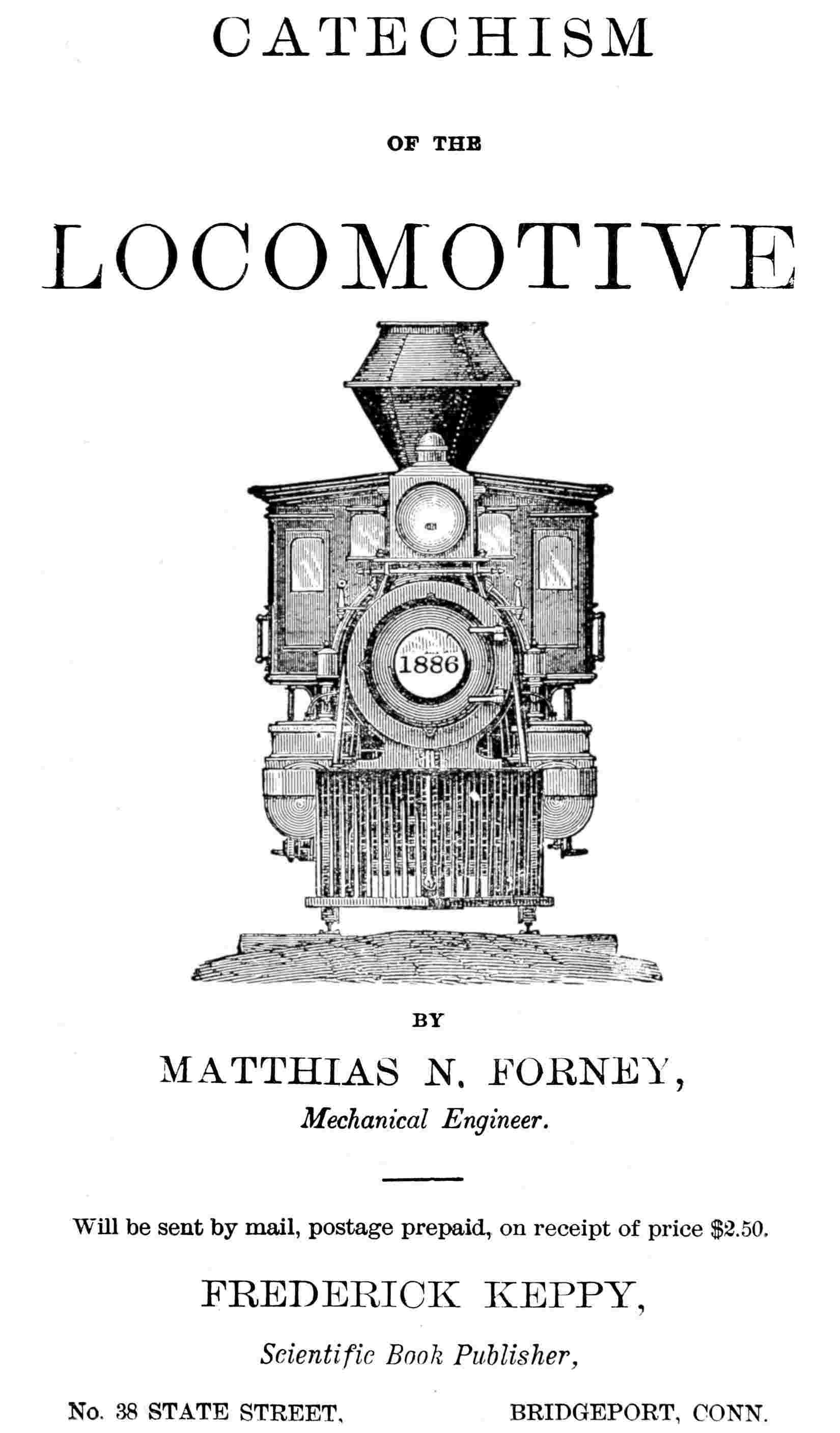
It is also evident that in looking at a locomotive or any other object, the appearance of the engine depends upon our position in relation to it. Thus, if we stand on the side of it, we see that part of the engine, and a drawing which represents the side, is therefore called a side view or side elevation. A drawing which represents a locomotive or other object as it would appear to us if we stood in front of it, is called a front view or front elevation, and a representation of the back part of any object as it would appear to us if we stood behind it is called a back view or back elevation. Plate I is a side view, Plate II a section, Plate III a top view or plan;[1] the vignette in the title page is a front view and fig. 71 a back view of a locomotive. If the drawing is made as the object would appear if it was turned upside down, and we were looking at it from above, then it is called an inverted plan.
It is obvious, too, that it is possible to make a great many different sectional views of nearly any object, especially of a machine. Thus, we could suppose a locomotive cut through vertically and lengthwise, as is shown in Plate II. Such a representation is called a longitudinal section. A locomotive could also be cut through crosswise, as shown in fig. 40, which is called a transverse section. It is of course possible to represent a transverse section of a machine like a locomotive at a great many different points; for example, it could be shown as though it was cut through the smoke-stack as in fig. 40, or through the boiler farther back, as the latter is shown in fig. 42. Usually when a section is shown through a cylindrical object like a smoke-stack or boiler, it is shown through its centre. If, however, this is not apparent from the drawing or engraving, it should be stated at what point it is supposed to be taken, thus the section D of the apple is on the line a b of fig. A, and the section C is on the line c d.
In drawing sections, the parts which are supposed to be cut in two are usually shaded with parallel diagonal lines drawn at equal distances apart, as shown in the sections of the apple at C and D. Sections are also sometimes represented with solid black surfaces, as in Plates II and III, and in the engraving of a pump in fig. 66.
Objects which are behind others which are in front of them are often shown with dotted lines, so as to indicate their position. The seeds of the apple are thus indicated at A.
It is also customary, in drawings of machinery, to take great liberties with the objects represented and to show them with parts removed or broken away, if their construction can thus be made plainer. It should be remembered that the purpose of drawings of this kind is not to give a pictorial representation of the object as it appears to the eye, but to make its construction and mode of operation apparent to the mind. In such drawings therefore all perspective is disregarded. It would lead us too far were we to explain the reasons for this, and therefore readers must accept the assertion without the proof.