
The Project Gutenberg eBook of Catharine de Bora: Social and Domestic Scenes in the Home of Luther
Title: Catharine de Bora: Social and Domestic Scenes in the Home of Luther
Author: John G. Morris
Release date: November 30, 2017 [eBook #56084]
Most recently updated: October 23, 2024
Language: English
Credits: Produced by Turgut Dincer, Stephen Hutcheson, and the
Online Distributed Proofreading Team at http://www.pgdp.net
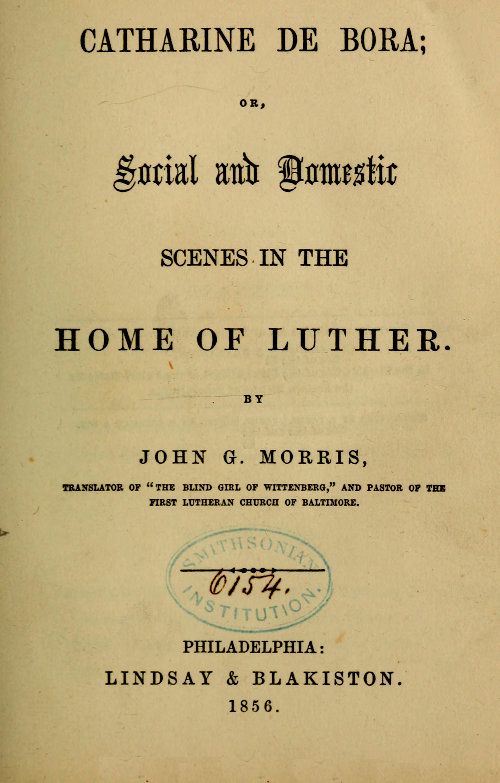
CATHARINE DE BORA,
WIFE OF LUTHER.
CATHARINE DE BORA;
OR,
Social and Domestic
SCENES IN THE
HOME OF LUTHER.
BY
JOHN G. MORRIS,
TRANSLATOR OF “THE BLIND GIRL OF WITTENBERG,” AND PASTOR OF THE FIRST LUTHERAN CHURCH OF BALTIMORE.
PHILADELPHIA:
LINDSAY & BLAKISTON.
1856.
Entered, according to Act of Congress, in the year 1856, by
LINDSAY & BLAKISTON,
in the Clerk’s Office of the District Court of the United States for
the Eastern District of Pennsylvania.
STEREOTYPED BY J. FAGAN PRINTED BY C. SHERMAN & SON.
CONTENTS.
- Page
- CHAPTER I.
- Clerical Celibacy—Luther—Bernhardi’s Marriage—Treatment of Catharine De Bora—the Convent—Wealthy Nuns—Convent Life—the Escape—Treatment of the Nuns—Florentine de Oberweimer—Leonard Koppe—Luther’s Defence 9
- CHAPTER II.
- Luther’s Reflections—Example of the Apostles—Celibacy—Gregory VII.—Luther’s Change of Mind—Luther’s Marriage—Character of Catharine 27
- CHAPTER III.
- Wedding-Dinner—Melanchthon—Slanders 43
- CHAPTER IV.
- Luther’s Domestic Life—Character of Catharine—Perils of Luther—Sickness—Death of his Parents—Private Life—Catharine 52
- CHAPTER V.
- Income—Expenses—Hospitality—Charity—Diet—Afflictions—Despondency—Journeys—Death 70
- CHAPTER VI.
- Catharine, a Widow—Her Support—Sufferings—Journeys—Death 84
- CHAPTER VII.
- Luther’s Children—Domestic Character—Catharine 94
- CHAPTER VIII.
- Character of Catharine 120
PREFACE.
There are many interesting and characteristic incidents in the domestic life of Luther which are not found in biographies of the great Reformer. The character of his wife has not been portrayed in full, and who does not wish to become better acquainted with a woman who mingled many a drop of balsam in those numerous cups of sorrow which her celebrated husband was compelled to drink?
This little book is the result of extensive research, and exhibits facts attested by the most reliable authorities, many of which will be new to those of my readers who have not investigated this particular subject.
J. G. M.
Baltimore, June, 1856.
LUTHER AT HOME.
CHAPTER I.
Clerical Celibacy—Luther-Bernhardi’s Marriage—Treatment of Catharine de Bora—the Convent—Wealthy Nuns—Convent Life—the Escape—Treatment of the Nuns—Florentine de Oberweimer—Leonard Koppe—Luther’s Defence.
The celibacy of the clergy was one of the strongest pillars on which the proud edifice of Romish power rested. It was a stupendous partition-wall which separated the clergy from all other interests, and thus consolidated the wide-spread authority of the Pope. It cut off the secular clergy, as well as the monks, from all domestic ties. They forgot father, mother, and friends. Political obligations to their sovereign and country were disregarded, but the cord which bound them to the interests of Rome was only the more tightly drawn.
Superior purity was the presumed ground of the system, but a total surrender of all rights, and complete submission to the will of the Pope, were its legitimate results. He was regarded as the only parent of the clergy—the only sovereign to whom they owed allegiance—the only protector in whom they were to confide, and, as dutiful sons, obedient subjects, and grateful beneficiaries, they were obliged to exert themselves to the utmost to maintain his authority and extend his dominion. Clerical celibacy was regarded not only as a duty, but as the highest attainment in moral perfection. The system was introduced with caution and maintained with sleepless vigilance and zeal. There were some who saw its errors and disadvantages, and desired its abolition, but their remonstrances were unheeded and their clamors silenced.
That, however, which was considered impossible by the whole Christian world, was accomplished by a single man, who himself had been a monk, and whose first duty as such was a vow of celibacy! That man was Martin Luther, Augustinian Monk, Doctor of Theology at the University of Wittenberg, who, by his heroic conduct in relation to this subject, has only added to the other inappreciable services he has rendered the Church. It was he who was bold enough to abandon the monastic order, and, in spite of the principles of the Church as they prevailed in that age, to enter the married state. This adventurous step led to the deliverance of a large portion of the clergy from the chain of Papal power. From having been the slavish satellites of a foreign master in Italy, they became patriotic subjects and useful men at home.
Several years before, two friends of Luther, who were his noble assistants in the work of the Reformation, Melanchthon and Carlstadt, had written treatises against clerical celibacy. Their books on this subject were equally as unexpected, and created as much excitement among the clergy, as Luther’s Theses against Indulgences had done six years before.
Luther was not the first priest of those days who practically rejected celibacy. As early as 1521, one of his friends and fellow-laborers, Bernhardi, superintendent of the churches at Kemberg, had the boldness to marry. He was the first ecclesiastic in Saxony who took this step, and his wedding-day was long regarded as the Pastors’ Emancipation Day; but Caspar Aquila, a priest residing near Augsburg, was married as early as 1516, Jacob Knabe in 1518, and Nicolas Brunner in 1519.
Luther was free from all participation in Bernhardi’s marriage, for at that time he was a prisoner in Wartburg Castle, and the first intelligence came so unexpectedly, that whilst he admired the courage of his friend, he was very apprehensive it would occasion him and his cause many severe trials. Not long after, Bernhardi’s metropolitan, the Cardinal Archbishop Albert, of Mainz and Magdeburg, demanded of the Elector of Saxony, Frederick the Wise, to send Bernhardi to Halle, to answer for his presumptuous act. Frederick did not yield to the demand of the Archbishop, and the latter professed to be satisfied with an anonymous defence of Bernhardi.
Luther himself sent a petition to Albert in behalf of the clergy who had already married and of those who intended to marry. Subsequently, however, Bernhardi suffered severely. When, in 1547, more than twenty years after his nuptials, the Emperor Charles V. captured Wittenberg, his savage Spaniards seized Bernhardi, and bound him fast to a table. His wife rescued him from their murderous hands; but, soon after, others laid hold of him, and after cruelly beating him, tied him to a horse and dragged him to the camp at Torgau. A German officer, after much trouble, had him liberated, and he finally, after unexampled suffering, reached his family at Kemberg. A considerable number of priests followed the example of Bernhardi. They were not deterred by the ban of the bishops, nor by the fear of deposition and imprisonment. But all this would not have created such immense excitement if Luther himself, to whom all eyes were directed, had not resolved, by his own example, to strike a deadly blow at priestly celibacy.
Catharine de Bora, a nun of the celebrated Bernhardin or Cistercian convent at Nimtschen, in Saxony, was the person whom Luther chose as his wife. She was born on the 29th of January, 1499. There is no authentic record of the place of her birth, and the history of her childhood is wrapped in obscurity. It is only as the nun Catharine that we first became acquainted with her. Her Romish calumniators (and no innocent woman was ever more bitterly and cruelly defamed,) declare that her parents compelled her to become a nun against her will, because they were poor and could not support her, and particularly because her conduct was so objectionable that her seclusion was necessary. As regards the first, it is true; she was not wealthy when she became the wife of Luther; but, if she had been compelled to enter the nunnery, it is likely that Luther would have mentioned it as an additional justification of her flight. Her objectionable morality is based by her enemies on the fact of her escape, and hence the accusation has no ground whatever. There is not a particle of proof to establish the calumnious charge.
This Convent was designated by the name of The Throne of God. It was founded in 1250 by Henry the Illustrious. No trace of it remains at the present day. In 1810-12 its ruins were removed to make room for the erection of an edifice connected with a school for boys established at that place.
Most of the inmates of this Convent were of noble birth, for at that day, as well as at present, it was the policy and interest of the Romish clergy to induce as many ladies of high rank as possible to take the veil, thereby rendering the profession respectable, and securing large sums as entrance fees if they were wealthy, and all their patrimony after their decease.
It may seem strange that Catharine de Bora, who, according to her own confession, was devout, industrious in the discharge of conventual duties, and diligent in prayer, should have determined with eight other “sisters” to escape from their prison. But when it is considered that the convent was situated within the territory of the Elector Frederick the Wise, who was Luther’s friend and patron—that Luther himself visited a neighboring monastery at Grimma as Inspector—that in 1519, after the dispute with Eck at Leipzig, he spent a few days in the town of Nimtschen—that the principles of the Reformation had already made some progress in that vicinity, and that several monasteries not far distant had been abandoned—the circumstance is easily explained. It is scarcely credible that amid the excitement of the times, no word of Luther’s doctrine should have entered the convent halls, and that the stirring events occurring around them should have been entirely concealed from the unobtrusive occupants. Could not some of those courageous friends of Luther, who afterwards, at his suggestion, effected the escape of the nuns, have previously introduced some of Luther’s tracts into the convent? He had at that time already written several small books against the monastic life, and it is likely that some of these had been clandestinely introduced, the perusal of which convinced these “sisters” that their profession was not sanctioned by the Scriptures, and that it was dangerous to their morals. They became so thoroughly assured of the enormous error they had committed in thus secluding themselves from the world, and were so heartily weary of the unnatural restraint imposed upon them, that they earnestly besought their relatives to liberate them for their souls’ sake! But these appeals were unheard, and now probably the unhappy petitioners turned immediately to Luther. He not only favored their resolution to escape, but selected his courageous friend, Bernhard Koppe, a citizen of Torgau, to execute the project. Two other citizens of the same place accompanied him on the adventure.
George Spalatin, Court Chaplain and Secretary of the Elector, reports that they fled from the convent on the night before Easter, April 4, 1523. There were nine of them in all.
The accounts of the manner in which their rescue was effected, differ. Some historians report that prudence required them to preserve the strictest secrecy as long as they were traversing the territory of Duke George, who was violently opposed to the Reformation, and hence they were conveyed away in a covered wagon, and a few affirm, on the authority of reliable documents, that they were concealed in casks. The historians, however, agree that Koppe performed his part in the enterprise with consummate courage and skill. It is very likely that the nuns were aware of Koppe’s design, and held themselves in readiness at the appointed time. Tradition tells us that they escaped through the window of Catharine’s cell. To this day, they show at Nimtschen a slipper which they say Catharine lost in the hurry of the flight.
They arrived at Wittenberg on the 7th of April, under circumstances calculated to excite the sympathy of every feeling heart. As they deserted the convent against the will of their relatives, and most of them probably being orphans, they did not know where to find shelter or support. But Luther, who had advised their flight, and aided in effecting it, kindly received them, and spared no pains to render their condition comfortable. In a few but expressive words to Spalatin, he announced their arrival and depicted their destitution. He thus writes on the 10th of April: “These eloped nuns have come to me; they are in destitute circumstances, but as very respectable citizens of Torgau have brought them, there can be no suspicion entertained as to their moral character. I sincerely pity their forlorn state, and particularly that of the great number still confined in convents, who are going to ruin in that condition of constrained and unnatural celibacy. * * * How tyrannical and cruel,” continues Luther, “many parents and relatives of these oppressed women in Germany are! But ye popes and bishops! who can censure you with sufficient severity? who can sufficiently abominate your wickedness and blindness for upholding these accursed institutions? But this is not the place to speak at large on this subject. You ask, dear Spalatin, what I intend to do with these nuns? I shall report these facts to their relatives, so that they may provide for them. If they should refuse, I shall look to some other persons, for several have promised aid. Their names are Margaretta Staupitz, Elizabeth de Carnitz, Eva Grossin, Eva Schönfield and her Sister Margaret, Lunette de Golis, Margaret de Zeschau and her sister Catharine, and Catharine de Bora. They are, indeed, objects worthy of compassion, and Christ will be served by conferring favors on them.”
As he could not afford to support them himself, he begged his friend to solicit donations at court, that these fugitives might be supported for several weeks. By that time he hoped to send them to their friends or patrons. As Spalatin did not reply immediately, Luther wrote again, and begged not to be forgotten. He added, “Yea, I even exhort the Prince to send a contribution. I will keep it a profound secret, and tell no one that he gave anything to these apostate nuns who have been rescued from their prison.”
There is no doubt that the Elector, who esteemed Luther highly, sent him the desired relief. The pacific Prince only wished the fact of his contribution to be kept secret, that he might not give the Romish clergy, and particularly Duke George of Saxony, occasion for new complaint.
Luther’s intercessions in behalf of the nuns with their relatives seem to have been fruitless, but the people of Wittenberg were liberal beyond his expectations in their donations for their support. They were kindly received into various families, and hospitably entertained. In this way Philip Reichenbach, a magistrate of the city, became the protector or foster-father of Catharine de Bora, who, by her virtuous and dignified behavior, rendered herself worthy of his paternal benevolence. This is, of itself, a sufficient refutation of the slanders of Romish writers, who charge her with leading a dissolute life until her marriage with Luther; for no city official, such as Reichenbach, would have hazarded his own character by harboring a licentious woman. Neither would Dr. Glacius and other eminent divines have sought her hand in marriage, as they perseveringly did, nor would she have enjoyed the friendship and confidence of Amsdorff and other professors of the University if she had not sustained a character above suspicion. The epitaph on her tomb-stone at Torgau commemorates her virtues in most exalted terms of eulogy, from the time of her escape to her death.
The flight of the nuns was itself an unusual event, but it became immensely important, for extraordinary consequences resulted from it. Pains were taken to conceal the bold step they had assumed, especially from all other convents. But these exertions were useless; nuns at other places heard what their more adventurous sisters at Nimtschen had dared to do, and they also undertook to fly from their narrow, unwholesome cells to breathe the pure air of heaven. The abbess and four other nuns of the Benedictine convent at Zeitz; six at Sormitz; eight at Pentwitz, and sixteen at Wiedenstadt, escaped in a short time. Luther’s enemies now assailed him with ferocious malignity. They regarded him as the author of all this enormous mischief, and tried to show that his work was productive of nothing but unmitigated evil, because it occasioned such abominable results as the flight of poor nuns from their convent prisons. Luther replied to them very briefly; he represented the dark side of the picture of conventual life, and narrated some striking facts in illustration. He published the life of a nun, Florentine de Oberweimer, who had escaped from a convent at Eisleben. “I was but six years old,” she says, “when I was sent to the convent by my parents. When I was eleven, without knowing or being asked whether I could or would observe the rules, I was compelled to take the vow. When I was fourteen, and I began to find out that this mode of life was against my nature, and hence complained to the abbess, she told me that I must be contented and should continue to be a nun no matter what I thought or felt. I then wrote to the learned Dr. Luther and begged his advice: but my letter was intercepted by my superiors, who immediately put me in prison, where I remained four weeks and suffered much. The abbess then put me under the bans. (Florentine then minutely describes the severe treatment she received before the ban was dissolved.) After that, I wrote to my relative, Caspar de Watzdorf, who loved the gospel truth, and complained of my treatment. This also became known to the abbess, and I cannot tell to strangers how shamefully I was abused by her and others. I was so violently beaten by her and four other persons that they became completely exhausted. She put me in prison again and fastened my feet with iron chains,” &c., &c.
In the dedication of this little book to the Duke of Mansfeld, in whose dominions the convent was located, Luther wrote on the 2nd of March, 1524, “What are you about, ye princes and lords, that ye drive the people to God whether they will or not? It is not your office nor in your power. To outward obedience you may compel them, but God will regard no vow that is not cheerfully and voluntarily kept. Hence, my dear, gracious sirs, I have published this little narrative that all the world may know what conventual life is, and the devil’s folly thus be made known. There are princes and lords who are very indignant about this affair, and it is no wonder. If they knew what I know, they would perhaps honor me more for it, and contribute much more towards spreading it abroad than I am doing.”
But Luther was not the only one who was charged with being accessory to the flight of these nuns. Leonard Koppe, as the chief instrument in effecting their escape, was, perhaps, exposed to greater dangers and persecutions than Luther, who was powerfully protected by his prince. For although Koppe had formerly been a councillor and a government auditor, yet he had reason to fear the worst treatment from the clergy if his participation in the act should become generally known. Hence he sought to conceal it: but Luther, who was a stranger to the fear of man, and who, in all things, went to work openly and boldly, was of a different opinion. Fully convinced that Koppe had performed a meritorious act, of which he should not be ashamed, but rather boast, he mentioned his name in a letter to Spalatin a few days after the escape of the nuns; but he also deemed it prudent to write to Koppe and inspire him with courage. “Be assured,” he writes, “that God has so ordained it, and that it is not your work or counsel; never mind the clamor of those who denounce it as a most wicked undertaking, and who do not believe it was so ordered of God. Shame! shame! they will say; the fool, Leonard Koppe, has suffered himself to be led by that cursed heretical monk, and has aided nine nuns to fly from the convent at once and to violate their vows. To this you will reply: ‘This is indeed a strange way of keeping the thing secret. You are betraying me, and the whole convent of Nimtschen will be up against me, or they will now hear that I have been the robber.’ But my reasons for not keeping it secret are good: 1. That it may be known that I did not advise it to be concealed; for what we do, we do in and for God, and do not shun the light of day. Would to heaven I could in this or some other way rescue all troubled consciences and empty all convents! I would not be afraid to confess my own agency in the business, nor that of all my assistants. Confidence in Jesus, whose gospel is destroying the kingdom of Antichrist, would sustain me, even if it should cost me my life. 2. I do it for the sake of the poor nuns, and of their relatives, so that no one may be able to say they were involuntarily abducted by wicked fellows, and thus be robbed of their reputation. 3. To warn the nobility and pious gentry who have children in convents to take them away themselves, so that no worse thing befal them. You know that I advised and sanctioned the enterprise; that you executed it, and that the nuns consented and earnestly desired it, and I will here briefly give the reasons for it before God and the world. First, The nuns themselves had before most humbly solicited the help of their relatives and friends in effecting their release; they gave them satisfactory reasons why such a life could no longer be endured, for it interfered with their souls’ salvation, and they promised to be faithful and dutiful children when they should be released. All this was positively denied to them, and they were forsaken by all their relations. Hence they had the right, yea, were compelled to relieve their burdened consciences, and save their souls by seeking help from other quarters, and those who were in a position to afford counsel and aid, were bound by Christian love to bestow them. Secondly, It is not right that young girls should be locked up in convents where there is no daily use made of the word of God, and where the gospel is seldom or never heard, and where, of course, these girls are exposed to the severest temptations. Thirdly, It is plain that a person may be compelled to do before the world what is not cheerfully done; but before God and in his service no one has a right to use compulsion. Fourthly, Women were created for other purposes than to spend a lazy and useless life in a convent.”
CHAPTER II.
Luther’s Reflections—Example of the Apostles—Celibacy—Gregory VII.—Luther’s Change of Mind—Luther’s Marriage—Character of Catharine.
All these preliminary steps were not unpremeditated by Luther. Encouraged by the example of other clergymen who had married, he now began seriously to reflect on the propriety of clerical matrimony.
In these reflections he found no difficulty as regards the secular clergy, that is, those who officiated as pastors of churches, because he considered their office as divinely instituted, and he knew from history that their celibacy was forced by the popes under the most cruel oppression. For although Paul advised the Christians of Corinth to remain unmarried during the season of persecution,[1] yet the first teachers of Christianity, and even Peter and most of the other apostles, were married men.[2] Besides, celibacy is no where regarded as a meritorious condition in the New Testament. Christ himself distinctly commends matrimonial affection and harmony, and Paul teaches that it is better to lead a married, than an unchaste life.[3] 1 Cor. 7; 2, 9, 28.
Notwithstanding all this, even during the first three centuries, a peculiar merit began to be attached to celibacy. Many bishops, who were, it is true, poorly enough supported, abstained from matrimony, or, if they were married, separated from their wives. A second marriage was particularly disapproved. But as yet there was no law on the subject, and the celibacy of the bishops was far from being general. Many of them were married men. It was only in the fourth century that it became a general custom for the bishops to lead single lives, and several councils held during this period, in this respect severely oppressed the secular clergy. At the council of Nice, held in the year 325, the first serious attempt was made to introduce celibacy, but the attempt failed through the influence of Bishop Paphnutius, of Upper Thebes. From this time, most of the bishops tried their utmost to prevent their secular clergy from marrying. Some Popes, since the end of the fourth century, such as Siricius, Innocent I., Gregory II., Nicolas I., and Leo IX. also made attempts to restrain the priests. The predictions of Paul in 1 Tim. 4; 1, 3, were soon fulfilled. Scarcely had Gregory VII. arrived at the papal dignity than he exerted all his influence to render the secular clergy independent of the state, and this he thought could be best accomplished through celibacy. The orders which he communicated to the council held at Rome in 1074 in relation to this subject were very severe; the married clergy were to be separated from their wives or be deposed, and from that time forth no man was to be ordained to the clerical office who would not bind himself to remain unmarried all his life. The opposition to this severe regulation was strong. In Germany they even committed violence on the papal ambassador, and openly reproached the Pope as a heretic, who disregarded the plain instructions of the Scriptures and introduced regulations which militated against human nature and Divine Providence, and which would lead to the most scandalous improprieties. When Archbishop Siegfried of Mainz held a council at Erfurt, and communicated the commands of the Pope to the secular clergy, the excitement was so great that he was in danger of his life. The Archbishop of Passau did not fare better. At the council of Worms, in 1076, Germans and French violently opposed the Pope, and proclaimed him as a usurper of the papal sovereignty. At a meeting in Pavia, the Italian bishops even put this Pope under the ban.
Notwithstanding all this opposition, Gregory could not be turned from his purpose. He executed his orders with all possible severity, and even demanded of the princes to forbid those priests who would not obey him from administering the sacraments or reading mass. Thus his unnatural law triumphed in 1080, though not universally, for Urban II. felt himself compelled in 1089 and 1095 to re-enact it, and it was reserved for Innocent III. in 1215 more firmly to establish celibacy as a disciplinary law, although, long before this, marriage had been declared to be a sacrament. In his address in 1520 to his Imperial Majesty and German nobility, Luther strenuously advocated the marriage of the secular clergy.
He entertained different views, however, with regard to the monastic order, and he made their celibacy a subject of investigation at Wartburg castle. Although, thought he, their office is not of divine appointment, yet they had chosen it, and had consecrated themselves to God; in most instances they had voluntarily assumed the vow, and hence were bound to keep it. Melanchthon, who had married a short time before, and Carlstadt, who followed his example a short time after, to Luther’s great joy, had both advocated the marriage of the monastic clergy in their writings, although not altogether with his approbation.[4] “Our Wittenbergers even wish the monks to have wives!” thus he wrote to Spalatin, August 6th, 1521, “but they shall force no wife on me! I wish Carlstadt’s book had more light and distinctness, for it contains much talent and learning.”[5]
But Luther’s penetrating mind soon discovered the truth. He communicated his new-formed opinion to his father, and openly came out in favor of the marriage of the monks. Although he now sturdily maintained this side of the question, yet he did not at this time feel himself inclined to matrimony. This was in the autumn of 1522.
Two years after this (1524), when he heard of a report in circulation that he was to be married, he thus wrote to Spalatin: “From the opinion which I have hitherto had, and now have, it is probable I shall never marry; not that I do not feel myself to be flesh and blood, for I am neither wood nor stone, but I feel no inclination in that way.” Still, he highly honored the married relation as an institution of God. Long after this he wrote thus to his friend Stiefel: “I did not marry as though I expected to live long, but to establish my doctrine by my example, and to leave behind me a consolation for weak consciences.” “I married also for the purpose of opposing the doctrine of Satan, and putting to shame the scandalous immorality practised in the papacy, and if I had no wife I would now marry even in my old age, just to honor the divine institution and to pour contempt on the ungodly lives of so many popish priests.”
Luther’s mind gradually underwent a change. He now secretly resolved to marry Catharine, who had already, as we shall see below, expressed a tender feeling towards him. An intimation of his purpose we have in a letter to his relative, Dr. John Ruhl, of May 4, 1525: “If I can manage to spite the devil, I will marry Catharine before I die if I hear that my enemies continue their reproaches.” From this it is evident that he would not have married, at least at this time, if the clamor of his enemies, the fear and weakness of his friends, and various other circumstances, had not determined him to take the step. The generous and public declaration of John the Constant[6] in favor of the Reformation, as well as his own opposition to the celibacy of the clergy, and the desire of gratifying the long-expressed wish of his father, hastened the consummation of his design. “Thus,” says he, “I could no longer deny this last act of obedience to my dear father, who earnestly entreated me to marry.” Besides this, he wished to set an example to others around him, for many whom he advised to marry had reproached him for writing against monastic celibacy and yet not practising his own doctrine.
In the meantime, he wrote frequently to his friends on this subject, and what gratified him much in the prospect of his marriage was the chagrin it would occasion the Romish party, and subsequent experience proved that he was not disappointed in his hopes.
Anxious as he was to consummate the event, yet his choice of Catharine was not precipitate. It was only after he was assured of the superlative excellence of her character that he offered her his hand. She conducted herself in her lowly circumstances with such a reserved and womanly dignity that he thought her to be somewhat prudish and proud, and it was only after a more intimate acquaintance that he perceived her numerous good qualities. “If I had felt a disposition to marry thirteen years ago,” says he, “I would have preferred Eva Schönfield, who is now the wife of Dr. Basilius. I did not love my Catharine at that time, for I suspected her of being proud. But it has pleased God otherwise, and, blessed be His name, all things have turned out well, for I have a pious, faithful wife, as Solomon says, Prov. 31; 11, my heart doth safely trust in her, and she contributes so much to my content and manages my affairs so prudently, that I have no need of spoil, that is, I have no temptation to envy the wealth of others or to prey upon my neighbors.”
Nor was she, on her part, in a hurry about giving her consent, but she deliberated long. Though she was poor, yet she followed the inclination of her heart.
Before he thought of marrying her himself he recommended her to Jerome S. Baumgartner, a Nurnberg Patrician, and a student of theology, who had a very tender regard for Catharine, and to whom she was not altogether indifferent. Luther wrote to him (Oct. 12, 1524,): “If you have made up your mind to marry Catharine, you had better be in a hurry before another takes her who is near at hand. She has not ceased to love you, and I should be much gratified to see you marry her.” But his recommendation was of no avail, probably because Baumgartner, after his return home, was captivated by some other lady. The other suitor to whom Luther alludes was Dr. Caspar Glacius, vicar of the Archdeaconate of the Castle Church at Wittenberg. Luther favored his pretensions to her hand, and this led her to complain to Amsdorff, Luther’s friend. She requested him to induce Luther to cease his importunity in behalf of Glacius, for whom she had no inclination whatever. She, however, honestly acknowledged to Amsdorff she would not refuse an offer either from himself or Luther. She was not mistaken in her estimate of Glacius, for he was an ill-tempered man, who never was at peace with his congregation, and was dismissed from his office in 1537.
The marriage of a nun was, until that time, unheard of, and hence we need not wonder that Luther’s enemies took every opportunity to calumniate him as well as his intended wife. As Erasmus says, “It was at that time an almost universal sentiment that the Antichrist would be the son of a monk and a nun;” and he remarks in relation to this old saying, “If this were true, the world has had thousands of Antichrists!” His enemies knew too well how to make the most of this popular belief, but they went still further, and charged him with all the misfortunes that befel the country; the demolition of the convents in the Peasants’ War, and other similar calamities, for they said that he inflamed the hatred of the peasants against monastic life and the possessions of the clergy, “And all this he did,” they affirmed, “that he might marry.”
But many of his friends also disapproved of such an alliance. “Our wise men are fiercely excited on the subject,” wrote Luther, after his marriage, to Stiefel. “They must confess it is the work of God, but my professional character, as well as that of the lady, blinds them and makes them think and speak unkindly. But the Lord lives, who is greater in us than he who is in the world, and there are more on my side than on theirs.”
It was perfectly in character with Luther not to delay the execution of a purpose he had once formed. He was particularly opposed to long-standing matrimonial engagements, and hence says, “I advise a speedy marriage after a positive engagement; it is dangerous to postpone the consummation, for Satan is ready to oppose many obstacles, by means of slanderers, and sometimes the friends of both parties interfere. Hence do not postpone the affair. If I had not married secretly, and with the knowledge of but few friends, my marriage would have been prevented, for my best friends exclaimed, ‘Do not take this one, but another.’” Hence we are not surprised to learn that his final engagement to Catharine and his marriage occurred on the same day.
His friends did not maintain that he should not marry at all, but they did not esteem it wise that one who had been a monk should marry a lady who had been a nun. They feared that the step would retard the Reformation among the common people, who did not look with indifference on the violation of the vow of chastity.[7] But Luther thought otherwise, and believed that by marrying a nun he would inflict a terrible blow on the whole system of monasticism.
The most minute attention was at that time paid to Luther’s doctrine and conduct, and the most unimportant circumstances in his eventful life were reported with the greatest care. We should hence suppose that the precise date of his marriage would also be noted, and yet the reports are very different. Melanchthon’s statement is the most reliable, for he lived at that time in Wittenberg; he had daily intercourse with Luther, and hence may be supposed to be intimately acquainted with his domestic circumstances. In a letter to Camerarius (July 21, 1525,) he gives the true date of Luther’s marriage: “As it may happen,” he writes, “that no one will give you a correct account of Luther’s marriage, I have thought it proper to inform you of the facts. On the 13th of June, 1525, he, quite unexpectedly, married Catharine De Bora.” There is no good reason to doubt Melanchthon’s report of the date, which is established by many other witnesses, and hence it is unnecessary to refute those who give other dates.
Agreeably to these accounts, compared with others, it appears that Luther on the Tuesday after Trinity, June 13, 1525, in order to avoid all excitement, took with him John Bugenhagen (Pomeranius) pastor of the City Church, Dr. John Apel, Professor of Canonical Law, and Louis Cranach, Court Painter, Councillor, and Chamberlain, without the knowledge of his other friends, and proceeded to the house of the town-clerk, Reichenbach, with whom Catharine lived, and there, in the presence of these three friends, he asked her consent in marriage. Unexpected as this declaration was, yet she yielded to the solicitation of her former deliverer and benefactor. Soon after, the Provost, Dr. Justus Jonas, and the wife of Cranach, entered, and Luther was there married in the presence of these four witnesses, Bugenhagen performing the ceremony. Luther was forty-two years of age, and Catharine twenty-seven. He did not even ask the consent of the Elector; but, as we shall subsequently see, he sent him an humble request for some game to supply his wedding dinner-table.
Before the wedding, Luther offered the following prayer: “Heavenly Father, inasmuch as thou hast honored me with the office of the ministry, and wilt also that I should be honored as a husband and the head of a family, grant me grace to govern my household in a godly and Christian manner. Grant me wisdom and strength to direct and train all the members of my family in the right way. Give them willing hearts and pious dispositions to be obedient, and to follow in all things the instructions of thy word. Amen.”
The golden wedding-rings of Luther and his wife were probably not exchanged on this evening, but afterwards. The celebrated artist, Albert Dürer, of Nurnberg, made them at the order and expense of the Patrician and Councillor von Pirckenheim. They are minutely described by some writers, and exact representations of them are given in various curious works. One of these rings has exchanged hands many times by gift, sale, and inheritance. Numerous imitations of them have been made, and sold to collectors of such articles.
When, on the following day, the marriage of Luther became generally known, the town council of Wittenberg sent him various articles, such as are usually considered essential to wedding festivals of every age and country.
CHAPTER III.
Wedding-Dinner—Melanchthon—Slanders.
Thus had Luther, actuated by the purest motives, suddenly and silently, entered into this matrimonial alliance. Now it was no longer secret, and in compliance with a custom common in that day he determined to invite a number of his friends, in and out of Wittenberg, including his parents, to a wedding-dinner. This was to occur on the 27th of June, two weeks after his marriage. On that day also, he purposed to conduct his wife publicly to his own residence at the Augustinian monastery. To his absent friends he sent written invitations, seven of which are still extant. But he was particularly desirous of having his parents, who resided at Mansfeld, present on the occasion. He was anxious to show them that he had finally gratified their most ardent wishes in abandoning the monastic life and entering on matrimony. But he also wished to make them personally acquainted with Catharine, and to receive from them their parental blessing. They, with three or four others of his friends, accepted the invitation. At this, as well at the other more private festival on the day after his marriage, the town council of Wittenberg expressed their highest respect for Luther by sending him some essential contributions to his dinner.
It may appear remarkable, at first sight, that Melanchthon, Luther’s most intimate friend and inseparable companion, should not have been present at this nor at the previous solemnity, nor even consulted by Luther on the subject of his marriage. But he well knew the timidity and excessive sensitiveness of Melanchthon. He knew that his friend was so painfully concerned for his reputation and peace of mind, that though he could not disapprove of the act, yet he would reprove him for the manner and time, fearing the evil consequences that might result to the work of the Reformation. Hence Luther did not consult Melanchthon, and even avoided his company at this time. The whole circumstance occasioned much painful anxiety to Melanchthon, not because he did not sanction the act in itself, but because it would give the numerous enemies of Luther fresh occasion for more bitter persecution and more virulent calumny.
Although Luther had acted with great deliberation in this affair, making it a subject of most fervent prayer, and hastening its consummation in order only to avoid excitement, yet occasionally he sometimes seemed deeply depressed on that very account, because in the opinion of many, the whole transaction was calculated to injure his reputation. But through the fraternal consolations of Melanchthon, he was soon restored to his usual vivacity. He felt himself happy in the possession of Catharine; for his marriage, instead of interfering with his numerous professional engagements, only inspired him with renewed courage and strength in the prosecution of his work. In many of his letters written at this period, he expresses the most affectionate interest in his wife and the most perfect satisfaction with his connubial state.
It would, however, have been surprising if the enemies of Luther had passed in silence his marriage with a former nun. The most outrageous slanders and abominable falsehoods might have been anticipated. Their hatred of the man who had shaken the pillars of their spiritual despotism, was also to be vented against the woman whom he had chosen for his wife. “See,” cried out these despicable slanderers, “see the real design of his apostasy from the Catholic Church! It was only that he might marry.” And yet Luther was not married until eight years after he had taken the first step towards the Reformation. They loaded Catharine with the most opprobrious and disgraceful epithets, and endeavored to cover her husband with shame and contempt. But they did not reflect that if Luther had been inclined to an irregular course of life, he might more easily, with much less excitement and much less censure too, have indulged his evil propensities as an unmarried monk than as a married clergyman. Even King Henry VIII. and Duke George of Saxony sent him letters most bitterly censuring his course. The language of the royal slanderer of England is especially vulgar, and his accusations are infamous. But his more recent enemies have not been less virulent. Luther, in dealing such a terrible blow on their forefathers, has fearfully wounded them also, and that wound will never heal. They most dishonestly perverted his language, and endeavored to dishonor the name of Catharine by the most wretchedly contrived and disgraceful fables. The principal object of Luther’s enemies was to sever the matrimonial bond which united him and his wife. They exerted all their diabolical cunning to gain Catharine over by their machinations, and induce her to separate herself from Luther in order to return to the convent. Two young men, members of the University of Leipzig, were employed to write Eulogies on Monastic Life, and send them to Luther in the hope that they would fall into Catharine’s hands, and induce her, as a penitent sinner, to resume the veil. But neither he nor his wife honored these writings with much attention at that time. They were sent back to their authors in not quite as good a condition as when received, for the servants, without Luther’s knowledge, had taken special pains to deface them. They accompanied the papers with the Latin word asini (asses), so ingeniously arranged in a square, that beginning in the centre the same word could be read in forty different directions. Some time after, Luther answered these writings and constructed several amusing fables on them. The treatment of these eulogies by Luther and his wife, and especially by the servants, created such an excitement in Leipzig that Jerome Walther, a councillor, found it necessary to communicate a full report of the whole transaction to the Court Chancellor of Duke George. The infamous attempt, however, to separate Luther and his wife signally failed.
The great restorer of the true gospel doctrine might have lived in open profligacy as a monk, and it would not probably have been noticed; but to marry was an unpardonable sin. The acknowledged teachers of the priests have laid down such doctrine as the following: Cardinal de Campeggi has taught that “It is a greater sin for a priest to marry than to lead an infamous life.” The Jesuit Coster taught that “Although a priest who indulges the most unnatural appetite commits a great evil, yet he sins still more if he marries;” and Cornelius à Lapide remarks, “For those who have taken the vow of chastity, it is better that they live unchastely than marry.” The men who taught such morals were the opponents of Luther’s marriage. The most influential of his enemies at this time was Erasmus, who, in the beginning did not disallow Luther’s merits, but he was fond of ridicule and sarcasm. He slandered Catharine most infamously, but eight months afterwards he had the magnanimity to retract his false accusations.
As we have already learned, Luther had determined to give a particular wedding-festival especially for the sake of his own parents, but we have no account of his having invited the parents of his wife. Every unprejudiced reader will conclude that either her parents were dissatisfied with her flight and marriage, or, what is more probable, they were no longer living. For from the well-known letter of Luther to Koppe, we cannot even with certainty conclude that her parents were living at the time of her escape from the convent. He states that those nine nuns had most earnestly implored their parents and relatives to deliver them from the prison, from which we presume that some of them were orphans, and for this reason applied to their relations. But Luther’s enemies still maintained that the parents of his wife were living, but were of no account, and hence not mentioned at all. It is likely that poverty first moved them to place their daughter in a convent early in life. Luther and some of his cotemporaries bear testimony to the fact that she possessed no property. At one place he thus expresses himself relative to the condition of her property, “As thou gavest her to me, so I return her to thee again, O thou faithful God, who richly aboundest in all things; support, sustain, and teach her as thou hast supported, sustained, and taught me, thou Father of the orphan and judge of the widow.” Even if she had taken property with her into the convent, how could she have secured it in her flight? But when Erasmus writes and says, “Luther has married a wife, a most beautiful daughter of the celebrated family of Bora, but, as is said, without a fortune,” this might also proceed from the dissatisfaction of her relatives with her marriage and her flight from the convent.
But though those enemies of Luther could not exactly show the humble condition of his wife’s parents, others tried hard to throw doubt, at least, on her noble birth. They could not deny that her mother was entitled to that distinction of rank, but they totally reject her father’s claim to it, and because Luther does not mention him in his writings, they draw the unsound conclusion that he must have belonged to the very lowest class of society. Catharine’s honor would not in the least have been periled even if her father had been of humble birth. But the most unimportant circumstances were industriously used by Luther’s enemies to degrade him; hence, they would not allow her distinguished birth, although the plainest proofs of the fact were given. His opponents sometimes contradicted each other. They all agreed in most scandalously calumniating him, but in their accusations they sometimes singularly differed, and often unintentionally wrote something which was more honorable to Luther than injurious. Cochlaeus, for example, charges it as the greatest sin of Luther “that he rescued from the convent nine nuns, who were all of noble rank, and, to the eternal disgrace of so many distinguished families, led them away.” Could this deadly enemy of Luther only have conjectured that some of his brethren of the faith ever intended to assail Catharine’s birth, he would have been more careful than to have spoken of noble rank and distinguished families. But the testimony of one such cotemporary is proof sufficient of her noble origin, and we need not stop to refute those who maintain that there never even existed a family of de Bora.
CHAPTER IV.
Luther’s Domestic Life—Character of Catharine—Perils of Luther—Sickness—Death of his Parents—Private Life—Catharine.
Luther led with Catharine a very peaceful and happy domestic life. It would be doing him great injustice and placing him in the rank of common men, to judge of his conjugal and domestic demeanor from his public character. Here there was no trace of that severity and violence which can only find an apology in the frequent insulting conduct of his enemies, the unrefined spirit of the times, but, above all, in his burning zeal for the glory of God and the truth of the Gospel. No! in the circle of his family he was an affectionate husband and tender father; kind and condescending to all his household, and benevolent to the poor. In writing to Stiefel (Aug. 11, 1526), he playfully says: “My rib, Kate, salutes you. She is well, with God’s help; she is amiable, obedient, and obliging in all things to a greater degree than I could have hoped for, thank heaven, so that I would not exchange my poverty for the wealth of Crœsus.” When he had finished his commentary on the Epistle to the Galatians, he cried out, “This is my letter to which I am betrothed; it is my Katy von Bora!” On the 31st of August, 1538, he thus writes to Bernard von Dohlen: “If I were a young man again, now since I have experienced the wickedness of the world, if a queen were offered to me after my Catharine, I would rather die than marry a second time.” “I could not have a more obedient wife unless I would have one hewn out of stone.” Many such expressions occur in his table-talk. Among other things, he says, “I hear that there are much greater faults and occasions of disagreement among married people than I find in my wife. This is an abundant reason that I should love and esteem her, because she is sincere and upright, as a pious and discreet wife should be.” “I have a pious and faithful wife in whom the heart of her husband doth safely trust.” Prov. 31; 11. “I value her more highly than I would the whole kingdom of France and the sovereignty of Venice; for God has given me a pious wife.” “The best and most valuable gift of God is a pious, affectionate, godly, domestic wife, with whom you can live at peace, to whom you may entrust all that you possess; yea, your very body and life.”
But Catharine had in Luther not only an affectionate husband, but a man who, on account of his enlightened understanding, his widespread usefulness, and his undaunted heroism, deserved all the veneration he received from all the truly pious of his generation.
From this time forth, Catharine was totally and forever weaned from the monastic life, and all the anxieties for the future which may have distressed her on her first escape, had now vanished. Though Luther’s worldly circumstances were not the most flourishing, yet he was aided by the liberality of the princes and other noble-minded men to such an extent, at least, that he did not absolutely suffer for the necessaries of life.[8] In this respect, Catharine’s circumstances were much improved. However, many dangers threatened the bold champion of truth, right, and liberty, which were calculated to disturb the happy serenity of his wife. He had several alarming attacks of sickness, which occasioned her painful solicitude. In the first year of his marriage some noblemen conspired against him because he effected the escape of thirteen nuns out of a cloister in the territory of Duke George. He himself acknowledges this in a letter to Stiefel, and says of it, “I have chased away Satan from this booty of Christ.” Hence, with tears, she entreated him not to leave Wittenberg at such a perilous time when he was invited to the wedding of Spalatin, and he yielded. But he was not accustomed to be alarmed at the thunder-clouds which rolled over him. Even as early as 1526, he undertook a journey in company with Catharine, and yet that was the time he had most to fear. But he was never free from danger. In 1530, when his father was lying on his death-bed, he dared not venture to visit him, but wrote an affecting letter, stating that his friends positively forbade his leaving Wittenberg, lest he might be murdered. A Jewish physician of Posen was hired for two thousand golden guilders to poison him. In 1541 he was waylaid by an assassin, but escaped. Notwithstanding his vigorous constitution, which seemed to promise extreme old age, yet from early youth he was subject to frequent severe attacks of sickness, and under such circumstances we may well wonder, that besides his numerous professional labors, he was able to prepare so many theological works, to conduct so extensive a correspondence with men of every class of society, and accomplish so many journeys, which must have consumed much time.[9] His master-piece, The Translation of the Bible, was a work which scarcely any learned man of the present day could have accomplished in the same space of time, under similar circumstances. Let it be remembered that the first time he ever saw the whole of the Bible in the Latin language he was already twenty-two years of age; that he had few of the preliminary aids essential to such a work, and that the German language was at that time still very imperfect. In twenty-eight years the translation of the whole Bible was finished and printed.[10] He suffered most from hæmorrhoidal affections, the treatment of which was little understood at that time. These attacks appeared mysterious to him, and in his depression of mind occasioned by them, and in the indulgence of a lively imagination, he ascribed the painful anxieties which he felt, agreeably to the notions of that day, to the temptations of the devil, who tried to hinder him in prosecuting his good work by assuming various forms and appearances. Attacks of sickness, which were in part the result of his severe fastings during his monastic life, were aggravated by his extraordinary mental labors, by his sedentary habits, and the numerous painful mortifications of spirit to which his unconquerable love of the truth exposed him. Above all, it was the unhappy sacramentarian controversy in 1525 which had the most injurious influence on his health. Hence these corporeal sufferings could never be entirely removed. Yet amid all his painful and melancholy hours Catharine was to him a ministering angel. By her affectionate sympathy, her tender nursing, and prudent accommodation to his whims, she greatly relieved his bodily and mental sufferings. She had frequent occasion to display these amiable qualities, for her husband had often recurring attacks of sickness. To notice but a few instances, we will state that as early as 1526 he suffered with hæmorrhoids, accompanied with severe oppression of the breast. But it was particularly in 1527 that he was attacked in a manner that brought him to the very borders of the grave. In July, he was so suddenly and dangerously seized that his wife and friends trembled for his life. But both of them displayed a greatness of soul and dignity of deportment which were truly admirable. Christian fortitude, perfect resignation to the will of God, and unshaken confidence in an all-controlling Providence, animated them both in the highest degree. They endured their present trials with pious submission, and with comfortable security they anticipated future dangers. Luther did not think that he would recover, but believed that he should have to part with the wife whose husband he had been but two years. Catharine was full of terrible apprehension of being left a poor widow and mother of one child, without being able to count much on human aid, and having no means of support. He was to leave the sacred work which he had begun, and for which he would have sacrificed his all, and she was to be dependent on the kindness of some real and many equivocal friends. Yet Luther prayed with a submissive heart, and commended his wife to God’s paternal care. “My loving and most benevolent Father! I thank thee from my heart that it was thy will I should be poor on the earth, and hence I can leave neither house, field, money, nor any other property, to my wife and son. As thou hast given her to me, so I restore her to thee,” &c. He also consoled his wife with these words; “My beloved Kate, I beseech you to submit to God’s gracious will, if it should please him to take me to Himself this time. You are my faithful wife, let the blind, ungodly world say what it may. Let your conduct be governed by the word of God, and hold fast to it, and thus you will have certain and constant comfort against all the temptations and blasphemies of Satan.” When, at his request, they brought his infant son to him, he said, “O you good, poor little child! now I commend your beloved mother and you, poor orphan, to my good and faithful God. You have nothing; but God, who is the father of the orphan and the judge of the widow, will richly provide for you.” Here he again turned to his wife, and said, “You know that, excepting the silver cups, we have nothing.” These, and similar expressions, awakened the most painful emotions in the heart of Catharine, and yet she tried to conceal her grief, and to encourage him, “My dear Doctor,” said she, “if it is God’s will, I would rather you should be with Him than with me. But it is not only I and my child who must be taken into account, and for whom your life would be valuable, but there are many pious and Christian souls who have need of your presence and services. Do not distress yourself about me; I commend you to His divine will. I trust he will graciously preserve you.” Eight days after, Luther recovered, to the great joy of his wife and all his friends.
Not long after, in the same year, a contagious disease broke out in Wittenberg, which created so much alarm that the students precipitately fled, and the University was transferred to Jena. The Elector, John the Constant, advised Luther to repair to Jena also; but this main pillar of the new-born church would not leave Wittenberg, although there were cases of the contagion in his own family. Bugenhagen also remained at the post of duty. Nov. 1, Luther wrote to Amsdorff, “My house is an hospital. I begin to feel anxious about my wife, who is in a delicate condition. My infant son has been sick these three days; he eats nothing and is extremely unwell.” But these attacks were not contagious, and their alarm soon subsided. In the following year, Luther suffered from a pulmonary affection and constant headache. In 1532, he was so severely attacked with vertigo that apoplexy was apprehended. He also occasionally suffered from obstinate boils; in his later years, symptoms of calculus were also apparent. In 1536, an affection of the hip-joint confined him to bed a fortnight. But in 1537, Catharine had especial occasion to display her affectionate solicitude, for her husband was again brought to the very brink of the grave. During this year he was commanded by John Frederick, Elector of Saxony, to proceed to Smalcald on important church business. Although he suffered severely from calculus, and the weather was extremely cold, he set out on his journey on Feb. 1. But he had scarcely arrived at Smalcald, when the pains increased to such an extent, to which an obstinate ischury was super-added, that everybody was doubtful of his recovery. The Elector, who was present, contributed everything in his power to his restoration. He visited and consoled him. On his departure, he thus addressed him: “If it should please God to take you away, be not concerned about your wife and children. I will take them into my protection.” He recovered sufficiently to enter on his journey home on the 26th. Dangerous as travelling appeared to be under the circumstances, yet it was of immediate service. On the way, he was relieved of the principal cause of his intense suffering, and communicated the joyful event to his wife and the sympathizing Melanchthon. To the former he wrote, “Yesterday I left Smalcald. I was not well three days whilst there; in a word, I was dead, and I had commended you and the children to God and my gracious Elector, for I never expected to see you again; but God had mercy on me. Most fervent prayers to God were offered for me, and many tears were shed on my account. God heard these prayers, and last night I was relieved. I now feel like a new-born man. Thank God for this; and let the dear children, with Aunt Magdalena, thank the Heavenly Father, for you had almost lost me, the earthly father. God performed wonders towards me last night through the intercession of pious persons. This I also ascribe to you, for I presume the Elector ordered word to be sent to you that I was dying, so that you might come and speak to me, or at least see me before I died. That is not necessary now, you may remain at home, for God has so mercifully helped me that I expect soon to meet you happily in our own house. To-day we are stopping at Gotha.” Something similar to this he wrote to Melanchthon: but, unfortunately, he had a relapse at Gotha, and anticipated death so certainly, that he requested Bugenhagen to administer to him the Lord’s Supper. As soon as Catharine heard of this she could be no longer restrained from setting out to meet him. She remained with him all the time, and accompanied him home. Thus Luther, for the present, had escaped all apparent dangers, but every year, for the ensuing nine, he was attacked by some disease. Dysentery, Rheumatism, fever, violent vertigo, and headache, painful cutaneous eruptions, and pulmonary affections, embittered all his days.