
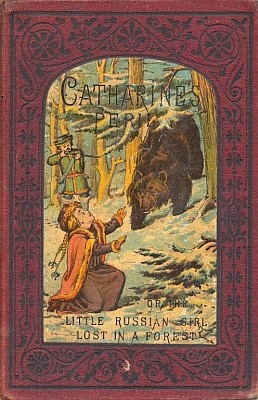
The Project Gutenberg eBook of Catharine's peril
Title: Catharine's peril
or, The little Russian girl lost in a forest; and other stories
Author: Mrs. M. E. Bewsher
Release date: April 25, 2007 [eBook #21216]
Most recently updated: January 2, 2021
Language: English
Credits: Produced by Marilynda Fraser-Cunliffe, Emmy and the Online
Distributed Proofreading Team at https://www.pgdp.net (This
file was made using scans of public domain works in the
International Children's Digital Library.)
CATHARINE'S PERIL;
OR,
The Little Russian Girl Lost in a Forest.
A TALE FOUNDED ON FACT.
By MRS. M. E. BEWSHER,
AND OTHER STORIES.
Seventh Thousand.
OLIPHANT, ANDERSON, & FERRIER
(LATE WILLIAM OLIPHANT & CO.).
1881.
PRINTERS TO HER MAJESTY'S STATIONERY OFFICE.
CONTENTS.
| PAGE | |
| CATHARINE'S PERIL; OR, THE LITTLE RUSSIAN GIRL LOST IN A FOREST | 5 |
| THE SHABBY SURTOUT | 27 |
| JANE HILL | 45 |
CATHARINE'S PERIL;
THE LITTLE RUSSIAN GIRL LOST IN A FOREST.
CHAPTER I.
In the year 1812, Napoleon Buonaparte, after conquering nearly the whole of Europe, invaded Russia, and led his victorious army to Moscow, the ancient capital of that country. Soon this city, with its winding streets, its hills, its splendid churches, its fine houses and cottages so mixed together, its corn-fields, woods, and gardens, as well as the Kremlin, consisting of several churches, palaces, and halls collected on the top of a hill and surrounded by walls, fell into the power of the French.
Rostopchin, the Governor, impelled by bigoted patriotism, resolved to set fire to the city confided to him by his imperial master Alexander, the Czar of all the Russias.
It was truly a heart-rending sight to witness the misfortunes of the inhabitants, forced to quit their homes to escape a horrible death.
The provisions stored in the granaries and other places were consumed in the flames.
The conflagration lasted about ten days, until almost the whole of Moscow was laid in ashes. The main body of the Russian army had retired towards Tula, and taken up a strong position on the road leading towards that town, in order to prevent the French from advancing into the interior of the country. Thus they were hemming them in on all sides, only leaving them the choice of being starved or burned, or returning by the way they had come, and wintering in Poland. This latter expedient might have saved the army had it been adopted in time.
The terrible Cossacks, first-rate riders, with lances ten feet long, and a musket slung over their right shoulder, were swarming around everywhere, and annoying the French outposts, cutting off the foraging parties, and hindering them in their attempt to penetrate into the south of Russia, where they would have found plenty of provisions for the winter.
Winter was fast coming on—a Russian winter, in all its bitter severity. The snow began to fall, the rivers to freeze, and crows and other birds died by hundreds.
God had sent His frost, and of the 400,000 enemies who had entered Russia, but very few lived to behold again their native land.
Amid the confusion and panic that prevailed in the burning city, Catharine Somoff, the little daughter of a Russian merchant, had been separated from her relations and friends, and to her dismay found herself alone in the crowd.
The weather was intensely cold. Forsaken and half frozen, the child wandered up and down, not knowing where to find shelter. Both her parents had mysteriously disappeared, and it seemed as if no one would claim her. So passed the long hours of the night; and at the dawn of day, Catharine, worn out by fatigue, cold, and hunger, fell down in front of a church which the flames had not yet reached, hoping to go to sleep.
Sleep soon comes to childhood; and, without doubt, this poor child, exposed to such a temperature, would never have unclosed her eyes any more in this world, had not a sutler's wife providentially come to fix up her little provision market near this church, and, noticing the lonely one, felt womanly compassion for the desolate, unprotected Catharine. This humane French-woman took all possible care of her—indeed, treated her as her own child, and by degrees the young Muscovite, thus rescued from an untimely death, grew to love her protectress with all the strength of her affectionate nature.
Meantime the French army had commenced its retreat, and the sutler's wife had to leave Moscow.
Were M. Somoff and his wife alive, or had they perished, like numbers of their fellow-countrymen, by famine or by fire, or amid the numerous ills of a captured city? This was a problem not to be solved for many long years. Nothing could be heard of them, so Catharine left her native place with her kind friend and protectress, the sutler's wife.
The snow was very deep, and every puff of wind increased the inconvenience of travelling; in some parts the snow-drifts were so bad that the poor horses sank into them till nothing but their heads was to be seen. The days were short, and the fugitives made but little progress, although they were often obliged to march during the night. It was owing to this that so many unhappy creatures wandered from their regiments. The weather was unusually cold. Even those who were fortunate enough to have on a complete dress of coarse cloth lined with sheep-skin, the wool left on and worn next the body, and over all a large cloth shubb lined with wolf-skin, the fur inside, and a warm lamb-skin cap, their feet encased in boots lined with fur, found their sufferings very great. What must it have been for those unfortunates who had but tattered pelisses and sheep-skins half burnt?—how fared they? They were perishing from exposure, hunger, and cold. Wretched men were seen fighting over a morsel of dry bread, or bitterly disputing with each other for a little straw, or a piece of horse-flesh, which they were attempting to divide.
It is difficult to imagine what the tenderly-nurtured Catharine Somoff had to undergo in this perilous journey. The hills and forests around presented only some white, indistinct masses, scarcely visible through the thick fog. At a short distance before them lay the fatal river the Beresina, the scene of untold horrors, which, now half-frozen, forced its way through the ice that impeded its progress. The two bridges were so completely choked up by the crowds of people, horsemen, foot-soldiers, and fugitives, that they broke down. Then began a frightful scene, for the bodies of dead and dying men and horses so encumbered the way, that many poor fellows, struggling with the agonies of death, caught hold of those who mounted over them; but these kicked them with violence to disengage themselves, treading them under foot. Thousands of victims fell into the waves and were drowned.
The reader will not be surprised to hear that at this awful time the little Catharine was separated from her protectress, who was probably drowned or killed, or else imagined the child to be engulfed in the waters of the fatal river. At all events, the Russian child and the sutler's wife never met again in this world.
| 'There is a power |
| Unseen, that rules th' illimitable world— |
| That guides its motions, from the brightest star |
| To the least dust of this sin-tainted mould; |
| While man, who madly deems himself the lord |
| Of all, is nought but weakness and dependence. |
| This sacred truth, by sure experience taught, |
| Thou must have learnt, when, wandering all alone, |
| Each bird, each insect, flitting through the sky, |
| Was more sufficient for itself than thou.' |
CHAPTER II.
In spite of all obstacles, Catharine managed to cross over one of the bridges to the opposite side of the Beresina, and then the poor child came on with a detachment of the French army as far as Poland. Many of her companions perished of exposure and want; others were lost on the way; some lay down from sheer exhaustion, or to try to sleep, and, ignorant of the hour of march, on awaking found themselves in the power of the enemy.
The sick and the wounded anxiously looked around for some humane friend to help them, but their cries were lost in the air. No one had leisure to attend to his dearest friend—self-preservation, the first law of nature, absorbed every thought.
Under these distressing circumstances, it so happened that the friendless little Russian girl found herself quite alone, forsaken in the midst of a large forest, where wolves and even bears were frequently seen.
The poor child, half-dead with cold, hunger, and fear, the snow nearly up to her knees, saw ere long, to her intense horror, a savage bear approaching; and Catharine, making a frantic effort to escape, found her limbs so benumbed and her weakness so great that she could not move.
The bear was coming nearer, preparing to attack her, when Catharine, in mortal fright, uttered a piercing scream, imploring help.
Thanks to a merciful Providence, at the precise moment that the savage bear was preparing to attack her, a shot was fired, and the bear fell dead at the feet of the astonished child.
The stranger, when he came to the spot where Catharine was still cowering, trembling with fright, looked with an eye of pity on the lonely little creature whose safety had been so wonderfully entrusted to him.
He proved to be a Polish lord named Barezewski, and taking some bread, cold meat, and wine out of his hunting-pouch, he gave them to Catharine, who soon felt better for the refreshment she so much needed, and cheered by the unexpected kindness of the gentleman, who now took her hand to lead her to his castle, at some little distance.
The countess received the poor outcast with much tenderness, and in a short time the young Muscovite was able to relate all she knew of her interesting and eventful history. The noble Pole and his lady were moved to tears by Catharine's recital of her sufferings and the horrors she had witnessed on the road; but, thanks to their compassionate sympathy and kindness, she soon ceased to think of what she had undergone, and was capable of appreciating the comforts and blessings now surrounding her.
Several years passed, bringing no intelligence of Catharine's parents; meanwhile, she grew in wisdom and in loveliness of mind and person, and no expense was spared to make her an elegant and accomplished young lady. She had attained her sixteenth year when an important event took place.
On the anniversary of the Russian child's wonderful and providential deliverance from a frightful death, it was customary each year to have a grand feast at the Castle, when the gentle and beloved Catharine Somoff would relate anew her thrilling history, and review the kindness shown her by her generous protectors, who looked upon her in every respect as their own child.
The season had come round once again, and she was in the middle of her tale, when a gun was heard at a short distance from the Castle. The weather was very stormy; the wind blew violently, the snow fell in large flakes, darkening the sky; it was almost impossible to see a yard before one.
'Doubtless it is some lost traveller imploring assistance, or perhaps being attacked by wild beasts, so numerous in the forest. It is impossible to be hunting or shooting merely for pleasure in this dreadful weather,' exclaimed Count Barezewski, giving orders for his men to provide torches and other needful apparatus, and come with him to find out what was amiss. They set off in the direction of the forest whence the report of the gun had proceeded—the identical spot where Catharine Somoff had been threatened by the bear some years ago. Great anxiety was felt at the Castle during the hour that passed before the brave Barezewski appeared, followed by his men, who bore the body of a bleeding Russian on a litter.
Catharine hastened to look at her fellow-countryman, and then expressed a wish to dress his wound. The stranger was soon restored to consciousness by the humane attentions of his hosts, and able to express his gratitude, as well as mention a few particulars of his adventures on this wintry day.
He said: 'I am a Muscovite merchant on my way to Warsaw. Before leaving this part, I wished to go and see a friend living at some little distance. I took my gun, and walked to his castle, where I was belated. The snow fell in large flakes; I lost my path. In vain I sought the proper road, when, noticing two men coming in my direction, I hastened to ask them to put me in the right way. I did not mistrust them the least in the world, and was patiently awaiting their reply, when suddenly both these rascals rushed upon me, throwing me to the ground, and robbed me of the small sum of money I had in my purse. I uttered a cry; then one of them, evidently intending to kill me, pointed his gun at my heart, and fired.'
All this time Catharine had kept her eyes intently fixed upon the stranger's countenance; she seemed to recall some well-known features, without being able to remember where she had seen them. Her heart beat violently, and her interest in the new-comer became greater every moment; indeed, her feelings appeared to be excited in an unaccountable manner. Count Barezewski begged his guest to give him a few details of the terrible fire at Moscow, which had caused so much misery and distress to both Russians and French. The Russian seemed to feel a very great disinclination to comply with his host's request; however, when he reflected upon the hospitality and kindness he was receiving, he knew not how to refuse. His voice betrayed excessive emotion as he described the sad sight of this immense conflagration; but as soon as he came to his own private misfortunes, he burst into tears, and with a deep-drawn sigh exclaimed:
'Alas! this awful fire not only deprived us of a great part of our fortune, but, far worse, of her who formed our chief joy, our cherished daughter. Amid the frightful panic that prevailed, whilst my wife and I endeavoured to save some of our most valuable effects from the rage of the devouring element, we lost our only child, then in her seventh year. Her nurse had taken her for safety to a house situated in a by-street occupied by a friend of ours, where the fire had not yet reached; but both the child and the nurse disappeared, and since this melancholy catastrophe all our numerous and anxious inquiries respecting them have proved utterly fruitless. Probably they were killed by a falling edifice, and so buried in its ruins; at least, this is my opinion, for my dear wife still has the hope of again beholding our long-lost but dearly cherished child.'
Catharine, who had listened with the most heartfelt interest to this touching recital, could not restrain her emotions any longer. She threw herself on the stranger's neck, exclaiming,
'My father, my dear father!'
It was a most affecting moment. We will not attempt to depict the joy and the thankfulness that filled the hearts of both parent and child. Let our young readers try to imagine themselves in Catharine's situation, or else in her father's; then only can they enter into the real sentiments that overpowered them both. How pleasure and pain are intermingled in this life!
Catharine's delight at being re-united to her dear father was undoubtedly great, but sorrow at the prospect of leaving friends like the Count and Countess proved a trial to the affectionate and grateful girl.
| 'Then happy those, since each must draw |
| His share of pleasure, share of pain; |
| Then happy those, belov'd of Heaven, |
| To whom the mingled cup is given, |
| Whose lenient sorrows find relief, |
| Whose joys are chastened by their grief.' |
CHAPTER III.
When the first excitement of this unexpected meeting had somewhat subsided, Catharine, in her turn, told of the wondrous and providential dealings to which she was indebted for her preservation amid countless perils.
The good sutler's wife was not forgotten in this extraordinary account; and with what sensitiveness and touching expressions of gratitude she disclosed to her attentive listener the innumerable acts of kindness she had received all these years from the noble Polish lord and his lady, who had loaded her with constant benefits, and had in every respect treated her as their own child.
In a few days Catharine's father had quite recovered from the effects of his wound. His business required attention, and he was impatient to restore his beloved child to her mother's arms, so father and daughter bade adieu to the Polish Count and Countess, but not before assuring them that their gratitude would never cease as long as they lived.
M. Somoff and his long-lost Catharine returned to Moscow, where they were welcomed with surprise and joy by the delighted mother, who forgot all her sorrows when once more embracing her child, who had been lost to her for so many long years.
Very soon the young Russian's marvellous history became known. She was asked in marriage by an officer holding high rank in the army, and in due time she became his wife.
Ten years passed.
Great changes had taken place on the Continent of Europe. Poland had proclaimed its independence, and Nicholas, the Emperor of all the Russias, had an immense army in the field to repress the efforts of this brave but most unfortunate nation.
The horrors that were perpetrated, and the sad issue of this too unequal warfare, are well known.
Catharine's husband had taken part in this campaign, and she had followed him to the camp.
We will not stop to describe the heartrending scenes connected with this war, but merely inform the reader that Warsaw was taken by assault; and in this is included a whole chapter of misery. On this fatal day many thousand Poles as well as Russians lost their lives. In the course of the evening after the battle, the superior officers of the triumphant army went to inspect the scene of the late bloody combat, where heaps of dead and dying were lying in confusion, for there might be seen the victor and the vanquished side by side.
Moved by charity, touched with compassion for the fate of those to whom fortune had been so unpropitious, Catharine's husband sent all who still retained a breath of life to the hospitals and ambulances. He was just on the point of leaving this desolate spot, when, casting his eye on a heap of corpses being covered over with earth, he noticed a Polish officer of high rank, decorated with numerous crosses and medals. He thought he saw some signs of animation, so he had him removed, and carefully conveyed to the house in which Catharine then was. Once there, every possible care was bestowed upon him. By degrees he recovered from his lethargy, and looked around the room.
Catharine was sitting at his bedside. Suddenly she uttered a cry: she had recognised the Polish lord Barezewski, her preserver and benefactor.
The Count recovered from his wounds, but he had only escaped one peril to fall into another even more terrible; his name was on the list of proscribed persons, and the mildest punishment for this in Russia means degradation and exile to Siberia.
Catharine no sooner discovered the fresh misfortune impending over the noble Pole than she determined to risk everything, and obtain an audience of the Czar Nicholas, when, falling before him, she embraced his knees, and with tears implored him to accord the pardon of her generous protector, Barezewski.
Nicholas, much touched by her gratitude and her earnest entreaties on behalf of the Polish lord, graciously granted his pardon.
Perhaps some of my readers may think Catharine need not have been so frightened at what she had to do in seeking an interview with the Emperor; but in our highly-favoured land we can scarcely enter into her feelings, for in Russia the sovereign is all-powerful, and, especially in past days, political offenders, or those taking their part in any way, were punished with the greatest severity.
I will tell you what happened during the reign of the Empress Elizabeth to the most beautiful and delicately nurtured lady at the court of Russia, because, poor creature, she had the misfortune to offend her imperial mistress. She was condemned to the knout, a fearful instrument of punishment made of a strip of hide, which is whizzed through the air by the hangman on the bare back and neck of the hapless victim, and each time it tears away a narrow strip of skin from the neck along the back. These blows were repeated until the entire skin of the lady's back hung in rags; then this woman's tongue was plucked out by the roots, and she was at once sent off to Siberia.
What does 'sent to Siberia' imply? Worse, far, far worse than any criminal, however vile and hardened, endures in our beloved country. We frequently hear of persons being condemned to penal punishment for many years, or even for life; but this is absolutely nothing compared to being exiled to Siberia, a place where the criminals of the Russian empire, and persons suspected of intrigues, are often sent without even knowing the cause of their banishment.
A faint idea of what the poor unfortunate exiles have to suffer may be gleaned from the description which follows:—'Barren and rocky mountains, covered with eternal snows, waste uncultivated plains, where, in the hottest days of the year, little more than the surface of the ground is thawed, alternate with large rivers, the icy waves of which, rolling sullenly along, have never watered a meadow or seen a flower expand. The Government supplies some of the exiles with food, very poor and very scanty; those whom it abandons subsist on what they obtain by hunting. The greater number of these hapless beings reside in the villages which border the river from Tobolsk to the boundaries of Tschimska; others are dispersed in huts through the plains. For these unfortunates not a single happy day exists.'
To such a state of exile and misery would the noble Polish lord have been reduced if Nicholas had not granted Catharine's petition. This tale shows how the eye of a tender and watchful Father is ever over the young and unprotected. How true are these beautiful words:
| 'No earthly father loves like Thee; |
| No mother, e'er so mild, |
| Bears and forbears as Thou hast done |
| With me, Thy sinful child.' |
THE SHABBY SURTOUT.
| My reader, need you ever say, |
| With Titus, 'I have lost a day,' |
| When right, and left, and all around, |
| God's poor and needy ones are found? |
THE SHABBY SURTOUT.
I had taken a place on the top of one of the coaches which ran between Edinburgh and Glasgow, for the purpose of commencing a short tour in the Highlands of Scotland. It was in the month of June, a season when travellers of various descriptions flock towards the Modern Athens, and thence betake themselves to the northern or western counties, as their business or fancy leads. As we rattled along Princes Street, I had leisure to survey my fellow-travellers. Immediately opposite to me sat two dandies of the first water, dressed in white greatcoats and Belcher handkerchiefs, and each with a cigar in his mouth, which he puffed away with marvellous self-complacency. Beside me sat a modest and comely young woman in a widow's dress, and with an infant about nine months old in her arms. The appearance of this youthful mourner and her baby indicated that they belonged to the working class of society; and though the dandies occasionally cast a rude glance at the mother, the look of calm and settled sorrow which she invariably at such times cast upon her child seemed to touch even them, and to disarm their coarseness. On the other side of the widow sat a young gentleman of plain yet prepossessing exterior, who seemed especially to attract the notice of the dandies. His surtout was not absolutely threadbare, but it had evidently seen more than one season; and I could perceive many contemptuous looks thrown upon it by the gentlemen in the Belcher handkerchiefs. The young gentleman carried a small portmanteau in his hand, so small, indeed, that it could not possibly have contained more than a change of linen. This article also appeared to arrest the eyes of the sprigs of fashion opposite, whose wardrobes, in all probability, were more voluminous: whether they were paid for or not, might be another question.
The coach having stopped at the village of Corstorphine, for the purpose of taking up an inside passenger, the guard, observing that the young gentleman carried his portmanteau in his hand, asked leave to put it into the boot, to which he immediately assented. 'Put it fairly in the centre, guard,' said one of the dandies. 'Why so, Tom?' inquired his companion. 'It may capsize the coach,' rejoined the first,—a sally at which both indulged in a burst of laughter, but of which the owner of the portmanteau, though the blood mounted slightly into his cheek, took no notice whatever.
The morning being fine at our first setting out, the ride was peculiarly pleasant. The dandies talked of horses and dogs, and fowling-pieces and percussion-caps, every now and then mentioning the names of Lord John and Sir Harry, as if their acquaintance lay among the great ones of the land. Once or twice I thought I saw an expression of contempt in the countenance of the young gentleman in the surtout, but in this I might be mistaken. His attention was evidently most directed to the mourner beside him, with whom he appeared anxious to get into conversation, but to lack for a time a favourable opportunity.
While we were changing horses at the little village of Uphall, an aged beggar approached, and held out his hat for alms. The dandies looked at him with scorn. I gave him a few halfpence; and the young widow, poor as she seemed, was about to do the same, when the young gentleman in the surtout laid his hand gently on her arm, and dropping a half-crown into the beggar's hat, made a sign for him to depart. The dandies looked at each other. 'Showing off, Jack,' said the one. 'Ay, ay, successful at our last benefit, you know,' rejoined the other; and both again burst into a horse laugh. At this allusion to his supposed profession, the blood again mounted into the young gentleman's cheek; but it was only for a moment, and he continued silent.
We had not left Uphall many miles behind us, when the wind began to rise, and the gathering clouds indicated an approaching shower. The dandies began to prepare their umbrellas; and the young gentleman in the surtout, surveying the dress of the widow, and perceiving that she was but indifferently provided against a change of weather, inquired of the guard if the coach was full inside. Being answered in the affirmative, he addressed the mourner in a tone of sympathy, told her that there was every appearance of a smart shower, expressed his regret that she could not be taken into the coach, and concluded by offering her the use of his cloak. 'It will protect you so far,' said he, 'and, at all events, it will protect the baby.' The widow thanked him in a modest and respectful manner, and said that for the sake of her infant she should be glad to have the cloak, if he would not suffer from the want of it himself. He assured her that he should not, being accustomed to all kinds of weather. 'His surtout won't spoil,' said one of the dandies, in a voice of affected tenderness; 'and besides, my dear, the cloak will hold you both.' The widow blushed; and the young gentleman, turning quickly round, addressed the speaker in a tone of dignity which I shall never forget. 'I am not naturally quarrelsome, sir, but yet it is quite possible you may provoke me too far.' Both the exquisites immediately turned as pale as death, shrank in spite of themselves into their natural insignificance, and scarcely opened their lips, even to each other, during the remainder of the journey.
In the meantime the young gentleman, with the same politeness and delicacy as if he had been assisting a lady of quality with her shawl, proceeded to wrap the widow and her baby in his cloak. He had hardly accomplished this when a smart shower of rain, mingled with hail, commenced. Being myself provided with a cloak, the cape of which was sufficiently large to envelope and protect my head, I offered the young gentleman my umbrella, which he readily accepted, but held it, as I remarked, in a manner better calculated to defend the widow than himself.
When we reached West Craigs Inn, the second stage from Edinburgh, the rain had ceased; and the young gentleman, politely returning me my umbrella, began to relieve the widow of his now dripping cloak, which he shook over the side of the coach, and afterwards hung on the rail to dry. Then turning to the widow, he inquired if she would take any refreshment; and upon her answering in the negative, he proceeded to enter into conversation with her, as follows:—
'Do you travel far on this road, ma'am?'
'About sixteen miles farther, sir. I leave the coach six miles on the other side of Airdrie.'
'Do your friends dwell thereabouts?'
'Yes, sir, they do. Indeed, I am on the way home to my father's house.'
'In affliction, I fear?'
'Yes, sir,' said the poor young woman, raising her handkerchief to her eyes, and sobbing audibly; 'I am returning to him a disconsolate widow, after a short absence of two years.'
'Is your father in good circumstances?'
'He will never suffer me or my baby to want, sir, while he has strength to labour for us; but he is himself in poverty, a day-labourer on the estate of the Earl of Hyndford.'
At the mention of that nobleman's name, the young gentleman coloured a little, but it was evident that his emotion was not of an unpleasant nature. 'What is your father's name?' said he.
'James Anderson, sir.'
'And his residence?'
'Blinkbonny.'
'Well, I trust that, though desolate as far as this world is concerned, you know something of Him who is the Father of the fatherless and the Judge of the widow. If so, your Maker is your husband, and the Lord of Hosts is His name.'
'Oh, yes, sir; I bless God that, through a pious parent's care, I know something of the power of divine grace and the consolations of the gospel. My husband, too, though but a tradesman, was a man who feared God above many.'
'The remembrance of that must tend much to alleviate your sorrow.'
'It does indeed, sir, at times; but at other times I am ready to sink. My father's poverty and advancing age, my baby's helplessness, and my own delicate health, are frequently too much for my feeble faith.'
'Trust in God, and He will provide for you; be assured He will.'
By this time the coach was again in motion, and though the conversation continued for some time, the noise of the wheels prevented me from hearing it distinctly. I could see the dandies, however, exchange expressive looks with one another; and at one time the more forward of the two whispered something to his companion, in which the words 'Methodist parson' alone were audible.
At Airdrie nothing particular occurred; but when we had got about half-way between that town and Glasgow, we arrived at a cross-road, where the widow expressed a wish to be set down. The young gentleman therefore desired the driver to stop, and, springing himself from the coach, took the infant from her arms, and then, along with the guard, assisted her to descend. 'May God reward you,' said she, as he returned the baby to her, 'for your kindness to the widow and the fatherless this day!'
'And may He bless you,' replied he, 'with all spiritual consolation in Christ Jesus!'
So saying, he slipped something into her hand. The widow opened it instinctively; I saw two sovereigns glitter on her palm. She dropped a tear upon the money, and turned round to thank her benefactor, but he had already resumed his seat upon the coach. She cast towards him an eloquent and grateful look, pressed her infant convulsively to her bosom, and walked hurriedly away.
No other passenger wishing to alight at the same place, we were soon again in rapid motion towards the great emporium of the West of Scotland. Not a word was spoken. The young gentleman sat with his arms crossed upon his breast, and, if I might judge by the expression of his fine countenance, was evidently revolving some scheme of benevolence in his mind. The dandies regarded him with blank amazement. They also had seen the gold in the poor widow's hand, and seemed to think that there was more under that shabby surtout than their 'puppy brains' were able to conjecture. That in this they were right was speedily made manifest.
When we had entered Glasgow, and were approaching the Buck's Head—the inn at which our conveyance was to stop—an open travelling-carriage, drawn by four beautiful grey horses, drove up in an opposite direction. The elegance of this equipage made the dandies spring to their feet. 'What beautiful greys!' cried the one; 'I wonder who they can belong to?' 'He is a happy fellow, anyhow,' replied the other; 'I would give half Yorkshire to call them mine.' The stage-coach and travelling-carriage stopped at the Buck's Head at the same moment; and a footman in laced livery, springing down from behind the latter, looked first inside and then at the top of the former, when he lifted his hat with a smile of respectful recognition.
'Are all well at the castle, Robert?' inquired the young gentleman in the surtout.
'All well, my lord,' replied the footman.
At the sound of that monosyllable the faces of the exquisites became visibly elongated; but without taking the smallest notice of them or their confusion, the nobleman politely wished me good morning, and, descending from the coach, caused the footman to place his cloak and despised portmanteau in the carriage. He then stepped into it himself, and the footman getting up behind, the coachman touched the leaders very slightly with his whip, and the equipage and its noble owner were soon out of sight.
'Pray, what nobleman is that?' said one of the dandies to the landlord, as we entered the inn.
'The Earl of Hyndford, sir,' replied the landlord; 'one of the best men, as well as one of the richest, in Scotland.'
'The Earl of Hyndford!' repeated the dandy, turning to his companion. 'What asses we have been! There's an end to all chance of being allowed to shoot on his estate.'
'Oh, yes, we may burn our letters of introduction when we please!' rejoined his companion; and, silent and crestfallen, both walked upstairs to their apartments.
'The Earl of Hyndford!' repeated I, with somewhat less painful feelings. 'Does he often travel unattended?'
'Very often, sir,' replied the landlord, 'especially when he has any public or charitable object in view; he thinks he gets at the truth more easily as a private gentleman than as a wealthy nobleman.'
'I have no doubt of it,' said I; and having given orders for dinner, I sat down to muse on the occurrences of the day.
This, however, was not the last time that I was destined to hear of that amiable young nobleman, too early lost to his country and mankind. I had scarcely returned home from my tour in the Highlands, when I was waited upon by a friend, a teacher of languages in Edinburgh, who told me that he had been appointed Rector of the Academy at Bothwell.
'Indeed!' said I; 'how have you been so fortunate?'
'I cannot tell,' replied he, 'unless it be connected with the circumstance which I am going to relate.'
He then stated that, about a month before, he was teaching his classes as usual, when a young gentleman, dressed in a surtout that was not over new, came into his school, and politely asked leave to see his method of instruction. Imagining his visitor to be a schoolmaster from the country, who wished to learn something of the Edinburgh modes of tuition, my friend acceded to his request. The stranger remained two hours, and paid particular attention to every department. When my friend was about to dismiss the school, the stranger inquired whether he was not in the habit of commending his pupils to God in prayer before they parted for the day. My friend replied that he was; upon which the stranger begged that he would not depart from his usual practice on his account. My friend accordingly prayed with the boys, and dismissed them; after which the stranger thanked him for his politeness, and also withdrew. Nothing more occurred; but, four or five days afterwards, my friend received a letter from the Earl of Hyndford, in which that nobleman, after stating that he had satisfied himself as to his piety and ability as a teacher, made him an offer of the Rectorship of the Academy at Bothwell.
'Was your visitor fair-haired,' said I, 'and his surtout of a claret colour?'
'They were,' replied my friend; 'but what of that?'
'It was the Earl of Hyndford himself,' said I; 'there can be no doubt of it.' And I gave him the history of my journey to Glasgow.
'Well, he took the best method, certainly, to test my qualifications,' rejoined my friend. 'I wish all patrons would do the same; we should have better teachers in our schools, and better ministers in our churches.'
'All patrons, perhaps, are not equally qualified to judge,' said I; 'at all events, let us rejoice that, though "not many wise men after the flesh, not many mighty, not many noble, are called," still we see one here and one there distinguished by divine grace, to the praise and the glory of God the Saviour.'