
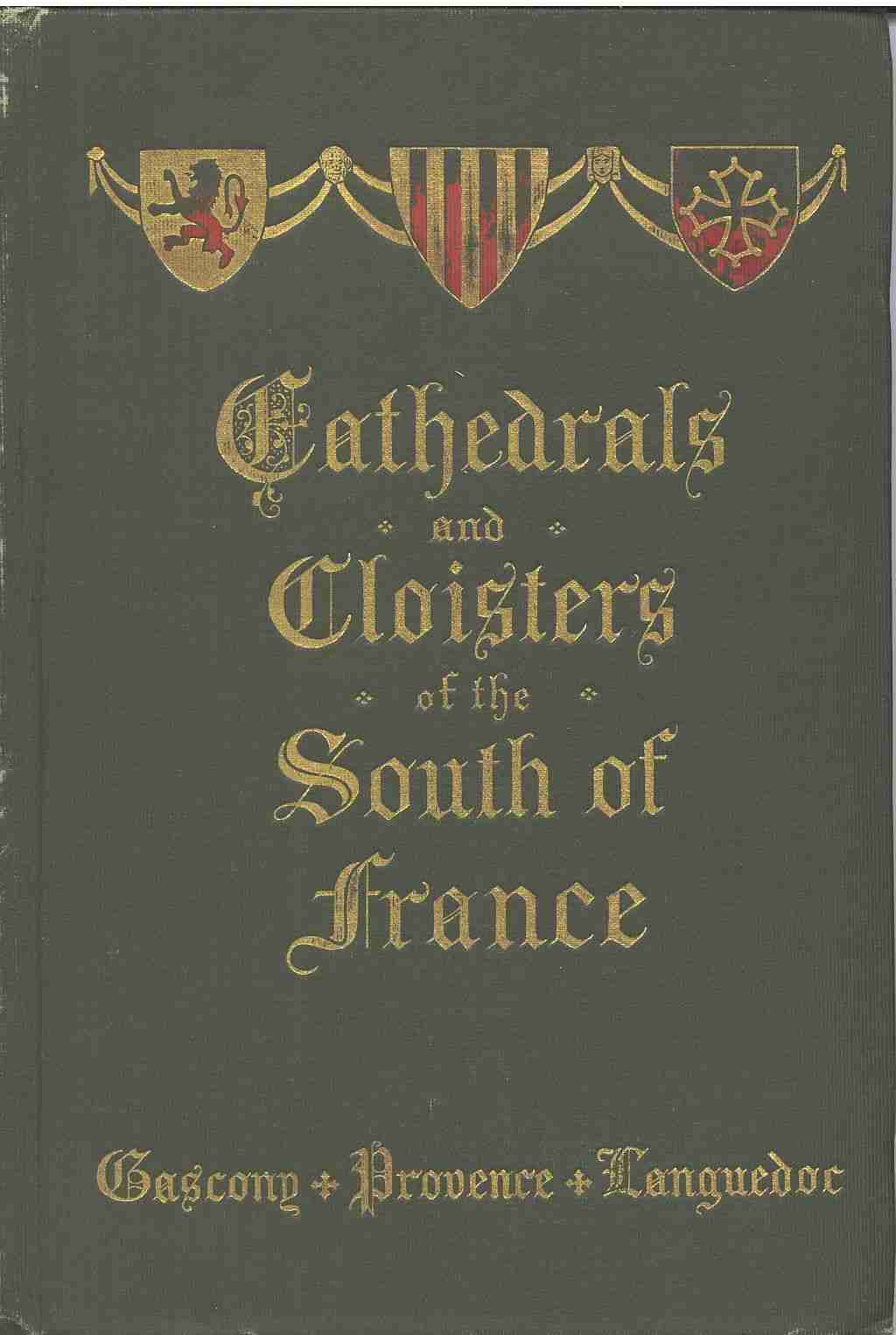
The Project Gutenberg eBook of Cathedrals and Cloisters of the South of France, Volume 1
Title: Cathedrals and Cloisters of the South of France, Volume 1
Author: Elise Whitlock Rose
Illustrator: Vida Hunt Frances
Release date: September 22, 2007 [eBook #22718]
Most recently updated: January 3, 2021
Language: English
Credits: Produced by Juliet Sutherland, Marcia Brooks and the Online
Distributed Proofreading Team at https://www.pgdp.net
CATHEDRALS AND CLOISTERS
OF THE SOUTH OF FRANCE

“Sheer and straight the pillars rise, ...
and arch after arch is lost on the shadows of
the narrow vaulting of the side-aisle.” [To List]
CATHEDRALS
and CLOISTERS
OF THE
SOUTH OF FRANCE
BY
ELISE WHITLOCK ROSE
WITH ILLUSTRATIONS FROM ORIGINAL PHOTOGRAPHS
BY
VIDA HUNT FRANCIS
IN TWO VOLUMES
VOLUME I.
NEW YORK AND LONDON
The Knickerbocker Press
1906
by
G. P. PUTNAM'S SONS
PREFACE.
For years the makers of this book have spent the summer time in wandering about the French country; led here by the fame of some old monument, or there by an incident of history. They have found the real, unspoiled France, often unexplored by any except the French themselves, and practically unknown to foreigners, even to the ubiquitous maker of guide-books. For weeks together they have travelled without meeting an English-speaking person. It is, therefore, not surprising that they were unable to find, in any convenient form in English, a book telling of the Cathedrals of the South which was at once accurate and complete. For the Cathedrals of that country are monuments not only of architecture and its history, but of the history of peoples, the psychology of the christianising and unifying of the barbarian and the Gallo-Roman, and many things besides, epitomised perhaps in the old words, “the struggle between the world, the flesh, and the devil.” In French, works on Cathedrals are numerous and exhaustive; but either so voluminous as to be unpractical except for the specialist—as the volumes of Viollet-le-Duc,—or so technical as to make each Cathedral seem one in an endless, monotonous procession, differing from the others only in size, style, and age. This is distinctly unfair to these old churches which have personalities and idiosyncrasies as real as those of individuals. It has been the aim of the makers of this book to introduce, in photograph and in story,—not critically or exhaustively, but suggestively and accurately,—the Cathedral of the Mediterranean provinces as it exists to-day with its peculiar characteristics of architecture and history. They have described only churches which they have seen, they have verified every fact and date where such verification was possible, and have depended on local tradition only where that was all which remained to tell of the past; and they will feel abundantly repaid for travel, research, and patient exploration of towers, crypts, and archives if the leisurely traveller on pleasure bent shall find in these volumes but a hint of the interest and fascination which the glorious architecture, the history, and the unmatched climate of the Southland can awaken.
For unfailing courtesy and untiring interest, for free access to private as well as to ecclesiastical libraries, for permission to photograph and copy, for unbounding hospitality and the retelling of many an old legend, their most grateful thanks are due to the Catholic clergy, from Archbishop to Curé and Vicar. For rare old bits of information, for historical verification, and for infinite pains in accuracy of printed matter, they owe warm thanks to Mrs. Wilbur Rose, to Miss Frances Kyle, and to Mrs. William H. Shelmire, Jr. For criticism and training in the art of photographing they owe no less grateful acknowledgment to Mr. John G. Bullock and Mr. Charles R. Pancoast.
E. W. R.
V. H. F.
CONTENTS.
- PREFACE
- LIST OF WORKS CONSULTED.
- ILLUSTRATIONS.
- PAGE
- The South of France
- I. The South of France3
- II. Architecture in Provence, Languedoc, qnd Gascony29
- Provence
- I. The Cathedrals of the Sea55
- Marseilles—Toulon—Fréjus—Antibes—Nice
- II. Cathedrals Of The Hill-towns72
- Carpentras—Digne—Forcalquier—Vence—Grasse
- III.River-side Cathedrals101
- Avignon—Vaison—Arles—Entrevaux—Sisteron
- IV. Cathedrals of the Valleys178
- Orange—Cavaillon—Apt—Riez—Senez—Aix
- Languedoc
- I. Cathedrals of the Cities237
- Nîmes—Montpellier—Béziers—Narbonne—Perpignan—
- Carcassonne—Castres—Toulouse—Montauban
Illustrations
- Page
- RodezFrontispiece
- “ Sheer and straight the pillars rise, ...
- and arch after arch is lost on the shadows of
- the narrow vaulting of the side-aisle.”
- “Carcassonne, the invulnerable”5
- “The Tower of an early maritime Cathedral”—Agde10
- “A nave of the earlier style”—Arles15
- “A nave of the later style”—Rodez19
- “The delicate choir of Saint-Nazaire”—Carcassonne23
- “A cloister of the South”—Elne27
- “A Romanesque aisle”—Arles31
- “The sculptured portals of Saint-trophime”—Arles33
- “A Gothic aisle”—Mende35
- “Corresponding differences in style”—Carcassonne39
- “Fortified Gothic built in brick”—Albi43
- “A church fortress”—Maguelonne45
- “Stately Gothic splendour”—Condom47
- Entrevaux52
- “People gather around the mail-coach as it makes its
- daily halt before the drawbridge.”
- “The new Cathedral”—Marseilles57
- “The desecration of the little cloister”—Fréjus65
- “The military omen—the tower”—Antibes70
- “The interior of Notre-dame-du-bourg”—Digne77
- “The interior has neither clerestory nor triforium”—Digne81
- “A large square tower served as a lookout”—Forcalquier86
- “A suggestive view from the side-aisle”—Forcalquier87
- “The old round arch of the Bishop's Palace”—Vence92
- “The low, broad arches, and the great supporting pillars”—Vence93
- “Higher than them all stands the Cathedral”—Grasse97
- “The pont d'Avignon”99
- “The interior has a shallow, gracefully balustraded balcony”—Avignon103
- “The porch, so classic in detail”—AVIGNON107
- From an old print
- “Notre-Dame-des-Doms”—Avignon111
- “The Tower of Philip the Fair”—Villeneuve-les-Avignon114
- “The great Palace”—Avignon119
- “On the banks of a pleasant little river is Vaison”123
- “The ruined castle of the Counts of Toulouse”—Vaison125
- “The whole apse-end”—Vaison127
- “The south wall, which is clearly seen from the road”—Vaison129
- “Two bays open to the ground”—Vaison131
- “The great piers and small firm columns”—Vaison133
- “In the midst of the wealth of antique ruins”—Arles135
- “The façade of saint-trophime”—Arles137
- “Right detail—the portal”—Arles141
- “Left detail—the portal”—Arles145
- “Through the cloister arches”—Arles147
- “A nave of great and slender height”—Arles149
- “The beauty of the whole”—Arles151
- “The Gothic walk”—Cloister—Arles153
- “This interior”—Entrevaux156
- “The Romanesque walk”—Cloister—Arles157
- “One of the three small drawbridges”—Entrevaux159
- “The Portcullis”—Entrevaux160
- “A fort that perches on a sharp peak”—Entrevaux161
- “A true 'Place d'Armes'”—Entrevaux163
- “The long line of walls that zigzag down the hillside”—Entrevaux165
- “The church tower stood out against the rocky peak”—Entrevaux169
- “The Cathedral is near the heavy round towers of the outer ramparts”—Sisteron172
- “The bridge across the Durance”—Sisteron173
- “Entrances to two narrow streets”—Sisteron176
- “It was a low-vaulted, sombre little cloister”—Cavaillon182
- “The Cathedral's tower and turret”—Cavaillon187
- “The main body of the church”—Apt191
- “The Virgin and Saint Anne—by Benzoni”—Apt194
- “Saint-Martin-de-Brômes with its high slim tower”197
- “The fortified Monastery of the Templars”—near Gréoux199
- “The tower of Notre-Dame-du-Siège”—Riez201
- “Nothing could be more quaintly old and modest than the Baptistery”—Riez202
- “Between the columns an altar has been placed”—Baptistery, Riez203
- “The beautiful granite columns”—Riez207
- “The mail-coach of senez”211
- “The open square”—Senez213
- “The palace of its prelates”—Senez214
- “The Cathedral”—Senez215
- “The Cathedral”—Senez218
- “Tapestries beautify the choir-walls”—Senez219
- “Between branches full of apple-blossoms—the church as the curé saw it”—Senez221
- “The south aisle”—Aix224
- “The Romanesque portal”—Aix225
- “The cloister”—Aix227
- “The Cathedral”—Aix231
- “An amphitheatre which rivals the art of the Coliseum”—Nîmes238
- “The general effect is somewhat that of a port-cochère”—Montpellier244
- “The finest view is that of the apse”—Montpellier245
- “The clock tower is very square and thick”—Béziers248
- “The quaint and pretty fountain”—Béziers250
- “The door of the cloister”—Narbonne255
- “This is a place of deserted solitude”—Narbonne257
- “These flying-buttresses give to the exterior its most curious and
- beautiful effect”—Narbonne261
- “All the old buildings of the city are of Spanish origin”—Perpignan265
- “The unfinished façade”—Perpignan267
- “The stony street of the hillside”—Carcassonne269
- “The ancient Cross”—Carcassonne272
- “Often too little time is spent upon the nave”—Carcassonne275
- “The choir is of the xiv century”—Carcassonne279
- “The façade, straight and massive”—Carcassonne281
- “Perspective of the Romanesque”—Carcassonne283
- “The nave of the xiii century is an aisle-less chamber, low and
- broadly arched”—Toulouse291
- “The present Cathedral is a combination of styles”—Toulouse294
LIST OF WORKS CONSULTED.
| Bayet. | Précis de l'Histoire de l'Art. |
| Bodley. | France. |
| Bourg. | Viviers, ses Monuments et son Histoire. |
| Choisy. | Histoire de l'Architecture. |
| Cougny. | L'Art au Moyen Age. |
| Cook. | Old Provence. |
| Corroyer. | L'Architecture romane. |
| " | L'Architecture gothique. |
| Cox. | The Crusades. |
| Darcel. | Le Mouvement archéologique relatif au Moyen Age. |
| Ès. | L'Église Saint-Etienne, Cathédrale de Toulouse. |
| Dempster. | Maritime Alps. |
| Ducéré. | Bayonne historique et pittoresque. |
| Duruy. | Histoire de France. |
| Ferree. | Articles on French Cathedrals appearing in the “Architectural Record.” |
| Gardère. | Saint-Pierre de Condom et ses Constructeurs. |
| Gould. | In Troubadour Land. |
| Guizot. | Histoire de France. |
| " | Histoire de la Civilisation en France. |
| Hallam. | The Middle Ages. |
| Hare. | South-eastern France. |
| " | South-western France. |
| — | History of Joanna of Naples, Queen of Sicily (published 1824). |
| Hunnewell. | Historical Monuments of France. |
| James. | A Little Tour through France. |
| — | Le Moyen Age (avec notice par Roger-Milès). |
| Larned. | Churches and Castles of Mediæval France. |
| Lasserre, L'abbé. | Recherches historiques sur la Ville d'Alet et son ancien Diocèse. |
| Lechevallier | |
| Chevignard. | Les Styles français. |
| Macgibbon. | The Architecture of Provence and the Riviera. |
| Marlavagne. | Histoire de la Cathédrale de Rodez. |
| Martin. | Histoire de France. |
| Masson. | Louis IX and the XIII Century. |
| " | Francis I and the XVI Century. |
| Mérimée. | Études sur les Arts au Moyen Age. |
| Michelet. | Histoire de France. |
| Michelet and | |
| Masson. | Mediævalism in France. |
| — | Monographie de la Cathédrale d'Albi. |
| Montalembert. | Les Moines d'Occident. |
| Milman. | History of Latin Christianity. |
| Palustre. | L'Architecture de la Renaissance. |
| Pastor. | Lives of the Popes. |
| Pennell. | Play in Provence. |
| Quicherat. | Mélanges d'Archéologie au Moyen Age. |
| Renan. | Études sur la Politique religieuse du Règne de Philippe le Bel. |
| Révoil. | Architecture romane du Midi de la France. |
| Rosieres. | Histoire de l'Architecture. |
| Schnasse. | Geschichte der bildenden Künste. (Volume III, etc.) |
| Sentetz. | Sainte-Marie d'Auch. |
| Sorbets. | Histoire d'Aire-sur-l'Adour[Pg 17]. |
| Soulié. | Interesting old novels whose scenes are laid in the South of France:— |
| " | “Le Comte de Toulouse.” |
| " | “Le Vicomte de Béziers.” |
| " | “Le Château des Pyrénées,” etc. |
| Stevenson. | Travels with a Donkey in the Cévennes. |
| Taine. | The Ancient Regime. |
| " | Journeys through France. |
| " | Origins of Contemporary France. |
| " | Tour through the Pyrénées. |
| — | 'Twixt France and Spain. |
| Viollet-le-Duc. | Histoire d'une Cathédrale et d'un Hôtel-de-Ville. |
| " | Entretiens sur l'Architecture. |
| " | Dictionnaire raisonné de l'Architecture française du XIe au XVIe siècle. |
The South of France.
I.
THE SOUTH OF FRANCE.
If it is only by an effort that we appreciate the valour of Columbus in the XV century, his secret doubts, his temerity, how much fainter is our conception of the heroism of the early Mediterranean navigators. Steam has destroyed for us the awful majesty of distance, and we can never realise the immensity of this “great Sea” to the ancients. To Virgil the adventures of the “pious Æneas” were truly heroic. The western shores of the Mediterranean were then the “end of the earth,” and even during the first centuries of our own era, he who ventured outside the Straits of Gibraltar tempted either Providence or the Devil and was very properly punished by falling over the edge of the earth into everlasting destruction. “Why,” asks a mediæval text-book of science, “is the sun so red in the evening?” And this convincing answer follows, “Because he looks down upon Hell.”
For centuries before the Christian era the South of France, with Spain, lay in the unknown west end of the Sea. Along its eastern shores lay civilisations hoary with age; Carthage, to the South, was moribund; Greece was living on the prestige of her glorious past; while Rome was becoming all-powerful. Legend tells that adventurous Phœnicians and Greeks discovered the French coasts, that Nîmes was founded by a Tyrian Hercules, and Marseilles, about 600 B.C., by a Phœnician trader who married a chief's daughter and settled at the mouth of the Rhone. But these early settlements were merely isolated towns, which were not interdependent;—scarcely more than trading posts. It was Rome who took southern Gaul unto herself, and after Roman fashion, built cities and towns and co-ordinated them into well-regulated provinces; and it is with Roman rule that the connected history of Gaul begins.
From the outset we meet one basic fact, so difficult to realise when France is considered as one country, the essential difference between the North and the South. Cæsar found in the South a partial Roman civilisation ready for his organisation; and old, flourishing cities, like Narbonne, Aix, and Marseilles. In the North he found the people advanced no further than the tribal stage, and Paris—not even Paris in name—was a collection of mud huts, which, from its strategic position, he elevated into a camp. The two following centuries, the height of Roman dominion in France, accentuated these differences. The North was governed by the Romans, never assimilated nor civilised by them. The South eagerly absorbed all the culture of the Imperial City; her religions and her pleasures, her beautiful Temples and great Amphitheatres, finally her morals and effeminacy, till in the II century of our era, anyone living a life of luxurious gaiety was popularly said to have “set sail for Marseilles.” To this day the South boasts that it was a very part of Rome, and Rome was not slow to recognise the claim. Gallic poets celebrated the glory of Augustus, a Gaul was the master of Quintilian, and Antoninus Pius, although born in the Imperial City, was by parentage a native of Nîmes.
Not to the rude North, but to this society, so pagan, so pleasure-loving, came the first missionaries of the new Christian faith, to meet in the arenas of Gaul the fate of their fellow-believers in Rome, to hide in subterranean caves and crypts, to endure, to persist, and finally to conquer. In the III and IV centuries many of the great Bishoprics were founded, Avignon, Narbonne, Lyons, Arles, and Saint-Paul-trois Châteaux among others; but these same years brought political changes which seemed to threaten both Church and State.
Roman power was waning. Tribes from across the Rhine were gathering, massing in northern Gaul, and its spirit was antagonistic to the contentment of the rich Mediterranean provinces. The tribes were brave, ruthless, and barbarous. Peace was galling to their uncontrollable restlessness. The Gallo-Romans were artistic, literary, idle, and luxurious. They fell, first to milder but heretical foes; then to the fierce but orthodox Frank; and the story of succeeding years was a chronicle of wars. Like a great swarm of locusts, the Saracens—conquerors from India to Spain—came upon the South. They took Narbonne, Nîmes, and even Carcassonne, the Invulnerable. They besieged Toulouse, and almost destroyed Bordeaux. Other cities, perhaps as great as these, were razed to the very earth and even their names are now forgotten. Europe was menaced; the South of France was all but destroyed.
Again the Frank descended; and like a great wind blowing clouds from a stormy sky, Charles Martel swept back the Arabs and saved Christianity. Before 740, he had returned a third time to the South, not as a deliverer, but for pure love of conquest; and by dismantling Nîmes, destroying the maritime cities of Maguelonne and Agde, and taking the powerful strongholds of Arles and Marseilles, he paved the way for his great descendant who nominally united “all France.”
But Charlemagne's empire fell in pieces; and as Carlovingian had succeeded Merovingian, so in 987 Capetian displaced the weak descendants of the mighty head of the “Holy Roman Empire.” The map changed with bewildering frequency; and in these changes, the nobles—more stable than their kings—grew to be the real lords of their several domains. History speaks of France from Clovis to the Revolution as a kingdom; but even later than the First Crusade the kingdom lay somewhere between Paris and Lyons; the Royal Domain, not France as we know it now. The Duchy of Aquitaine, the Duchy of Brittany, Burgundy, the Counties of Toulouse, Provence, Champagne, Normandy, and many smaller possessions, were as proudly separate in spirit as Norway and Sweden, and often as politically distinct as they from Denmark.
In the midst of these times of turmoil the Church had steadily grown. Every change, however fatal to North or South, brought to her new strength. Confronted with cultured paganism in the first centuries, the blood of her martyrs made truly fruitful seed for her victories; and later, facing paganism of another, wilder race, she triumphed more peacefully in the one supreme conversion of Clovis; and the devotion and interest which from that day grew between Church and King, gradually made her the greatest power of the country. After the decline of Roman culture the Church was the one intellectual, almost peaceful, and totally irresistible force. The great lords scorned learning. An Abbot, quaintly voicing the Church's belief, said that “every letter writ on paper is a sword thrust in the devil's side.” When there was cessation of war, the occupation of men, from Clovis' time throughout Mediævalism, was gone. They could not read; they could not write; the joy of hunting was, in time, exhausted. They were restless, lost. The justice meted out by the great lords was, too often, the right of might. But at the Council of Orléans, in 511, a church was declared an inviolable refuge, where the weak should be safe until their case could be calmly and righteously judged. The beneficent care of the Church cannot be overestimated. Between 500 and 700 she had eighty-three councils in Gaul, and scarcely one but brought a reform,—a real amelioration of hardships.
Something of the general organisation of her great power in those rude times deserves more than the usual investigation. Even in its small place in the “Cathedrals and Cloisters of the South of France,” it is an interesting bit of Church politics and psychology.