
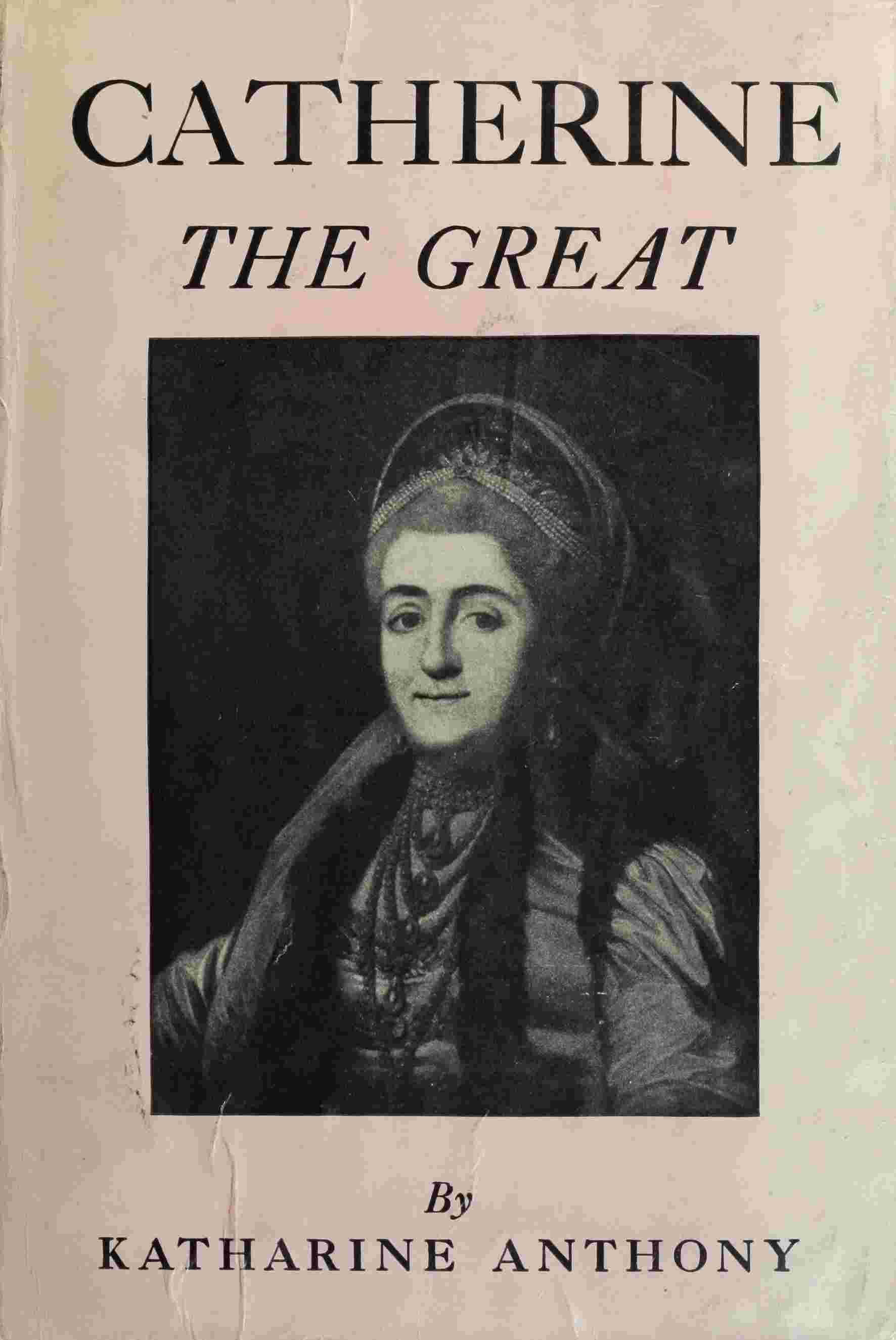
CATHERINE THE GREAT
Early in the eighteenth century, the north German town of Stettin had all the grim and rigid characteristics of a frontier post. It was a border town and had long been a center of warfare. The broad rich lands of Pomerania, bursting with fertility, had been repeatedly devastated by the march and countermarch of Russian and Prussian soldiers. High on a strip of barren coast, the gray stone walls of Stettin overlooked a bleak northern sea over which the boats of the great Russian Peter had come sailing to batter and destroy the town. But if Stettin had trembled before Peter, who was six and a half feet tall, it had trembled even more before Frederick William who was so short that his children called him Stumpy behind his back. Ceded finally to Stumpy by treaty in 1720, Stettin settled down to the dull routine of garrison life.
It was not a place in which the refinements of society flourished. A reviving commercial life brought no relief to the rigid military atmosphere which prevailed. Ships moved out of the harbor laden with guildsmen’s stuff from the interior of Germany. A chamber of commerce came into existence and a new class of prosperous trades-people appeared on the scene. But the hereditary aristocracy of Stettin was not prosperous. Stumpy’s officers were usually hard-up; they were under-paid and over-regimented. Their wives led a dull life in the Prussian garrison where society was neither gay nor gracious. Stettin had no style.
Its military and religious grandees understood each other perfectly. In those days the Prussian warrior was so pious and the Lutheran believer so militant that they faded imperceptibly into each other. Frederick William and Martin Luther worshiped an identical God.
The Lutheran idol was an armored hero whom a Prussian soldier could fear and respect. He dominated the spiritual climate of Stettin without a rival, except for the unimportant claims of a Calvinist deity worshiped by the French governesses and emigrant school-masters of the place. Luther had elected to throw in his lot with the German nobles and they in turn had embraced his religion with the puritanical devotion of recent converts. In military circles bigotry was the fashion.
Such was Stettin in 1727, after seven years of regimentation by the Prussian king. In that year there stood at Number One in the Grosse Domstrasse a substantial gray stone house owned by the president of the Handelskammer. A newly married pair took up their residence there in early winter. They were rather ill-matched as to age, the husband being thirty-seven and the wife fifteen. They were poor but pretentious, the kind of gilded paupers that heralded the decline of feudalism. Prince Christian August of Zerbst-Dornburg was the commander of a regiment of infantry quartered in Stettin. He was one of Frederick William’s generals, who had reached this degree of promotion after many years of campaigning in the Prussian service. The business of soldiering had given him little taste or opportunity for home and the family which he was to found in Stettin was not to see a great deal of him. His wife seemed to manage just as well without him.
The general was a cousin of the reigning Prince of Anhalt-Zerbst who was growing old without an heir. Christian August and his brother Johann Ludwig, of the Dornburg branch, both had an eye on the little principality and its petty emoluments which loomed large to them. The brothers were both pious and unmarried and were on excellent terms with each other. It was clearly the duty of one of them to perpetuate the family. But Johann Ludwig, the elder and the logical successor, lived in Jever with a spinster sister and did not wish to change his state. It therefore fell to Christian August to go forth and seek a wife. The history of his wooing is unfortunately not known to us. Whether he saw it as a duty or an opportunity we cannot say. At any rate, he was successful.
Promoted to the status of a married man and the father of a family, he was regarded by the elder but childless brother Ludwig as co-heir. When the reigning duke finally died the two brothers inherited Zerbst together and ruled the principality as co-regents. They were peace-loving men who lived in harmony with each other, except for occasional strife, stimulated, it is said, by sister Sophie Christine. At any rate the loyal pair did not live long to rule in Zerbst. After three years Johann Ludwig died and five months later Christian August followed him. Two months afterward Sophie Christine was buried beside her brothers. They died as they had lived in the narrow bonds of mediæval clannishness. It was an unaggressive and obscure strain. Not all the efforts of German historical research have availed to discover any brilliance or heroism in the race.
In the meantime, the marriage of Christian August had yielded, after some disappointments, the desired heir. This son lived to become the last reigning Prince of Zerbst and followed in the undistinguished steps of his ancestors. Only because he turned out to be the brother of Catherine of Russia did he become more famous than the rest. Catherine’s memoirs refer with vague sarcasm to the “peculiar exploits” of his career and Schlözer speaks of him as a gentleman of “unstable temperament.” Although married in his youth for a few brief years, he left no heirs behind. With his death in 1793 the house of Anhalt-Zerbst came to an end. The heroic attempt of his father to perpetuate the family had only resulted in prolonging it by one generation. In the personality of this sterile princeling, however, the general commonplaceness of the Zerbst family was touched with eccentricity. This proceeded from his mother without doubt, who was a clever, energetic and hysterical woman.
Johanna Elisabeth of Holstein-Gottorp was not yet sixteen when she married her Prussian general, yet she ruled the family from the first. The portraits of this lady and her spouse which hang in the Potsdam palace reveal, even through the conventional art of Pesne, marked differences of temperament. The general has the dreamy eye that betrays the extreme idealist, while his wife looks out with the peculiar verve and readiness of a real woman of action. “Apparently they got on excellently with each other,” says their daughter in her memoirs, “in spite of the great difference in age and although their inclinations were so different. My father, for instance, was very saving; my mother, on the other hand, was quite extravagant and open-handed. My mother loved pleasure and fashionable society exceedingly; my father valued retirement. She was cheerful and wilful; he serious and austere in his morality.... My mother passed as more clever and intellectual than my father; but he was a man of earnest and sterling character and well-stocked knowledge. He liked to read, as did my mother, but all that she knew was very superficial. Her spirit and beauty had won for her a great reputation; moreover, she understood the ways of the fashionable world better than my father.”
Christian August had married his wife at the court of the Duchess of Brunswick, her godmother, who had brought her up as if she were her own child. Johanna Elisabeth was the daughter of the Bishop of Lübeck who had twelve children. Having lost Schleswig to the Danes and finding himself therefore in reduced circumstances, he willingly gave away one of his children to the kind godmother who offered to bring her up. The court of Brunswick, which thus became the home of the keen little Princess of Holstein-Gottorp, was one of the most showy in Germany. It was far more elegant than the court of the parsimonious King of Prussia. Here Johanna Elisabeth seems to have grown up partly as a much-spoiled favorite and partly as a poor relation. She brought nothing to her marriage but the bridal chest given her by her godmother. The newly married pair started housekeeping in the Domstrasse house under the most frugal circumstances. Garrison life must have seemed sordid to her after the refinements of Brunswick. One hope at least she had. If she produced an heir she might one day become the reigning Princess of Anhalt-Zerbst instead of being merely the wife of a Prussian general in a garrison town.
In the meantime she made the most of being a Holstein-Gottorp, a clan whose members had married royalty and were related to thrones. Johanna Elisabeth’s brother had been affianced to the youngest daughter of Peter the Great and, but for his death by the smallpox, would have become the great Czar’s son-in-law. Johanna Elisabeth’s first cousin, who was a nephew of Charles XII of Sweden, had married another daughter of Peter the Great and had left a son who had claims upon the thrones of both Sweden and Russia.
These alliances with Holstein-Gottorps were supposed to bring to Russia a strip of sea-coast, and sea-coast was Peter’s passion. No doubt he regretted that he had only two daughters to sell for a bit of strand. But he never realized on these schemes and the young ladies themselves fared badly. Elisabeth, who lost her bridegroom through smallpox, remained unmarried all her life, while Anne, who went to live in Kiel, was scandalously neglected by her husband. “I have to tell you,” she wrote her sister, “that the Duke and Mavrushka [her best friend] are quite loose. He stays not a single day at home, rides out with her in the same carriage, or goes visiting or to the theatre.” Poor jealous Anne was obliged to stay at home because she expected a child. Three months after its birth, she gave up her spiritless existence and died of “tuberculosis and homesickness.” Her son, who was called Karl Peter Ulrich, was handed over to nurses and developed into a sickly, unpromising boy.
But no tragedy could dim the luster of the Russian connection in the eyes of the romantic Johanna Elisabeth of Holstein-Gottorp. She felt that her husband should announce their marriage to the Russian court. The Prince of Zerbst therefore wrote: “Imperial Highness: May you, in your world renowned magnanimity, not take it ill that I venture to inform you with the most humble respect that on the eighth of November, after previous betrothal, I married the youngest sister of the Bishop of Lübeck recently deceased in Petersburg, the Princess Johanna Elisabeth of Holstein-Gottorp, in the country seat of Weheln in Brunswick-Wolfenbüttel.” This humble composition bears all the marks of being the Prince’s own.
Soon after her marriage, the Princess made a round of visits accompanied by her husband in order to present the general to his numerous Holstein relatives. “In this week,” says a family letter, “comes the Princess Elisabeth and her man.” The Holsteiners were not especially impressed by the Prince of Zerbst and took him rather casually from the first. As time went on the Princess managed to escape from the dulness of her Stettin home as much and as often as possible by making long visits to Holstein relatives in Hamburg and Brunswick. After the first formalities of introduction were over she left her husband at home. But she was always accompanied by her daughter on these restless flights from the tedium of small town life.
2
The ambitious Lady of Zerbst had encountered several discouragements in the process of producing an heir. Her first child, born May 2, 1729, in the Domstrasse house, was a girl. “It has been told me,” wrote this girl, looking backward after forty years, “that I was not so very joyfully welcomed when I first appeared because a son was expected. My father, however, showed more satisfaction than his environment.” Perhaps his natural reserve and a certain philosophy which he undoubtedly possessed helped him to conceal his disappointment. The Princess’s chagrin can easily be imagined. The child had nearly cost the sixteen-year-old mother her life. We can picture the ordeal of her confinement in the small bedroom one flight above the noisy Domstrasse: the long Lutheran Sunday which happened also to be May-day; the morning and evening chiming of the church bells; the religious atmosphere of a prayerfully expectant household; the crude methods of the midwife; the waiting cradle and the charcoal pan beside which the first-born son was presently to be swaddled. Finally in the gray dawn of Monday morning, at the chill hour of half-past two, a daughter was born instead of the expected son.
As the new-born infant lay in her cradle, the charcoal pan set fire to the floor. The board was almost burned through before anyone noticed it, so preoccupied was everybody with the condition of the mother. The new baby was further overlooked in several ways. Neither her birth nor her baptism was registered in any Stettin church, an extraordinary omission for such a pious family. The only birth record in existence is the letter which Christian August wrote to Cousin Johann August who was waiting with his barren wife at Anhalt-Zerbst to hear the outcome of events at Stettin. The general announced that his consort had been delivered that morning of a Princess-daughter who would be baptized on the next day but one and would receive the name of Sophie Auguste Friedrike. The little girl was always called Fike.
Of Fike’s relation to her parents, she says, “My father, whom I saw less frequently, regarded me as an angel; my mother did not trouble much about me. A year and a half later she bore a son whom she loved idolatrously. I was merely endured and was often harshly and vehemently scolded, and not always with justice. I felt this without being, however, quite clear in my knowledge.”
This son, Wilhelm Christian, at first an object of so much pride, soon became a source of deep concern and even of humiliation. From an unknown cause, which was discovered after his death to have been a dislocated hip, he was from infancy a cripple unable to walk without a crutch. He died at the age of twelve. Johanna Elisabeth’s talent for the enhancement of life’s experiences is shown again in her exaggerated grief at her son’s death. “My mother was inconsolable,” writes Fike, “and the presence of the entire family was necessary to help her bear her grief.” Even Fike’s old grandmother journeyed all the way down from Hamburg to Dornburg to comfort the bereaved Princess. But a second son, Friedrich August, born in 1734, came to take his brother’s place and eventually to become the last Prince of Anhalt-Zerbst. Two more daughters were added to the family but both died in infancy. Of the five children, only two, Fike and Fritz, lived to grow up.
Fike was oldest sister. She played teacher to her brothers, training them in the art of penmanship as she had learned it from Monsieur Laurent and Pastor Wagner. This doubtless meant a saving for the general’s pocket-book, which was always too slender for the requirements of Fike’s mother. When, at the age of fifteen, she held in her hands the first money which she had ever owned and which had been given her by the Russian Empress for card-playing, she wrote to her father at once, “I have heard that your Highness has sent my brother to Homburg; I know that this occasions a rather heavy expense. I beg your Highness to allow my brother to remain there as long as necessary for his recovery, requesting for myself the privilege of paying all his expenses; and beg your Highness to mention a banker to whom I may send whatever is necessary.” Her maternal attitude toward Fritz survived for many years. As an Empress she played with the idea of making him a Kurfürst, but nothing came of it. The best that she could ever do for him, after she had become an influence in the international politics of Europe, was to restore him to his modest inheritance of Anhalt-Zerbst, which through his own and his mother’s folly had been temporarily lost.
3
Born a girl, Fike’s only prospect for a career was to become the wife of some German princeling whose rank was at least equal to that of brother Fritz. Her chances of marriage were often discussed in her presence. They were not brilliant. In the first place, the girl was not beautiful. “I do not know for sure,” she says in her memoirs, “whether as a child I was really ugly, but I remember well this was often said of me, and that I must therefore strive to show inward excellence and intelligence. Up to the age of fourteen or fifteen years, I was firmly convinced of my ugliness and was therefore more concerned with acquiring inward accomplishments and was less mindful of my looks. I have seen a portrait of myself painted when I was ten years old and that is certainly very ugly. If it really resembled me, they told me nothing false.” While this confession tells us little of Fike’s real looks as a young girl, it tells us a great deal about her private hopes of getting a husband.
It was not as if her parents could dower her with influence or riches. There was, for instance, her third cousin in Eutin, the son of the dead Anna Petrovna, a peevish boy for whom no one had a good word. Sophie’s mother dangled the sickly Duke of Holstein before her daughter’s eyes from time to time, only to withdraw him again with the remark, “Not him; he needs a wife who can support his rights and claims by the power and prestige of her family. My daughter will not be suitable for him.” More hopeful was old Bolhagen, a faithful henchman of Fike’s father, who visited the nursery every afternoon and there spun yarns about his travels. One afternoon when Fike was seven, the old man brought with him a newspaper from which he read the report of the marriage of the Princess Augusta of Saxe-Gotha with the Prince of Wales. “Do you know,” said the old soldier to the governess, “this Princess is not really so well educated as ours, and nevertheless, she is now destined to become Queen of England. Who knows what ours may yet become?” “He then began,” says Fike, “to preach to me wisdom and Christian virtues, and stern morality, to the end that I might be worthy to wear a crown, should one ever be allotted to me. This crown never again went out of my head and has since given me much to do.”
This story indicates that the girl began to think of marriage at the age of seven. By the time she was fifteen she had had a long time to occupy herself with hopes and fears. In her memoirs there is no mention of the latter. Perhaps the passage of years erased these unhappy recollections. On the other hand, her memory for episodes in which this Prince or that sued for her hand and was turned away by her high-minded father is very good. Her account of how Prince Heinrich of Prussia almost became a suitor does not quite ring true, although one’s imagination likes to dwell on the possible consequences of such a union. What would the aggressive Sophie of Zerbst have done had she been immured like those other women who were married to the Princes of Prussia, the wives of Prince Heinrich and Great Frederick himself? It is hardly conceivable that she would have succumbed without adding a dramatic chapter to the annals of the Prussian house.
As a portionless Princess, she had probably considered before she was fifteen the alternative to marriage. The alternative was vivid enough. Both sides of her family bristled with old maids. Two hundred years of Lutheranism had failed to abolish celibacy among the daughters of the German nobility. For, while Luther preached against celibacy, he also preached in favor of monogamy. The combination, however, was better adapted to the stable bourgeois class which was just beginning to dominate society than to the restless aristocracy which had flourished in the middle ages. The feudal families who went over to the Reformation and the Lutheran idea of marriage were still obliged to dedicate as many surplus daughters as ever to the abbeys and priories. The reason is that for these princesses and other high-born ladies there was not enough monogamy to go round.
Little Princess Fike had several aunts who lived in abbeys. There was great-aunt Marie Elisabeth who was Abbess of Quedlinburg; and Aunt Hedwig Sophie who was Provost in the same abbey. There was also Aunt Sophie Christine who was Canoness of Gandersheim. Fike often went with her mother to visit the aunts at Quedlinburg. “These two Holstein princesses,” she says, “who remained unmarried and had to live in one and the same house, quarreled incessantly and often refused to see each other for years at a time. My mother often tried to mediate between them and sometimes she was successful.”
Fike’s memories of her aunts remained ever vivid. Her portraits of them, penned after thirty years of life in Russia, have a clearness of detail like a Dürer drawing. “The Princess-Provost Hedwig Sophie Augusta was a great friend of dogs and especially loved the so-called pugs. As a child, I have been amazed to see at one time in her chamber, which measured in size at most four cords of wood, as many as sixteen pugs. Many of the curs had young which also lived in the same room with my aunt. They slept and ate there and attended to their necessities. A maid was employed to keep them clean and this took her the whole day. A large number of parrots besides lived in the same room; one can imagine the fragrance which reigned there! When the Princess drove out, she had always in her carriage at least one parrot and a half a dozen dogs; the latter even accompanied her to church. I have never seen anyone who loved animals as much as she; she was wholly occupied with them the livelong day and only bestirred herself for their sakes. She had consequently grown quite stout, which with her short stature, made her very ugly and even deformed. The Princess might have had her talents had she taken any trouble. She wrote German and French in the most beautiful hand that I have ever seen written by a woman.”
This dumpy old lady was an elder sister of Fike’s mother, who was by contrast in her daughter’s eyes the perfect pattern of beauty, grace, and fashion. Fike herself, who was not beautiful and had only her fine handwriting and good conduct to recommend her, might easily end her days at Quedlinburg in a room no bigger than four cords of wood, with a family of dogs. To be sure Aunt Hedwig might have had a bigger room and a much better thing of it altogether if she were appointed, as Fike’s great-aunt had been, Abbess of Quedlinburg. Fike’s mother tried to bring this about by using her influence, which she over-estimated, with the Prussian King. But Frederick had a sister of his own who needed this refuge and who eventually got it. Even to become a prioress, there was competition. Everywhere there was competition in life. This was one of the earliest lessons that Fike absorbed from her worldly-wise mother.
Another aunt, an elder sister of her father’s, is also portrayed in her memoirs. Tante Sophie Christine, Canoness of Gandersheim, is the same spinster lady who is said to have fomented quarrels between her brothers, the Princes of Zerbst. “She was more than fifty,” writes her niece, “very tall and so thin that I had at eleven years old a bigger waist than she; she was, however, very proud of her figure. At six o’clock when she arose she carefully laced herself in and only took off her stays when she went to bed. She used to maintain that she had once been beautiful but that an accident had damaged her beauty. When she was ten years old her powder-mantle had caught fire and thereby the lower part of her face had been seriously hurt; the chin and the lower part of the cheeks were shriveled up and the parchment skin really looked ghastly. She was kind and good but when she wanted anything, very hard-headed too. Upon the various German Princes who had passed under her inspection, she had made serious demands, and but for lack of willingness on their part she might have been well married.
“She made wonderful embroidery and loved birds very much. Her kind heart mostly went out to those who had suffered a misfortune. I have seen in her chamber a thrush that had only one foot, a lark with a broken wing, a one-eyed goldfinch, a hen whose head was half-way pecked off by the cock, a cock whose tail-feathers had been torn out by the cat, a lame and lop-sided nightingale, a parrot that could not use its feet and lay flat on its belly, and many other birds of different kinds that ran and flew about her room. I was a very lively and right wilful child, and I remember how once I offended this Princess by doing something for which she never forgave me. I was left alone in her room for a few moments and the idea of opening the window occurred to me. Naturally half of the menagerie flew out! I shut the window and ran away. When my aunt returned she found only her little cripples left. She could guess how this had happened and her room was in the future closed to me.”
Fike’s gallery of portraits includes another spinster, Fräulein Khayn, who always accompanied her mother and herself on their travels. In the depths of the bitter-cold winter of 1740, the restless Johanna and her daughter, together with the companion, went to visit the old Duchess of Brunswick. “I slept in the same room with Fräulein Khayn, a companion of my mother’s,” says Fike. “My bed stood against the wall and hers not far from mine, with only a small passage between. Another passage remained open between the windows and the bed of Fräulein Khayn. On a table between the windows stood a water-pitcher, a silver basin, and a night-light. The only door of the room was at the foot of the bed and was closed. Toward midnight, I was suddenly awakened by someone who lay down beside me in bed; I opened my eyes and saw that it was Fräulein Khayn. I asked her why she wanted to come into my bed. She answered, ‘For God’s sake leave me and go to sleep quietly.’ I wanted to know what had caused her to leave her bed and come to mine, for I saw that she was trembling from fright and was almost speechless. When I pressed her she said, ‘Don’t you see what is going on in the room and what is there on the table?’ and drew the cover over her face. I got on my knees and reached over her to draw away the curtain and see what was going on. But I heard and saw absolutely nothing. The door was closed; candles, basin, and silver pitcher were on the table. I told her what I saw and she became somewhat quieter. A few minutes later she arose to shove the bolt on the door but it was already locked. I went to sleep again but the next morning she looked wretched and quite distracted. I wanted now to know why and what she thought she had seen in the night; but she answered that she could not say. I knew that she believed in ghosts and visions and that she often claimed to have seen apparitions. She often said that she was a Sunday child and that those who were born on other days did not have the clear sight that she had. I related the occurrence to my mother who was already accustomed to Fräulein Khayn’s experiences. Often she had frightened and disturbed my mother. I have often wondered why this adventure did not make me fearful.”
Fike must have been deeply interested in the eccentricities of all these spinster ladies since she remembered and described them so vividly so many years afterwards. Her mother, the Princess Johanna Elisabeth, towered above other women and also above her honest and pious consort, undoubtedly a superior being. The Princess had a way of absorbing the whole environment within herself and becoming its embodiment. Fike writes, for instance, “My mother had that year an extraordinary adventure on the return journey to Stettin.” As the story develops, one learns that Fike herself, the ever-present Khayn, another attendant, and several postilions, shared along with Fike’s mother the adventure of being lost in a terrible snowstorm. On another occasion, when Frederick the Great ascended the throne, Fike says, “When my father had received in the name of the King of Prussia the allegiance of Pomerania, my mother journeyed to Berlin.” There several events took place at court in the account of which the General is not mentioned. Presumably as the Governor of Stettin, he accompanied the party and had his day at court as well. In the eyes of his little daughter, moving in her accustomed place in mother’s entourage, the General appears to have played a minor part even when he was officially the center of the picture.
Princess Johanna Elisabeth was a clever woman but also a bit of a fool; that is to say, she was romantic and proud. As the wife of the Governor of Stettin, she tried to introduce in her dull town some semblance of court etiquette. For instance, she required Fike to kiss the hem of the garments of distinguished ladies who visited the house. When the old King of Prussia died, she strove to induce the ladies of Stettin to wear mourning as the court at Berlin was doing. But so cordially was the old King hated that not a lady would wear black for him. The Princess and her daughter and the faithful Khayn went bravely forth for a couple of Sundays in solemn weeds, but all the other Stettin dames united against them and the Princess was at last obliged to give up the fight.
While little Fike lived in a chronic state of filial bedazzlement, she had occasional glimpses of fact that left their mark. When her mother visited the court at Berlin, she was questioned there about the mourning episode at Stettin. “She denied the fact,” says Fike. “I was present and wondered greatly at this. It was the first time I had ever heard anyone deny a fact. I thought to myself, is it possible that my mother has forgotten something which happened so recently? I was near to reminding her; but I restrained myself, and that was surely my good fortune.”
The Princess was not always truthful. Deliberate falsehoods of the kind that her daughter noted at Berlin were probably not usual. But she was a fluent weaver of inward and outward deceptions and she usually wore her rose-colored glasses when she sat down to her correspondence. In this respect Fike was quite different from her mother. Although she could lie brazenly, for reasons, she had a clear sense of reality and her letters and memoirs are remarkable for the small amount of romancing they contain.
Perhaps she had from her father, the Prince of Anhalt, a saving sense of moderation. He occupies so little space in his daughter’s memoirs that no clear picture of his character is possible. But certain traits come through in his correspondence. In spite of his stiff pedantic style he reports the facts more reliably than does his wife in her more eloquent epistles. His ambition was tempered with philosophy. At one time in his life, after his daughter had gone to Russia, he tried unsuccessfully to become the Duke of Courland. “I am, thank God,” he wrote, “well satisfied with what I possess, yet I should like to hear no reproaches later that we had slept away our luck at such a favorable moment.”
This is the only time in his history that he shows himself in a covetous light. Perhaps his motive in grasping at Courland was to be nearer to his daughter in Russia. He seemed to realize, as his wife did not, that German Princesses who married into the Czar’s family had a way of being neglected and mislaid in that vast uncharted country.