
VIII
ORLOV
In the six weeks which intervened between the death and burial of Elisabeth Petrovna, the new Czar had offended public opinion in numberless ways. While the Grand Duchess was diligently observing all the rituals ordained by the Greek Church for the dead Empress, Peter III was conducting himself like a boy just let out from school. His sharp strident tones could be heard down the corridors, conveying the joyous excitement he was unable to control. He could not kneel endlessly beside the coffin, as Catherine did, nor even stand, but paced restlessly about the church talking and grimacing. On the day of the funeral his grotesque behaviour shocked the people in the street. He was in a good humor, says Catherine, and allowed himself his little joke.
As the long procession passed through the Nevsky Prospect, across the bridge, and into the island fortress of Saint Peter and Saint Paul, Peter walked immediately behind the coffin. He wore a mourning robe of state with a long train, the end of which was borne by Count Sheremetiev. The Czar’s little joke was to stop in his tracks from time to time and then hasten forward with long strides to overtake the coffin. The unhappy Count was unable to manage the train of his master, which flapped wildly in the wind to the great delight of the Czar who repeated the jest again and again. The procession was finally so jammed by this trick that a messenger was sent forward to stop the leaders until they could catch up. The new Czar who amused himself so well at the funeral of his late aunt, was nearly thirty-five years old. The public was scandalized and his courtiers blushed for him before the gossips of Europe. Still they continued to kiss the hand of his Imperial Highness and to observe all the forms of supreme respect. Like crows they circled in awe around this feeble image of dignity and awe.
The reign of Peter III lasted altogether six months. His ukases were a hodge-podge of foolish and reasonable commands. One day he gave an order that the gentlemen of the court might hunt ravens and other birds in the streets of Petersburg; also that they might shoot on sight all dogs found in the vicinity of the palace. Another day he freed the nobles from compulsory military service. Although the princes and counts were delighted with this law, they still mistrusted their capricious emancipator and feared his next measure. Petersburg was filled with rumors of what it might be. It was reported that Peter III meant to divorce Catherine and to marry Elisabeth Vorontsov, and that, to cement this innovation, all the other ladies of the court would be required to divorce their husbands and take new ones. So jumpy was the public and so whimsical was their Czar that this nonsense was easily believed.
Wherever Peter III appeared in public his reputation for capriciousness grew. When he went to see the guard changed, which he often did, he would beat the soldiers and even the spectators. Countess Dashkov tells a story of how his negro servant Narcissus was redeemed by a ceremony after having had a fight with the scavenger of the regiment. It was at a military parade. An officer suggested jokingly, “Let Narcissus pass three times under the banners of the regiment.” Peter, intensely serious, was delighted with the idea; he insisted that the points of the banners should draw blood from the negro’s head, which caused Narcissus to set up a loud yell to the immense amusement of the officers and the solemn satisfaction of the Emperor. His beloved Narcissus had been cleansed by a ritual. Numerous stories of his behaviour survive as sufficient evidence that his mind had wholly lost its unity and integrity. Bilbassov says of his condition, “a man of sound sense and clear memory can not understand the conceited blindness in which the Duke of Holstein, who had become Emperor of Russia, lived. The frequent drunkenness of Peter III does not explain it.... It must be traced back to the unfortunate coincidence between the personal qualities of Peter III and the unlimited power which became his by inheritance.... He had lost the power to think straight.”
The pathos of his condition was that it inspired in his environment so much hatred and so little sympathy. As a rule, only the women, to whom he turned with childish appeal, took pity on him. Even Catherine, his wife, who has gone down in history as his greatest enemy, wrote tolerantly of him in her memoirs, “He did not have a bad heart; but a weak man usually has not.” And Elisabeth Vorontsov, his mistress, was loyal to him all through the final crash of his fortunes with which his brief reign came to an end. Her behavior in that crisis shows that her attitude toward Peter all along had had something in it besides the mere ambition which was supposed to have guided her. But Peter had no friend among the men. He was afraid of men and therefore he challenged and insulted them on every occasion. From the period of his early fights with his tutors, it could be foreseen that Peter’s greatest safety in the future would consist in keeping as far as possible away from his own sex. It would be an ominous day for him if he were ever cut off wholly from the mercy of women and cast entirely on the protection of men.
2
The political acts of Peter III were of a kind which no Czar of Russia could have perpetrated and survived. He prattled about his devotion and allegiance to the King of Prussia with an openness which embarrassed even the Prussian representative. One of his first steps as Czar was to make peace with Prussia. Not satisfied with a mere cessation of hostilities, he signed a treaty of eternal peace with Prussia in April, 1762. It was celebrated with great pomp and ceremony, during which the Czar brought forth his famous toast to the “3 times 3.” On being questioned he said that the trio whom he had in mind consisted of himself, Peter III, George III of England, and Frederick III of Prussia. When it was pointed out to him that Frederick was only the II’d, it did not disturb him in the least nor interfere with the elaborate design of fireworks which he ordered to burn upon the sky above the Neva this historic alliance: “3 × 3.” It was a union over which Elisabeth Petrovna, now sleeping in the Fortress of Saint Peter and Saint Paul, and Sir Charles Hanbury Williams, now sleeping in Westminster Abbey, had once waged a long and bitter controversy. Peter had suddenly brought it to pass, like a mischievous child. But it was too much like a harlequinade. What Europe wanted to know was, how long would it last? Peter was playing with big destinies.
His domestic policies were as ill-inspired as his foreign policies. The whole of Russian politics revolved around the two pillars: the army and the church. During his seventeen years as Grand Duke in Russia Peter had never made friends with either. Soon after his accession he issued an order confiscating the possessions of the church and allowing the priests an income from the state. This of course was never executed as the six months of his reign were not long enough to accomplish such a revolution. It sufficed however to solidify the antagonism of the people toward a Lutheran Czar who had no respect for icons and priestly robes and who read the German Bible. They believed he wished to change their creed.
Peter’s tactlessness with the army was no less damaging than with the church. He made his uncle, Prince George of Holstein, generalissimo of the Russian army. This was a double error, in that he placed a foreigner in command and resigned to him a place which as Czar he should have filled himself. He took away the long, loose Russian coats of the soldiers and put them into tight German uniforms. His next step was to mobilize the army for a campaign against Denmark. He was Czar of all the Russias yet a few square miles of Holstein territory in the possession of Denmark occupied all his attention and filled all his military dreams. “He had a passionate love,” says Catherine, “for the little corner of the earth where he was born. He was constantly preoccupied with it. He had left the land of his birth at the age of twelve or thirteen years; his phantasy grew heated whenever he spoke of it, and because no one in his environment, beginning with myself, had ever been in this wonderful land according to his accounts, he told us daily stories about it which put us to sleep but which we were supposed to believe. He grew angry when he saw that we did not believe him.” This had been his attitude as Grand Duke; as Czar of Russia he behaved as if he had just come into his own as the ruler of Holstein and seemed to forget entirely his vast Russian domain.
His indifference to being crowned was a part of his satisfaction with the rôle of mere Duke. It was immemorial custom to crown the Czars of Russia in Moscow, in the Kremlin, with all the colorful pageantry of the Church and Army arrayed against that rich Byzantine background. Peter neglected to make any preparations for this ceremony. His model in all things, Frederick the Great, had never been crowned; nor had Frederick’s father before him. As a matter of fact, both of these Prussians, father and son, were too penurious to spend money on coronation spectacles. But the Czar did not question their reasons; the precedent was sufficient. When Frederick heard that Peter was dilatory about his coronation ceremony, he was alarmed and wrote to the young Czar urging him to proceed at once to Moscow and crown himself there. He reminded Peter III that Ivanushka was still living in the Schlüsselburg fortress and that he represented a possible rival to the throne. The Czar was impervious to this good advice. He replied that the crowns were not ready. The months passed and the campaign against Denmark was his only interest. But even this he postponed from time to time. Almost ready to march, he nevertheless decided to delay a few weeks in order to celebrate his name-day, June 29, with the usual garden party gayeties at Peterhof.
3
During the six months of Peter III’s reign, Catherine lived in strict retirement. When obliged to appear in public, she wore heavy black draperies edged with costly ermine which served a double purpose: they showed her respect for the late Empress whom she genuinely mourned and they concealed her pregnancy. In April the new Winter Palace of stone overlooking the Neva, which had been built by Elisabeth, was completed. The Imperial family moved out of the old wooden palace on the Nevsky Prospect, of whose drafts and other discomforts the Grand Duchess had often and bitterly complained. Here Catherine was assigned rooms at the opposite end of the palace from the Czar, where on April 11th she bore a son. He was called Alexei Gregorevich Bobrinsky. His last name was taken from the beaver skin in which the new-born babe was wrapped. Bobrinsky went through life as Alexei, son of Gregory. With this child, Catherine abandoned finally the pretense that he was the son of Peter. Her eldest son, Paul Petrovich, remained as the sole representative of this fiction.
Catherine concealed the birth of her second son and brought him up in a school for cadets. Her position was too insecure to allow her to keep Orlov’s child with her. As with the other two, she was again deprived of any maternal satisfaction in the care of him. Ten days after her confinement, on her thirty-third birthday, she appeared in public to receive the customary congratulations. She carried off the occasion as if nothing had happened. Little Bobrinsky’s birth had not caused a ripple on the surface of things. Presumably the Czar did not even know of his existence. Catherine subsequently bore two daughters to Orlov who were spirited away even more completely than little “beaver-skin” had been. They were brought up under fictitious names at court and properly married in the course of time. The legends do not tell us whether their lives developed happily or otherwise.
Four months after his accession, Peter III called his wife a “fool” in public; it was at the great dinner of state given to celebrate the peace with Prussia. To Peter’s foggy mind this doubtless seemed only a casual insult, as was the case when he made Count Buturlin into a life-long enemy by calling him a “son of a bitch” at a dinner party. The Czar sat at the head of the table and proposed a toast to the Imperial family. As the pokals clattered down upon the board, Peter observed Catherine sitting in her place. He sent the adjutant who stood behind his chair to inquire why she had not risen and the adjutant returned with the reply that she herself belonged to the Imperial family. The silly inconsequential Czar leaned forward in his place and shouted down the table, in the presence of the assembled Russian nobles and foreign diplomats, “dura” which means “fool.” It is the epithet which one izvostchik bawls out to another in a street argument. The Empress’s eyes filled with tears and she turned to Count Stroganov who stood behind her chair and begged him to say something amusing to keep her from crying. It was for Catherine the last straw. Two months from that date the reign of Peter III came to an end and the reign of Catherine II began.
The conspiracy which the Grand Duchess had made during her intimacy with Poniatovsky and Williams had been more elaborate than the one in which she now engaged. In those days, three years before the Empress died, Catherine had had plenty of money—English money—at her command. She says herself that on the day of Elisabeth Petrovna’s death she was literally bankrupt; she had not sufficient credit to order herself a new dress for Christmas. “On this day,” she adds, naïvely regretting that she had not ordered it, “the Empress died, something which I had not been able to foresee.” Ten years afterward she still regretted the dress she had foregone.
In the year 1762, as Czarina, she found herself in the possession of an income. This time it was Russian money not English money at her disposal, and she had acquired other Russian resources as well. Formerly, Catherine’s confederates had been foreigners; this time there was no suspicion of foreign influence in her friendships. The five brothers Orlov were the center and the focus of her plans and there were enough of them to do most of the underground work needed in the barracks. Alexei, the eldest, was a tough-minded person who had some of Catherine’s own strength. Gregory, the second brother and her lover, famous for his good looks, was softer and more sensitive. There still remained Ivan, Feodor, and Vladimir, who moved under Alexei’s orders. It was a typical Russian brotherhood with Alexei as leader. The Orlovs all lived in the barracks where they quietly suborned the guards with gossip and money. Count Kyril Razumovsky, Lieutenant-Colonel of the Ismailov Regiment, had long been subservient to Catherine’s charm. He gave her no trouble and his military position was useful to her. One woman, the Countess Catherine Dashkov, who played a showy though rather a dummy rôle in the preparations and their execution, must be included among the inner circle of conspirators. They were all Russians of ancient Russian lineage, except Catherine herself, who liked to forget that she had German blood in her veins.
The Countess Dashkov occupies a prominent place in the history of Catherine’s revolution. Her memoirs were published as early as 1840 and were the first authoritative account to be circulated in Europe. In the stories which multiplied around her name during the nineteenth century she figures as an Amazon and a leader only second to Catherine the Great. She was actually not very important. Her age precluded that, for she was only nineteen when Catherine deposed Peter and ascended the throne. The Countess had a strategic value due to the fact that she was the sister of Elisabeth Vorontsov, Peter’s mistress. Her allegiance to Catherine’s party divided the Vorontsov family as Catherine wished to divide it. She was a possible source of information concerning the other camp but she was also a possible channel for leakage in the opposite direction. For this reason, Catherine tells us, she was not fully initiated in the secret plans of the Empress and the wholly devoted Orlovs. The Empress had a rendezvous with her Dashkov at which we may assume the nineteen-year-old Countess told all she knew without being told much in return. Catherine once wrote to her, to reassure her anxiety about a rendezvous, “As for your reputation, it is better established than that of the whole calendar of saints.” The scorn is a bit transparent. Peter III, with all his stupidity, put the case clearly enough when he said to Countess Dashkov, “My child, you would do well to recollect that it is much safer to deal with honest blockheads like your sister and myself than with great wits, who squeeze the juice out of the orange and then throw away the rind.” Catherine was not quite so egoistic as Peter made her out. She did not throw away the rind; she preserved it carefully. The Countess Dashkov enjoyed the patronage and protection of the great Empress all her life.
Another confederate of the Empress in her conspiracy was Nikita Ivanovich Panin, the governor of her son. Panin had lived fourteen years in Stockholm as Russian Ambassador. There he had imbibed the concepts of liberalism and had formed a vague picture of Russia as a constitutional monarchy. Panin’s critics say that he did not sufficiently realize the political differences between a compact little country like Sweden, with its one blood and one faith, and the vast empire of Russia with its conglomerate races and cultures and religions. To his delight, Panin found, on his return to Russia when he was recalled to educate the infant Paul, that the Grand Duchess Catherine had also imbibed the new ideas from her diligent reading of French authors. Panin took hope for the future of his country when a liberal Empress would be in a position of power. This powerful position he pictured in a special way. Like other observers about the court, he perceived the tragic impossibilities of Peter as Czar and imagined that in some way he would have to be supplanted. Panin’s solution of the future, however, was to elevate Paul as actual emperor and Paul’s mother as Regent. He wished to establish a régime like that which Elisabeth Petrovna had overturned, that of Ivanushka and his surly mother, Anna Leopoldovna. Panin prepared elaborate schemes to this end, some of which he put on paper. The Grand Duchess, prior to 1762, read his plans with interest. After 1762, she declared that she had never really agreed to them.
4
On the night of the 27th of June, 1762, the Imperial family was more than usually divided, although the morrow was to usher in the celebration of the Emperor’s name-day. Peter Feodorovich slept at Oranienbaum; Catherine Alexeievna slept at Peterhof; and the little Grand Duke slept in the Summer Palace at Petersburg in the care of Nikita Panin. It was planned that the Czar and his retinue would drive over the next morning from Oranienbaum to Peterhof where the usual name-day celebration would take place. Catherine, unattended except by a maid, waited at Peterhof for her husband and his gay party to come over from Oranienbaum and enliven the place.
She slept that night in the little red brick pavilion known as Monplaisir. Her bedroom opened upon a terrace lapped by the waves of the blue Finnish Gulf. It was a doll’s house built by Peter the Great, whose head almost touched the ceilings, crowded as close down to the sea as he could crowd it. The Empress Elisabeth loved Monplaisir for her father’s sake and because she had a kitchen there where she herself could cook. The big Czar and his tall daughter have left their memories about this pavilion at Peterhof. But Catherine the Great, who spent the most dramatic hours of her life there—hours which were to make her the Empress of Russia—never liked the place. As an old woman she used to say that she hated the noise its fountains made and that her dog hated the gurgle of those fountains too. She would never spend any money in developing and beautifying the premises after they came into her possession.
On this particular night in June, 1762, the fountains were still, awaiting the coming of the Czar on the morrow when they would play. In the pale light, the gilded statues shone on the terraces leading down to the sea. At six o’clock in the morning a man came stealing through the park, skirted the main palace, and made his way down to the pavilion at the water’s edge. He wore the uniform of a Captain in the Preobrazhensky Regiment and he seemed to know where he was going. A French window opened into the Empress’s bedroom. He stepped inside. Catherine was sleeping in a broad silken bed alone. “Matushka, little Mother, wake up,” he said. “The time has come.” The man was Captain Alexei Orlov, the brother of Gregory Orlov, Catherine’s lover.
The night before had been a restless one in the city of Petersburg. The army had been mobilized for the campaign against Denmark and the General, Prince George of Holstein, was ready to march as soon as the celebration at Peterhof should release the Emperor to accompany them. The war was unpopular and the soldiers grumbled. They did not like their German commander and they did not like their uniforms. Nevertheless they stood ready to go; it was the Czar’s orders. Late in the evening the news went round that Captain Passeck had been arrested: again the Czar’s orders. The report was passed indifferently enough from person to person until it reached Alexei Orlov. Immediately the five Orlov brothers were all in action. Captain Passeck was the boon companion of Alexei and was one of the forty officers who had been sworn into the conspiracy. Arrest was likely to be followed by torture and Captain Passeck’s secrets were not secrets which could be told to the inquisitors of Peter III. So Alexei evidently thought, for he hired an ordinary carriage from the street, took with him Lieutenant Bibikov, and drove out to Peterhof. It was midnight when they left the city, and it was six o’clock when Captain Orlov entered Catherine’s bedroom and awakened her.
Her festival dress was laid out ready for the day; but she did not put it on. She donned instead the black mourning gown which she had taken off the night before. Together with Orlov and her maid she passed out through the park on foot, for the carriage had been left standing in the road outside the grounds. They were half an hour in reaching it. Catherine and her maid seated themselves in the carriage, Bibikov stood up in the back and Orlov sat on the box with the driver. The hack horses turned their faces towards Petersburg. They had travelled their twenty-nine versts that night, and had now to trace the same distance back again. Nevertheless, urged on by Alexei Orlov, they covered the distance in less than an hour and a half. The white dust from the roadway rose in clouds and settled on the black garments of the Empress, for the carriage was an open calèche. About half-way to the city they met Catherine’s hairdresser on his way to Peterhof to prepare her for the gala day. The Empress sent him back telling him she would not need him. About five versts from the city, they met Gregory Orlov and Prince Bariatinsky. The Empress changed to Gregory’s carriage because his horses were fresher. Escorted by her lover and Bariatinsky she drove up to the Ismailov Regiment. It was the regiment of Count Kyril Razumovsky, who had long been in love with her as a Grand Duchess and had assisted all her projects in Russia.
An old priest was found to administer the oath of allegiance, while the whole regiment headed by Razumovsky hastened to swear fealty to Catherine II of Russia. The Empress got into her hired carriage again and, preceded by the priest and followed by the regiment, went on to the Preobrazhensky Regiment. Here the oath of allegiance was again hastily administered and the augmented procession moved forward to the Nevsky Prospect. The third regiment, the Semionovsky, suffered a moment of indecision, but they too were in line by the time the procession reached the Kazan Cathedral. It was now nine o’clock. Catherine entered the Cathedral and was met by the priests who blessed her with the cross. The nobles crowded around the new Empress, competing with the military to kiss her hand. From the Cathedral the procession went on up the Nevsky Prospect and turned into the Morskaya, proceeding to the new Winter Palace.
At ten o’clock, just after the Empress entered the palace, another hired carriage was seen dashing up to the entrance. A fat man and a little boy in his night clothes were sitting inside. It was Panin and the Grand Duke Paul, and this was their first appearance on that stirring June morning. They had slept late. Count Panin had always been dilatory, unready. It is said of him that the Empress Elisabeth had once cast her eye upon him as a likely favorite. She summoned him one day to wait for her outside the bath; but when she emerged she found him crumpled on his chair fast asleep. So she decided to employ him in the diplomatic service. On the morning of Catherine’s accession, after fourteen years of international diplomacy, Count Panin had not changed. When he entered the Winter Palace with his charge, the Empress came to meet them and carried the boy out on the balcony to present him as her heir. This was the end of Panin’s scheme to make Paul emperor, Paul’s mother the Regent, and himself Grand Chancellor. He remained always rather resentful about it and did not fail to hamper the ambitions of the Orlovs whenever he had a chance. Catherine said of him, “Count Panin was naturally indolent, and he had the art of making his indolence pass for calculating prudence.”
The doors of the Winter Palace were thrown wide open and anybody from the street could enter and kiss the hand of the new Empress. The palace was a gorgeous new building, only just completed, yet all the common soldiers were free to tramp through it and take the oath of allegiance to their Little Mother. It was a master stroke. “The least soldier of the guards,” Catherine wrote to Poniatovsky, “on seeing me said to himself: that is the work of my hands.” Other master strokes of the Empress were the fluent manifestoes which she composed from time to time during the following days, to be set up and printed in the cellar beneath the Academy of Science and distributed to a people who could not read them. In 1762, few of the nobles could read. Fortunately the manifestoes were carefully preserved in the archives for the enjoyment of a more literate age.
The first one drafted by her facile hand read thus: “We by the Grace of God, Catherine II, Empress and Autocrat of all the Russias, etc., etc., All true sons of the Russian Fatherland have clearly seen the danger which threatened the Russian Empire. Namely, the law of our Orthodox Greek Church has been shaken by the disregard of ecclesiastical traditions, so that our ancient Orthodox Church in Russia was exposed to the extreme danger of being obliged to adopt another confession. Secondly, our glorious Russia, which has been lifted to a high degree by its conquering weapons, has been placed in complete subjection to its bitterest enemy by the new peace for which so much blood has been spilt, while the inner organization of the country, on which the whole Fatherland depends, lies in ruins. Therefore and because we are convinced of the danger to our faithful subjects, we have seen Ourselves obliged with the help of God and his Justice, but especially in response to the distinct and undissimulated wish of Our faithful subjects, to ascend the throne as Autocrat of all the Russias, whereupon all Our faithful subjects have taken the solemn oath of allegiance to Us.
Catherine.”
During the day the Empress and her counsellors decided that a military campaign to Peterhof was necessary. The object was to secure the person of Peter III and obtain his abnegation of the throne. As Brückner well points out, the so-called army which Catherine II led to Peterhof was partly a spectacular, romantic parade and partly an exhibition of political genius.
At ten o’clock in the clear light of the evening of June 28, 1762, the Colonel of the Guard—Catherine herself—took her place at the head of her troops. She was mounted on a white horse and wore oak leaves in her hair. Her uniform was borrowed from a lieutenant in the Life Guards. It was doubtless chosen because the lieutenant and the Empress happened to be of a size, but it scarcely clothed her new position and title. For Catherine had not hesitated to assume the title Colonel of the Guards, the traditional place of the Czars of Russia which Peter had resigned to his Uncle George of Holstein. Beside her at the head of the troops, likewise clad in military uniform, rode the Countess Catherine Dashkov. During the night she remained beside the Empress, while her sister, Elisabeth Vorontsov, stuck close to the Emperor. There was deep jealousy between the sisters.
Catherine II left the following note, written in her own strong free flowing hand: “Gentlemen and Senators! I go now with the Army to secure and safeguard the throne, and leave in your care as my highest representatives with the fullest confidence the Fatherland, the People, and my Son.
Catherine.”
The Senate solemnly responded in a note which overtook the Empress at two o’clock in the morning, resting on her way to Peterhof: “His Highness, the Czarevich, is as well as could be desired. In the house of Your Imperial Majesty, as well as in the city, all goes well and the measures you have commanded are being carried out.”
Catherine bestrode her horse and rode onward to Peterhof. She had lived for this triumphant moment: little Fike riding her pillow in the dark bedroom at Stettin; Grand Duchess Catherine cantering about the courtyard in Petersburg while an admiring riding-master kissed her boot,—these earlier exhibitions had prepared the way for this spectacular ride at the head of her spectacular army. But it was her last showy ride. In the future, she would be too busy and perhaps a shade too serious.
5
Eight hours after Catherine and Alexei Orlov had left Peterhof, Peter and a gay party drove through the park and halted in front of Monplaisir. The ladies and gentlemen sprang from the low chair-à-bancs and strolled about the terrace. No one came to welcome them. The red pavilion was empty and silent. Peter went through the rooms searching for Catherine in vain. It is said that he even looked under the bed. Mystified and vaguely alarmed the party wandered down to the pier where three small vessels were moored.
Here they received the first news of events in Petersburg. A man bringing the inevitable fire-works for the Czar’s name-day landed from a small boat at three o’clock. He told how the Preobrazhensky Regiment had hailed Catherine as Empress at nine o’clock that morning and how he had nevertheless just gone about his business of the day, which was to bring the fire-works to Peterhof. This seemed definite enough. Catherine had mutinied.
Peter was accompanied by Count Münnich, Prince Trubetsky, Chancellor Vorontsov, Count Shuvalov, several other nobles and officers, and about seventeen ladies. His old tutor, Stehlin, tells the story of this day. Throughout the sunny afternoon the party remained on the lower terrace. The ladies and gentlemen withdrew a little to the garden, where they lay stretched out under the open sky through most of the fine summer day and a part of the fine summer night. Peter and his advisers lingered near the canal and wrote one ukase after the other which the Czar signed against the stone balustrade and sent to Petersburg. He paced up and down the walk beside the canal and took everybody’s advice in turn. Finally Chancellor Vorontsov volunteered to go to Petersburg and bring the Empress to her senses. Then Shuvalov and Trubetsky departed on similar errands. But like the other less important messengers whom the Czar had already dispatched to the city, these gentlemen also did not return.
Peter’s fears increased. The Holstein Guards who had been sent over from Oranienbaum to defend Peterhof against attack reported that there was no ammunition in the place. Gradually, as the hours passed, a plan matured by which the whole party would go to Kronstadt in the three vessels which lay at anchor at the foot of the canal. A messenger was sent to the island and returned with the report that the way was clear. It was an error, as Peter learned when he tried to bring his yacht into the Kronstadt harbor at four o’clock in the morning. None of the three vessels was allowed to approach the island and the watchman called back brutally across the water, “There is no Peter III. There is only Catherine II.”
The Czar’s yacht fell away and took the course toward Oranienbaum. The Czar himself lay on the deck in a dead faint.
Early the next morning, forerunners from Catherine’s advancing army began to gallop up to Peterhof. First and foremost on the scene, at each stage of the developments, was Alexei Orlov. Quiet, undistinguished, inexorable, he was the Empress’s own man. The Colonel herself arrived at Peterhof at eleven o’clock. She sent messengers forward to Oranienbaum, demanding Peter’s abnegation, which the trembling Czar was by this time in no mood to refuse. General Ismailov brought back to the Empress the official document in which the Czar renounced all claims upon the throne.
It was General Ismailov who lured the ex-Emperor into a carriage with the promise that he would be sent to Holstein with Elisabeth Vorontsov. As soon as they had passed the gates of Oranienbaum, the Czar was separated from his favorite and brought as a prisoner to Peterhof. “To prevent him from being torn to pieces by the soldiers,” says Catherine, “he was put in the charge of a reliable guard under the command of Alexei Orlov.” From this time on Peter was at the mercy of his military guards; he never saw his mistress again. But the ghosts of his father, Brümmer and Bergholz, and all the tutors and governors who had tortured his childhood in the name of discipline, now crowded upon him with unspeakable terrors. Only now they bore the names of Alexei Orlov, Feodor Bariatinsky, and other Russian officers.
6
Peter was driven up to Peterhof in a closed carriage, with drawn curtains. He was taken into an empty room, stripped of his uniform, and left in utter solitude. At the other end of the palace, remote and invisible, sat the terrible Empress. From her came messengers from time to time, directing this and commanding that. One of the messengers was Count Panin, amiable, soft Panin. The Empress apparently wished to communicate with him through human agents as well as wolves like Alexei Orlov. But if Peter was a bleating lamb, Panin was a fat old sheep. His interview with the deposed Czar, in which the prisoner kissed his hand, alternately pleading and commanding, left a painful wound on a sensitive personality. Panin afterwards said that he considered it one of the greatest misfortunes of his life that he was obliged to see Peter III on this day. The memory haunted him and made him fearful on behalf of the little boy he was bringing up, Paul Petrovich, who believed himself to be the son of the martyred Czar.
The Empress allowed the prisoner to choose the place of his confinement. Peter chose Ropsha, a small estate with a large garden and a fishing pond not many miles from Peterhof. What the Empress really intended to do with Peter no one knows or ever knew, probably she herself least of all. But this is what she said she intended, though it was many years afterwards that she wrote it. “To go with Peter to Ropsha, the Empress named Alexei Orlov, Prince Bariatinsky, and several other officers. They chose a hundred men from the different regiments of the guard. They had orders to make the life of the monarch as agreeable as possible and to provide what he wished for his entertainment. The intention was to send him from there to Schlüsselburg and, according to circumstances, to allow him after some time to go with his favorites to Holstein. So little was his personality regarded as dangerous.”
What actually happened at Ropsha was quite different. Peter’s tragedy came swiftly. Shut up in a bedroom and not allowed to leave it even for exercise, his existence was unutterably miserable. After the first night he complained of the bed and asked to have his own bed brought from Oranienbaum. Curiously enough, this whim was promptly gratified by Alexei Orlov who had the great four-poster and all its trappings brought to Ropsha and set up before nightfall. An English traveller who saw this bed several years afterwards describes it for us. “It had a white satin coverlet, and was on a large four-post bedstead, with curtains of pink and silver brocade, and ornamented at the top with a plume of red and white feather.” But even his own bed brought little comfort to the victim. He remained in twilight and solitude, for he was not permitted to open the green curtains which hung at the windows. In desperation, he asked for companions, and again his request was granted. His negro Narcissus, his dog, and his violin were brought, at the Empress’s command, from Oranienbaum. He begged for Elisabeth Vorontsov’s presence but this was refused him. Presently he fell ill with diarrhœa, a disease to which he was always subject in a crisis. His personal physician was brought to Ropsha.
The leniency of the Empress bears out her statement of her intentions. Comforted by Narcissus, his dog, and his violin, Peter might live on at Ropsha indefinitely. But it was a dull life for the guards. Orlov, Bariatinsky, Passeck and the others were accustomed to all the excitement of life in Petersburg. Playing cards all day and all night at Ropsha was monotonous entertainment by comparison. Six days of it gave them a picture of future weeks, future months, stretching possibly into years. The revolution, with all its hectic anticipations, was over, and this was where it had landed them. It was all very well for the Empress and the others, enjoying life in Petersburg, to be magnanimous toward the prisoner, to take measures to mitigate his suffering and prolong his endurance. In the eyes of men like Orlov and Bariatinsky, Peter was not a man anyway. He was no better than a worm that lay in their path and asked to be stepped on. They played cards and drank heavily. Saturday came and at mid-day Peter was invited to come out of his room and dine with the guards....
In the meantime the Empress, established in the Winter Palace, received daily messages from the ex-Czar and Alexei Orlov about the progress of things at Ropsha. Three chief petitions from the prisoner and three letters from his jailer project for us the scenes of the tragedy which developed so swiftly and inevitably from the circumstances.
“Madame,” wrote Peter, “I beg Your Majesty to rest assured concerning me, and to have the goodness to order that the guards be removed from the second room, in order that I may move about in there; because, as you know, I always walk about in the room and I shall otherwise get swollen legs. Then I beg you further to command the officers not to remain in the same room when I have necessities; that is unendurable for me. Finally I beseech Your Majesty not to treat me like a great evil-doer. I am not conscious that I have ever wronged you. While I commend myself to your magnanimous thoughts, I beg that you will at least send me with the persons named to Germany. God will certainly reward you. I am, Your very devoted servant, Peter. P.S. Your Majesty can rest assured of me that I shall think and do nothing against your person or your reign.”
The second note is shorter. “Your Majesty: If you do not wish to destroy utterly a human being who is already unhappy enough, have pity on me and send me my only consolation, that is Elisabeth Romanovna [Vorontsov]. In this you will be doing one of the most merciful deeds of your reign. Also if Your Majesty would but visit me for one instant my highest wishes would be fulfilled. Your very devoted servant, Peter.”
The two preceding messages were written in French but the third and last one was written in Russian, the language which Peter hated and Catherine loved. The drowning man caught even at this straw. “Your Majesty: I beg you, since I have fulfilled your will in everything, to allow me to go abroad with those for whom I have already petitioned Your Majesty. And I hope that your magnanimity will not leave me without nourishment. Faithful servant, Peter.”
The letters of Alexei Orlov, brought by the same messenger, picture what was happening meanwhile in the guards’ quarters at Ropsha.
On Tuesday he wrote: “Little Mother, Gracious Empress: Health we all wish you for countless years. We and the whole command are well as this letter leaves us, but our monster has grown very sick and has had an unexpected attack of colic. And I am afraid that in the end he might die tonight and fear still more again that he might live. The first fear I have because he chatters pure nonsense, and that does not amuse us; and the second fear, because he is really dangerous for us all because he often speaks as if he had his former position.
“According to your orders, I have paid the soldiers for half a year, also the under-officers with the exception of Potiomkin, because he serves without salary. Many of the soldiers have spoken with tears of your Graciousness, they had not deserved so much of you, to be rewarded in so short a time. I send you herewith a list of the entire command at present here; but a thousand rubles were lacking, Little Mother, and I have added them in ducats. There was much laughter here among the guardsmen on account of the ducats, when they received them from me. Many asked questions because they had never yet seen any and gave them back to me because they thought them worth nothing.... Until death, your devoted slave, Alexei Orlov.”
On Saturday morning, Orlov wrote, “Our Little Mother, Gracious Empress; I know not what I should do for I tremble before the anger of Your Majesty, that you do not believe something awful about us, and that we are not the cause of the death of your rascal and also of Russia and our law. But now the lackey Maslov sent to serve him has fallen ill and he himself is so sick that I do not believe he will live until evening, and he is already quite unconscious; which the whole command knows and begs God that we become rid of him as soon as possible; and this Maslov and the officer dispatched can inform Your Majesty in what condition he now is, if you are pleased to doubt me. This written by Your Faithful Servant....”
On Saturday evening, a messenger from Ropsha galloped up to the Winter Palace with the last letter from Alexei. “Little Mother, Merciful Empress. How shall I explain or describe what has happened? You will not believe your devoted slave but before God I will speak the truth. Little Mother! I am ready for death but I myself do not know how the misfortune happened. We are lost if you have not mercy upon us. Little Mother, he lives no longer in this world. But no one had thought that, and how should we have had the thought to lift hand against the Czar? But Empress, the misfortune has happened. It came to a quarrel at table between him and Prince Feodor: we could not separate them, and already he was no more. We cannot ourselves remember what we have done, but we are all to the last man guilty and deserve death. Have mercy upon me, if only for my brother’s sake! I have made my confession and there is nothing to investigate. Pardon me or quickly make an end of me. I hate the light of day: we have angered you and our souls are hurled to destruction.”
On Sunday morning the Empress informed the public by an official statement that Peter III had died of a hemorrhoidal attack and would be buried in the Alexander Nevsky Cathedral. There is no record that she ever tried to give anyone at any time a confidential explanation of Peter’s death. The letters of Alexei Orlov were put away and never came to light until after her death. Her silence remained unbroken. Formerly this woman had worried excessively about what Europe might say about the birth of her first child and her relations with Saltikov. Now Europe had nothing less than murder to talk about, and talk ran high. But Catherine seemed impervious to any curiosity concerning this foreign gossip. As an old woman, however, she one day suddenly asked Diderot, “What do they say in Paris of the death of my husband?” When Diderot was too embarrassed to answer, she turned the conversation by a jest at his expense.
7
During his brief reign, Peter III had reversed the foreign policies of his late aunt. The Austrian and French interests had gone into eclipse, while the Prussian interest had blazed up again. Frederick’s envoy lived at the elbow of the Czar whispering good advice to a mental invalid who was unable to profit by it. No sooner was Peter III out of the way than the Austrian and French envoys came out of their retirement and began to plead their cause with Catherine II. They took for granted that Frederick the Great had had his day and that his enemies, Austria and France, would now have theirs. Had not the Empress issued a manifesto in which Prussia was referred to as Russia’s “bitterest enemy”? Had not Field Marshal Saltikov advanced upon Prussian soil, opening all of a sudden an offensive campaign? For a moment Frederick the Great trembled in his well-worn boots while the hopes of France and Austria ran high.
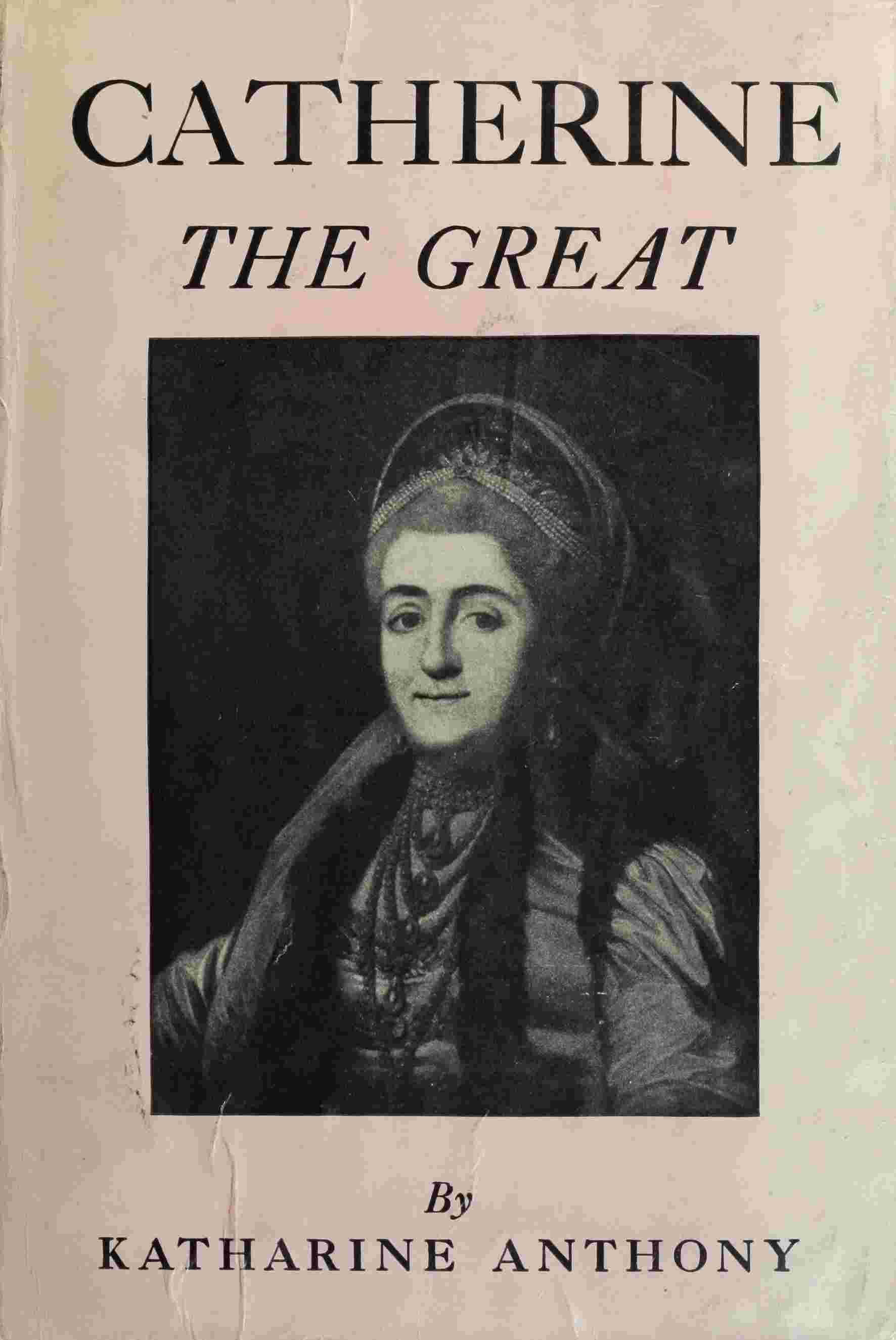
CATHERINE THE GREAT
From a painting by Ericsen
But the Empress was not occupied with the interests of Prussia, or Austria, or France. She preferred the interests of Russia, which happened to be her own. She recalled the hasty General Saltikov from Prussian territory so adroitly that he scarcely knew he had been recalled. She assured Austria and France of her good will and friendship and left them thinking that their temporary estrangement from Russia during Peter’s reign had been wiped out. Catherine II wished to have peace with Europe. She had called Frederick the Great the deadly enemy of Russia on the day of her accession; but a few days afterwards she confirmed the peace with Prussia which Peter III had made and which her manifesto had denounced. The Empress made no attempt to justify this inconsistency. She was a woman of action and explanations have a way of taking too much time. From her accession until her death she was one of the busiest monarchs in Europe.
GREGORY ORLOV
She recalled Bestushev and presented him with a great house furnished with comforts. The old man was nearly seventy now and of no great service to her. But she owed him much and he was a magnificent monument because he had once known Peter the Great. She recalled Biron, also aged with exile, and made him the Grand Duke of Courland. He was useful to her there because he kept the House of Saxony from getting a foothold in Courland. Poniatovsky, who had long awaited this day in Poland, now wrote asking to be summoned to Russia, but she did not recall him. She discouraged him from writing to her at all, saying, “I must walk straight ahead; I must not be suspected.” She had long ago planned with Poniatovsky and Williams that the Count was one day to be made the King of Poland. She now urged the Count to stop at home in Poland and abide the course of events.
One of Catherine’s first acts as Empress was to give orders for her coronation. The ceremony which Peter had postponed until he had at last died uncrowned was foremost in her thoughts. Four days after her accession, she ordered the fire-works for her coronation; and seven days afterwards, the day on which the death of the unfortunate Peter became known, she announced the date. It was to take place in September. She gave Prince Trubetsky fifty thousand rubles and sent him to Moscow to get everything in readiness. He carried with him the specifications for a great spectacle, and, with the assistance of a corps of official merry-makers, managed to complete all preparations within the time arranged for. Promptly on the first day of September, the Empress left Petersburg with an enormous train. There was evidently to be no postponement of the date originally set for the ceremony, no repetition of the succession of postponements which had delayed the marriage of the Grand Duke and the Grand Duchess under the late Empress. The new Empress had none of the dilatoriness of Elisabeth; she had respect for time. In this regard, she remained always only half a Russian.
Between Petersburg and Moscow, a slight cloud threatening delay rose above the horizon. It appeared in the direction of the train of Count Panin and his pupil, the Grand Duke Paul. The Empress received a message from Panin that his pupil had fallen ill of a fever and might not be able to enter Moscow on the expected day. Would the Empress travel more slowly? The Empress halted and waited with impatience. She was rewarded by a second message saying that the Grand Duke had another and a worse attack. The Empress no longer wavered; she sent her ultimatum to Panin. It directed that Panin and his train should travel forward when the boy’s health permitted; in any case, the Empress would enter Moscow on the following Friday. On the receipt of this message, Paul’s health suddenly became better and he was able, under the escort of Panin, to enter Moscow in the company of his mother.
Catherine’s coronation took place in the Kremlin on Sunday, September 23, 1762. In the early morning the regiments marched through the towering gates and stationed themselves in front of the four great cathedrals whose pinnacles rise like glittering golden tulips above the city. At ten o’clock the Empress appeared on the Red Staircase leading to the Uspensky Cathedral. Six chamberlains carried her train and Count Sheremetiev bore the end of it. Six months previously he had carried the train of the erratic Peter at the funeral of the Empress. This time his offices were accepted by his sovereign with supreme decorum. The procession advanced slowly, while the great crowds who had gathered without the military cordon and occupied the roofs of the houses gazed in awestruck silence at the ermine-and-silver clad figure of the Empress, their Little Mother. Only the myriad bells of Moscow spoke and the cannons thundered their salute.
From cathedral to cathedral, the stately procession advanced. As Catherine placed the crown upon her own head, the cannons fired a salute on the Red Square. Surrounded by Prelates and Archimandrites, she nevertheless chose to give the Holy Communion to herself. As she had on the night of June 28 unhesitatingly placed herself at the head of the army as Colonel, she now placed herself with just as much assurance at the head of the Church of Russia. Now as then, no one questioned her right to do so.
While the Empress distributed honors in the Granovitaya Palata, the sacred chamber into which women had been first admitted by Peter the Great, the whole city of Moscow was turned into one vast festival. The merry-making was prolonged for weeks. The fountains ran wine, bread and roast meat were given for the asking, and silver rubles were thrown to the people. No single tradition of grandeur or graciousness was overlooked by the new Russian monarch. An allegorical pageant called the Procession of the Triumphant Minerva brought the coronation festivities to a close, but by this time winter was so far advanced that the performers shivered in the flying snow.
The triumphant Minerva was a happy allegory for Catherine. Not so happy perhaps was the inspiration of the Archimandrite of Troitsky who welcomed her at the gates of the Cloister with an oration comparing her to Judith. Afterwards a group of students, wearing gold-embroidered garments and green wreaths on their flowing locks, sang a cantata composed in her honor. The unmusical Empress could not distinguish one note from another but she bore herself graciously throughout. A few years later, grown more accustomed to power and partly satiated, she was less tolerant. She would sometimes send a page to the orchestra in the theater and arbitrarily stop the music.
9
Captain Gregory Orlov became Count Orlov on the day of Catherine’s coronation. She also named him General-Adjutant and gave him her portrait set with diamonds which he wore on his breast. Gregory Orlov sat many times for portraits which may still be seen in Petersburg showing him to be as handsome as report has made him out. He was indolent and unaspiring, content to be the escort of her Majesty and to eschew all influence in public affairs. In the spring of 1763, after Catherine had been Empress for about a year, a rumor of her marriage to Gregory Orlov was whispered about. Whence arose this rumor? Had the slothful Gregory suddenly become ambitious? It was more likely that the idea came from Alexei, the head of the Orlov clan.
Count Gregory occupied an equivocal position. He was a parvenu and the favorite of the Empress. Among the nobles, the Orlovs were not popular. Among the forty officers who had supported Catherine’s conspiracy, were many who regarded them with a jealous eye. They had been showered with honors and riches, though the Empress had done much also for a number of her supporters. The intimacy between the Empress and Gregory Orlov aroused distrust. If the favorite were promoted to the position of a consort, the Orlovs would certainly become powerful. Their fellow-conspirators were not pleased to be so far outstripped.
There is a legend that about this time the Empress sent Chancellor Vorontsov to sound out Count Alexei Razumovsky on his alleged marriage to Empress Elisabeth. According to the story, the ancient Count, fast falling to decay in his chimney corner, behaved very strangely when questioned. He produced an old yellow satin-covered document which he kissed dramatically and then threw into the open fire. Tradition says this was his certificate of marriage which he sacrificed to prevent its being used as a precedent by Gregory Orlov in his suit with the Empress. He destroyed by this act his last chance to go down to posterity as an honest husband. But he also destroyed whatever hopes of a precedent the Orlovs may have had. The story was first told by a descendant of the Razumovsky family and may well be doubted.
Whatever may have happened in Razumovsky’s house, the gossip did not stop. The Empress, attended by Gregory Orlov, left Moscow for Rostov to spend the month of May in a cloister. No sooner had she left the city than old Bestushev produced a petition, suggesting a second marriage for the Empress on the grounds that the Grand Duke Paul had such delicate health. When this paper reached Panin, he asked the Empress outright whether it was issued with her permission or not. The Empress said not, but Panin did not believe her. The town talk increased, and little groups began to put their heads together behind closed doors. Presently a certain groom of the Bed Chamber, Chitrovo, who had been one of the guards of the late Czar at Ropsha, was arrested and held for a secret investigation. The young man’s grandfather was enraged. He met old Bestushev on the street and scolded him. “Mercy on us, your Highness. What power these Orlovs have, that gentlemen can so completely disappear!”
Chitrovo was accused of having made threats against the life of Alexei Orlov. The Empress, watching everything from her hiding-place in the cloister, saw that matters were growing serious. Messengers galloped back and forth between Rostov and Moscow, while Catherine directed the hearing of Chitrovo to the last detail. The least word from his lips was set down on paper for her. In the end she sent him off to his own country estate. It was a light sentence, for she did not want to increase the talk.
She gave peremptory orders that the investigation was to be kept secret. But it was no longer possible. All Moscow was talking of the affair, and the Empress knew that Moscow was talking. She decided to issue a manifesto which she called the “Manifesto of Silence” and which she ordered to be read aloud in the streets of Moscow. The President of the Senate summoned the crowds together by the beating of drums and then read aloud to them these commands of the Empress:
“It is Our Will and Wish, that each and all of Our faithful subjects shall attend alone to their office and occupation, and shall refrain from spreading unseemly and bold rumors. But against Our expectations and to Our great distress and dissatisfaction, we hear that there are people with wicked thoughts and manners who think not at all of the common good and peace; but, attacked by singular ideas about things which do not concern them and of which they can have no real knowledge, nevertheless they busy themselves with putting these ideas into other weak heads.... Although such harmful judgments really deserve punishment, for they damage Our own and the general peace, we shall not in this case proceed with full strictness; but, with Our inborn humanity, maternally admonish all those who have been affected by these restless thoughts to refrain from unnecessary conversation.... If however Our motherly admonition has no effect upon their wicked hearts and does not lead them back upon the way of the good, then let every one of these bad people know that we shall proceed with the full strength of the law....”
With the Manifesto of Silence, the talk stopped. But the project of marriage with Gregory Orlov also came to an end. When Catherine returned to Moscow the subject had been forgotten. It was the only attempt of her reign to acquire a legal consort and to win back the good name she had lost. Henceforth she was to remain the widow of Peter III and the mistress of many lovers. In her life-time she made two valiant attempts to become a respectable married woman but both of them failed for wholly different reasons. The first time was when she married the ineffectual Peter. The second time was when she tried to marry Gregory Orlov and was stopped by public opinion in Russia.