
X
POTIOMKIN
The middle-aged Empress grew enormously stout. Some of the clothes which she wore at fifty and thereabouts are still preserved in the Kremlin Museum. A skirt of blue velvet, her favorite wear, testifies to the ungraceful breadth of beam which detracted from her Majesty’s appearance and afflicted her pride. She had always been eager to look her best and as she grew older and stouter and more toothless, her cheeks grew brighter and brighter with rouge. She made up every day as if for a dress rehearsal. Her friseur came regularly to arrange her really fine rich crop of hair, and the only time, so far as known, that he was turned away for more important matters was the day when the Empress rode up from Peterhof to Petersburg to seize her husband’s throne. She was proud of her hair, and her hairdressers were persons of considerable importance in her life. Yet none of them approached in this respect old Yevreinov who had been her first barber and paternal adviser when she came to Russia, and who had been banished from court because of his friendship for her.
She liked to dress well but not to eat well. Her contemporaries say she had no interest in food, that she employed wretched cooks and set a poor table. Those who enjoyed the distinction of dining daily with the Empress had to put up with bad cooking. When the cook burned the food, the Empress thought it a joke and that was the end of it. She herself had such an indifferent palate that all the dishes set before her were pretty much alike. At supper she ate nothing and wine she eschewed altogether. A decanter of currant-juice, alcohol-frei, stood beside her plate.
But this does not mean that she avoided stimulants entirely: she was addicted to both coffee and snuff. Catherine’s morning coffee was a daily feat which has impressed itself on history. Her cook used one pound of coffee for the five cups which she drank to the last drop. She was apparently immune to caffeine. “Anybody else would have got heart disease from this concentrated poison,” says one biographer, “Catherine however needed it for her health.” It certainly seems true that the health of those persons who lived to acquire the surname of “The Great” was apparently in need of some very peculiar things. The constitution of Catherine the Great might be expected to develop unique necessities, and it did. Besides one pound of coffee daily, it needed vast quantities of snuff. Like Frederick the Great, also a snuff addict, Catherine spilled the brown powder in her pockets and her clothes reeked of it.
The story goes that her son Paul detested snuff and could not abide the smell of it. This prejudice is said to have aided the conspiracy which was formed against his life. But for his hatred of the smell, the Emperor might have discovered the conspiracy. A certain official who was talking with him had in his pocket at the moment a paper which divulged the plans and the names of the conspirators. Paul put his hand into the man’s pocket on some jesting pretext, but hastily withdrew his fingers when they encountered loose snuff, which disgusted him. And so, according to the story, Paul’s fate was sealed and the conspiracy which was to cost him his life matured in secrecy.
Perhaps it was Catherine’s snuff-taking and coffee-drinking which had made her palate indifferent to food. Nevertheless she continued to put on weight in the most distressing way until her tiny feet ached from carrying her heavy body around. The stout old lady never lost the dignity of her carriage nor the uprightness of her posture, thanks to the hangman’s jacket in which she had spent so many years of her youth. Her bearing was extremely impressive. It was one of the things for which her aunt, the Empress, and her husband, the Czar, had hated her. Her blue-gray eyes had a commanding and open gaze. She had a long chin and a firm jaw. In short, she had the features which are supposed to go with a commanding personality and which in her Majesty’s case fulfilled the tradition. Withal her eyes were friendly and smiling and at times roguish. The person on whom they rested had an impulse to obey.
The Empress loved flattery. Her letters from Grimm, from Voltaire, from Frederick the Great, are full of it. Best of all she liked to be praised to her face. Diplomats arriving at the Russian Court were warned by their well-wishers to indulge the Empress in her whim. It was said that there was no limit to either the amount or the crudity of what she could enjoy. This was an exaggeration. She wanted the tributes to sound convincing, the flowers to seem real. Diderot, for instance, was not always happy in his efforts, and the Empress could be cynical if the flatterer allowed her to catch him red-handed.
“I do not like flattery,” she wrote to Prince Viazemsky, “and I expect none from you.” But the Prince would not have risen to be one of the chief advisers of her reign if he had taken her instructions too literally. “Sie hatte die Eitelkeit eines parvenu, eines self-made man,” says Brückner, borrowing from both French and English to express her quality. The German Princess, whose native language has no word to express exactly the kind of person that she became as Russian Empress, was every inch a parvenu, if not literally a self-made man, and she had the psychology of this type. Certainly she loved flattery, an art in which the eighteenth century excelled. There were giants in those days; magnificent egoists who knew how to drink their flattery like gentlemen.
The qualities of this complex Catherine scatter themselves before us like the pictures in a scrap-book. She was this and she was that, and in every instance she was also the opposite. Perhaps the simplest way to organize the variegated picture of her complex personality is to say at the start that she was a despot, in private relations and in public life. No temperament more dominating, not even that of Peter the Great, ever held sway over all the Russias, whose throne, by the way, both of them obtained by usurpation. Catherine was a successful tyrant because she knew how to command and also how to yield. She had extraordinary insight into human nature with not many prejudices to block the view. In all directions not so blocked, she was extremely clairvoyant. She was easy on her servants, allowing them to sleep late while she waited on herself and made her own fire. Petty graft she passed over with a jest. Laughter she adored. One of her scientific essays discussed the different ways of laughing. When Voltaire died it was not his wisdom that she mourned but his gaiety. “Since Voltaire died,” she wrote, “it seems to me that honor no longer attaches to good humor; it was he who was the divinity of gaiety. Procure for me an edition, or rather a complete copy of his works, to renew within me and confirm my natural love of laughter.” Voltaire once compared her to Saint Catherine, but she repudiated the title of saint. She prided herself on being a child of nature, and one of the rowdier children of that careless mother besides.
History has said of Catherine that she was a woman with a masculine disposition. She had brains, she was ambitious, she kept favorites. All this is comprised in the statement that she was one of the absolute monarchs of her time; she followed a trade to which women were not ordinarily admitted and got herself into it by her own efforts. To out-Herod Herod was her way of staying there. She said of herself that she had a masculine disposition and we know that she loved to play the part of “Monsieur” in her correspondence and in her horseback riding, and that she named herself Colonel of the Guards. As she grew older and stouter, the rôle of “Matushka” blotted out that of “Monsieur” and “Colonel”; but the change to Little Mother betokened no lessening of the aggressive note in her personality. It was her tendency to dominate and she could always find a rôle, either masculine or feminine, in which she could play out her natural disposition.
Catherine’s estimates of her own character are the best that have been written. It is a great loss to students of human nature that her sketch of herself, written at the age of fifteen, was destroyed. We should like to compare it with one which she wrote at the age of sixty-two, addressed to Sénac de Meilhan, as the adolescent portrait had been addressed to Count Gyllenborg. Her pen, it seems, moved best when her thoughts were directed toward some person as if in a conversation à deux.
“I have never believed that I had the creative spirit,” she wrote, “I have come to know many people in whom I have recognized, without envy or jealousy, much more genius than I have. It was always easy to influence me, because in order to do that it was only necessary to have really better and actually worthier ideas than my own. Then I was as teachable as a lamb.... I have never tried to force people’s views but I have also in any particular case held my own opinion. I do not love strife, because I have always found that in the end each remains of the same opinion. Besides I have never learned to lift my voice. I have never been resentful, because providence has given me a position in which I could not be so toward individuals, and because, in order to be just, I could not regard the circumstances as equal. In general I love justice but I am of the opinion that there is no unconditional justice and that moderation alone corresponds to human weakness.... When old people preached severity to me, I confessed my weakness to them with tears in my eyes and it sometimes happened that many of them, also with tears in their eyes, came over to my opinion. I am by nature cheerful and open-hearted, but I have lived too long in the world not to know that there are bitter natures which do not love cheerfulness and that it is not everybody who can endure candor and truth.”
2
The love relationships of Catherine the Great form the most fascinating aspect of her life and character. For nearly two hundred years she has been celebrated as a Northern Semiramis, a Russian Messalina. Myths and romances in countless numbers have been woven around her personality. Posterity knows her as a loose woman.
She loved to picture herself in heaven conversing with Confucius and Cæsar and Alexander the Great. If she could have seen herself as the theme of all the pornographic stories which float around in Russia about her to-day, or as the heroine with three hundred lovers who sparkles so wickedly on so many modern stages, she would, without the least shadow of a doubt, have been extremely happy and delighted. That posterity should think of her as a feminine Don Juan would be exactly to her taste. She thought of herself as a feminine Don Juan; or, rather, as a feminine Henri le Grand whose life was in so many respects the inspiration of her own. It was said of the brilliant Henri le Grand that but for his fatal prowess as a Don Juan he would have succeeded in driving the Turks out of Europe. Catherine hoped to succeed, though her hero had failed, in both. She was willing to go down to posterity as a light woman but she hoped also to be remembered as the monarch who had driven the Turks out of Europe.
The number of her lovers was after all only thirteen if we count her husband. They were openly acknowledged and no legitimate consort could have enjoyed a brighter glow of publicity. The Empress did not indulge in secret rendezvous or episodic affairs. During the period when she was breaking away from her ten-years’ union with Orlov, there were passing episodes, but these were only means to an end. Nothing is more surprising than the formality with which she surrounded her favorites or the curious acquiescence and matter-of-factness with which they were regarded by society in Russia. Most of the romancing and denouncing came afterwards when Catherine and her twelve lovers had gone the way of all flesh.
The Empress was, in this aspect of her life as well as others, a woman of few explanations. But she wrote a sort of apologia for her sex life and left it as a legacy to history, inserting it in the memoirs which she wrote for publication. “I was very affectionate,” she said, “and gifted with an appearance which was very attractive. I pleased at the first glance, without employing any arts or pains to that end. I was very sympathetic and possessed rather a masculine than a feminine temperament. As I have already said, I pleased the men. The first half of the temptation was there and the second followed the first according to human nature; for to tempt and be tempted are very close to each other. And if a strong feeling is added to this, however strongly the principles of morality may be imbedded in the mind, one goes farther than one would wish; and, even until now I do not know how that is to be prevented. In this case, perhaps absence might bring aid; but there are cases, situations in life, and circumstances which make absence impossible. How can one in the midst of court life flee away, remove oneself, turn aside? That would at once attract attention and cause talk. Yes, if one cannot remove oneself, nothing is harder in my opinion than not to yield to that which allures. All that is said to the contrary is hypocrisy and ignorance of the human heart. One does not hold one’s heart in one’s hand, and it does not obey the commands of reason.”
This was a sincere effort on the part of a sixty-year-old Empress to be truthful and candid about her past. Aside from certain obvious misrepresentations, such as saying that she had an attractive appearance though she did not believe it herself, she thought that she was speaking the truth. But one is struck by the extraordinary weakness of her defense. A woman who has had twelve lovers and has learned no more from life than to defend herself on moralistic grounds shows that she has remained unteachable to the last. Her explanation of her conduct might suitably be given by a girl of fifteen. Catherine once said of Diderot that in some respects he was a hundred years old and in others he was no more than ten. It was a wise remark and could be equally well applied to herself. When she tries to explain the irregularities of her sex life by saying that temptation has been too strong for her to resist she speaks as the pupil of Pastor Wagner. It shows that her conduct was still just as much of a mystery to herself as it was to anybody else. She had learned however one thing which Pastor Wagner and the rationalists of the eighteenth century had not taught her, and that is that the heart does not obey the commands of reason.
However impulsive the Empress may have been in the initial stage of a love affair, she was shockingly rational in the way that she developed it. Like Frederick the Great, she had a terror of venereal disease but she had a less ascetic method of protecting herself. She required the hopeful candidate to submit himself to a medical examination at the hands of Dr. Rogerson, her Scotch physician. He was then put through a kind of ordeal or apprenticeship by Countess Bruce or Princess Protassov who were known for their function as “les eprouveuses.” If these experienced ladies recommended the young man for his office, he was installed in the elegant apartments prepared for his reception. In the drawer of his dressing-table he found the generous salary allotted to the Empress’s Adjutant General, and then began for him a life of the most appalling regularity.
At ten o’clock every morning, he called on the Empress, and at ten every evening he escorted her to her private chambers. When she drove out, he sat beside her, and on all occasions stood ready to offer his arm. He was dedicated to his duties and lived in complete retirement. After Gregory Orlov, none of Catherine’s lovers was allowed to make visits or receive them. No Sultan could have been more arbitrary with his harem than Catherine with her favorites. She lavished presents and honors upon them; her extravagance toward them knew no bounds. The English Ambassador Harris, who had a talent for statistics, estimated that she spent $190,000,000 in cash on the men she kept. The amount seems staggering even for our day. Yet it was not enough, with all the other perquisites added, to prolong the bondage of the victim more than two or three years on the average. After Gregory Orlov, they all escaped in one way or another at the end of a period of about this duration.
Vassilchikov, with whom she carried on the most perfunctory affair she ever had, describes his life with the Empress thus: “I was nothing more than a kept woman and was treated as such. I was not allowed to receive guests or to go out. If I made a request for anyone else, I received no answer. If I spoke for myself, it was the same. When I wished to have the order of Saint Anne, I spoke to the Empress about it. The next day I found a thirty thousand ruble banknote in my pocket. In this way, they always stopped my mouth and sent me to my room.”
It must be said that Vassilchikov’s courtship was probably the poorest performance given by any of Catherine’s lovers. The only one of them who had royal blood in his veins, for he was supposed to be a descendant of Rurik, he was nevertheless the last and least of all in the eyes of his mistress. Catherine had installed him in Orlov’s stead to displace the absent Gregory, and Vassilchikov’s office was primarily to help her wean the Count. Not that the Empress was aware that she was pushing Orlov out of his warm nest into a cold hard world. On the contrary, she had got the idea that Orlov intended to desert her and she did not mean to be left in the lurch. She also thought at first that she was in love with Vassilchikov, tall scion of the Ruriks, and was bitterly disappointed when the affair proved cold. Her complaints of their relationship were fully as dismal as his and her disappointment even more pathetic. This appears in a confession which she wrote for Gregory Potiomkin, who in turn displaced Vassilchikov and became Gregory Orlov’s first real and genuine successor. It appears that Potiomkin had heard stories about his predecessors, which shows that gossip had already begun to exaggerate the number of the Empress’s lovers. To reassure him, the Empress wrote a brief confession in which she told him all the facts about her previous relationships.
The Empress’s list begins with Sergei Saltikov and tells how she accepted him on the advice of Madame Choglokov and how Madame Choglokov in her turn had been induced to act by the “insistence of Sergei’s Mama.” This sudden peeping out of Sergei’s mama from behind the scenes of Catherine’s life makes a vivid impression. The lady was already an invalid, it seems, who pulled the strings of history, just once and silently, and died.
The next lover named in Catherine’s confession is the King of Poland. “He was amiable,” says his mistress, “and was loved from 1755 to 1761. After he had been away three years, that is since 1758, and because Prince Gregory Gregorevich, to whom well-meaning people called my attention, took trouble for me, I changed my way of thinking. He would have stayed forever if he had not grown tired. I learned this on the very day of his departure from Czarskoe Selo for the Congress and drew from it the simple conclusion that with this knowledge I could no longer have any confidence. The thought tortured me cruelly and led me to make out of desperation a choice by chance (Vassilchikov). During this time, yes until this month, I have fretted more than I can say and never more than when others were satisfied. Every expression of tenderness caused my tears to flow and I believe that never since I was born have I wept so much as in this year and a half. In the beginning I thought I would get used to it, but the longer it lasted the worse it grew. For the other person began to sulk for three months at a time and I must confess that I was never more contented than when he was angry and left me in peace. But his tenderness forced me to weep.”
The confession ends for the time being with Gregory Potiomkin, the lover to whom it is addressed and of whom she begs forgiveness for earlier sins. “And now, Sir Hero, can I after this confession hope for forgiveness of my sins? You will see that it is not fifteen but only one-third as many. The first, against my will, and the fourth, who was taken out of desperation, cannot be charged to frivolity. Of the other three, only believe the truth. God knows that I took them not out of debauchery, to which I have no tendency. If fate had given me in my youth a husband whom I could love, I should have remained true to him forever. The trouble is that my heart would not willingly be one hour without love.... But I write you that needlessly for accordingly you will love or will not wish to go away to the army, out of fear that I could forget you. But really I do not believe that I could be so foolish. If you would attach me to yourself forever, then show me as much friendship as love, and beyond everything, love and speak the truth.”
3
Potiomkin must have understood his lady’s wish and satisfied it in his way, for Catherine loved him fifteen years. She had loved her first Gregory ten years before she cast him off; her second Gregory held first place in her affections for a longer period. She had a degree of faithfulness with which she has never been credited. Not that Potiomkin lingered in the terem all this time. As official favorite and public escort he lasted only two years. He was too restless for captivity and he could not bear to be stared at, a part which the handsome Orlov had played to perfection. A curious arrangement was reached between the wandering favorite and the Empress. Potiomkin went away to Novgorod, to the Turkish wars, to the Crimea; he was driven hither and thither across the endless plains of Russia by his craving restless spirit. The Empress, left alone, something that she could not bear, took one lover after the other in his place. But always Potiomkin returned and compelled her to dispose of them. At a word from him, she turned them out.
According to the legend, Potiomkin became a sort of panderer to his lady and the gentlemen whom he chose for her survived as long as they remained in his good graces. What really happened was that the Empress chose each new lover for herself and certainly with the hope that he would see her through. But, after a year or two, the unmanageable Potiomkin would suddenly arrive on the scene and turn the rascal out. His appearance would be preceded by threatening letters about what he was going to do. For instance, the big blond Yermalov sat uneasily in his armchair one day because Potiomkin had written her that he was coming to Petersburg to send “that white nigger” away. Potiomkin came and the white nigger went. Catherine turned her attention to dark lovers and chose two of them, Mamonov and Zubov.
Mamonov proved to be one of her few mistakes. He was a normal man who fell in love with one of the ladies of the court of his own age and married her. It was the only time that her Majesty was ever actually deserted by one of her lovers, unless Saltikov may be said to have done so, and it was a shattering experience. She chose another dark man, Plato Zubov, and tried to gain for him the approval of the absentee Potiomkin. The little black boy, she wrote, was learning fast, sent his love to Papa, and so on. But Potiomkin wrote back that he was returning to Petersburg “to have a tooth out,” which had an ominous play on Zubov’s name, which means “tooth.” The conflict over Zubov’s removal brought to an end the relation between Catherine and Potiomkin which had lasted for fifteen years. Potiomkin was not able to send this rival away.
The lovers who followed Potiomkin were Zavadovsky, Zoritch, Korsakov, Lanskoy, Yermalov, Mamonov, and finally Zubov. Except for Lanskoy, who died, and Mamonov, who married, Potiomkin had arbitrarily dismissed all of them or believed that he had so dismissed them. When he could no longer do that he realized that his lady had discarded him for good. He became, as Gregory Orlov had become fifteen years before, an exile from the warm nest that had sheltered him for so long, and, like Gregory Orlov, he could not survive his banishment.
Potiomkin had a fascinating personality. He was not likable but he seized the imagination and captured the attention. Legend has pictured him as a great Russian brute who drank heavily and swore outrageously. Doubtlessly he swore, as every Russian swears as naturally as he breathes. But he was not a drunkard and he was not a brute. He was a frightened, timid hare, with a certain creative genius which came through here and there without ever developing very far in any direction. He could be a real poet on occasion, although he is known as the author of only one song, and also a real general on occasion, although he trembled at the sound of guns. The most contradictory things have been said about him because the most contradictory things were true about him.
He had the tall, well-built figure which Catherine required of her lovers but otherwise his appearance was not prepossessing. He had lost an eye and it is characteristic of Potiomkin’s reticence that nobody knew when or how the accident had happened. Potiomkin himself never spoke of it but his feelings on the subject may be imagined from the fact that when a one-eyed man was sent to him one day with a message, Potiomkin struck him down. Various stories are told about the loss of his eye. Alexei Orlov is said to have put it out in a struggle over a game of billiards. Another story told is that Potiomkin himself destroyed it because it had a blemish, probably a squint. It is doubtful whether Catherine herself knew the true cause of the accident. In writing about Potiomkin, she passed over his handicap as if it did not exist. And yet she made one indirect reference in her memoirs. In speaking of the ignorance of the Russian court, she remarked that even an ordinarily intelligent person at this court was like a one-eyed man among the blind. Another peculiarity of Potiomkin’s which she passed over in silence was a nervous jerking of his face, a kind of facial tic which she had once detested in Count Shuvalov. One trait, however, she did refer to sometimes in a jesting tone and that was the way he constantly gnawed his finger-nails. The rest of his peculiarities she passed over in silence.
Potiomkin was cynical, morose, and silent; a wistful, tortured creature who was obliged to make people afraid of him in order to conceal his timidity toward others. They called him “Cyclops” and his imposing figure did not belie the reference to the one-eyed giant. Perhaps the original Cyclops also was as sensitive and fearful at the core as was the awe-inspiring Potiomkin. Legend has made a great deal of the middle syllable of his name, “tiom,” which means dark, and has served to accentuate the romantic picture of Potiomkin as a villain and a hero.
Like Razumovsky who had been the favorite and the reputed husband of Empress Elisabeth, Potiomkin was a Southerner, a Ukrainian. The men of his family had followed either a military or a cloistered life. His father was an obscure captain and an uncle, who had risen to the rank of colonel, retired from the army to enter a monastery. Gregory Potiomkin reversed his uncle’s course. He first became a monk or almost became one, having spent several years in preparation travelling from one monastery to the other. He was well versed in the theology of the Greek Church and was extremely superstitious. His orthodoxy was another aspect of her lover which Catherine, who prided herself on being a free-thinker, did not like to expose. During the first year that she lived with him, they made a pilgrimage through the old Russian cloisters together. It happened that Prince Henry of Prussia was due to pay a visit to Catherine during these months, but she wrote asking him to postpone his visit until the following year. Usually she liked to have foreign guests accompany her on her travels, but this time she did not wish to combine the Protestant prince and the Greek theologian in one religious pilgrimage.
Up to the age of thirty-five, when he became the favorite of the Empress, Potiomkin seems to have had no love affairs and no idea of marriage. He was deeply attached to his sister, whom, with her five daughters, Catherine kept about the court. With one of his nieces, Countess Branicky, Potiomkin was especially intimate. After he left the Empress, this niece accompanied him everywhere. It was as if, like Catherine, he was morbidly afraid of being left alone, and Sashinka Branicky was obliged to be always with him. One of the scandals about General Potiomkin was that, instead of galloping over the battlefield on a war horse like General Suvarov, he usually appeared driving along in a kibitka with Sashinka at his side. In this state, nevertheless, he managed to cover a great deal of ground, for few Russians travelled farther or more swiftly than did General Potiomkin. And always his devoted niece was near at hand. How Sashinka found time to marry and have children, as she did, is hard to explain. It has been said that her relations with her uncle were not above reproach. If it was true that a physical intimacy existed, there would have been nothing shocking in the circumstances to the Russian Empress who had once contemplated marriage with her Uncle George of Holstein and spoke in later life almost regretfully of the unfulfilled engagement.
Potiomkin had been one of the original conspirators who had helped to make Catherine the Empress. He had ridden to Peterhof in her train on that white night in 1762 when she seized the Czar and imprisoned him. He had been one of the guardsmen left in charge of the ex-Czar at Ropsha, and he had been present at Peter’s death. Alexei Orlov’s letter absolves him from all responsibility for the murder. The worst that can be said of him in this connection is that with many others, who were likewise not blamed, he also was present. The Empress did not forget him during the next ten years, for she furthered his career by sending him with a letter to General Razumovsky, who employed him in the Turkish wars. His picture lay dormant in her mind through all this time until it began to take on an increased vividness by comparison with the actual presence of a Vassilchikov whose caresses made her weep. The stories of Potiomkin’s wooing give him credit for an amount of initiative which he did not have. In Catherine’s confession, addressed to Potiomkin, she says that she deliberately recalled him to Petersburg, whereas the current story tells how Potiomkin schemed to be sent to the Little Mother with a painting and a message and how when he got there he impetuously wooed her. The second story is the one which the Empress would have much preferred to have us believe had her own statements of what took place not weakened its credibility.
“Then came a certain hero,” she wrote. “This hero was, through his services and his enduring tenderness, so wonderful that as soon as people heard of his arrival they began to say that he ought to remain here. They did not know of course that we had summoned him secretly by a letter, but with the secret intention after his arrival not to proceed quite blindly but to investigate whether that inclination existed of which Bruce had spoken and which many had long suspected; that is, the kind of inclination which I wished that he should have.”
It is not difficult to picture the impulsive Catherine sitting down to her writing-table one fine morning to pen the letter which brought Potiomkin to Petersburg as fast as a kibitka could carry him. The image of the dark, morose man, biting his nails and glowering at the world, which had slept so long at the bottom of the pool, had at last risen to the surface and now floated there with a sharp commanding vividness. Potiomkin’s time had come. The Empress sat down and addressed to the hero whose image summoned her the letter which was to be the making of his fortune. He came to Petersburg and for two years he remained in close attendance on the Empress. He played his part in the Hermitage gatherings in his own peculiar way. He was a ventriloquist and could imitate to perfection the voices of various animals. He could reproduce with uncanny accuracy the voice of Catherine herself uttering some characteristic remark. This trick hugely delighted the Empress who had also a gift for mimicry. In return, she would caterwaul a duet with the Princess Dashkov who, like the Empress, was unable to carry a tune.
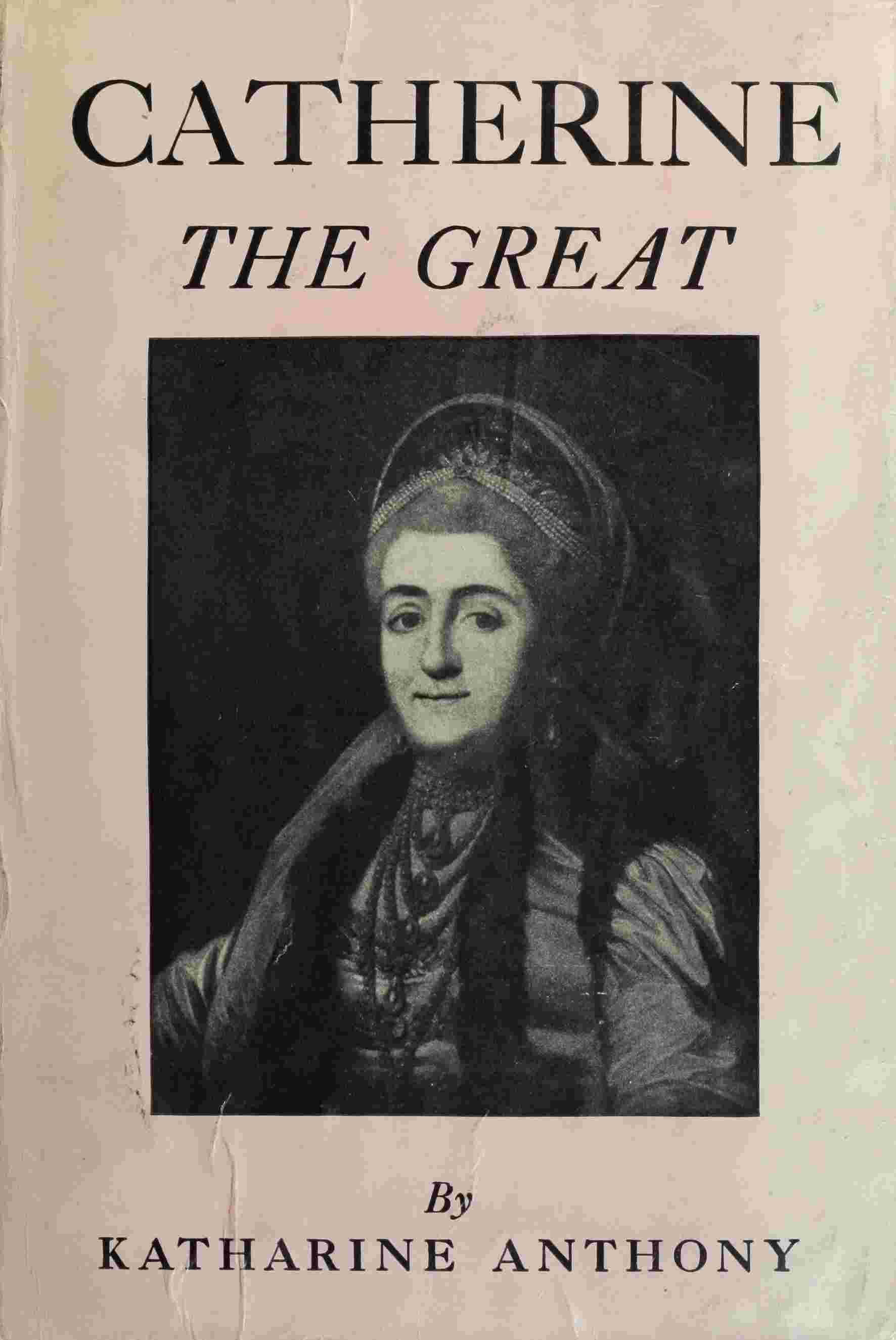
CATHERINE THE GREAT
Painted by Ericsen for Baron Dimsdale
Potiomkin was a semi-Tartar in his habits. Slovenly and indolent, he would lie on his couch for days clad only in a khalat. In the same informal habit he would visit the Empress, to the horror of the Europeans and the astonishment even of the Russians. Potiomkin fancied himself in this informal costume, over and beyond the fact that the lazy undress suited the inertia of his temperament. The loose khalat was not unlike the monastic robe which he had once planned to wear and which now and then, when things went wrong between himself and his imperial mistress, he thought of putting on again. He was friendly with all priests, with whom he spent much time, not, it appears, so much in theological discussion, though he is said to have excelled in this, as in card-playing and betting. His devotion to the Church is seen in the way that he could stand motionless and decorous all day while mass was being said. He was not physically too lazy for this effort although otherwise so indolent that the formalities of Russian court life were too arduous for him.
CATHERINE THE GREAT
From a painting by Roslin
Many vindictive outré portraits of Catherine’s lover have been drawn for posterity. Most of them were produced by French writers who could not understand a man who, notwithstanding all the riches that his mistress placed at his disposal, preferred to live as a Byzantine when he might have lived as a Parisian. To the sophisticated French who left most of the written accounts of Russia in the eighteenth century, Potiomkin was scarcely a Russian; he was almost an Asiatic. The big one-eyed man who sprawled on a couch all day in a bright dressing-gown, playing with a handful of unset jewels or listening to Plutarch’s Lives which some one read aloud, was a strange creature who had deliberately turned his back on the civilization of Louis XV and France and who yearned only to revive the ancient glories of Alexander the Great and Constantinople.
The mere name of Alexander was an inspiration to Catherine and Potiomkin: it had been the name of Potiomkin’s father and became the name of Catherine’s grandson. It symbolized the magnificent dream which united them. Together they would go to Constantinople. One day Potiomkin burst forth, as he sprawled on his couch and listened to Plutarch’s Lives, “If anyone should come today and tell me that I should never go thither, I would shoot myself through the head.” In a similar mood, though less violent, the satirical Empress threatened, in case the Swedes bombarded her out of Petersburg, to set up her capital in Constantinople. If she did not revive the Byzantine Empire, she hoped that Monsieur Alexander, her grandson, would one day revive it in her stead. United in their feverish dream, the Empress and her lover drove in perfect unison toward their common hope. Together they would one day enter Constantinople. For many years they passionately believed it; and when they no longer believed it, they died.
4
Potiomkin, a true son of Ukrainia, was a troubadour. He composed a song to his lady which became a popular lyric. “As soon as I beheld thee, I thought of thee alone; thy lovely eyes captivated me, yet I trembled to say I loved. To thee, love subjects every heart, and enchains them with the same garlands. But, ah heaven, what a torment to love one to whom I dare not declare it! One who can never be mine. Cruel gods, why have you given her such charms? Or, why did you exalt her so high? Why did you destine me to love her and her alone, her whose sacred name will never pass my lips, whose charming image will never quit my heart.”
Catherine’s churlish lover was not poor in fancy. He could offer tributes to his lady showing an imagination of no mean order. As he composed lyrics in her honor, he could also compose pageants and other exhibitions of great beauty and impressiveness. The famous journey to the Crimea was a magnificent processional. Potiomkin’s arrangement of this trip was the work of a poet and a dramatist as well as that of a politician and a general. It employed all his talents at once. His contrivance of effects along the way has been misunderstood. Hence the legend of the “Potiomkin villages,” which according to his detractors were mere painted façades overlooking the Volga and filled with peasants and cattle who had travelled on foot many hundreds of versts in order to complete the picture. That history should have blamed instead of praising Potiomkin for his artistry shows how little his mission in life and his share in Catherine’s grandiose schemes have been understood. Both of them believed that the road to Constantinople would one day be lined with prosperous villages and that the temporary settlements thrown up at so much expense along the route would at no great distance in the future become permanent establishments. No one was deceived by the demonstration of prosperity, unless perhaps it was Potiomkin himself, who half-way believed in the spectacular growth of population induced suddenly by his own imagination aided by Catherine’s rubles. Prince de Ligne, who accompanied the Empress on her Crimean journey, tried to correct the story at the outset. “They have already spread a ridiculous report,” he wrote to France, “that villages of cardboard have been distributed along our route at intervals of a hundred leagues, that paintings of vessels and cannons and cavalry without horses are displayed.” The Prince persisted in his efforts to send out to Europe a true description of the Crimean journey; but he fared as all honest and unpicturesque journalists are destined to fare. People preferred to believe in Potiomkin’s cardboard villages and in the perfidy of their contriver who employed in their construction millions of the Empress’s own rubles in order to deceive the Empress. The story is still told to show to what nefarious depths Potiomkin was willing to descend. What it really shows is that he was a daring artist who designed and executed grandiose effects.
The Empress’s whole Crimean trip was a theatrical enterprise with Potiomkin as author, producer, and actor. It followed soon after the birth of her two grandsons whom she at first planned to take with her though she abandoned the idea before the start was made. The purpose of the journey was ostensibly to inspect the work of General Potiomkin as administrator in the South. Its actual intention was political, to reconnoitre the way to the Orient while hostilities between the Russians and the Turks were in abeyance. No one understood this kind of political game better than Potiomkin and his mistress. Ostentation was the breath of their nostrils and for once they had their fill of it. The Empress and her entourage proceeded down the Dnieper in a fleet of twenty boats, each of which was named for some tributary of the stream. Catherine’s own vessel was called the Dnieper and was fitted out with mirrors and Turkish rugs, while a smooth green carpet covered the deck like a meadow. Behind the gorgeous Dnieper floated the Bog, the vessel in which Potiomkin travelled. Beneath a silken canopy, he lounged among Turkish draperies, while Sashinka Branicky attended him. Behind Potiomkin’s Bog came the other eighteen vessels filled with ladies and gentlemen, musicians and dancers, cooks and lackeys, who strolled the decks and counted the peasants along the shores. The whole social life of the palace was transported to the Empress’s fleet; receptions and balls and concerts followed each other as smoothly and uninterruptedly as the bends of the flowing river followed each other southward. The fleet had halcyon weather.
Most of the boats proceeded to Cherson, passing successfully the rapids which the Russian peasants were afraid to navigate. One of the aims of the trip was to quiet this popular fear by demonstrating a safe passage. The laurels remain with Potiomkin for the Empress left the fleet and proceeded by carriage along the last stretch of the journey. The royal guest who rode in the carriage with her, the son of Maria Theresa and the future Emperor of Austria, did not fancy perhaps the idea of threading the Dnieper rapids. It seems unlikely that the Empress herself avoided the adventure or feared the danger after she had sailed so blithely and triumphantly into the hazards of inoculation.
At the end of the journey, the excitement was intense. All the world had crowded into Cherson to see the Empress and her Prince. A room for the night cost a thousand rubles and an egg for breakfast cost a florin. Potiomkin was beside himself with joy. He ordered the gates of the city to be moved several versts farther out and told the Empress this had to be because the throng of visitors had decided to remain as a permanent addition to the population. He believed it himself and the Empress believed it with him. It was May and their dream was at fever heat. Looking out over the harbor of Cherson toward Constantinople they could believe anything.
They believed that the Empress of Russia was going to drive the Turks out of Europe and the rest of Europe was going to thank her for her services. In a kibitka they drove to the mouth of the Bog and the Empress looked across the narrow water at Turkish land beyond and lusted after it. The next day three new Russian ships were launched in the harbor. Upon the blue expanse of water they floated down gently and safely from their staples. A great triumphal arch had been reared, on which was inscribed, in clear beautiful Greek lettering: “Here lies the way to Constantinople.” The whole performance was dramatic and picturesque to the last degree but not exactly diplomatic. The agents of the French government in Constantinople, whose business it was to manœuvre there against the designs of Russia, must have thought that Catherine and Potiomkin were mad. And so they were, a little, but their madness was a great driving force with which mere rational diplomacy would have to reckon seriously.
There was method in the madness of the pair. The Empress employed the same Machiavellian technique in the acquisition of the Crimea that she had already used in Courland and in Poland. Her predatory art was chiefly a matter of simple bribery, a method of bargaining in which no monarch has ever excelled her. The credit, or the blame, for Russia’s acquisition of the Crimea usually goes to Potiomkin. He was at least the flawless negotiator of his lady’s bargain. The Khan was slowly forced into a corner from which he could only escape by running straight into the arms of the Empress. This was where he found himself in April, 1783, just five years after Catherine’s visit to Cherson, while Potiomkin took possession of his peninsula in the name of Russia. The Khan, fleeing the wrath of the Turks, went to Petersburg to live on the pension of a hundred thousand rubles which the Little Mother of all the Russias had generously given him. Catherine had at last won possession of the ancient land of Tauris where Iphigenia, snatched away from her father’s house, once lived and reigned as a priestess among barbarians.
Was it not something like this which had happened to the little Fike of Stettin when she became Catherine of Russia and the priestess of a foreign temple? Catherine and Potiomkin restored the ancient name of Tauris to the peninsula and revived the Greek names of the towns and seaports, hoping to call back the Greeks who had abandoned their homes to the Tartars. To Potiomkin himself the Empress gave the title, Prince of Tauris; and henceforth he swept magnificently through her correspondence as the Taurian. Every mention of his name was invested with the glamour of his heroic exploits.
5
When the Empress conquered through diplomacy, she never knew failure. As an open aggressor, she was not a brilliant success. She avoided war as long as possible and especially did she avoid war with Western Europe. The Swedes forced her into a campaign of defence but she much preferred to measure her troops against the Orientals. With all her bluster and threats against the French Revolution, she failed to come forward with actual military support of the intervention which she so loudly urged and applauded. The Turkish wars were another matter. If they could have been avoided by any possible exercise of diplomacy and expenditure of rubles, no matter how great, they would never have filled so many pages of history. Unfortunately for Catherine’s kind of pacifism, Constantinople could not be bought. The Empress and Potiomkin had gone as far in the conquest of the South as Machiavelli could carry them. They had acquired by high bidding and sharp dealing Crimea and Georgia, the Tauris and Colchis of the ancient Greeks redolent with memories of Iphigenia and Medea and the Golden Fleece.
But the Empress had no thought of stopping there. Crimea and Georgia only fed the flame of her passion for the East. She watched Constantinople as a cat watches a mouse-hole, with a fascinated attention which nothing could divert. But France did not want the Russians in the temple of Sophia and England was fast coming to share this view. If the Empress had been a little less concentrated and had watched her mouse-hole a little less confidently she would have realized earlier than she did the strength of the opposition which was growing up against her in Western Europe and which was carefully preparing to defeat her aims. Behind Mustapha and the Turks, whom she regarded as the enemy, stood a strong wall of diplomacy raised by the western powers. Catherine’s phantasy overleaped this wall. For her, beyond Constantinople lay only India. She believed the way was still as open as it had been for Peter the Great when he dreamed of taking it.
The dream was now hers, as she was now Peter. She conducted her campaign against the Turks as Peter had conducted his campaign more than half a century before, and her preparations for war, imitating his, were in many respects even worse. There were not enough recruits for the companies; there were not enough tents for the men; the powder was half dust; all the supplies were either defective or deficient and graft and autocracy were everywhere. The Russians lost their first battles, but everybody was gay about it. Voltaire wrote to Catherine: “I see with joy and surprise that this convulsion has in no way shaken the composure of that great man whose name is Catherine.” He might have added that Peter the Great with all his six feet seven could not have borne the defeat with greater steadfastness and courage.
The Pforte, instigated by the French, declared war against the Russians in 1768. The following year Gregory Potiomkin joined the army under General Rumiantsov, whom he afterwards displaced as leader of the forces against the Turks. After five years of undistinguished service he was summoned to Petersburg by the Empress and stopped there for two years idle in her boudoir. From this time onward Gregory Potiomkin was a changed man. Although he trembled at the sound of guns, he could fight the enemy at times with the fierceness of a tiger and the cunning of a serpent. At court he went about like a savage, barefoot, without breeches, unwashed and uncombed. At the front, these simplicities gave him a degree of independence beyond the other officers. He could live for days on onions alone and the ordinary comforts of life meant nothing to him. It was said that Potiomkin was in most ways a creature of the eleventh and not the eighteenth century anyway. When he went forth to war his eleventh century side came uppermost and found there its congenial expression. He was not unhappy at the front except when the guns roared, and as long as Sashinka stood by to comfort him he could endure even that.
The first Turkish War should, according to the general expectation, have ended with the Congress of Fokshani. The Empress, her foreign minister in Petersburg, and especially the Russian minister in Constantinople who happened to be in a Turkish prison awaiting peace for his release, were all surprised and disappointed at the outcome of the Congress. They had expected a satisfactory treaty. But Gregory Orlov, who represented Russia, suddenly departed for Petersburg while the negotiations were still in the air. A rumor of disaster in his private affairs had suddenly reached him, and fearing that his relations with the Empress were threatened he dashed away to reassure himself. We know how suddenly his journey ended, in arrest and quarantine at Gatchina. His nerves were never quite the same again, and no wonder. The shock was extreme, even for a military officer and a stalwart man. His eccentricities of behaviour increased after this experience but they did not begin there. Looking back over Orlov’s previous life it is easy to see that his disorganized state of mind would have made the peace congress at Fokshani a failure even if all the other conditions had been favorable.
The Empress was philosophical, as well she might be. She was obliged again to correspond with the Sultan with cannon balls, as she wrote to Voltaire. The war dragged on for two years longer, while the handsome Vassilchikov occupied Orlov’s apartments and made the Empress weep whenever he grew tender. In July, 1774, came the Peace of Kutchuk-Kainardi. Potiomkin signed this treaty. He had displaced the unsuccessful Vassilchikov four months before and was now the Empress’s envoy to the Turks. She was enchanted with the terms he made. “Ah! What a good head the man has. He has had a greater share than anyone in this peace, and this sound head of his is as amusing as the devil.” She hung her darling with blazing orders and collected honors for him from foreign sovereigns. Potiomkin loved his decorations and adored his jewels. There were occasions when he pinned the whole exhibit on his velvet coat until his chest was panoplied with gold and silver and diamonds. In the midst hung a portrait of the Empress at which people gazed intently while talking to him for they dared not gaze at the black patch which he wore over his eye. This was General Potiomkin on those rare occasions when he considered a dressing-gown not admissible.
During the Second Turkish War, Catherine wrote to her lover twice every week. In her letters she showered him with pet names as in public she hung him with orders. He was her belovedest, her little love, her gold pheasant, her Papa. So she spurred him on to battle with the Turks. It was not easy. The Ukrainian either stormed ahead or collapsed in moods of desperate discouragement. There were days when he was ready to evacuate the Crimea and to resign his generalship in favor of Rumiantsov, his detested rival. “You are as impatient as a five-year-old child,” the Empress chided, “while the business entrusted to you demands unshakable patience.” The General was subject to frequent relapses to his five-year-old emotions and in such moods he was ready to abandon all to the Turks if the Empress’s letters had not served to restore his aggressiveness. She had urgent need to write him twice a week. The Prince of Tauris was ready to give up Tauris itself whenever these pessimistic moods overcame him.
The Empress was distressed by the terrible cost of war. She discovered that it was even more expensive than diplomacy and bribery. Up to the unpleasantness with the Turks, she had managed to get her way by means of money and lively military display. But it seemed that actual warfare demanded an additional expenditure of treasure. She complained to the sculptor, Falconet, “To make war three things are necessary: money, money, money.” Yet she was always able to find the wherewithal to carry on and keep her three quarrelsome generals, Potiomkin, Suvarov, and Rumiantsov, active in the field.
She built a fleet and planned to sweep the Black Sea with it. The Russians, in spite of the efforts of Great Peter, had never become navigators, a deficiency which obliged her to import her naval officers from England. The scheme was easily carried out. The English were employable and adjustable, and all went well until the Empress had the idea, inspired from Paris by Dr. Benjamin Franklin, of adding the American naval officer, John Paul Jones, to her forces. The American hero’s exploits resounded at the moment through Europe while he himself was sojourning in Paris, rather lonely, very famous, and extremely hard up. The Empress met his terms, which were sufficiently high, for Jones was a good bargainer, and the American was soon sailing a Russian ship on the Black Sea. But luck, it seems, had deserted the little man. He not only played an undistinguished part in the Turkish wars but left Russia under the shadow of a personal scandal, invented, his defenders said, by British officers serving under Catherine who resented the presence of the colonial in the same navy with themselves. However, that may be, he earned no honorable mention in Russia and the history of that country gives no credit to John Paul Jones for helping to win the Turkish Wars.
In June, 1788, Catherine’s fleet won the battle of Otchakov. The victory made a great impression on Europe and even Frederick the Great spoke of it respectfully. Was the Empress really marching toward India? She believed that she was marching toward Constantinople at least and that the Prince of Tauris would enter the Turkish city within the year. But France and Prussia and England thought otherwise. English policy was well clarified by now and was neatly expressed in a book on Russia published by an English captain in the year 1790. “The Turks,” he said, “happily for us, are not a commercial people; we cannot do without those valuable articles which their soil produces almost spontaneously; and the Turks, like the easy possessor of a very rich mine, allow us to enrich ourselves at our pleasure. Three per cent. duty equally on all exports and imports is, with little exception, their only restriction to Europeans engaged in their trade. Would the Empress be equally moderate, if in possession of the fertile region? Believe me, she would not.”
It appeared that Europe did not wish to be cleansed of the Turks by Catherine the Great. The easy-going Mussulman with his three per cent. duty had great advantages over a Christian monarch like the Russian Empress. The representatives of Protestant Europe in Constantinople put their heads together and backed up Turkish diplomacy in the south while the King of Sweden prepared to invade Russia on the north. The Swedish invader was Gustavus III, the son of the Princess Ulrica whose gown had once been offered to Princess Fike to make her presentable at the German court. Ulrica’s son had a curious relationship with Cousin Catherine of Russia. He paid friendly visits and wrote flattering letters to her and then made war on her. As soon as the treaty was signed, he wrote and asked her to forget their differences, “like a storm that has passed.” The passing storm, however, had shaken the Empress as she had seldom been shaken. She was not prepared to carry on war on two fronts and the Swedish invasion had made the Turkish Wars no longer endurable. “If you wish to roll a stone from my heart,” she wrote to Potiomkin on the Turkish front, “if you wish to free me from a heavy nightmare, then send a courier at once to the army with instructions to begin operations immediately by sea and by land; otherwise you will drag out this war still longer and that you can wish just as little as I.”
Potiomkin was unable to make an attack or to conclude a treaty. He had reached the same state of mind which had rendered Gregory Orlov incompetent to negotiate terms with the Turks at Fokshani in 1772. Orlov’s mental inertia on that occasion had caused the first Turkish War to drag on two years longer. The history of Orlov was repeated by Potiomkin in 1791. Potiomkin’s relations with the Empress were threatened in that year as Orlov’s had been threatened in 1772. Potiomkin felt that it was time for him to go to Petersburg and dismiss “the little black boy” who seemed to be settling into his place there with an air of permanence.
As soon as Potiomkin departed from the field, Prince Repnin took command and brought the second Turkish War to a speedy close. The treaty of Jassy was signed at the end of 1791. But Potiomkin was already dead.
6
The myth about Catherine the Great relates that she had three hundred lovers. The same legend is attached to the Empress Elisabeth and the mother of Sergei Saltikov. It belongs to the Russian fable.
There is no need to speculate on the number of lovers that Catherine had; she has herself told us the facts. Besides her husband, there were twelve. After she became Empress she made no secret of her love affairs, but rather the contrary. The only place where any vagueness exists is in the beginning before the birth of Paul. Her German biographer, Gertrud Kircheisen, as well as Bilbassov, thinks that her early intimacy with Andrei Chernichev must have gone farther than she admits in her memoirs. Chernichev was banished from the court on her account and Catherine’s letters to him, discovered in later years, suggest that their relations were not merely platonic. But Catherine’s memoirs are not the only evidence we have concerning her lovers. Her confession to Potiomkin leaves him out. In this document, which has all the marks of a genuine confession, she tells Potiomkin that he is the fifth. The favorites of Catherine as Empress were a public institution and their number was certainly no secret. After Potiomkin there were seven.
They were: Zavadovsky, her secretary, who was one of the most intellectual of her lovers and minister of public instruction under her grandson, Alexander I; Zoritch, the Serbian, who afterwards founded a school for boys in the country; Rimsky-Korsakov, a sergeant of the guards, the most beautiful and the most stupid of them all, who ordered a library to fit the shelves of his house; Lanskoy, with whom she is said to have had only platonic relations and who died in her arms; Yermalov, the “white nigger” whom Potiomkin dismissed from the palace on a day’s notice; Mamonov, a man of some ability, who married one of her court ladies and eliminated himself from office; and Plato Zubov, the young man of twenty-four who became her lover when she was sixty and lived with her until her death.
Altogether there were thirteen men with whom the Empress made, so to speak, twelve unhappy marriages. The Russians accepted her arrangements without much comment; the irregularity of her relationships did not trouble them. What did scandalize them, however, was the frequency with which she changed the incumbent of the office. She would dismiss her Adjutant General one day and install another the next day, and her fickleness seemed to increase with her years.
There were a few things which all her lovers had in common. They were tall, well-built men and graced a military uniform to perfection. It is true that so long as they remained in office as favorites they were obliged to lead an idle life and forego all active service; only sedentary occupations were possible for them. But with two or three exceptions, the men were not intellectual. The Adjutant-General’s main duty was to wear his clothes well and give his arm to the Empress. He was an officer on leave. At the age of fifty, the restless woman was capable of falling in love with a military uniform at first sight, as she did when she espied Rimsky-Korsakov among the guards at the palace gates. She was as susceptible to an imposing military figure as any German backfisch was in the day before the great war abolished the temptation. The Empress was herself once a German backfisch in a military garrison where her father, the Prince of Anhalt-Zerbst, was commandant. He was a tall man and a handsome one, rather silent and stupid presumably but every inch a military officer who graced his uniform. Old memories of that impressive Prince, her father, sometimes rose within her, when she beheld her favorite in all the glory of his uniform and the decorations which she had pinned upon him. No doubt the stiff old Prince had been rather splendid in his time.
Among the seven successors of Potiomkin, Sasha Lanskoy especially stands out. He was a young man of taste if not of intellect. In all the enterprises of the Empress which required artistic judgment Lanskoy had a contribution to make and made it. He was capable of enjoying her correspondence with Grimm and of being a real companion to his mistress. She was fifty-one and Lanskoy was twenty-two when he became her lover. He was a poor officer of the horse guards. Like all her favorites, he had nothing and she gave him all. For four years he flourished under her maternal care, a sensitive youth much liked and respected by those about the court. Then in June, 1784, he fell desperately ill. The physician who hastened from the city to attend him at Czarskoe Selo said that he had angina and would die. This was ten days before his death occurred. Catherine nursed him day and night, passionately fighting for his life until at last the young man died in her arms.
The Empress resolved to remain a widow. She would live without a lover and comfort herself with her little grandson Alexander. For a whole year, she moped in solitude, shutting herself up in her chamber and valiantly trying to endure her loneliness. She strove to fortify her resolution by poring over a book by a famous German hypochondriac entitled “Uber die Einsamkeit.” To Zimmermann, the author, she sent a ring and a portrait of herself, in grateful acknowledgment of his words on the solitary life. But neither the book nor her correspondence with Zimmermann was able to keep her always faithful to her vows. Her struggles to get on without a lover became more and more pathetic until after a year of sacrifice she installed Yermalov in the apartments of the favorite.
Her trial of suttee after Lanskoy’s death is often brought forward to show that Catherine at last experienced love in the true meaning of the word. But the English Ambassador who wrote after her death that she had died “a stranger to love” perhaps came nearer to the truth. The woman who had had twelve lovers never learned to love. Death overtook her while she was still trying to learn.
7
When Potiomkin came up to Petersburg in the spring to “have a tooth out,” as he said, meaning thereby to dispossess Zubov, he growled his usual thunders in advance. But the elderly Empress was infatuated with her young lover and refused to drive him forth at Potiomkin’s bidding. It was the first time that Potiomkin had felt himself wholly powerless in this situation and the disturbance within him was acute. Since bluster and threats were of no avail, though with all previous rivals they had sufficed, he fell back upon his prowess as a wooer. The Prince of Tauris would win his lady back as he had won her fifteen years before. He would turn poet and troubadour as he had been in the springtime of their love. At that time Potiomkin had been an impecunious officer who could only afford to write verses to lay at his mistress’s feet. Now he was a Prince with princely riches at his command. The Empress loved gaiety and merry-making on a grand scale. Potiomkin decided to give her such an entertainment as Petersburg had never seen, and to stake all on the outcome.
The Prince had built a magnificent palace near the court of his Empress. He had adorned it with the richest materials of the South. His oriental furnishings and treasures would have inspired the great Alexander himself with envy. In a vast room strewn with Persian rugs, his guests dined from Persian glass and golden dishes of Russian workmanship. Potiomkin’s cook was a person wholly different from the botchers whom the Empress employed in her kitchen. His cook was famous for making the best sterlet soup in Russia, and his master had been known to send a military officer two thousand versts to fetch him a tureen of it. In short, the Prince’s table was such a table as had never before been spread in Russia and probably never since. He used his military officers to fetch and carry for his cook. They brought oysters from Riga, melons from Astrakhan, and grapes from the Crimea. The first oranges ever eaten in Russia were served on Potiomkin’s table. Even Frederick the Great, who was one of the great epicures of his age, envied the dinners of the Prince of Tauris.
The festival of the despairing lover surpassed anything he had ever done before. His resources were strained to the uttermost. He gave a series of dinners, balls, pageants, arranged around the Empress as the central figure, whose grandeur astonished the court. His food and fireworks were an experience for the most blasé of the Russian nobility. The magnificence of his effects mounted from day to day, as the strain of his effort also increased. He was fighting for his life.
For the Empress also the strain was frightful. She endured it as long as she could and then mercifully swung the axe which was to end his struggles. One morning she sent for her host and thanked him expressly for his entertainment of the evening before. She referred to it as a farewell feast and spoke regretfully of his departure for the front which she assumed was immediately necessary. Potiomkin understood. He had lost his last throw.
He left for the South in a mood of the blackest depression. He told his friends that he would never return. As soon as he arrived in camp at Jassy, he fell ill with a fever. His niece, the faithful Sashinka Branicky, was with him and nursed him. What the doctors prescribed Potiomkin would not do; all that they forbade, he instantly demanded. He insisted on eating like a gourmand. In every way he acted like a man determined not to live. His last meal was like the repast of a condemned man on the morning of his execution. He ate a quantity of salt pork, raw beets, a goose and still another fowl, all of which he washed down with Crimean wine and Russian kwass. He is said to have died from over-eating while in a fever; but he had really died before he left Petersburg. He was scarcely a living man when he arrived at Jassy.
After this orgiastic meal, his bed became intolerable to him. He demanded to be taken from Jassy to Nikolaev, as he said, for a change of air. With his niece in the kibitka beside him, the dying man drove westward. Gradually his strength faded and his raging temperature subsided. The attendants were obliged to take him from the carriage and lay him on a rug at the roadside. There beside the dusty chaussée, in the arms of Sashinka, he expired. He had gone the way of Gregory Orlov, but had gone more directly. His Little Mother, his Matushka, had killed her last man.
When the Empress heard of Potiomkin’s death, she fainted three times. Once upon a time she had written to Potiomkin, “Without thee, I am without hands.” This proved to be true. With Plato Zubov’s hands, she could never work the same, for Plato’s hands worked alone for their master. The last years of Catherine’s reign were years of disappointment, unwisdom, and failure. Her glory had passed when Potiomkin died by the roadside. In destroying him, she had struck a fatal blow at herself.