
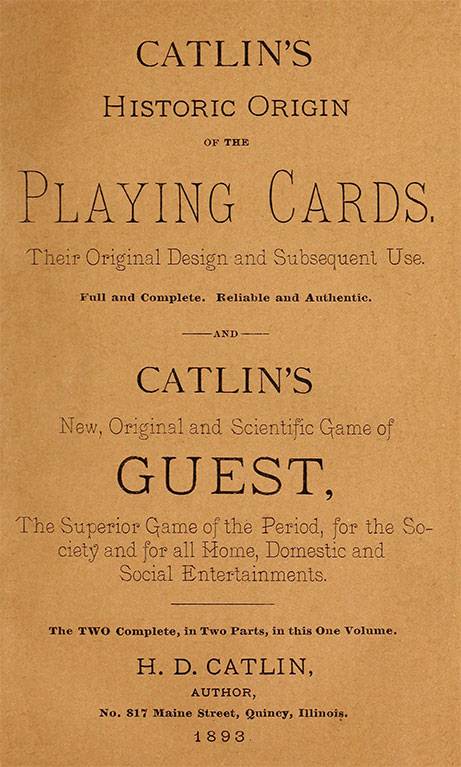
CATLIN'S
NEW, ORIGINAL AND SCIENTIFIC GAME OF
"GUEST,"
The Superior Game of the Period for the Society
and for all Home, Domestic and
Social Entertainments.
The game of "Guest" is strictly a scientific and mathematical game, and yet it is as simple as "A, B, C," and as practical as "two and two make four." It is void of any and all complications, and therefore it is not fatiguing, but on the contrary resting, giving the needed rest required to overcome the mental and physical fatigue of the day and affording a pleasant and enjoyable pastime, uniting the family and home society in a common, mutual and congenial domestic interest. To this end the game has never been equalled; it can never be excelled; it is "perfection perfected."
There can be only three original and legitimate games:
The three most popular games for all home, domestic and social entertainments. The game of "Guest" is the latest and best of the three games. It is played with a selection of thirty-six cards from the original fifty-two card pack, leaving out of use the four 5 spots, the four 4 spots, the four 3 spots, the four 2 spots; and with the introduction of the "Joker" thirty-seven cards are used for the required purpose of having "one odd card," which is, and must be, the defined "trump" with each and every deal of the cards. The deal is made as in "Whist," and the cards are played as in "Euchre."
The design of this game is recognized as "practical business." The "Guest" furnishes the capital by a system of irregular, alternate deposits in the hands of two contestants, business firms, with each and every deal of the cards. Such is the business capital of the two contestants, to gain and save to the end of the play, with success and defeat ever changing. Nine cards are given by the "Guest" (through the dealer,) to each of the four hands. The "Joker" must be held in one of the four hands and not permitted to be exposed on the table. To this end the two last cards, in hand of the dealer, should be consulted, when, if possible, the dealer takes the first and gives the second to the table as the gift of the "Guest" and decides the trump for each and every deal of the cards. The indicating trump on the table is of no value to the hand to be played, as it is the gift of the "Guest" and counts for nothing in the game. Inasmuch as trumps will always predominate, therefore, in honor of and complimentary to the "Guest," the first lead must be a trump card, if such is possible; otherwise the trump lead must pass to the next player; trump must lead; after which, any card may be led at the option of the next leader, when the three players must follow suit, if such is possible; otherwise trump may be played, at the option of the player, as in "Whist" or "Euchre." It will be observed that the trump suit will always be one card more than one-fourth of all the cards in use, and the three side suits (not trump) will always be one card less than three fourths of all the cards in use—ten trumps and twenty-six suit cards. Thirteen points constitute the full game. The counts are decided by subtracting the less number of tricks taken from the greater number, placing the balance to the credit of the parties showing the greater number of tricks taken in each and every hand played. All counts will, of necessity, be one, three, five, seven, or possibly nine, when a full march is made. The "Joker," with the use of the right and left bowers, are of the same value as in "Euchre;" otherwise all suit cards are played as in "Whist" and "Euchre" and of like value.
There is no trump to be taken up, no trump to be ordered up, no trump to be turned down, no alone hand to be played, no cards out of use, no idle player, and no time to be lost. "Time is money." The foregoing objections are more than overcome and compensated by the use and application of a "lapse" of one or more points, in excess of the thirteen points, and made to apply on the next succeeding game. If the winning partners stand on an even number of points they will "lapse" an even number; if they stand on an odd number of points they will "lapse" an odd number. If the game is correctly kept, and the total number of points to the credit of the two partnerships is correctly footed, then by subtracting the smallest total from the largest total, you may have a credit balance of points, showing a duplicate result of the evening's play and a "trial balance" proof of same.
We have endeavored to cover, as briefly as possible, all the ground required to make clear and concise the method of the game, and give the reasons why, after a period of nearly four hundred years, a new, improved and superior game is now demanded to meet the progress of civilization, and give to the public a more modern and advanced game, more in keeping with the spirit of the times, and more congenial to the social enjoyment of the many modern entertainments of the present day and generation.
The game of "Whist" is too lengthy, too fatiguing and too exhausting. The game of "Euchre" is too short, repeats itself too often, and soon becomes too monotonous and uninteresting. Catlin's game of "Guest" continues with unabated interest, does not fatigue and never exhausts. It is based on an exact even divide between the two games of "Whist" and "Euchre" in every particular. In the original game of "Whist" the full pack of fifty-two cards are used, and in the original game of "Euchre" thirty-two cards are used, just twenty cards less than in "Whist," and with the same number of twenty cards held in the four "Euchre" hands. In the present game of "Guest" thirty-six cards are held in the four hands—sixteen less than in "Whist" and sixteen more than in "Euchre." Twenty-one points constitute the original "Whist" game, thirteen points constitute the present "Guest" game, and five points constitute the original "Euchre" game—a difference of eight points in each of the three games. Thirteen cards are held in each of the four hands in "Whist," nine cards are held in each of the four hands in "Guest," and five cards are held in each of the four hands in "Euchre"—a difference of four cards in each of the three games.
In recognition of the two numbers 20, and in remembrance of the twelve idle cards on the table out of use, unknown and embarrassing to the players of "Euchre," the fifty-two card pack, from which the game of "Whist" derived its origin, may be accounted for with special favor on the side of Catlin's new, ingenious and scientific game of "Guest." It is a very genteel game, a very simple game, a very practical game; strictly mathematical, educating mental culture as an accomplishment.
The law of the game of "Guest" is fixed, arbitrary, abiding and unchangeable; otherwise it could not be the superior, scientific and mathematical game designed by the author, and must of necessity be at the mercy of many devices of many players, and soon would cease to be the only law-abiding game known to the historic origin of the playing cards, and sustained by the law of the game which prompted the basis of its origin. The law is fully defined by the following sections:
First—The name "Guest" is fixed, arbitrary and unchangeable, signifying its origin, as expressed in the published game.
Second—The peculiar selection of the thirty-six cards—from ace to six spot, inclusive—as expressed.
Third—The introduction of the "Joker" as the required odd card and commanding trump, as expressed.
Fourth—The thirteen points required to make and constitute the full game, as expressed.
Fifth—The method of count, by subtracting the less number of tricks from the greater number, giving credit, balance only, to the side of the greater number, as expressed.
Sixth—The first lead must be a trump card when possible; otherwise pass the lead to the next player. Trump must lead.
Seventh—The lapse of all points, one or more, in excess of the thirteen points, to apply on the next succeeding game.
Eighth—The position of the indicating trump on the table must be at the left hand of the present dealer, at the right hand of the one who must deal next, under the eye of the four players, and no question to ask or answer is required.
Finale—The game is sustained by the best and most modern law known to the best and most modern system of "Double Entry Book-keeping," on the basis of defined balances, with each and every business transaction, as proved by the final balance sheet of the evening's play of the game of "Guest."
Rules for the play of the game of "Guest" may be at the option of, and sustained by the judgment of each player, so long as the law of the game is fully understood, applied and sustained, with no deviation whatever.
The author would advise and recommend the lead of the "Joker," when such is possible, for your first trump lead; otherwise lead your smallest trump card, trusting the result to your partner's play.
For your second and subsequent leads play the ace, when such is possible; otherwise play your smallest suit card, trusting the result to your partner's play.
When the leader holds a single card of any one of the three side suits, it is desirable for a second or third lead to reduce suit, and thus to give an added opportunity for the subsequent play of trump, trusting the result to your partner's play.
The three games may all alike be made "progressive," and conform to modern custom, under the three popular names of—
The merit due to the game of "Guest" is its practicability, simplicity and perfect harmony, overcoming the two objectionable extremes, alike peculiar to the two games of "Whist" and "Euchre." The strength of this present game is in the close attention and watchful observance of the players, remembering the cards as played and to be played, which may be known alike to each of the four players by a studied application to the play of the game.
Copyright, 1893, by H. D. Catlin.
Transcriber's Notes
1. The printers' error "entertain-tainments" was changed to entertainments on line 382.