
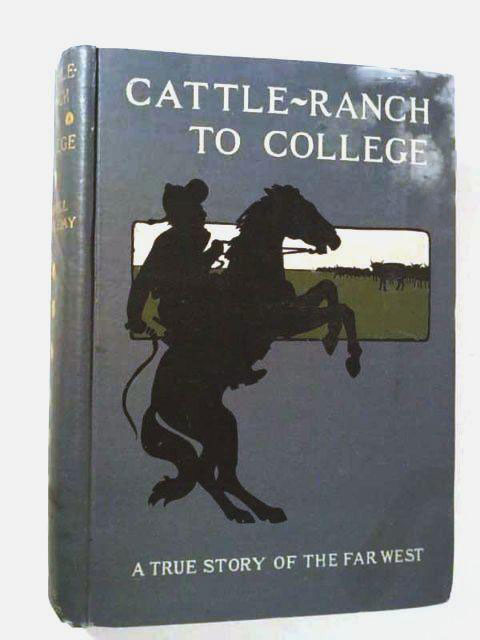
The Project Gutenberg eBook of Cattle-Ranch to College: The True Tales of a Boy's Adventures in the Far West
Title: Cattle-Ranch to College: The True Tales of a Boy's Adventures in the Far West
Author: Russell Doubleday
Illustrator: Janet MacDonald
Ernest Thompson Seton
Release date: May 29, 2012 [eBook #39850]
Language: English
Credits: Produced by David Edwards, Josephine Paolucci and the
Online Distributed Proofreading Team at http://www.pgdp.net.
(This file was produced from images generously made
available by The Internet Archive.)
CATTLE RANCH TO COLLEGE.
CATTLE-RANCH TO COLLEGE
THE TRUE TALE OF A BOY'S ADVENTURES IN THE FAR WEST
BY
RUSSELL DOUBLEDAY
"A GUNNER ABOARD THE YANKEE"
NEW YORK
DOUBLEDAY & McCLURE Co
MDCCCXCIX
Copyright, 1899, by
DOUBLEDAY & McCLURE CO
TO MY MOTHER,
KINDLY CRITIC, COUNSELLOR, AND FRIEND,
THIS BOOK IS
AFFECTIONATELY DEDICATED.
PREFACE.
This is a true tale of a boy's life in the West twenty-five years ago. It is an account of his amusements, his trials, his work, his play. The incidents described actually happened and are described substantially as "the boy" related them to the writer.
The "wild and woolly" West is fast vanishing, and a great deal of the adventurous life is going with it. Buffalo hunts are things of the past; encounters with Indians that were experienced in the time of John Worth's boyhood are now happily very rare; railroads have penetrated the cattle country, and vast herds of cattle are no longer driven long distances to the shipping point, so that the consequent danger, hardship, and excitement are largely done away with.
In places the great prairies have been fenced, in others grain grows where heretofore only buffalo, cattle, and horses ranged, and much of the free, wild life of the cowboy, the ranchman, and the miner is gone for all time.
It is hoped that this book will be of interest, not because of its novelty but of its truthfulness. The author feels that the story of a boy who has passed through the stern training of a frontier life to an honorable place in an Eastern university will be acceptable to boys young and old.
CONTENTS.
CHAPTER PAGE
I. An Indian Attack 1
II. The Young Brave's Daring 20
III. A Narrow Escape 36
IV. Hitting the Trail 54
V. In a Mining Camp 73
VI. A Snowshoe Race 91
VII. A Buffalo Hunt 106
VIII. A Close Finish 122
IX. A "Bad Man's" End 140
X. Battle Royal 157
XI. A Trying Journey 177
XII. A Change of Scene 195
XIII. Herding Horses and Panning Gold 214
XIV. A Migration 229
XV. "Range-Riding" 245
XVI. A Broncho Buster 261
XVII. A Cow-Puncher in Earnest 273
XVIII. A Midnight Stampede 289
XIX. An Awakening 304
XX. A Transformation 317
XXI. Twelve Hundred Miles Awheel to College 331
LIST OF ILLUSTRATIONS.
A XXX Bunch Frontispiece
FACING PAGE
Mounting a Bucking Broncho 14
Glancing over Saw an Indian Village 32
Custer's Command 50
The Tail of the Cook's Wagon was let down 62
The Stock of the Rifle Rested Closely against His Cheek 86
Ben Went over to where the Game Lay 86
Roping an Unbroken Horse 98
"Crow Hat's Facing this Way" 104
The Indian Camp 104
The Biggest Game the Country Afforded 118
A Squaw ... just Saw Some Buffalo 118
A Shepherd ... Alone with His Flock 136
A Difficult Task if there are Many Lambs in the Flock 146
Mr. Worth had Built for Himself a New House 158
The Sheep Ranch House 158
He ... Bucks, Pitches, Kicks 170
Curran, Brady's Night Wrangler 190
The Men Broke up into Little Groups 210
A Rope Corral was Drawn about the Saddle Band 220
Each Man Took His Rope and Flung it over the Horse he Wanted 236
A Little Box of a Cabin it was 248
The Snubbing Post Holds Him Fast 264
Jerry Takes in the Slack 264
John Knots the Rope Loosely Round his Neck 264
Roped 278
Thrown 278
Whose is it? A Question of Ownership 278
Dragged it up to the Fire 290
... while the Iron was Applied 290
Herds were Pouring in from Every Direction 308
The Drive ... Fording a Stream 320
The Sun River Ranch House 334
MARGINAL ILLUSTRATIONS BY JANET MAC DONALD.
The drawings of beaver, etc., on pages 75, 84, and 90, by Ernest Seton Thompson are reproduced through the courtesy of Recreation.
CATTLE RANCH TO COLLEGE.
CHAPTER I.
AN INDIAN ATTACK.
A solitary horseman rode into the little frontier town of Bismarck, shortly after dark one evening, about twenty-five years ago. Horse and rider passed up the single unpaved street; in the darkness no one noticed the fagged condition of the animal, nor the excitement of the rider, betokened by the continued urging of his weary pony.
The town was unusually full of the nomadic people who made up its population, cow-punchers, saloon keepers, gamblers, freighters, and outlaws. The evening quiet was constantly broken by the sounds of revelry, and the report of a pistol occasionally punctuated the general noise as some hilarious cowboy playfully shot at the lights.
In the dim ray cast across the street through the small windows of the saloons and dance halls, no one saw the horseman ride up the street to "Black Jack's," one of the most conspicuous saloons; here he stiffly dismounted and tied his pony to the pole where stood a row of other horses. After glancing around to see that all was secure, he entered. He was hailed with a chorus of shouted greetings and questions.
"Hello, Harry! what's the matter?"
"Why, there's Harry Hodson! What drove you down the trail to-night?"
"Are you dry, old man? Come and drive a nail with me."
These and many more questions poured in on him so thick and fast that no chance, for some time, was given him to speak.
As the crowd drew around the newcomer, who was a sober, steady cattleman from twenty-five miles up the river, they noticed that there was something out of the ordinary in his manner. Even the fact of his appearance at that place and hour was unusual.
"No, boys," he said, in answer to the many invitations to drink. "I think we'll all need clear heads before daylight."
"Why, what's the trouble?" chorused the crowd.
"The fact is," continued Hodson, hurriedly, "I cached my cattle and then came down to tell you that a big bunch of Indians crossed the river above my place this afternoon, and they looked as if they were on the war path."
All were attentive now, and even the most reckless of these wild men, living continually in the midst of dangers, wore grave faces.
"I didn't stop to investigate. I wasn't taking any chances, you see," he went on. "So I ran my cattle over onto Woody Island and then started down the trail, giving the word to the fellows along the road. Hostiles have been pretty thick across the river lately, and I've had to watch out."
By this time all hands were thoroughly interested. As Hodson went on with his tale, the men drew nearer to him, their faces showing how keenly they realized what his news might mean to all.
Questions followed thick and fast.
"How many were there? Where did they cross?" asked one.
"How many horses? Did they have any squaws with them?"
Without giving Hodson a chance to answer, they all began to talk in an excited babel of voices, advancing opinions and theories as to what had taken place. One big fellow, in a red flannel shirt, asserted that they must have crossed the river at Elbow Island; another contradicted this statement and said that the stream was too wide at this point and that they crossed in "bull boats," as the rude craft made of buffalo or cow hides stretched over strong light frames of willow were called.
Hodson stood apart while this discussion was going on, with the bored air of one who was fully acquainted with the facts and could end the unnecessary talk in a moment if he was allowed an opportunity.
"Big Bill" Smith, one of the older men, took in the situation. "Dry up," said he; "let Harry talk, will you? He's the only one who knows anything."
"Well," said Harry, as the crowd once more turned to him, "there isn't much talking to do, but there's plenty of hustling ahead for us. About two hundred Indians crossed the river up at Sioux Ford. They were travelling pretty light, and I guess they are looking for beef or anything else they can lay their hands on; probably they think they can scare us off with a few shots and then run the stock off. They had a lot of horses—not enough to go around—but a lot. We've got to get ready for them on the jump, for if they're coming they'll be here before daylight, and the stock and wagons will have to be got in right away."
"Somebody go for Jim Mackenzie," said Big Bill.
As one of the men started for the door to carry out this order, a tall, commanding figure, grizzled and somewhat bent, but more from hardship than from age, entered the room. He was recognized at once as the sheriff: the central figure when trouble was brewing, but a retiring, inconspicuous citizen when all was peaceful.
When action was required he was in his element. A man to depend on in time of trouble, one to command in an emergency. It was very noticeable that these rough cattlemen, accustomed to depend upon themselves, who when off duty acknowledged no law except their own wishes, instinctively looked for a leader when confronted with this common danger. No one thought for an instant of questioning his orders, but obeyed with military precision. For the time, his word was law.
"Harry," said the sheriff, turning to the bringer of these bad tidings, after the above facts had been told him, "you put your saddle on my bay and take a couple of men with you back on the trail. Bring back Jim White and his outfit of wagons and stock; he's camped down on Hay Creek. There are some smaller outfits on the Black Hills road; better help them get in. You'll want to hustle," he added, as Hodson and his two helpers went out.
"Smith," continued the sheriff, issuing orders as fast as a pony could trot, "take a couple of men and get in the circle bar stock, there's only a night-herder with them. The rest of you who have wagons and stock out, bring them in yourselves. All you loose men," he added, as he noticed that several men still lingered in the hot, close, smoke-filled room, "get your guns, saddle up, and come to my shack."
The sheriff had been in the place but five minutes, but now fat Sam Whitney, a frequenter of the place, Black Jack, the saloon keeper, and a couple of soldiers from the fort across the river, were all that remained with him.
The men outside could be heard saddling up, struggling with their refractory horses, and calling out to each other; from time to time the rapidly diminishing sound of galloping hoofs came to the ears of the silent men who for the moment remained motionless.
The sheriff was planning his defence against the expected Indian attack, and the men who were with him, without a word, waited for the announcement of his next move. It was Jim Mackenzie, and they put themselves in his hands with blind confidence.
Bismarck was a frontier town in the full sense of the word. A collection of rude houses, more or less strongly built of logs and dried mud, straggled along the single street. Placed at the intersection of the expected railroad and the Missouri River, a town of considerable size was mapped and many streets with high-sounding names were projected. But only Main Street was actually laid out. The houses, which their inhabitants called shacks, were built on the north side of the street facing the south, in obedience to the natural law of cold climates, so Bismarck boasted really of but half a street, and that a short one.
Fort Abraham Lincoln, situated directly across the river, was supposed to afford protection to the settlers from the Indian marauders, but the hardy, self-reliant frontiersmen were generally able to take care of themselves. Not many of the inhabitants stayed the year round. The few who did remain through all seasons—the saloon keepers, horseshoers, stable keepers, and the three families—dwelt in the more pretentious houses. The other residences were mere temporary shelters, which their owners would not have considered worth fitting up had they been able to do so.
Around the outskirts of the town were always a number of freight outfits, and this night was no exception to the general rule. The cumbrous wagons were drawn in a circle, harnesses lying in a seemingly hopeless tangle on the wagon tongues, and the tents were pitched against their sides or canvas lean-to's were rigged up. A number of greasy men lounged around the campfires, some sleeping, some re-braiding whips, some mending harness or chopping out new brake blocks. The work stock were grazing at a little distance where the grass was good, guarded by an armed herder.
To these freighters' camps came the sheriff himself to warn them of the impending danger. Immediately all was activity. The work stock were brought, and, in a trice, harnessed to the heavy wagons. The mules were urged forward with shouts and cracking of whips, and soon the whole outfit was on its way to form a cordon around the town, or, at least, on the side that was most likely to be attacked.
Mackenzie rode with the wagon-train for a short distance, then branched off after giving some final orders, or rather suggestions, for any emergency that might arise.
"So long," he said.
"So long," said the driver of the leading team. (Whether a man was leaving for a trip across the street or across the continent, the parting words were, invariably, "So long.")
Mackenzie went on his way, skirting the town, keeping his eyes and ears wide open. There was nothing within hearing to indicate that the settlement was in danger of attack from the dreaded Indian. The teamsters could still be heard shouting to their mules, and an occasional creaking squeak from the wagons broke the stillness. The sheriff listened in vain for more ominous sounds.
"The reds are still pretty far off, or they are keeping mighty dark," he said to himself, as he put spurs to his horse and galloped towards one of the better-looking houses that stood on a little rise some distance from the Main Street settlement. Messengers had been sent in every direction, to warn sleeping citizens, and all had been arranged for except this household, one of the three families of the town.
Mackenzie rode up to the door and, without dismounting, knocked.
In an instant there was a sound of bustling, for the Westerner sleeps with one eye open, and is ready at a moment's notice for anything that may occur.
"Who's there?" shouted a voice.
"Mackenzie," answered the sheriff.
Almost at the same moment the door opened, and a man stepped out.
"Hello, Worth!" said the sheriff. "You'd better bring the wife and children further down. Harry Hodson just came down the trail and reports a big bunch of Indians a few miles up, and——"
But Worth did not wait to hear any more.
"John," Worth shouted back into his shack; "you and Ben help your mother pack up the bedding and take care of the baby. We've got to be lively. You know what to do. You see, Mac," he said, turning to the horseman, "I thought I might as well get things started while you were telling me about these hostiles."
"All right," said the sheriff. "Good scheme. You might as well saddle up and come along with me so you can find a place beforehand for the wife and kids."
In a few minutes both men were on their way to the centre of the town: Mackenzie, to send out his pickets and guards, and to arrange the placing of stock and wagons; Worth, to find a temporary shelter for his family. The boys, John and Ben, were left behind to look after the home, pack up the goods, catch and saddle the horses. It was a seemingly big task for boys of ten and twelve, but from the time these boys were able to walk they—in common with other boys of the frontier—had to look out largely for themselves. They were strong, sturdy little chaps. John, the elder, was his father's right-hand man, and when Mr. Worth was away on one of his frequent freighting trips, John was often called upon to take care of the family in emergencies much like the present one.
In this frontier town, the reports of bands of hostile Indians coming to raid and kill were not uncommon. The single man, active, mounted, armed with weapons as familiar to him as his right hand, had no fear of not being able to outwit or escape the enemy, wily as the redskins were. In fact, the Indians themselves were well aware of the ability of the plainsmen to cope with them when unhampered by women and children, so they practically never began hostilities until they could get their white enemies at a disadvantage. The few families were, therefore, their especial point of attack. It was their helplessness that tempted the onslaught and aroused the savage instincts of these marauders. When the head of the family, the bread winner, was away, the dread of these fearful, relentless attacks on his helpless ones abode with him always. The mother and children, left at home, lived always under the shadow of the same fear.
John and his brother, therefore, fully understood the danger and the need for speedy and careful preparation. They had often, at the warning of the hostiles' approach, helped their mother make a fort of the solid log house by piling up the scanty furniture and bedding against the doors and windows, leaving only loopholes for their rifles; and though the present situation was one that would make ordinary boys useless through fear, John and Ben, on the contrary, were too busy to worry; they knew exactly what was to be done, and in their sturdy, independent way went to work to do it.
"Say, Ben," said John, as they went toward the corral (the circular inclosure in which the saddle horses were kept), "I'll bet it's just those Indians we saw across the river, day before yesterday, while we were hunting Gannons' horses. There was a lot of squaws in that bunch, do you remember?"
"That's right," assented Ben; "and I'll bet that some of Gannons' horses were in that lot of Indian ponies. If it was ten dollars reward instead of five, it might have been worth while to run the risk of trying to find out; but five dollars is too little to go fooling around a strange Indian's camp for."
The talk was ended by their arrival at the corral and the subsequent busy time catching and bridling of the horses. The ponies were then led to the door, where they were saddled. As they were cinching them up—as the tightening of the girths is called—Mr. Worth returned. In a few minutes the whole family were on their way to the Sebells', one of the other Bismarck families who lived on Main Street.
In town they found all activity. Horsemen were galloping to and fro, cattle, horses, and mules dashed in and out, wagons driven at full speed crossed and recrossed the dusty street. As soon as they were installed at their new-found shelter and their household goods disposed of, John went with his father to get in the extra stock of horses and mules, for, next to his family, these are the freighter's chief care.
They found their stock together, as was expected, for animals, particularly horses, that come from the same place, always stay together. This instinct made it much easier for the herder to gather his own, when there were many animals belonging to different outfits on a common grazing ground. The Worth stock was promptly driven inside the now almost complete circle of wagons, and there tied.
A group of men were busy piling up boxes, barrels, and bales, taken from the freighters' wagons, into the semblance of breastworks. As John and his father approached, the sheriff came forward and joined them.
"Family all right, Worth?" he asked, kindly. "I sent up a couple of men to help you and they reported that your shack was deserted and the place locked up for keeps. You didn't waste any time."
"That was good of you, Mac," said Mr. Worth, holding out his hand. "How you're able to think of so many things at once, beats me. Yes, we got out in pretty quick shape; you see my boys, Johnny here and Ben, are first-rate hands to depend on in an emergency. They did pretty near the whole thing to-night. By the way, the boys were hunting horses up the river day before yesterday, and saw quite a large bunch of Indians in the brush below Harry Hodson's."
"Why didn't you say something about this before?" interrupted the sheriff, turning to John.
"Ben and I have seen plenty of Indians," said John, eagerly. "There were a lot of squaws in this bunch, so I didn't believe they were a war party. We didn't think anything more about them until this scare came up to-night."
"Well, you have got a good head on you, young man. I don't know but you are right, and this may be a false alarm. Still Hodson generally knows what he's talking about." The sheriff was speaking more to himself than to his hearers. "I'm glad we've got a lot of first-rate scrappers with us; I guess the reds would think twice if they knew what they were running up against."
All was now comparatively quiet. The work and strain of preparation was succeeded by a time of waiting, a period of suspense that was, perhaps, harder to bear than the first shock of the unpleasant news.
John and his father returned to their temporary home to calm the mother's fears. Mrs. Worth had the family rifle ready, and Ben had polished and oiled every cartridge in the belt, so that they would slip in without jamming. Mr. Worth shouldered the gun and went out, leaving the boys with their mother. Though all was now quiet and his mother and brother were asleep, John could not close his eyes. He understood, as his younger brother could not, the danger that menaced the household and the town. Death, swift, by knife or bullet, or slow through torture, was sure to come if that band of Indians got inside the inclosure. He had heard gruesome tales describing the treatment that the savages meted out to their prisoners and the horror of it would not leave him. At last he could stand it no longer. Quickly he rose from the heap of bedding and stole to the door. He was fully dressed, and his little six-shooter still slung on his left hip where he had buckled it when the sheriff first knocked at the home shack.
All was still outside, except for the occasional stamping of a pony or the distant wail of a coyote. Pickets were posted just over the rise to the north of the town, from which direction the attack was expected. They were to give warning of the approach of the Indians by a rifle shot.
Suddenly there was borne on the breeze to the waiting men the sound of galloping horses. Louder it grew, then fainter; then again still louder. So the sound wavered, but ever came nearer.
The watchers sprang to their feet, rifles ready, eyes gleaming.
"Steady, boys," said the calm voice of Mackenzie. "Wait a bit."
Still the thumping of many hoofs approached nearer.
What had become of the pickets? Had they been all killed with the enemy's noiseless arrows? Or had they been lured away beyond hearing and shot?
Daylight was breaking; the enemy could now be seen, that was one comfort. And as they stood, ears alert, eyes strained, their nerves keyed up to the tensest pitch, awaiting the onslaught, that ominous noise of hoof-beats came ever nearer, nearer, nearer.
Suddenly a horse's head appeared above the brow of the hill, then another and another until quite a score or more were in plain view. They dashed down the incline toward the corral of wagons. But they were all riderless! Presently two riders appeared. They shouted a greeting as they came down the hill and explained that they were of the N bar N outfit (that is to say, their brand bore these marks: )
A space was hastily cleared between the wagons to allow these newcomers' horses to enter the inclosure; but it was too late; the bunch parted, turning to right and left. The two herders also separated in pursuit, each following a bunch.
Immediate danger over, the waiting men relaxed their extra vigilance, and all hands watched the efforts of the two herders in their vain attempts to head off their charges. The sheriff was just saying, "I wish some of you fellows would help round up that bunch; we want to get them all in before the hostiles show up," when a third horseman appeared, riding like the wind.
"Say, that chap has got a fresh horse," said "Casino," one of the freighters.
The new arrival, after a headlong dash, regardless of ditches, brush, and badger holes, succeeded in rounding up the frightened horses, and with the help of the herder, drove them into camp. A similar performance soon brought in the other bunch.
As the new rider trotted in through the gap, some one shouted: "What'll you take for that horse? He's a regular whirlwind."
"Yes," said one of the herders, "he's a dandy, isn't he? My stock would have got away if Johnny Worth hadn't come out on Baldy."
"So it's Johnny Worth, eh!" said Bill Smith. "Good work, kid."
"Oh!" said Johnny, "they're only worn-out, winded plugs; they were easy for Baldy. He was saddled and all ready," the boy added in explanation.
"Well done, Johnny," said the sheriff, who had once before that night praised the boy's pluck. Then, turning to the group about him, "Some of you boys had better get breakfast," said he; "there's no telling when that war party may turn up, and you must eat now when you have the chance."
CHAPTER II.
THE YOUNG BRAVE'S DARING.
While the men were eating (a sufficient number being left to keep watch and guard) in one of the dance halls, which was hastily impressed for the purpose, the herders of the N bar N outfit were questioned as to their knowledge of the Indians.
They reported that the redskins were in force and were coming rapidly in the direction of the town. That while they were guarding their stock, they were startled by the sudden appearance of an Indian near them, who yelled and waved his blanket, and finally succeeded in stampeding the animals. They started off at a gallop after the horses, and this solitary brave forthwith disappeared.
The stock stampeded but the herders stayed with them, riding full speed over all sorts of rough country. The Indians appeared at intervals in pursuit of them, and added to the confusion and danger by keeping up a running fire.
The herders said they were about to give up the attempt to keep their charges out of the savages' hands when they came in sight of the town. "Even then," said one of the men, called Singing Jim, "we couldn't have corralled the beasts if that youngster hadn't chased out to help us on a fresh horse, and a fast one at that."
"We'll have troubles yet," said the other herder, Calamity Jake he was called, because of his ability to see small black clouds of evil a great distance off. "Plenty of trouble, too, in the shape of Indians on the warpath. They were not far behind us when we reached these diggin's."
"What became of your wagons?" said Harry Hodson, a mouthful of beans interfering somewhat with his speech.
"Oh, I guess they're done for. Probably makin' light for the Indians to do a war dance by," remarked Singing Jim, cheerfully.
"I reckon not," said Mackenzie, who had appeared in time to hear the last; "they'll not show their location by making a big blaze like—"
"I heard a shot fired from over the hill," shouted Johnny, who stuck his head in at the door that moment. "Maybe it's one of the pickets."
The men jumped up and made a rush for the door. The herder, Singing Jim, who was the last man out, exclaimed as he disappeared, "Well, if that kid ain't ubikkertous, as the States' papers say!"
Several shots were now heard and then the pickets topped the rise and made a break down the slope to the town.
The enemy was close, but still invisible behind the ridge.
The men lay crouched behind their barricade, silent, alert, ready for what might come. The three pickets made their way back to the breastworks and reported that the advance guard had shown itself coming down a coulie half a mile away, and the main body, probably fifty strong, was straggling after when the pickets last looked back. A long night of vigil and hurried preparation had told on these watchers and they were anxious to begin the work and end the suspense. The short ten minutes which elapsed seemed ten hours. Then two Indians rode to the top of the ridge and looked down upon the preparations for their reception. They were a long rifle shot distant and the defenders had no ammunition to spare. Moreover, if unprovoked, the redskins might go without firing a shot. To tell the truth, however, especially when they saw the unlikelihood of making a successful assault, most of the little garrison were in the mood to feel disappointed if the attack ended so harmlessly.
"If those fellows are hard up for a fight," said Big Bill Smith, "maybe they'll tackle us; but I never saw an Indian yet that would ride a quarter of a mile in the open under fire even when he wanted something to eat,"—and Bill knew Indians.
"They won't leave without tryin' us," said Casino. "You'll see if I ain't right."
A moment later two painted and befeathered savages appeared to the left, and rode full tilt along the hillside in direct view of the camp, yelling and waving their blankets in derision: a tantalizing sight to the waiting men.
"Keep steady, there," called Mackenzie, sternly, as several rifles were raised. "There's no use shooting now; they're only trying to draw our fire and find out how strong we are. There'll be more presently. Wait for them."
A few minutes later half a dozen braves repeated the ruse. The flying figures, almost naked, being poor targets, the fire of the little garrison was still reserved. A dozen then made the run, one following the other, at regular intervals. More and more of the painted, yelling, gesticulating savages followed, dashing along the slope in single file and disappearing over the ridge to the right, until what was a short line became a procession.
Presently they began to creep down the hill, each rider advancing beyond the one preceding him, all yelling epithets of contempt as they came ever nearer the silent garrison.
This was the regular mode of Indian attack; it afforded them an opportunity to fire and yet gave their enemy a very poor chance to do any damage.
A desultory firing began; each Indian letting go his reins, fired his rifle as best he could as he rushed past. The shooting was naturally bad, for there was no chance to take careful aim. If the savages planned, however, to draw the fire of the besieged and so determine their strength, the scheme failed, for not a shot was fired from the camp, though the provocation was great.
The rushing line came closer and closer. The colors of the war paint and fluttering feathers could now be plainly seen. It was within easy range, but still the fire was withheld. Each Indian had worked himself into the frenzy which is so necessary a part of a brave's courage.
As the distance was lessened, the savages' aim became better, and several bullets struck the wagons and the barricade. The situation began to be interesting; any shot might now reach its human target, and the temptation to return the fire was almost irresistible.
But the sheriff only said, "Not yet."
The bullets were striking freely and the yelling enemy were within easy revolver range.
At last Mackenzie, who showed signs of suppressed eagerness, said, just loud enough to be heard: "Boys, don't shoot when your man is opposite; wait till he has passed, then aim at his back and shoot straight. You can't hit him otherwise. Ready now. Fire!"
This was not a military company, but a band of frontiersmen, which a common danger united under the leadership of one man. The volley which followed, therefore, was not one of precision, for every man took his time and pulled the trigger when he was ready.
The Indians, anticipating a return fire, rode by at full speed, their bodies hugging their horses closely. They made difficult targets, so the first few shots did nothing more than kill and disable a horse or two; but soon the fire became more rapid and accurate. A big buck was seen to fall out of his saddle, another was thrown violently from a wounded horse, several were hit in arms and legs. The yelling diminished and the line moved further up the slope, scattering as it went.
As the file, now rather scattered, turned the ridge at the right, firing as it moved, a young buck, in full war regalia and mounted on a beautiful bay pony, bounded into view. He dashed out of the circle of Indians, and rode boldly down toward the white men, yelling defiance.