
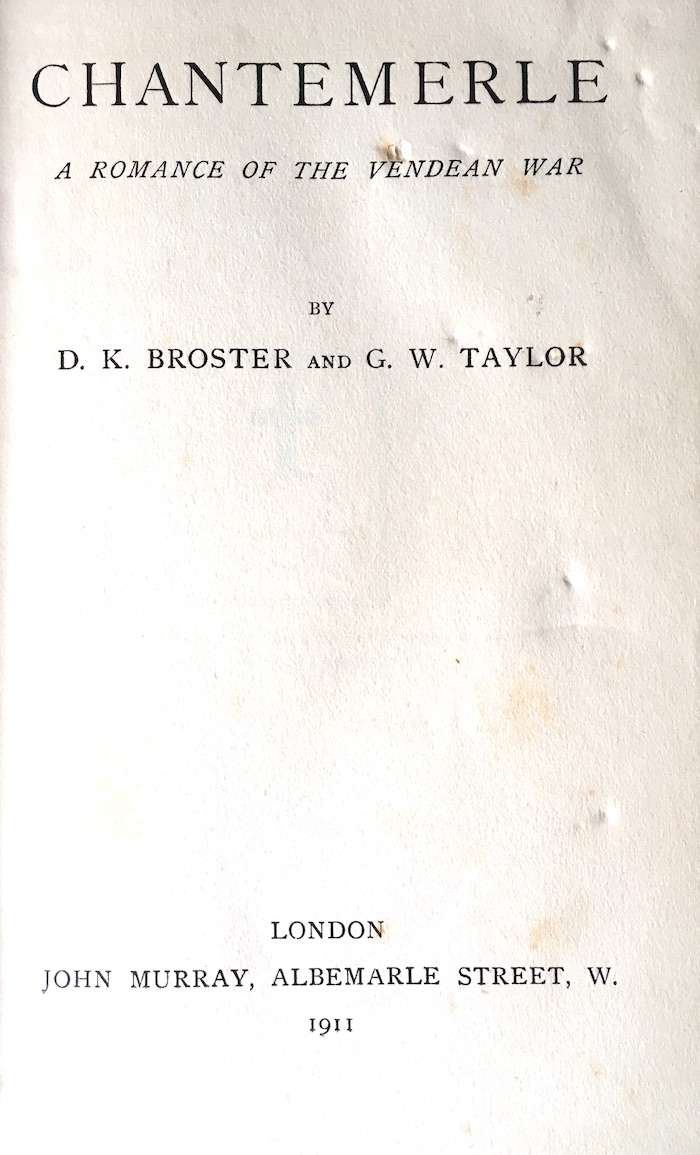
As the sun set on Nuillé-sur-Vicoin a single horseman clattered into its main street, and, drawing rein before the Soleil d’Or, looked about him. Mr Harry Trenchard had been journeying in France for pleasure, but even to his impassivity there had come an intimation that the pleasure was well-nigh over, and that its place was being taken by an increasing peril which was not, however, without its own charm. The young man—he might have been thirty—was therefore proceeding to Nantes by leisurely stages, and on horseback, as his custom was, he having a dislike to the diligence. Tall, well-built, well-dressed, he sat his mare with a confident aspect, and as he looked along the almost deserted street he exclaimed aloud at the negligence of the hostelry which hung out its sign of refreshment and provided no ostler to hold the steed of the traveller.
He shouted; no one appeared at the moment, but, as he withdrew his foot from the stirrup preparatory to dismounting, the figure of a young man emerged from a side-street on his right and crossed the cobbles towards the inn. Mr Trenchard was not sure that his voice had evoked him, but as he looked very shabby he hailed him again in his resolute tones.
“Hi! my good fellow, come and hold my horse! I shall be out in a minute.” He swung out of the saddle as he spoke, and when he turned, with the reins in his hand, was astounded to find the shabby young man regarding him with what he instantly characterised to himself as “a d——d insolent French stare.” He looked very handsome, rather ill, and at the moment decidedly quarrelsome.
“You want me to hold your horse!” he exclaimed in tones of mingled anger and astonishment.
Trenchard attributed this resentment to the form rather than to the nature of the request, since the newcomer seemed by no means too prosperous to be above acceding to it.
“I beg your pardon, citizen,” he said, with scarcely veiled sarcasm. “I forgot that I was not giving you your proper title. I assure you that I meant no disrespect to you nor to the French nation—but if you will not hold her, will you tell me where I can find a citizen who will?”
Instead of being further irritated by this somewhat unwise address the shabby young man appeared mollified. The frown disappeared, and, suddenly smiling an easy smile as one who is amused at an idea of his own, he came nearer and put a hand on the bridle. His other arm, as Trenchard now remarked, he carried in a sling beneath his well-worn coat.
“There is no need; I will hold her myself, citizen traveller,” he said with a composure not unmixed with the air of one conferring a favour. Nor was his French, even to the ear of a foreigner, the French of the lower classes.
Trenchard swept a hasty, half-puzzled glance over him, and went into the tavern. Outside Louis de Saint-Ermay, who loved all horses, stood with her bridle over his arm and talked to the Englishman’s mare.
“Was I not a fool, ma belle, to be angry? But it was startling, confess now,” he said, stroking her muzzle. “I hope your master will be generous to a poor one-armed devil. And are you not to get anything yourself?” The mare, pleased by the voice, began to sniff at him, and finally dropped her nose on to his left shoulder. Louis winced, and, smiting her softly under the chin, induced her to remove this mark of favour, on which she searched his pockets for apples, and the Vicomte, whistling idly, looked at her beautiful lines and wished that he and Gilbert had a couple of steeds like her in place of their own broken-down hacks.
Presently out came the mare’s rider again, tapping his booted legs with his riding-whip.
“Hallo! my beast seems to have taken a fancy to you, citizen. I have changed my mind about going on; I shall wait until to-morrow. But I shall want my horse put up, and there seem to be no servants at this inn.”
“There are scarcely any,” responded Louis. “I will take your horse round to the stable if you wish.”
“Thank you, citizen,” said Mr Trenchard, feeling in his pocket. “And see that some one attends to her.”
“If you want that done,” advised the Vicomte, “you had better come round with me, for most likely there will be no one there, and though I would willingly stable her myself—she is such a fine beast—I am not sure that I can manage it with one arm.”
Again the Englishman looked at him, puzzled at his easy tone, and the assignat between his finger and thumb dropped back into his pocket as he postponed the moment of recompense. Louis smiled to himself as he turned to lead the mare; the little interlude was amusing him.
The stables, by courtesy so called, rather resembled a cowshed, and the yard was thickly coated with various kinds of mire. Here, however, they did find a sort of ostler, to whom Trenchard a little suspiciously committed his mare.
“I shall come out again shortly and see that you have done your work properly,” he said severely, and turned round to reward the holder of his steed, fully expecting, he knew not why, to find that he had slipped away. But the shabby young man stood at his elbow in evident expectation of some recognition of his services.
“Thank you, citizen,” he said gravely, pocketing the blue ten-sol assignat without a trace of embarrassment. “If you want me to hold your horse again you will find me in the inn.” And with a species of salute he made his way over the filth of the yard towards the hostelry. The Englishman could have sworn that he laughed softly as he went.
By nightfall the traveller was fully persuaded that the Soleil d’Or was the worst of all the bad French inns on which he had chanced on his wanderings. He had the best bedroom, which a tawdry attempt at magnificence rendered only the more squalid, and he had also the best supper, a meal which merely awoke in him a wonder as to what the worst could be like. To eat it he sat at the best table spread with the best cloth, and he thought as he surveyed the latter article with disgust, that the inferior tables at the other end of the room, which had none, might be preferable. And while he studied these less lofty places he saw at one of them, to his surprise, his acquaintance of the afternoon. Seen without his hat, in a room full of bucolic faces, he—as well as the companion with whom he shared the little table in the corner—seemed to the Englishman oddly incongruous with his clothes. The discrepancy was so striking that he became curious.
“Can you tell me who those two men are—who is the one with his arm in a sling?” he demanded of the frowsy wench who removed the thing of skin and bone, afloat in tepid water, which the inn termed a roast chicken.
She followed his glance. “He is a druggist’s assistant, Monsieur. The other is the apothecary.”
“Apothecaries!” repeated Trenchard, incredulously, looking at them again.
“Yes, sir. The citizen apothecary himself bound up my hand for me this afternoon when I cut it. He is very skilful.”
“H’m,” said Trenchard sapiently.
He resolved to speak again with the shabby young man, whom he once saw glance laughing in his direction, but when he had finished the two companions were gone, and he did not see them again that evening. Later, when Trenchard tossed in the best bed, he regretted that he had not applied to the apothecary for some specific against its other occupants.
But the apothecary might himself have been in the same need, for the attic which he shared with his assistant was, outwardly at least, more objectionable than the Englishman’s chamber. Nevertheless, on one of the two pallets which lay, without bedsteads, on the bare floor, near the single dormer window, Louis slumbered peacefully. Château-Foix, on the contrary, was looking up at a solitary star, the only clear object in view either of his eyes or his mind. At last the star, much gazed at, seemed to grow dim and die out, and then all at once he was staring at it again, grown brighter than ever, with the consciousness of having heard a noise. He listened; it was repeated, and defined itself as a gentle tap at the door.
For a moment Gilbert hesitated, then he decided not to wake the sleeper, and got up to see what it was. When he drew back the crazy bolt he saw standing there, a lantern in her hand, the slatternly girl whose fingers he had that afternoon bound up. She looked completely terrified.
“Go! go at once!” she said in little gasps. “You will all be murdered, or put in prison at least! I heard them say it.”
“Who?” asked Gilbert, bewildered. “And who will be murdered?”
The girl glanced nervously down the staircase. “May I come in, lest they hear me?” And as the Marquis stepped back for her to enter she went on quickly: “You and your friend, the English milord. They say that he is one of Pitt’s spies, and that you are aristocrats. O mon Dieu, the dreadful threats! I heard them in the bar-room. They are half drunk; they will denounce you to the section if they are sober enough, but they will come up and cut your throats if they get drunker.”
At least the girl seemed persuaded of the truth of her warning. The lantern swayed in her shaking fingers, and her ugly features were rigid with terror. What she said was, moreover, quite possible. Gilbert went across to his cousin’s pallet.
But Louis had already struggled up on to his elbow. “What on earth are you doing?” he demanded in a sleepy voice. “Is this an assignation?”
Château-Foix told him, while the trembling girl implored them to be quick.
“Oh, let us leave by all means,” observed the Vicomte when Gilbert finished. “Can we get at our ci-devant horses; they might go faster than we can walk.”
“Here is the stable key,” put in their protectress. “There is no one about at the back, and a lane leads from the yard. I will help you saddle the horses.”
“And the Englishman?” asked Louis, getting to his feet. “Has no one warned him?”
“We cannot very well leave him,” said Château-Foix. “Still——”
“Oh, we will give him a chance,” said Louis cheerfully. “He is a good fellow; perhaps he will tip me again. Just help me into my coat, Gilbert, and while Mademoiselle and you get the horses ready, I will go to the milord’s room.”
As Louis in his disabled state could be of little use in the stable-yard, Gilbert reluctantly consented to this plan, and as silently as they could the three stole down the creaking staircase.
So it befell that Harry Trenchard was roused from a deep though troubled slumber by a hand which vigorously shook his shoulder, and by a low voice adjuring him in English instantly to get up. As his eyes blinked in the sudden candle-light he pushed his hand quickly under the pillow.
“That is useless,” said the voice. “I took it away before I woke you. I am the man who held your horse, and I have come to tell you that you and I and my cousin are in danger of being murdered.”
Trenchard lay for a full ten seconds and stared at his midnight visitor without speaking. Possibly his survey convinced him, for at the end of that time he said slowly: “Then I will get up.”
“Pray do, and be very quick and quiet,” said Louis, seating himself on the bed. “Are you a spy of Pitt’s?”
“Oho! is that the game!” exclaimed Trenchard as he got out of bed. “No, I am not. And—imagine your speaking English!—why should we be murdered together?”
Louis told him, very laconically, while Trenchard hurried on a portion of his clothing.
“Then you are a proscribed aristocrat?” he asked, surveying the shabby figure with interest.
“So they suppose,” returned Louis with composure. “Are you nearly ready, because we cannot wait much longer.”
Trenchard finished buttoning his waistcoat before replying. “I am not sure that I shall come,” he said suddenly. “Why should I run away from these rapscallions? I would rather see it out.”
Louis got off the bed and scanned him with a glance between amusement and annoyance. “Very well, milord,” he said. “Here is your pistol. Perhaps, then, one of us may have your horse?”
“Confound you!” said the traveller, rather angry. “Why should you take me for a fool? Why don’t you stop too?”
“Because the next knife I have into me may go further than the last,” returned Saint-Ermay with meaning. “However, it is nothing to me whether you come or no. I have warned you.”
Mr Trenchard, half into his coat, stared at him across the bed, and the dimly-seen figure may have suggested to him that, after all, the more adventurous course lay in following the unknown out into the night.
“I don’t know who the devil you are,” he said, “but I’ll come with you.”
CHAPTER XXIV
“I SENT A LETTER TO MY LOVE”
Fortune was markedly kind to the fugitives. The bar-parlour of the Soleil d’Or, whence indeed a considerable clamour was heard to issue, lay in the front of that hostelry; the stable-yard was completely deserted, and its deep dirt silenced the horses’ hoofs. In less than ten minutes after their reunion, the three men were riding unchallenged along the high-road, into which the lane from the yard had conveniently and unostentatiously conducted them.
“We are in luck, by Gad!” observed Mr Trenchard feelingly. “I cannot be sufficiently grateful for your warning, Monsieur. May I, without indiscretion, know whom I have the privilege of addressing? My name is Trenchard.”
“Forgive me,” said Louis, “and let me present my cousin, the Marquis de Château-Foix. He has a fancy for travelling as a druggist, and you may address him as the Citizen Pomponne. I am the Vicomte de Saint-Ermay, his incompetent assistant.”
“If I had only known——” began the Englishman in some confusion.
“You would not have given me ten sols,” finished Louis, laughing. “I know it, but I shall not return your bounty.”
The Marquis remarked politely that he was glad to make Mr Trenchard’s acquaintance, though in unpropitious circumstances, and asked him how long he had been in France.
“Quite long enough,” responded Mr Trenchard, “to see that this country, if you will pardon my saying so, is in a devilish bad way,” and launched therewith into a narrative of his experiences in Burgundy and Franche-Comté, in the course of which he contrived to impart to his companions a quantity of information about their native land, and to lay open his own convictions with no sparing hand. Louis, who rode in the middle, listened with concealed amusement; the Marquis scarcely attended to the sense of Mr Trenchard’s utterances, but the knowledge that somebody whom he did not know was talking copiously about matters which did not personally concern him, acted as a kind of vent for his own thoughts, and he let his mind float away on the stream. There reached him occasional fragments of what appeared to be a lecture on the English constitution—“the noblest in the world,” on the English system of local government, “which is just what your lower orders need,” on the duty of a landlord to reside on his estate. “I am so thankful,” he heard Mr Trenchard to remark at this point, “to think that the tradition of our own country is that the interests of the landlords are the interests of his tenants, and that he is always welcome back among them. Here, I am afraid it is very different; and this, it seems to me, is the root of the whole trouble.”
“I must tell you,” said Louis, with a note of enjoyment in his voice, “that my cousin has always lived on his estates, from choice.”
“Indeed!” said the Englishman, a little taken aback, and Gilbert was conscious that he was craning his neck in the darkness to look at him. “I did not believe that there was a single proprietor in France who did so; I had heard rumours, but discredited them.”
“There are,” said the Vicomte judicially, “a number of such persons, and in my opinion it is they who are responsible for the Revolution.”
The champion of the resident landlord could by no means accept this staggering statement, and he proceeded to combat it with due vigour, evidently expecting the Marquis to bear his part in rebutting the charge brought against him by his kinsman. But nothing was further from Gilbert’s intentions, and the argument, which had now taken the place of the lecture, continued as a duologue.
Owing to the inferior horses of the cousins, the little cavalcade progressed but slowly, but it did not appear that Mr Trenchard was at all chafing at having to accommodate his pace to theirs. Indeed, when pressed once or twice to leave them, he absolutely refused, asserting that since the Frenchmen were making for the Loire at Varades or Ingrande, and he was going to Nantes, their ways lay together as far as Candé. Dawn, therefore, found the three still jogging along the high-road. But since the paling of the stars conversation had flagged, and when, about six o’clock, the travellers came in sight of a little village, they drew rein not unwillingly. Having got a good meal, they then bought provisions, made an unsuccessful attempt to obtain better horses, an equally abortive one to induce Louis to rest for an hour, and set off again unmolested. At midday they rested themselves and their nearly worn-out horses by the side of the lonely road, and, though scanned curiously by a passing peasant or two, were unmolested by questions. Slow as their progress was thereafter, they had crossed the Oudon by five o’clock. A little later Mr Trenchard, who seemed determined to find characteristics markedly dissimilar in every one of the newly formed departments, realised that he had been for some time on the soil of Maine-et-Loire, and began to look about him with new interest that he might differentiate it from that of Mayenne. In so doing his glance fell upon a clump of wayside poppies.
“That—unfortunately—reminds me of my native Suffolk!” he exclaimed, pointing to it with his whip.
“You come from Suffolk, then?” asked Gilbert, surprised. He might have heard the fact being imparted to him during the night, had he been attending more closely.
“I live near Bury St Edmunds,” replied the Englishman. “But I suppose that conveys little to you, Monsieur le Marquis.”
“On the contrary,” returned Gilbert, “I know the neighborhood quite well. My mother’s sister married an Englishman, Sir William Ashley of Ashley Court, near Mildenhall. My cousin and I both stayed with him some years ago.”
Trenchard expressed considerable surprise, though he knew, it appeared, that Sir William’s late wife had been a Frenchwoman. Having elicited from Château-Foix that he had stayed in Suffolk partly for the sake of gaining an acquaintance with English methods of agriculture, he entered into a discussion of these which lasted for another five miles or so.
“When we part,” he concluded heartily, “you must let me take some message from you to Ashley Court. The distance is inconsiderable, and it would give me the greatest pleasure in the world.”
“You are very kind, Monsieur,” murmured Gilbert.
“There is Candé,” broke in Louis suddenly. He had not spoken a word since the Englishman’s revelation of his domicile.
They all pulled up, while Trenchard and the Marquis debated whether they should enter the little place or no, and finally agreed that the night could well be spent in a thick clump of pine trees some quarter-mile off the road, but that the Marquis was to push on a little towards Candé with the intention of making a sort of reconnaissance and also of procuring further provisions.
Nineteen hours on a bad horse had not improved the condition of Louis’ wounded shoulder, but he was not particularly occupied with the curious little shoots of pain along the top of his left arm as he sat in the fir wood with his back against a tree, and looked at Trenchard, busy with the horses at a short distance. For as he gazed at him he detached him from his surroundings, and saw him riding up the wide sweep of carefully gravelled avenue that led to Ashley Court, with a letter from Gilbert to Lucienne in his pocket. That Gilbert would send a letter he did not doubt. It seemed to Louis as if, armed with the overwhelming desire which swept through him, it would not be impossible by sheer force of will to dispossess Trenchard’s spirit from its habitation, and himself journey to England in its place. He shut his eyes and put his head back against the fir bole. His mind, wrenched from its moorings by physical fatigue and pain, was floating away from his control, and seemed to him to be curiously independent of his body. Scene after scene of the last few days swept mistily through his mind, but all the time, at the back of them, was some thought which he was reaching after and could not grasp. At last, quite abruptly, it formulated itself, and fell, as it were, into his hand, and he held it, a tangible object, for a moment in his palm. He, too, could send a letter to Lucienne.
The blood leaped in his veins, and he opened his eyes and saw Trenchard beside him.
“I thought you might be asleep,” said the Englishman half apologetically.
“I believe I was dozing,” responded Louis.
“You would be more comfortable lying down.”
“I suppose I should,” returned Saint-Ermay; but he made no movement, and continued to gaze at Trenchard so intently that the latter began to feel somewhat uncomfortable.
“No,” said Louis at last aloud, “I can’t!” And immediately he shifted his position, and with the aid of his unfettered arm slipped down to his full length at the foot of the tree.
Trenchard, rather alarmed, sprang up and stood over him. “Are you faint? I have some brandy in my holsters.”
“No, thanks,” said Louis. “I think I am sleepy.”
“Oh, very well,” returned the Englishman. “Look here, I’ll get you a saddle. You’ll be much more comfortable.”
And meanwhile, seated on a fallen tree about half a mile away, his horse grazing beside him, Gilbert also was occupied about a letter to Lucienne. But there was in his mind no conflict over the question of sending it—what detained him was its contents. As he sat there, pencil in hand, there ran through him a thrilling desire, not indeed to accuse, but to beg for some explanation, for the recital of some condoning circumstance. Stronger motives stifled it. The events of the last few days had transmuted his love for Lucienne into a passion intensely protective, half lover-like, half paternal. He could not bear for her to have so far to humiliate herself as to acknowledge that her heart had strayed from him. Moreover, how short a way had it strayed! He took out and re-read the little singed letter. “I cannot bear it! Come to me!” The cry, forlorn and despairing, seemed to flutter across the miles which separated her from him, and to nestle, faint as a whisper, in his heart. He put the letter back, and a consuming rage lit his face. Yes, it was so; she had appealed for protection against Louis—Louis, the traditional homme à bonnes fortunes, who had amused himself with her, no doubt, for a month or two, and passed on, regardless of the ruin he had caused. By God! it should be no one’s ruin but his own! Again the image of the copse smiled at Gilbert, and this time with preciser details. It was sunrise, and the Vicomte, in his reddening shirt, the sword fallen from his hand, lay writhing on the woodland grass. . . .
As he came in sight of the clump of firs Gilbert perceived his cousin lying under a tree with a saddle for a pillow, and a cloak spread carefully over him. Near him sat the owner of both. “What an excellent opportunity!” the rider reflected with a sneer.
Château-Foix slept little that night. Towards morning he sank into a deep slumber, from which he woke with a start to find Trenchard saddling the horses. Louis, apparently himself again, was assisting him as well as he could. Château-Foix remembered that they had arranged overnight for an early start and separation, since their ways no longer lay together—and it was already six o’clock.
“Why did you not wake me before?” he asked.
“It seemed a pity,” answered Louis cheerfully, pulling at a strap. “Conceive, also, the virtue I feel at being up before you. Can I help you with that girth, Mr Trenchard?”
“Thanks, I have finished,” said the Englishman. “What is our next move to be?”
“Breakfast,” responded Louis promptly. “Don’t I gather that Gilbert went foraging last night? We used to think an al fresco meal the height of bliss when we were boys.”
The Marquis went silently to his saddlebags and produced their contents. Louis talked throughout the brief meal which followed with his accustomed spirits. Château-Foix said very little. The minutes were slipping away, and he wished with all his heart that he could draw Trenchard aside to give him the letter to Lucienne, but it was impossible to do it without attracting Saint-Ermay’s attention. The idea that Louis would know all the time his purpose in doing so was insupportable to him. Sooner than that he would deliver his commission in front of him.
It was what he had to do in the end. Somewhat reluctantly the three led their horses out of the little wood. The upland was astir with the breath of a new morning. Trenchard’s way lay south-west; and to join his road, whose signpost rose against the sky half a mile away, ran a bridle path among the gorse. He mounted slowly; the others stood by their horses in front of him.
“I wish, by George, that this was not good-bye,” he said with real feeling. “I can’t make speeches, you know . . . but I’m deuced grateful to you both. If there’s ever anything I can do I hope you will command me. Ah, by the way, M. de Château-Foix, what about taking a message from you to Sir William Ashley?”
Gilbert paled a little. “I mean to take advantage of your kind offer,” he said, slipping his hand inside his coat. “I will ask you to convey this letter, not to Sir William himself, but to Mademoiselle Lucienne d’Aucourt, my affianced wife, who is at present under his care.”
“I shall be only too much honoured,” replied Trenchard, with an inclination.
“You will be putting me under a great obligation,” said Gilbert. He glanced mechanically at the letter as he held it, address uppermost. Louis, leaning against his horse’s neck, was looking away into the distance, and only his profile was visible. His air of unconcern stung the Marquis, in some inexplicable fashion, more sharply than any display of the vital interest he knew it to conceal. The constraint that he had been putting on himself snapped suddenly, like an overdrawn bow. “You have perhaps a message to send her too?” he said, launching the words at his cousin like a missile.
The second that they were out of his mouth he would have given all that he possessed to recall them. He saw, or thought he saw, Trenchard’s eyebrows go up, and the color ebb from Louis’ face as he turned sharply round and faced him. He had himself in hand again in a moment, and with a control immeasurably stronger for his outburst.
“My cousin and I were both brought up with Mademoiselle d’Aucourt,” he said to Trenchard with some sacrifice of accuracy. The same ease was apparent in his tone as he turned to the Vicomte and repeated his question. Louis had had time to collect himself, as he was meant to have. He forced a smile.
“Tell Mademoiselle d’Aucourt that I hope she is improving her English,” he said to Trenchard. He did not look at Gilbert, who handed to the Englishman the letter, which Trenchard put silently into an inner pocket. A moment later they had shaken hands with their companion.
“Good luck to you both,” said he, gathering up the reins. “May I say ‘Au revoir’? I shall expect to see you some day, Monsieur le Marquis, at Bury; it is a promise, is it not, if ever you come to Suffolk.”
“Certainly,” replied Château-Foix, with something resembling a smile. Then he drew himself up. “I hope to be at Ashley Court before very long.”
“To claim your betrothed,” finished Trenchard, crossing the t’s of this declaration without guessing at its significance. “Naturally. Well, I hope that day will soon come. Good-bye, sir. Good-bye, Vicomte. I trust your shoulder will not give you much more trouble. The invitation, of course, extends to you as well. If ever you can contrive it, I should be glad to hear from either of you . . . The best of luck! Au revoir!” He raised his hat and turned his mare.
Gilbert had but one thought in his mind—to repair his error. The last thing in the world that he desired at present was to provoke an explanation with Louis, and he bent his energies, quickened by apprehension, into the attempt to pass off his unfortunate remark as a natural question, or at least to prevent the Vicomte from thinking it over. He had never seen a situation more clearly, nor acted on his knowledge more promptly. Trenchard turned back once or twice in the saddle to wave his hand. At last he put his mare to the trot; he gained the signpost and was on the high-road, turned round for the last time, was seen to cram his hat more firmly on his head, and to set his face resolutely westward. The episode of the Englishman was over.
Gilbert plunged instantly into action. “There goes a good son of John Bull,” said he. “I trust that he will have a safe and pleasant journey to his native Suffolk. There is no doubt that he will instruct his neighbours in French methods of agriculture, but I am afraid that he will not represent them as superior to British. Did I not hear him lecturing you too on the subject, Louis?”
The Vicomte was looking at him rather oddly, but a smile strayed round his mouth at the remembrance. “There was more about the country gentlemen of England than about their farms, so far as I can recall,” he answered.
“I suspect,” observed Gilbert, pulling at his horse, “that the English country gentleman is to our friend the embodiment of all political and social virtue. I am sure that he thinks it a greater privilege to belong to that sacred class than to be born a Rohan or a Montmorency in France. . . . Well, shall we be starting? Can you manage to mount?”
“Perfectly, thanks,” responded the Vicomte, his foot in the stirrup. This solicitude was new, and the sudden flow of conversation amazed him.
“My idea,” resumed the Marquis, as he turned his horse’s head, “is to push on as far as La Cornuaille, and then, if we cannot possibly get other horses, to proceed on foot. These creatures will certainly not carry us further than that. We could then make up our minds whether to cross at Ingrande or Varades. Don’t you think that would be best?”
“Certainly,” answered the bewildered Louis.
CHAPTER XXV
“OÙ PEUT-ON ÊTRE MIEUX QU’AU SEIN DE SA FAMILLE ?”
“No news, and delay again!” exclaimed Madame de Château-Foix, rising impetuously from her chair as M. des Graves came through the long window into her boudoir. “Antoine tells me now that the Pouzauges diligence has been delayed by an accident on the road, so that the newspaper has not come. It is unbearable!”
“Madame,” said the priest, “I am going this afternoon to see old Mère Blandin at La Guyonnière, and I will return by the village and see if the paper has come.”
“Pray, Father, do not do anything so foolish!” exclaimed the Marquise sharply, for, as had been anticipated, the priest was now an inmate of the château, and practically in hiding. “I will send Antoine down again shortly.” She paused, sighed, and said: “It is a terrible pity that Gilbert has been so punctilious about the date of his marriage (and that you supported him in it, added her tone). Poor dear Adélaïde d’Aucourt, she little knew what she was doing when she made that stipulation. But for her there would not have been all this anxiety on Lucienne’s behalf—But there,” she added, with a more feeling resentment, “there is always Louis as well. I feel convinced that he is at the bottom of this delay. If I had been consulted a little more——”
“Gilbert did his duty in going to Louis’ assistance, Madame,” said the priest gently. “It is not for us to lament over the consequences. Moreover, you have had no bad news.”
“No,” said the Marquise, not noticing that he used the second person plural where the first would have seemed more natural. “No, there has been nothing but silence. But that is enough. None, I suppose, but a mother can understand a mother’s anxieties.” She bit her lip. . . . “Are you going immediately, Father? Ask Mère Blandin if she would like me to send her some soup. . . . He is remarkably unconcerned,” thought the Marquise to herself, as the priest passed out into the sunlight. “And yet I am sure that, in his own way, he is very fond of Gilbert.”
For more than a fortnight the two had lived together, and it spoke well for the restraint of Madame de Château-Foix that not until the last two or three days had she allowed herself to betray how overwrought she was becoming. The unsettled state of the country was not in itself sufficient to account for the entire absence of a letter or message of any kind from Gilbert, and the news of the temporary popularity of the King since the events of the 20th of June, which had filtered through to the provinces, was more puzzling than reassuring. On one count at least—that of Lucienne—the Marquise quite realised the need of her son’s journey to Paris, but her anxiety caused her to feel that even for that necessity there must be blame somewhere, and who was so near at hand to bear this as M. des Graves? There was no fault to find with him, and sometimes she wished that there had been. Moreover, his personal safety was beginning to be a care to her. She watched him now as he went down the steps to the terrace. Supposing that he met some official from Chantonnay?
There lay open on her table a copy of Saint François de Sales, which her duty caused her to study. La Vie Dévote was a favorite book with M. des Graves, and one which he usually carried in his pocket—a fact well known in the household since the celebrated day, years ago, when Louis, having obtained possession of his copy, had cut out its contents and, neatly substituting for them Manon Lescaut, had restored the metamorphosed volume to the priest’s cassock. The Marquise turned the pages at random and read: “La conduite la plus parfaite est celle qui est pleine de tranquillité, de quiétude et de repos.” She did not proceed any further, but glanced at the clock and shut the book with something like a snap. It was as if M. des Graves himself had spoken, and there were some things which M. des Graves did not understand, one of them being, she suspected, the heart of a mother. Madame de Château-Foix was a good woman and a dutiful daughter of the Church, but her piety was cast in the mould of action rather than of contemplation. Some women would have passed the hours of suspense in prayer, but with her to pray was to work. She spent the afternoon in a tour of inspection of all the living-rooms in the château, and it was nearly six o’clock when she returned to her boudoir, having satisfied herself that Gilbert’s bed was thoroughly aired. This gave her a feeling of his imminent arrival.
About the same time M. des Graves was walking slowly homewards, his head and shoulders bent with the weight of care he carried. He was horribly anxious. Two days ago the newspaper had contained a somewhat veiled and evidently delayed account of the discovery of a Royalist conspiracy, followed by a number of arrests. There were no names given, and the Marquise, if she had even seen the announcement, had mercifully not connected it with Louis’ political escapade nor, consequently, with Gilbert’s errand. But the priest had every word of it by heart. Moreover, he knew what Madame de Château-Foix did not know—that Gilbert’s name had once figured, by accident or design, on the list of conspirators. For two days he had kept silence, but he was beginning to feel that he could bear the suspense no longer, that it was not right to let slip any more time in waiting for news. But what could he do? He was himself a proscribed man. “Blessed is the man that feareth the Lord,” he murmured, “he will not be afraid of any evil tidings.” No, not for himself, perhaps, but when disaster threatened another, how hard to say that! . . . And all the way up the avenue, where the shadow of the elm trunks lay long and barrier-like in the setting sun, he thought of the two boys who used to run to meet him there, and to escort him on his way with laughter. Of these he had perhaps helped to send the better-loved to his death.
The Marquise was not on the terrace, as he had somehow expected. He went slowly up the steps to the salon window, which was open. The room was empty, but from behind the folding-doors which led into the hall came the sound of voices, a laugh which rang impossible in his ears, and a smothered sob. M. des Graves hurriedly pushed open the doors.
In the hall, with his back to him, stood a dusty and travel-stained figure on whose breast Madame de Château-Foix was laughing and crying. Another, not at once recognisable as Louis, in an exceedingly old coat drawn all awry over an invisible left arm, leant rather wearily against the tall cabinet which enshrined the penultimate Marquis’ collection of Chinese porcelain. Gilbert turned his head, and the Vicomte sprang forward.
The most poignant moments of life are always liable to be impinged upon by the commonplace. Perhaps if the travellers had not been so palpably tired and dirty the scene might have prolonged itself, but the Marquise, drying her eyes, soon disengaged herself from her son’s arms, and declared that she would ask no questions until the two were rested and fed. Neither the Marquis nor Louis demurred at this fiat; only the latter turned for a moment with his foot on the bottom stair.
“You didn’t expect us at all—ever!” he whispered to the priest. “I saw that you didn’t.”
M. des Graves bowed his head. “God’s mercies are too high for us,” he answered. “Let us not forget to thank Him for them.” But, indeed, as he knelt in the chapel five minutes later, it seemed to him that he could not realise so great a restitution.
The prosaic medium of a meal brought them all together again. At the bottom of the table sat the Marquise, and M. des Graves, on Gilbert’s right hand, faced Louis across the plentifully spread board. Unconsciously the priest found himself studying the face opposite to him, wondering what change not only a perilous journey, but nine months of absence and a hazardous existence had written there. The outline of the Vicomte’s head was dark against the unshuttered window behind him, but his face was in full candle-light. Yet the priest could read nothing, while he was penetrated by the conviction that there was something to be read. The young man looked white and tired, but that was only natural, and he smiled across at his very good friend with exactly his old half-mocking gaiety. Was there, or was there not, some impalpable difference? Perhaps the soft, half-submerged candle-light was baffling, for Louis’ visage remained an enigma.
But since the observer is himself in no way exempt from observation, Louis, too, looked between the pointed candle-flames at M. des Graves. He saw beneath the priest’s eyes the unmistakable black rings whose recurrence he remembered well in his boyish days, and he attributed them without hesitation to one of those daylong fasts of which he used then to hear rumours in the village. But he was wrong, for it was anxiety which had set the marks there.
It was obvious that the travellers were hungry, and it was equally obvious that the Marquise, despite her disclaimer, was hungry also—for information. As soon as the two were served the servants were dismissed, and when Madame de Château-Foix, after a struggle of short duration with her nephew, had succeeded in cutting up his viands for him, it was plain that she would shortly attempt to satisfy her curiosity. Seeing this the priest, not without malice, entangled her in a conversation of some complexity concerning one of her pensioners, the very old woman whom he had that afternoon been to visit. The Marquise became restive, but it was some time before she could break free, and meanwhile Louis at least, a prey to an undutiful amusement, made the best use of his time. At last the poor lady succeeded in her efforts, and dismissed the obtrusive topic.
“Well, I will send her some soup to-morrow,” she said. “Gilbert, will you not have some more meat?”
“No, thank you,” replied her son, filling his glass; “we have not been actually starving, ma mère.”
“Well, then, I do not wish to hurry you, nor to tire you with talking, but I cannot help being anxious to hear now what has happened to you. Why did Louis have to come back in those extraordinary clothes?” It had already been briefly explained to her why he wore his arm in a sling.
“Because I am a druggist’s assistant,” murmured the Vicomte to his plate.
“Did you say that you wanted the bread?” enquired the Curé across the table. Louis took a piece without explaining, but as he did so he lifted his eyes to the priest’s. Their meaning—which M. des Graves did not visibly acknowledge—was “You are beaten!”
Gilbert pushed away his wine glass with a sigh. “It is a long story,” he said slowly, trying mentally to arrange it under headings.
“Suppose you give us the outlines,” suggested the priest.
“Tell me first,” put in Madame de Château-Foix quickly, “what has become of dear Lucienne. I am most anxious to know what you finally arranged about her. I wished so much afterwards that I had insisted upon accompanying you, for what with not hearing from you, and fancying that you might have been arrested——”
“We are here at all events now, my dear mother,” said Gilbert, smiling down the table at her. “And Lucienne is, I hope, long ago in safety in Suffolk. I saw her leave Paris with that excellent woman, Madame Gaumont, of whom you may have heard.”
“But when was that?” asked the Marquise, in rising bewilderment. “And what did you do before that—and why have you been so long in coming back?”
“We did not have a very peaceable journey down here,” responded the Marquis in answer to the third and last query.
“My dear Gilbert,” said his mother, with a suspicion of tartness, “I can see that with my own eyes. Do start at the beginning, and do not assume that we know everything!”
“Dear aunt,” broke in Louis suddenly, “you are not aware of it, but you are putting too heavy a strain on Gilbert’s modesty. It is more fitting that I should relate the story. When he got to Paris Gilbert found that the suspicions which had brought him there were quite just; at first I did not think so, and stood out against his arguments, with the result that I spent a night in La Force.”
“You were arrested!” gasped the Marquise.
“I was,” returned her nephew, “and it is owing to Gilbert that I am not still in that condition. Some of the other poor devils are. When I was released——”
“One moment!” interrupted the Curé. “What do you mean by saying that it was owing to Gilbert?”
Louis seemed, as it were, pulled up. “I mean . . . that he got me out.”
“But how?” enquired his aunt, now grasping the point of discussion.
The Vicomte was silent for a moment and glanced at his cousin.
“Louis, fortunately, had an influential friend among the Girondins,” interposed the Marquis shortly. About this point the priest began to understand that he had better have left his question unasked. “It was through this person that I was able to procure an order of release. The difficulty of getting out of the city we solved——”
“But I still can’t understand,” said the Marquise persistently. She turned to Louis. “This person must have been greatly in your debt to do you such a service.”
“Not that I am aware of,” returned the young man. “Indeed, the whole affair is a mystery to me. Gilbert must have been very persuasive.” Here, looking across the table, Louis found the priest’s eyes fixed upon him. “Were you aware of his powers in that direction, Father?” he asked mischievously.
“Perhaps I am, my son. Go on with your story,” said the Curé, with the suspicion of a smile.
Thus urged, Louis gave a vivid account of their exit from Paris, the Marquise hanging on his words with evident joy at having secured, if only for a time, a circumstantial narrative. The recital, full of colour and vivacity, came down to their arrival at the inn at Pézé-le-Robert, where it suddenly stopped.
“Yes?” said Madame de Château-Foix, her eyes shining like a girl’s.
“Oh, then,” said Louis carelessly, “we had an unfortunate little affair, which was the real cause of our delay in getting here. As usual it began in my carelessness—and ended in a knife. An inquisitive citizen picked up one of those handkerchiefs which you embroidered for me on my last birthday, my aunt, and grudged the poor druggist’s assistant his finery. If Gilbert had not dragged me out and carried me about forty miles to the nearest habitation——”
“My poor boys!” ejaculated the Marquise, shuddering. “How far did you say it was?”
“Louis is romancing,” said Château-Foix coldly. “The farm was about three-quarters of a mile away, and he went most of the way on his own feet.”
“A farm!” said the priest. “Was it safe?”
“I hope you got into a comfortable bed, my poor Louis,” observed the Marquise.
“A hay bed, my aunt. No, the place would scarcely have been safe for suspected aristocrats if Gilbert had not again employed his powers of persuasion with the fair sex, and won us a shelter in the lady’s loft.”
“Oh, it was a woman! But you did not tell us about any other woman?” exclaimed Madame de Château-Foix, with every appearance of a lively interest groping for light.
The Vicomte’s pause at his slip was only momentary. “Quite true,” he returned in a tone of cheerful surprise. “I forgot to mention the chambermaid at Dreux, who was so much impressed by his bel air that she gave us almost clean sheets.”
The Marquise looked disappointed but satisfied, M. des Graves bit his lip, and Gilbert was not at all amused.
“And did this woman look after you well, Louis?”
“Almost too well, aunt. She hauled me down from the loft and imprisoned me in her own fastness, whence Gilbert, who might have been speeding back to you and safety, had a good deal of trouble in extricating me.” The momentary smiling glance at Château-Foix came back to the Marquise. “So you see, my dear aunt, that you owe nearly all your anxieties to your unworthy nephew.”
Gilbert suddenly sat up in his chair. “Louis has quite omitted to state that if he had not taken the knife in his shoulder it would have been in my back. It was like this,” he went on rapidly, while all three stared at him. “When they fell upon us we had each to fend for himself, but one cannot see all round one, and if Louis had not thrown himself in between——”
“Rubbish!” interposed the Vicomte, looking both surprised and disconcerted. “I never knew that the man had a knife till I felt it.”
“That does not alter the fact that you probably saved my life,” said the Marquis. “Surely after that one would owe everything——” His voice and eyes dropped, and his fingers played with the stem of his wine glass.
“Will you bring me some more wine, my dear Louis?” asked the Marquise in a low voice; and when the young man, rising, brought it from the sideboard and filled her glass, she laid her hand on his and kept him for a moment in converse by her chair. Gilbert too got up, and helped himself to a plateful of the meat which he had not long ago refused. M. des Graves sat quite still, and looked out at the tops of the elms, dead black now against a dying green sky. Was that the voice of gratitude? Not indeed that there had been the faintest note of grudging in the tribute, but because, to his fine ear, it was pierced by the sharp consciousness of a counter-claim which might, in a man of Gilbert’s temperament, have been the very motive of its payment. He was troubled.
“Will you hear the rest to-night, ma mère?” asked the Marquis, sitting down again. After all, he had left the plate on the sideboard. “I must have a conversation with M. des Graves this evening, and it grows late.”
The Marquise let her nephew go. “We must hear it to-night,” she answered. “But I hope that you do not all intend to sit up till morning.”
“You need not distress yourself about me, my dear aunt,” retorted Louis, dropping into his chair. He looked indeed extremely fatigued, and even his gaiety rang to the priest a little forced. “I hope,” he went on, “to be asleep in another half-hour. There is no need for me to take part in the council. I have always known that there were advantages in not living on one’s estate. One pays the penalty of one’s model dairies—though that English milord, by the way, was not looking after his tenants in the prescribed British fashion. You might tell them about him, Gilbert.”
The narrative, losing in the Marquis’ hands the lively humour with which Louis had previously invested it, was listened to in silence. Nine o’clock struck as Gilbert finished with almost obvious relief. Madame de Château-Foix sighed, and rose with more obvious reluctance.
“Louis, I release you. You will find your old room all ready for you,” she said to him, as he lifted her hand to his lips. “And may God bless you for what you did,” she added softly, kissing him. “Promise me that you will not keep Gilbert long, Father. Good-night, my son.”
“Good-night, my dear mother,” said Château-Foix, kissing her tenderly.
As he released her, she caught hold of him again. “Thank God that she is safe too,” she said, emphasising the pronoun. “I wish that she knew you were so.”
“She will soon know that we reached Candé at least in safety,” answered the Marquis unhesitatingly. “You may trust an Englishman to fulfil a promise. I sent a letter by him.”
“You never told us that!” remarked his mother, a little surprised. “Dear Lucienne! I fear that, once knowing she was safe, I have been remiss in my enquiries. How did she bear the parting?”
“I had some difficulty in persuading her to leave Madame Elisabeth,” replied Gilbert in the same level tones. “As far as safety and comfort are concerned, I am sure that she is in good hands, and after the events of the 20th that must be some consideration. But I will tell you all about her to-morrow,” he said, concluding this answer which was none at all.
“I must be content with that, then, I suppose,” said Madame de Château-Foix, kissing him again. “And I am forgetting that I can apply to Louis too,” she added quickly, turning to the Vicomte where he stood silent, waiting to lead her out. “After all, you really know more about the dear child just now than Gilbert. How often have we not been glad that you were near her!”
“Yes,” put in the Marquis slowly, looking at his cousin, though he spoke to the Marquise, “you must make him give you a full description of events before I got to Paris.” His voice grated ever so slightly.
Louis made a supreme effort. For the last few moments, between mental turmoil, fatigue, and real physical pain, all he could realise was that he was nearing disaster, and he snatched blindly at the forces which were slipping from him.
“I shall be happy to tell you everything about her to-morrow,” he said, with an inclination towards his aunt. Yet the ring in his voice seemed to the priest, who was watching his white face, to be meant for some one else. “But to-night. . . .” Unconsciously he caught hold of the high back of his chair to steady himself.
“To-night, my dear boy,” interposed the Curé, coming round to him, “we can see that you will be back again in the apothecary’s hands if you do not go to bed at once. Is it not so, Madame? And I want the apothecary’s entire attention myself.”
“Yes, indeed; I know that I am being selfish,” rejoined the Marquise, moving forward. “Come, Louis, I will not keep you a moment longer, and you shall let me dress your shoulder for you.” She swept past him up the table, and Louis threw a flickering glance of gratitude at the priest and followed her without a word.
As he went Gilbert awoke to a half-alarmed realisation of what he had done. If Louis left the room without speaking to him—and, from whatever cause, he evidently intended to do so—his mother and the priest would certainly regard it as an extraordinary lapse, on this, of all nights. He hastily poured out a glass of wine and intercepted the Vicomte before he got to the door.
“Had you not better drink this before going up the stairs?” he said, holding it out to him.
Louis took the glass. His brain was by now too confused to transmit anything but a vague conception of hostility embodied somehow in Gilbert, whose figure, in a nightmarish fashion, was tending queerly to vary in size. Whatever happened he must not seem to notice this. He drank; and, less by the physical stimulus than by some inner succour of blood and breeding, was restored to speech.
“Thank you,” he said, carefully putting down the glass. “I am all right now. Good-night, Gilbert.” He paused a second and then held out his hand; it scarcely shook.
The Marquis took it unhesitatingly. “Good-night,” he returned. “I hope you will sleep.”
“I hope so too,” said the Vicomte, and with a little white, half-defiant smile he gave his arm to the Marquise at his elbow. Gilbert held open the door and the two passed out.
The observer by the hearth had barely had time to feel puzzled and a trifle hurt at the absence of any farewell from his former pupil, when Madame de Château-Foix reappeared alone upon the threshold.
“Louis desires your blessing, Father,” she said. “Will you give it him out here, for I think the poor boy is really too worn out to move a step further than he need.”
When the priest came back he found Gilbert standing as he had left him, staring into the fire, but when he put his hand on his arm the Marquis turned and followed him without a word.