
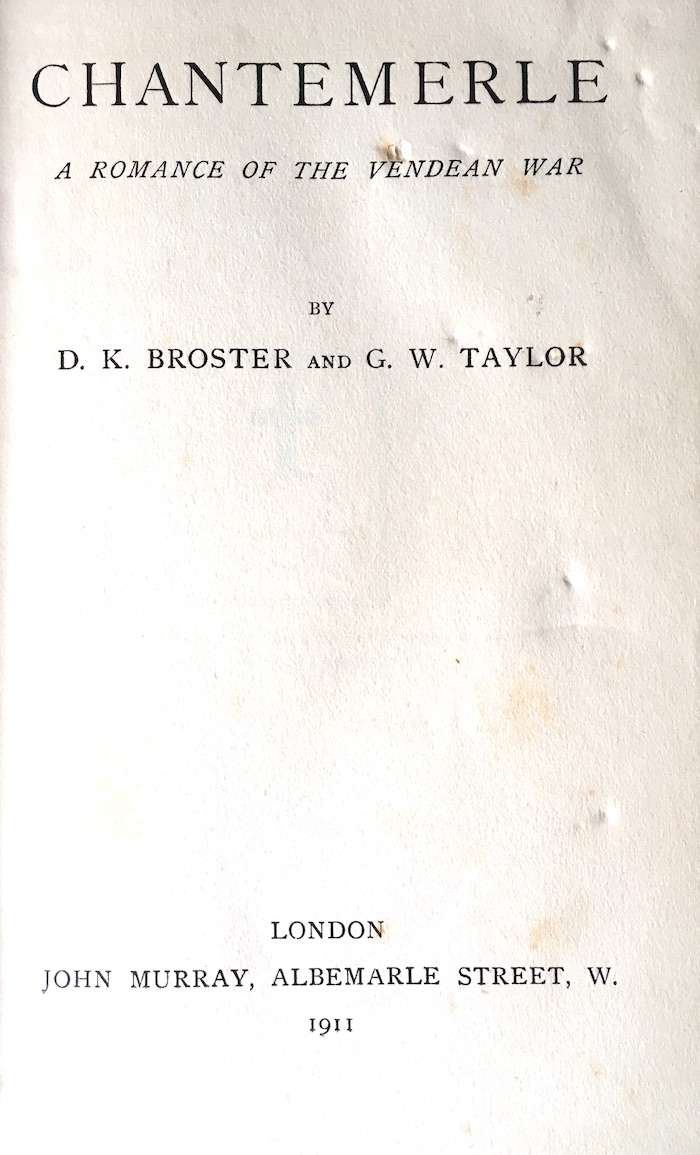
The solid library windows rattled under the onslaught of the gale; rain streamed on to them furiously, then ceased as abruptly; torn twigs dashed against the panes, and the frenzied wind seemed to be concentrating on the glass all its attempts to get into the room, though now and again a puff of smoke, bellying slowly forward, testified to a successful entrance by the chimney.
There are occasions when the elements are not at variance with the mood of the individual. The whirling wind, its noisy but useless attack, was not, apparently, unpleasing to M. des Graves as he sat at the long table in the library and looked out into its manifestations. There was a little colour in his cheeks; his lips were pressed together, his eyes very steady, and he beat gently upon the table with his pen. It was as if there sat in his familiar chair a rather different man, much younger, more alert, with a new poise of the head, who seemed to be enjoying the storm.
As a matter of fact, the priest was not acutely conscious of the elements. It was another storm which he had been contemplating, and one not yet broken. Of the three principal inmates of the château M. des Graves had, very naturally, lent the most sensitive ear during the last few days to its mutterings. For he saw quite clearly that the long-expected crisis was on them at last, and he did not shrink before it. An observer would have said that it had revivified in him some older self, had conjured up, out of its long sleep, the ghost of a man who once had—who still had—all the aptitudes of command.
Yes, he could not doubt it: the moment was approaching. And all those long two-and-twenty years spent in this obscure corner of Vendée seemed to have been but a preparation for it; and so, too, seemed the lives of the two men with whom his own existence was so intimately united. How would the emergency find them? One was out there in the gale, riding in peril of his life, with bitter hatred in his heart. It was on just such another March afternoon that he had first entered the house—a little bright-haired child who had so easily won their hearts, a child for whom happiness seemed a birthright. . . . Poor Louis!
And what of the other boy who had so often sat with his lesson books in this room, at whose feet Fate was about to fling a rôle of which he might make something great and noble . . . if he could take it up. For a man worthily to lead a religious war he must be more than a great soldier, more than a natural leader, he must be a saint. And Gilbert?
Another critic would have urged to himself that the Marquis’ private life was stainless, his dealings with his dependents marked by invariable uprightness and generosity, his ability as a soldier, though untried in actual practice, guaranteed to a large degree by his brilliant studies and by his marked capacity for organisation. M. des Graves did not cast a thought on these things; there was something deeper than all these which was lacking. The peasantry among whom Château-Foix lived, simply and without ostentation, and to whose interests he had sacrificed his own, respected, admired, perhaps a little feared him, but they did not love him. Did they, too, feel that coldness, that intense moderation, that lack of enthusiasm which had made of his existence, until lately, but half a life? Did they know—they must know—what barrenness of soul was covered by his minimum of religious observance? If they were ignorant of it now, they would learn it all too soon, and the men ready to die for their altars would find that their leader knew little of the inspiration which was theirs.
The pity of it! The pity . . . yes, and whose was the blame?
Since Gilbert’s return from England to take up his father’s estates the priest had sought, if anything, to withdraw his influence. He had carefully prepared and trained a mind, hoping that with a right prejudice it might go on to find its own perfection. And instead of this—well, Gilbert was what he was now. It was the path which the priest had chosen deliberately, carefully, not without conflict—and to what had it led? The tool which he might have fashioned for such an hour of need as this was useless. To what end, then, had he abstained from moulding that beloved spirit? All these years, when he had sought to divert allegiance from himself, he had been following an impossible and a visionary ideal. And now it was too late.
And he loved Gilbert so dearly! Above all others he would fain have called him his son; it was for that very reason that he had kept himself apart from him. And this son would soon be fighting in a holy war, living in hourly danger of death, perhaps dying alone, unreconciled to the Church. His was not only the yearning of the priest, but of the childless man also. What would he not give in exchange for Gilbert’s soul, if only it might be granted to him? Yes, awful though they were, those words, he could use them. . . . For Gilbert’s sake he was willing to be himself a castaway.
His hands slid from his face and knitted themselves together in front of him on the table, and his head fell forward on to them. If it were possible. . . . God! God! if it were possible. . . .
The rain beat still more violently upon the panes, but in the room was a long stillness like death, and in that stillness, while his body lay bowed over the table, the priest’s will, rising into regions not subject to space and time, made at last the supreme act of surrender, and yielded up to the Divine Purpose, not its own eternal welfare, but that of its best beloved.
When he came back to the world of sense, M. des Graves discovered himself leaning back in his chair, his hands no longer clenched in entreaty but lying open on the table, palms uppermost, in a gesture of offering. He remained so for a moment, and putting up a hand to his forehead, found it dripping with sweat. After that he sat a long time motionless, looking at the crucifix which stood in front of him.
And in his mind, not as a sudden after-revelation, but quite clear and developed, as if he had brought it back from the mysterious places in which he had been, was the sense that the circumstances for Gilbert’s salvation existed, ready and waiting, if only he could be brought to use them.
When the priest had first read Lucienne’s appealing letter, he had said, “This must not go on.” After his stormy interview with Louis he had pondered the situation deeply, not indeed because it involved two aching hearts—for suffering or joy were to him only the accompaniments of life, not life itself—but because of the wrong that Gilbert was doing. Now he saw that, if it were the will of God, Gilbert’s love, just because it had come to mean so much to him, might be the saving of him . . . if he would renounce it. For at last the real reason of the change in Château-Foix was fully apparent to him. The cold, passionless man was living at fever-heat, devoured with a love begotten of jealousy, filled with the lust of possession; he had his motive force now. It was this overbearing spirit, this determination to possess, this stiff-neckedness which was so well hidden that only at a crisis could the outside world perceive it—it was this that must be slain. If Gilbert’s passion could be diverted, then elements which, unchecked, would go on to complete the ruin of a character might be the means of the saving of a soul. Torn and beaten down in the struggle Gilbert would be more receptive than at any other period of his life. There are some, as M. des Graves knew, who will never behold the gate of heaven save from the very dust of earth.
But the stakes were terribly high. If he failed, he lost for ever Gilbert’s love and such influence as he had with him. If he won, it would mean horrible suffering to the being whom he loved best on earth.
It was the same evening after supper, a meal at which they had spoken little. The Marquis had been sitting idly in a low chair before the fire, his eyes half closed, listening to the unceasing scratching of the priest’s pen. At last the sound stopped, and the Curé, turning suddenly in his chair, began to address him.
“Gilbert, I want to say something to you to-night.”
Château-Foix opened his eyes and regarded the speaker attentively. He seemed a little startled.
“You know,” continued the priest, looking down at what he had just written, “that there is very little doubt of the peasants coming and asking you to lead them if war breaks out.”
“I do know it,” said the Marquis.
There was silence for a few moments; then M. des Graves began again. “You have lived among these people all your life, you are their natural leader, and they respect and trust you.”
“Yes,” assented Gilbert; “they respect me, but they do not love me. I suppose I could not expect it otherwise, and yet I have given up a good deal for them.”
“They cannot understand you,” said M. des Graves shortly.
Again there was silence. “Tell me,” said the priest at length—“all these years I have never asked you to give me a reason, but I ask it now—why cannot you accept the Catholic faith?”
A deep flush spread over the Marquis’ dark features. Without moving a muscle, and looking straight before him, he replied somewhat haughtily: “I have appreciated your silence, and honoured you for it, though I acknowledge the right by which you have thought to break it. You think my lack of orthodoxy will sit ill upon the shoulders of one who presumes to lead your flock?”
The priest vouchsafed no reply.
Presently Gilbert turned round. “Forgive me,” he said in a softer tone. “I know that I am no fit leader for them. I may try to deceive them, but it will not be for long. There is no Château-Foix for me to go to at Easter now.”
“Why not remove for ever the need to go away at Easter?” asked his companion.
“You are suggesting, I suppose, that, for the sake of the peasants, I should go to my Easter duties as though, for one in my position, such a course would not be a sacrilege? I have been thinking over the matter myself, and, if you consider it absolutely necessary, I am willing to sacrifice my self-respect to their ideals. Will that do?”
“That was the last thing which I meant to suggest,” replied the priest very gravely. “I meant what I said, that I want to know why you cannot make a genuine submission, and be received back into communion.”
The Marquis leant back in his chair, a tiny mocking smile about his lips. “Do you really want a list of my intellectual stumbling-blocks, Father? I am afraid that they are too many to be demolished between now and midnight—or even before Easter.”
Again the priest put by the gibe. “My son,” he said, “I have no wish to belittle any man’s intellectual difficulties, but the time is past for argument. You know, we both know, that in a world where we cannot have intellectual certainty for many of the truths which we, nevertheless, hold with unshakable conviction, such difficulties are not the real barrier. . . . Gilbert, we shall soon be face to face with the realities of life and death. We may both of us, for aught we know, be dying men. By all that I hold sacred I conjure you to look into your own soul, lest, too late, you find in yourself the obstacle to faith.”
“What do you mean?” asked the young man curtly.
“I mean,” continued M. des Graves, and his voice was cold, “that I believe your own hardness of heart to have been the cause of your lukewarmness all these years. I mean that you cannot now make your submission to the Church because submission is a mere name to you. Only once in your life have you known what it is to surrender your own wishes; you have never known what it is to take the second place—except for your own convenience or when you had no choice.”
The Marquis settled himself again in his chair, an almost amused expression playing about his mouth, but when he spoke his voice sounded a long way off.
“You are fluent to-night, mon père,” he said. “Pray go on! Will you not illustrate my hardness of heart, my—what am I to call it?—my overbearing nature?”
“Yes,” returned the priest; “since you ask I will illustrate it. The girl whom you intend to make your wife loves and is loved in turn by another man. You——”
Gilbert started angrily from his chair. “Great Heavens!” he cried, “you presume too much! How do you know this? It is false—I tell you that it is a lie!”
M. des Graves had risen also. “My son,” he said, “sit down. It is not false. You shall hear me to the end, and you shall not ask me how I know what I know.”
A very definite majesty hung about the priest as he stood with one hand raised in expostulation. No one could have guessed that the tumult in his mind almost equalled that of Gilbert’s. They stood thus for several seconds, measuring swords against each other, till at last, when the tension began to get unbearable, the Marquis suddenly sat down.
“Go on,” he said harshly; “I will hear you to the end.”
M. des Graves walked over to the fire, turned, and began to speak. “I am in possession of certain facts, which you know to be true. I do not speak idly. I am not accustomed to play with words, nor is my information derived dishonourably. You know that Lucienne loves Louis; you know also that long ago they agreed to see no more of each other. You have taken no account of the suffering that went to that resolution. You intend to marry that unhappy lady with the consent of her will but not of her heart. You have been wronged in thought, I grant you; you are within your rights, I grant you—but have you no chivalry, have you no pity? Do you really mean to wreck two lives, and your own also—for nothing but misery and disillusionment can come of such a union?”
“You would suggest that I abdicate in favour of my cousin?” asked the Marquis.
“That is my meaning,” answered M. des Graves.
There was another long silence, while Gilbert, his head between his clenched hands, stared at his shoe buckles.
At last the priest left his place and came to him. His voice was changed, his face very sad. “My son,” he said, “I ask your forgiveness. It is because I love you that I have made myself speak thus to you. . . . Oh, believe me, if you could put aside your will, if you could only throw yourself upon the venture, it is not the intellectual difficulties that would keep you from the Divine embrace.”
And after a moment’s hesitation Château-Foix rose and took his hand. “As for forgiveness,” he said, “it is yours without the asking. It is all true. You may be right . . . I cannot tell . . . but the path you bid me tread is too steep. You ask me to put from me the traditions of a lifetime, and it is too late. I cannot.”
“‘Whosoever will come after Me, let him deny himself and take up his cross and follow Me,’” said the priest. “. . . ‘For that shall bring a man peace at the last,’” he added, almost to himself, as he turned and went slowly out of the room.
CHAPTER XXXVII
“CHILDE ROLAND TO THE DARK TOWER CAME”
The grey March afternoon was dwindling into dusk, a dusk of windless cloud. A little sunset afterglow stained the west, behind the leafless chestnuts, as Gilbert walked steadily along the rough and narrow lane, one of that network of intersecting pathways which only a Vendean born could comfortably traverse. He was making his way, by an unfrequented route, to the solitary little hostelry which, just over a week ago, he had appointed as a rendezvous for his cousin when the latter should return from Nantes. Since then he had changed his mind about sending him on a further errand; but the arrangement had not been cancelled, and he must at any rate meet Louis at the Etoile de Vendée. And perhaps the unfamiliar surroundings would help him in what he had to do.
Gilbert de Chantemerle, unlike his father, had never found any real consolation in philosophy. Over against the solace which it offered he could always discern, set as in battle array, the challenge of the Christian life—of the lives of Christians. He lived himself in close contact with such a life, which—as his father had done—he admired and loved, but it troubled him with its perpetual question. He could not, like his father, walk placidly by Sébastien des Graves with his eyes on a different goal. Even from the tenantry towards whom he was so wise and so upright, to whose welfare he had sacrificed his own young ambitions, he was separated by a gulf which he knew to be impassable. It had not needed M. des Graves to tell him that he could not lead them, when the time came, in the spirit with which they would follow. If only he could! All the winter, since his return from Brittany, a longing had been budding in his heart. But the fulfilment of that longing demanded a miracle; in other words, it was impossible. How could he ever change his point of view, how pass from doubt to the certainty of faith? Mere desire, however vehement, will not transport one’s body from one adjacent point to another; how should it change the country of that immeasurably more tenacious thing, the soul?
Then had come the priest’s attack on him, and that interview which, though only a week old, seemed to be separated from the present by a century of struggle and anguish. . . . And he had been so consumed with wrath at the preposterous suggestion then made to him just because M. des Graves was not really the first to make it. His own heart had once or twice faintly whispered the same thing to him. But now, since one who dwelt within the gates of his desire had said that this was the key to unlock them, what could he do but try it? He did not believe in its efficacy, and yet—must not a sacrifice so bitter, so crushingly repugnant, for it was the immolation of his own intensely stubborn will—must not this offering call down some spark from heaven? . . . To this had the depth of his desire brought him, to the oblation, almost as an experiment, of his inmost personality, and to this, the crisis of all his emotional and moral life, he walked under the cloudy sky, repeating to himself the formula in which he meant to accomplish it. Only in such a way, as an actor speaking a part well conned, could he ever get through it.
The Etoile de Vendée, nominally an inn, was in reality half a farmhouse, half a cottage, in front of which the solitary old man who owned it had hung out a signboard, perhaps merely to satisfy a whim, for the building stood by no high-road, and lay at least two miles away from the nearest hamlet. It was all the better as a rendezvous. When Gilbert turned at last into the wavering lane which crawled past it, it suddenly occurred to him how more than likely it was that Louis had not been able to get to the tryst at the time appointed. But the unconfessed hope was vain, for there, tethered in front, was his cousin’s bay horse, who turned his head enquiringly at the sound of steps, and pricked his ears as he recognised the Marquis.
The door of the long, low parlour was exactly opposite the hearth, so that the first thing which Château-Foix saw on entering was Louis, sitting in a somewhat dejected attitude by the fire, with his head on his hand. He looked round as the door opened, but did not move from his chair, and the Marquis divested himself of his own hat and cloak without saying anything, and came forward to the hearth.
Louis plunged his hand into the breast of his coat. “I met your man at Nantes,” he said. “He gave me this letter for you. But it seems to me that it matters little to us now how much of M. de la Rouërie’s plans for Brittany are discovered. The whole of Northern Vendée is alight.” His tone expressed no elation at the fact—nothing but weariness.
The Marquis took the letter. “Nevertheless, I am extremely glad to have this, and I am very much obliged to you for going.”
“It was a pleasure,” said Louis curtly.
There was a sting in that simple and conventional reply. Gilbert took no notice, and pulling forward a chair opened his letter and began to run through it. But in half a minute he was looking instead at his cousin, who, his elbows on his knees, was leaning forward staring into the fire. Was it fancy that there was something in the set of his jaw that had not been visible six months ago, a line about the mouth which spelt . . . what?
The Marquis’ scrutiny of the profile presented to him was cut short, however, by Louis suddenly becoming aware of it.
“What are you looking at me for?” he demanded. “Is not the paper all right?”
“I don’t know,” said Château-Foix. “I was looking at you because—well, I want to speak to you about something else.”
Whatever the Vicomte may have thought of this exordium he did not betray. He kicked the smouldering log on the hearth with his spurred heel and sank back in his chair. “Very well,” he replied indifferently; “I am ready.”
Gilbert deliberately folded up the letter, put it in his pocket, and rose. “I should like,” he said, in a steady voice of ice, “to take back most of the things that I said to you the other day at the ford. I was . . . mistaken. I believe now that you did your best, that you had no intention of acting treacherously. The fault was mine for putting you in such a position.” He paused for a second; Louis had not stirred. “You have assured me that Lucienne does not return your affection; I appreciate your motive in the assurance, but I know that it is not true. And if we come out of this alive I do not, therefore, intend to press my claim. . . . That is all I have to say.” He turned and went to the table.
The stupor which had held Louis enmeshed during this short speech relaxed its hold. He sprang up. “Gilbert . . . God in heaven! You don’t mean it—I can’t——”
“Oh yes, you can,” replied the Marquis coolly, taking up his cloak. “She is yours already in spirit; you know that.” And he went towards the door.
But Louis, springing after him, caught him by the arm. “Gilbert . . . for God’s sake, don’t go like that . . . You can’t mean it! You——”
Somehow, without actually shaking him off, Gilbert succeeded in disengaging himself. “Surely,” he said bitingly, “you are not usually so dull. I cannot stay here all evening to repeat the same thing. Lucienne is yours—if she will have you. Is not that plain enough?”
Their eyes met. Then something more like horror than any other emotion dawned in the Vicomte’s, and with a catch of the breath he recoiled a little. The Marquis went quickly out and shut the door behind him.
He set his face towards the miles of rough upland behind the inn. He must walk—he must walk for ever to get away. A fine soaking rain was beginning to fall; he did not feel it. Past the few bitten oaks that fringed the garden he strode, and up the vacillating track that ceased at last, disheartened, on the shaggy hillside. Where was the balm which the priest had promised him? “Liar! liar!” he said between his teeth. He had done it; he had wrenched his heart out, and where was the difference? . . . He walked, equally oblivious of time and of distance; of the rain and of the broken hilly ground, stumbling over gorse bushes, catching his feet in rabbit holes. At last, almost at the top of a hill, he came to a stop, not knowing or caring where he had got to, and threw himself down on his face in the wet grass.
It was night indeed in his heart. All was gone; Lucienne’s love—though that, he knew, he had lost long ago—and that fierce and steadfast determination to keep her in spite of everything, which had sustained him for months. When he had lost his hold on that he was indeed beaten to his knees by that force stronger than himself, whatever it was, which had conquered his own stubborn will and smitten to the earth his pride. The sense of loss, of shock, was at once more and less than pain; it was numbing, grinding, annihilating. . . . Of Lucienne, as desirable, loved and beautiful, cast from him by his own act, he hardly thought at all. The act itself had cost him too much.
He lay there long motionless, careless of the rain, of the deepening darkness, of the passage of time. The smell and touch of the friendly little blades of grass against his face and mouth began first to recall him to external things. They were life, and he, too, had to live—with nothing left to live for. . . . Yes, one thing! If only the moment would come soon, soon!
He stirred and sat up. The rain was ceasing; one or two stars were visible, hanging over a dark mass which stood out against the sky a little above where he lay, and which must be the wood on the top of the hill of La Chapelle-Michel. It was a surprise to find how far he had come. Dully, mechanically, he thought that he must get back, and that he was very cold and almost wet through. Then, suddenly galvanised into life, he jumped to his feet and stood listening with the most concentrated attention.
Through the silence drifted a faint jangling sound, which seemed to come from the direction of Chantemerle. It was a bell ringing the tocsin.
CHAPTER XXXVIII
THE SWORD IS DRAWN
(Chant Vendéen).
Once again M. des Graves sat in the library, and he sat in silence—save for a very cheerful and crackling fire. But he was not alone. By the side of his chair, an elbow on the arm of it, Louis had assumed a rather favourite position on the floor. It was over, the telling of his incredible news, incoherently as it had been done, and now he had no more to say, cast up by that flood of emotion and amazement on to a shore of silence. But at last he shifted his position a little and asked, for the second time: “You are sure that you do not disapprove, Father? You are sure that I may take her?”
“Yes, Louis,” came the answer, grave and low; “you may take her.”
“I don’t deserve it,” said the young man to himself, and fell to pulling at the bearskin rug on which he lay. Presently he broke the silence again. “It was horrible for him—horrible. And I cannot try to thank him; he would hate it.”
The priest’s hands tightened on the arms of his chair. It was difficult to articulate in the throes of a joy so piercing as to be pain. Perhaps if he could betake himself for a little to the prayer which surged up from his inmost soul it would ease the almost intolerable emotion. And perhaps he could then show to Louis his sympathy with his happiness. He said gently: “He will be able to take your thanks some day,” and with that got out of his chair.
“Are you going?” asked the Vicomte, jumping to his feet.
“Yes; to the chapel for a little while.”
“You might say a prayer for me,” murmured Louis, looking away. Then he seemed to get the better of his embarrassment, and seized both M. des Graves’ hands. “I had no right to hope for such a thing as this—no claim to deserve it now,” he said, with deep and real feeling in his voice. “And Gilbert—— What was that?”
It was, apparently, some small hard object striking against glass. The two men stood motionless for a second, then Louis abruptly loosed the priest’s hands, and going to the nearest of the long windows tugged aside the curtains and threw it open.
There was nothing to be seen, but out of the evening, grown now to the semblance of night, came an ominous sound of voices and of many feet. The noise, thrilling to the nerves and more than a little sinister in suggestion, appeared to come from the front of the house.
“Keep back!” whispered Louis over his shoulder. “Who knows what it may be?—perhaps they are come for you.” And slipping out on to the long and narrow balcony he leant over and peered into the darkness. “Who is there?” he shouted.
There was no direct answer, but feet shuffled on the gravel, and he caught excited whispers. “It is not he!” “No, it is Monsieur le Vicomte.” “Perhaps he is not here.”
“What is it, in God’s name?” cried Louis sharply. “And who is in the avenue?”
A couple of rough voices raised themselves. “We want Monsieur le Marquis.” “We saw a light here, so we came this way. . . .” The strong local accent was enough for Louis, and turned his vague fear into a vague hope.
“Oh, it is you, my friends, from the village? Wait a moment.” He stepped back into the room and caught up a lamp. “No, don’t come out, please, Father, for a moment.”
The ring of light showed, a few feet below, a knot of peasants, armed. And in a flash the young man understood. His heart leapt. “It has come,” he said to himself. Aloud he said: “You have come to ask Monsieur le Marquis to lead you, perhaps?”
A shout of joyful asseveration was the response, and in the increasing din from the front other figures, attracted by the light which he was holding, began to pour round the corner of the château, vociferating wildly, and evidently mistaking him for his cousin.
“Monsieur le Marquis is not here at present,” said Saint-Ermay in his clear, carrying voice, “but he will soon be back. Go round, my friends, to the front, and Monsieur le Curé and I will come to you at the steps.”
“You are sure, Monsieur Louis, that Monsieur le Marquis will be back soon?” enquired an anxious voice.
“We expect him every moment,” said Louis confidently, and went in with his lamp.
M. des Graves had dropped to his knees before the crucifix on his writing-table. His face was hidden in his hands. Louis looked at him as he set down the lamp, hesitated, then hurried from the room. In the hall were gathered the domestics, plainly terrified, and with some cause, for the great door was resounding under repeated blows, not all effected with the human hand.
“Open the door, Pierre!” commanded the Vicomte. “There is nothing to be afraid of.” Yet even as he spoke there was audible, through the hammering and the muffled shouts, the sharp crash of broken glass.
“Morbleu!” muttered the young man, frowning, “we can’t have that. Open the door, imbeciles, unless you want it to be driven in!—I must open it myself, then.” He was actually pulling at the bolts before he found old Antoine and Jasmin beside him.
At the noise of the unbolting the hammering ceased, the door swung open, and Louis stepped out into a clamour and a scene which reminded him, instantly and none too pleasantly, of that day, three and a half years ago, when the Paris mob had raved outside the railings of the great courtyard at Versailles. Here was the same indescribable atmosphere of emotion, the same medley of weapons, the same sea of excited faces. Yet it was different, for as the light streamed out behind him and he was recognised, a wave, not of that deadly hostility, but of welcome surged towards him.
“It is Monsieur le Vicomte! A la bonne heure, Monsieur Louis! Vive Monsieur Louis! Ohé, Monsieur le Vicomte, are you coming with us?”
Louis could not make himself heard, and when at last he was able to do so for a moment, the cry for the Marquis began and drowned him. It seemed to him a very desirable thing that Gilbert should indeed return quickly, for he had never seen the villagers so out of hand. As they shouted they brandished here a scythe-blade, here a pitchfork lit up by the glare of a few torches and the broad fan of light from the door. At last the Vicomte began to get annoyed. He shouted to a domestic: “Go, for God’s sake, and ask Monsieur le Curé to come. . . . Ah, here he is! Father, can you stop this racket?”
Apparently M. des Graves had that power. The noise had slackened the instant that he appeared; now, as he held up his hand, it died down to an undertone.
“My children!” he said a little reprovingly, and then to Louis: “Now speak to them, my son, and tell them that Gilbert will soon be back. No—it is your place to do it, not mine.”
And the young man, after glancing at him, went forward to the topmost step. “My friends, be patient!” he urged. “Monsieur le Marquis will soon be here.” And he added with a half-smile: “I can guess why you want him, can’t I?”
A hundred voices asserted that he could. Finally, in answering queries as to whether the Marquis would consent to lead them, and in shaking the hands held up to grasp his own, Louis was more or less pulled down the steps into a sea of passion in which a hostile swimmer would have had little chance of his life.
“Monsieur le Vicomte, you will come, too?” shouted a group of young men, rosaries round their necks and no more than stout sticks in their hands. “Monsieur Louis has learnt soldiering,” explained a voice. “He was in our King’s guard. That’s what we want, a soldier!”
It was all very hot and breathless and uncomfortable, and the Vicomte soon contrived to disengage himself and to return to his vantage post on the steps. Hence, being now more successful in making himself heard, he invited any one who wished to enter the house, and ordered such food and drink as it contained to be brought out to the invaders. No one would come in, but when the latter arrangement was at last carried through a measure of quiet fell upon the excited throng, as, like the Israelites, they ate and drank standing and prepared for departure.
It was now ten o’clock; the rain had ceased, and there was the promise of a feeble moon. The sound of the tocsin, presage of the unusual, came dinning to the ears of the young man and the old as they stood by the door and looked at the scene, ready and waiting for the principal actor. Why did he not come? The priest, who had been down in the throng, was aware of the tiniest pang of fear. And Louis seemed to know it.
“I can’t conceive where he can have gone to,” he said. “There is a man here, who has only just come, who says that he saw Gilbert walking very fast towards La Chapelle-Michel about three hours ago. He took it for granted that he was going there to make a vow or pay his devotions before—this.” He indicated the scene below. “But I think he must have been mistaken. . . . What is it, Antoine? More wine?”
Some half-hour later the Vicomte was down again among the crowd, listening to the story of how the village had organised itself, when suddenly the narrator’s hand tightened on his arm, and Louis’ heart leapt like the rest as he recognised the figure that came quickly out on to the steps. In the rapturous storm of applause which greeted the advent of the Marquis he edged his way nearer, and, when the cheering subsided, heard the latter ask simply: “What do you want of me, my friends?”
Evidently out of respect, the peasants had accorded their seigneur a spokesman. A burly, middle-aged man, in whom Louis recognised the miller, separated himself from the rest and advanced up a step or two.
“It is time, Monseigneur, is it not?” he said in his strong Vendean accent. “We have borne it long enough. Our priests are gone, our churches are empty. Now we ourselves must go out of the country to fight for those who oppress us.” His hoarse voice shook with a hardly-mastered passion. “We will never go, never! We will die first here in Vendée. . . . Monsieur le Marquis, they have risen in the Marais, in the Pays de Retz; Messieurs de Sapinaud took Les Herbiers the day before yesterday, the men of Le Coudrais, peasants like ourselves, have defeated the National Guard of Saint-Fulgent, Montaigu is captured, and now we hear that the men of Saint-Florent-le-Vieil on the Loire have taken Chemillé and are marching on Cholet. . . . We must go, too! But we must have some one to lead us—we are ignorant of war. We have come to ask you to be our leader.”
A dead silence, more impressive than clamour, followed his simple words. The miller stood motionless on the steps, leaning on the old fowling-piece which he carried, and looking up, like every one there, at the young man on the steps.
And perhaps, of all the seigneurs of Vendée, Gilbert de Château-Foix, the cold and prudent, alone accepted on the instant the call to that desperate and heroic conflict.
“If it is your wish,” he said steadily, looking down on them, “I am ready to lead you to the best of my ability. But it is my duty to urge you to remember against what forces you are pitting yourselves.”
“We know, Monsieur le Marquis—we have remembered!” came back to him, mixed with wild cries of “Long live the Marquis!” “To Les Herbiers!”
Gilbert held up his hand. “Before I can settle anything I must talk with some of you. Let Jean Guéchery, Laurent Robineau, and François Batliau come up here. And where is M. de Saint-Ermay?”
“Here,” said Louis, and made his way through the crowd up the steps, to a meeting so different from their parting of a few hours ago.
“That is right,” said Gilbert, hardly glancing at him. “I shall want you to be my lieutenant. Now, tell me, Guéchery, what arms you have.”
They all passed into the library, discussing. Outside, the March night grew gradually quiet of clamour and torches, as the waiting peasants slowly made their way, for shelter rather than for sleep, to kitchen, stable, or outhouse.
When, a couple of hours later, the three leading peasants went out again to the rest, Louis, left alone with Château-Foix in the hall, stood a moment looking irresolutely at his back as he stopped to take down a pair of pistols from the wall. Then he went up to him. “Gilbert——” he began almost timidly.
The Marquis, though he must have heard, took no notice, but finished disentangling the pistols. Then he wheeled suddenly round. Seen in a better light his face appeared very drawn. “Oh, is that you?” he observed coldly. “Do you want to know anything?”
In a flash Louis had adopted another method of address. “Yes, several things, if I am to be of any use as your lieutenant,” he replied, in a matter-of-fact tone. “Where can I see you for a few moments?”
It was just evident that Gilbert welcomed his change of front. “Come to me in the library in an hour’s time,” he said, slipping the pistols into his pockets. “And I should advise you to put together a few clothes as well as your arms.”
Louis nodded and swung on his heel. It would be many a long day before Gilbert could bear a word on that subject. Well, he did not marvel at it.
Meanwhile Gilbert went to his own room, changed his wet clothes, wrote a brief note to Lucienne, and came down to the library, where a servant had set food and wine. In a business-like manner he despatched these, and then, pulling down a sheaf of maps from a shelf, selected one and spread it out on the table. He was bending over it when the door opened, and in came, not Louis but M. des Graves. The Marquis instantly shifted the shade of the lamp, which he had tilted up in his own direction.
“I am looking out the best route to Les Herbiers, Father,” he remarked. “I believe it would really be shorter to go by Saint-Martin.”
The priest took no notice, but came round the table to his side. “Because we may neither of us be alive at this time to-morrow, Gilbert,” he said very solemnly, “it is my duty to say to you, however much you shrink from the subject, that I am sure you have done right, and that I believe God will bless your sacrifice. . . . And now I shall not refer to the matter again until the day when you shall come to me of your own will and tell me that all is well with you.”
Gilbert, who had not removed his gaze from the map over which he bent, now stood up and looked at the priest. “I fear that day will never come, Father,” he returned in polite and chilling tones. “But I rejoice that you are convinced I have acted rightly. And it is done, and there is an end of it, and, as you say, we will bury the subject. Perhaps you would kindly give Louis a hint that I do not desire to be thanked . . . as though I had given him a horse or paid his debts for him,” he added to himself.
M. des Graves looked at the pale, resolute face, and his eyes were full of compassion and understanding. “It shall be as you wish, my son,” he said quietly. “You have acted; there is no need of further words. . . . Ah, here is Louis. Louis, we are looking out the roads to Les Herbiers.”
“And I have got the wrong map,” said the Marquis, rolling it up. “Please bring me the bundle by the bookcase, Louis. Thank you. Now the distance: from here to Saint-Martin-des-Noyers— supposing that we go that way—six miles; from Saint-Martin to Les Quatre Chemins another six——”
“And from Les Quatre Chemins to Les Herbiers about the same,” finished Louis. “And after that?” He laughed gaily. “That lamp of yours is going out, Gilbert. However, it is nearly dawn already.”
CHAPTER XXXIX
THE FOUR ROADS
But they never got to Les Herbiers.
On that strange daybreak march a better, if a more hazardous, idea had occurred to Gilbert. Between him and Les Herbiers lay Les Quatre Chemins, the cross-roads where the highway from Nantes to La Rochelle cut that from Saumur to Les Sables. Though nothing but the tiniest hamlet had grown up at their intersection, the spot was strategically of immense importance, for a force holding it could prevent supplies and help from coming southwards. Château-Foix knew that his little troop could not hope to block the way against any large contingent, but no such contingent could yet have been got together; and smaller bodies, if they knew the route to be cut, would hesitate before adventuring upon it. He consulted Louis; he took the opinion of the leading peasants, and bivouacked that evening among the hedges of the Bocage.
The risk which he had taken had been justified. Not only had the setting up of the white standard attracted scores more peasants from the district, but a concentration of the two other larger Royalist contingents already on foot was imminent. Gilbert de Château-Foix had the honour of first possession of what was afterwards to be the headquarters of the army of the centre, but at this moment, the morning after his arrival, he was sharing it with others. M. de Sapinaud de la Verrie, fresh from his victories at Les Herbiers and Tiffauges, had just marched in two thousand strong, and the two MM. de Royrand were momentarily expected.
The newcomer, on his big grey horse, sat talking to Gilbert in the road. He was a well-built, handsome man of five-and-fifty, with a face at once gentle and energetic. A cloudless blue sky smiled over the two and over the characteristically Vendean landscape. Among the high-banked fields, each exactly like the other, an army could have encamped without its presence being discovered. Nowhere was there a landmark. And every bank was topped with trees, leafless now, or only flushed with green, but soon to be capable of affording cover. The Chevalier’s own men were scattered about, resting after their march, but in a field on the other side of the nearest hedge Louis was attempting to instil some elementary principles of warfare into the heads of the most promising recruits from Chantemerle, while Sapinaud told the Marquis how the men of Saint-Florent, under Cathelineau and Stofflet, after capturing Chemillé, had, the day before, taken Cholet itself.
As he finished Louis dismissed his recruits, and, clambering through the hedge, jumped down into the road. Gilbert presented him, and Louis saluted the old soldier.
“You were drilling your men, Monsieur le Vicomte?”
“A very hopeless task, sir,” responded Saint-Ermay, smiling ruefully. “And if only we had arms! How does one do musketry drill with pitchforks?”
“Our first brush with the Blues will provide us with muskets,” said Gilbert. “That is how your men got theirs, is it not, Monsieur le Chevalier?”
Sapinaud nodded. “When we entered Les Herbiers we had only scythes, fowling-pieces, or clubs. But we got three of our guns there, and some at Tiffauges.”
This was encouraging; but afterwards, as the three went towards the little cottage which served as Gilbert’s headquarters, Sapinaud spoke very gravely of the terrible difficulty of getting the peasants to face artillery fire, and they discussed the alternatives of devoting a few days to drilling them, or of risking an engagement in order to give them confidence. They were about to enter, when there was seen coming down the Saint-Fulgent road a fresh body of peasants headed by two horsemen. The riders pressed on, and in a moment or two were dismounting and shaking hands.
The elder M. de Royrand, a retired lieutenant-colonel of musketeers, was a tall, vigorous old man; his brother, somewhat younger, bore, in the empty sleeve pinned to his breast, a memento of the naval battle at Ushant where he had lost the arm which once filled it. Both wore the cross of Saint Louis.
Louis caught his cousin by the arm. “You will not need me,” he said. “If you do, you can send for me. I had better keep an eye on these three armies; perhaps they won’t get on together.”
And, going out, he found himself in converse with a peasant who had accompanied the newcomers, and discovered that his name was Cougnon. It was he who, having been elected by his comrades as their leader, had conducted them to M. de Royrand.
“M. Charles de Royrand is full of valour and goodness,” said he in his heavy patois. “We must always have a noble to lead us.”
“And what arms have you?” asked Louis.
“Clubs and pikes,” answered Cougnon, waving his hand at his troop, nearly all young men. “They were enough to frighten the National Guard at Saint Fulgent,” he added, seeing the Vicomte’s face fall a little.
Saint-Ermay left him and walked slowly down the road, whose banks were lined with peasants. More solemn and determined than elated was their gaze at him as he passed them, sitting or standing against the hedges, some with their wide-brimmed hats of Sunday and holiday wear, some with their everyday reddish woollen caps on their long hair, cut short on the forehead but left long and unkempt behind. Some of them were wearing coarse white or blue stockings, others long gaiters of homespun, but hardly one possessed any other footgear than wooden sabots. Under their short waistcoats of white flannel or of grey serge the bulging shirt affected by the Vendean was sometimes covered by a handkerchief wound round the waist. A few had these handkerchiefs stuffed with cartridges. There was not a cartridge belt among them, nor was Louis ever to see one worn, for when they got them from their enemies they threw them away, preferring to keep their ammunition in their pockets or in these sashes. Most of them were young, or at best middle-aged, but Louis saw one old man whose years were marked less by his lined face than by the old-fashioned little pieces of wood which fastened his waistcoat in lieu of buttons.
Some of the insurgents were at their prayers, some polishing their weapons, though few had weapons of any distinction to polish. There were deadly scythe-blades lashed to poles, many pitchforks, clubs in plenty, even pointed sticks—fowling-pieces of all descriptions, but hardly a musket. Two young men were armed with old bayonets, still rusty, fastened to what appeared to be broom handles; one or two had brought hoes, and over the shoulder of a peasant who knelt with his back to the observer hung a large sickle. But every man had his rosary round his neck or dangling from a buttonhole, and on almost every breast was pinned or sewn the symbol of the Sacred Heart.
The rustic levy did not look likely material, and the young officer of the Maison du Roi with difficulty restrained himself from shrugging his shoulders as he walked along to the actual cross-roads. Here, round a rude Calvary, some fifty peasants were telling their beads. He pulled off his hat and passed on. Down the Chantonnay road, along which they had marched the day before, the breeze was lightly raising little swirls of March dust. And away in the distance was a larger cloud. Louis screwed up his eyes, shading them from the sun; then he sprang up the nearest bank. Yes, it was a rider, and one who came on so fast that the beat of his hoofs had been audible but a few moments before he was upon the watcher. Louis jumped down and held up his hand, and the man, seeing that he had to do with a gentleman, pulled up.
“From L’Oie, to warn you. . . .” he panted out. “A strong body of patriots from Fontenay and Niort are on the way. They must have reached Chantonnay by now.”
Louis said only two words: “With artillery?”
“I believe so.”
“Lend me your horse,” said Saint-Ermay sharply. And in a moment he was tearing up the road through the groups of startled peasants, to break up the council of war with news that rendered its deliberations useless. There was not a minute to lose. One thing only was determined—not to wait to be attacked, but to march to meet the enemy, a decision which was received outside with acclamations.
And so a few thousand undrilled peasants, miserably armed, marched off to battle under the conduct of five gentlemen, two of whom had never seen active service. Down the sunny road they went, full of fervour, chanting litanies, until the roll of the Republican drums came upon their ears. And on this they were split by their leaders into a main body, in the road, and two wings, one on either side, pursuing a parallel course in the embanked fields.
Thus it was that only a part of them—those in the road—fulfilled Sapinaud’s prediction, and would not face the hostile artillery. For while their comrades were racing for cover across the fields, the main body, pent between the high banks, perceptibly wavered as the first projectile burst from the blue-coated mass in front of them. It was the critical moment, and seeing it the younger Royrand, Royrand Bras-Coupé, trotted forward in front of the hesitating ranks. “Mes enfants, follow me! There is nothing to be afraid of!” he cried, turning in the saddle. The next instant he and his horse were hurled bodily across the road, and flung in one mangled wreck under the hedge.
The foremost ranks broke and turned. Gilbert, from the field on the right, saw it and ground his teeth. It was in vain that Sapinaud and the slain man’s brother urged, entreated; the tangible evidence of the power of artillery lay before the peasants in that crumpled mass at the side of the road. But even as they turned from it affrighted, huddling back like sheep, something like a miracle happened. Another cannon ball thudded into the bank; the spot was wet from a spring—mud flew in all directions. Ere the confusion had died away a peasant sprang from the breaking ranks. “Forward, les gars!” he cried in a voice of thunder; they have no more ammunition, they are firing with mud!” And carried away by his amazing idea the terrified men rallied, re-formed, began to advance, gained pace, poured along the road, and broke like a torrent on the Republican ranks.
Meanwhile Louis, to his no small disgust, had found himself told off, with a party of picked marksmen, to line a hedge on the left, two fields away. He had obeyed sighing, to find, when he got to his post, that it was no sinecure. Directly his presence was discovered the bank became a target. But he soon saw that his men were adepts at taking cover; and if his service in the bodyguard had not been a very serious training for war, it had taught him how to make himself obeyed, and he soon steadied down his recruits to their work. Their deference, indeed, amused him, when he considered that it was the first time that he, no less than they, had been under fire, while many of them, as poachers, were better shots than himself, and he nearly told them so.
At last, irritated by their well-directed fire, the Republicans trained one of their guns on the objectionable hedge. Louis, taking this as a compliment, leaped down from his post of observation, assuring his men that they were perfectly safe. It was not a fact, but it was stated with such cheerful confidence that, crouching behind the bank, the peasants waited undismayed for the report which never came. It was while they were thus waiting that the idea occurred to Saint-Ermay to creep along under shelter of the bank and to open fire again from a slightly different angle. In the execution of this manœuvre the sound of fierce cheering burst upon his ears. He scrambled to the top of the bank.
“By God!” he exclaimed, “they have done it! No, wait a moment, men—we may be of more use here.”
From the top of the bank he could see across the intervening fields into the road, full of a mass of swarming, struggling men. The peasants, using their scythes and pitchforks with deadly and unexpected effect, were all over the Republican guns. Suddenly a whole swarm of Republicans poured over the next hedge and came diagonally across the field towards Saint-Ermay’s post. There was no need to speculate whether they were merely fugitives flying from the strange onslaught, or were seeking to take Royrand’s men in the rear. They had more the appearance of the former.
“Now is your opportunity!” cried the Vicomte, and his marksmen poured a devastating fire into the advancing cohort. About a dozen dropped; they paused, taken by surprise, then came on again wildly, firing their pistols at the bank.
“Steady, mes gars, steady!” said Louis quietly. “Give it them again and they’ll turn.” As he spoke the peasant next him fell forward with a groan, shot through the head, but the volley rang out with deadly effect. It was enough: the disorganised mass broke and turned.
Louis’ sword flashed out in the sunlight. “Now for a little fun!” he laughed as he leapt down from shelter, and without a second’s hesitation his men rushed after him.
Driving the fugitives before them they reached the road, the scene of an indescribable confusion—captured guns, slewed half round, the artillerymen, where they had stood to them, lying dead with ghastly scythe wounds, peasants snatching up the sorely-needed muskets and cartridges, a Republican officer, with his back to the hedge, defending himself against three assailants and falling, ere Louis could get to him, with his brains blown out. Away on the right Saint-Ermay distinguished a mounted figure that looked like Gilbert; he seemed—if it were he—to be urging on his men towards a gentle slope, where a handful of Republicans were re-forming. Many of the fugitives, too, were making for this point, but a large proportion were shot down as they ran, for every hedge now held some cunning marksman, and Royrand’s men, turning against them the captured guns, soon dislodged those who reached the point of vantage.
The pursuit raged down the high-road as far as the quiet little village of Saint-Vincent-Sterlange with its legendary fountain, and here, some two hours later, Château-Foix, riding to and fro in the street trying to re-form his men, came on Louis engaged in the same task. He said nothing, but as he passed held out his hand and caught his cousin’s in a momentary fierce grip.
That night when, still further reinforced by Baudry d’Asson and the three De Béjarry brothers, they took possession of Chantonnay, both Sapinaud and Royrand thanked the Vicomte for the tenacity and judgment with which he had held his post. But after Gilbert’s unspoken greeting the veterans’ praise was oddly tasteless.
And yet two days later, on Passion Sunday, a dispirited body of men were straggling back in drenching rain along the high-road to Les Quatre Chemins. It was the victors of March 15th, for whom the veteran general De Marcé and the troops of the line had proved too strong. De Marcé had found the Royalists drawn up to meet him a mile beyond Chantonnay, and for six hours, in torrential rain, he had withstood their attack. The peasants would not face his guns. In vain Sapinaud and Royrand had led them against the artillery, in vain they had showed them how to throw themselves on the ground and let the projectiles pass over their heads, in vain the two Chantemerle had recklessly exposed themselves. They could not achieve the impossible. De Marcé was in Chantonnay, and they were marching back beaten to their former camp.
Château-Foix with his contingent brought up the rear. By his side, at the moment, walked Louis, holding to his stirrup leather; he had given up his own horse to one of his followers, a young man named Toussaint Lelièvre, whom, shot through the leg, he had contrived to bring into safety under a considerable fire. The cousins were silent; they could not discuss the conduct of their men in the midst of them, and there was not much else to say. The rain streamed down Gilbert’s hair, for he was bareheaded, making it of a polished blackness. At times he raised a bandaged bridle hand and wiped away the drops falling into his eyes. He was wet, hungry, dispirited, anxious . . . and yet not unhappy. He looked down at the plodding figure by his side.
“Are you tired, Louis?” he asked in a low voice. “Take my horse for a little.”
Louis raised a face not so wet but much dirtier; a bullet striking a bank had bespattered him with mud, which the rain, partially washing off, had transformed to an uniform grime.
“No, thanks,” he said with a sort of resigned cheerfulness. “Besides, if I am, I can have my own back again; my protégé ought not really to be riding, I suspect, but I thought it would spare the men’s carrying him.” And they relapsed into silence.
Gilbert had arranged to bivouac at the hamlet of L’Oie, a little nearer to Chantonnay, and consequently a more dangerous post. But there was no alarm that night from the direction of Chantonnay, and the wearied, disheartened peasants slept in peace. The Marquis, whose injured hand kept him awake, lay long looking at his cousin, stretched on a couple of chairs in the profound slumber of youth and fatigue.
The dawn saw them both afoot, somewhat in expectation of marching orders from the Four Roads. But none came, and Gilbert, when he rode over there, found the elder soldiers determined to give their men a day’s rest and to attack De Marcé again on the morrow. Towards evening, everything being quiet, the Marquis suggested to his cousin the propriety of making a little reconnaissance from the slightly rising ground to the north of their cantonments, a proposal to which Louis readily assented.
They were mounting this slight eminence when, without warning, Gilbert’s mare shied violently at a clump of bracken.
“What is it?” queried Louis, quieting Saladin.
Gilbert pulled up. “I will see,” he said, tossing his reins to his cousin, and, dismounting, went back to the fern. “It is a woman—dead, I fear,” he said over his shoulder. He went round to the other side of the clump, stooped, and gave a violent exclamation.
Roused by his tone, Louis flung himself off Saladin, and, dragging the two horses after him, came to the place.
He saw first the skirt of a green amazone, then the whole slim length of the body of a woman, a young woman, lying on the slope, one arm flung wide into the fern, the other crooked under her head. Only the breast of the amazone was darkly stained. His eyes travelled to her face. . . . “O my God!” he said softly, and the reins fell from his fingers. Gilbert slowly raised himself, and took off his hat, his eyes, too, riveted on the dead face of her who had been Célie d’Espaze.
There was a faint smile on her discoloured lips. A tress of the bright brown hair was caught in the dead bracken; a ruby glowed on the lace at her throat; but for her look she seemed cast there to sleep. The cold horror of the moment was broken by no words; it lasted like a spell while Louis, baring his head, sank to his knees and buried his face in his hands. Gilbert did not look at him. The gold and white room, the white dress and the gold couch, and the voice saying, “Reflect that in this changing world I may some day be needing help from you. . . . Next time that you are in Paris, my friend . . .” Instead of these he stood with Louis by the body of the “adventuress” with whose society he had not long ago taunted him. If only he had not said that. . . .
Louis raised his head at last, and taking the gauntleted hand that lay near him in the bracken he kissed it reverently and laid it back again. Then he turned a grey face on his cousin. “God knows how she came by this,” he said hoarsely. “We cannot leave her here.”
“She must have died instantly,” said Gilbert, half to himself. “I will go back and send a party. You will stay by her?”
Louis nodded without speaking, and Gilbert left him kneeling there.
They buried her that evening. In her grave-clothes she was more than ever the nun of Gilbert’s first impression. Where Louis spent the night Château-Foix did not enquire, but it was not in their room.
Months afterwards he learned the truth—and assumed that Louis knew it, too. Madame d’Espaze had quarrelled some two months earlier with Lecorrier, and had left him for a former admirer, the Marquis de Beaulieu, a revolutionary noble who commanded the National Guard of Montaigu. When the peasants took Montaigu De Beaulieu was killed, and, since he was cordially detested, his château was sacked. His mistress fled, alone; it was said in the direction of Châtillon. Further than that nothing was known; neither how she came to have lost her horse, nor whose the hand, Royalist or Republican, that shot her, nor what she was doing so far away from Châtillon. There were moments when Gilbert wondered whether she could possibly have been making for Chantemerle—if indeed she had been aware of its proximity—but that he should not know now. Her name was never mentioned again between Louis and himself; but it was many days before he, at least, could pass a clump of bracken without expecting to see its yellow fronds entangled with a woman’s hair.