

Charles Sumner Centenary: Historical Address / The American Negro Academy. Occasional Papers No. 14
Explore more books like this:
About This Book
The address profiles Charles Sumner’s intellectual formation, tracing his legal and literary studies, wide reading, and European travel as preparation for public life. It recounts his entrance into national legislative service and the deliberate restraint and meticulous rhetorical work that preceded his forceful articulation that slavery was a sectional evil. The speaker emphasizes Sumner’s moral consistency, cosmopolitan perspective, and preference for principle over party, and reflects on how those qualities shaped his oratorical leadership and contribution to national debates about law, justice, and democracy.
About the Author

More Books by This Author
6 picks
 Modern Industrialism and the Negroes of the United States / The American Negro Academy, Occasional Papers No. 12
by Archibald Henry Grimké
Modern Industrialism and the Negroes of the United States / The American Negro Academy, Occasional Papers No. 12
by Archibald Henry Grimké
 Papers of the American Negro Academy. (The American Negro Academy. Occasional Papers, No. 18-19.)
by Archibald Henry Grimké
Papers of the American Negro Academy. (The American Negro Academy. Occasional Papers, No. 18-19.)
by Archibald Henry Grimké
 Right on the Scaffold, or The Martyrs of 1822 / The American Negro Academy. Occasional Papers No. 7
by Archibald Henry Grimké
Right on the Scaffold, or The Martyrs of 1822 / The American Negro Academy. Occasional Papers No. 7
by Archibald Henry Grimké
 The Ballotless Victim of One-Party Governments / The American Negro Academy, Occasional Papers No. 16
by Archibald Henry Grimké
The Ballotless Victim of One-Party Governments / The American Negro Academy, Occasional Papers No. 16
by Archibald Henry Grimké
 The Negro and the elective franchise. A series of papers and a sermon
by Archibald Henry Grimké
The Negro and the elective franchise. A series of papers and a sermon
by Archibald Henry Grimké
 The Ultimate Criminal
by Archibald Henry Grimké
The Ultimate Criminal
by Archibald Henry Grimké
You May Also Like
6 picks
 "'Tis Sixty Years Since" / Address of Charles Francis Adams; Founders' Day, January 16, 1913
by Charles Francis Adams
"'Tis Sixty Years Since" / Address of Charles Francis Adams; Founders' Day, January 16, 1913
by Charles Francis Adams
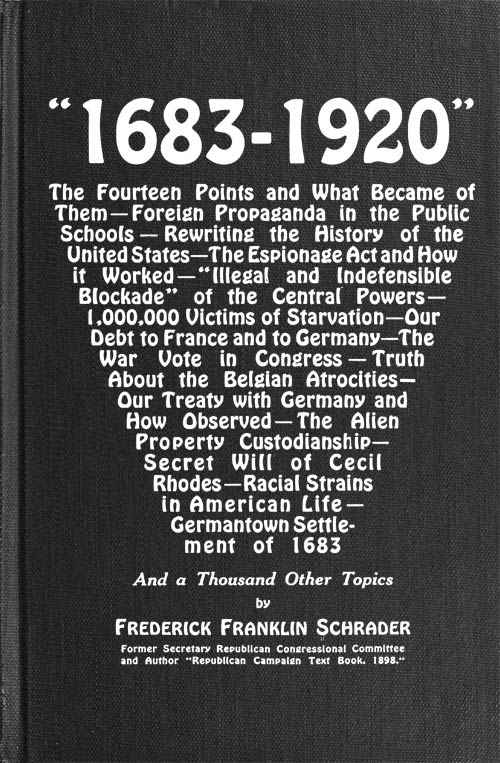 "1683-1920" / The Fourteen Points and What Became of Them—Foreign Propaganda in the Public Schools—Rewriting the History of the United States—The Espionage Act and How It Worked—"Illegal and Indefensible Blockade" of the Central Powers—1,000,000 Victims of Starvation—Our Debt to France and to Germany—The War Vote in Congress—Truth About the Belgian Atrocities—Our Treaty with Germany and How Observed—The Alien Property Custodianship—Secret Will of Cecil Rhodes—Racial Strains in American Life—Germantown Settlement of 1683 and a Thousand Other Topics
by Frederick Franklin Schrader
"1683-1920" / The Fourteen Points and What Became of Them—Foreign Propaganda in the Public Schools—Rewriting the History of the United States—The Espionage Act and How It Worked—"Illegal and Indefensible Blockade" of the Central Powers—1,000,000 Victims of Starvation—Our Debt to France and to Germany—The War Vote in Congress—Truth About the Belgian Atrocities—Our Treaty with Germany and How Observed—The Alien Property Custodianship—Secret Will of Cecil Rhodes—Racial Strains in American Life—Germantown Settlement of 1683 and a Thousand Other Topics
by Frederick Franklin Schrader
 "America for Americans!" / The Typical American, Thanksgiving Sermon
by John Philip Newman
"America for Americans!" / The Typical American, Thanksgiving Sermon
by John Philip Newman
 "Billy" Sunday, the Man and His Message / With his own words which have won thousands for Christ
by William T. Ellis
"Billy" Sunday, the Man and His Message / With his own words which have won thousands for Christ
by William T. Ellis
 "Boots and Saddles"; Or, Life in Dakota with General Custer
by Elizabeth Bacon Custer
"Boots and Saddles"; Or, Life in Dakota with General Custer
by Elizabeth Bacon Custer
 "Broke," The Man Without the Dime
by Edwin A. Brown
"Broke," The Man Without the Dime
by Edwin A. Brown