
The Project Gutenberg eBook of Cities in the air
Title: Cities in the air
Author: Edmond Hamilton
Illustrator: Frank R. Paul
Release date: August 1, 2024 [eBook #74171]
Language: English
Original publication: New York, NY: Stellar Publishing Corporation, 1929
Credits: Greg Weeks, Mary Meehan and the Online Distributed Proofreading Team at http://www.pgdp.net
Cities in the Air
By Edmond Hamilton
[Transcriber's Note: This etext was produced from
Air Wonder Stories November, December 1929
Extensive research did not uncover any evidence that
the U.S. copyright on this publication was renewed.]
Edmond Hamilton
Here is one of the most extraordinary stories that it has been our good fortune to read. For sheer audacity in construction, excellence in science and breath-taking adventure, this story undoubtedly stands in the foreground of science air-fiction stories of the year.
The recent advances in aeronautics where airplanes have been in the air for weeks at a time without coming down to the ground, point the way for tremendous achievements in the generations to come.
City life today is a conglomeration of structures close together. We have buildings now that house as many as 40,000 people at one time and soon we will have single business buildings that will house 100,000 and more individuals at the same time. Furthermore, every doctor will tell you that living at the surface of the earth is usually unhealthy because of the dust and the high density of the air, which gives rise to most pulmonary diseases, particularly consumption, colds and the like. At high altitudes such diseases tend to disappear. Therefore physicians usually send their afflicted patients to the higher altitudes.
You may be sure that conditions such as are described by the author of this marvelous story will come about sooner or later.
We also know that this story will arouse a great storm of discussion among our readers, due particularly to the audacity of the author in picturing his ideas as to future aviation—which by the way will not seem so fantastic two hundred years hence as they might seem now.
"Captain Martin Brant, of American Federation Air-Cruiser 3885!"
As the high clear voice rang through the bridge-room of my racing cruiser, I turned toward the distance-phone from which it issued. Pressing a stud beneath the instrument I answered into it.
"Captain Brant speaking."
"Order of the First Air Chief to Captain Brant: You are informed that the European and Asiatic Federations have combined in alliance to launch a great and unexpected attack upon the American Federation. The European Federation fleet of five thousand air-cruisers is now racing over the Atlantic toward New York and other eastern cities, while the Asiatic Federation fleet of the same size is heading over the Pacific toward our western coasts. All American cruisers patrolling east of the Mississippi, including your own, are ordered to head at full speed toward New York, where our eastern squadrons are assembling to meet the European Federation fleet. Upon arriving there yourself and all other squadron commanders will report at once to the First Air Chief."
The clear voice ceased, and I turned from the distance-phone to meet the startled eyes of Macklin, my first officer, who stood at the cruiser's wheel beside me.
"Head eastward—full speed, Macklin!" I cried to him. "It's war at last—war with the European and Asiatic Federations!"
Instantly Macklin swung over the wheel in his hands, and as he did so the whole long bulk of our cruiser swung likewise in mid-air, curving up and backward to race eastward above the green plains, the descending sun at our backs. A moment more and the cruiser's long torpedo shape, gleaming and unbroken metal save for the rows of portholes and the raised, transparent-walled bridge-room in which we stood, was splitting the air eastward at a speed that mounted with each moment. I reached for the order-phone, and as Hilliard, my young second officer, answered from the motor-rooms beneath, I informed him briefly of what had just been told me. Then there was a muffled cheer from the hundred-odd members of our crew, beneath, and a few minutes later the drone of the great motors had reached to an even higher pitch, and we were racing through the sunlight high above the earth at more than a thousand miles an hour.
Standing there with Macklin in the bridge-room as we shot eastward, though, my thoughts were grave enough despite the exciting quality of the news we had just heard. War!—the war that we of the American Federation had expected, had feared for decades. It had not been more than thirty years since the third Air War of 2039. Three mighty nations alone now shared the world between them; the American Federation, comprising the whole North and South American continents, with New York as its capital; the European Federation, which included all Europe west of Caucasus and all Africa, its center at Berlin; and the Asiatic Federation, which held all Asia and Australasia for the brown and yellow races, with Peking as its capital.
And though for three decades now there had been peace between them, it had been an uneasy peace dictated by the fact that each feared to attack another lest he be attacked by the third. The great navies of air-cruisers of the three mighty Federations had patrolled the air in ceaseless vigilance, their air-forts ever watchful. Lately, however, it had become apparent to all that a rapprochement had taken place between the European and Asiatic Federations, and such an alliance could only mean an attack upon our own, the American. So we had stood even more vigilantly upon the watch, and now that for which we had waited had come at last, and the two great Federations had launched their two mighty fleets upon us.
Gazing ahead, as our cruiser drove onward, I was as silent as Macklin, at the wheel beside me, and as young Hilliard, who had come up into the bridge-room from beneath. Far beneath us the green plains were rolling swiftly backward, as our motors hummed their unceasing song of power. Those great electric motors drew their current in limitless quantities from the electrostatic or atmospheric electricity surrounding the earth, by means of great transformers that changed it from electrostatic to current electricity to give us a power that could hurl us forward with almost unlimited endurance and speed. Connected as they were to our great horizontal tube-propellers, which were set in the cruiser's walls and which moved it forward by drawing immense volumes of air at vast speed through themselves from ahead, those motors could fling us on at more than a thousand miles an hour. This utmost force, as our indicators told us, was shooting us eastward now.
Beneath us the green plains had given way to the great tumbled folds and peaks of the Alleghanies. Somewhere to the south lay Pittsburgh, and to the north Cleveland and Buffalo, but being headed directly to New York, we therefore did not see them. Beneath us we could make out in swift flashes of vision masses of the air-traffic between those cities, great passenger-liners and bulky freight-carriers and slender private craft, but in our own military-craft level there moved only a few cruisers like our own racing eastward toward New York in answer to the alarm. With these, however, there was small danger of collision.
Now the Alleghanies had dropped behind and we were rocketing over the rolling, pleasant countryside that lies between them and the eastern Appalachians. As we shot on I gazed downward, over the green and silent and empty landscape rushing beneath us, and wondered momentarily what a citizen of fifty years ago would have thought to see this once-populous land over which we were speeding lying as lifeless and deserted beneath us as it was now. Then it had given way to the greater folds and ridges of the Appalachians, and then, as we shot on and over their tumbled masses, Macklin lifted his hand from the wheel to point ahead.
"The air-forts!" he said.
On to New York
Swiftly they were looming before us as we rushed on toward them, giant domed cubes of dull metal, each five hundred feet in width, that hung in a great, curving line in mid-air before us, five miles above the green land. At intervals of five miles they hung, floating motionless there in a great grim chain or ring, the metal sides and dome of each bristling with great heat-guns like those of our own cruisers, and with narrow openings from which the occupants could gaze forth. Each of these great air-forts, we knew, was suspended thus high above the ground by the gravity-repelling effect of the cosmic rays. It had been but fifty years since the machinery had been discovered which directed the great power of the cosmic rays to overcome the force of gravity. It had been found that the rays could be collected and their power concentrated in the structures that they were to support. Dynamic towers were used for the collection of this great limitless energy.
In a great ring they hung before us, the line of them curving away vastly to right and left, a great ring that encircled and defended New York, as air-forts hang in rings about all air-cities for defence. Then as we drove toward the nearest of these great fortresses of the air, there came from the distance-phone before me its sharp challenge.
Swiftly I replied to that challenge and then we were driving past the air-fort, past the openings in its walls through which we could see those inside standing ready at the great heat-guns. We heard faintly their cheers as we flashed past them toward the east; we cheered ourselves somewhat by the sight of the air-forts. They could maneuver in space in any direction, though at only a fraction of the speed of the air-cruisers. They would form a stubborn defence for New York, we knew, though incapable of meeting alone a swift invading fleet. But now far ahead, as we rushed within the mighty ring of the air-forts, we glimpsed the gray gleam of the Atlantic's vast expanse, stretching away to the east, the green, irregular coastline, the narrow little island, between a larger island and that coast, that had been the site of the New York of fifty years before. Green and deserted as all the countryside behind us it lay now, but I glanced at it only, looking up as there came a low exclamation from Hilliard, beside me.
"New York!"
Full before us lay the mighty city, now, waxing with each moment greater as we raced on toward it. The air about and beneath us was filled with the great swarms of cruisers like our own and of merchant-traffic that was converging from north and west and south upon it. For the moment we three gazed toward it, forgetful of the peril that had brought us to it. We were caught and entranced as always by the splendid and superb beauty of this New York. For it was a New York immeasurably different from that city upon the earth, that decades ago had born its name. It was a city, not of the earth, but of the air.
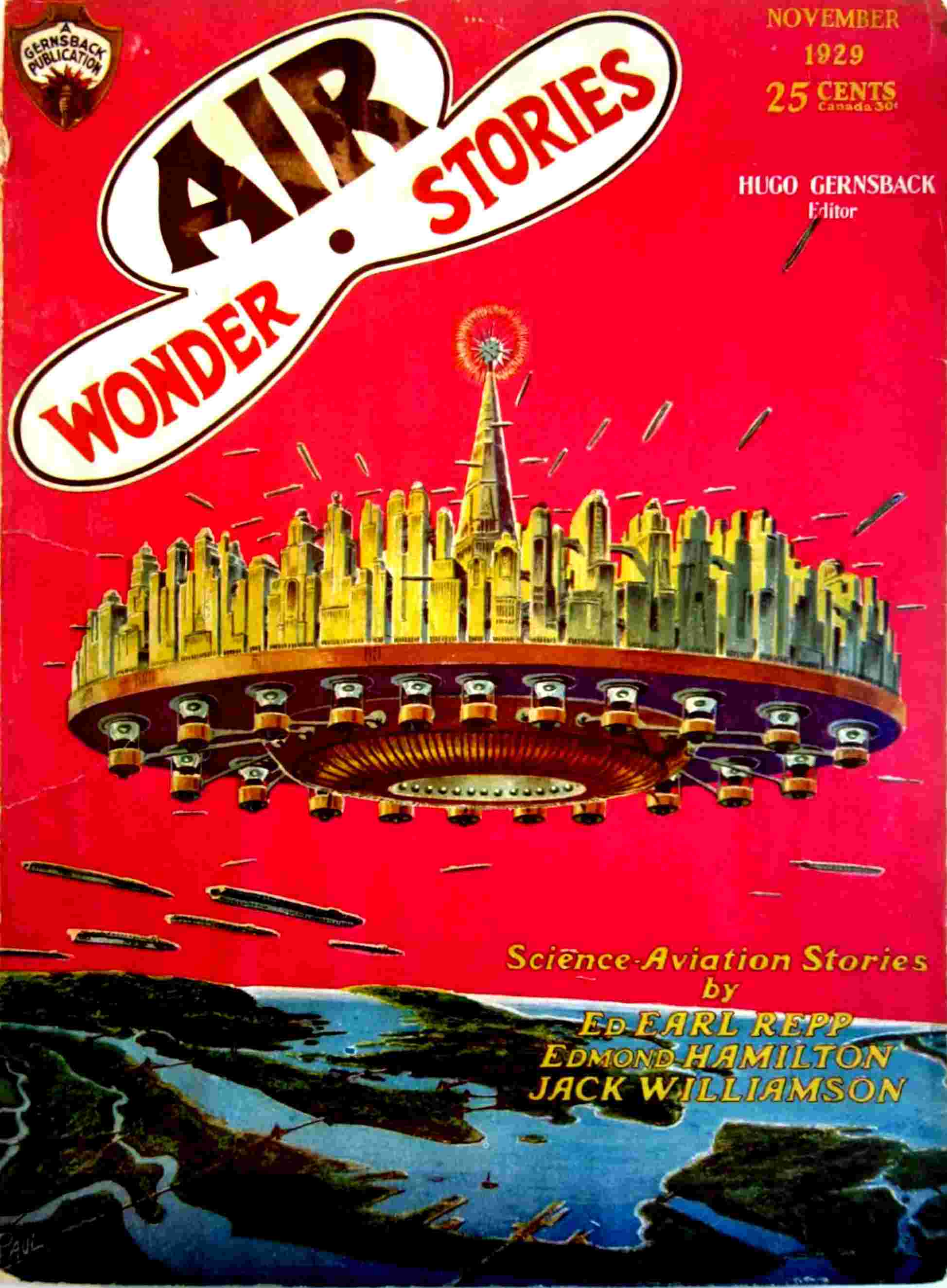
It was a city whose close-clustered spires and towers and pyramids had been gathered together upon a vast metal disk-like base, and hung suspended five miles above the green earth! It was circular in form and of five miles diameter, the colossal metal base or disk upon which it rested more than a thousand feet in thickness, the metal buildings and towers that rose from that base and were integral with it soaring for five thousand feet farther upward! A colossal city floating there in the air, with its streets and buildings swarming with activity, with thronging hordes, and with great masses of fear-driven craft speeding through the air toward it from all directions.
A city of the air! Suspended by huge batteries of great electrostatic motors in its base, motors that drew the exhaustless energy of earth's atmospheric electricity from countless slender pinnacles that soared from the central plaza; whence the current was conducted along cables within the pinnacles to the giant motors beneath. The cities too were suspended by the gravity-repelling quality of the collected cosmic rays. To this had mankind come, at last. The flimsy airplanes of a good century before, with their little endurance records of weeks and months in the air, had given way to the great electric-driven cruisers which drew their power from the static about them, and which could stay aloft indefinitely. And then had come the great air-forts, held aloft in the same way, and finally, when the great air-wars had made life upon the ground so unsafe as to approach suicide, then had come the construction of giant metal cities, on huge metal bases, that contained enough great motors and tube-propellers to hold themselves in any direction at moderate speed.
The Great Conference
Such now were all the cities of earth; Chicago, San Francisco, Buenos Aires, Berlin and Tokio. Great cities that hung always in mid-air, usually near the sites of those vanished cities of earth from which they had gained their names. But the air-cities could move from place to place now and then for better climate or defence. These great cities held within them all the world's population; the earth beneath being used only for the mining of metallic ores and the minerals used in the creation of the synthetic foods and fabrics now universal.
The great cities were each protected by a ring of air-forts, and also by great batteries of heat-guns set within their own walls. A hundred of such huge air-cities there were in the American Federation, holding in their colossal masses of clustered sky-flung towers an average of five million inhabitants each. And in the European and Asiatic Federations combined, I knew, there were more than two hundred mighty cities of the air.
Now, though, it was the huge air-city of New York that held all our attention, and as we rushed closer toward it I saw that above it, above the panic-driven masses of air-craft that were swirling down to take refuge within it, there hung squadron upon squadron of cruisers like our own, over two thousand in number, hanging there in grim, motionless ranks, as though unconscious of the swarming, fear-driven activity in the huge city beneath them. From every quarter other cruisers were arriving to join those squadrons, cruisers that came like our own from patrols over the green inland plains, from above the icy Labrador wastes, from over the jungle-bordered Caribbean coasts, all rushing to answer the call to arms. As our own ship neared the city, we headed down toward the central plaza.
"Straight down to the central plaza, Macklin," I said. "The First Air Chief will be there and orders are to report to him first."
Macklin had already slowed our ship's speed, and now as we drove to a position beside the aspiring central pinnacle, with its clustered points, the city's static-tower, he turned the power of our motors completely from our horizontal tube-propellers, into our vertical ones, which held us motionless in mid-air. Then, as he slowly decreased that power, we sank smoothly down until in a moment more we had come to rest upon the smooth central plaza among a score or more of other cruisers. These rested in a great ring about the plaza's edge, their crews waiting within them, but at the center of that ring, beside the mighty static-tower's base, stood a little group of men, the First Air Chief, Yarnall, and his squadron-commanders.
As our cruiser came to rest I opened the door beneath the bridge-room, and stepped onto the metal plaza and across it toward that group. Around the great plaza, I noted, were vast, seething crowds, thousands upon thousands of the mighty air-city's inhabitants. Other thousands were gazing down toward us from the towers that soared around us into the golden afternoon sunlight. These people, watching us and the mighty fleet hanging grimly far above, were silent, but from beyond them there came to my ears from far across the air-city's mighty mass, the dull roar of millions of blended voices, in unceasing, excited shouts. Then I reached the First Air Chief and the group before him, my hand snapped to a salute, which Yarnall silently returned. And then, gazing for a moment in silence from one to another of us, his strong face and gray eyes grave, he began to speak to us.
"You, the squadron-commanders of our eastern forces," he said, "know why you have been summoned here, why I, under the orders of the Federation's Central Council, have summoned here you and all the cruisers that wait above us. The great European Federation fleet, twice as large as our forces, is rushing westward over the Atlantic toward us, and within the hour we must meet that fleet in battle."
He paused, and in the silence that ensued the dull, dim roar of the great city about us seemed suddenly infinitely remote from our ears. Then the First Air Chief went on.
"Within the hour we must meet that fleet in battle and as we go out to meet it our western forces will be going out from San Francisco, under the command of the Second Air Chief, to meet the Asiatic Federation fleet racing eastward toward it. And upon those two battles rests now the fate of our nation. If they are lost, if either of them is lost, within days our nation will be but a memory, our cities annihilated. If the two approaching fleets are defeated and beaten back, then we shall have won for ourselves a respite in which we can prepare to meet the great enemies that crowd now upon us. So I say to you, the Central Council says to you, that this battle must not be lost!
"The fleet that we must meet has twice the number of cruisers of our own, and there have been rumors of some new method being prepared by them with which to attack us, now or later. We have to aid us only the air-forts about this city, which have been equipped with a new device. I have ordered them to move east of the city to lie between it and the enemy. This great air-city itself, when we go out from it, will move inland at its highest speed away from the battle, just as Boston and Charleston and Miami and San Francisco and Los Angeles and all our great air-cities, north and south. There will be, therefore, none but our cruisers gathered above and our air-forts massing eastward to fight this battle upon which the Central Council has staked our fate.
"But great as these odds are against us, this battle must not be lost! We are the sons of the Americans who fought through the First and Second and Third Air Wars, who reared this nation out of the blood of a thousand air battles until now its hundred air-cities hold in their power a third of all the world. And now that the rest of that world comes against us, the Last Air War begins. My word to you is this: Fight only as those men before you fought, and before tomorrow the European Federation fleet shall have been beaten back—or the last of our cruisers and our air-forts and ourselves will have perished!"
There was silence as the First Air Chief ceased, and then from us assembled commanders there broke a great cheer, a cheer that was taken up by the massed thousands around the plaza and that spread like fire over all the great air-city about us. Then we all returned toward our waiting cruisers, the First Air Chief toward his own, and a moment later his cruiser, with its three parallel stripes of silver running from stem to stern distinguishing it from all others, was rising smoothly upward, followed by our own. Upward we shot, a vast roar coming up to us from the mighty floating city beneath us. Then our score or more of ships were taking their places each at the head of its squadron of a hundred ships, while the First Air Chief in his silver-striped flagship rushed to a position at the head of all. There we hung, the dull, great roar coming unceasingly up to us from the city below, and then as an order sounded from the distance-phones of all the fleet we were moving forward, eastward, out from over the great air-city, from over the green coastline, out over the gray expanse of the Atlantic.
With Macklin and Hilliard again beside me as our own cruiser moved forward at its squadron's head, we three turned to glance back. We saw New York, its mighty towers splendid against the descending sun, moving also, but slowly westward and away from us, away from the coming battle, dwindling to a dark spot and vanishing as we raced on outward over the gray Atlantic. Now we were racing above the great air-forts that had massed in a great double line a score of miles out from the coast, high above the waters. Over these too we sped, at steadily mounting speed, until with great motors droning, crews shouting as they ran our heat-guns out from tops and sides and keels, winds whining shrill about us, our great fleet reached its maximum speed toward that great oncoming battle by which our Federation was to stand or fall.
CHAPTER II
The Battle Over the Atlantic
Gazing ahead, Macklin and Hilliard and I stood together in the bridge-room of our cruiser. The squadron which we headed was at the lead of one of our fleet's great columns. Far behind us stretched its ships, flashing forward at uniform speed. Then from the distance-phone before us came the First Air Chief's voice.
"Squadrons 1 to 6 take up scouting positions!" he ordered.
Instantly the first six squadrons of the two columns, our own one of the first, leapt forward and out from the two great lines of the main fleet. Our own and another squadron moved straight ahead, past the silver-striped flagship of the First Air Chief, until our two hundred ships had spread out into a great, thin fringe that was flying forward miles before the main body of our fleet. Two of the other four squadrons drove to right and left of the fleet, spreading there in the same way, the remaining two taking up positions high above and far beneath our two great columns. Thus, with its great lines of scouts fringing it and protecting it from surprise on all sides, our great fleet drove on toward the east over the gray and endless plain of the Atlantic, holding at Yarnall's orders a speed of eight hundred miles an hour.
The crimson descending sun flaming in the heavens behind us, the great gray ocean stretching endlessly beneath us, we rushed on through empty sea and sky. By then Hilliard had gone down to take up his position with the crew beneath, but Macklin and I still stared into the great empty vista before us. With the drone of our great motors and those of the scouts flying beside us, we seemed like a great flight of bees. Beneath there was no sound now from the crew, a silence that told of the tenseless, of expectancy. But still before us was no sign of the great fleet that we had come out to meet, and almost it seemed that in spite of our certain information as to its course we had missed it, since already we were some hundreds of miles out to sea. Then suddenly, as I gazed ahead, I caught my breath, and the next moment had turned swiftly to the distance-phone.
"Squadron 1 reporting," I said rapidly. "The scouts of the European Federation fleet are in sight and are heading toward us!"
For there ahead a great line of dark dots had appeared suddenly in the empty sky, a great fringe of dark dots that were rushing toward us and that were becoming quickly larger! With each moment that they raced toward us they became larger, until they had come plain to our eyes as long torpedo-shaped cruisers like our own. They differed from our own only in that their bridge-rooms, instead of being raised like our own, were sunk flush with their upper-surfaces, only their transparent forward-windows showing. They were the scouts of the European fleet, and at the same time I saw them they must have seen us, for they changed their course slightly. So racing straight toward us were five hundred cruisers opposing the two hundred of our far-flung line. On and on they came, and I saw momentarily far behind them a great cloud of other cruisers, the mighty main body of the European fleet. I shouted the information into the distance-phone. Then the next moment the speeding line of cruisers before us had rushed straight into our own onrushing line!
The next moment all the air about us seemed filled with whirling, striking cruisers, as the two scouting lines met and crashed. In that first moment a score of our cruisers crumpled and collapsed in headlong collisions with European cruisers. And then as Macklin threw the wheel up at my hoarse cry, our own ship heeled over with sickening speed to avoid two European cruisers hurtling straight toward us. Then as we rushed by them there came the swift sharp detonations of their great heat-guns and a storm of shining cylindrical heat-shells rushed from them toward us. At that moment Macklin swung our cruiser back upward and over the two rushing European ships, and as there came a word from Hilliard to the crew, our own keel heat-guns rained down a score of heat-shells upon the two ships. One of those ships the heat-shells missed, but the other was struck squarely by three of them.
Instantly there was a blinding flare of white light as the striking heat-shells burst, releasing upon the luckless European ship all the terrific heat contained within them, the vast vibrations of radiant heat. For this was the most deadly weapon of modern air-warfare, these shining shells in which, by special processes, the vibrations of intense radiant heat could be concentrated. And as those shells struck and burst upon the luckless ship below we saw the ship hang motionless for a moment in the midst of that blinding flare, its metal sides glowing and fusing. Then we saw it plunge downward like a great meteor toward the gray Atlantic!
But now our own cruisers were whirling up and backward, back toward the struggling ships that hung now in a mighty, struggling line. Like swooping hawks our own craft flashed, diving down upon that battling line with bow and keel guns raining heat-shells upon the European ships below, racing down at a giddy angle into that wild melee of struggling ships and heat-shells that the combat there had become. So wild and fierce had been the combat in the few moments since we had met the European scouts that already scores of ships had plunged down in white-hot destruction toward the ocean. But we had, I saw, well accounted for ourselves in those moments, since almost twice as many of the European cruisers had fallen as our own, and they seemed staggered. Then as our ships leapt like angry birds of prey after them, there came a quick order from the distance-phone that abruptly halted us.
"Main body of European forces approaching! All front and side scout-squadrons rejoin our fleet!"
Trapped!
Instantly Macklin whirled our cruiser again up and back, and as the rest of our scout-squadrons turned and leaped back through the air after us, we saw that the battered European scout-lines were receding also, racing back toward their own main fleet. That mighty fleet was in full sight to the eastward now, its five thousand great cruisers advancing majestically toward us in the familiar battle-formation of the European Federation—a great ring or hollow circle of ships. On they came, the scouts taking their place within that circle with the rest. Then we, too, had fallen back into place at the head of our own two great columns, the silver-striped flagship of the First Air Chief before us, and slowly now, with ten miles more of clear air between them, the two giant armadas were advancing toward each other.
Standing there with Macklin, heart pounding, I gazed watchfully ahead as our fleet and the European one swept nearer toward each other. We came each withholding our fire for the moment, since the heat-guns have but a short effective range. Although outnumbered two to one, we were moving steadily toward the oncoming giant circle of the enemy. Then suddenly the ships of the great European fleet, still holding its circular formation, had leapt steeply upward with sudden tremendous speed, to slant above us!
As they did so, a quick order rang from the distance-phone and the two great columns of our fleet had leapt upward also, up to the level of the other until a split-second more would have seen us crashing headlong into that oncoming circular fleet. I saw the air before me filled with gleaming ships rushing lightning-like towards us, heard another order ring out, and then Macklin had swung our cruiser to the right and our whole great fleet had divided, one column flashing like light to the right of the oncoming European fleet and the other column to the left of it. Before they could change formation or slant down to escape that swift maneuver of ours, we were flashing past them on both sides, and then to right and left of them our heat-guns were thundering and loosing a storm of swift heat-shells.
As those shells struck, as our passing column loosed a hail of them upon the European cruisers, the air about us seemed filled completely with blinding bursts of light and heat. Scores, hundreds, of the enemy ships were withered by that deadly fire from right and left, glowing and melting and plunging downward like chariots of white fire.
Surprised as they were by our swift maneuver comparatively few fired upon us as we raced past them, but even those few shells found their marks among the cruisers of our rushing column. Cruisers of my own squadron were struck and hanging there glowing and fusing from the terrific heat released upon them, unable to avoid the fast-speeding ships behind them which raced headlong into the white-hot wrecks. Then our columns were past them and as behind us their ships fell thick in white-hot melting ruin, I turned toward Macklin, exultant.
"We're beating them!" I cried. "Another blow like that one and——"
A cry from the second officer cut me abruptly short, and quickly I gazed back to where he was pointing, toward the mighty ring of the European fleet. Our two columns had converged inward toward each other after that deadly blow, when the great ring-shaped formation of cruisers behind us had halted abruptly its own forward flight, and had shot back a great double file of its cruisers between our own two racing columns! And then, before we could see and forestall its menace, before we had time to obey the swift command that the First Air Chief shouted from the distance-phone, that double tongue of ships had split, each line moving sidewise with terrific force and speed toward our own two lines, pressing them outward from each other, separating them, rolling them sidewise and backward in two great enveloping motions.
In that moment I felt our cruiser reel madly as a European cruiser shot against it, saw Macklin clinging madly to the wheel as I was thrown down and backward, while about us in that mad moment the heat-shells were speeding forth from ship to ship to burst in flaring destruction about us. Then as Macklin swung our cruiser up to a level keel, our heat-guns beneath detonating now as our gunners worked them like mad beings, we were fighting the remorseless lines of the enemy that swept us back and I was aware that our fleet's two columns had been swept hopelessly apart, that our forces had been fatally divided and that each division of them was now completely encircled by the outnumbering masses of cruisers of the European fleet!
Cruisers on all sides of us now seemed to fill the air, enemy cruisers that tossed about us in a great sea of ships and that made our own ships the target now of their unceasing volleys. Our column, rolled together by that irresistible maneuver, had massed into a solid group, the silver-striped flagship of the First Air Chief just beside our own. The air around us was livid with flares of blinding light as the heat-shells broke and burst in unceasing destruction, as the thunder of our detonating guns seemed to drown all other sounds in the universe.
Not for long could we thus remain the target of these masses of cruisers that swarmed about and above and beneath us. Our other column had been swept back and that was surrounded by enemy cruisers and fighting desperately even as we were. Unless we could join them, and reunite our shattered fleet, we must inevitably be destroyed. At that moment the voice of the First Air Chief rang from the distance-phone before me in a high command.
"Triangle formation!" he shouted. "North at full speed!"
Instantly the ships behind and about us, reforming swiftly and smoothly even under the rain of shells shifted into a great wedge-shaped formation, a great triangle of solid ships whose apex was the First Air Chief's cruiser, and which pointed north, toward the other isolated and struggling half of our fleet. Then the next moment our great triangle had leaped forward straight toward the north at full speed, into the swarming masses of European ships that surrounded us. Our own cruiser hung just behind the First Air Chief's, just behind the triangle's apex. Then with a terrific crash we had smashed into the solid wall of ships before us.
Our cruiser rocked and reeled beneath me as its sharp stem rammed at full speed into a European cruiser that had swung broadside in an attempt to escape us. Its side crumpled beneath that awful blow and I saw it reel back and downward, I felt other rending crashes that shook our ship wildly as our triangle crashed through the European fleet. Then suddenly we were through it, had smashed our way by sheer force through its sea of ships and had reached the second half of our fleet, joining with it once more. Scores, hundreds even, of our own cruisers and of the enemy's were tumbling and twisting downward toward the sea, battered wrecks of metal that had been all but annihilated in our mad crash through the enemy armada!
Now swiftly our re-united fleet, still almost two thousand strong, were massing together in a single long rectangle, our flagship speeding to its head, and as we moved toward the scattered swarms of European ships about us, that numbered almost four thousand still, they had formed into a similar formation. Then as our own long rectangle or column rushed toward them they were racing sidewise at the same speed as ourselves, so that side by side now our two great fleets sped through the air, our heat-guns detonating again as we held still to the awful struggle. Our cruiser seemed to bear a charmed life, since as we drove headlong through that hail of shining death, behind the First Air Chief's cruiser, we were sometimes missed by inches only. And now as Macklin, his eyes steady but burning, held our ship onward with those about us in this mad running fight of the two great fleets, I was aware that in that fight they were both slanting steadily downward, down toward the gray Atlantic far beneath!
Fleet hanging to fleet, the air between them thick with shining heat-shells, down we rushed until we were within yards and then feet of the ocean's tossing surface! But, still firing at each other steadily, they were swooping downward still until we were plunging straight down into the ocean's depths. For these great air-cruisers could move beneath water as well as through the air. Each opening in them sealed tight during flight, their air-supplies always automatically furnished by great tanks of liquid-air, their great tube-propellers sucking water through them at immense speed even as they did air, and hurling the cruiser on at a speed which while far less than that in the air was still great—with these features our cruisers were now down into the great waters of the Atlantic.
"Hold steady!" I cried to Macklin as we swooped downward, and the waters rushed up toward us. "Keep in line with the First Air Chief's ship!"
I saw his hands clench upon the wheel, and then the waters were just beneath us, were rushing nearer and nearer, while even then our ships and those about us were loosing their heat-shells upon the European fleet whose great column was plunging downward like our own. Down—down—and then with a shock our cruiser had plunged into the great waters, had rushed beneath the waves, and instantly the light of sunset all about us had vanished, had given way to the green translucence of the waters. Through that green obscurity there shot yellow shafts of revealing light, the underwater searchlights in the walls of our cruiser which I had snapped on. From all the ships before and behind us came other brilliant shafts. Our great fleet still grappled with the European fleet rushing down to our right, our heat-guns loosing their deadly shells still through the green waters toward each other's fleet! The great battle over the Atlantic was to be carried on in the great ocean's very depths!
CHAPTER III
Under the Sea
Green depths that swirled about us, shafts of yellow light that swung and stabbed through them, rushing cruisers and detonating guns and drone of motors and wild shouts—all these merged and mingled in one great phantasmagoria of strange impressions in those first moments. I had shot under the ocean's surface in my cruiser many a time before, but never in battle. And now, with our two great fleets plunging down into those peaceful depths, all about me seemed for a moment a strange dream. Then I saw before us, the cruisers of the First Air Chief and those about him, dark long bulks that gleamed there in the depths beneath us as the yellow shafts of light struck and crossed them.
Peering downward, figure tensed over the wheel, Macklin was holding the cruiser behind those rushing ones ahead, and now, looking away to the right, I could make out the dark, long bulks of the European cruisers also. And across the gap from fleet to fleet were hurtling storms of the heat-shells still, shot forth by our great heat-guns whose valve-breeches made them capable of underwater operation. And as they burst there broke from them the same great flare of light and heat as in the air above, little affected for the moment by the waters about them, destroying in that moment the ships they struck and making the waters about those fusing ships boil terribly with their terrific released heat.
But straight downward through those boiling waters swirled and swept the following cruisers of the two great fleets. As our guns thundered there in the great deep, as heat-shells raced and broke and flared about us, I saw schools of fish and strange sea-creatures and denizens, for a moment in the glow of the yellow searchlights or the flares of bursting heat-shells. The fish were all striving desperately to escape from this hell of battle and death that we men had carried down with us. And still downward—our two great columns were racing, hanging to each other with fierce, resistless tenacity, raking each other still with the great heat-guns as we shot lower into the mighty depths!
Finally Hilliard dashed up into the bridge-room from below.
"This can't keep on much longer!" he cried. "The cruiser's walls can't stand this heat and speed!"
"It'll have to keep on as long as the First Air Chief keeps on!" I shouted to him, over the drone of motors and thunder of guns. "If the battle is to end for both fleets here—let it!"
But I saw even in that moment that Hilliard was right, and that the walls about us, the transparent metal of the windows, had become searing to the touch. Not only had we raced through areas of water boiling at terrific temperatures from heat-shells that had burst in ships there, but our own immense speed was producing by its friction with the waters a heat that was almost softening the cruiser's walls. Yet I saw that still the First Air Chief's cruiser was rushing deeper and deeper before us, and that still the great column of our own fleet and that of the European fleet were following locked in that colossal death-grip, their heat-guns thundering still toward each other.
I could see too that the cruisers of the European fleet were suffering far more than our own in this awful undersea battle, since there in the green depths, only able to half see each other and to aim their heat-guns by the uncertain light of their searchlights, their greater numbers were of but small advantage to them. And our gunners, following the former orders of the First Air Chief, were concentrating their fire upon the European column's head, so that when ships were struck there by heat-shells, changed to motionless white-hot wrecks in the waters, those behind were unable in the green depths to see them in time to swerve aside, and so crashed into the fusing wrecks and were themselves destroyed. It was a maneuver that the First Air Chief had long before explained to us for use in undersea warfare, and now it was proving of the highest effectiveness and score after score of the European ships were flaring and crashing in their opposing column.
Our gunners, following the orders of the First Air Chief, were concentrating their fire on the European column's head, there in the ocean's green depths.
For only a moment more, though, did the two great columns continue thus, for then the European fleet, feeling the great losses which it was experiencing in this terrific underwater combat, responded suddenly to some order, curving sharply upward again. Instantly the First Air Chief snapped an order from the distance-phone, and instantly our own great column of ships had turned upward too, had curved upward through the waters after the racing European fleet like wheeling sharks after prey, their guns and ours still beating a tattoo of thundering death there in the great depths. Now as we rushed upward again at undiminished speed the waters were becoming green and translucent once more. Then as we flashed up through those green depths, heat-guns sounding still from fleet to fleet, the cruisers ahead and above us, and then our own, burst suddenly up from the waters into the sunlit air once more!
Into the Clouds
Surely some battle out of a nightmare was this, in which our two great masses of cruisers hung still with deadly purpose upon each other. Macklin and Hilliard and I aware of ourselves now only as infinitesimal and unreasoning parts of this mighty fleet about us, moved upward, miles again above the waves. The two rushing fleets slowed, halted, as though by mutual purposes. Slowed and halted there in two great masses of cruisers in mid-air, our own to the west and the European one to the east, and then, with every heat-gun detonating and with the air between them seemingly filled with shining, hurtling shells, they were hanging motionless in a mighty death-grip!
The great struggle for its sheer intensity was appalling, as the two giant fleets hung there unmoving, high in the air, each unheeding its own danger, intent only upon annihilating the other. I was aware, as though I were a spectator, that I was shouting hoarse commands into the order-phone, that in obedience to those commands our gun-crews beneath were working the great heat-guns like madmen, loosing an unceasing hail of shining shells toward the fleet opposite, shouting as they did so even as Macklin and Hilliard were shouting wildly beside me. I was aware of heat-shells that seemed exploding all around us, of brilliant and unceasing flares of blinding heat and light that burst in dozens each second amid either fleet, their cruisers whirling downward now in score of hundreds.
I know now that that motionless battle there in mid-air could not have exceeded a few minutes, yet then it seemed an eternity. I was aware dimly that our ships were falling faster than the Europeans, that their greater numbers were telling upon us once more here in the open air, and that but few more than a thousand ships were left to us, no more than half of our original number. Yet more than twice that number of European cruisers remained, smothering us with shining shells! Then suddenly the silver-striped ship of the First Air Chief, that had swayed beside our own, turned westward, and at the same moment Yarnall's voice came sharply from the distance-phone.
"Retreat-formation!" he was shouting. "All ships retreat westward at full speed!"
"Retreat!" My cry was one of incredulity, of mad anger. Retreat—we were beaten, then, our great battle lost—I was aware of Macklin hovering in irresolutely over the wheel, of Hilliard almost sobbing in his rage.
Then despite our fury the sense of discipline was reasserting itself, and with the First Air Chief's ship at its head, our great mass of ships was turning, was forming swiftly into a great T, the longer column or stem of it pointing westward, moving westward at swiftly mounting speed with the flagship at its head, while the shorter column or head of the T lay across its rear at right angles. This protected us somewhat from the European fleet that now was leaping swiftly after us, triumphant, exultant at our flight. Our stern guns still firing toward them as they leapt upon our track, we raced westward, on until at full speed. And now, even as the thunder of guns still came to our ears from behind, a dull, dead silence reigned over our own ship, and those about us, Macklin and Hilliard as silent beside me as myself, a silence of the apathy of utter dismay and despair. For never, surely, had any American fleet ever thus fled homeward, before, pursued by a conquering enemy.
On to the westward though we raced still, our rear-guard line of cruisers now the targets of numberless heat-guns. Still cruisers among them were being destroyed by the heat-shells, and still, too, they were striking savagely back to find their marks here and there among the mass of our pursuers. On and on we rushed, the European fleet closing gradually toward us, and now we were but a score or so of miles from the coast, I knew, and should be sighting the great double line of our air-forts that were hanging far out to sea. It was the one chance of escape for our outnumbered fleet, I knew, to gain the shelter of those great forts. And now it was clear that it was with this object that the First Air Chief was leading our fleet in full retreat westward. But as we gazed ahead, we saw that though we should have been within sight of them the great air-forts were nowhere to be seen! Save for a great, long bank of floating white clouds ahead the sky was completely empty, and of the air-forts there was no trace!
"The air-forts gone!" I cried. "Our last chance gone!"
"But our fleet's going on!" exclaimed Macklin. "The First Air Chief's leading us into those clouds!"
The Ambush
Gazing ahead, incredulous, I saw in a moment that it was so, that the First Air Chief's cruiser was flying straight on toward the great long bank of clouds ahead, leading our whole fleet into their fleecy white masses. Even as I stared unbelievingly, I saw his silver-striped ship rush into those clouds and vanish from view, and after it were rushing our own ship and all those about us, all the long mass of our fleet! Unable to credit my eyes, almost, I stared, for it was a suicidal maneuver, to attempt to elude our pursuers in those fleecy masses. They needed only to surround the cloud-bank and then wait and destroy us one by one as we emerged again. Yet even as I gazed forward our ships were speeding into the white masses of vapor, after our flagship, our rear cruisers still returning the fire of our pursuers. Then as our own cruiser flashed into them, all things vanished from about us save the thick masses of cloud-vapor that hemmed us in, that seemed to press against our windows, curtaining all things else from sight!
I stared forth tensely with Macklin and Hilliard in a vain attempt to see through those masses, heard the thunder of guns still going off blindly somewhere in the great cloud-mass behind us, knew that in the wild heat of pursuit the European fleet had rushed after us into that great cloud-bank. Then came a swift order of "All ships halt!" from the distance-phone, and as we came swiftly to a halt there in the blinding, fleecy masses, motors droning still, we heard the crash of ship on ship behind us in the cloud-bank as the foremost cruisers of the European fleet drove blindly into our own, then halted fearfully themselves, milling confusedly about in fear of further collisions and with neither fleet firing now in the absolute blindness that held each ship. Thus the two mighty fleets hung there for the moment blind and helpless in the huge cloud-bank, and in that moment there came again the First Air Chief's voice from before us in a swift, shouted command.
"All American Federation ships—drop!"
Before the order had ceased to echo Macklin's hand had flashed to the power-stud, and as the great drone of our motors suddenly lessened our cruiser dropped downward like a falling stone, plunged downward until in a moment more it had ripped through the great fleecy mass of the cloud-bank and into the open clear air beneath it, leaving the great European fleet for the moment still in it. And in that moment, even as our cruisers halted their plunging downward fall, there came a great hissing sound from above as of the hissing of terrific jets of air, and at the same instant we saw the mighty cloud-bank above breaking up, disintegrating, its great fleecy masses whirling suddenly away in all directions, driven away in a moment as though by mighty winds, breaking away in formless flying vapors! Breaking away to leave clear air where they had been, to leave the European fleet hanging there, appearing to our sight suddenly as a confusedly milling mass of numberless ships above us! And coming to——? on either side of that confused mass of ships was the great double line of our giant air-forts!
"The air-forts!" My cry was echoed in that moment by Macklin and Hilliard beside me, by all in our cruiser, in our fleet.
The air-forts! On either side of the disorganized European fleet they hung, in their mighty double line, and as that fleet saw them now for the first time with the sudden disappearance of the cloud-bank that had hidden them, it seemed to hang motionless still as though stunned with astonishment. Then the great heat-guns of the air-forts had swung toward them, were thundering in swift chorus, were loosing storm upon storm of heat-shells upon the confused, astounded ships that swung between them! Were pouring forth in that awful moment all the concentrated fire of their mighty batteries upon the European ships caught between them.
The air-forts! And it was between them, between their two mighty lines, that the First Air Chief had purposely led the European fleet, I saw now. For this, then, was the new device of the air-forts of which he had spoken to us before our start, this device which enabled them to surround themselves with a great cloud-bank that kept them hidden from all and unsuspected by any enemy. Some device for projecting forth great masses of water-vapor it must be, that had enabled them to form that great artificial cloud-bank about themselves. And when the First Air Chief, staking all upon the device, had led the pursuing European fleet into that great cloud-bank, into that giant ambush of the air-forts, then with our own fleet dropping down out of it they had needed only to disperse the artificial cloud-mass about them by means of great air-jets of terrific power, to disperse the cloud-mass and to turn all the fury of their great guns upon the European fleet that hung still dazed there in the withering fire of those suddenly-unmasked batteries!
For now above us the European ships, whirling aimlessly about in that terrific fire that raked them from either side, were falling faster still! Their own shells burst and flared along the sides of the great air-forts, but were too few in number to cripple or destroy any of those gigantic, heavily-armored edifices. And at that moment, even as the European ships strove to mass together to escape from that great death trap of the air, the First Air Chief's ship was slanting up toward them, and now we needed no orders to follow as we raced up after him. Up until our great fleet rushing upward in a single mass was pouring up before us a third terrific fire of heat-shells which, added to that of the air-forts on either side, sent blinding death-flares dancing and leaping over all the mass of ships above us.