
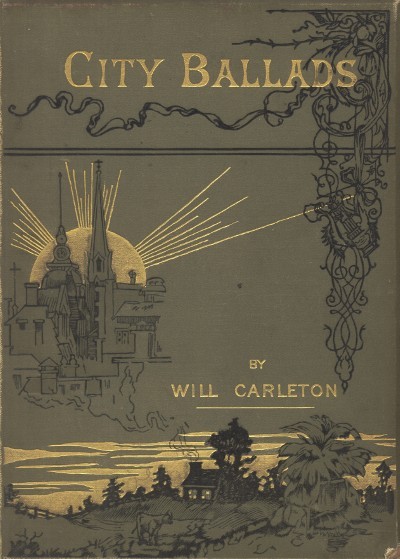
The Project Gutenberg eBook of City Ballads
Title: City Ballads
Author: Will Carleton
Release date: August 3, 2011 [eBook #36954]
Most recently updated: January 8, 2021
Language: English
Credits: Produced by Juliet Sutherland, Dianne Nolan and the Online
Distributed Proofreading Team at https://www.pgdp.net
CITY BALLADS
BY
WILL CARLETON
"YOUNG FOLKS' CENTENNIAL RHYMES" ETC.
HARPER & BROTHERS, FRANKLIN SQUARE
PREFACE.
When city people go among forests and hills, they drink in the fresh air and weird scenery of rural surroundings, with much more relish, enjoyment, and appreciation, than do the life-long residents they find there.
For the same reason, the great drama of metropolitan existence falls most forcibly upon those just from the clear streams and green meadows of the country. Their impressions then are deeper, and their feelings more intense than if they were city born and bred.
With the latter fact in view, this book is an effort to reproduce some of the effects of city scenes and character upon the intellect and imagination of two people from the country:
First, a young student, who has travelled the well-beaten roads of a college course, but is just entering real life, and now for the first time walks the paved and palace-bordered streets of which he has heard and read so much.
Second, an old farmer, with very little "book-learning," but a clear brain, a warm heart, and independent judgment, and a habit of philosophizing upon everything he sees, which habit he brings to the city, and applies to the strange facts he witnesses.
These, with certain incidental thoughts and characters encountered and discussed, constitute the present work. It will be found, as intended, sketchy and suggestive rather than elaborate and complete. Note-books and diaries are designed, not so much for the history of a career or an event, as a light to the memory, a stimulus to the imagination, and a help to the heart.
It is the hope of the author that his book may perform those offices for you, his readers, and that it will rouse your pity of pain, your enjoyment of honest mirth, your hatred of sham and wrong, and your love and adoration of the Resolute and the Good, and their winsome child, the Beautiful.
In which case he shakes hands with his large and loved constituency, and continues happy.
W. C.
CONTENTS.
| Page | |
| WEALTH | 15 |
| Including | |
| The Lovely Young Man | 28 |
| If I'd a Million Millions | 35 |
| Farmer Stebbins on Rollers | 40 |
| WANT | 46 |
| Including | |
| That Swamp of Death | 53 |
| A Sewing-Girl's Diary | 64 |
| FIRE | 75 |
| Including | |
| When Prometheus Stole the Flame | 77 |
| Flash: The Fireman's Story | 79 |
| How we Fought the Fire | 84 |
| "You will Tell me Where is Conrad?" | 90 |
| WATER | 93 |
| Including | |
| The Dead Stowaway | 97 |
| The Wedding of the Towns | 102 |
| Farmer Stebbins at Ocean Grove | 107 |
| VICE | 113 |
| Including | |
| The Boy-convict's Story | 115 |
| Farmer Stebbins on the Bowery | 119 |
| Farmer Stebbins Ahead | 124 |
| The Slugging-match | 130 |
| VIRTUE | 132 |
| Including | |
| More Ways than One | 136 |
| The March of the Children | 141 |
| TRAVEL | 143 |
| Including | |
| Her Tour | 144 |
| At the Summit of the Washington Monument | 148 |
| The Silent Wheel | 155 |
| Farmer and Wheel; or, The New Lochinvar | 157 |
| Only a Box | 166 |
| HOME | 170 |
| Including | |
| Let the Cloth be White | 172 |
ILLUSTRATIONS.
| Page | |
| "These are the spires that were gleaming" | Frontispiece. |
| "I saw tall derricks by the hundred rise" | 21 |
| "I reached my hand down for it and it stopped" | 29 |
| "When all to once the wheels departed suddenly above, an' took along my heels" | 43 |
| Farmer Stebbins on Rollers | 45 |
| "Yes, it's straight and true, good preacher, every word that you have said" | 51 |
| "Choked and strangled by the foul breath of the chimneys over there" | 54 |
| "Oh, the air is pure and wholesome where some babies coo and rest, and they trim | |
| them out with ribbons, and they feed them with the best" | 55 |
| "Weary old man with the snow-drifted hair, not by your fault are you suffering there" | 59 |
| "Is't the same girl that stood, one night, there in the wide hall's thrilling light?" | 65 |
| "And hateful hunger has come in" | 69 |
| "He begged that horse's pardon upon his bended knees" | 80 |
| "Away he rushed like a cyclone for the head o' 'Number Three'" | 82 |
| "Laid down in his harness" | 83 |
| How we Fought the Fire | 87 |
| "Battered and bruised, forever abused, he lay by the moaning sea" | 99 |
| "Miss Sunnyhopes she waded out" | 108 |
| "Two inland noodles, for our first acquaintance with the sea" | 109 |
| "A-floating on her dainty back" | 110 |
| "I tried to kick this 'lovely wave'" | 110 |
| "Heels over head—all in a bunch!" | 111 |
| "We voted that we'd had enough" | 111 |
| "To make four hundred dollars clear, an' help the children too" | 121 |
| "We come 'thin part of one of it" | 123 |
| "They 'put their heads together' in a new an' painful way" | 127 |
| "He makes himself a bigger fool than all the fools he makes" | 129 |
| The Salvation Army | 140 |
| The March of the Children | 141 |
| From the Monument | 149 |
| "And he stood there, like a colonel, with her trembling on his arm" | 159 |
| Chasing the Bicycle | 163 |
| "Only a box, secure and strong, rough and wooden, and six feet long" | 167 |
| "And carry back, from out our plenteous store, enough to keep himself a fortnight | |
| more" | 172 |
| "The hungry city children are coming here to-night" | 173 |
| "He heard its soft tones through the cottages creep, from fond mothers singing their | |
| babies to sleep" | 177 |
CITY BALLADS.
WEALTH.
[From Arthur Selwyn's Note-book.]
Through its long pathways I wander.
These are the spires that were gleaming
All through my juvenile dreaming.
This is The Something I heard, far away,
When, at the close of a tired Summer day,
Resting from work on the lap of a lawn,
Gazing to whither The Sun-god had gone,
Leaving behind him his mantles of gold—
This is The Something by which I was told;
"Bend your head, dreamer, and listen—
Come to my splendors that glisten!
Either to triumph they call you,
Or to what worst could befall you!"
This is The Something that thrilled my desires,
When the weird Morning had kindled his fires,
And the gray city of clouds in the east
Lighted its streets as for pageant or feast,
Whisp'ring—my spirit elating—
"Come to me, boy, I am waiting!
Bring me your muscle and spirit and brain—
Here to my glory-strewn, ruin-strewn plain!"
Digging where life-rootlets burrow,
Blade of the food-harvest swinging,
In the barns toiling and singing,
Breath of a hay-meadow smelling,
Forest-trees loving and felling—
Where'er my spirit was turning,
Lived that mysterious yearning!
When in the old country school-house I conned
Legends of life in the broad world beyond—
When in the trim hamlet-college I cast
Wondering glances at days that were past—
Ever I longed for the walls and the streets,
And the rich conflict that energy meets!
Bearing me down like a brute with its weight.
So I have come: but The City is cold,
And I am lonelier now than of old.
Even to fail here were glory!
Grand, to be part of this ocean
Of matter and mind and emotion!
Here flow the streams of endeavor,
Cityward trending forever.—
Wheat-stalks that tassel the field,
Harvests of opulent yield,
Grass-blades that fence with each other,
Flower-blossoms—sister and brother—
Roots that are sturdy and tender,
Stalks in your thrift and your splendor,
Mind that is fertile and daring,
Face that true beauty is wearing—
All that are dainty and sweetest.
Look to the domes and the glittering spires,
Waiting for you with majestic desires!
List to The City's gaunt, thunderous roar,
Calling and calling for you evermore!
Long in the fields you may labor and wait—
You and your tribe may come early or late;
Beauty and excellence dwell and will dwell
Oft amid garden and moorland and fell;
Long generations may hold them,
Centuries oft can enfold them;
But the rich City's they some time shall be,
Sure as the spring is the food of the sea.
[From Farmer Harrington's Calendar.]
September 20, 18—.
Thermometer 'twixt seventy-eight and nine.
Ground rather dry; sun flails us over-warm;
It's most time for the equinoctial storm.
Family healthy as could be desired;
Except we're somewhat mind and body tired
At moving over such a lengthy road,
And settling down here in our town abode,
And wrestling with the pains that filter through one
When he gives up an old home for a new one.
Now I'll change works, and do the same by you!
You're just as good as when, with aching arm,
I cleared and worked that eighty-acre farm!
And every night, in those hard, dear old days,
'Twas one of my most unconditional ways,
When to my labors I had said Good-night,
And recompensed my home-made appetite,
And gathered all the latest township news,
And dealt my sons a sly fraternal hit,
And flirted with my daughters just a bit,
And through the papers tried my way to see,
So the world shouldn't slip out from under me,
As I was saying—in those sweet old days,
'Twas one of my most unconditional ways,
To go to you, old book, before I'd sleep,
And hand you over all the day to keep.
Likewise the different phases of my mind;
What my hard hands from morn to night had done,
And what my mind had been subsisting on;
What accidents had touched my brain with doubt,
And what successes it had whittled out;
How well I had been able to control
The weather fluctuations of my soul;
What progress or what failures I had made
In spying round and stealing Nature's trade;
The seeds of actions planted long ago,
And whether they had blossomed out or no;
And oft, from what you of the past could tell,
I've learned to steer my future pretty well.
I'll stand by you, as you have stood by me;
And now I'm "City people"—having moved
(My circumstances suddenly improved)
Into this town, with some quick-gotten pelf,
To educate my children and myself,
And give my wife, who has a pedigree,
A chance to flutter round her family tree,
And show her natural city airs and graces
(Which didn't "take" quite so well in country places)
Now we are here, old fellow, while we stay
I'll give you all the news from day to day.
By regular, systematic, hard days' works;
I'll rummage fearless round amongst the harm,
As when I hoed up thistles on my farm;
Shake hands with Virtue, help Sin while I spurn it,
And if there's anything to learn, I'll learn it.
Scrambling for pennies in that patch of clay,
The bare expenses of our lives to meet—
That waves of wealth were washing at my feet!
And when my hard and rather lazy soil
Sprung a leak upward with petroleum-oil—
When, through the wonder in my glad old eyes,
I saw tall derricks by the hundred rise,
Flinging wealth at me with unceasing hand,
And turning to a mine my hard old land,
Until it seemed as if the spell would hold
Till every blade of grass was turned to gold—
I felt, as never yet had come to me,
How little round the curves of life we see;
Or, in our rushings on, suspect or view
What sort of stations we are coming to!
It brought a similar twinge—though not so bad—
As once, when losing every cent I had.
My mind didn't faint at one good piece of news.
I think I'd too much ballast 'neath my sail
To be capsized by one good prosperous gale
(Same as I didn't lie down and give up all
That other time, when tipped up by a squall).
I didn't go spreeing for my money's sake,
Or with my business matters lie awake;
'Twould never do, as I informed my wife,
To let a little money spoil our life!
I'll look about, and see what I can see;
Appoint myself a visiting committee,
With power to act in all parts of the city;
Growl when I must, commend whene'er I can,
And lose no chance to help my fellow-man.
For he who joy on others' paths has thrown,
Will find there's some left over for his own;
And he who leads his brother toward the sky,
Will in the journey bring himself more nigh.
I'll tell to you, Old Calendar, each day;
And if I choose to do the same in rhyme,
What jury would convict me of a crime?
For every one, from palaces to attics,
Has caught, some time or other, The Rhythmatics.
[From Arthur Selwyn's Note-book.]
Still do I wonder and wander.
City—unconscious descendant
Of olden-time cities resplendent!
Child of rich forefathers hoary,
Clad in their gloom and their glory!—
Dream I of you in the rich, mellow past,
Throbbing with life, and with Death overcast.
Even the wreck-loving Ivy will come!
Where stood your hundred broad, world-famous gates,
Now a black Arab for charity waits.
Not like this City—metropolis bold—
Where the whole world brings its goods and its gold!
"I SAW TALL DERRICKS BY THE HUNDRED RISE."
Thought they could travel to Heaven by tower.
(How like some sinners to-day, whose desires
Mount by the way of their greed-builded spires!)
Ruined fore'er by one beautiful guest—
(Here many Helens, though less of renown,
Do for some men what she did for a town!)
'Mid the bleak sand, reared the beautiful queen
(Sweet-faced Zenobia, peerless
Proud in her virtue, and fearless)
In this metropolis, virtuously grand,
Many a queen is a joy to the land!
Rest in the depths of a desolate sea;
Long may it be ere the spray's salted showers
Foam o'er the walls of this city of ours!
Even your names are in ruins—and lost.
What if, some time when this nation is nought,
Vainly our names in our graves should be sought!
That the rich Future must nourish!
Where will you take up your stations—
Where set your massive foundations?
Where are the slumbering meadows,
Dreaming of clouds through their shadows,
That by rough wheels rudely shaken,
Into new life shall awaken?
Harbors that placidly float
Nought but the fisherman's boat,
Under the blue of your sky;
When shall be built on your land
Palaces wealthily grand;
When in your face from tall spires
Gleam the electrical fires?
Cities that yet are to be,
You are not phantoms to me!
You are as certain and sure
As that Old Time shall endure.
Flashing and flaming and dancing on high,
Each is an earth to its millions,
Each has its domes and pavilions.
Cities, I see you—by reasoning led—
On the great map with blue leaves overhead.
Seaport and lakeport and rich inland town,
Capital city, and village of brown;
Thanking the prairie-food-givers,
Strung on the winding star-rivers.
Earths that can signal to earths, every one,
With the bright torches you stole from the sun,
Each on its surface has strown
Cities and towns of its own,
Fraught with their crimes and their graces,
Full of mysterious places.
They are no myths unto me—
Clearly their outlines I see;
Millions of towns I descry
Hanging o'er me from the sky.
Dreaming, I walk up and down.
Is it so much of a wonder—
Part of this whole, yet asunder,
I in this throng, and I only—
That I am wretched and lonely?
Loneliness—loneliness ever—
Leaving me utterly, never!
Yes, I am part of this ocean
Of matter and mind and emotion;
Yet how entirely apart,
Severed in mind and in heart!
[From Farmer Harrington's Calendar.]
September 25, 18—.
From all I'd thought and dreamed and heard and read,
To think so much wealth, in whatever while,
Could be raked up into one shining pile!
Not long ago, a hundred dollars clear,
Big as a hay-stack would to me appear.
When first a thousand dollars made me smile,
I sympathized with Crœsus quite a while;
But looking round here makes me feel the same
As if I hadn't a nickel to my name!
Has cost a mine of Californi' gold!
The very ground one building here might fill
Would almost buy the town of Tompkins Hill!
But catches several figures in its cost;
And when your eyes into the parlor go
('Mongst things they leave the curtains up to show),
And see the carpets, rugs, and draperies rich,
That twine ten dollars into every stitch,
And view great pictures that such prices hold
As if the painter's brush were dipped in gold;
With covers on, and rich-dressed folks inside,
And up on top a man to drive the team—
As fat as any cat brought up on cream
(Man and team both), the driver dressed as gay
As if he meant to marry that same day,
Or wed his boss's daughter that same night
(Which some consider as the coachman's right,
And think it's understood, when he engages,
A daughter should be thrown in with his wages),
When even the horses, as so many do,
Wear jewelry that cost a farm or two,
You wonder in what tree-top grew the cash
To buy so much reality and trash!
Are gold-mines from the ceilings to the floors!
The shop we thought would ruin Cousin Phil,
Because 'twas over-large for Tompkins Hill,
Would, in the small vest-pocket, lose its way,
Of one man's place I wandered through to-day!
As full of money as an egg of meat
(Although one never knows beyond a doubt
What colored chickens they'll be hatching out);
An independent fortune in each pew.
One window-pane in one big church that's here
Cost more than our old preacher made per year!
(A city pastor's salary, I declare,
Would keep him all his life, with cash to spare,
A-preaching in that little house of wood,
Holding his hearers' eyes in all he could,
With rolling meadows and green trees in view,
And fresh-complexioned streamlets wandering through);
Where children can be taught up-stairs and down,
Swifter (if not so thorough), I suppose,
Than in the small log school-house, where I rose
From Numeration to the Rule of Three,
And had Irregular Verbs whipped into me;
Fortunes on wheels rush in and drive away;
And then the steamboats paddling up and down—
Towns swimming on their way from town to town;
Done up in silks and satins, spangled o'er
As if it had rained diamonds for an hour,
And they had gone and stood out in the shower;
The rising generation's "Upper 10"
(With the "1" left off), who each day, no doubt,
Spend twice as much as all my "setting out,"
When Father said, "The family craft is full;
Launch your own craft and show us how to pull."
Throwing his (father's) money on all sides,
And peeking under each young lady's veil,
As if he'd bought her at a mortgage sale,
How shrewd it was of him, right on the start,
To have a father who was rich and smart!
(Folks often pride themselves much, by-the-way,
Because their parents greater were than they.)