
The day is full of healthfulness, the birds are all about;
There is a quiet breeziness in all the pleasant air—
I hope this happy exercise will drive away your care.
For I am a pedestrian—
A very good pedestrian—
And all the glowing benefit of walking I can share;
Although I tread the atmosphere, and do not touch the ground,
I greet you as a brother, sir, wherever you are bound.
But my impatient lady-love in yonder town doth wait;
I wish you better company, and strike a swifter gait.
I do not seem to frighten him, so here is by your side.
It is a feast of happiness to smoothly bound along,
With sturdy muscles under you, and footing swift and strong.
For I am an equestrian—
A very fair equestrian—
With bugle blast of melody and unassuming song;
And all the thrilling ecstacy of horsemanship I feel,
Although the nag I ride upon was bred of burnished steel.
But his impatience urges me to swifter gait than you,
And so I wish you pleasure, sir, and bid a kind adieu.
I never would disparage him, or say too much of mine;
Your horse is full of mettle, sir, and bravely draws his load;
It must be pure deliciousness to speed him on the road.
But I am quite a racing man—
A modest, humble racing man—
Though small is my solicitude upon the turf bestowed;
And if you have anxiety to try a little race,
I'll undertake, with courtesy, to give you second place;
But if the first you take from me, and it be fairly earned,
I'll hope that on some future day the tables may be turned.
Those cushions are luxurious, and pleasantly you glide!
'Tis very good and fortunate, if one be tired or ill,
To calmly call his carriage out, and travel as he will.
But I, sir, keep my carriage, too—
A very pleasant carriage, too—
Though it is not the easy one that your desire would fill;
It carries me in comfort over many a pleasant mile,
And all my best acquaintances are suited with its style.
'Tis with a blithe economy establishments are run,
With driver, footman, passenger, and horses—all in one!
As with a rush of victory we sweep across the land!
If some may be dissatisfied to view the way we ride,
We only wish their majesties could wander by our side!
For we are good philanthropists—
Unqualified philanthropists—
And would not have our happiness to any one denied.
We claim a great utility that daily must increase;
We claim for inactivity a bright and grand release;
A constant mental, physical, and moral help we feel,
Which makes us turn enthusiasts, and bless the silent wheel!
[From Farmer Harrington's Calendar.]
November 20, 18—.
How many ride around here on a wheel;
The streets are graded very smooth and nice,
And make this town the wheelman's paradise.
A brother-farmer—neighbor, once, to me—
Who's down here, like myself, to hear and see,
Told me, last night, before we "doused the glim,"
How a young wheel-chap got the start of him.
'Twould skip my memory, maybe, if I'd let it;
I'll put it down here so I sha'n't forget it.
[FARMER AND WHEEL; OR, THE NEW LOCHINVAR.]
I.
An' a hearkin' in my stomach for the dinner-trumpet's tune,
An' reflectin', when my daughter should be married, 'twould be best
She should take Josiah Baker's son, who jines me on the west,
An' consolidate our acres into one immense abode,
When my hired man says, "By ginger, look a-yender down the road!"
When a buggy-wheel gets loosened, an' goes runnin' 'round alone."
But my man he says, "By mustard!" (as the critter nearer came)
"Don't you see that there's a feller on a-straddle of the same?"
An' it was as nice a shaver as you'd see 'most any day,
Who was travellin' through the country in that unexpected way.
An' his pants they signed a contract with his stockin's at the knees;
An' he had a pair o' treadles some'at underneath his seat,
So's to run the queer contraption, by a-workin' of his feet;
An' the sun descended on it, in a manner warm an' bright;
'Twas as sing'lar as a circus, an' an interestin' sight.
There was somethin' was the matter with my folks's dinner-horn;
Ah! the hired girl, when she tried to, couldn't blow it very well,
For to call us in to dinner—so she sent my daughter Belle:
Who came up just at that minute—nice a girl as could be found:
An' this fellow looked her over, an' came smashin' to the ground.
An' I run to him, remarking "You have caught a dreadful fall."
An' my daughter hovered round him, tremblin' with her she alarms,
Lookin' just as if she would like to some'at take him in her arms;
But he glanced up, faintly smilin', an' he gaspin'ly replied,
"I am only hurt intern'lly" (which I s'pose he meant inside).
An' he lay there on the sofa, still an' quiet as a mouse;
An' he would not have a doctor; but he called my daughter Belle,
An' then laughed an' chatted with her, like a person gettin' well;
An' along late in the evenin', I suppose, he went away;
For he wasn't there next mornin', an' Belle hadn't a word to say.
For to pay us for his passage on the stone-boat, like as not;
An' 'twas quite enough equivalent for his transitory stay;
But whate'er he might have left us, still he carried more away;
For my daughter Belle grew absent, glanced at every sound she heard,
And Josiah Baker junior couldn't get a civil word.
II.
When my son-in-law by contract came a-runnin' 'cross the way,
An' remarked, "It's been the bargain—for how long I needn't tell—
That these two farms should be married—as should also me an' Belle;
An' how much the indications indicate that that'll be,
If you'll come down here a minute, you will have a chance to see."
"AND HE STOOD THERE, LIKE A COLONEL, WITH HER TREMBLING ON HIS ARM."
Where my gal an' that wheel fellow sat as cosy as you please;
An' she'd put some flowers an' ribbons on the wheel, to make a show,
An' they'd been a-shakin' hands there, an' forgotten to let go;
An' she sort o' made a chair-back of the fellow's other arm,
With no 'parent recollection of Josiah Baker's farm.
But this gal that you are courtin' is Josiah's gal an' mine;
You're a mighty breechy critter, an' are trespassin' all round;
Why, this very grove you sit in is Josiah's father's ground."
Then he rose up, stiff an' civil, an' helped Belle across the stile,
Also put the masheen over, with a queer but quiet smile;
An' remarked, "I beg your pardon, if I've done you any harm.
But so far as 'trespass' matters, I've relieved you of that load,
Since the place I now am standing is, I think, the public road.
And this very sweet young lady, you in one sense yours may call,
But she's mine, sir, in another—and Josiah's not at all.
And come back in fifteen minutes to arrange the whole affair.
And please do not touch the 'cycle'—'tis as yet without a flaw,
And I do not want a quarrel with my future father-in-law;
If this Mr. Baker junior follows up his glances, though,
With his fingers, I will thrash him till he thinks his cake is dough."
An' the acres of the daddies seemed increasin'ly apart;
An' we didn't wait to see him; but, with one impatient jerk,
We shook our heads in concert, an' went back unto our work;
An' I couldn't help reflectin'—"He is steady like, an' cool,
An' that wheel may be a folly, but it didn't bring a fool."
III.
Rather drowsy from a dinner that had just been stowed away,
And regrettin'—when old Baker's an' my homestead jined in one.
That he wasn't to furnish daughter, an' I wasn't to furnish son,
So's to have my name continued, 'stead of letting it go down,
When Josiah Baker junior came a drivin' home from town.
An' they both to once alighted, an' come walkin' through the yard;
When, as fate was bound to have it, also came my daughter Belle,
From a visit in some neighbor's, lookin' very sweet an' well;
An' they stood there all together—that 'ere strange, dissimilar three,
An' remained in one position—lookin' steady down at me.
"If this gal an' I's to marry, it is time the day was set;
For that one-wheel feller's always 'round here courtin', on the fly,
An' they say she rides out with him, in the night-time, on the sly.
Father'll give us board an' victuals, you can give her land an' dower,
Wherefore, if she wants to have me, please to set the day an' hour."
"I would like to wed your daughter, an' have come for your consent.
She is very dear to me, sir, when we walk or when we ride,
And, I think, is not unwilling to become my cherished bride.
I can give her love and honor, and I ask of you no dower;
Wherefore, please bestow your blessing; we have set the day and hour."
An' remarked that on this question there should be just one speech more;
But I rendered my decision in a flame of righteous rage,
An' I shouted, "You'd no business for to court or to engage!
This 'ere gal has long been spoke for; an' you'll please to clamber on
Your old hind-wheel of a buggy, an' forevermore be gone!"
An' I formed a move to stop 'em, but was most perplexin' late;
He had fixed a small side-saddle on his everlastin' wheel,
So that she could ride behind him (clingin' 'round him a good deal);
An' straight down the Beebe turnpike, like a pair o' birds they flew
Towards a preacher's who had married almost every one he knew.
"They'll be hustlin' off our daughters on a streak o' lightnin', next!"
An' we took Josiah's wagon, an' his old gray spavined mare,
An' proceeded for to chase 'em, with no extra time to spare;
An' Josiah whipped an' shouted, it was such a dismal pinch,
An' kept just so far behind 'em, but we couldn't gain an inch!
"Go it, Baker, or you'll lose her! ten to one upon the bride!"
An' I fumed an' yelled an' whistled, an' commanded them to halt,
An' the fact we couldn't catch 'em wasn't Josiah Baker's fault;
But he murmured, "I am makin' father's mare into a wreck,
Just to see my gal a-huggin' round another feller's neck!"
An' before I reached the altar all their marriage-vows was said;
An' I smashed in wildly, just as they was lettin' go o' han's,
An' remarked, in tones of sternness, "I hereby forbid the banns!"
While Josiah Baker junior close behind me meekly came,
Sayin', "Were my father present, he would doubtless do the same!"
An' he said, "I beg your pardon; let Josiah have the farm.
We've accomplished the sweet object for which we so long have striven,
And, as usual in such cases, are prepared to be forgiven."
An' the whole thing seemed so funny, when I thought of it a while,
That I looked 'em both all over, an' then blessed 'em with a smile.
An' 'twas difficult decidin' which indulged the most in foam;
An' he said, "I'll drive alone, sir, if the same you do not mind;
An' your son an' daughter Wheeler maybe'll take you up behind."
An' he yelled, while disappearing with a large smile on his mouth.
"I kin git a gal whose father jines my father on the south!"
IV.
An' reflectin' on a letter that had lately come our way,
How that Belle had every blessin' that a married gal could need,
An' had bought her two twin daughters a small-sized velocipede,
When the thought came stealin' through me, "Well, so far as I can see,
In the line of love an' lovin', what's to be is apt to be."
November 21, 18—.
Where everything seemed going pretty well;
But all through boyhood's easy-moulding day
I'd heard so much of Webster and of Clay,
That, though they had been dead for many a year,
I thought at least by proxy they'd appear.
It was a disappointment, I declare:
Daniel or Henry—neither one was there!
New York, January 1, 18—.
As if the things we've seen would fill ten books!
Some time I'll write our wanderings to and fro;
It's a large job: I'll have to take it slow.
[From Arthur Selwyn's Note-book.]
[ONLY A BOX.]
Rough, and wooden, and six feet long,
Lying here in the drizzling rain,
Waiting to take the up-bound train.
"ONLY A BOX, SECURE AND STRONG,
ROUGH AND WOODEN, AND SIX FEET LONG."
Cold, and livid, and glassy-eyed;
Little to him if the train be late!
Nothing has he to do but wait.
Heady to close when he gets there;
Turfs and grasses and flowerets sweet,
Ready to press him 'neath their feet.
Waiting to see the traveller come;
Naught he will tell of distant lands;
He cannot even press their hands.
He has no gifts for a child's delight;
He did not come with anything;
He had not even himself to bring.
And he will move about in state;
They will give him, when he appears,
Love, and pity, and tender tears.
HOME.
[From Farmer Harrington's Calendar.]
July 1, 18—.
But stranger things than that have happened here:
The old farm, after giving oil by stream,
(Until the world itself would almost seem
About to lose its progress smooth and true,
And creak upon its axis, first we knew),
Closed business in the twinkling of an eye,
And every blessed well we had went dry!
Then all the oil-springs that my neighbors had
The example followed—be it good or bad;
And the whole region round here, high and low,
So full of wealth a few short months ago—
And men, to get their circumstances oiled—
Is now poor farm-land, pretty nearly spoiled!
The little town a mile away from here,
Where we sold eggs and butter many a year,
(And feared the neighbors' hens might over-lay,
And glut the market some sad Saturday),
From a few grown-up folks, a small child-crop,
A church, post-office, store, and blacksmith shop,
This village grew to be, within a year,
A town of fifteen thousand people clear.
It had its banks, its street-cars, and its gas,
And other wonders cities bring to pass;
As my old farm was worth three years ago.
But the town did not grow on brain or soil,
But floated on a hidden sea of oil,
Which ebbed away, one evening, on the sly,
And left "the city" stranded high and dry.
And now the place is crumbling to the gaze—
A modern ruin in these modern days:
No banks, no street-cars, no hotels in town—
The mansions have been burned or taken down.
It shows how soon all greatness is unmade
When once it gets upon the down-hill grade!
Fix it up somehow, coax back its old charm,
And live here—by the city noise unstirred—
To cogitate on what we've seen and heard
While living in a bustle and a brawl
That sometimes hardly let us think at all.
The old house was kept whole in every part
(I had that put in writing on the start),
And though the farm seems very much as though
An earthquake had lived here a year or so,
We mean to try and make it seem, some week,
More as it did before it sprung a leak.
And thus afford us time to breathe a bit:
"We've been out to the city, now, my dear,
Let's bring a small part of the city here.
I'm going, on this very day, to send
For several children such as need a friend,
And have them come out here and get some air,
With room to turn around, and some to spare."
Who give poor children help, as well as pity,
"Send out as many as you can afford!
And every one shall have a month's clean board,
And carry back, from out our plenteous store,
Enough to keep himself a fortnight more."
I did what some whole families would condemn—
I moulded up my feelings into rhyme,
In something less than fifteen minutes' time,
Then voiced it to whoever would come near;
I'll put the imposition right in here:
"AND CARRY BACK, FROM OUT OUR PLENTEOUS STORE,
ENOUGH TO KEEP HIMSELF A FORTNIGHT MORE."
[LET THE CLOTH BE WHITE.]
The hungry city children are comin' here to-night;
The children from the city, with features pinched an' spare,
Are comin' here to get a breath of God's untainted air.
From places dark an' dismal, by tears of sorrow stained;
From where a thousand shadows are murdering all the light:
Set well the table, Mary dear, an' let the cloth be white!
They never heard the rain-drops upon a cottage roof;
They do not know the kisses of zephyr an' of breeze;
They never rambled wild an' free beneath the forest trees.
The very air their lungs breathed was full o' poison seeds;
The very air their souls breathed was full o' wrong an' spite:
Go set the table, Mary dear, an' let the cloth be white!
They never picked a wild-flower from off its dewy stem;
They never saw a greensward that they could safely pass
Unless they heeded well the sign that says "Keep off the grass."
Who go down in the folk-swamps an' take the children's part—
Those hungry, cheery children that keep us in their debt,
An' never fail to give us more of pleasure than they get!
The little ones are coming; have plenty for 'em all.
There's nothing we should furnish except the very best
To those that Jesus looked upon an' called to him an' blessed.
[From Arthur Selwyn's Note-book.]
Where the heart has its refuge, unfailing and strong;
Where the cares of the world sign a partial release,
And the soul can lie down to a sweet sleep of peace!
The mine whence we dig out affection's pure gold,
The fire where we warm our poor hearts when they're cold!
The grand, tender chorus, by love's fingers stirred,
Where all the sweet tones of the soul-life are heard!
Who wrote that great song full of soothing and rest—
"Through pleasures and palaces though we may roam,
Be it never so humble, there's no place like home"—
He who, in a moment unfettered by art,
Let that heavenly song fly from the nest of his heart,
He wandered the earth, all forgot and alone,
And ne'er till he died had a home of his own!
He wandered the earth at his own dreary will,
And carried his great heavy heart with him still;
He carried his great heavy heart o'er the road,
With no one to give him a lift with his load;
And wherever he went, with his lone, dreary tread,
He found that his sweet song had flown on ahead!
He heard its grand melodies' chimes o'er and o'er,
From great bands that played at the palace's door;
He heard its soft tones through the cottages creep,
From fond mothers singing their babies to sleep;
But he wandered the earth, all forgot and alone,
And ne'er till in Heaven had a home of his own!
There was no one on earth but himself he could blame.
God meant, when he made this world cheerful and bright,
Then looked it all over and said 'twas all right,
Then stole Adam's rib while he lay fast asleep,
And when he awoke gave it to him to keep—
He meant that this world, as he gazed on it there,
Should blossom with homes, rich and radiant and fair;
That his chain of love-gold, flung from Heaven's glittering dome,
Should be forged into links, and each link be a home!
FROM FOND MOTHERS SINGING THEIR BABIES TO SLEEP."
Than any young couple that ever was married.
They'd a nice, cozy home, unencumbered and free,
Save a slight reservation on one little tree;
They toiled not and sweat not in tilling their lands:
Their orchards were trimmed by invisible hands;
They were bothered by no tailors' bills over-due;
Their dress-makers' bills were quite moderate, too;
No tax-ghost each year their scared domicile haunted,
To find out how much more they owned than they wanted;
In sooth this young pair more advantages carried
Than any young couple that ever was married!
She had acted the usual feminine way,
And piercingly screamed, and run, reckless and blind,
As if Satan were only two minutes behind,
Then Adam, man-like, had soothed sweetly her fright,
Saying, "What do you fear? 'tisn't poison; 'twon't bite;"
Then, catching a club, he had towered up above it,
And promptly had pounded the devil out of it,
'Twould have saved some hot tears, some hard toil, some disgrace,
And been a great thing for the whole human race.
But they treated him kindly, and gave him his say,
And 'twas not very long ere himself was to pay.
Is noted for making his family calls;
Some families—shame on the impudent wretch!—
He stays with at times for a week at a stretch;
And some it would seem as if, pleased with the fare,
He had taken his permanent residence there!
But when to his dear friends these visits he makes,
He doesn't always come in the persons of snakes.
To ward off these dangers that ever befall;
To beat back these devils of discord and sin,
That always are striving to steal their way in;
To use all the means God hath placed in our sight,
To keep our homes innocent, happy, and bright;
For a home that rejoices in love's saving leaven,
Comes deliciously nigh to the splendors of Heaven!
Still do I study and ponder;
But with no loneliness round me;
Severed—the black cords that bound me!
No more my spirit is weary;
I have a home, bright and cheery;
Full of love's sweet, saving leaven:
Home is the daughter of Heaven.
THE END.
SELECTED HOME READING.
WILL CARLETON'S POETICAL WORKS.
Illustrated. Square 8vo, Ornamental Cloth, $2 00; Gilt Edges, $2 50; Full Seal, $4 00.
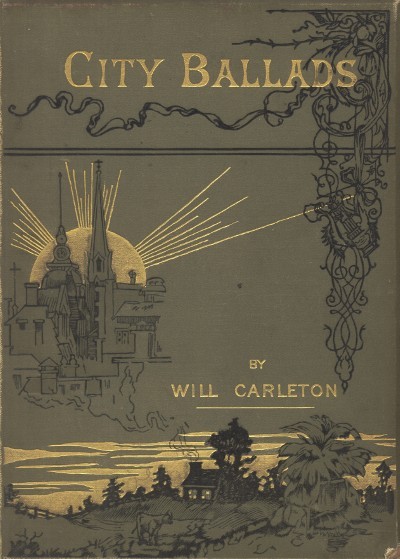
City Festivals. City Legends. City Ballads.
Farm Festivals. Farm Legends. Farm Ballads.
CYCLOPÆDIA OF POETRY.
Harper's Cyclopædia of British and American Poetry. Edited by Epes Sargent. Large 8vo, Illuminated Cloth, Colored Edges, $4 50.
POETS OF THE NINETEENTH CENTURY.
Poets of the Nineteenth Century. Selected and Edited by the Rev. Robert Aris Willmott. With English and American Additions. Superbly illustrated. Small 4to, printed on Superfine Tinted Paper, Extra Cloth, Bevelled Gilt Edges, $5 00; Half Calf, $5 50; Full Turkey Morocco, $9 00.
THE POETS OF SCOTLAND.
The Poets and Poetry of Scotland. From the Earliest to the Present Time. Comprising Characteristic Selections from the Works of the more Noteworthy Scottish Poets, with Biographical and Critical Notices. By James Grant Wilson. With Portraits on Steel. 2 vols., 8vo, Cloth, $10 00; Cloth, Gilt Edges, $11 00; Half Calf, $14 50; Full Morocco, $18 00.
WALLACE'S BEN-HUR.
Ben-Hur: A Tale of the Christ. By Lew. Wallace. Garfield Edition. 2 volumes. Twenty Full-page Photogravures. Over One Thousand Illustrations as Marginal Drawings by William Martin Johnson. Crown 8vo, Silk and Gold, Uncut Edges and Gilt Tops, $7 00. (In a Box.)
TENNYSON'S SONGS, WITH MUSIC.
Songs from the Published Writings of Alfred Tennyson. Set to Music by various Composers. Edited by W. G. Cusins. With Portrait and Original Illustrations by Winslow Homer, C. S. Reinhart, A. Fredericks, and Jessie Curtis. Royal 4to, Cloth, Gilt Edges, $5 00.
TENNYSON'S WORKS.
Complete Works of Alfred, Lord Tennyson. Poet-Laureate. With an Introductory Sketch by Anne Thackeray Ritchie. With Portraits and Illustrations. Pages 430. 8vo, Cloth, $2 00; Gilt Edges, $2 50.
FOLK-LORE OF SHAKESPEARE.
Folk-Lore of Shakespeare. By the Rev. T. F. Thiselton Dyer, M.A., Oxon. 8vo, Cloth, $2 50.
DOWDEN'S SHAKSPERE.
Shakspere: A Critical Study of his Mind and Art. By Edward Dowden, LL.D., Vice-President of "The New Shakspere Society." 12mo, Cloth, $1 75.
GOLDSMITH'S WORKS.
The Works of Oliver Goldsmith. Edited by Peter Cunningham, F.S.A. From New Electrotype Plates. 4 vols., 8vo, Cloth, Paper Labels, Uncut Edges and Gilt Tops, $8 00; Sheep, $10 00; Half Calf, $17 00.
ROLFE'S ENGLISH CLASSICS.
Edited, with Notes, by W. J. Rolfe, A.M. Illustrated. Small 4to, Flexible Cloth, 56 cents per volume; Paper, 40 cents per volume.
Select Poems of Goldsmith.—Select Poems of Thomas Gray.—Select Poems of Robert Browning.—Browning's Dramas.—Milton's Minor Poems.—Macaulay's Lays of Ancient Rome.—Wordsworth's Select Poems.
Shakespeare's The Tempest.—Merchant of Venice.—King Henry the Eighth.—Julius Cæsar.—Richard the Second.—Macbeth.—Mid-summer Night's Dream.—King Henry the Fifth.—King John.—As You Like It.—King Henry IV. Part I.—King Henry IV. Part II.—Hamlet.—Much Ado About Nothing.—Romeo and Juliet.—Othello.—Twelfth Night.—The Winter's Tale.—Richard the Third.—King Lear.—All's Well that Ends Well.—Coriolanus.—Taming of the Shrew.—Cymbeline.—The Comedy of Errors.—Anthony and Cleopatra.—Measure for Measure.—Merry Wives of Windsor.—Love's Labour's Lost.—Timon of Athens.—Two Gentlemen of Verona.—Troilus and Cressida.—Henry VI. Part I.—Henry VI. Part II.—Henry VI. Part III.—Pericles, Prince of Tyre.—The Two Noble Kinsmen.—Venus and Adonis, &c.—Sonnets.—Titus Andronicus.
SHAKESPEARE'S WORKS.
Friendly Edition of Shakespeare's Works. Edited by W. J. Rolfe. In 20 volumes. Illustrated, 16mo, Cloth, $25 00; Half Leather, $35 00; Half Calf, $50 00. (In a Box.)
SHAKESPEARE'S DRAMATIC WORKS.
The Dramatic Works of Shakspeare, with the Corrections and Illustrations of Dr. Johnson, G. Steevens, and others. Revised by Isaac Reed. Illustrated. 6 vols., Royal 12mo, Cloth, $9 00; Sheep, $11 40.
SWINTON'S ENGLISH LITERATURE.
Studies in English Literature: being Typical Selections of British and American Authorship, from Shakespeare to the Present Time; together with Definitions, Notes, Analyses, and Glossary, as an aid to Systematic Literary Study. By Professor William Swinton, A.M., Author of "Harper's Language Series." With Portraits. Crown 8vo, Cloth, $1 20.
BRUCE'S POEMS.
Old Homestead Poems. By Wallace Bruce. Illustrated. Square 8vo, Cloth, $2 00.
THE BOOK OF GOLD, AND OTHER POEMS.
The Book of Gold, and Other Poems. By J. T. Trowbridge. Illustrated. 8vo, Ornamental Covers, Gilt Edges, $2 50.
CHRISTMAS IN SONG, SKETCH, AND STORY.
Nearly Three Hundred Christmas Songs, Hymns, and Carols. With Selections from Beecher, Wallace, Auerbach, Abbott, Warren, and Dickens. Illustrations by Raphael, Murillo, Bouguereau, Hofmann, Defregger, Story, Shepherd, Darley, Meade, Nast, and others. Selected by J. P. McCaskey, Compiler of the "Franklin Square Song Collection." Royal 8vo, Cloth, $2 50.
ENGLISH MEN OF LETTERS.
12mo, Cloth, 75 cents a volume. PEOPLE'S EDITION, 36 vols in 12, 16mo, Cloth, $12 00. (Sold only in sets.)
Johnson. By Leslie Stephen.—Gibbon. By J. C. Morison.—Scott. By R. H. Hutton.—Shelley. By John Addington Symonds.—Hume. By Professor Huxley.—Goldsmith. By William Black.—Defoe. By William Minto.—Burns. By Principal Shairp.—Spenser. By Dean Church.—Thackeray. By Anthony Trollope.—Burke. By John Morley.—Milton. By Mark Pattison.—Southey. By Edward Dowden.—Chaucer. By Adolphus William Ward.—Bunyan. By James Anthony Froude.—Cowper. By Goldwin Smith.—Pope. By Leslie Stephen.—Byron. By John Nichol.—Locke. By Thomas Fowler.—Wordsworth. By F. W. H. Myers.—Dryden. By G. Saintsbury.—Hawthorne. By Henry James, Jr.—Landor. By Sidney Colvin.—De Quincey. By David Masson.—Lamb. By Alfred Ainger.—Bentley. By R. C. Jebb.—Dickens. By A. W. Ward.—Gray. By E. W. Gosse.—Swift. By Leslie Stephen.—Sterne. By H. D. Traill.—Macaulay. By James Cotter Morison.—Fielding. By Austin Dobson.—Sheridan. By Mrs. Oliphant.—Addison. By W. J. Courthope.—Bacon. By R. W. Church, Dean of St. Paul's.—Coleridge. By H. D. Traill.—Sidney. By J. A. Symonds.—Keats. By Sidney Colvin. (Other volumes in preparation.)
WORKS OF WILLIAM HAMILTON GIBSON.
SHARP EYES. A Rambler's Calendar of Fifty-two Weeks Among Birds, Insects, and Flowers. Profusely Illustrated. 8vo, Cloth, $5 00.
HAPPY HUNTING-GROUNDS. A Tribute to the Woods and Fields. Illustrated by the Author. 4to, Cloth, Gilt Edges, $7 50. (In a Box.)
HIGHWAYS AND BYWAYS; Or, Saunterings in New England. Illustrated by the Author. 4to, Cloth, Gilt Edges, $7 50. (In a Box.)
PASTORAL DAYS; Or, Memories of a New England Year. Superbly Illustrated. 4to, Cloth, Gilt Edges, $7 50. (In a Box.)
STROLLS BY STARLIGHT AND SUNSHINE. Illustrated by the Author. Royal 8vo, Cloth, Gilt Edges, $3 50.
ENGLISH'S POETICAL WORKS.
THE BOY'S BOOK OF BATTLE LYRICS. By Thomas Dunn English, M.D., L.L.D. Illustrated. Square 8vo, Ornamental Cloth, $2 00.
AMERICAN BALLADS. By Thomas Dunn English, M.D., LL.D. 32mo, Paper, 25 cents; Cloth, 40 cents.
PERRY'S ENGLISH LITERATURE.
English Literature in the Eighteenth Century. By Thomas Sergeant Perry. 12mo, Cloth, $2 00.
SKETCHING RAMBLES IN HOLLAND.
By George H. Boughton, A.R.A. Beautifully and Profusely Illustrated with Wood-engravings from Drawings by the Author and Edwin A. Abbey. With Two Artists' Full-page Proofs, Japanese Paper, without Letters. Square 8vo, Cloth, Uncut Edges, and Gilt Top, $5 00.
ILLUSTRATED BY E. A. ABBEY:
"THE QUIET LIFE." Certain Verses by Various Hands; the Motive set forth in a Prologue and Epilogue by Austin Dobson; the whole adorned with numerous drawings by Edwin A. Abbey and Alfred Parsons. 4to, Ornamental Leather, $7 50. (In a Box.)
OLD SONGS. Illustrated by Edwin A. Abbey. With Decorative Designs by Alfred Parsons. 4to, Ornamental Leather, $7 50. (In a Box.)
SHE STOOPS TO CONQUER; OR, THE MISTAKES OF A NIGHT. A Comedy. By Dr. Goldsmith. Illustrated by Edwin A. Abbey. With Ten Full-page Photogravure Reproductions, printed on separate plates, and numerous Wood-engravings. Folio, Illuminated Leather, Gilt Edges, $20 00. (In a Box.)
SELECTIONS FROM THE POEMS OF ROBERT HERRICK. With numerous Illustrations by Edwin A. Abbey. 4to, Illuminated Cloth, Gilt Edges, $7 50. (In a Box.)
COLERIDGE'S ANCIENT MARINER. ILLUSTRATED BY DORÉ.
The Rime of the Ancient Mariner. By Samuel Taylor Coleridge. Illustrated by Gustave Doré. Folio, Cloth, $10 00.
POE'S RAVEN. ILLUSTRATED BY DORÉ.
The Raven. By Edgar Allan Poe. Illustrated by Gustave Doré. With Comment by E. C. Stedman. Folio (Uniform with Doré's Ancient Mariner), Illuminated Cloth, Gilt Edges, and in a neat Box, $10 00.
DORÉ'S LONDON.
London: A Pilgrimage. Illustrations by Gustave Doré. Letter-press by Blanchard Jerrold. Folio, Cloth, $5 00.
ILLUSTRATED BY ALFRED PARSONS:
A SELECTION FROM THE SONNETS OF WILLIAM WORDSWORTH. With numerous Illustrations by Alfred Parsons. 4to, Full Leather, Gilt Edges, $5 00. (In a Box.)
THE WARWICKSHIRE AVON. Notes by A. T. Quiller-Couch. Illustrations by Alfred Parsons. 8vo, Ornamental Half Leather, $2 00.
ART AND CRITICISM.
Monographs and Studies. By Theodore Child. Profusely Illustrated. Large 8vo, Cloth, $6 00.
AMERICAN ARCHITECTURE.
Studies. By Montgomery Schuyler. With Illustrations, pp. ix., 211. 8vo, Full Leather, Ornamental, Uncut Edges, and Gilt Top, $2 50.
NAST'S CHRISTMAS DRAWINGS.
Thomas Nast's Christmas Drawings for the Human Race, pp. 130. 4to, Cloth, $2 00.
Published by HARPER & BROTHERS, New York.
Harper & Brothers will send any of the foregoing works by mail, postage prepaid, to any part of the United States, Canada, or Mexico, on receipt of the price.