
The Project Gutenberg eBook of Civilization and ethics
Title: Civilization and ethics
The philosophy of civilization, part 2
Author: Albert Schweitzer
Translator: C. T. Campion
Release date: May 10, 2025 [eBook #76061]
Language: English
Original publication: London: A. & C. Black, Ltd, 1929
Credits: Actonian Press
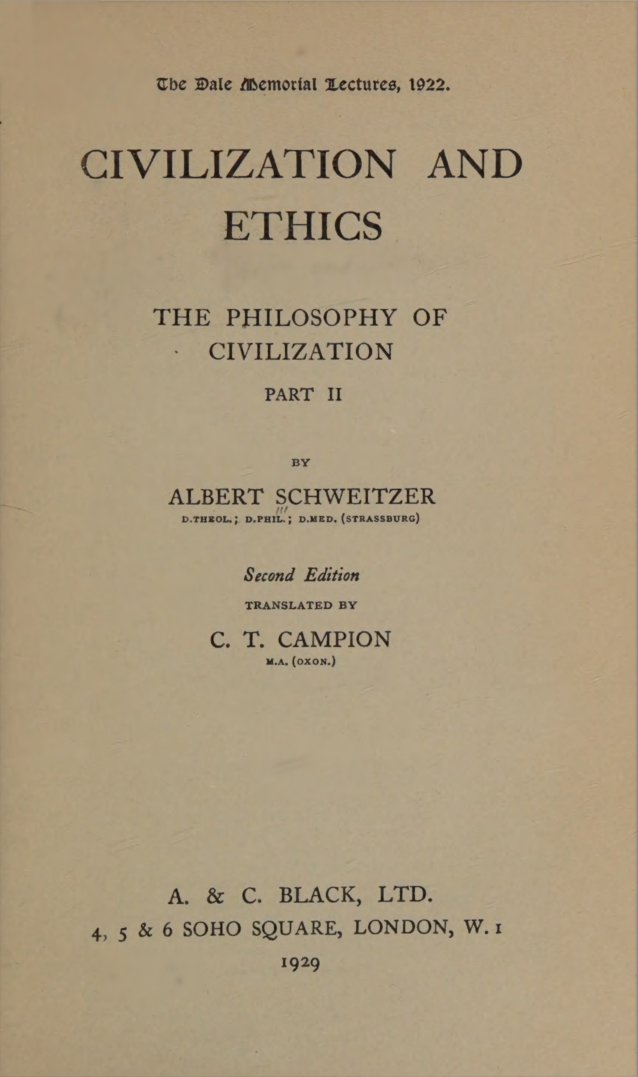
The Dale Memorial Lectures, 1922.
CIVILIZATION AND ETHICS
THE PHILOSOPHY OF CIVILIZATION
PART II
BY
ALBERT SCHWEITZER
D.THEOL.; D.PHIL.; D.MED. (STRASSBURG)
Second Edition
TRANSLATED BY
C. T. CAMPION
M.A. (OXON.)
A. & C. BLACK, LTD.
4, 5 & 6 SOHO SQUARE, LONDON, W. 1
1929
First Edition published November, 1923
Second Edition (revised), published in 1929
To
MY WIFE
THE MOST LOYAL OF COMRADES
Printed in Great Britain.
PREFACE
MY subject is the tragedy of the Western world-view. 1
While still a student I was surprised to find the history of thought always written merely as a history of philosophical systems, never as the history of man’s effort to arrive at a world-view. Later, when reflecting on the current of civilization in which I found myself living, I was struck by the strange and inexorable connexions which exist between civilization and our view of the world as a whole. Next I felt a still stronger compulsion to put to Western thought the question what it has been aiming at, and what result it has reached in the matter of world-view. What is there left of the achievements of our philosophy when it is stripped of its tinsel of learning? What has it to offer us when we demand from it those elemental ideas which we need if we are to take our position in life as men who are growing in character through the experience given by work?
So I came to an unsparing reckoning up with Western thought. I recognized and admitted that it has sought for that world-view from which alone a deep and comprehensive civilization can come. It wanted to reach a position [pg vi] of world- and life-affirmation and on that foundation lay down that it is our duty to be active, to strive for progress of all kinds, and to create values. It wanted to reach an ethical system and on that foundation lay down that for the sake of serviceable activity we have to place our life at the service of ideas and of the other life around us.
But it did not succeed in grounding its world- and life-affirming ethical world-view convincingly and permanently in thought. Our philosophy did nothing more than produce again and again unstable fragments of the serviceable world-view which hovered before its mind’s eye. Consequently our civilization also remained fragmentary and insecure.
It was a fatal mistake that Western thought never admitted to itself the unsatisfying result of its search for a stable and serviceable world-view. Our philosophizing became less and less elemental, losing all connexion with the elementary questions which man must ask of life and of the world. More and more it found satisfaction in the handling of philosophic questions that were merely academic, and in an expert’s mastery of philosophical technique. It became more and more the captive of secondary things. Instead of real music it produced again and again mere bandmaster’s music, often magnificent stuff of its kind, but still only bandmaster’s music.
Through this philosophy which did nothing but philosophize instead of struggling for a world-view grounded in thought and serviceable for life, we came to be without any world-view and therefore without any civilization.
Signs of an awakening of thought on this point are beginning to be visible. It is admitted here and there that philosophy must again try to offer a world-view. This is generally expressed by saying that people are encouraging it to venture once more on “metaphysics,” that is to put forward definitive views about the spiritual nature of the world, whereas hitherto it has been occupied with the classification of scientific facts and in cautious hypotheses.
Not only in philosophy, but in thought generally this [pg vii] awakening of the need for a world-view expresses itself as a need for “metaphysics.” Fantastic systems of “metaphysics” are sought for and offered. Individuals who believe that they have at their disposal peculiar psychic experiences, and assert that with their aid they can look behind the actual nature of phenomena, come forward as bringers of a world-view.
But neither the cautious academic, nor the much-claiming fantastic “metaphysics,” can really give us a world-view. That the road to a world-view leads through “metaphysics” is a fatal error which has already enjoyed too long a span of life in our Western thought. It would be tragic if we renewed its vigour just now, when we are faced by the necessity of working our way out of that lack of world-view in which our misery, both spiritual and material, is grounded. No further wandering along the traditional roads that lead nowhere can save us, whether we advance as the successors of our fathers or on adventurous lines of our own. Only in a deep conception of and experience in the problems of world-view is there for us any possibility of advance.
That is why I am undertaking what has never been attempted in this way before, viz. so to pose the problem of the Western world-view as to make the Western search for a world-view come to a halt and take account of itself. There are two points on which it must be clear before it proceeds to further exertion. The first is the overwhelming importance in the search for a world-view of the quality of the world-view sought. What is it that we want? We want to find the world- and life-affirmation and the ethical system which we need for that serviceable activity which gives our life a meaning, based on such thought about the world and life as finds a meaning in them also. If our search for a world-view is once thoroughly permeated by the recognition that everything turns upon these two fundamental questions, it is thereby saved from betaking itself to by-paths, thinking that by some happy disposition of fortune it can reach its goal along them. It will then [pg viii] not search for a “metaphysic,” thinking by means of it to reach a world-view, but it will search for a world-view and accept with it anything “metaphysical” that may turn up. From every point of view it will remain elemental.
The second task which the conscious search for a world-view must not shirk, is the consideration of what is the real and ultimate nature of the process by which it has hitherto attempted to secure that serviceable world-view which hovered before it. Reflexion on this is necessary that it may make up its mind whether further advance along the road it has hitherto followed gives any prospect of success. Our philosophy ought to have been philosophizing long ago about the road along which it was going in search of a world-view. It never did so, and therefore was always running uselessly round and round in a circle.
The process by which Western thought has hitherto sought for a world-view is doomed to be fruitless. It consisted simply in interpreting the world in the sense of world- and life-affirmation, that is, in attributing to the world a meaning which allowed it to conceive the aims of mankind and of individual men as having a meaning within it. This interpretation is acted upon by all Western philosophy. A few thinkers who venture to be un-Western and resolutely allow world- and life-negation and ethics to be made subjects of discussion, are side-currents which do not affect the main course of the river.
That this process followed by Western thought consists in adopting an optimistic-ethical interpretation of the world will not be clear without further explanation, for it is, indeed, not always openly followed. The optimistic-ethical interpretation is often to be found imbedded in the results of investigations into the nature of knowledge; it often appears beneath a veil of “metaphysics”; it is often so delicately shaded that it produces none of its usual effects. It is only when one has clearly grasped the fact that Western thought has nothing else in mind than to establish for itself a world-view based on world- and life-affirmation and ethical in character, that one can realize [pg ix] how in its theory of knowledge, in its metaphysics, and in all its movements generally in the game of life, it is guided, consciously or unconsciously, by the effort to interpret the world in some way or other and in some measure in the sense of world- and life-affirmation and of ethics. Whether in this attempt it goes to work openly or secretly, skilfully or unskilfully, honourably or craftily, does not matter. Western thought needs this interpretation that it may be able to give a meaning to human life. Its view of life is to be a result of its view of the world. No other course was ever taken into consideration by it.
But this awakening of Western thought will not be complete until that thought steps outside itself and comes to an understanding with the search for a world-view as this manifests itself in the thought of mankind as a whole. We have too long been occupied with the developing series of our own philosophical systems, and have taken no notice of the fact that there is a world-philosophy of which our Western philosophy is only a part. If, however, one grasps philosophy as being a struggle to reach a view of the world as a whole, and seeks out the elementary convictions which are to deepen it and give it a sure foundation, one cannot avoid setting our own thought face to face with that of the Hindus and Chinese in the Far East. The latter looks strange to us because much of it has remained even till now naïve and embodied in myth, while in other parts again it has spontaneously advanced to refinements of criticism and to artificialities. But this does not matter. The essential thing is that it is a struggle for a world-view: the form it takes is a secondary matter. Our Western philosophy, if judged by its own latest pronouncements, is much naïver than we admit to ourselves, and we fail to perceive it only because we have acquired the art of expressing what is simple in a learned way.
Among the Hindus we encounter the world-view which is based on world- and life-negation, and the way in which it grounds itself in thought is calculated to leave us not knowing what to make of our prejudice in favour of world- [pg x] and life-affirmation, which, as Westerners, we are inclined to assume as something more or less self-evident.
The attraction and tension which in Hindu thought govern the relations between world- and life-negation and ethics, afford us glimpses into the problem of ethics for which Western thought offers us no comparable opportunities.
Nowhere, again, has the problem of world- and life-affirmation, both in itself and in its relation to ethics, been felt in so elemental and comprehensive a fashion as in Chinese thought. Lao-tse, Chwang-tse, Kung-tse (Confucius), Meng-tse, Lie-tse, and the rest, are thinkers in whom the problems of world-view with which our Western thought is wrestling, encounter us in a form, strange indeed, but compelling our attention.
Discussing these problems with them means discussing them with ourselves also.
That is why I bade our search for a world-view seek to reach clear ideas about itself, and come to a halt in order to fix its attention on the thought of mankind as a whole.
My solution of the problem is that we must make up our minds to renounce completely the optimistic-ethical interpretation of the world. If we take the world as it is, it is impossible to attribute to it a meaning in which the aims and objects of mankind and of individual men have a meaning also. Neither world- and life-affirmation nor ethics can be grounded on what our knowledge of the world can tell us about the world. In the world we can discover nothing of any purposive evolution in which our activities can acquire a meaning. Nor is the ethical to be discovered in any form in the world-process. The only advance in knowledge that we can make is to describe more and more minutely the phenomena which make up the world and their course. To understand the meaning of the whole—and that is what a world-view demands—is for us an impossibility. The last fact which knowledge can discover is that the world is a manifestation in every way puzzling, of the universal will-to-live.
I believe I am the first among Western thinkers who has ventured to recognize this crushing result of knowledge, and who is absolutely sceptical about our knowledge of the world without at the same time renouncing with it belief in world- and life-affirmation and ethics. Resignation as to knowledge of the world is for me not a hopeless fall into a scepticism which leaves us to drift about in life like a derelict vessel. I see in it that effort of honesty which we must venture to make in order to arrive at the serviceable world-view which hovers within sight. Every world-view which does not start from resignation in regard to knowledge, is artificial and a mere fabrication, for it rests upon an inadmissible interpretation of the world.
When once thought has become clear to itself about the relation in which world-view and life-view stand to each other, it is in a position to reconcile resignation as to knowledge with adherence to world- and life-affirmation and ethics. Our view of life is not dependent on our view of the world in the way that uncritical thought imagines it to be. It does not wither away if it cannot send its roots down into a corresponding world-view, for it does not originate in knowledge although it would like to base itself thereon. It can safely depend upon itself alone, for it is rooted in our will-to-live.
World- and life-affirmation and ethics are given in our will-to-live, and they come to be clearly discerned in it in proportion as it learns to think about itself and its relation to the world. The rational thought of other times aimed at getting to know the world, and at being able in that knowledge to conceive of the highest impulses of our will-to-live as purposive in view of the universe and its evolution. But that aim was unattainable. We are not meant to unite the world and ourselves in such harmony with one another. We were naïve enough to assume that our view of life must be contained in our view of the world, but the facts do not justify this assumption. The result is that our thought finds itself involved in a dualism with which it can [pg xii] never finally settle. It is the dualism of world-view and life-view, of knowing and willing.
To this dualism all the problems with which human thought has busied itself ultimately go back. Every fragment of the thought of mankind which has any bearing on man’s view of the world—whether in the world-religions or in philosophy—is an attempt to resolve this dualism. It is sometimes softened down, but only to let a unitary, monistic world-view be adopted in its place; at other times it is left current, but is transformed into a drama with a monistic issue.
Innumerable are the expedients which thought used in trying to get rid of dualism. Everything it has undertaken commands respect, even the staggering naïvetés and the meaningless acts of violence to which it committed itself, for it was always acting under the compulsion of an inner necessity: it wanted to rescue a serviceable world-view from the abyss of dualism.
But from this continuous mishandling of the problem no solution could issue capable of satisfying thought. We were to be taken over the abyss on tottering bridges of snow.
Instead of going on bridging this abyss with forced logic and imaginative ideas, we must make up our minds to get to the root of the problem and let it work upon us as it comes straight to meet us in the facts. The solution is, not to try to get rid of dualism from the world, but to realize it as something which can no longer do us any harm. That is possible if we leave behind us all the arts and the unveracities of thought and bow to the fact that, as we cannot harmonize our life-view and our world-view, we must make up our minds to put the former above the latter. The volition which is given in our will-to-live reaches beyond our knowledge of the world. What is decisive for our life-view is not our knowledge of the world but the character of the volition which is given in our will-to-live. The universal spirit meets us in nature as puzzling creative power. In our will-to-live we experience [pg xiii] it within us as volition which is both world- and life-affirming and ethical.
Our relation to the world as it is given in the character of our will-to-live, when this latter seeks to comprehend itself in thought: that is our view of the world. World-view is a product of life-view, not vice versâ.
The rational thought of to-day, therefore, does not hunt the phantom of getting to know the world. It leaves knowledge of the world on one side as something unattainable by us, and tries to come to clear ideas about the will-to-live which is within us.
The problem of world-view, then, brought back to facts and tackled by rational thought without assumptions being made, may be put thus: “What is the relation of my will-to-live, when it learns to think, to itself and to the world?” And the answer is: “From an inner compulsion to be true to itself and to remain consistent with itself, our will-to-live enters into relations with our own individual being and with all manifestations of the will-to-live which surround it, that are determined by the sentiment of reverence for life.”
Reverence for life, veneratio vitæ, is the most direct and at the same time the profoundest achievement of my will-to-live.
In reverence for life my knowledge passes into experience. The unsophisticated world- and life-affirmation which is within me just because I am will-to-live has, therefore, no need to enter into controversy with itself, if my will-to-live learns to think and yet does not understand the meaning of the world. In spite of the negative results of knowledge I have to hold fast to world- and life-affirmation and deepen it. My life carries its own meaning in itself. This meaning lies in my living out the highest idea which shows itself in my will-to-live, viz. the idea of reverence for life. With that for a starting-point I give value to my own life and to all the will-to-live which surrounds me, I persevere in activity, and I produce values.
Ethics grow out of the same root as world- and [pg xiv] life-affirmation, for ethics, too, are nothing but reverence for life. That is what gives me the fundamental principle of morality, viz. that good consists in maintaining, promoting, and enhancing life and that destroying, injuring, and limiting life are evil. Affirmation of the world, which means affirmation of the will-to-live that manifests itself all round me, is only possible if I devote myself to other life. From an inner necessity I exert myself in producing values and practising ethics in the world and on the world even though not understanding the meaning of the world. For in world- and life-affirmation and in ethics I carry out the will of the universal will-to-live which reveals itself in me. I live my life in God, in the mysterious divine personality which I do not know as such in the world, but only experience as a mysterious Will within myself.
Rational thinking which is free from assumptions ends therefore in mysticism. To relate oneself in the spirit of reverence for life to the multiform manifestations of the will-to-live which together constitute the world is ethical mysticism. All profound world-view is mysticism, the essence of which is just this: that out of my unsophisticated and naïve existence in the world there comes, as a result of thought about self and the world, spiritual self-devotion to the mysterious infinite Will which is continuously manifested in the universe.
This world-affirming, ethical, active mysticism has always been hovering as a vision before Western thought, but the latter could never adopt it because in its search for a world-view it always turned into the wrong road of optimistic-ethical interpretation of the world, instead of reflecting directly on the relation which man assumes to the world under the inner compulsion of the deepest characterisation of his will-to-live.
From my youth onwards I have felt certain that all thought which thinks itself out to an issue ends in mysticism. In the stillness of the primæval forest in Africa I have been able to work out this thought and give it expression.
I come forward therefore with confidence as a restorer [pg xv] of that rational thought which refuses to make assumptions. I know indeed that our time will have absolutely no connexion with anything that is in any way rationalistic, and would like to know it renounced as an aberration of the eighteenth century. But the time will come when it will be seen that we must start again where that century came to a stop. What lies between that time and to-day is an intermezzo of thought, an intermezzo with extraordinarily interesting and valuable moments, but nevertheless an unhappy and fatal one. Its inevitable end was our sinking into a condition in which we had neither world-view nor civilization, and which contains in itself all that spiritual and material misery in which we languish.
The restoration of our world-view can come only as a result of inexorably truth-loving and recklessly courageous thought. Such thinking alone is mature enough to learn by experience how the rational, when it thinks itself out to a conclusion, passes necessarily over into the non-rational. World- and life-affirmation and ethics are non-rational. They are not justified by any corresponding knowledge of the nature of the world, but are the disposition in which, through the inner compulsion of our will-to-live, we determine our relation to the world.
What the activity of this disposition of ours means in the evolution of the world, we do not know. Nor can we regulate this activity from outside; we must leave entirely to each individual its shaping and its extension. From every point of view, then, world- and life-affirmation and ethics are non-rational, and we must have the courage to admit it.
If rational thought thinks itself out to a conclusion, it comes to something non-rational which, nevertheless, is a necessity of thought. This is the paradox which dominates our spiritual life. If we try to come through without this non-rational, the result is views of the world and of life which are without life and without value.
All valuable conviction is non-rational and has an emotional character, because it cannot be derived from [pg xvi] knowledge of the world but arises out of the thinking experience of our will-to-live, in which we stride out beyond all knowledge of the world. This fact it is which the rational thought that thinks itself out to a conclusion comprehends as the truth by which we must live. The way to true mysticism leads up through rational thought to deep experience of the world and of our will-to-live. We must all venture once more to be “thinkers,” so as to reach mysticism, which is the only direct and the only profound world-view. We must all wander in the field of knowledge to the point where knowledge passes over into experience of the world. We must all, through thought, become religious.
This rational thought must become the prevailing force among us, for all the valuable ideas that we need develop out of it. In no other fire than that of the mysticism of reverence for life can the broken sword of idealism be forged anew.
In the disposition to reverence for life lies enclosed an elementary conception of responsibility to which we must surrender ourselves; in it there are forces at work which drive us to revision and ennoblement of our individual social and political disposition.
It is the disposition to reverence for life, too, which alone is capable of creating a new consciousness of law. The misery prevailing under our political and social condition consists to a great extent in this, that neither jurists nor laity have in their minds a living and direct conception of law. During the age of rational thought there was a search made for such a conception, and effort was made to establish fundamental laws which were held to be given in the nature of man, and to get them generally recognized. Later on, however, this was given up, and laws passed at definite dates displaced natural law. Finally we got to the stage of being satisfied with purely technical law. This was the intermezzo which followed the period of rational thought in the sphere of law.
We have entered on a period in which the feeling for [pg xvii] law is hopelessly bereft of force, of soul, and of sense of moral obligation. It is a period of lawlessness. Parliaments produce with easy readiness statutes which contradict the idea of law. States deal arbitrarily with their subjects without regard to the maintenance of any feeling for law. Those, indeed, who fall into the power of a foreign nation are outlaws. No respect is shown for their natural right to a fatherland, or freedom, or dwelling-place, or property, or industry, or food, or anything else. Belief in law is to-day an utter ruin.
This state of things was in preparation from the moment when the search for the natural conception of law, grounded on rational thought, was given up.
The only thing to be done, then, is to make a new connexion in the sphere of law also, at the point where the thread of the rational thought of the eighteenth century got broken. We must search for a conception of law that is grounded in an idea which grows directly and independently out of a world-view. We have to re-establish human rights which cannot be infringed, human rights which guarantee to each person the greatest possible freedom for his personality in his own national body, human rights which protect his existence and his human dignity against any foreign violence to which he may be subjected.
Jurists have allowed law and the feeling for law to be ruined. They could not help it, however, for there was no idea provided by the thought of the time to which a living conception of law could have anchored itself. In the complete absence of any world-view law collapsed entirely, and it is only out of a new world-view that it can be built up again. It is from a fundamental idea about our relation to all that lives, as such, that it must flow in future, as from a spring which can never dry up and never become a swamp. That spring is reverence for life.
Law and ethics spring up together from the same idea. Law is so much of the principle of respect for life as can be embodied in an external code; ethics are what cannot be so embodied. The foundation of law is humanity. It is [pg xviii] folly to wish to put out of action the links between law and world-view.
In this way a world-view is the germ of all ideas and dispositions which are determinative for the conduct of individuals and of society.
Flying machines carry men to-day through the air over a world in which hunger and brigandage have a place. It is not in China only that one recognizes the grotesque character of such progress: it is almost typical for mankind generally, and such grotesque progress cannot be changed to the normal till a general disposition prevails which is capable of bringing order again into the chaos of human life through ethics. In the last resort the practical can be realized only through the ethical
What a remarkable circle! Rational thought which thinks itself out arrives at something non-rational and subjective which is a necessity of thought, viz. the ethical affirmation of world and life. On the other hand, what for the purpose of moulding the conditions of existence for individual men and mankind as a whole is rational, that is to say, what is objectively practical in this regard, can only be brought about by individuals perseveringly putting into action the above-mentioned non-rational and subjective. The non-rational principle underlying our activity, a principle which is provided for us by rational thought, is the sole rational and practical principle underlying all the happenings which are to be produced through human action. Thus the rational and the non-rational, the objective and the subjective proceed each from the other, and return each into the other again. Only when the play of this mutual interchange is in full activity do normal conditions of existence arise for men and mankind. Let it be disturbed and the abnormal develops.
I have, then, in this book written the tragedy of the search for a world-view, and have myself trodden a new path to the same goal. Whereas Western thought has not arrived at any goal because it would not venture resolutely into the desert of scepticism about knowledge of the world, [pg xix] I make my way through this desert with calm confidence. It is, after all, only a narrow strip, and it lies in front of the ever-green oasis of an elemental world-view which grows out of thought about the will-to-live. In my attempt, however, to reach a world-view by this new method, I am conscious of having done no more than put together and think out to conclusions many gropings after this new method which were made by other seekers during the period covered.
But I also put into this book my conviction that mankind must renew itself in a new temper of mind, if it is not to be ruined. I entrust to it, further, my belief that this revolution will come about, if only we can make up our minds to become thinking men.
A new Renaissance must come, and a much greater one than that in which we stepped out of the Middle Ages; a great Renaissance in which mankind discovers that the ethical is the highest truth and the highest practicality, and experiences at the same time its liberation from that miserable obsession by what it calls reality, in which it has hitherto dragged itself along.
I would be a humble pioneer of this Renaissance, and throw the belief in a new humanity, like a torch, into our dark age. I make bold to do this because I believe I have given to the disposition to humanity, which hitherto has ranked only as a noble feeling, a firm foundation in a world-view which is a product of elementary thinking and can be made intelligible to everyone. Moreover, it has gained thereby a power of attracting and convincing which it has not had hitherto; and is capable now of coming to terms in energetic and consistent fashion with our so-called reality, and of proving its full value within it.
ALBERT SCHWEITZER.
July, 1923.
The two instalments of my Philosophy of Civilization which are now ready—The Decay and Restoration of [pg xx] Civilization and Civilization and Ethics—will be followed by two others. In the next, which will be entitled The World-view of Reverence for Life, I elaborate this world-view, which so far I have only sketched for a conclusion to my discussion of the search for a world-view, as carried on down to the present day. The fourth and last will treat of the Civilized State.
The translator offers his thanks to Mrs. C. E. B. Russell, now helping at Lambarene, who kindly reviewed the whole work before it went to the printers. Many of her criticisms and suggestions were adopted, and have helped to secure a better translation.
CONTENTS
- I. THE CRISIS IN CIVILIZATION AND ITS SPIRITUAL CAUSE [I]
- The material and spiritual elements in civilization [I]
- Civilization and world-view [6]
- II. THE PROBLEM OF THE OPTIMISTIC WORLD-VIEW [11]
- The Western and the Indian conceptions of civilization[11]
- The struggle for the optimistic world-view [12]
- Optimism and pessimism [14]
- Optimism, pessimism, and ethics [17]
- III. THE ETHICAL PROBLEM [19]
- The difficulties of ethical perception [19]
- The importance of thought about ethics [21]
- The search for a basic principle of morality [22]
- Religious and philosophical ethics [24]
- IV. RELIGIOUS AND PHILOSOPHICAL WORLD-VIEWS [27]
- The world-views of the world-religions [27]
- The world-views of the world religions and that of Western thought [29]
- V. CIVILIZATION AND ETHICS IN THE GRÆCO-ROMAN PHILOSOPHY [32]
- The beginnings: Socrates [32]
- Epicureanism and Stoicism. The ethic of resignation [35]
- Plato’s abstract basic principle of the ethical. The ethic of world-negation [40]
- Aristotle. Instruction about virtue in place of ethics [42]
- The ideal of the civilised State in Plato and Aristotle [47]
- Seneca, Epictetus, and Marcus Aurelius [52]
- The optimistic-ethical world-view of the later Stoicism [57]
- VI. OPTIMISTIC WORLD-VIEW AND ETHICS IN THE RENAISSANCE AND POST-RENAISSANCE PERIODS [61]
- Belief in progress and ethics [61]
- Christian and Stoic elements in modern ethics [64]
- VII. LAYING THE FOUNDATION OF ETHICS IN THE SEVENTEENTH AND EIGHTEENTH CENTURIES [71]
- Hartley, Holbach. Devotion as enlightened egoism [71]
- Hobbes, Locke, Helvetius, Bentham [75]
- Altruism as a natural quality. Hume, Adam Smith [80]
- The English ethic of self-perfecting [84]
- Shaftesbury, An optimistic-ethical nature-philosophy [87]
- VIII. LAYING THE FOUNDATIONS OF CIVILIZATION IN THE AGE OF RATIONALISM [90]
- The mentality and the achievements of the ethical belief in progress [90]
- Obstacles to the reform movement. The French Revolution [99]
- The undermining of the rationalistic world-view [102]
- IX. THE OPTIMISTIC-ETHICAL WORLD-VIEW IN KANT [106]
- Kant’s ethics, deepened, but lacking content [106]
- Kant’s attempt to reach an ethical world-view [110]
- X. NATURE-PHILOSOPHY AND WORLD-VIEW IN SPINOZA AND LEIBNIZ [116]
- Spinoza’s attempt to reach an optimistic-ethical nature-philosophy [116]
- Leibniz’s optimistic-ethical world-view side by side with nature-philosophy [122]
- XI. J. G. FICHTE’S OPTIMISTIC-ETHICAL WORLD-VIEW [125]
- Speculative philosophy and Gnosticism [125]
- Fichte’s speculative founding of an ethic and of optimism [126]
- Fichte’s mysticism of activity incapable of being carried through [131]
- XII. SCHILLER; GOETHE; SCHLEIERMACHER [136]
- Schiller’s ethical world-view: Goethe’s world-view based on nature-philosophy [136]
- Schleiermacher’s attempt at a nature-philosophy [138]
- XIII. HEGEL’S SUPRA-ETHICAL OPTIMISTIC WORLD-VIEW [141]
- Ethics in Hegel’s nature-philosophy, and in his philosophy of history [141]
- Hegel’s supra-ethical world-view. His belief in progress [145]
- XIV. THE LATER UTILITARIANISM, BIOLOGICAL AND SOCIOLOGICAL ETHICS [150]
- Beneke, Feuerbach, Laas, Auguste Comte, John Stuart Mill [150]
- Darwin and Spencer [153]
- The weak points in biological and sociological utilitarianism [156]
- Sociological ethics and socialism. Mechanical belief in progress [160]
- XV. SCHOPENHAUER AND NIETZSCHE [165]
- Schopenhauer. An ethic of world- and life-denial [165]
- Absorption of ethics in world- and life-denial [171]
- Nietzsche’s criticism of current ethics [174]
- Nietzsche’s ethic of higher life-affirmation [177]
- XVI. THE ISSUE OF THE WESTERN STRUGGLE FOR A WORLD-VIEW [181]
- Academic thinkers: Sidgwick, Stephen, Alexander, Wundt, Paulsen, Höffding [181]
- The ethic of self-perfecting, Kant’s successors: Cohen, Herrmann [183]
- The ethic of self-perfecting: Martineau, Green, Bradley, Laurie, Seth, and Royce [185]
- Nature-philosophy and ethics. Fouillée, Guyau, Lange, Stern [186]
- Nature-philosophy and ethics in Eduard von Hartmann [194]
- Nature-philosophy and ethics in Bergson, Chamberlain, Keyserling, Haeckel [198]
- The death-agony of the optimistic-ethical world-view [202]
- XVII. THE NEW WAY [205]
- Why the optimistic-ethical world-view cannot be carried through to the logical conclusion [205]
- Life-view independent of world-view [208]
- XVIII. THE FOUNDATIONS OF OPTIMISM SECURED FROM THE WILL-TO-LIVE [212]
- The pessimistic result of knowledge [212]
- The world- and life-affirmation of the will-to-live [216]
- XIX. THE PROBLEM OF ETHICS, STARTING FROM THE HISTORY OF ETHICS [221]
- An ethic of self-devotion, or an ethic of self-perfecting? [221]
- Ethics and a theory of knowledge. Ethics and natural happenings. The enthusiastic element in ethics [224]
- The ethic of ethical personality, and the ethic of society [228]
- The problem of a complete ethic [230]
- XX. THE ETHIC OF DEVOTION AND THE ETHIC OF SELF-PERFECTING [232]
- The widening of the ethic of self-devotion into a cosmic ethic [232]
- The ethic of self-perfecting and mysticism [235]
- Abstract mysticism and the mysticism of reality. Supra-ethical and ethical mysticism [241]
- XXI. THE ETHIC OF REVERENCE FOR LIFE [244]
- The basic principle of the moral [244]
- The ethic of resignation. An ethic of veracity towards oneself, and an activist ethic [251]
- Ethics and thoughtlessness. Ethics and self-assertion [253]
- Man and other living creatures [256]
- The ethic of the relation of man to man [258]
- Personal and supra-personal responsibility. Ethics and humanity [262]
- XXII. The CIVILIZING POWER OF THE ETHIC OF REVERENCE FOR LIFE [269]
- Civilization as a product of reverence for life [269]
- The four ideals of civilization. The struggle for a civilized mankind in the machine age [271]
- Church and State as historical entities, and as ideals of civilization [278]
- The moralizing of the religious and political community [280]
- FOOTNOTES
- INDEX [287]