
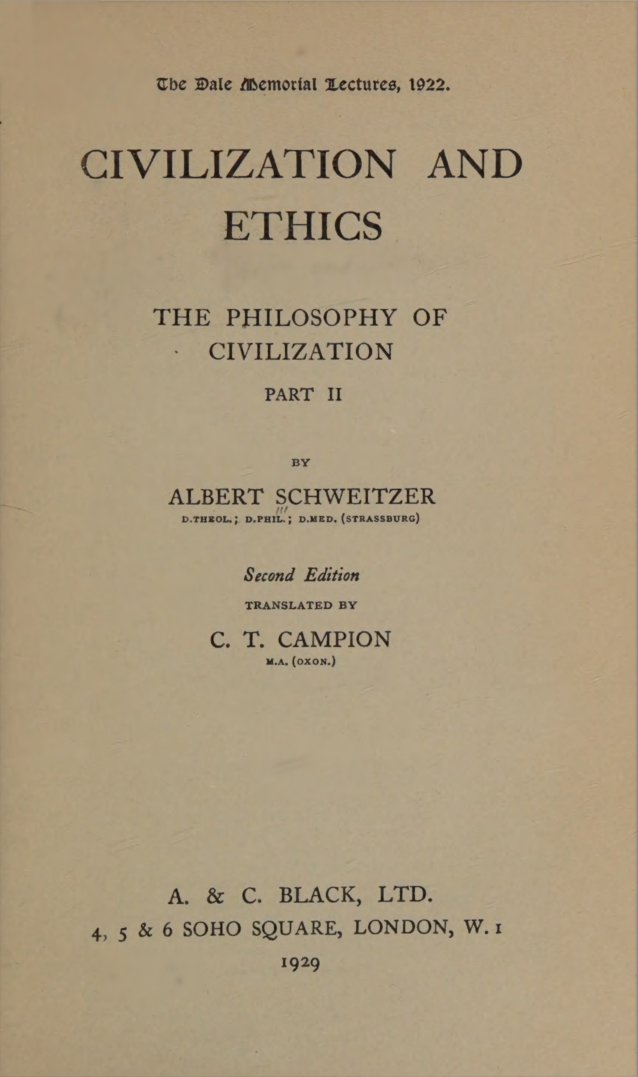
CIVILIZATION AND ETHICS
CHAPTER I
THE CRISIS IN CIVILIZATION AND ITS SPIRITUAL CAUSE
The material and spiritual elements in civilization
OUR civilization is going through a severe crisis.
Most people think that the crisis was produced by the war, but that is wrong. The war, with everything connected with it, is only a phenomenon of the condition of un-civilization in which we find ourselves. Even in States which took no part in the war, and on which the war had no direct influence, civilization is shaken, only the fact is not so clearly evident in them as in those which were hard hit by the consequences of its peculiarly cruel spiritual and material happenings.
Yet is there any real, live thought going on among us about this collapse of civilization, and about possible ways of working ourselves up out of it? Scarcely! Clever men stumble about in seven-league boots in the history of civilization and try to make us understand that civilization is some kind of natural growth which blossoms out in definite peoples at definite times and then of necessity withers, so that new peoples with new civilizations must keep replacing the worn-out ones. When they are called upon, indeed, to complete their theory by telling us what peoples are destined to be our heirs, they are somewhat embarrassed. There are, in fact, no peoples to be seen whom one could imagine to be capable of even a portion of such a task. All the peoples of the earth have been in large measure under the influence both of our civilization [pg 002] and of our lack of it, so that they share more or less our fate. Among none of them are to be found thoughts which can lead to any considerable original movement of civilization.
Let us put on one side cleverness and interesting surveys of the history of civilization, and busy ourselves in a practical way with the problem of our endangered civilization. Of what character is this degeneration in our civilization, and why has it come about?
To begin with, there is one elementary fact which is quite obvious. The disastrous feature of our civilization is that it is far more developed materially than spiritually. Its balance is disturbed. Through the discoveries which now place the forces of Nature at our disposal in such an unprecedented way, the relations to each other of individuals, of social groups, and of States have undergone a revolutionary change. Our knowledge and our power have been enriched and increased to an extent that no one would have thought possible. We have thereby been enabled to make the conditions of human existence incomparably more favourable in numerous respects, but in our enthusiasm over our progress in knowledge and power, we have come to a defective conception of what civilization is. We value too highly its material achievements and no longer keep in mind as vividly as is desirable the importance of the spiritual. Now the results are upon us, and summon us to reflect. They tell us in terribly harsh language that a civilization which develops only on its material side but not in corresponding measure on its spiritual side, is like a ship which with defective steering gear gets at a constantly accelerating pace out of control, and thereby heads for a catastrophe.
The essential nature of civilization does not lie in its material achievements, but in the fact that individuals keep in mind the ideals of the perfecting of man, and the improvement of the social and political conditions of peoples, and of mankind as a whole, and that their habit [pg 003] of thought is determined in living and constant fashion by such ideals. Only when individuals work in this way as spiritual forces on themselves and on society is the possibility given of solving the problems which have been produced by the facts of life, and of attaining to a general progress which is valuable in every respect. Whether there is rather more or rather less of material achievement to record is not what is decisive for civilization. Its fate depends on whether or no thought keeps control over facts. The issue of a voyage does not depend on whether the vessel’s pace is somewhat quicker or somewhat slower, but on whether it steers a correct course, and its steering gear keeps in good condition.
Revolutions in the relations of life between individuals, society, and peoples, as they follow in the train of our great material achievements, make, if they are to show real progress in the sense of valuable civilization, higher demands on the habit of thought of civilized people, just as the increased speed of a ship presupposes greater reliability in rudder and steering gear. Advances in knowledge and power work out their effects on us almost as if they were natural occurrences. It is not within our power so to direct them that they influence favourably in every respect the relations in which we live, but they produce for individuals, for society, and for nations, difficult and still more difficult problems, and bring with them dangers which it is quite impossible to estimate beforehand. Paradoxical as it may seem, our advances in knowledge and power make true civilization not easier but more difficult. One can even say that, judging by the events of our own and the two preceding generations, we are almost entitled to doubt whether in view of the way in which these material achievements have been showered upon us, true civilization is still possible.
The most widespread danger which material achievements bring with them for civilization consists in the fact that through the revolutions in the conditions of life men [pg 004] become in greater numbers unfree, instead of free. The type of man who once cultivated his own bit of land becomes a worker who tends a machine in a factory; manual workers and independent trades-people become employees. They lose the elementary freedom of the man who lives in his own house and finds himself in immediate connexion with Mother Earth. Further, they no longer have the extensive and unbroken consciousness of responsibility of those who live by their own independent labour. The conditions of their existence are therefore unnatural. They no longer carry on the struggle for existence in comparatively normal relations in which each one can by his own ability make good his position whether against Nature or against the competition of his fellows, but they see themselves compelled to combine together and create a force which can extort for itself better living conditions. They acquire thereby the mentality of unfree men, in which ideals of civilization can no longer be contemplated in the needful purity, but become distorted to correspond with the surrounding atmosphere of struggle.
To a certain extent we have all of us, under modern conditions, become unfree men. In every rank of life we have from decade to decade, if not from year to year, to carry on a harder struggle for existence. Overwork, physical or mental or both, is our lot. We can no longer find time to collect and order our thoughts. Our spiritual dependence increases at the same pace as our material dependence. In every direction we come to conditions of dependence which in former times were never known in such universality and such strength. Economic, social, and political organizations, which are steadily becoming more and more complete, are getting us more and more into their power. The State with its more and more rigid organization holds us under a control which is growing more and more decided and inclusive. In every respect, therefore, our individual being is depreciated. It is becoming more and more difficult to be a personality.
Thus it is that the progress of our external civilization brings with it the result that individuals, in spite of all the advantages they get, are in many respects injured both materially and spiritually in their capacity for civilization through those very advantages.
It is our progress in material civilization, too, which intensifies in so disastrous a way our social and political problems. Through the social ones we are involved in a class struggle which shakes and throws into confusion economic and national relations. If we go down to rock-bottom, it was machinery and world commerce which brought about the world war, and the inventions which put into our hands such mighty power of destruction made the war of such a devastating character that conquered and conquerors alike are ruined for a period of which no one can see the end. It was also our technical achievements which put us in a position to kill at such a distance, and to wipe out the enemy in such masses, that we sank so low as to push aside any last impulse to humanity, and were mere blind wills which made use of perfected lethal weapons of such destructive capacity that we were unable to maintain the distinction between combatants and non-combatants.
Material achievements, then, are not civilisation, but become civilization only so far as the mental habit of civilized peoples is capable of allowing them to work towards the perfecting of the individual and the community. Fooled, however, by our advances in knowledge and power, we did not reflect on the danger to which we were exposing ourselves by the diminished value we put on the spiritual elements in civilization, and we surrendered completely to a naïve satisfaction at our magnificent material achievements, and went astray into an incredibly superficial conception of civilization. We believed in a progress which was a matter of course, because contained in the facts themselves. Instead of harbouring in our thought ideals approved by reason, and undertaking to mould reality into accordance with them, we were fooled [pg 006] by a vain feeling for reality, and wanted to come through with lowered ideals which were borrowed from it. By taking this course we lost all control over the facts.
Accordingly, just when the spiritual element in culture was necessary in extraordinary strength, we let it waste away.
Civilization and World-View
How could it come about that the spiritual element in civilization became so lost to us?
To understand that, we must go back to the time when it was at work among us in a direct and living way, and the path thereto leads us back into the eighteenth century. Among the Rationalists who approach everything through reason, and would regulate everything in life by rational considerations, we find expression given in elemental strength to the conviction that the essential element in civilization is a habit of thought. It is true that they are already impressed by modern achievements in discovery and invention, and do allow to the material side of civilization a corresponding importance. But they nevertheless regard it as self-evident that the essential and valuable element in civilization is the spiritual. That interest is focused first of all on the spiritual progress of men and humanity, and in that they believe with a mighty optimism.
The greatness of these men of the period of the “Aufklärung” lies in this, that they set up as ideals the perfecting of the individual, of society, and of mankind, and devote themselves to these ideals with enthusiasm. The force on which they count for the realizing of them is the general habit of thought; they demand of the human spirit that it shall transform men and the relations in which they live, and they trust to it to prove itself stronger than the facts of life.
But whence came the impulse to set up such high ideals of civilization, and their confidence of being able to realise [pg 007] them? It was from their view of the world (Weltanschauung).
The Rationalist world-view is optimistic and ethical, its optimism consisting in this, that it assumes as ruling in the world a general purposive adaptation which is directed to the perfecting of the world, and from this purposiveness the efforts of individual men and of mankind to secure material and spiritual progress derive meaning and importance and a guarantee of success.
This world-view is ethical because it regards the ethical as something in accordance with reason, and on that ground demands from man that, putting egoistic interests behind him, he shall devote himself to all ideals that are waiting for realization, taking the ethical as in everything the standard by which to judge. A habit of humane thought is for the Rationalists an ideal which they can be induced by no consideration to resign.
When at the close of the eighteenth century and the beginning of the nineteenth the reaction against rationalism set in and criticism began to play upon it, its optimism was reproached as being superficial and its ethics as being sentimental. But the good it did, in spite of its manifold imperfections, by inspiring men with ideals of civilization grounded in reason, the spiritual movements which criticise it and take its place cannot develop in the same way. The energy of thought about civilization decreases imperceptibly but steadily. In proportion as the world-view of rationalism is left behind, the feeling for actuality makes its influence felt, until at last, from the middle of the nineteenth century onwards, ideals are borrowed no longer from reason but from actuality, and we therewith sink still further into a state of uncivilization and lack of humanity. This is the clearest and the most important of all the facts which can be established in the history of our civilization.
What has it to tell us? It tells us that there is a close connexion between civilization and world-view. Civilization is the product of an optimistic-ethical view of the world. [pg 008] Only in proportion as the prevalent world-view is one which is world- and life-affirming and at the same time ethical, do we find ideals of civilization put forward and kept influential in the habits of thought of individuals, and of society.
That this inner relation between civilization and the world-view of civilized peoples has never received the attention that it deserves, is the result of there having been among us so little real meditation on the essential nature of civilization.
What is civilization? It is the sum total of all progress made by men and mankind in every sphere of action and from every point of view, so far as this progress helps towards the spiritual perfecting of individuals as the progress of all progress.
The impulse to strive for progress in all spheres of action and from every point of view comes to men out of an optimistic world-view which affirms the world and life to be something valuable in themselves, and consequently bears within itself a compulsion to raise to its highest possible value all that is, so far as it can be influenced by us. Hence come will and hope, and effort directed to the improvement of the condition of individuals and of society, of peoples and of mankind. This leads to a lordship of the spirit over the powers of Nature, to the completion of the religious, social, economic, and practical grouping of men, and to the spiritual perfecting of individuals and of the community.
Just as the world- and life-affirming, that is, the optimistic world-view is alone capable of stirring men to effort aimed at promoting civilization, so in an ethical world-view alone is there latent the power to make men, when putting aside and giving up altogether their selfish interests, persevere in such effort for civilization, and keep them always turned in the direction of the spiritual and moral perfecting of the individual as the essential object of civilization. Bound the one to the other, then, world- and [pg 009] life-affirming world-view and ethics think out in harmony the ideals of true, complete civilization and set to work at realizing them.
If civilization remains incomplete or its level falls, this rests in the last resort on the fact that either the world- and life-affirmation of the world-view, or its ethics, or both of them have remained undeveloped or have gone backwards. And that is the case with us. It is evident that the ethics required for civilization have gone out of use.
For decades we have been accustoming ourselves increasingly to measure with relative ethical standards, and no longer to allow ethics to have their say in all questions alike. This renunciation of consistent ethical judgment we feel as an advance in practicality.
But our world- and life-affirmation also have become shaky. The modern man no longer feels under any compulsion to think about ideals of progress and to will them. To a large extent he has come to terms with actuality. He is much more resigned than he admits to himself, and in one respect he is even outspokenly pessimistic. He does not really believe any more in the spiritual and ethical progress of men and of mankind, which is nevertheless the essential element in civilization.
This stunting of our world- and life-affirmation and of our ethics has its cause in the constitution of our world-view. In regard to this we have since the middle of the nineteenth century been going through a crisis. It is no longer possible for us to arrive at a conception of the universe in which the meaning of the existence of men and of mankind can be recognized, and in which, therefore, there are also contained the ideals which flow from thoughtful world- and life-affirmation and from ethical volition. We are falling more and more into a condition of having no world-view at all, and from our lack of that comes our lack of civilization.
The great question for us is, therefore, whether we have to renounce permanently the world-view which carries within it in all their strength the ideals of the perfecting of men and of mankind, and of ethical effort. If we succeed [pg 010] in establishing again a world-view in which world- and life-affirmation is given in convincing fashion, we shall become masters of the decay of civilization which is in progress, and shall reach again a true and living civilization. Otherwise we are condemned to see the wreck of all attempts to arrest the degeneration. Only when the truth that renewal of civilization can only come by a renewal of our world-view becomes a universal conviction, and a new longing for a world-view sets in, shall we find ourselves on the right path. But this is not yet in prospect. The modern man is still without any correct feeling of the full significance of the fact that he is living with an unsatisfactory world-view, or without any at all. The unnatural and dangerous character of this condition must first be brought home to his consciousness, just as those persons who exhibit disturbances of the stability of their nervous system have to be clearly told that their vitality is threatened, although they feel no pain. Similarly, we have to stir up the men of to-day to elementary meditation upon what man is in the world, and what he wants to make of his life. Only when they are impressed once more with the necessity of giving meaning and value to their existence, and thus come once more to hunger and thirst for a satisfying world-view, are the preliminaries given for a spiritual condition in which we become again capable of civilization.
But in order to learn the way to such a world-view we must see clearly why the struggle undertaken by the European spirit to secure it was for a time successful, but during the second half of the nineteenth century came to an unfortunate end.
Because our thinking is too little occupied with civilization it has been insufficiently noticed that the most important part of the history of philosophy is the history of man’s struggle for a satisfactory world-view. Regarded in this light, the history unrolls itself like a tragic drama.
CHAPTER II
THE PROBLEM OF THE OPTIMISTIC WORLD-VIEW
The Western and the Indian conceptions of civilization
FOR us Westerners civilization consists in this, that we work for the perfecting of ourselves and of the world at the same time.
But do the activities that are directed outwards and inwards necessarily belong together? Cannot the spiritual and moral perfecting of the individual, which is the ultimate aim of civilization, also be secured if he works for himself only and leaves the world and its circumstances to themselves? Who gives us any guarantee that the course of the world can be influenced so as to promote the special aim of civilization, viz., the perfecting of the individual? Who tells us that it has any meaning at all which can be further developed? Is not any action of mine which is directed on the world a diversion of what could be directed on myself, though everything depends finally upon the latter?
Moved by these doubts the pessimism of the Hindus and that of Schopenhauer refuse to allow any importance to the material and social achievements, which form the outward and visible part of civilization. About society, nation, mankind, the individual is not to trouble himself; he is only to strive to experience in himself the sovereignty of spirit over matter.
This, too, is civilization, in that it pursues the final object of the latter, viz., the spiritual and ethical perfecting of the individual. If we Westerners pronounce it incomplete, we must not do so too confidently. Do the outward progress of mankind and the inner completion of the individual really belong together as we imagine them to? Are we not, under an illusion, forcing together things which are [pg 012] different in kind? Has the spirit in one kind of action actually some gain for the other?
What we set up as our ideal we have not realized. We lost ourselves in outward progress, allowing the moralization and inward deepening of the individual to come to a stop. So we have not been able to produce practical proof of the correctness of our view of what civilization is. We cannot, therefore, simply put aside that other narrower conception, but must come to terms with it.
There will come a time—it is already being prepared for —when pessimistic and optimistic thought, which have hitherto talked past each other almost as strangers, will have to meet for practical discussion. World-philosophy is just dawning. It will shape itself in a struggle as to whether its world-view shall be optimistic or pessimistic.
The struggle for the optimistic world-view
The history of Western philosophy is the history of the struggle for an optimistic world-view. If in antiquity and in modern times the peoples of Europe have managed to produce a civilization, it is because in their thought the optimistic world-view was dominant, and held the pessimistic permanently in subjection, although it was not able to suppress it altogether.
The accessions of knowledge which have come in the course of our philosophy have been nothing in themselves: they always stand in the service of one world-view or the other, and attain only in it to their real significance.
But the characteristic thing about the way in which the settlement is made on each occasion, is that it never is made openly. The two world-views are never brought face to face and the case of each heard. That the optimistic alone is in the right is a conviction which is accepted as more or less self-evident. The only thing felt as a problem is how to marshal all possible knowledge in the triumphal procession of proof to defeat the other, and to knock on the head anything that may still wish to rise in its defence.
Since the pessimistic world-view has never made its presence properly felt, Western thought manifests a lofty unwillingness to understand it, though it has a splendid faculty for detecting it. Where it finds, as in Spinoza, too little interest for activity directed upon the world, it reacts immediately with rejection of it. Yet all objectively thinking investigation of the reality of nature is disliked by it because it may lead to the central position of the human spirit in the world being insufficiently emphasised. It is because materialism seems likely to be the last ally of pessimism that it carries on so embittered a struggle against it.
In the discussion of the problem of the theory of knowledge from Descartes to Kant and beyond him it is really the cause of the optimistic world-view which is being maintained. That is why the theoretical possibility of a depreciation or a denial of the world of sense is attacked with such obstinacy. By proving the ideality of space and time Kant hopes to make finally secure the optimistic world-view of rationalism with all its ideals and demands. Only so can it be explained that the most acute examinations of the theory of knowledge are carried through with the most naïve conclusions about world-view. The great post-Kantian systems of thought, however much they differ from one another in their subject-matter and the process of the speculation with which they deal with it, are all united in this, that they crown the optimistic world-view in their cloud-castles as the ruler of the universe.
To fit in the aims of mankind with those of the universe in a logically convincing fashion, that is the endeavour in which European philosophy serves the optimistic world-view. Anyone who does not help, or who is indifferent about it, is an enemy.
In its prejudice against scientific materialism philosophy was right. Materialism has done much more to shake the position of the optimistic world-view than Schopenhauer has, although it never proceeded against it with outspoken hostility. When, after the collapse of the great systems, [pg 014] it was allowed to seat itself at table with philosophy, which had now become more modest, it even exerted itself to find out in what sort of tone the latter would like the conversation to be carried on. In dealing with Darwin and others, philosophizing natural science made touchingly naïve attempts so to extend and stretch out the history of zoological development which led up to man, that mankind and with it the spiritual should appear again as the goal of the world-process, as in the speculative systems. But in spite of these well-meant efforts of the proletarian guest the conversation could no longer be carried on in the old spirit. Of what use was it for him to try to be better than his reputation? He brought with him more respect for nature and facts than was consistent with the convincing establishment of the optimistic world-view. He therefore shook it, even when he did not intend to.
To such a disregard of nature and science as was shown by the earlier philosophy we can never return. Nor can we expect the return of a system of thought which makes it possible to discover in any convincing way in the universe the aims and objects of mankind, as was allowed by the old methods. The optimistic world-view ceases, therefore, to be self-evident to us, or to be demonstrable by the arts of philosophy. It must give up the idea of finding for itself a solid foundation.
Optimism and Pessimism
Confusion is caused by the fact that the optimistic and pessimistic world-views seldom come forward in their purity in the history of human thought. Their relations are usually such that the one is predominant, while the other treats with it without being officially recognized. In India a tolerated world- and life-affirmation maintains for pessimism something of interest in the external civilization which it nominally denies. With us pessimism slips in and gnaws at the civilizing energies of the optimistic view, the result being that belief in the spiritual progress of [pg 015] mankind has left us. From it, too, comes the fact that we everywhere conduct the business of life with lowered ideals.
Pessimism is a lowered will-to-live, and is to be found wherever man and society are no longer under the pressure of all those ideals of progress which must be thought out by a will-to-live that is consistent with itself, but have sunk to the level of letting actuality be, over wide stretches of life, nothing but actuality.
It is where pessimism is at work in this anonymous fashion, that it is most dangerous to civilization. It attacks then the most valuable ideas belonging to life-affirmation, leaving the less valuable ones untouched. Like some concealed source of magnetic power it disturbs the world-view’s compass, so that it takes, without suspecting it, a wrong course. Thus the unavowed mixture of optimism and pessimism in our thought has the result that we continue to approve the external blessings given us by civilization, things which to thinking pessimism are a matter of indifference, while we abandon that which alone it holds to be valuable, the pursuit of inner perfection. The desire for progress which is directed to objects of sense, goes on functioning because it is nourished by actuality, while that which reaches after the spiritual becomes exhausted, because it is thrown back upon the inner stimulus which comes from the thinking will-to-live. As the tide ebbs, objects which reach deep down are left stranded, while what is just on the surface remains afloat.
Our degeneration, then, traced back to our world-view and what resulted from it, consists in true optimism having, without our noticing it, disappeared from among us. We are by no means a race weakened and decadent through excessive enjoyment of life, and needing to pull ourselves together to show vigour and idealism amid the thunderstorms of history. Although we have retained our vigour in most departments of the direct activities of life, we are spiritually stunted. Our conception of life with all that depends on it has been lowered both for individuals and for the community. The higher forces of volition and [pg 016] influence are impotent in us, because the optimism from which they ought to draw their strength has become imperceptibly permeated with pessimism.
A characteristic feature of the presence at the same time of optimism and pessimism as lodgers in “Thoughtless House” is that each goes about in the other’s clothes, so that what is really pessimism gives itself out among us as being optimism, and vice versâ. What passes for optimism with the mass of people is the natural or acquired faculty of seeing things in the best possible light. This illumination of them is the result of a lowered conception of what ought to be now and in the future. A person ill with consumption is brought by the poison of the disease into the condition which is called Euphoria, so that he experiences an imaginary feeling of health and strength. Similarly there is an external optimism present in individuals and in society just in proportion as they are, without realizing it, infected with pessimism.
True optimism has nothing to do with any sort of lenient judgement. It consists in contemplating and willing the ideal in the light of a deep and self-consistent affirmation of life and the world. Because the spirit which is so directed proceeds with clear vision and impartial judgement in the valuing of all that is given, it wears to ordinary people the appearance of pessimism. That it wishes to pull down the old temples in order to build them again more magnificently is by the vulgar optimism put down to its discredit as sacrilege.
The reason, then, why the only legitimate optimism, that of volition inspired by imagination, has to carry on such a hard struggle with pessimism is that it always has first to track the latter down in vulgar optimism and unmask it. That is a task which optimism has never finished, for so long as it allows the enemy to emerge in any shape there is danger for civilization. When that happens, activity in promoting the special aims of civilization always diminishes, even if satisfaction with its material achievements remains as strong as before.
Optimism and pessimism, therefore, do not consist in counting with more or less confidence on such or such a future for the existing state of things, but in what the will desires to have as the future. They are qualities not of the judgement, but of the will. The fact that up to now that inadmissible definition of these qualities was current side by side with the correct one, so that there were four items to deal with instead of two, made the game easier for the unthinking by deceiving us about what true optimism is. Pessimism of the will they passed off as optimism of the judgement, and optimism of the will they put aside as pessimism of the judgement. These false cards must be taken from them, so that they may not continue to deceive the world in such a fashion.
Optimism, Pessimism, and Ethics
In what relation do optimism and pessimism stand to ethics?
That close and peculiar relations do exist between them is clear from the fact that in the thought of mankind the two struggles, that for optimistic or pessimistic world-view and that about ethics, are usually involved in each other. It is the general belief that when one is being fought out the other is being fought as well.
This mutual connexion is very convenient for thought. When a foundation for ethics is being laid, optimistic or pessimistic arguments are unawares pressed into the service, and vice versâ ethical arguments when optimism or pessimism have to be established. In this process Western thought lays most stress on justifying a life-affirming ethical system, that is an activist one, and thinks that merely by doing so it has proved the case for optimism in its world-view. With Indian thought the most important thing is finding a logical foundation for pessimism, and the justifying of a life-denying ethical system, i.e. a passivist one, is rather a derivative from that.
The confusion which resulted from the two struggles for [pg 018] optimism and pessimism and for ethics not being kept distinct, has contributed almost more than anything else to prevent the thought of mankind from attaining to clarity.
It was an easy mistake to make. The question whether it is to be affirmation or denial of life and the world, crops up in ethics in the same way as in the dispute between optimism and pessimism. Things which by their nature belong together feel themselves drawn together, so that optimism naturally thinks it can support itself on an affirmative ethical system, and pessimism thinks the same about a negative one. Nevertheless, the result has hitherto always been that neither of these two closely-related entities could stand firm, because neither of them chose to depend on itself alone.
CHAPTER III
THE ETHICAL PROBLEM
The difficulties of ethical perception
HOW came mankind to think about morality and to make progress in that sphere of thought?
It is a picture of confusion that unrolls itself before the eyes of anyone who undertakes a journey through the history of man’s search for the ethical. The progress made in that sphere of thought is inexplicably slow and uncertain. That the scientific view of the world could be delayed in its rise and development is to a certain extent intelligible, for its advance depended more or less on the chance of there existing gifted observers, whose discoveries in the realm of the exact sciences and the knowledge of nature was needed first, to provide new horizons and to point out new paths for thought.
But in ethics thought is thrown back entirely on itself: it has to do only with man himself and his self-development, which goes on by a process of causation from within. Why, then, does it not make better progress? Just because man himself is the material which has to be investigated and moulded.
Ethics and æsthetics are the step-children of philosophy. They both deal with a subject which is coy about submitting itself to reflexion, for they both treat of spheres in which man exercises his purely creative activities. In science man observes and describes the course of nature, and tries to penetrate its mysteries. In practical matters he uses and moulds it by applying what he has grasped of it outside his own person. But in his moral and artistic activities he uses knowledge and obeys impulses, [pg 020] perceptions, and laws which originate in himself. To establish these firmly and to create ideals from them is an undertaking which can be successful to a certain extent only. Thought lags behind the material on which it exercises itself.
This is evident from the fact that the examples with which ethics and æsthetics try to work upon reality are usually not quite consistent and are often foolish. And how far from simple is whatever is laid down in either this or that! How the assertions made contradict each other! The guidance that an artist can get for his activities from the best works on æsthetics is but small. Similarly, a business man who seeks in a work on ethics advice as to how, in any given case, he is to bring the demands of his business into harmony with those of ethics, can seldom find any satisfactory information.
The inadequacy in this respect of æsthetics is not of great importance for the spiritual life of mankind. Artistic activity is always the peculiar affair of individuals whose natural gifts develop more by the actual production of works of art than by consideration of the conclusions arrived at by æsthetic theorizing.
With ethics, however, it is a matter of the creative activity of the mass of men, an activity which is largely determined by the principles which are current in the general thought of the time. The absence of that progress which is still possible in ethics is something tragic.
Ethics and æsthetics are not sciences. Science, as the description of objective facts, the establishment of their connexion with one another, and the drawing of inferences from them, is only possible when there is a succession of similar facts to be dealt with, or a single fact in a succession of phenomena, when, that is, there is a subject matter which can be reduced to order under a recognized law. But there is no science of human willing and doing, and there never can be. Here there are only subjective and infinitely various facts to be studied, and their mutual connexion lies within the mysterious human ego.
It is only the history of ethics that is scientific, and that [pg 021] only so far as a history of man’s spiritual life is scientifically possible.
The importance of thought about ethics
There is, therefore, no such thing as a scientific system of ethics; there can only be a thinking one. Philosophy must give up the illusion which it has cherished even down to the present day. As to what is good and what is bad, and about the considerations in which we find strength to do the one and avoid the other, no one can speak to his neighbour as an expert. All that one can do is to impart to him so much as one finds in oneself of that which ought to influence everybody, though better thought out perhaps, and stronger and clearer, so that noise has become a musical note.
Is there, however, any sense in ploughing for the thousand and second time a field which has already been ploughed a thousand and one times? Has not everything which can be said about ethics already been said by Lao-tse, Confucius, the Buddha, and Zarathustra; by Amos and Isaiah; by Socrates, Plato, and Aristotle; by Epicurus and the Stoics; by Jesus and Paul; by the thinkers of the Renaissance, of the “Aufklärung,” and of Rationalism; by Locke, Shaftesbury, and Hume; by Spinoza and Kant; by Fichte and Hegel; by Schopenhauer, Nietzsche, and others? Is there a possibility of getting beyond all these so materially contradictory convictions of the past to something new which will have a stronger and more lasting influence? Can the ethical kernel of the thoughts of all these men be collected into an idea of the ethical, which will unite all the energies to which they appeal? We must hope so, if we are not to despair of the fate of the human race.
Does thought about ethics bring more ethics into the world? The confused picture offered us by the history of ethics is enough to make one sceptical about it. On the other hand, it is clear that ethical thinkers like Socrates, Kant, or Fichte had a moralizing influence on many of their [pg 022] contemporaries. From every revival of ethical reflexion there went forth ethical movements which made the contemporary generation fitter for its tasks. If any age lacks the minds which force it to reflect about the ethical, the level of its morality sinks and with it its capacity for answering the questions which present themselves to it.
In the history of ethical thought we wander in the innermost circles of world-history. Of all the forces which mould reality morality is the first and foremost. It is the determining knowledge which we must wring from thought. Everything else is more or less secondary.
For this reason everyone who believes that he can contribute something to help forward the ethical self-consciousness of society and of individuals has the right to speak now, although it is political and economic questions that the present day prescribes for study. For what is inopportune is really opportune. We can accomplish something lasting in the problems of political and economic life only if we approach them as men who are trying to think ethically. All those who help forward in any way our thought about ethics are working for the coming of peace and prosperity to the world. They are engaged in the higher politics, and the higher rational economics, and even if all they can do is nothing more than to bring ethical thinking to the fore, they have nevertheless done something valuable. All reflexion about ethics has as one result a raising and rousing of the general disposition to morality.
The search for a basic principle of morality
But however certain it is that every age lives by the energies which have sprung from its thought about ethics, it is equally certain that up to now the ethical thoughts which have become current have after a longer or a shorter period lost their power of convincing. Why has the establishment of an ethical system never met with more than a partial and temporary success, and never been a permanency? Why is the history of the ethical thinking of [pg 023] mankind the history of inexplicable stoppages and fallings-back? Why has there been in this sphere no organic progress which allows one period to build upon the achievements of preceding ones? Why in the sphere of ethics do we live in a town full of ruins, in which one generation builds for itself here, and another there, what is absolutely necessary?
“To preach morality is easy, to establish it is hard,” says Schopenhauer, and that saying shows what the problem is.
In every effort of thought about ethics there is to be seen, distinctly or indistinctly, the search for a basic principle of morality, which needs no support outside itself, and unites in itself the sum total of all moral demands. But no one has ever succeeded in really formulating this principle. Elements only of it were brought to light and given out to be the whole, until the difficulties which emerged destroyed the illusion. The tree, however finely it sprouted, did not live to grow old, because it was unable to send its roots down into the permanently nourishing and moisture-giving earth.
The chaos of ethical views becomes to some extent intelligible as soon as one sees that we are concerned with differing and mutually contradictory views about fragments of the basic principle. The contradiction has its foundation in their incompleteness. There is ethical matter in what Kant objects to in the ethics of rationalism, as also in what he puts in its place; in that part of Kant’s writings where his conception of the moral is opposed by Schopenhauer, as also in what is to take its place in the ethical system of the latter. Schopenhauer is ethical in the points on which Nietzsche attacks him, and Nietzsche is ethical in his opposition to Schopenhauer. What is wanted is to find the fundamental chord in which the dissonances of these varied and contradictory ethical ideas unite in producing harmony.
The ethical problem, then, is the problem of a basic principle of morality, which is founded in thought. What is the common element of good in the manifold goods which we feel to be such? Is there such a universally valid [pg 024] conception of the good? If there is, in what does it consist, and how far is it real and necessary for me? What influence has it over my general disposition and my actions? Into what relations with the world does it bring me?
It is, then, on the basic principle of the moral that the attention of thought has to be fixed. The mere giving of a list of virtues and duties is like striking notes at random on the piano and thinking it is music. And when we come to discuss the works of earlier moralists, it is only the elements in them which can help the establishment of an ethical system that will interest us, not the way in which any system has been advocated.
Otherwise there is no success for any attempt to bring order into chaos. How utterly at sea Friedrich Jodl 2 is in his history of ethics, the most important existing work in this department, when he tries to estimate the relative values of the various ethical standpoints! Failing to judge them directly by their distance from an initial basic principle of morality, he is unable to establish a standard of comparison. He gives us, therefore, only a survey of ethical views, and no history of the ethical problem.
Religious and philosophical ethics
When we come to look for the fundamental principle of morality, are we concerned only with the direct attempts of philosophy to find it? No, we are concerned with every kind, those of religion as well as others. We must trace out the whole experience of mankind in its search for the ethical.
The raising of a dividing wall between philosophical ethics and religious ethics is based on the mistaken idea that the former are scientific and the latter non-scientific. But neither of them is either: they are both alike merely thought; only one has freed itself from acceptance of the traditional religious world-view, while the other still maintains its connexion with it.