
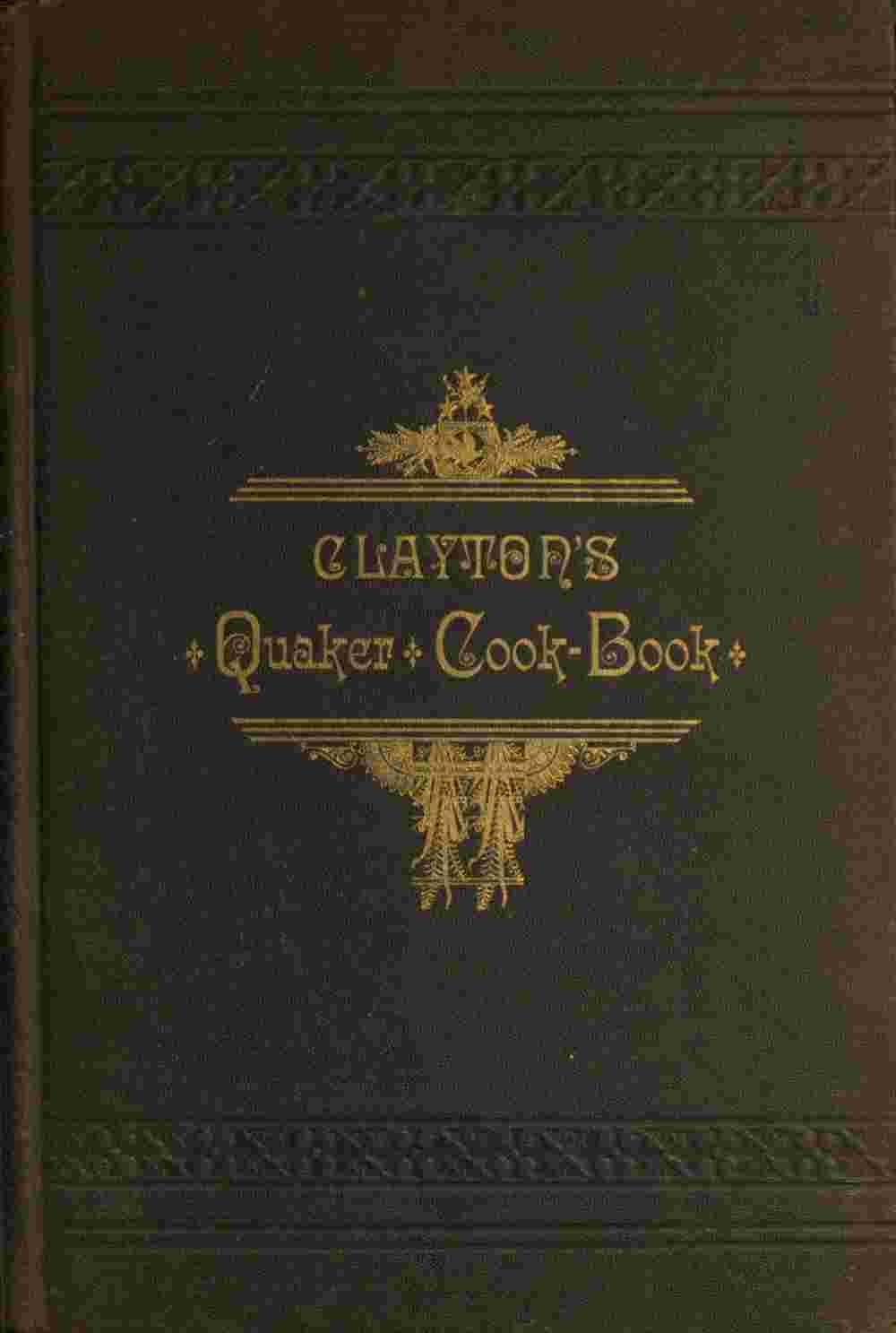
The Project Gutenberg eBook of Clayton's Quaker Cook-Book
Title: Clayton's Quaker Cook-Book
Author: H. J. Clayton
Release date: February 10, 2012 [eBook #38823]
Most recently updated: January 8, 2021
Language: English
Credits: Produced by Jason Isbell, Julia Miller and the Online
Distributed Proofreading Team at https://www.pgdp.net (This
file was produced from images generously made available
by The Internet Archive/American Libraries.)
Clayton's Quaker Cook-Book,
BEING A PRACTICAL TREATISE ON THE CULINARY ART ADAPTED TO THE TASTES AND WANTS OF ALL CLASSES.
With plain and easily understood directions for the preparation of every variety of food in the most attractive forms. Comprising the result of a life-long experience in catering to a host of highly cultivated tastes.
—BY—
San Francisco:
WOMEN'S CO-OPERATIVE PRINTING OFFICE.
1883.
Copyrighted according to Act of Congress, A. D. 1883, by H. J. Clayton.
PREFACE.
One of the sacred writers of the olden time is reported to have said: "Of the making of many books, there is no end." This remark will, to a great extent, apply to the number of works published upon the all important subject of Cookery. The oft-repeated saying, attributed to old sailors, that the Lord sends victuals, and the opposite party, the cooks, is familiar to all.
Notwithstanding the great number and variety of so-called cookbooks extant, the author of this treatise on the culinary art, thoroughly impressed with the belief that there is ample room for one more of a thoroughly practical and every day life, common sense character—in every way adapted to the wants of the community at large, and looking especially to the preparation of healthful, palatable, appetizing and nourishing food, both plain and elaborately compounded—and in the preparation of which the very best, and, at the same time, the most economical material is made use of, has ventured to present this new candidate for the public approval. The preparation of this work embodies the result of more than thirty years personal and practical experience. The author taking nothing for granted, has thoroughly tested the value and entire correctness of every direction he has given in these pages. While carefully catering to the varied tastes of the mass, everything of an unhealthful, deleterious, or even doubtful character, has been carefully excluded; and all directions are given in the plainest style, so as to be readily understood, and fully comprehended by all classes of citizens.
The writer having been born and brought up on a farm, and being in his younger days of a delicate constitution, instead of joining in the rugged work of the field, remained at home to aid and assist his mother in the culinary labors of the household. It was in this home-school—in its way one of the best in the world, that he acquired not only a practical knowledge of what he desires to fully impart to others, but a taste for the preparation, in its most attractive forms, of every variety of palatable and health-giving food. It was his early training in this homely school that induced him to make this highly important matter an all-absorbing theme and the subject of his entire life study. His governing rule in this department has ever been the injunction laid down by the chief of the Apostles: "Try all things; prove all things; and hold fast that which is good."
INTRODUCTORY.
A Brief History of the Culinary Art, and its Principal Methods.
Cooking is defined to be the art of dressing, compounding and preparing food by the aid of heat. Ancient writers upon the subject are of opinion that the practice of this art followed immediately after the discovery of fire, and that it was at first an imitation of the natural processes of mastication and digestion. In proof of the antiquity of this art, mention is made of it in many places in sacred writ. Among these is notably the memoirs of the Children of Israel while journeying in the wilderness, and their hankering after the "flesh-pots of Egypt."
Among the most enlightened people of ancient times,—cooking, if not regarded as one of the fine arts, certainly stood in the foremost rank among the useful. It was a highly honored vocation, and many of the most eminent and illustrious characters of Greece and Rome did not disdain to practice it. Among the distinguished amateurs of the art, in these modern times, may be mentioned Alexander Dumas, who plumed himself more upon his ability to cook famous dishes than upon his world-wide celebrity as the author of the most popular novels of his day.
In the state in which man finds most of the substances used for food they are difficult of digestion. By the application of heat some of these are rendered more palatable and more easily digested, and, consequently, that assimilation so necessary to the sustenance of life, and the repair of the constant waste attendant upon the economy of the human system. The application of heat to animal and vegetable substances, for the attainment of this end, constitutes the basis of the science of cookery.
Broiling, which was most probably the mode first resorted to in the early practice of this art, being one of the most common of its various operations, is quite simple and efficacious. It is especially adapted to the wants of invalids, and persons of delicate appetites. Its effect is to coagulate, in the quickest manner, upon the surface the albumen of the meat, effectually sealing up its pores, and thus retaining the rich juices and delicate flavor that would otherwise escape and be lost.
Roasting comes next in order, and for this two conditions are essentially requisite—a good, brisk fire, and constant basting. As in the case of broiling, care should be taken at the commencement to coagulate the albumen on the surface as speedily as possible. Next to broiling and stewing, this is the most economical mode of cooking meats of all kinds.
Baking meat is in very many respects objectionable—and should never be resorted to when other modes of cooking are available, as it reverses the order of good, wholesome cookery, in beginning with a slow and finishing with a high temperature. Meats cooked in this manner have never the delicate flavor of the roast, nor are they so easily digested.
Boiling is one of the easiest and simplest methods of cooking, but in its practice certain conditions must be carefully observed. The fire must be attended to, so as to properly regulate the heat. The utensils used for this purpose, which should be large enough to contain sufficient water to completely cover the meat, should be scrupulously clean, and provided with a close-fitting cover. All scum should be removed as fast as it rises, which will be facilitated by frequent additions of small quantities of cold water. Difference of opinion exists among cooks as to the propriety of putting meats in cold water, and gradually raising to the boiling point, or plunging into water already boiling. My own experience, unless in the preparation of soups, is decidedly in favor of the latter. Baron Liebig, the highest authority in such matters, decidedly favors this process. As in the case of roasting, the application of boiling water coagulates the albumen, thus retaining the juices of the meat that would be dissolved in the liquid.
Stewing is generally resorted to in the preparation of made dishes, and almost every variety of meats are adapted to this method. The better the quality of the meats, as a matter of course, the better the dish prepared in this way; but, by careful stewing, the coarser and rougher quality of meats can be rendered soft, tender and digestible, a desirable object not generally attained in other modes. Add pieces of meat, trimmings, scraps and bones, the latter containing a large amount of palatable and nourishing gelatine, may be thus utilized in the preparation of wholesome and appetizing dishes at a comparatively trifling cost.
An Explanatory Word in Conclusion.
As a matter of strict justice to all parties concerned, the author of this work deems it proper to explain his reasons for mentioning in the body of some of the recipes given in this book, the places at which the purest and best articles used are to be purchased. This recommendation is, in every instance, based upon a thorough and complete personal test of every article commended. In these degenerate days of wholesale adulteration of almost every article of food and drink, it is eminently just and proper that the public should be advised where the genuine is to be procured. Without desiring to convert his book into a mere advertising medium, the author deems it not out of place to give the names of those dealers in this city of whom such articles as are essential in the preparation of many of the recipes given in these pages may be procured—of the most reliable quality, and at reasonable rates.
INDEX.
| Soups. | |
|---|---|
| Stock | 1 |
| General Directions for making Soup | 2 |
| Calf's-Head Soup | 3 |
| Ox-Tail Soup | 3 |
| Okra Soup | 3 |
| Chicken Gumbo | 4 |
| Fresh Oyster Soup | 4 |
| Fish Chowder | 5 |
| Clam Soup | 5 |
| Clam Chowder | 6 |
| Bean Soup | 6 |
| Dry Split-Pea Soup | 6 |
| Tomato Soup | 7 |
| Celery Soup | 7 |
| Pepper-Pot | 8 |
| Egg-Balls for Soup | 8 |
| Nudels | 8 |
| Fish. | |
| Boiled Fish | 9 |
| Fried Fish | 10 |
| Broiling Fish | 10 |
| Fried Oysters | 10 |
| Oysters in Batter | 10 |
| Oyster Patties | 11 |
| Stewed Lobsters or Crabs | 11 |
| Roast, Boiled, Baked, Broiled and Fried. | |
| Retaining the Juices in Cooking Meats | 12 |
| Roast Pig | 13 |
| To Roast Turkeys and Chickens | 13 |
| Roasting Beef | 15 |
| A good way to Roast a Leg of Mutton | 15 |
| Clayton's Mode of Cooking Canvas-Back Ducks | 15 |
| Clayton's Mode of Cooking California Quail or Young Chickens | 16 |
| To Cook Boned Turkey | 17 |
| To Bone a Turkey | 18 |
| To Cook Ducks or Chickens, Louisiana Style | 18 |
| Breast of Lamb and Chicken, Breaded | 19 |
| Scrapple or Haggis Loaf | 19 |
| Pig's-Feet and Hocks | 20 |
| To Cook a Steak California Style, 1849-50 | 21 |
| A Good Way to Cook a Ham | 21 |
| Beefsteak Broiled | 21 |
| Beefsteak with Onions | 22 |
| Corned-Beef and how to Cook it | 22 |
| Spiced Veal | 22 |
| Calves' Liver with Bacon | 23 |
| Calves' or Lambs' Liver Fried | 23 |
| Spiced Beef | 23 |
| Stews, Salads, and Salad-Dressing. | |
| Terrapin Stew | 24 |
| Stewed Chicken Cottage Style | 25 |
| Stewed Tripe | 25 |
| Chicken-Salad | 25 |
| Clayton's Celebrated California Salad Dressing | 26 |
| Salad Flavoring | 27 |
| Eggs and Omelettes. | |
| Boiling Eggs | 27 |
| Scrambled Eggs | 27 |
| To Fry Eggs | 28 |
| Oyster Omelette | 28 |
| Ham Omelette | 28 |
| Cream Omelette | 28 |
| Spanish Omelette | 29 |
| Omelette for Dessert | 29 |
| Vegetables. | |
| Beans, Baked [See Bean Soup] | 6 |
| Baked Tomatoes | 30 |
| Raw Tomatoes | 30 |
| Cucumbers | 30 |
| Boiled Cabbage | 30 |
| To Cook Cauliflower | 31 |
| To Cook Young Green Peas | 31 |
| A Good Way to Cook Beets | 31 |
| Mashed Potatoes and Turnips | 32 |
| Boiled Onions | 32 |
| Stewed Corn | 32 |
| Stewed Corn and Tomatoes | 32 |
| Succotash | 33 |
| Saratoga Fried Potatoes | 33 |
| Salsify or Oyster-Plant | 34 |
| Egg-Plant | 34 |
| To Boil Green Corn | 35 |
| Boiled Rice | 35 |
| Stewed Okra | 35 |
| Bread, Cakes, Pies, Puddings and Pastry. | |
| Solid and Liquid Sauce. | |
| Quick Bread | 36 |
| Quick Muffins | 36 |
| Brown Bread | 36 |
| Graham Rolls | 36 |
| Mississippi Corn-Bread | 37 |
| Nice Light Biscuit | 37 |
| Clayton's Corn-Bread | 37 |
| Johnny Cake | 37 |
| Sweet Potato Pone | 38 |
| Ginger Bread | 38 |
| Molasses Ginger Bread | 38 |
| Quaker Cake | 38 |
| Pound Cake | 38 |
| Chocolate Cake.—Jelly Cake | 38 |
| Currant Cake | 39 |
| Cream Cup-Cake | 39 |
| Jumbles | 39 |
| Sweet Cake | 39 |
| Sponge Cake | 40 |
| Ginger Snaps | 40 |
| A Nice Cake | 40 |
| Icing for Cake | 40 |
| Chocolate Icing | 41 |
| Lemon Pie | 41 |
| English Plum Pudding | 42 |
| Baked Apple Pudding | 42 |
| Bread Pudding | 42 |
| Baked Corn-Meal Pudding | 42 |
| Corn-Starch Pudding | 43 |
| Delmonico's Pudding | 43 |
| Peach Ice-Cream | 43 |
| Apple Snow | 44 |
| Strawberry Sauce | 44 |
| Farina Pudding | 44 |
| Snow Pudding | 45 |
| Fruit Pudding | 45 |
| Charlotte-a-Russe | 46 |
| Solid Sauce | 46 |
| Liquid Sauce | 46 |
| Currant or Grape Jelly | 46 |
| Calf's Foot Jelly | 47 |
| Ice Cream | 47 |
| Orange Ice | 48 |
| Lemon Jelly | 48 |
| Wine Jelly | 48 |
| Peach Jelly | 48 |
| Roman Punch | 49 |
| Miscellaneous. | |
| Butter and Butter-Making | 49 |
| A Word of Advice to Hotel and Restaurant Cooks | 51 |
| Clayton's California Golden Coffee | 53 |
| The very Best Way to Make Chocolate | 54 |
| Old Virginia Egg-Nogg | 55 |
| Clayton's Popular Sandwich Paste | 55 |
| Welsh Rabbit | 56 |
| Delicate Waffles | 57 |
| Force-Meat Balls | 57 |
| Beef Tea | 57 |
| Crab Sandwich | 58 |
| Pork.—The kind to Select, and the best Mode of Curing | 58 |
| Lard, Home-Made | 59 |
| Sausage, New Jersey | 60 |
| Pot-Pie | 60 |
| Curried Crab | 61 |
| To Toast Bread | 61 |
| Cream Toast | 61 |
| Fritters | 61 |
| Hash | 62 |
| Hashed Potato with Eggs | 62 |
| Macaroni, Baked | 62 |
| Drawn Butter | 63 |
| Spiced Currants | 63 |
| Canning Fruits.—Best Mode of | 63 |
| Quinces, Preparing for Canning or Preserving | 64 |
| Clayton's Monmouth Sauce | 65 |
| Mustard.—To Prepare for the Table | 65 |
| Mint Sauce | 65 |
| Eggs ought never be Poached | 66 |
| Sunny-Side Roast | 66 |
| Clayton's Spanish Omelette | 66 |
| Plain Omelette | 67 |
| Clam Fritters | 67 |
| Fried Tripe | 67 |
| Ringed Potatoes | 67 |
| New Potatoes, Boiled | 67 |
| Fried Tomatoes | 68 |
| Squash and Corn.—Spanish Style | 68 |
| Pickles | 68 |
| Nice Picklette | 69 |
| Pickled Tripe | 69 |
| To Cook Grouse or Prairie Chicken | 69 |
| Brains and Sweet-Bread | 70 |
| Stewed Spare-Ribs of Pork | 70 |
| Broiled Oysters | 71 |
| Pumpkin or Squash Custard | 71 |
| Fig Pudding | 71 |
| Fried Apples | 72 |
| Clayton's Oyster Stew | 72 |
| Boiled Celery | 72 |
| Selecting Meats | 72 |
| Rice Pudding.—Rebecca Jackson's | 73 |
| Bread and Butter Pudding | 73 |
| Codfish Cakes | 73 |
| Pickled Grapes | 74 |
| Forced Tomatoes | 74 |
| Broiled Flounders or Smelts | 74 |
| Onions | 75 |
| Singeing Fowls | 75 |
| Taste and Flavor.—Secret Tests of | 75 |
| Ware for Ranges.—How to Choose | 76 |
| Herbs.—Drying for Seasoning | 76 |
| Roaches, Flies and Ants.—How to Destroy | 76 |
| Tinware.—To Clean | 77 |
| Iron Rust | 77 |
| Mildew | 77 |
| Oysters Roasted on Chafing-Dish | 77 |
| Cod-Fish, Family Style | 77 |
| Cod-Fish, Philadelphia Style | 78 |
| Advertisements. | |
| Jersey Farm Dairy | 81 |
| W. T. Coleman & Co., Royal Baking Powder | 82 |
| Quade & Straut, Choice Family Groceries | 83 |
| J. H. McMenomy, Beef, Mutton, Veal | 83 |
| Arpad Haraszthy & Co., California Wines and Brandies | 84 |
| Will & Finck, Cutlers | 85 |
| Wilton & Cortelyou, Dairy Produce | 86 |
| John Bayle, Tripe, Calves' Heads, Feet | 87 |
| Palace Hotel, John Sedgwick, Manager | 88 |
| Deming Bros., Millers and Grain Dealers | 89 |
| E. R. Durkee & Co's Standard Aids to Good Cooking | 90 |
| Berlin & Lepori, Coffee, Tea and Spices | 91 |
| B. M. Atchinson & Co. Butter, Cheese, Eggs, Lard | 92 |
| Kohler & Frohling, California Wines and Brandies | 93 |
| Richards & Harrison, Agents for English Groceries | 94 |
| Robert F. Bunker, Hams, Bacon | 95 |
| Edouart's Art Gallery | 96 |
| E. R. Perrin's Quaker Dairy | 97 |
| Hills Bros., Coffee, Teas and Spices | 98 |
| Emil A. Engelberg, German Bakery & Confectionery | 98 |
| A. W. Fink, Butter, Cheese, Eggs | 99 |
| J. Gundlach & Co., California Wines and Brandies | 100 |
| Lebenbaum, Goldberg & Bowen, Grocers | 101 |
| Women's Co-operative Printing Office | 102 |
| W. W. Montague & Co., French Ranges | 103 |
| Mark Sheldon, Sewing Machines and Supplies | 104 |