
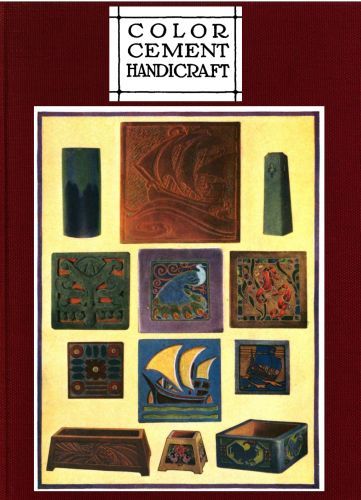
The Project Gutenberg eBook of Color Cement Handicraft
Title: Color Cement Handicraft
Author: Pedro J. Lemos
Reta A. Lemos
Release date: September 17, 2016 [eBook #53067]
Most recently updated: October 23, 2024
Language: English
Credits: Produced by Chuck Greif and the Online Distributed
Proofreading Team at http://www.pgdp.net (This file was
produced from images available at The Internet Archive)
|
Some typographical errors have been corrected; a list follows the text. List of Illustrations (etext transcriber's note) |
|
|
||
| C O L O R CEMENT HANDICRAFT |
||
Copyright, 1922
by The Davis Press, Inc.
Worcester, Mass.
Printed in the
United States of America
Dedicated to
ROBERT B. HARSHE
Director of the
Chicago Art Institute
for his early recognition
and encouragement
of Color Cement
Handicraft
TABLE OF CONTENTS
| Page | ||
| Foreword | 9 | |
| Chapter 1. | Materials and Equipment | 11 |
| Chapter 2. | The Making of Plaster Molds | 21 |
| Chapter 3. | Plain and Incised Cement Tiles | 33 |
| Chapter 4. | Making Vases and Bowls | 47 |
| Chapter 5. | The Use of Color in Cement Tiles | 57 |
| Chapter 6. | Color Cement Relief Tiles | 67 |
| Chapter 7. | The Majolica Tile | 75 |
| Chapter 8. | Sgraffito Color Cement Work | 87 |
| Chapter 9. | Modeled and Carved Color Cement | 95 |
| Chapter 10. | Color Cement for Bowls and Vases | 103 |
| Chapter 11. | Glass Mosaic Tiles | 111 |
| Chapter 12. | Flower Boxes and Other Straight Forms | 119 |
| Chapter 13. | Color Cement for the Garden | 129 |
| Chapter 14. | The Making of Candlesticks and Book Supports | 141 |
| Chapter 15. | Color Cement for Interior Decoration | 147 |
| Chapter 16. | Surface Finishes | 159 |
| Chapter 17. | Decorations in the Open | 165 |
| Chapter 18. | Tile and Pottery with Color Magnesite Cement Work | 173 |
| Chapter 19. | Color Cement Projects for the Schoolroom | 179 |
| Chapter 20. | Designing for Tiles and Pottery | 191 |
LIST OF ILLUSTRATIONS
FOREWORD
It is evident to the most casual observer that the use of cement and concrete has developed into a most important building material—undoubtedly the most important of the age. Industrial and vocational educators have recognized this importance and thousands of school children have received instruction in its use and application to objects of utility. Its use has been the subject of many books, and the reason for the issuing of this book is to present in printed form the use of color cement for the decoration or surface enrichment of cement and concrete objects. We heretofore have thought of cement in terms of rough surfaces and crude retaining walls, little thinking that beautiful patterns and textures are possible with proper combinations of color with cement, presenting possibilities for producing art tiles, pottery, and decorations of a high art quality.
After a study some years ago of the various forms of producing clay pottery and its possible relation to school arts and industrial education, the handicap of necessary firing to give permanency loomed large against its general adaptation by schools. This resulted in considerable research and experimenting by the authors with cement and the use of color in the endeavor to parallel in some measure each of the methods employed in the making of fired tiles and pottery. Particular attention was given to simplifying the process of securing permanent form to many of the plastic forms of schoolroom art, which have been presented in clay and other perishable mediums. With the projects presented in the following chapters permanent useful objects can be secured by students in their school art subjects. Attention was also given to the enriching or refining by decoration the many objects heretofore made in cement and concrete by vocational classes. The problems and methods explained in the following description solve this need.
Craftsmen or amateur home-workers who delight in creating and building objects of beauty around them can find in color cement a medium which will appeal to their needs, in that the necessary working equipment is simple and the work can be done within small space.
The following chapters by no means complete the story of color cement. They record the results of the work of the authors and it is hoped that it will stimulate interested readers to carry this delightful handicraft to even greater achievements.
The results achieved have been accomplished through several years’ patient experimenting by the authors, but the realization that many other teachers, craftsmen and students will be aided in continuing this delightful, durable handicraft, is in itself an enjoyable reward to the authors for their efforts.
Reta A. Lemos
Pedro J. Lemos
|
|
||
| CHAPTER 1 Materials and Equipment |
||
IN THE MAKING OF COLOR CEMENT HANDICRAFT the chief material used is Portland cement. While this material has assumed a most important part in the building history of our present time, there are not many who know its history and source, and as every craftsman is a better craftsman if he knows something of the story of the material with which he works, here is the brief story of Portland cement.
PORTLAND CEMENT DERIVES ITS NAME because of resemblance in color to a stone quarried near Portland, England, and it was named by its inventor, Joseph Aspdin in 1824. It is a manufactured product produced by a scientific process. At the beginning of the Christian era the Romans used a natural cement very extensively, and many fragments of color frescoes and friezes remain from the work of the ancients, showing that they used color with their work.
THE PRINCIPAL INGREDIENTS OF PORTLAND CEMENT are lime, silica, iron, and alumina. These materials are mixed in definite proportions and then subjected to a degree of heat that almost causes them to melt, forming a clinker or slag. This clinker is ground until it is reduced to a powder, and this is the Portland cement. Portland cement is generally mixed with an aggregate to produce strength and this aggregate is usually stone, gravel or sand. The third material needed to complete the combination is water.
SUCCESS IN THE USE OF CEMENT depends largely upon cement that is fresh. Cement is very sensitive to moisture and if kept where fogs, dew or moisture of any nature is absorbed into it, the first set or “hydration” takes place and destroys its use for fine handicraft.
TO TEST FRESH CEMENT when the cement sack is open, thrust the hand into it and see that no hard lumps are in it. Fresh cement will feel slippery and soapy when rubbed between the finger tips. If it feels gritty and sandy it may do for the rough parts or body of vases and tiles, but only fresh cement should be used to mix with color and for surfacing purposes.
THE PROPER CARE OF CEMENT requires that it be kept in a covered receptacle and kept in a dry place, preferably up from the floor if the floor is near the ground. It should be kept in a dry, tight work-shop and the doors should be kept closed at night to avoid any moisture from the night air reaching it. Nothing can restore spoiled cement and it should not be used as the results will be discouraging.
GOOD GRADES OF AGGREGATES SHOULD BE USED in cement work. Clean sand should be used and a sand that is not too fine is preferable. Gravel and crushed rock used in large work such as garden seats, large bowls and outdoor problems should be of a good grade to form a good mixture.
THE WATER USED IN CEMENT WORK should be free from all impurities. Moderately warmed water will hasten the setting or hardening of cement while very cold water retards the hardening.
THERE ARE TWO COLORS OF CEMENT, gray and white. Portland cement is gray in color and a white cement is also made that is a refined form of cement. White cement is not as hard or durable as gray cement, but gives a smooth surface and sets as satisfactorily as the gray cement. It is more expensive than the gray cement and should not be used later than six months after the sack is opened.
WHEN CEMENT IS USED ALONE IT IS TERMED “NEAT.” When it is mixed with rock, gravel or sand it is termed “concrete.” Concrete produces strength and the neat cement produces a smooth texture and surface. When concrete is used the cement and water will rise to the top and if the surface is worked and pressed with a trowel the cement is “flowed” to the top, producing a smooth surface.
MOLDS ARE USED FOR FORMING CEMENT AND CONCRETE, and are made from wood, metal or plaster-of-Paris. The forms in all instances should be tied or braced together to prevent the moisture of the mixture from running out, as the water is essential to the successful hardening of the cement. In the making of cement pottery and tiles, plaster-of-Paris molds or forms are generally used and plaster-of-Paris therefore forms an important material in the making of color cement handicraft.
Plaster-of-Paris is made in different degrees of setting periods. These are quick-setting, medium-setting, and slow-setting. Casting plaster or sculptor’s plaster should be asked for and a medium-or slow-setting plaster is preferable for the beginner.
CEMENT, AGGREGATES, WATER AND PLASTER FORM THE MAIN PARTS of our working materials excepting the color, which is especially described in the chapter on Color.
THE EQUIPMENT for concrete pottery is simple, and much of it may be pressed into service from material to be found about the house or workshop. Inventive ingenuity on the part of the worker will find clever uses for many discarded kitchen utensils and unused tools.
Following is a list of convenient things needed to produce pottery. These may be added to or elaborated through personal requirements.
WORKING EQUIPMENT.
- galvanized iron pans about 2 x 3 feet
- 2 large spoons
- 4 or 5 pans
- 2 ladles
- 1 large file or rasp
- 2 table knives
- 3 pieces of ordinary glass about 12 x 18 inches
- 1 palette knife
- 1 lb. modeling wax
- 1 bristle brush ½ inch wide
- 2 small sable oil brushes, No. 1 or 2
- 1 small clay-modeling tool
- 2 pieces of thin wood for mixing paddles
- ½ doz. small saucers or butter dishes
- strips of thin metal
- thin soft wire
- 1 sifter
- 2 pails
- muller and pestle
- several pieces of surfaced wood about 12 inches square.
With a flat table to work on, running water or a pail of water handy, a box to receive waste plaster-of-Paris and cement, the proper environment for color cement is set.
GALVANIZED IRON WATER TRAYS can be made by taking a three-inch by seven-inch sheet and cutting a two-inch strip off of one end, reserve for making scrapers and other useful tools. Cut the remaining metal into three rectangular sections for trays.
To make the trays, lay one of these pieces over a strong box with an even edge and hammer into tray shape as shown in the accompanying plate. The corners should be bent so as to make the trays waterproof without soldering. A wooden mallet should be used for hammering the metal as a metal hammer may cut the metal.
MOLDING CASE. Several pieces of board hinged together with one series of edges coming so that they will rest evenly on a flat surface, will produce an adjustable case to use in making molds. A strong cord will keep it in place. A strip of metal (tin, brass or iron) may be used as a cylinder, the circumference being pressed in and tied to conform to the dimensions of the object to be molded.
MIXING PADDLES. Paddles for mixing plaster or cement can be made out of firm wood strips and handles shaped to fit the hand.
INCISING TOOLS. A nail hammered into a piece of firm wood and the head snipped off with nippers then sharpened with a file or emery stone until it is a tapering wedge point. Nut picks may be filed down slightly for this purpose. Two or three points of varying widths will be handy to have, particularly when some of them disappear occasionally as all small tools will.
SCRAPER. A piece of barrel stave or heavy wire bent like a croquet wicket with a wire fastened from end to end is particularly convenient where a number of clay or plasticene tiles are to be produced. For class use two strips of wood are fastened to the bench, the desired width separating the strips. Between these strips a piece of strong paper should be laid and the clay or plasticene pressed firmly onto it between the strips. The scraper will shave the surplus clay if it is moved along so that the wire rests on the wooden strips. Measure off the six-inch or eight-inch squares, cut across with a knife from strip to strip and remove the squares by sliding the paper out. This will give a smooth, even surface on which to model or incise designs.
THE OTHER ITEMS OF EQUIPMENT all have their part to play as follows:
- 2 large spoons—For handling plaster and cement.
- 1 large file or rasp—For occasional use on the tile edge.
- 3 pieces of glass—On which to cast tiles.
- 2 table knives—For paring molds, etc.
- 1 palette knife—For working color into cement.
- 1 bristle brush—With which to oil molds.
- Small modeling tool—To use on clay and plasticene.
- Nut picks—For incising.
- ½ doz. small saucers—In which to mix colors.
- Thin soft wire—For cutting molds.
- Sifter—To sift cement and color for glazes.
- 2 pails—In which to mix cement and plaster.
- Muller and pestle—Grinding mineral colors with cement.
It may be unnecessary to add that the old axiom “A place for everything and everything in its place,” will do wonders toward keeping the temper sweet, and a good temper is a most necessary ingredient for producing good cement handicraft.
|
|
||
| CHAPTER 2 The Making of Plaster Molds |
||
THE SUCCESSFUL USE OF PLASTER is such an important part in the making of color cement tiles and pottery that as a preliminary step or auxiliary to the cement craft it should be well accomplished by the student before using the cement. It is not at all difficult and for those who have not used plaster, there awaits an interesting medium for all forms of plastic applications or adaptations. Our concern with it will be in the making of successful molds for the producing or reproducing of our cement tiles and pottery, but a whole book could be written upon the making of plaster objects. The uses of plaster form a large industry and many art objects are produced in plaster for many forms of applied art.
PLASTER IS SENSITIVE to moisture, and should be kept in a dry place. If plaster does not set within a short time it probably is old and even if it does set in time it will have a tendency to pulverize. It is always safer to purchase an entire sack than to purchase a small lot from the hardware dealer, grocer, or druggist, for the chances are that his plaster has been exposed in a bin so long that its strength has vanished. This is mentioned because instances have been known where trouble in cast making was traced to just such conditions.
ON RECEIVING THE SACKS OF PLASTER AND CEMENT the tendency will be to let contents remain in the sacks. It will be found much more convenient and economical to empty the sacks into a small barrel or box to which a cover has been made. A tin tray under the box or barrel will catch all waste that may drop around the edge, preventing the material from being tracked over the floor. A nail or hook on the side of the barrel for holding the ladle or spoon used for taking out the plaster will enable you to find it when you need it.
THERE ARE VARIOUS GRADES OF PLASTER, but the best for this purpose is molding plaster. The plaster should always be kept in a good dry location.
TO MIX PLASTER SUCCESSFULLY for molds observe the following directions: A bucket or pan large enough to contain the required amount of plaster needed should be used. Then half the water for the amount of plaster used should be poured into the bucket. Sift the plaster-of-Paris through the fingers into the water, until the water absorbs it no longer. This can be determined by small portions of the plaster remaining on the surface. Then stir the whole mass slowly with the mixing paddle until the passage of the paddle through the plaster leaves a channel which closes up slowly.
IT IS THEN POURED PROMPTLY into the center of the space on the glass prepared for the plaster tile so that the poured plaster gradually spreads from the center toward the corners and edges filling up the spaces and coming up the sides to about one-half inch height. Jarring the table or a slight shaking of the glass will cause the plaster to settle very level as well as causing any bubbles in the plaster to rise to the surface and break. Care should be taken that the plaster is not too thick before being poured. This stage of the proceedings requires one having their wits alert, and discussing Futurist art or any other topic may result in “try, try again.” If the plaster appears too thin more plaster should be added until it is the proper consistency.
After the plaster is poured it should set for about half an hour (varying according to the dryness of the atmosphere) before any attempt is made to remove it. Meanwhile all buckets, paddles, ladles, etc., containing plaster should be cleaned while the plaster is soft and easy to remove.
WHEN THE PLASTER MOLD IS READY TO REMOVE, a table knife slightly inserted between partitions and carefully pryed will cause the parts to separate. A most important part of casting molds and the using of the plaster molds is the oiling. All parts of the molds to come in contact with fresh plaster, cement or concrete must be thoroughly oiled or greased to prevent them sticking to each other. If wood, glass or metal is used with plaster, cement or concrete, remember to oil or grease such surface before pouring the plaster or cement on it. If you do not, you will have to use a chisel and with discouraging results.
The best way to oil the surface is as follows:
GLASS—Apply salad oil with brush or cloth removing as much as will come with the palm of the hand.
PLASTER BARS AND MOLD should first be soaked in water ten or fifteen minutes to prevent drawing the moisture out of the fresh plaster or cement. Wipe off surface moisture with soft cloth, and replace with oil, before using for molding. If oil is left thick or in brush streaks, it will leave its influence on the surface of the casting.
WOOD—A smooth-surfaced wood should always be used, and oiled well.
A good grease formula for all surfaces is as follows: Three parts paraffin and one part tallow, melt and add one pint of kerosene. This is applied with a brush.
AS AN EXPERIMENT PROBLEM for the use of plaster so as to become familiar with its use, we will proceed with the casting of a simple flat plaster tile.
Taking a piece of glass, smooth board, marble or oil cloth, brush the surface with a little salad or lubricating oil, or linseed oil. There should be no free oil on the surface or streaks of oil as such will cause an uneven surface. When using glass it is possible to insert a diagram or pattern of the shape underneath on a piece of paper as a guide to the bars or retaining walls of the mold. These retaining bars or walls may be of various materials. Strips of wood or plaster are excellent and strips of linoleum, metal and even glass are used. If four pieces of wood about ten or twelve inches long and one and one-half inches wide are used they can always be adjusted to fit any dimension from twelve inches down, by being placed as shown in the diagram.
TO OIL THE RETAINING BARS, brush the surface to come in contact with the plaster and then hold the wood in position over the diagram below, using modeling wax or clay to keep it in position. The clay of course should always be in position on the outside of the wood and should never be in the space into which the plaster is to be poured.
PLASTER HARDENS SLOWLY IN COLD WEATHER and hardens rapidly in a warm temperature. Salt added to plaster will cause it to set more rapidly and to harden more firmly. No exact proportion can be given—just a little sprinkled in a pan of plaster will cause it to set more rapidly.
DIFFERENT PLASTERS SET AT DIFFERENT PERIODS. As has been described before, casting plasters can be secured in quick-setting, medium-or slow-setting mixtures. Medium-setting or slow-setting will be found to be good average mixtures for use.
TO RELEASE THE PLASTER TILE after it has hardened (generally a half hour will insure the hardening action as being completed), the bars can be released and the tile gently lifted at one corner will cause it to come apart from the oiled surface. If glass is used the glass can be placed upright and the separating of the tile from the glass can be watched as indicated by the moisture suction disappearing as the tile is gradually separated. If oilcloth is used the tile can be turned over and the oilcloth peeled off easily. This of course is necessary only where any sticking occurs, for most times the tile will separate easily. If sticking does occur it is generally some fault of the oiling for it needs only one or two little spots overlooked to cause considerable trouble as the plaster will stick to any part that has been skipped in the oiling.
Plaster dries rapidly and will dry in the sun more rapidly. When plaster is damp it can be scraped or carved easily. Temperature and the age of the plaster affect its drying periods.
LARGE TILE MOLDS should be strengthened by having burlap strips or wire imbedded into the back while the plaster is soft. This creates a stronger layer than where plaster alone is used. Wood strips should not be used for backing plaster unless thoroughly dried as otherwise it causes cracking by its shrinkage, and it is best not to use it for reinforcing.
TO CORRECT FAULTS IN PLASTER CASTS use a little of the plaster scraped from the back to fill in holes or defects. If a corner or portion is broken off, gouge a hole or cavity so that a little plaster mixed and placed on that section will become firmly connected. As it hardens, a little of it can then be scraped with a knife to connect correctly with the surrounding parts or surface.
A SECOND PRACTICE PROBLEM is to take the plaster tile and incise a line pattern in the surface. To make the incising easier, dip the tile in water and then trace the design previously prepared onto the plaster. Pressure alone on the paper with a pencil will make an indentation on the plaster that can be easily followed in the incising.
THE DESIGNS FOR INCISED PATTERNS are best where the lines enclose a shape. The parts are more comprehensive and confusion of the lines will not result if simple outlines are used. In the chapter on Design, line patterns are shown that are adaptable to incised work.
TO INCISE THE PATTERN take a nail point or nut pick or other metal point and shape the point on a grindstone or by the use of a file so that each incised line will have a tapering side. If any undercuts are produced the cast or plaster that is poured into it will become locked and refuse to separate.
The tile is next immersed in water, taken out and after the water is absorbed, a brushing of oil is given to it.
A PLASTER TILE IS MADE MORE DURABLE if it is dried and given a coat or two of shellac before it is used for molding plaster or cement. Otherwise repeated brushing of damp plaster with the oil brush will gradually wear the edges and details of the mold away.
TO MAKE A CAST FROM THE PLASTER MOLD, it is surrounded with the retaining bars after they have been oiled and held in position with the modeling wax or clay; this time they are placed firmly against the sides of the plaster mold.
THE CAST OF OUR FIRST EXPERIMENT now becomes the mold for our second practice problem as the mold is always the part that produces the cast. The cast in turn may become a mold for another cast.
TO SEPARATE THE CAST FROM THE MOLD the bars are removed and a knife edge is pressed between the parts to separate them. Care should be taken not to become too anxious and force the sections apart before the cast has dried or they will cause it to break. If it refuses to come apart easily when completely dry, a little wooden wedge tapped into the crevices in one or two places will cause it to part easily. Sometimes plaster flows over the sides of the mold and binds the edges together. On removing the mold and cast from the retaining bars, examine it to see if any plaster is binding it and if so remove it.
IF THE PARTS ARE ABSOLUTELY SOLID it is because the incising was not properly done and the lines interlock somewhere and the only thing to do is to break them apart and correct the faults and try again. Sometimes when interlocking tiles are separated the faulty parts have fragments of the opposite part attached in the defective parts showing where the faults are located.
THE TWO PLASTER TILES SHOULD BE RETAINED for they can be used in casting plain cement and color cement tiles in various finishes. When they have completely dried they should be given two or three coats of thin shellac, a day apart, on the surface only, which will make them good durable molds for future use.
CASTING IN THE ROUND is more difficult than flat casting or bas-relief work and while the making of plaster molds for vases and bowls is given particular attention in the chapter on Cement Bowls and Vases, directions for casting objects in the round will be given here.
AS A GOOD TEST PROBLEM take any small object or toy and, if it is wood, oil it well. If it is porcelain or glass it will not need to be oiled. A simple form, animal or bird, can be made in modeling wax or clay to be used as the original or model from which to make a mold. The best objects are those modeled in broad surfaces with but little detail.
PREPARING FOR CASTING. The equator or half-way mark should be marked on the surface of the object, as one-half of the mold should be made at a time. Instead of one-half, one-third is often used on round objects to permit easier release of the molds. Mold divisions when possible should follow corners of objects.
THE FIRST SECTION of the mold is made by placing a layer of clay along the division lines on the object which have been indicated as division lines for the sections of molds. Sometimes the object can be laid on the table or on glass and the plaster poured around it up to the half-way line as shown in the accompanying plate. In this method a strip of linoleum or metal can be placed around it to make a retaining wall for the plaster.
AFTER THE FIRST SECTION is cast, the model is removed from the plaster and if the plaster has risen past the equator it should be scraped back and indentations or “keys” made in the plaster portions that are not those producing the parts of the model. The model is replaced in its hollow and the entire surface of the mold that is exposed is oiled, including the sides of the metal, linoleum or whatever is used as retaining walls. Plaster is again poured for the second half after which it is permitted to dry before separating the mold sections.
OILING. It must be remembered that the molds must be oiled after each casting as each pouring absorbs the oil. All surfaces coming in contact with the next pouring of plaster must be oiled to cause separation.
POURING. A hole must be cut in the molds to permit the plaster to enter. Air holes leading upward as shown in the engraving are scraped upward out of the molds to permit the escape of the air; otherwise air bubbles may be formed in the plaster causing defects.
TO HOLD MOLD PARTS TOGETHER tie a cord or wire around parts. Notches cut on corners or edges of molds to hold the tieing cord will prevent them from slipping. Molds should fit closely together. If for any reason they do not, the crevices can be filled with modeling wax as a temporary filler. The best results are obtained, however, from perfect molds and it is a saving of time to make a mold over if it is not perfect in the first casting.
RELEASING CAST. After the plaster has set long enough to harden, the molds are opened by gentle prying or tapping with a wooden wedge. Often an obstinate cast is released by placing the mold over a stove or flame for a few seconds. This causes the steam formed in the mold to separate the mold from the cast.
CEMENT BOWLS AND VASES are made by pouring thin cement into the molds and rotating the mold and pouring out the surplus cement. After a few minutes another layer is poured in and the operation repeated. This method is explained more fully in the chapter on Bowls and Vases.