
The Project Gutenberg eBook of Colored girls and boys' inspiring United States history
Title: Colored girls and boys' inspiring United States history
Author: William Henry Harrison
Release date: May 19, 2018 [eBook #57181]
Most recently updated: January 24, 2021
Language: English
Credits: Produced by Turgut Dincer, Chuck Greif and the Online
Distributed Proofreading Team at http://www.pgdp.net (This
file was produced from images generously made available
by The Internet Archive)
A number of typographical errors
(punctuation, reversal and duplication of letters on words, etc.)
in the original have been corrected.
(etext-transcriber's note.)
“SERVICE OUR MISSION.”
(Graduating Class Motto)
WILLIAM HENRY HARRISON, Jr.,
As a hustling agent delivering his popular book, which (by making the saddest person laugh, the jolliest person cry and the most thoughtless person think), is selling itself like buckwheat cakes and sausage steaming-hot some frosty morn or cool refreshing ice cream when the sun is very warm.
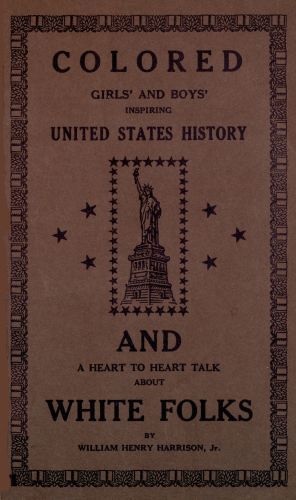
C O L O R E D
GIRLS AND BOYS’
INSPIRING
U N I T E D S T A T E S
H I S T O R Y
AND A
HEART TO HEART TALK
ABOUT
W H I T E F O L K S
BY
William Henry Harrison, Jr.
COPYRIGHT 1921
BY
WILLIAM HENRY HARRISON. Jr.
THIS BOOK IS DEDICATED
TO THOSE COLORED GIRLS AND BOYS
UPON WHOSE NOBLE EFFORTS AND ACHIEVEMENTS
WILL REST THE FOUNDATIONS FOR
THE FUTURE SUCCESS OF
THE NEGRO RACE:
AND
TO ALL THOSE WHITE WOMEN AND MEN
WHOSE KIND ENCOURAGEMENT OF AND JUST
DEALINGS WITH ALL HUMANITY ARE BRINGING
ABOUT BETTER UNDERSTANDING AND GREATER
CO-OPERATIONS BETWEEN
WHITE AND COLORED PEOPLE.
COMPOSED—COMPILED—WRITTEN
ARRANGED—DESIGNED
AND
ORIGINAL DRAWINGS
MADE FROM ALONG
THE FAMOUS PICTURESQUE LEHIGH VALLEY
OF PENNSYLVANIA, U. S. A.
BY
WILLIAM HENRY HARRISON, Jr.
TABLE OF CONTENTS
AUTHOR’S PREFACE
Not to Boast but to Boost
In Race progress herein they read;
But to such readers let me tell
This book means not our heads to swell;
For five of the greatest rich white men
Could buy the wealth of our Race: and then!
But just to inspire our younger host
To elevate their racial name
From poisoned stains of slavery shame,
By climbing to the highest heights
Thro aid of friends who are “real whites”.
TWENTY-FIVE years ago, when a lad fifteen years old attending the public schools of Pennsylvania, in which State I was born and reared, certain ideas and sentiments caused me to secretly resolve that some day, when I had gotten together the necessary data, I would write just such a book as is contained herein. At the time that resolution was formed, I was attending the Darlington School in Middletown District, Delaware County over which Prof. A. G. C. Smith was Superintendent. And I remember with much gratefulness my first and last public school teachers, Misses Carrie V. Hamilton and Rebecca R. Crumley and Prof. Smith for their kind and frequent words to me as encouragement to continue my education after graduating from the public schools.
My favorite study was the United States History, and even at the tender age of fifteen years, I was greatly surprised and Race pridely hurt not to find any history, except about slavery, in such books concerning the American Negro. I had such childish confidence in my school books and their authors that I felt sure if Negroes had fought and died in the several American wars; had become great poets, orators, artists, sculptors, etc., the histories I was studying would have mentioned such. I thought in doing that they would have been preserving United States valuable history more so than merely giving just credit to the Colored people who had made such history. I did not know that right then the attentions of many public school children in far away Europe were often called to the histories of such distinguished Colored Americans as Phyllis Wheatley, the poetess; Frederick Douglas, the orator; Henry O. Tanner, the artist; Edmonia Lewis, the sculptoress—all of them having won recognition and fame in Europe as well as in America.
My youthful ignorance, regarding the achievements of my race, is easily explained when it is taken into consideration that I was a farmer boy living far from libraries I had never seen and Negro histories I had never heard about. And the United States histories then used in the public schools had nothing in them to enlighten me on that subject. They misled and kept me, along with thousands of other Colored school children, in absolute ignorance relative to the progress and attainments of the American Colored people. So whenever our history classes went up to recite and my white classmates proudly went through the lessons about General George Washington, Noah Webster, Benjamin Franklin, Eli Whitney, Longfellow, etc., while I knew and could just as easily recite such history, nevertheless, my feelings of crushed race pride and mortification were beyond expression because not one thing could I proudly recite from my lessons about great things my people had accomplished in America.
It is the same with the United States histories used in our public schools of today. They do not relate about Crispus Attucks, a Negro soldier and the first Colonist martyr to give his life for America in the Revolutionary War; nor about the Colored sailor, William Tillman, who received six thousand dollars from the Federal Government for recapturing a stolen schooner from the Rebels in the Civil War; nor about the Colored Registrars of the United States Treasury, B. K. Bruce, J. W. Lyons, W. T. Vernon and J. C. Napier, whose names, during different administrations covering a period of more than thirty years, appeared on all the United States paper money made and issued during that period; nor about Matthew A. Henson, who was with Commodore Peary when he (Peary) discovered the North Pole; nor about Booker T. Washington, one of the greatest orators America has ever produced and also builder of one of the most famous institutions of learning not only in America but in the world.
As I said before, I knew nothing about such Negro history while I was a farmer’s boy, but I could never quite rid myself of a feeling that the Colored people in the United States did have a worthy history. I studied the white man’s U. S. History from cover to cover and learned all I could from it, but I got no more racial inspiration from it than a white boy would get from studying only a Negro history in which nothing was written about his own racial achievements. So I secretly resolved to immediately begin to quietly and patiently research for American Negro data in order to some day publish a book so that future Colored school children would not be kept in ignorance about their own race history. I felt it was perfectly right and necessary to study the white man’s history at the school desks, but if Colored children were not permitted to study the history of their own race at the same desks, it was perfectly right and necessary that Colored children learn about the achievements of their great men and women at their home firesides within their family circles.
So for the benefit mostly of Colored youths, here are the crude results of my boyhood resolutions and manhood efforts after twenty-five years filled with trying discouragements, and bitter disappointments, but also just as full of unswerving determinations, constant hopefulness, upward climbs, ceaseless works and fervent prayers to God to succeed.
The author wishes to use this place and opportunity to express his deepest thanks to the more than one hundred prominent Colored men and women, living in as many large cities in all parts of the United States, who so friendly sent to him up-to-date information regarding the progress and success of Colored people in those cities.
For the unusual generosity and kindness in giving of their valuable time to personally and helpfully send to him exceptionally fitting and authentic Negro data, the writer most courteously acknowledges and gratefully names the following distinguished Colored and white contributors;
Mr. Cleveland G. Allen, New York City, N. Y., Associate Editor of the New York Home News, and Lecturer on Negro Music in the Public Schools of New York City.
Rev. G. W. Allen, D. D., Editor & Manager of Southern Christian Recorder, Nashville, Tenn.
Attorney Violette N. Anderson, foremost woman lawyer in Chicago, Ill., and one of the most prominent Colored women in her profession in America.
Rev. F. P. Baker, prominent minister in Evansville, Ind.
Miss Eva D. Bowles, New York City, N. Y., Executive Secretary in charge of Colored Work of the Young Women’s Christian Association.
Mr. Thomas F. Blue, Head of Colored Library, Louisville, Ky.
Miss Mabel S. Brady, Branch Y. W. C. A. Secretary, Kansas City, Mo.
Rev. Geo. F. Bragg, prominent minister and author of Baltimore, Md.
Mr. Chas. H. Brooks, Phila., Pa., Sec’y of Cherry Bldg. & Loan Ass’n, and prominent in insurance business.
Captain Walter R. Brown, Assistant Commandant, Hampton Institute, Va.
Rev. Russell S. Brown, prominent minister in Atlanta, Ga.
Mr. Walter A. Butler, San Francisco, Cal., Financier and President of the Northern California Branch of the N. A. A. C. P.
Rev. H. W. Childs, D. D., LL. D., prominent minister in Pittsburgh, Pa., and member of the Executive Board of New England Baptist Convention.
Dr. J. B. Claytor, prominent physician in Roanoke, Va.
Mr. M. L. Collins, Editor of Shreveport Sun, Shreveport, La.
Prof. J. W. Cromwell, Historian, and instructor of higher education in Washington, D.C.
Mr. A. G. Dill, New York City, Editor of The Brownies’ Book and Business Manager of The Crisis Magazine.
Prof. Carl Diton, Phila., Pa., noted composer, organist and pianist.
Mr. James E. Gayle, New Orleans, La., Editor of The Vindicator, and Manager of the Pythian two hundred thousand dollar Temple in that city.
F. Grant Gilmore, Author, Playwright and Producer, Philadelphia, Pa.
Bishop Robert E. Jones, Editor of Southwestern Christian Advocate, New Orleans, La., first and only Negro elected Presiding Bishop over the Louisiana, Alabama, Mississippi and Texas Diocese of the Methodist Episcopal Church.
Mr. Joseph L. Jones, Founder & President of the Central Regalia Co., Cincinnati, Ohio.
Rev. D. J. Jenkins, D. D., Editor of Charleston Messenger, Founder and President of The Orphan Aid Society, Charleston, S. C.
Hon. Jas. Weldon Johnson, New York City, N. Y., United States ex-Consul to several foreign countries, Associate Editor of The New York Age, Secretary of the National Association for the Advancement of Colored People.
Mr. Tony Langston, Chicago, Ill., Advertising Manager of Chicago Defender and eight theaters, President of Langston’s Slide and Advertising Company.
Mr. Matt. N. Lewis, Editor of The Star, Newport News, Va.
Principal Isaac H. Miller, A. B., Cookman Institute, Jacksonville, Fla.
Mr. J. E. Mitchell, Editor of The Argus, St. Louis, Mo.
Dr. J. E. Mooreland, New York City, N. Y., International Secretary and Head of the Colored Department of the Young Men’s Christian Association.
Mr. Daniel Murray, Assistant Librarian, Congressional Library, Washington, D.C.
Dr. Harvey Murray, M. D., prominent physician, Wilmington, Del.
Mrs. Mary F. Parker, Chester, Pa., Undertaker and Embalmer, and Fraternal worker.
The late Mr. Chris Perry, who until his death was Editor of The Philadelphia Tribune and President of National Negro Press Association.
Attorney T. Gillis Nutter, Charleston, W. Va., Representative in the West Virginia Legislature.
Mr. Geo. W. Perry, Boley, Oka., Editor of Boley Progress and prosperous farmer.
Mr. Jos. L. Ray, Bethlehem, Pa., Confidential Man of Mr. Charles M. Schwab.
Mr. John H. Rives, Dayton, Ohio, Editor of The Dayton Forum.
Hon. F. M. Roberts, Sacramento, Cal., Assemblyman in the California State Legislature.
Mr. C. K. Robinson, Editor of Independent Clarion, St. Louis, Mo.
Mr. R. H. Rutherford, President & Treasurer of The National Benefit Life Insurance Co., Washington, D.C.
Miss Myrtilla J. Sherman, In Charge of Negro Record Department, The Hampton Normal and Agricultural Institute, Hampton, Va.
Mr. John A. Simms, Jacksonville, Fla., Editor of The Florida Sentinel.
Attorney Harry C. Smith, Cleveland, Ohio, Editor of Cleveland Gazette, ex-Member of the Ohio State Legislature where he introduced as Bills and had enacted as Laws, The Ohio Anti-Lynching Law and The Ohio Civil Rights Law.
Mr. C. C. Spaulding, Durham, N. C., Vice-President & Gen’l Manager of The North Carolina Mutual Life Insurance Company.
Mrs. Maggie L. Walker, Richmond, Va., R. W. G. Secretary & Treasurer of the I. O. of St. Luke, and President of the St. Luke Bank.
Miss H. Georgiana Whyte, Chicago, Ill., Editor of the Women’s Department, The Favorite Magazine.
Mr. J. Finley Wilson, Washington, D.C., Editor of The Washington Eagle, and President of The National Negro Press Association.
Dr. Carter G. Woodson, Washington, D.C., Editor of The Journal of Negro History, and Director of Research for The Association For The Study of Negro Life and History, Incorporated.
Mr. P. B. Young, Norfolk, Va., Capitalist and Editor of The Journal and Guide.
But the full credit, due for most of the Negro data references contained in this book, the author takes great pleasure in justly acknowledging and gratefully extending, through the Negro Year Book, to its Editor, Prof. Monroe N. Work, Director, Department of Records and Research, Tuskegee Normal and Industrial Institute, Tuskegee, Ala., whose personal consent was obtained by the writer to take extracts from the Negro Year Book.
FIRST AFRICANS VISIT VIRGINIA
Invited Guests Detained
And made this land their home so real;
So Negroes to, have right to feel
This is their home without appeal;
For they were brought invited guests
And told that they must always stay;
So this is why they are here today
Most loyal citizens every way.
—Harrison.
OVER three hundred years ago (1619) Africans were first brought as “Negro Servants” (Ref. Prof. Monroe N. Work’s Negro Year Book; page 153, 1918-1919 edition) to the early colonies of the United States by the captain of a Dutch ship who sold twenty Negroes to white plantation owners at Jamestown, Virginia. As the results of those and many other native Africans being later captured and forcibly brought to America, real slavery was finally started and spread so rapidly that there were about four million slaves in the United States by January 1, 1863. At that time all the slaves in the Rebel states were set free by the Emancipation Proclamation of President Abraham Lincoln, who was later murdered for that Godly act by one of his own race. But today Abraham Lincoln is remembered in all civilized countries as one of the greatest among the greatest men the world has ever known; as the noblest president who has ever governed the United States and as the truest and most fair-minded white friend the Negro race has ever had. On December 18, 1865 the adoption of the 13th Amendment to The Constitution of the United States gave freedom to the remaining slaves who lived in the states that had not rebelled against the Union. Thus in these two legal ways, that were made possible by the Northern States winning the Civil War, were all the slaves in the United States of America set free.
When the few broad-minded white people in the early colonies stopped to realize that the first African people who arrived were not used to America’s new foods, unusual hard work, cold changeable climates and were without a knowledge of the white man’s language, habits and religion; it is no great wonder why that small portion of justice thinking white people so readily saw unusual good qualities and latent talents in a group of supposed brainless heathens who so quickly, peacefully and profitably stepped from the narrow paths of African savagery into the broad avenues of American civilization. But the large numbers of narrow-minded people, who then (as now) tried so hard to make themselves and others believe that Negroes were inferior human beings to themselves, put forth the explanation that the remarkable and rapid adjustments of the slaves to American surroundings were due to their childlike dispositions to imitate actions, to humbly obey orders and their great physical strength to do all kinds of hard work at all times under all conditions. Such people were entirely wrong in such ideas, just as all ill-meaning prejudiced ideas keep their owners wrong, mean and in the lowest stages of human society. When men and women allow their minds to become poisoned with hateful, envious and jealous prejudice toward other people and refuse to have anything to do with them because they are Colored, they have and show just about as much greatness in good taste and good common-sense as if they were to refuse to puff on their favorite brand of Havana cigars or to nibble on one of Mr. Huyler’s famed chocolate bon-bons just because the cigar and bon-bon are of rich brown colors. Such narrow-minded actions do not make people great except in their own home-town little social circles. And when they leave home and go out into the world to mingle among well-cultured, highly educated and broad-minded people, prejudiced men and women soon find that their supposed greatness along side of, for instance, an Abraham Lincoln or a Harriet Beecher Stowe[A] is as large as a grain of sand is along side of a mountain. If President Lincoln had not preserved the Union and signed the Emancipation Proclamation, or if Mrs. Stowe had not written Uncle Tom’s Cabin,[A] but instead, both had turned up their noses in disdain, tossed their heads in haughty proudness and snobbishly spurned well-behaved, well-dressed and intelligent people just because of their colors; the names of Lincoln and Stowe (in stead of now being enshrined in the Hall Of Fame and written in the world’s history ever to be remembered and beloved by all nations) would have been buried and forgotten a few years after their owners had died as is the case with the names of all race prejudiced people. But this point regarding the utter foolishness and ignorance of people showing race prejudice was much more ably and vividly brought out in one of Mr. McKay’s bull’s-eye-shot and soul-stirring pictures that appear in the Sunday issues of the New York American—one among several such big white journals from which the writer derives new inspiration and increased knowledge every Sunday. This picture and editorial in question, that described the “Namaqua” savage tribe of Negroes living in the African jungles, were printed in the March 6, 1921 issue of the New York American, and the following is an extract from that article titled “Shooting At The Storm.”
“The savages of Africa had first of all to fight and conquer the burning sun, hence the black skin that keeps off the deadly “actinic rays” that would quickly destroy any white race in their climate, and the thick woolly hair, saturated with grease, protecting the skull from the heat and the deadly effect of those same rays.
“As we think of different kinds of human beings, let us judge them by the conditions under which they live, whether they be Eskimos near the North Pole or men like these Namaquas at the Equator.
“Self-satisfied ignorance is horrified at the Eskimo eating enormous quantities of rank, fat whale blubber. Any race transferred to the Arctic Circle would do that or die. Ignorance despises the black skin and woolly hair of the African. Any white race transferred to the African tropics would develop such skin and hair, or it would die.
“UNDERSTAND what you are discussing, as far as possible, before discussing it. An eagle cannot understand a turtle, or a turtle an eagle. And a cow, mildly grazing, cannot understand either. Every human being that despises another, no matter what the other may be, simply represents the animal expression of prejudice based on ignorance.”
Now the real truth, as to how those strange and friendless slaves were able to so readily adapt themselves to this country and so aptly adopt the methods and customs of the colonists, is that from mere force of habits they put into their everyday lives their inherited qualities of open-friendliness, big-heartedness, broad-mindedness, trustworthiness, constant-loyalty, quick-alertness, unbounded-patience, everready-forgivefulness and undying hopefulness. These qualities (in which all civilized countries of today stand badly in need of a much broader growth and a higher culture) had been handed down to the American slaves by their African forefathers who had for centuries dwelt in the darkest and wildest torrid jungles without a knowledge of the white man’s civilization. And those black ancestors had passed to their suffering offsprings such full portions of the above named manhood and brotherhood principles that the slaves were able, as they pitifully and tearfully went back and forth to their body-torturing and spirit-crushing tasks, to shame, by their unspiteful and unrevengeful actions under such cruel treatments, just a little measure of their inherited virtues into the so-called civilized, educated and Christian white people who held them in bondage. It must be granted that their owners did teach the slaves (whose foreparents had lived in a very hot country where little clothing was needed and food was plentiful without working for it) how to properly dress and how to regularly work. And although those enslaved people were taught those good habits only as means for their selfish and greedy owners to enable themselves to get richer, nevertheless, the Colored people of to-day are glad and thankful that they are now able to turn to their own personal and racial advantages the industrial habits learned by their people in slavery. On the other hand, Colored people will always be sorry and unthankful to those brute overseers and raping slave owners who so sinfully and beastfully forced upon and taught numerous and most harmful immoral vices to their slaves. And those soul-damning and life-sapping vices are still clinging to and leaving their marks on the rapidly advancing Colored people, just as the poison ivy clings to and mars the health and beauty of the young and tender acorn sprouts as they struggle upward to become future majestic oaks in the densely foliaged forests.
However, all of the white people in America at that time did not approve of or own slaves (just as all of the white people in the United States today do not approve of nor take part in discriminating against respectable Colored people) because they knew it was not right. They had the kind of Christianity that was real and pure enough to make their minds fully understand and their hearts to tenderly feel that slavery in its kindest manner is the worse sin against God and the greatest crime against humanity. And it was this class of God-serving and fellowman-loving white men and women who secretly and in great danger of being caught and punished (for the laws of the country forbid the educating of slaves) taught the otherwise friendless people in bondage their first knowledge of God and Jesus Christ. When it is remembered that those African people were just a few years out of a land where the practices of their tribes for centuries had been to worship in a different religion; it is easily seen that the slaves were an unusual reasoning, sensible and broad-minded group of uncivilized people to have so quickly found the mistake in and so suddenly thrown aside their old and false religion and so readily accepted in its place the new and true Faith.
Answered Prayers
During the two hundred and forty-four years of their bitter servitude those shackled people had learned to place so much faith and trust in their newly found religion that they felt sure God in his own wisdom, time and manner would hear and answer their usually silent and always heart-rending prayers for deliverance from slavery.
So as Southern heats washed briny sweat into their sun-dazed eyes, or Northern colds checked frozen blood from flowing through their veins; the hopeful prayers of the slaves, that they and their children might some day become free, were constantly offered up from the tobacco plantations of Virginia; from the cotton belts of Alabama, Georgia and Mississippi; from the corn fields of Tennessee and Texas; from the rice swamps of South Carolina; from the orange groves of Florida; from the stone quarries of Connecticut, New York, and Pennsylvania; from the truck farms of Delaware, Maryland and New Jersey; from the turpentine forests of North Carolina; from the blue grass meadows of Kentucky; from the fishing banks of Massachusetts, New Hampshire and Rhode Island and from the cane-brakes of Louisiana.
Likewise, the Colored people of today, as they patiently and gradually draw themselves up and away from the slum and slime of slavery, are constantly sending up to Heaven from the east, the west, the north and the south points of this country their hopeful and earnest prayers that God in His mysterious way will convert and bring back to Christianity those prejudiced, heathenish and uncivilized members of the Caucasian race who persecute and discriminate against all darker races just on account of their progress. As living witnesses and proofs that such prayers are already being duly heard and daily answered by God, the author will tell on the following pages of this book (mainly for the inspiration of Colored boys and girls so that they will not lose confidence in themselves, trust in mankind and faith in God) just a little of the remarkable progress and success made by the American Colored people during their fifty-eight years of freedom.
But the Negro youths who read these following pages should ever bear in mind that the members of their race who have climbed and mounted these rounds of success have only been able to do so through the guidance and care of God; through the unswerving determinations and ceaseless struggles on the part of themselves and through the hearty good-will and brotherhood helpfulness of the thousands of American white people who are today true and loyal friends of the American Colored people.