
The Project Gutenberg eBook of Company G
Title: Company G
a record of the services of one company of the 157th N. Y. Vols. in the War of the Rebellion, from Sept. 19, 1862 to July 10, 1865, including the roster of the company
Author: A. R. Barlow
Release date: August 26, 2013 [eBook #43562]
Most recently updated: October 23, 2024
Language: English
Credits: E-text prepared by the Online Distributed Proofreading Team (http://www.pgdp.net) from page images generously made available by Internet Archive (http://archive.org)
The Project Gutenberg eBook, Company G, by A. R. (Albert Rowe) Barlow
| Note: | Images of the original pages are available through Internet Archive. See http://archive.org/details/companygrecordof00barl |
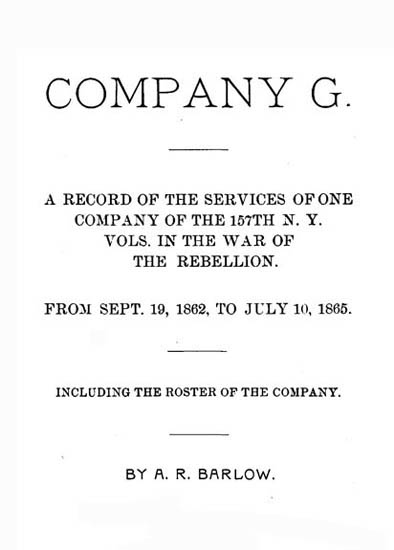
COMPANY G.
A RECORD OF THE SERVICES OF ONE
COMPANY OF THE 157TH N. Y.
VOLS. IN THE WAR OF
THE REBELLION.
FROM SEPT. 19, 1862, TO JULY 10, 1865.
INCLUDING THE ROSTER OF THE COMPANY.
BY A. R. BARLOW.
A. W. Hall, Publisher,
Syracuse, N.Y.
1899.
PREFATORY.
The production of this little work has long been contemplated. It has seemed right that the records of some of the volunteer organizations sent from Canastota and vicinity, during the War of the Rebellion, should be recorded in such a form as would preserve to the families of those boys, their deeds in marching, in fighting, in suffering for the old flag. In an effort to accomplish such an undertaking as this, the patronage of the general public is not considered. The book, if requiting for the expense of publication, will be considered a success financially.
As a literary effort, no claim is filed, unless one is admissible for general accuracy in the matter of events and dates. Some critics may take exception to the attempt herein made, to individualize a collective noun and yet retain plurality; and in the same measure, pervert mood and tense. It is admitted that the license is unique. Quite likely other departures from good old grammatical paths will be noted. Let it be remembered, however, that the experiences of Co. G were, as a whole, unique, and to harmonize the literal with the actual, the record should be drawn uniquely.
No apology is offered for trivial treatment of some of the subjects; in truth, they are deserving of severe handling. If lack of respect for commanding officers is shown, the explanation given is, that they have been removed from the high pedestals of war-gods and are considered only as men.
It is in no bitter sense the men who fought Co. G are termed rebels. They were in rebellion and were known to the boys as rebels, or johnny rebs. A false delicacy only would prompt the writer to deprive those Southern men of a title which, apparently, they bore with pride.
As stated, this is not a work for the public eye. It is an offering to comrades, from a comrade who marched with them, and experienced with them the fortunes and misfortunes of war. And in performing this work, care has been taken to omit such occurrences as might not be understood by others than the actors; and while thus avoiding over-coloring by a faithful portraiture of events, and suppressing nothing worthy of record Co. G go into history.
In performing this duty, individual names have been used, illustrative of passing events. Should any person feel aggrieved over such freedom, let it be known, it was, indeed, born of familiarity with the subjects, and is indulged in a spirit of good comradeship, without thought of disparagement.
No man who marched with those boys can think of them unkindly. If there were ever differences of a serious nature, the writer is unmindful of them.
To travel over the old roads, to hunger and to thirst again; to sleep where night found them; in sunshine, in storm out on the picket-line; to toss upon a bed of suffering and weaken, day by day, for lack of tender care;—in brief, to march away to the wars and enjoy the rich compensation of an honorable return, all this and more, has been lived again while preparing this record. And so with the old boys, as long as they live, will they by this effort be enabled to travel Virginia roads in all kinds of weather, without danger of sticking fast in the mud, or of being stifled amid clouds of gray dust.
Why Co. G did not cut a broader swath along the pathway of glorious attainment, they cannot understand. They were a willing body of men, and were of a regiment of noble hearts. Misfortunes of war, simply, were not the only elements at work defeating their best endeavors. The true causes can be learned, only, in a huge compendium of tragical, whimsical and amusing facts, concealed within the folios of that unwritten or mythical history of the war, which never will be published, a history that would tumble war-idols to the ground, and elevate men who have passed into obscurity.
But Co. G have never permitted their escutcheon to lie prone in the dust, that they might more readily engage in wrangling over such small matters as position and preference. They do not grumble, they do not boast. They learned, thirty-five years ago, to accept the inevitable, which has been awarded to them in large quantities.
Co. G were boys of Lenox, who served in the name of Lenox. They belonged, then to Lenox, as her offering in the war, and their record is a part of the history of the town. Divested of verbiage, their deeds will still be found honorable and manly. For, as once said the lamented Capt. Frank, Co. G did "as well as any of them."
A few words should be given in memory of the dead, who, in life, stood shoulder to shoulder with the boys of Co. G Dead?—a word applied to express a religious belief; but how inexpressive of a new-birth.
Thus sang an inspired woman, and thus shall it be said of the boys who gave their lives for the flag, and for their comrades who shall follow them. And some day, upon the great plain of Light, the hosts will once more marshal for a grand review.
ROSTER OF CO. G, 157TH N.Y. VOLS.
- CAPTAINS.
- Abraham Tuttle.
- [1] Harrison Frank.
- [2] Lafayette McWilliams.
- LIEUTENANTS.
- Maurice D. Bailey.
- Harrison Frank.
- Marshall Hemstreet.
- [2] Frank E. Gates.
- [2] Robert E. Grant.
- [2] Jerome Forbes.
- Clark Pierce.
- ORDERLY SERGEANTS.
- Israel P. Moore.
- Marshall Hemstreet.
- Frank E. Gates.
- [2] John H. Roe.
- Jerome Forbes.
- Hubbard Suits.
- SERGEANTS.
- Marshall Hemstreet.
- Frank E. Gates.
- Henry C. Jarvis.
- John H. Roe.
- James B. Hooper.
- [2] Nicholas Binges.
- John H. Fancher.
- Wm. H. Barlow.
- [2] Harvey Lindsley.
- CORPORALS.
- Jerome Forbes.
- [2] Irwin A. Sayles.
- [2] James B. Hooper.
- Clarence L. Spencer.
- [2] Asa E. New.
- Wm. J. Peck.
- Wm. H. Barlow.
- Nicholas Binges.
- Hubbard Suits.
- [2] Charles A. Near.
- Daniel A. Betsinger.
- [2] Albert R. Barlow.
- [2] Jerry Murphy.
- [2] William Miller.
- Wm. H. Kimball.
- MUSICIAN.
- W. H. Perry.
- TEAMSTER.
- Wm. G. Johnson.
- COOKS.
- William Mallows.
- Ziba Cloyes.
- Patrick Matthews.
- PRIVATES.
- [2] Amos Avery.
- [2] Peter Agan.
- Daniel A. Betsinger.
- Wm. W. Baldwin.
- [1] Albert D. Bridge.
- Daniel Brockway.
- Albert R. Barlow.
- Ziba Cloyes.
- Alfred J. Cole.
- Peter Cummings.
- Francis H. Carey.
- John H. Dunham.
- Nicholas Ecker.
- [1] John W. Foltz.
- Conrad Foltz.
- [2] Robert Farrington.
- John H. Fancher.
- Francis M. Gault.
- Daniel D. Grovestein.
- Stephen D. Harrington.
- Joseph H. Hart.
- [1] John A. Hart.
- Jacob Hallicus.
- [3] James M. Hainsworth.
- [2] James Johnson.
- [1] Luzerne E. Johnson.
- Henry Kellogg.
- Harvey Lindsley.
- [1] Asa C. Lawrence.
- Luther Loucks.
- Wm. Mallows.
- Myron A. Menzie.
- Henry Mason.
- Patrick Matthews.
- James Matthews.
- Jerry Murphy.
- [1] Durell Moore.
- Jeremiah McLane.
- [2] John J. McMaster.
- [2] William Miller.
- [2] John Miller.
- [2] Michael Miller.
- [2] Chas. A. Near.
- [2] Simon Nestler.
- [2] Hugh O'Brien.
- [1] Francis C. Pratt.
- [2] William Pease.
- [2] John Pfleiger.
- Mason Phelps.
- Chas. O. Ricker.
- Wm. E. Rinn.
- [3] Henry W. Richardson.
- Nicholas J. Snyder.
- Eusebius Sweet.
- Hubbard Suits.
- [2] James L. Travis.
- John Torrey.
- Elmer A. Wise.
- [1] Alfred Wilder.
- [2] Henry Whaling.
- Calvin White.
- DRAFTED RECRUITS.
- Geo. S. Orr.
- Scott D. Whitney.
- SUBSTITUTES FOR DRAFTED MEN.
- James Leonard.
- John Wise.
- ENLISTED AS RECRUITS.
- [1] Abram Thornton.
- Sylvanus D. Alexander.
- Peter Delong.
- Chas. Hoxie.
- Nelson Kimball.
- Henry Nobles.
- Sylvanus S. Ostrander.
- Samuel N. Jacquay.
- [1] Russell Stroup.
- Paul Stowell.
- Wm. H. Schuyler.
- Levi Schuyler.
- Chas. O. Hinman.
- [2] Wm. L. Johnson.
- Wm. H. Kimball.
- Patrick Kinney.
- Alfred J. Leird.
- William Rudd.
- John Terry.
- Daniel Winchell.
- John Brown.
- George Plank.
- Arthur Campbell.
- Rufus C. Baldwin.
[1] Killed in Action.
[2] Wounded.
[3] Died by disease or accident.
COMPANY G.
The date of their captain's commission placed Co. G seventh in rank—beginning with A—and ninth company from the extreme right as the regiment formed on the colors. The company was enrolled and became a part of the 157th regiment of New York Volunteers, enlisted for three years unless sooner discharged—"for three years unless sooner shot," according to Irwin Sayles, who left the company and the service minus a right arm. The regiment was raised in Cortland and Madison Counties, under the call of July 2d, 1862, for 300,000 three years men.
ABRAHAM TUTTLE, the first captain of Co. G, was a farmer living near Clockville. He was about forty years of age, slightly gray, but strong and active. Capt. Tuttle was an old-time California gold-seeker, who took the long route via Cape Horn to the then new Eldorado. In some respects he was well fitted for a soldier, but he had no taste for such a life, as a profession, and resigned after experiencing the discomforts of a winter campaign in Virginia.
MAURICE D. BAILEY, of Wampsville, was first lieutenant of Co. G. He was one of the handsomest men in the regiment—finely made and set-up in good style and in the prime and vigor of life. He was a big-hearted man and popular. At home he was a farmer. After serving with the company for a few months, he was assigned to Co. K, being promoted to a captaincy, and remained with the regiment until the autumn of 1863, when he resigned, at Folly Island, S.C.
HARRISON FRANK, second lieutenant of Co. G, was a speculator in farm produce and lived at Wampsville; he was thirty-two years of age, a rather tall, spare-built man. He came from German stock, and his grandfather, Albert Frank, was a soldier of the Revolution. His maternal grandfather, George Siver, was a soldier of 1812. Andrew Frank married Nancy Siver and Harrison Frank was their son.
So it appears that Harrison was born with a martial spirit in him. Unfortunately his physical powers were too frail for the hardships of camp and field. It would seem that only a strong will power supported the man for weeks at a time. "I will never give up until I am down," was written on every line of his features, while his figure was unsteady and his limbs seemed unfit for carrying his body. But his eye was clear and his voice rang out sharp and authoritative. He possessed a shrill tone of voice, was rapid in speech, his perceptions were clear, his preferences leaning to that which was just and right; was methodical, correct, generous, temperate. Cared little for the glitter of military display and wore on parade the dress coat of a private adorned with shoulder straps. This was not from penuriousness. One day the colonel took him to task for not appearing in a uniform coat.
"Colonel," he replied, "I have a mother and others at home, who need all I can save from my pay. In my baggage I have a new uniform coat. My boys know me in this uniform."
He wore that plain dress coat unmolested. In fact, when he fell at Gettysburg he wore the ordinary blouse of a private soldier, with two bars attached, taken from an old shoulder strap.
When Frank was made captain, the discipline of Co. G was very indifferent, their tactics none of the best. They needed inspiring and the right sort of man took hold of them, who knew there was crude material in his company, of such from which good soldiers were produced; so he applied himself and with immediate results, to make Co. G one of the good companies of the regiment. Frank had been left behind when the regiment went to the front. He was in poor health, but finally reached Washington and lay there in hospital, or under treatment, for weeks, rejoining the boys at Fairfax Court House, Va. He was still weak, but brimful of patriotism, was sanguine of victory for the North and said he expected to march into Richmond. Such sort of grit served him to the last. Gradually, as the winter gave place to balmy spring, his health seemed to improve and with that encouraging condition came his ability to convey to his men the ambition of the soldier; and it was not long before Co. G were looking up handsomely. In April, 1863, President Lincoln reviewed the Army of the Potomac then lying in the vicinity of Falmouth. Co. G were bright under the applications of tripoli polish, blacking and brush-brooming; new uniforms, white gloves, etc. Capt. Frank was proud of his men. As their esprit improved the men grew to liking more and more the man who sought their greatest good.
In this connection it is only just to remember a patriotic act of Mrs. Daniel Crouse, of Canastota, who presented a regulation sword to each of the officers of Co. G. The ceremony occurred in the old Dutch Reformed Church in Canastota. Judge Barlow made the presentation speech, to which the then Lieutenant Frank responded in a modest, but manly style.
A FEW NOTES OF GENERAL INTEREST.
Co. G was recruited in the middle portion of the Town of Lenox, Madison County. It was known in the regiment as the Canastota Company. A patriotic region was the territory within a radius of four miles of that small village. Before 1856 it was counted a reliably Democratic locality, but the anti-slavery agitation soon found it fertile ground for propagating Free-Soil ideas and it rapidly changed to the Republican side, as soon as the issue was fairly made. So, when the war broke out, the missionary work of such men as Gerrit Smith, Samuel J. May, Beriah Green, and others, became apparent, and patriotism burned bright upon its rural altars. It is estimated that at least five hundred men were recruited within the territory already designated. The Town of Lenox paid $136,030 for town bounties, while Madison County paid a total of $1,338,320 for bounties to recruits. Lenox paid for support of families $3,786, distinct from Poor Fund; both for bounties and for relief thus raised by tax, Lenox shows double that of any other town in the county. And those figures do not by any means represent the thousands of dollars voted at the recruiting meetings and subscribed and donated for local bounties and for relief purposes.
Very pleasant to recall are the kind words spoken and written in those trying times by noble-hearted men and women, as the boys went forth to the war.
In August, 1862, a war fund was raised in Madison County. Hon. Gerrit Smith, with his usual generosity, promptly sent in his check for $5,000, and in his note which enclosed the same, he says—"I would that the fund should not be regarded as a mercenary appeal to our volunteers—but as a gift from loving neighbors toward helping them to arrange their affairs that they can leave their homes more freely and pleasantly. These volunteers and their neighbors constitute a partnership sacred and sublime, and never to be broken."
Canastota was very active and like many other towns at the time, doing unceasingly for the men in the field, for local relief and in support of the good cause generally. It is doubtful if any locality in the State, with the same population and a like assessment, can show a more honorable record.
It should be noted that at least fifty per cent. of the men enlisted in 1862 were at the time beardless youths, the greater portion of whom proved enduring soldiers. Those boys did not enlist for sake of obtaining bounties. Enthusiasm was aroused in various ways—by speeches at war-meetings, by martial music and by the newspapers. Everybody talked war, the girls sang war songs, one boy enlisted and his chums followed him. Very little cared those young fellows for bounties. The county of Madison gave $50, and the State $50, bounties. One month's pay in advance $13 and $2 bonus from the general government and $100 at the expiration of the term of service (increased after the war to $200). In the fall of 1864 the town of Lenox gave for bounties to 3-years men $1,100, the county $500 added to that, besides the State and national bounties, and many of those men never were in a battle.
But the trials of war were not entirely with the boys at the front. Dependent parents, wives and children felt the denials keenly; and when news came that a battle had been fought and some of their boys had fallen, the entire community was interested at once and freely sympathized with sorrowing friends. And the firm belief that they were thus cared for strengthened the boys wonderfully.
Of the eighty-seven men originally enrolled in Co. G, one-half of them were between the ages of eighteen and twenty-one years, and no doubt a number of them several years below the minimum age of eighteen, fearing rejectment, assumed to be older.
The fatalities of war among those volunteers are difficult to estimate. Not a few were reported as "missing," who never returned. Many of the sick and wounded lived to see their homes and soon after died.
During its term of service the company lost one captain and six enlisted men killed in action, and one man accidentally shot, while three died of disease. The man Asa Lawrence, missing at Chancellorsville, is included among the killed, and according to all that has been learned, he has never been heard from. One captain, three lieutenants and twenty-four men, were wounded. Of the original enrollment sixteen were discharged on account of sickness or wounds, five were discharged to accept commissions and five were transferred to the Invalid corps. Nine men deserted. Forty-two enlisted men returned with the regiment, others not present were still borne on the rolls.
The company during its term received accessions of two substitutes, two drafted men and twenty-four recruits. Of those, several were slightly wounded and two died of disease.
The casualties in Co. G were not as many as in some of the companies of the regiment. Co. C lost seven killed and more than forty wounded. Co. I lost one officer and eight men killed and their captain and twenty-nine men wounded.
It was understood at the time the authorization was issued that the company was to be assigned to a regiment forming of Cortland and Madison County men, with Philip P. Brown, Jr., of Hamilton, as colonel, and to rendezvous at Hamilton. As rapidly as possible the enlistments were pushed along and about two weeks from the time recruiting began, the company was assured of its quota and took its name as Company G.
At Hamilton, the camp was established on the fair grounds north of the village. For a time a large tent afforded shelter to the men, but its capacity being insufficient, five barrack buildings were erected on the west side of the enclosure, two companies in each building. Co. G shared in the shelter of the most northerly barrack and in the west section of the building, with Co. B, their neighbors, in the eastern portion. Two tiers of bunks ranged along each side of the structure and each bunk was occupied by two men; at the entrance was a room for commissioned officers, most of whom preferred the softer beds in the hotels of the village to the hard straw ticks of the camp.
As the recruits arrived in town they were taken to one of the public halls, where surgeons Hendrick, Beebe and Crawe hammered their chests, listened to their heartbeats and respiration, looked into the eyes of the recruits, finally ordering them to jump over the floor on each leg consecutively. During this ordeal the boys appeared in the uniform of Nature only. Few failed to pass the Board, however, and the successful ones then appeared before the adjutant. If a minor, a written consent was required from the parent or guardian.
Accepted recruits were given orders upon the quartermaster and were taken over to a warehouse near the canal and there received an outfit. The dress coat of dark blue, also dark blue flannel blouse and pants, overcoat, coarse gray shirts, canton flannel drawers, woolen socks, shoes and blanket, not to forget the dark blue fatigue cap so heartily disliked by the wearers. The civilian garb was shed at once and the green soldier was revealed in the cut and fit of his new clothing of war, while his back itched under those shirts as though numerous flies and ants were perambulating there, with an occasioned nipping from a stray spider. But how very, very verdant the boys appeared—so harmless-like in their uniforms, and to add to the ludicrous feature of the occasion very many of them hastened to a gallery to have their appearance preserved for all time.
Knapsacks, haversacks and canteens, tin cups and plates, knives and spoons, came to each in time. No guns were issued in Camp Mitchell; guards about the camp carried guns borrowed from a local armory—no cartridges were issued. A high board fence presented the most discouraging barricade to such of the boys as desired a night outside.
It was amusing to observe the schemes for gaining liberty and to see the boys return to duty after a day or two in the narrow quarters of the guard house. They were not accustomed to such discipline; but they were soon to learn that they had entered upon a new career.
Life in barracks was not tedious. During the day there were several marching drills by squad, platoon and company, and in the evening dress parade, and perhaps, a few attempts at battalion evolutions. Officers in nearly every company were as green as the men. A few short-enlistment men who had seen service and returned, and some who had served in home companies, usually were the drill-masters. Col. Brown had been captain of the Hamilton Grays; Major Carmichael for a time served as captain in the 76th N.Y.; a few other officers had been in the service.
Co. G were drilled by Sergeants Hemstreet and Gates, six months' recruits to the 12th N.Y.V.; also by Frank Cooper afterwards a member of the 78th N.Y. During drill hours "hay-foot, straw-foot!"—"heels together, toes on a line, body erect resting on the toes,"—"forward, march!" and "halt,"—the orders from drill-masters, were heard on all sides; and over in one corner of the pen were the ten or more fifers and drummers taking first lessons in martial music. The scene was enough to make an old soldier weep from laughter, and yet it was not an unusual one wherever raw troops were mustered.
The eating house at Camp Mitchell (so named in honor of David J. Mitchell, a lawyer, at one time a resident of Hamilton) stood at the east end of the enclosure, into which the men were marched by their officers, three times daily to their meals. Good, wholesome fare was provided and in abundance and would have been pronounced grand one year later, could those boys have obtained it on Folly Island, in place of wormy hardtack and tough salt-horse.
The sick at Hamilton were quartered in a small church near the grounds, but Co. G were fortunate as to health while at the rendezvous. Many of the boys enjoyed furloughs during those five or six weeks and their friends visited them and were often permitted to pass the night at the barracks. Amusements of various kinds broke the monotony of barrack life—card playing, wrestling, quoits, various games and much rough horse-play, continually in sight.
While there was so much life astir in Camp Mitchell, it must be acknowledged that a few of the men were down-hearted, particularly those about to leave wives and children; and who could blame them? There were heavy hearts in the homes of those boys. One man when called upon to give a written consent for his sons to enlist, remarked that he felt as if he were signing their death-warrants. For there was a terrible uncertainty for soldiers in those days and the much-quoted silver lining of the heavy clouds overhanging our country, was yet to be discovered in the future efforts of her loyal sons. Cripples and sick men were returning from the front and occasionally somebody's child was brought home for burial. The failure of the Peninsula Campaign, followed by the disaster at Bull Run, were bad records, scarcely effaced by the hard-earned victory at Antietam. And yet, amid such desolation the American people of the North never ceased to give of blood and treasure and the boys kept marching on, the matrons and the maidens smiling and waving farewells with hearts and eyes overflowing, the men and boys cheering, bands playing, fifes shrieking and drums beating. The boys marched away, the hospitals filled, little mounds dotted many a Southern field, the ranks thinned and the scene was repeated again and again until victory came; and then it was time to count the cost. Those who suffered were the ones to cast the reckoning.
On the 19th of September, 1862, the regiment was mustered into the service of the United States. The preliminary of scanning-over the men was performed during a dreary rain storm, by regular army surgeons, the men in line by company. Few were rejected and those for defects of eyes or teeth, or for manifest feebleness. There was Ziba Cloyes of Co. G, a man of sixty years, who had enlisted as being only forty-four, gray hair and a general suspicion of advanced years about him. The surgeon reached him in the line.
"What is your age, sir?"
"Forty-four."
The surgeon smiled. "Open your mouth."
Ziba obeyed, disclosing a full set of teeth such as would have delighted many a dude. Then he brought them together with a sharp snap.
"Put your finger in there," he said, again opening his jaws to their widest limit.
"You will do, sir," said the surgeon as he passed, with a broad grin, to the next man.
After the examination came the formal muster-in by companies, and Co. G were then an arm of the government and on the direct road to active service. Orders thereafter emanated from officers of the general government and the State was duly accredited. Co. G had saved Canastota from a draft.
Sept. 25th, with their new rubber-cloth knapsacks, haversacks and canteens, at an early hour, Co. G were mustered for the road. Teams had been generously offered by the people far and near, gratuitously, and on that morning to the number of more than one hundred blocked the streets of the village, long before daybreak, in waiting to carry the regiment to Canastota.
The loading was quite slow and consumed considerable time, but the day was fine and the roads in excellent condition and the journey to Peterboro was made without further delay. In that pleasant little village the regiment left the wagons and marched into the park, where tables were spread on the green and laden with good fare. While the boys were eating, they were favored with a speech from Hon. Gerrit Smith. He was seated upon a white horse. His deep, eloquent tones were heard above the clatter of dishes. It was his wish that the boys be not withheld from eating. Above his head waved the stars and stripes at half-mast, in memory of Capt. Barnett, killed at Antietam—a Peterboro boy. All that was saddening, all that was eloquent and nobly good in the place, was not so appealing just then, as the feast before them; the boys of Co. G were hungry. After the feast and the address of welcome and God-speed, the wagons were again mounted.
The long train reached Canastota about 5 p.m. They were unloaded south of the town and the men given their first experience with those handsome new knapsacks, as they marched (bent forward like pack-peddlers) through the village streets. It was their first experience, also, in straggling—the head of the regiment led by the Hamilton band, was approaching the Peterboro St. bridge as the rear of the column passed into Center St., strung nearly around the square.
A platform had been built in a field north of the Crouse residence and near the railroad. Prominent citizens of Cortland and Madison were on the platform; Gen. Bruce was speaker. Guards were thrown around the enclosure to keep the crowd outside, but not to exclude the relatives and friends. Caresses and sobbing, tears and forced gaiety marked that occasion. Little ones were there and the father fed himself with one hand as he pressed his child to his breast with the other. Old age came also, and parents trembling with years, tried to be brave as their part in the war, if nothing more. Even the abundance of choice food supplied for the men was hardly relished under the strain of parting; so the women filled the haversacks, poured coffee into the canteens, completing the whole with a hearty kiss and sent the boys on their way. There were times, when the happiest soldier boy was he, who, when going to war, left none at home to weep for him.
A train of emigrant cars received the regiment and at daybreak next morning they reached Albany. A good breakfast was served in a building near the depot. A portion of the regiment was taken over the ferry and the remainder, including Co. G, marched to the executive mansion where Gov. Morgan presented the stand of colors, D. J. Mitchell responding.
The boys will ever remember their ride down the rail along the Hudson. At every station and in homes along the road, in the fields and on the river, wherever men, women or children were seen, their handkerchiefs and hats were waved to cheer the soldier boys. The boys in blue threw kisses to the blushing girls, or upon brown paper or pieces cut from lunch boxes, wrote and cast forth gentle words of appreciation. Really it must have grown monotonous to those people, as soldiers were passing nearly every day; if so, it was such a monotony as they appeared to enjoy immensely. With some of the men of Co. G the situation was too serious for trifling—they were leaving their Marias and Nancys and Kates.
City Hall barracks, New York City—never forget them. The postoffice building now covers that ground. Bunks floored with slats to sleep upon, into which the many occupants had crawled, each time carrying in from the floors a fresh supply of sand to fall into the eyes of the fellows in the lower berths; the rooms ill-ventilated and odorous of many stalwart smells. The food was unattractive and few of Co. G had the hardihood to partake. Just one cheering feature of the situation, was the hope ever constant, that their stay would be brief. They stopped but one night and a day. As evening approached they were marched down to a covered dock and remained there in the dark, unlighted place, awaiting the arrival of a steamer to take them over to Jersey.
Soon as darkness came on the men became very quiet as though the bogie-man was abroad. By and by a clicking, cracking sort of noise came out of the depths of darkness, soon followed by a smacking sound. Co. G were eating cheese—the other companies were eating cheese.
"Commandants of companies will see that their men are kept together," roared the colonel.
The officers could not see very well in the dark. The men broke open no more cheese boxes. They had spied the boxes through the gathering gloom on their first arrival and simply waited patiently for darkness.
John Schultz, a German, and member of Co. G, had sat himself down on the outer timber of the wharf and fell asleep. He had not removed his knapsack. What his canteen contained is not known. He nodded awhile, snored a little and suddenly disappeared. Some one raised the cry that a man had fallen into the slip. A police boat picked old John out and soon he returned, thoroughly wet and considerably sobered.
Near midnight a steamer reached the wharf and took the regiments away to Port Monmouth, the northern terminus of the Delaware and Raritan Bay R. R. Once more the raiding propensities of the boys were exhibited upon a car-load of peaches on a siding, but they were promptly restrained. The men were not thieves; they had somehow reached the conclusion that a change in dress demanded a change in morals. They knew there was some sort of transformation going on within them, as without, and certainly they must act differently than when they were plain civilians. Instead of being peaceful lambs at home, they must be wolves and hunt in packs. But a few months of strict discipline set them aright.
It was Sunday afternoon when the regiment reached Philadelphia, tired and hungry. A lunch had been served on the train early in the day, but that was only a "hand-out." At Philadelphia many thousands of men of passing regiments, were fed at the Cooper's Union refreshment rooms. So Co. G, though only one-tenth of a regiment, were favored with plenty of clean water, soap and towels and then were served with a delicious meal of good substantial food, served on a clean cloth, from earthen dishes, "just like home," said the boys.
Philadelphia always treated the soldiers in the most generous style. A sick or wounded man felt greatly favored to be sent to a Philadelphia hospital.
After the regiment was fed, the march was taken for the Baltimore depot, several miles distant. The walks were crowded with people. Such cheering, waving handkerchiefs, tossing of kisses, helped mightily in the struggle beneath those galling knapsacks. Some of the giddy girls rushed up to the ranks and exchanged handkerchiefs bearing their names; others tossed flowers among the boys, and "good-by," "God bless you," was heard, from the start to the finish.
The cars in waiting were ordinary cattle cars, in which rough board seats were built. This was the first acquaintance the men had with such sort of conveyance. For the officers, a coach was provided, but many of them remained with their men.
In the recent war with Spain, coaches were provided for the men; and for the sick, sleeping cars and dining cars, all of which was perfectly right. Between Washington and any portion of the eastern and Middle states, no soldier, during the War of the Rebellion, should have been obliged to ride in a car built for cattle, particularly after the war had progressed for over one year.
At Baltimore the namby-pamby feature of the excursion ceased, Enfield rifles were dealt out to the companies, together with accoutrements, the cartridge box, belts, etc. That seemed like war. No cartridges were issued; those came on Arlington Hights.
The city of Baltimore had shown, to some extent, an inclination in favor of secession. Many of its young men had gone to the Confederate lines and a strong feeling against federal interference with secession was very noticeable among a certain class of the citizens. Troops were stationed there to preserve order.
The regiment was marched into an open street with guards stationed to prevent the men from wandering about the city. Co. G remained strictly passive within bounds and found no opportunity for doing otherwise. They were exemplary fellows when under guard.
An unusual place for a dining hall was that at Baltimore—on an upper floor near the depot. Very good food was supplied, particularly the coffee.
Co. G were very fond of coffee; although at that early day it had not become so necessary to those heroes in embryo as it was a few years later. The experience of soldiers generally in that war, favored the use of coffee. It was food as well as drink. When a fellow was nearly fagged, on a severe march, the mention of coffee appeared to brace him, and a hand would slip into the haversack for a pinch, only to tide him along. A spoonful of coffee in a canteen of water lifted one comfortably over many a weary mile. To abolish the whisky ration was wise. To have taken away the coffee would have endangered the cause.
Coffee and the letters from home were two important auxiliary supports of the nation. Those letters were a power. Nothing went just right when the mail was delayed. Anticipation is a great word and the soldiers worked it for all it is worth; on all the various grades of the psychic thermometer from zero to fever heat. Ah, when fever heat was struck, the indication was reliably certain that she had "gone back on" her soldier lad.
Clean cattle cars were supplied at Philadelphia, but the sort in which Co. G traveled from Baltimore to Washington were fragrant of stable odors. The distance was little over forty miles, yet the entire night was consumed. That scheme of traveling nights and loafing around half dead during the daytime, was never explained. Some of the men had a suspicion that Col. Brown was fearful that he might lose some of his men if he changed cars in the night time, and so corralled them the same as other stock. However that might have been, in his regiment the most remarkable desertions were among the officers.
Co. G did not enlist to become deserters and the few of them who did desert were scarcely missed; and a halo of glory which hung over the heroic Co. G at the close of the war obscured, if it did not eliminate, all weak points. Orators and newspapers accorded them glory, the popular cry glorified them. Why not place the laurel crown right here?
September 30th was a beautiful day, but warm in Washington. Co. G jumped down from their cattle cars and were marched to cattle barracks near the capitol. There was plenty of space for camping, but no tents had been issued to them. Those barracks terraced up the hill, resembled barns, rough boarded and whitewashed. The lawmakers over in the huge marble building nearby, reclined upon soft cushions. The sons of their constituents, who had come down to settle a serious difference stirred up in that building, were marched into foul-smelling barracks because they were soldiers. It was too bad to treat American troops that way.
At those barracks the feeding place for soldiers at that time was abominable in filth and mussiness. Coffee was served in what the boys named swill-pails, with a coating of grease outside and inside. The cooks and waiters bore hands and faces that lacked for soap and water. Many a bold soldier boy, after a peep into the feeding room, retired to a convenient refreshment saloon and bought his meals. As for Co. G, they said little but thought much, resolving that a revelation should appear as the years moved along, and even thus it is recorded, long after those slip-shod cooks have ceased to slop, and longer since the boys have any use for them. And now the vindictiveness of Co. G is spent.
Unfortunately, before Co. G could be taken out of Washington some of its members had filled themselves with poor liquor. The same fellows had given trouble while en route from the North, and on various occasions suspicious looking bottles were taken from them by the officers and thrown from the train. More shame for Co. G, who were not fighting under the banner of King Alcohol.
In the middle of the day column was formed and the boys marched out on Pennsylvania Avenue. Numbers of small boys flanked the line bargaining for the task of carrying knapsacks—carts were there for the same purpose and a brisk bargaining ensued. It was indeed a comfortable way to carry a knapsack—transferred to a cart or to the back of a negro boy. Thus disburdened, marching was easier. The air was hot, the roads very dusty. Across Long Bridge they went, past Forts Runion and Albany, to an old camp known as Camp Chase, nearly one mile in rear of the Lee mansion, on Arlington Hights. Old A tents were there, pitched and ready for occupation, true, not as clean as desirable, but a shelter which a little labor of dusting and arranging greatly improved.
Routine is the term expressive of life in camp. The soldier of experience is a stranger to monotony—he is part of a machine. All the comforts and amusements he can get outside of the routine life, are luxuries to be dissipated at a word of command.
Co. G dropped into the routine of camp life with good grace. They threw down brush upon the sacred soil of Virginia, they filled their ticks with dried grass, then spreading their blankets, composed themselves for the sleep of innocence, their knapsacks as pillows affording support to the shoulders galled in carrying them. Oh, those knapsacks. Sleep on, brave; bulge out knapsack, you are to be reconciled shortly.
Suddenly their dreams were broken—the day had dawned. From near and far came the bugle blast and the rattle of fife and drum. Hungry mules took up the refrain in varying keys. The boys of G soon heard the voice of Orderly Moore, "Co. G, fall in for roll-call!"
Drilling with the guns was for the first time attempted at Camp Chase and sergeants with tactics in hand, were drilling squads of men in all directions. A few lessons were given in the manual of arms by an officer of the regular army. As for Co. G, they forged ahead slowly, gradually cultivating a liking for a gun and accoutrements. They were drilled in squads, company and battalion evolutions, and rushed in this and that direction for health's sake.
The innocent verdancy of the sons of Lenox was alike typical of all the companies. Officers made clumsy work with tactics and the colonel worked out his battalion evolutions quite gingerly. One day the regiment was marched nearly a half mile with arms at a shoulder, whereas they should have moved en route with arms at right shoulder-shift—a much more comfortable position.
The captain of Co. G at this time, was an emphatic, sharp spoken man, and sometimes his orders came red-hot and snapping. In one of the other companies the captain addressed his men as gentlemen,—"Gentlemen, attention to roll-call!" or, "Gentlemen, right dress, if you please!" Captain Beck, good man, had fitted himself, originally, for hotel keeping. Capt. Tuttle was a farmer. Beck's ways were very pleasant, but Tuttle's language and style were preferable even if he did embellish his orders occasionally, and surely he felt often provoked. For some men are always lagging behind, others never learn to handle a gun properly, and occasionally a man is found who never keeps step.
There were a few officers in the regiment who really used swear-words. Co. G was composed of a sterling set of mortals who knew very well that swearing was barred by Army Regulations, and Co. G knew better than to swear at an officer; yet, to swallow such bad treatment without mental comment, equally pungent, would have been unlike some of those sorely tried warriors.
But all this time Co. G men were bracing themselves for all emergencies. Physically, they were pretty hearty. They were learning to wash their clothing and sew on buttons and do a little patching, but they, as a rule were not supplied with Scriptural reading. So it came to pass that Gerrit Smith sent down bushels of small testaments to be distributed throughout the regiment as an inducement to the men to read the Scriptures. Into those beautiful knapsacks went Co. G's testaments. Alas, and alack, they were too generally allowed to remain there. A number of the boys could not read if they would, and more did not read, as they should. No evidence is at hand to prove that a man of Co. G ever caught a bullet in the testament carried in his pocket; and as they scorned to turn their backs to an enemy those testaments escaped a glorious perforation.
While on this subject a record should be made of the good people at home who were continually writing loving letters into which was lavishly insinuated a peculiar style of sermonizing, which though kindly intended and respectfully accepted, really did not accomplish much. They declared that the armies of the North were fighting God's battles; that the Lord would reward them. Over the rebel lines just such ideas were being instilled into the minds of Southrons. But Co. G, so wise were they, as not to charge the Heavenly Father of All with any denials that came to them. If they reasoned at all they understood, that, both North and South, it was the negro up the sleeve, or in the fence, that was causing all their misery. Indeed Co. G were more fighters than philosophers.
The donations of Hon. Gerrit Smith did not cease after sending the testaments. He also gave $500 to be used for the purpose of supplying the men of the regiment with stationery; a very thoughtful gift.
While at Camp Chase the troops were reviewed by Gen. Casey, when Co. G passed in review very satisfactory, to themselves; if the boys were not praised by others at this period in their history they could not very well understand the reason. They were not so green looking now, as they were getting sunburned and all of the same shade. The water of Virginia was not agreeing with all of them, but they were quite lively. Army rations, particularly the bean and hominy, were gradually accepted as the proper food for warriors, and the company had some hearty feeders.
The locality known to Co. G as Camp Chase No. 1, was occupied about one week, when sanitary rules demanded a removal to fresh ground. Accordingly a site was selected in a field of scrub oak, which was cleared and the stumps grubbed from company streets. Such duty was called fatigue duty. Police duty, was the everyday work of policing the streets—cleaning up the camp. This duty was usually allotted to offenders, as a mild punishment, with the occasional addition of a chain fastened to a fellow's ankle to which was attached a small cannon ball. It must be recorded that Co. G had a representative in the police gang at Camp Chase No. 2, who was wearing the ball and chain because of repeated disobedience. He was the first and the last of that noble band to thus disgrace the company.
At the new camp, excellent water was found. Fresh sweet soil made wholesome tent floors. As the camp was quite near the Lee mansion frequent strolls were enjoyed through the grounds and through the building. And for the first time, while encamped there, cartridges were issued and each man when equipped was carrying forty rounds. Soon after that event came a sensation that tried the mettle of Co. G.
At two o'clock one dark morning the long-roll was sounded throughout the entire line. Starting a mile away, it came nearer and nearer, from camp to camp, until the band of the 157th struck up their drums. Buglers and drums, shouting officers and orderly sergeants startled the heroes into their respective company streets. Nor were the mules silent, mistaking the racket for an early reveille and call to feed. When the battalion was formed, the object of the alarm was met, and orders came promptly, to return the men to their quarters. That sort of drill occurred twice while the boys remained on Arlington Hights. The first time was frightful and some of the men were terribly shocked. But the second time they came forth promptly and becomingly. One year later the long-roll found them ready for anything, every pulse beating regularly and they were as calm as if on parade; for by that time they had become prime food for bullets.
Finally orders arrived to prepare for a march. The quartermaster had received his wagons and teams and among other accessions a sutler had located his tent near the camp, and was working up quite a trade in ginger snaps and green gingerbread.
Reveille sounded at 3 o'clock on the morning of October 12th. Tents were struck and with one day's cooked rations Co. G fell into line. About 7 o'clock the regiment started for Fairfax Court House, a distance of fifteen miles. Four hours consumed in striking tents, eating and getting away, was pretty easy soldiering; but they were learning a little all the time, those boys.
The road from Long Bridge to Fairfax had always been a long one for new regiments, and to Co. G, particularly so, on this march. Fifteen miles is not a great march for veterans. But heavy knapsacks, cartridge-boxes, haversacks and canteens and the rifle and bayonet, made quite a load for new troops. Co. G started forth boldly in the misty rain and made their first acquaintance with the slippery Virginia mud. All went well for a few miles and then the column began to lengthen. Apparently the faster the colonel led the head, the slower moved the foot of the regiment, and when he reached Fairfax with the colors and a handful of men, the rear was but half way there. Brave Co. G, not to be out-straggled by the others, spread over as much of the country as possible, and when they drew near the town, Gen. Sigel was at the picket line to receive them. So interesting an occasion and one so novel was rare even in those days. The captain of Co. G, was at the camping place to receive them as they dragged in and reported themselves. And he spoke to them, cheerily, "Hurry now, and get the blank-blinkety-blank tents up. You have done blankety-blink well to-day, boys." Co. G knew all that and accepted the compliment. Stoical chaps, with aching shoulders.
One, and perhaps the greatest impediment to rapid marching that day, were the heavy knapsacks, although the cartridges, rations and canteens of water, weighed upon the shoulders of the boys with no kind results. But the knapsacks, crammed with necessary clothing, books, toilet articles, whetstones, hatchets, and much other stuff, three-fourths of which was dispensable, bore heaviest of all. All new regiments were similarly afflicted. Experience, however, taught in the army as at home.
Col. Brown, it is meet to record, was thoroughly disgusted with this first march of his men on a complete war-footing. Yet he was blameable. He should have known that forty pounds of regulation outfit was a full load, and that thirty pounds of additional weight in albums, revolvers and gim-cracks handicapped his heroes on the road. Even without sacrificing those stores of novelties, if the colonel had moved slowly, halting frequently and resting his men, he would have saved himself great humiliation. But he was getting schooled, learning something that he had overlooked or forgotten, at every public exhibition of his knowledge. He had called the men at Hamilton "my soldiers." One bright lad remarked "If he is our father, who in Hamilton is our mother?" He was indeed a fatherly sort of a man in some ways. As to their regimental mother, she never addressed her children, but was ever ready to enfold them within her bosom, and before three years had gone by, they became well acquainted with Mother Earth.
For some reason it was always harder on the boys marching under Col. Brown. Quite a contrast were Lt. Col. Arrowsmith and Major Carmichael, who were no less prompt than Brown; but they appeared to understand the men better. They realized that the short legged men were on the extreme left of the companies. That the tall men led the companies, and consequently unless all took the same length of step the line soon began to draw out; as on the historic march just mentioned.
The exercises at Fairfax resembled the ordinary routine, varied with exercises in firing blank cartridges. Men were here detailed for the first time for duty on outposts. A picket was stationed not far from the camp, who were given strict orders. With loaded pieces they stood post, rain or fair, in continual expectation of the arrival of the entire rebel army. No rebels appeared. Gen. Lee held no special grudge against Co. G.
While no rebels attacked Co. G at Fairfax there was another sort of gray-back came into camp. The colder weather of autumn and the dismal rains came on, adding greatly to the usual discomforts of tent life. Men began to sicken, others were homesick and consequently careless of their persons. Of course Co. G boys were mortified when the first specimens appeared and such a boiling of underwear as followed, checked the increase of the pest. The pediculus is in question.
Co. G were now being represented in the hospital. Sergeant Jarvis kept around as long as he was able, showing wonderful nerve, but finally was obliged to leave the company and never returned; being discharged, he was taken home by friends where with good nursing he recovered. In November, J. M. Ainsworth died in hospital at Washington, and Alfred Wilder died in hospital at Fairfax. Orderly Sergeant Moore was taken sick and left the company permanently.
So much sickness in the regiment suggested the need of better quarters and camp was changed. The men were ordered to build fire places and chimneys. An old building was sacrificed to supply bricks as well as lumber to use for flooring.
Fairfax was noted for many incidents worthy of note. Singular it was that so many of the boys cut their hands when procuring wood. In a few instances the forefinger of the right hand suffered. The surgeons became suspicious, after a while, for those accidents in most cases, appeared to be of an intentional character. The mania was not popular, the victims were not discharged. But ever after, such men were spoken of as those who were wounded at Fairfax. Co. G frowned upon such tricks so effectually that only one or two of its members caught the mania.
While at this camp the regiment was assigned to the 11th Corps under Gen. Franz Sigel, in the first brigade of the third division. Gen. Carl Schurz commanded the division and Gen. Alex. Schimmelpfennig, the brigade.
The 11th Corps was reviewed by Secretary Chase, at Fairfax, when Co. G marched proudly forth with expanded chests and flashing eyes to the brazen notes of "Hail to the Chief;" every one of them being a chief on his own mountain, he appeared to receive the music as a personal compliment; but after hearing it a few hundred times, later on, they leaned more fondly to "The Girl I Left Behind Me."
The 11th Army Corps was termed a German corps while in truth at least three-fifths of them were born in this country, and Poles, Hungarians, Scandinavians and Italians were to be found in the eleven so-called German regiments. Sigel had been praised for his good work at the Second Bull Run fight, and unfortunately being a German officer prejudice was aroused against him, and of course the corps commanded by him were considered "Dutch." It was a bad day for the North when Sigel was removed from that corps of willing fighters.
In Schimmelpfennig's brigade were the 74th Penna., 61st Ohio, 68th N.Y., 157th N.Y., and 82nd Ill., regiments, the last two new regiments. Sigel, Schurz, "Schimmel" and Col. Hecker of the 82d Ill. had all seen service in Germany and Hecker was one of the leading revolutionists there in 1848, in fact Hecker, Sigel and Schurz fled for refuge to America. Especially did Co. G feel honored to be placed in the division led by Carl Schurz, the patriot, statesman, gentleman and soldier. And so the brave Co. G were to go "marching on" with the "Dutch," but unfortunately never to fight "mit Sigel." They shared in the dangers of the 11th Corps. They shared in the severely unjust criticism the corps received.
The absence of ready means for trading purposes was beginning to be felt in Co. G. Now and then a fellow could produce a little money and was content. As the boys saw their money disappear into the sutler's till, they were said to then have bought pocket-books—as their cash was disappearing they began to save, like true soldiers; and when the last dollar was gone they regretted their foolishness, like all the world. They were at school and in the freshman year; shortly, the sutlers will have a story to tell.
Money of the war was greenbacks and postal currency in fractional parts of a dollar. As soon as the war began the speculators hoarded the silver and the people were soon obliged to use the bills of state banks, and shin-plasters issued for fifty, twenty-five and ten cents, by merchants and others, redeemable at their places of business. Ordinary postage stamps were circulating in small amounts enclosed in diminutive envelopes and passed around as change. So when Co. G went to the front such of the boys as had bills on state banks, found them useless. And the tormenting postage stamps were often found stuck together from the perspiration of one's body. Although mustered for pay Co. G had not yet seen a paymaster. So they drew on funds at home, if they had any, and in traffic received the beautiful new 50s, 25s, 10s, 5s and 3-cent paper currency; an event worthy of remark. The greenback came out late in 1861, and McClellan's men and others received them who previously were paid in gold.
A sad accident occurred while the company was at Fairfax. It was on a pleasant day, October 30th. The boys were at platoon drill when they were interrupted and returned to camp. One of their comrades had been shot. His name was Henry Richardson, who being detailed on fatigue duty was at work arranging for a hospital tent. A detail from the 26th Wisconsin regiment returning from picket duty, had discharged their guns into an embankment a half mile distant and in line with the 157th. A stray ball went over the bank and struck Richardson on the side of the head, killing him instantly. There was not a great deal of mirth in camp the evening following the accident. And when the bright moon came up, a line was quietly formed and followed the ambulance down the road to the picket line, the fifes and muffled drums playing the march for the dead. Members of the regiment had subscribed money and the body was taken to Washington by Sergeants Hemstreet and Gates, there embalmed and forwarded to Canastota. And for a long time, the deep shadows of the oaks, the white cover of the ambulance and slow stepping body of men who marched to the solemn music, was an impressive scene and one seldom commented upon. In the language of one of the boys, "It was bad enough to be shot at by rebels," without additional risks from the rifles of their friends.
In the latter part of October orders came to pack up the superfluous clothing, which included of course albums, quarto dictionaries, library books of all kinds, hardware, etc., already toted so far in the knapsacks. The object was not so much to lighten the loads of the men as to increase their speed. Gen. Sigel had not forgotten that memorable march from Arlington in which Co. G succeeded so well in lagging behind. And so it happened that a cart load of boxes filled with the surplus wardrobes and toilet articles and bric-a-brac of Co. G, were stored somewhere in Fairfax and to be left there as prey for looters.
The first day of November marching orders came and the boys took the road for Centerville. At one of the first resting places the knapsacks began to drop and in their place the popular blanket roll was hung over the right shoulder, thus supplying a nice pad for the rifle to rest upon while marching. The same scene of disburdening occurred at every halt, until the men were reduced to easy marching order, and at every halt the ground was littered with the goods. Germans following who were better fitted for the task, loaded themselves like pack horses; and what the Germans did not take was culled over by the teamsters. What cared Co. G, their shoulders were now relieved.
The first day's march was through Centerville and down the hill to Bull Run, encamping near Stone Bridge, a locality noted for the scene of slaughter there but a few months previous. Coffee was boiled in turbid water from the stream and the boys bivouaced under the stars. The boys of Co. G thought hard and rapid that night as they gathered like frogs along the margin of the stream and bathed the pouching blisters which adorned their heels. No matter what they thought of other matters, the men of G were never known to lack in respect for one of those old army blisters; and the more the blisters smarted, the more they were respected.
Co. G were tired and even the snorers of the company were quiet. There was Jerome Forbes a capital snorer; he was soon promoted to a lieutenancy and probably then gave up snoring. And Hub Suits who bunked with Jerome, was an excellent second. But they all slept quietly that night for those fields were reminders of serious conflict. Around them lay a good-sized army, victims of two great battles: lay as fallen soldiers are buried on the battlefield, in shallow trenches or above the ground with a thin cover of earth over them; their fleshless skeletons protruding to mock the so-called glory in war. And only the stars looked down compassionately. Those sleeping forms of the living also were offerings, and of the 157th, every ninth man was to be lain on the nation's altar before the close of the war. Still they slept on, perhaps dreaming of home, of mothers, wives, babes. What a miserable trade is war?
It was on that terrible field the chaplain of the regiment received the acceptance of his resignation. He was a good man,—had served the gospel but little to the men. He declared later, that he was discouraged. He never did any harm, if he did no good. Co. G were very sorry to lose the chaplain, for they felt the dignity of the regiment was well guarded so long as a man of peace was with them. No, no, Co. G had done nothing to discourage the chaplain; possibly he was shocked by those long-rolls on Arlington Hights.—But the bugle sounds the reveille.
"It appears to me people are in the habit of rising early in this part of the country," remarked Doc White, as he gazed upward into the constellated arch.
"Yes," spoke John Miller, "and I must carry that grist to mill to-day."
"You'll carry it on your back, Miller," called out another, in memory of a knapsack.
"Co. G, fall in for roll-call!" sang out the orderly sergeant.
The line of march this day lay toward Thoroughfare Gap. Not far from Hay Market the column halted and were drawn up in double-column on the center.
"Attention-n-n!" yelled Col. Brown. "My men, the enemy are supposed to be near. They have been seen to-day. You may shortly be called into action and I expect every man to do his duty. Remember, the eyes of Cortland and Madison counties are upon you. Attention! By division, right wheel! For-w-a-r-d, March!"
Off into a field and skirting the woods, moved Co. G. Another wheel and to the left, and the advance began. They moved briskly and steadily along, until one of those narrow wash-outs peculiar to Virginia soil, yawned fully four feet in width before them. Over went the divisions like sheep, the major in the lead, for alas, the horse ridden by the colonel—the old cow—refused to take the ditch. Fortunately the eyes of Madison county were not present at the circus which followed. Thump! thump! went the colonel's heels against the ribs of the cow; then he whirled and dashed at the obstacle again. All the time Co. G were on a still hunt for wandering rebels. And when the colonel, by making a wide detour, succeeded in overtaking his men, they were well across the field and had not bagged a single johnny. The company generously shared their disappointment with Colonel Brown, just the same as though he had kept his place with the column. The colonel had been foiled—and that, his first Virginia ditch. In fact that was not a day really rich with glory for Madison and Cortland counties.
As the field manoeuvre was over, the column again took the road—it was doubtful if there was a force of rebels within twenty-five miles.
Toward night Thoroughfare Gap (an opening through the Bull Run mountains) was reached and Co. G bivouaced in the oak woods with an abundance of leaves for bedding. Two nights they slept on the ground without tents—no great hardship in good weather; but the second day at the Gap the shelter or dog-tents arrived; the day following they were pitched, after a fashion.
While at the Gap the entire division of Gen. Schurz appeared to have run wild. Every house, the fields, all property was exposed to the looting soldiers, who were well supplied with government rations but craved chickens, fresh mutton and tender beef, honey, home-made bread, jams, and jellies. The camp of the 157th resembled a market. Cattle and sheep were lowing and bleating in pens, fowls were plenty and dressed carcasses, hams and many other articles and things hung from the trees. Guns were popping and stray bullets flying, for the brave boys had discovered the presence of the saw-back hog, a species common in the South, usually running at large. They had first met him on the road while marching in, when the big saw-back with long snout to the ground claimed the middle of the road, and got it too; going down from the head of the regiment to the rear, the ranks opening graciously to allow him to pass. And he minded little the bayonet jabs pushed at him as he sped as only his family can run. But many a saw-back fell that day, of all ages, from roaster to patriarch.
After some hours of such ill-becoming looting, strict orders were issued and guards thrown out about the camps. A few hours later the doctors were busy with sick men who had gorged on honey and fresh pork.
Thoroughfare Gap witnessed several contests during the war and many times the cavalry, either of yanks or johnnies, saw each other's heels flying through that winding defile with warm spurs. And the place was remembered ever after in the annals of Co. G, as the camp where much property was stolen and also the locality where Dan Brockway left his little leather-covered trunk.
Dan was formerly a peddler of various kinds of flavoring extracts, ink and bluing. For some funny reason he carried a stock of his essences with him into the army; a strange freak indeed. He had lugged that package thus far, patiently bearing the compliments of officers and men as they urged him to keep in place. He was one of the smallest men in the company, but it took one of the largest and the strongest to land him on his back at square-hold. Brock was always good natured and always busy.
The day came for another moving and the captain said in a firm, but pleasant, way,
"Brock, you must get rid of that blinkity-blim box of yours. Do you understand me?"
Brock understood, as when the captain spoke that way he was in earnest. So the box of beautiful extracts, cinnamon, peppermint and the rest, was left at a house near the gap and is there still, perhaps, for Co. G never saw it again.
The 11th Corps had been thrown forward to guard the supplies for McClellan's army then on the march from Harper's Ferry. Large quantities of stores came up and were in waiting for the advancing columns, and as soon as the Army of the Potomac had gone into camp near Warrenton the 11th Corps was moved to New Baltimore.
Orders for marching came Nov. 7th, a chilly, cloudy day. Before the march of twelve or fourteen miles was half concluded, snow began to fall and Co. G pitched their tents at New Baltimore, in a brisk snow storm, and in a cornfield. Corn stalks were plenty and served for tent-flooring. It was a blundering piece of work, ordering men to camp in a muddy cornfield while a few rods distant was a desirable rise of ground, to which they were removed within a few days. The 157th had many experiences among corn stubble, until the boys came to counting upon such a bivouac as sure whenever one was found conveniently at hand. Blame was unjustly attached to Col. Brown for those cornfield camps.