
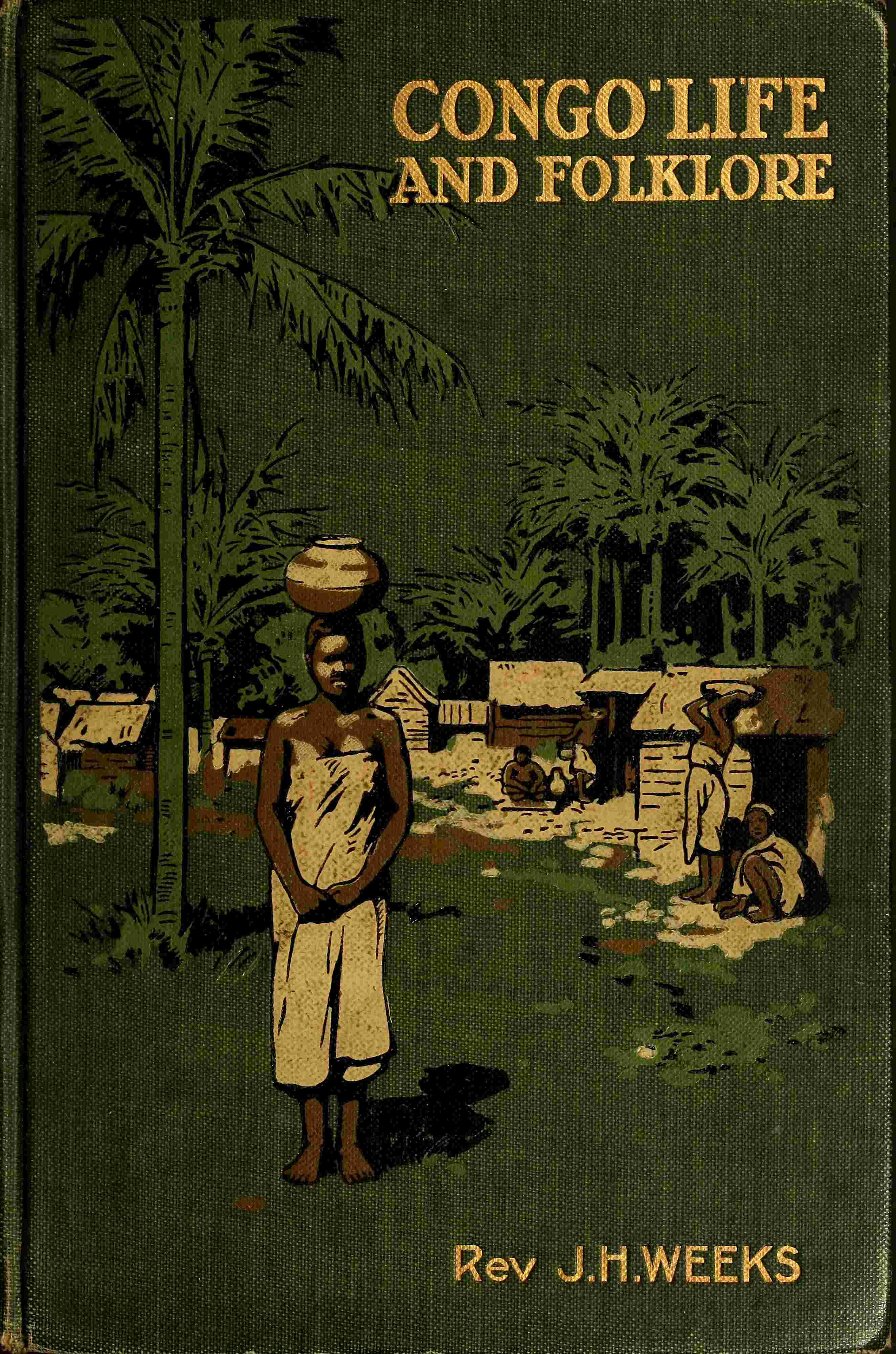
PART I
Life on the Congo
AS DESCRIBED BY A BRASS ROD
THE BRASS ROD
[The currency of the Country]]
Chapter I
En Route to Congo
I am packed in a box--Sent to Congoland--My journey on the ocean steamer--Curious names of the Kroo boys--Landed at Banana--Thrown on the deck of a river steamer.
I am much older than you think, for it is more than twenty-five years ago since I was born in a great factory in one of your English towns. The years that have passed since my birthday have been filled with joy and sorrow, rest and toil; but in looking back over them I think they have contained more sorrow and toil than rest and joy.
When I was born I was very tall--nearly thirty inches high; but instead of growing taller I have become shorter, being only[2] eleven inches long now, for my enemies have cut off one little piece after another to melt down for brass ornaments. Folk think more of finery than of honesty. I must not, however, anticipate my sorrows, for they came all too soon.
Soon after I was born I was put with many other brass rods into a dark box, and nailed in very tightly; for I heard one of the workmen say that I was to take a very long journey over sea and land. There was fortunately a hole in my box, and looking I saw that we were first put on a train, and then carried into the hold of a big ship. Soon after we were all packed carefully and tightly in the hold, the steamer began to move, and we could hear the creaking of the rigging and the rattling of the racing engines, and feel the pitching and rolling of the great steamer itself.
I felt very glad when the pitching and rolling stopped, and the cover was taken from the hold, and the beautiful sunshine came streaming in, making the rats scurry off with their young to dark corners and cracks.
Just then we heard the bang of a cannon and the shrill scream of a whistle; and, wondering what was going to happen next, we heard the babble of many voices, and the patter of naked feet along the deck; and a voice shouted; “There, our gang is complete. We don’t want any more, and the sooner you others get over the side into your canoes, the better for your health.”
I heard an old palm-oil barrel who had taken this journey many times remark to a new one: “We are now off the Kroo Coast, West Africa, and have taken on Kroo boys[3] to work the cargo and keep the decks clean. That bang of the cannon was to call them, and the whistle was to hurry them.”
I do not know how many Kroo boys we engaged; but they were very noisy, and gave us many a sleepless night. At four o’clock in the morning, while we were at sea, they began to rub the decks with stones and scrape the ironwork with knives, talking incessantly all the time; but when we were in port it was worse, for they not only worked the winches right over our heads from early morn till late at night, but they came down into the hold, turned us over and pitched us about so that if I had not had a good wooden box round me I should have been badly bent and bruised. Some of my friends were smashed to pieces, and some bales I knew received deep gashes in their sides, and others I never saw again.
It was a sad journey, full of partings, for those Kroo boys never came into our hold without tying up some of my friends, and we saw them for a moment hoisted into the air, and over the side they went, into what?--I knew later, but not then.
What curious names those Kroo boys had! Some of them still linger in my memory, such as: Peasoup, Teacup, Bottle-of-Beer, Brass-pan, Top-hat, Kettle, Arm-chair, Pen-and-ink, Kiss-me-quick, Flower-vase, Napoleon-Buonaparte, and Duke-of-Wellington.[4] I learned afterwards that the reason why they had these names was that their white masters, not being able to pronounce their proper country names when they first engaged them, gave them any name that happened to come into their heads at the moment, and such names stuck to them all the days of their service on the coast. It was amusing to hear these names called, or, when one was asked his name, to hear him answer: “Me, massa, me be Bottle-of-Beer.”
The Kroo boys good-humouredly retaliated by giving their masters names that picturesquely described any peculiarities they observed in them. One they called Big-nose, another Skinny-legs, another Long-legs, and a fourth Bald-head. There was more appropriateness in the names they gave their masters than the names they received from them.
About seven weeks after we started my box was tied with others, hoisted into the air, and thrown over the side of the ship into a big boat, and we were rowed ashore and landed at Banana. As we were going a Kroo boy spied me through my peephole, and tried hard to drag me out of my comfortable resting-place; but I clung tightly to the others, and thus successfully resisted his attempts to steal me. I soon found myself in a large store filled with huge piles of boxes, bales, and crates, and long rows of large bottles filled with rum and other fiery waters.
After a few days a white man came into our store, and, sorting out a large number of cases, bales and bottles, sent them away on the heads and shoulders of Kroo boys. For two days they were carrying out loads as quickly as they could, and just as I was thinking that I should not be disturbed a Kroo boy came and lifted my box in his strong arms, and, carrying me across the busy, sunlit yard, threw me with much force on the deck of a steamer, and I became unconscious.
Chapter II
My Journey up the Congo
When my senses returned I found my box was piled on deck with many other boxes like it, and thus I had a fine view. The sun was rising, flooding the river with its brightness, lighting up the distant hills and throwing into sombre shadow the mangrove trees that lined the banks. There was much hustling and shouting on board as the ropes were cast loose; and I soon began to feel the throb of the engines, and hear the rush of the water as the small steamer pushed its way against the strong current that was hurrying the mighty volume of the Congo to the sea.
On reaching mid-channel I could see that the trading-houses of Banana were built on a narrow tongue of sand, having on one side the Atlantic Ocean constantly rolling and sometimes madly rushing as though it desired to tear the very tongue out of the mouth of the river; and on the other side the gentle lap, lap of a back current of the river itself.
The Congo is said to be fifteen miles wide at the mouth--from hills to hills; but it does not look so wide because of the islands and mangrove swamps that hinder a clear view of the whole width, and narrow one’s vision to the channel in which you are steaming.
From my position I had an easy view of the deck of our small steamer. There were only two white men on board--a captain and an engineer; the former was a short man, who never spoke without swearing, and never gave an order without punching or kicking one of the black crew. He had a large rubicund nose, hideously coloured by frequent applications to the bottles that were always on his table. He was privately nicknamed by his crew as Red-nose, and was thoroughly feared and hated by them all. Many of them were slaves and could not get away from him, and others had contracted for one or two years’ service, and if they ran away they would have lost their pay; but notwithstanding this some did escape, preferring loss of pay to constant brutal treatment.
The current was too strong to remain long in mid-channel, so the steamer went near to the bank and pushed and fought its way, with much rattling, throbbing and panting, from point to point of the various bays. When the water was too swift to be conquered at one place, the steamer, snorting with defeat, crossed the channel and worked its way up-river on the other side.
There was not much to be seen--no hippopotami, no crocodiles, and very few natives in canoes, and only an occasional trading-station on low-lying, swampy land surrounded by palm-trees, plantain groves and vegetable gardens. Here and there men were to be seen fishing with large oval nets. They stood on the rocks by which the water rushed tumbling and foaming in its hurry to reach the sea, and dipped in their nets with the mouths up-stream, and, pulling up the whitebait thus caught, laid them on the rocks to dry. Others made small fences by the river’s bank about eighteen inches apart and three feet long, and into these they put small scoop-shaped nets, and drew up the small fish that had passed between the fences.
By sunset we reached a trading-station belonging to my owners. Our steamer was quickly tied to the bank, and all made secure for the night. The men soon had some fires lighted along the beach, and saucepans of food boiling on them, and pieces of meat roasting in the ashes. Groups gathered round the fires, and after a hearty meal of rice, ship-biscuits and meat, they became very talkative, and soon started asking riddles. Some of these riddles I still remember after all these changeful years; and I will try to tell you a few of them.
A Loango man named Tati seemed to know most riddles,[5] and he was called upon to make a start. After much persuasion he asked: “What is this? The stick is very little; but it has a number of leaves on it.” One after another attempted to give the answer, but as they all failed, Tati said: “The answer is--Market, because it is a small place, but has a lot of people on it.” They chuckled with delight over the neatness of the riddle, and demanded Tati to give them another.
Tati sat in a brown study for a few minutes, and then, looking up, said: “There were five buffaloes; but only four tracks.” Semo, who was Tati’s rival in this game, instantly cried out: “Fingers” as the answer, because while there are five fingers on a hand there are only four tracks, i. e. spaces between them.
Semo was then asked to give one, and without a moment’s thought he cried out: “My father’s fowls laid their eggs under the leaves.” All kinds of guesses were made; but at last admitting their failure, Semo said: “Peanuts,” and of course they all saw it at once--peanuts grow under the ground beneath their own leaves.
Semo was called upon for another riddle, and after a short pause he said: “I went to a strange town, and they gave me one-legged fowls to eat.” This one also was too difficult for them to guess, and after many attempts Semo had to give the answer, viz. Mushrooms, which have only one stalk (i. e. one leg) on which to stand.
Soon after this the talk became general, and gradually died away as one by one they rolled themselves in their mats and went to sleep, leaving the fires brightly burning to throw out warmth to the sleepers and to frighten away hippopotami, crocodiles and sundry other creatures. During the night the snorting of hippopotami could be heard as they gambolled in the shallow water near the bank; and occasionally the switch of a crocodile became audible as it hurried by in search of food for its cruel but never-satiated jaws; many noises also came from the dark forest just beyond the settlement, that filled the night with weirdness and made the first glow of dawn welcome to men, birds and beasts.
A CONGO HUT.
THE LOWER CONGO RIVER ABOUT 90 MILES FROM THE SEA.
Just as the sun peeped above the eastern horizon bells began to ring, and the whole station awoke to life. My friends, the crew, hurriedly came from their mats, and were soon carrying bales, boxes and bottles ashore, under the directions of a white man, and in an hour or so all the goods for that station were discharged, and the steamer was pushing its nose against the strong current of brown, oily-looking water to the next up-river station.
The higher we ascended the river the narrower it became, and the more powerful was the rush of water on its ever-scurrying way to the sea. Whirlpools opened up at the most unexpected places, making the steamer roll and pitch, and straining the engines until they panted and groaned in their never-ceasing struggle with the giant current. Twice we were twisted round in a place called the Devil’s Cauldron and carried down-river, but at the third attempt the giant was conquered, and an hour or so later we were tied up to a wharf at the highest point on the Lower River.
Just below us the river narrows between steep hills to a mile and a quarter in width, and through that funnel more than twenty thousand miles of rivers empty themselves into the “cauldron” which constantly seethes, bubbles and boils with the rush of water tearing over its rough, rocky bottom.
Chapter III
My Overland Journey Begins
The white man’s fetish--I am exchanged with others for rubber and ivory--My new companions express freely their opinions about the white men--Why the white men are on the Congo--Native suspicions and prejudices.
The morning after the steamer arrived all the goods were taken ashore, put into a huge store, and arranged in their places. Just opposite the store door was a large image, gaudily coloured and grotesquely ugly. It was a fetish[6] that the white man had bought of a native “medicine man,” and had placed it there in the store to frighten the natives and deter them from stealing. Of course it was no use, for the natives knew that no “medicine man” would sell a real fetish to the white man, consequently it did not overawe them, nor keep them from thieving when they had the opportunity.
I had not been in the store many days when the box in which I was packed was carried out and handed over to some natives who had brought some tusks of ivory and rubber to the white trader for sale. From what I heard it had taken them a long time to settle the price; but directly that had been agreed upon they quickly selected their goods, viz. forty pieces of assorted cloth, ten barrels of gunpowder, fifteen flintlock guns, one box of brass rods, two demijohns or large bottles of rum, five cases of gin, and some common looking-glasses, knives, beads and various other trinkets.
I was carried, with the other trade goods, to the native sleeping-quarters, and found my new owners were not tall men, but wiry, lithe, strong fellows, who, after they had bound us with ropes in long baskets, commenced their tedious overland journey to their town far in the interior. Before sunset we had crossed the hills, descended the valley, and forded by means of a canoe the Mposo river. The boys of the party collected wood and fetched water, and very soon bright cheerful fires were blazing, and the camp resounded with much chatter and laughter.
Most of the talk was about white men and their strange ways. One laughed at them for having such a silly fetish in their store. “Why, I know,” said he, “the ‘medicine man’ who made it; and he told me himself that he had put no strong charms in it, as he was not going to hurt his own people for any white man; but the foolish white man gave plenty of cloth and gunpowder for it.”
Another asked if they knew Fomu,[7] a white man who lived in the next district? “Well, he put a weight under his scale, and cheated us for a long time; but we found him out, and at first we would not trade with him again, until some one found a way to punish him for defrauding us.”
“What did you do?” asked another.
“Well,” answered the first, “we procured some bananas and coated them with rubber, and sold them to him as solid rubber; and it was a long time before he discovered it, and then we had to cut every lump of rubber into pieces; but I think we recovered what he stole from us.” There was a hearty and good-humoured laugh over this playing off of one trick against another.
Just then an old man with a long plaited beard chimed in: “Yes,” he said, “I had a friend who lived in a part of the country where, instead of using brass rods as we do, they use strings of blue pipe beads as money--a hundred beads on each string. One day my friend sold some ivory to a trader there, and received some packets of beads as part payment; but when he arrived home he found that instead of there being one hundred beads on each string there were only sixty. He was cheated out of forty beads on every string, and before he could pass them on the markets he had to make them up to the proper number.
“After that no native would deal with that trader unless he gave two strings of beads in the place of one, so he lost in trying to cheat us.
“Pish!” exclaimed the old man, “the white men are cheats! They put heavy pieces of iron under their scales to rob us; they put lumps of stuff in their measures to rob us; they give beads in short numbers to rob us; when we work for them they beat us just before our term is finished so that we may run away without our pay, and when we have carried loads for them they often pretend we have stolen from them so as to have an excuse for not paying us.”
The old man had worked himself into a rage as he recalled wrong after wrong; but his voice was drowned in a burst of laughter that came from a group sitting round another fire. “What are you laughing at?” he shouted aggressively.
“Not at you, father,” respectfully answered one of the young men. “We are laughing at what we heard yesterday: A trader had treated his house boys, his people, and his customers very badly for some time, so some of them met together one evening, went to his house, and stripping him of his clothes, they carried him into the bush, and rubbed him well with cow-itch, and then let him go. He had a very bad time; but he has been better to his people since that night.”
There was much snapping of fingers and chuckling over this joke played on the white man.
“For what purpose does the white man buy rubber and ivory?” asked one of the boys of the old man with the plaited beard.
“I don’t know,” replied the old man. “When I was a boy we made pestles and trumpets of the ivory, and drumstick knobs with the rubber; but I think the white man only buys rubber and ivory to hide the real reason of his presence in our country.”
“What is that?” asked the lad.
“Well,” said the old man, with a knowing look in his black eyes, “the white man does not like the work of making cloth, hence they come to this country to buy up all the bodies of those who die to send to their country to make cloth for them. They preserve the bodies in their stores until there is a good opportunity of sending them away in their steamers; and when these bodies reach Mputu (the white man’s country) the spirits are forced to return to them by the magic of their great ‘medicine men,’ and then they are compelled to work for them as their slaves.
“The white men have very strong magic, surpassing the magic of our people; but if the white men were not here, very few, if any, of our people would die. Why, a friend of mine told me all about it the other day. He said: ‘In the sea there is a hole,[8] and the white man goes in his steamer to this hole and rings a bell, and the water sprites push up the end of a piece of cloth, and the white man pulls on it one day, two days, three days, until he has enough cloth, and then he cuts it off and measures it into pieces, and binds it into the bales, as we see in their stores. But before he leaves the hole he throws into it some bodies he has bought in our country.’ Yes, the white men are very wicked, and don’t you have anything to do with them. Why, all your relatives who have died are now, perhaps, slaves in Mputu, and some day you may be the same.”
A thrill of horror went through the gaping crowd as the old man in graphic language and with dramatic gestures told these things. When he had gained his breath he began again.
“The other day I heard of some exceedingly wicked white men who pretend to tell people about God, white men who will give you medicine if you ask for it, and will teach you in a school how to read and write, and will even take you into their houses and clothe and feed you. Beware of those white men, for they are only trying to secure you, and you will soon die and become their slaves in Mputu. The other white men say: ‘We have come for rubber and ivory,’ and we receive plenty of trade goods from them in return for our rubbish; but these very wicked ones say: ‘We have only come to tell you about the great God, and to help you.’ They are more crafty, cunning and wicked than the others. Keep away from them always, or you will quickly die!”
By the time the old man had finished there was a large circle of horror-stricken natives around him, who, with many a cry of rage and hatred against such evil doings, promised never to go near such wicked wretches as these white men were, and with many an oath they threatened they would kill them if ever they had the opportunity.
Soon after this the fires were replenished, and men and boys curled themselves in their mats and cloths, and went to sleep dreaming of the cruel wickedness of white men. And all through the night the river went gliding by to the great Congo and on to the sea to lose itself in the waters of the Atlantic; and it took no warning to the white men who were leaving home, friends, and family to tell such as those who slept on its banks of the great and good God.
Chapter IV
We reach the Town of my Owner
Crossing the Mpalabala hills--The head man knocks his toes--It is an evil omen--He visits the “medicine man”--Finds his brother dying--Last hours of the dying chief.
The next morning was dull and damp--a weeping morning, and every one shivered with the cold as they hastily picked up their loads and prepared for the steep ascent that would take them over a spur of the Mpalabala mountains. The road was a narrow track, steep and stony; huge boulders were often in the path, and had to be climbed over or avoided by detours, thus making the way difficult and tiring. By ten o’clock the sun was shining brilliantly on the white stones, making the eyes ache with their glare and the body perspire with their reflected heat. The men panted beneath their burdens from the heat, and water was very scarce.
By midday we had passed the steep and wearisome hills of Mpalabala and were camped in the valley by a pleasant stream.
Just before arriving at the resting-place the head trader unfortunately struck his toes against a stone, and, being very superstitious, he was filled with horror at the evil omen. It was the general subject of conversation as to what this omen predicted. One thought that a wife of the head trader was dead; another suggested that his house and goods were destroyed by fire; and thus they prophesied one evil after another until Satu--the poor fellow who had struck his toes--could hardly rest at the midday halt; and he certainly put on a very woebegone appearance, for he had no doubt some great misfortune had befallen him or was about to happen to him. This fear so played on his mind that he had disturbed sleep and bad dreams that night; and often started out of a nightmare screaming that his sister or his wife was dead, or his house was burnt to the ground.
The next day a large town was reached, and Satu sought out the “medicine man” there, who was famous through all the countryside for the wonderful power of his fetish, and the charms he made from it. Satu told him how he had struck his toes against a stone, and his fear of the evil omen, and asked the wizard to avert the evil. Some of his companions laughed[9] at him for wasting his money over such nonsense, while others, who were more superstitious, advised him to fee the wizard well, and thus enlist his power to stave off the threatened mischief.
This particular “medicine man” had a charm which was called Kimbaji-mbaji (meaning, to-morrow), and any person who came under its protection could not be harmed because he who wanted to hurt him always put off the carrying out of his evil intentions until to-morrow, and, as you know, to-morrow never comes. The special charm used by this wizard was a shell full of various herbs which had been pounded, mixed and rammed into it.
The troubled man took a fowl to the wizard, who killed it and poured some of its blood into the shell, which he then placed on the ground, surrounding it with eight little heaps of gunpowder. After dancing about them for a short time, and chanting an incantation over them, he exploded the powder and blew his whistle vigorously. These ceremonies aroused the charm to work effectively in the postponement of the evil spells that were being used against the man. The wizard received twenty brass rods as his fee; and Satu went on his journey satisfied that the omen could not now work against him.
Satu, however, found on his arrival home that the wizard’s power was ineffectual in his case, for his brother, the chief of the town, was very ill and nigh unto death. Hence their arrival, instead of being acclaimed with the loud shouting of women and children, and the firing of many guns, was greeted with the solemn headshakes of the men, the crying of the women, and the beating of drums by the “medicine men.”
The patient was apparently so bad that as a last resort they had called all the “medicine men” of the district together in the hope that their combined force would rescue the man from the malignant influence of the evil spirit--the ndoki that was killing him. All night long they had been drumming, shouting, beating gongs, and parading about the town calling on the evil spirit to desist, but without avail, for the chief was now dying, and Satu had only just arrived in time to receive his brother’s last wishes about his property and the names of those who owed him money, and slaves.
All the goods brought from the coast were piled in the chief’s house so that he might gloat with dying eyes on his increased wealth, and curse in strong, passionate language the ndoki who was causing his death.
From my fortunate spy-hole I could with ease view the weird scene. It was a small hut built of grass and sticks tied neatly and securely together. There were two doors, but no windows, and the smoke escaped as best it could through crevices in the walls and roof.
In the far corner, lighted by the flickering flame of the wood fire, was the chief, lying on a bamboo bed covered with a papyrus mat, and squatting on the floor were numerous women--the hut was crowded with them--loudly talking, and freely giving their advice on the best way of curing the patient. Some suggested one particular charm, others argued in favour of certain rites and ceremonies; but all were angry with the witch (ndoki) who was regarded as the cause of all the mischief; and they were unanimous in their demand that the witch should be discovered, tried by the ordeal, and killed.
In the early hours of the morning the chief died. The female members of his family, old and young, set up a howl of rage and grief--rage because the witch had killed their chief, grief because their relative was dead. The men fired off their guns to frighten away evil spirits, to give expression to their sorrow, and to inform the spirits in the great, mysterious forest town, whence all the souls of the dead go, that a great man was coming to join them.
Upon Satu rested the responsibility of the funeral, and every detail had to be scrupulously observed, or the spirit of the deceased would trouble them as a family, and perhaps cause their extinction.
Chapter V
A Funeral Orgy
Satu becomes chief--Preparations for the funeral feast--My box is opened--I become a neck ornament--Bakula, my new owner, is smart, but superstitious--The mourners assemble and present their gifts--The toilet before eating--Drunkenness and quarrelling--Corpse is carried to the grave--A white man wants to steal the ivory trumpets--He is shaved and sent about his business.
As the deceased chief was a very great man it was necessary to postpone his burial for a month or two until fitting arrangements for a grand funeral could be conveniently made, otherwise his spirit would not be satisfied, and trouble would follow.[10] Moreover, if the chief had been hurriedly buried like an ordinary man, the whole countryside would have accused the family of meanness and selfishness in wanting to keep the dead man’s wealth for themselves. Therefore the body was dried, wrapped in a cloth and placed in a hut built for the purpose.
Satu sent to all the markets day after day for miles round, buying up every goat, sheep and pig that was offered for sale. Having collected a large number of animals he then began to send out invitations to the funeral ceremonies. It was decided that on the eighth nkandu[11] market day the rites should begin. All messengers sent to chiefs with an invitation had to take with them one or two goats, according to the chief’s importance, “to feed them and their followers on the journey” to the mourning town.
At the commencement of these preparations my box, in which I had travelled so far, was opened, and I should have been sent with many other brass rods to the markets in exchange for goats or pigs; but a lad took a fancy to me, and begged to give an old brass rod in my place. My new master, whose name was Bakula, turned over my two ends, and, hooking them together, he wore me round his neck as an ornament, and as he polished me brightly every day I was well able to see all that happened about me.
My new owner was a free-born lad of high spirits, alertness and agility, quick at all games, successful in all kinds of sports; but like many of his seniors, held the women and girls in great contempt except when he wanted a favour, and then he could cajole and flatter them until their eyes sparkled with pleasure and they became his slaves. He was, however, very superstitious, had many charms tied about his person, and regarded the “medicine men” with great awe and admiration. Bakula quite believed that his success in hunting, his smartness at games, and his general good fortune were entirely due to his charms and the regularity with which he made sacrifices to them.
The appointed day for the funeral was drawing nigh, so the preparations were pushed on apace. Large quantities of cassava flour[12] were prepared and an immense number of kwanga[13] loaves were bought at the different markets, and demijohns and calabashes of palm-wine were ordered for the three days’ feasting that were to precede the interment.
The eventful day at last dawned, and during the morning and early afternoon chiefs with retinues of wives, followers and slaves were constantly arriving. They came from all quarters and entered the town by all the roads leading to it. Bakula seemed to be ubiquitous, for he greeted most of the chiefs as they entered the town, and led them to where Satu was sitting in state to receive his guests. Those of humble origin knelt before Satu and paid homage to him; those of exalted position received homage from him; and those who were his equals sat down on a mat, and solemnly, they and Satu, clapped their hands at each other.
Every chief, head man, and invited guest brought a gift of cloth “to wind round the corpse,” and as soon as the salutations were over the cloth was presented, piece by piece, to Satu. The present was supposed to be in proportion to the giver’s social position. A chief who on account of his importance had received two goats with his invitation would be expected to give three times the value of the goats in cloth, and if he fell short of this he was considered mean; but if he went beyond it he was regarded as a generous, wealthy man, and his name would be in the mouths of all the mourners, and he could strut about puffed out with pride.
This cloth, though given ostensibly “to wind round the dead chief,” was really used to defray the expenses of the feast; and happy was the family which had no crushing debt left at the close of such festivities. Satu carefully noted the value of every gift, and although he could not write, yet at the close of the day he could have told from his well-trained memory the number and quality of every piece of cloth given by any chief.
Nearly three hundred people had gathered to the funeral, either by direct invitation, or in attendance on their husbands, their chiefs, or their masters. It was just at the beginning of the dry season, consequently all the cooking and eating was done in the open streets; and those who could not find a house in which to sleep considered it no hardship to spread their mats and sleep in front of the houses.
Soon after sunset the ordinary folk gathered round the fires watching the women cooking, while the chiefs and head men sat in groups gravely talking local politics or loudly boasting of their prowess in bygone hunts and fights. No cloths were laid for the feast, and no tables were set and decorated. Everything was in primitive style. Their fingers were all the cutlery they possessed, and their loin-cloths were substitutes for serviettes.
Just before the food was served boys and girls went round with calabashes of water, and each guest took a large mouthful, with which he washed his hands, mouth and teeth in the following manner: Having taken a large mouthful of water, the operator ejected some of it from his mouth in a gentle stream on to his hands, which he washed quickly and vigorously. With the remainder of the water he cleaned his teeth by putting the index finger of his right and left hand alternately into his mouth and rubbing them; then, throwing the residue of the water about in his mouth to rinse it, he spat it out. Lastly, drying his hands on his loin-cloth or on a bark cloth, he completed his toilet preparations for dinner.
It was an amusing sight to see scores of men sitting on their haunches and gravely squirting water on their hands. The puffed cheeks, filled with water; the intent looks, and the care shown to aim the jets of water straight so as not to waste any, made a humorous picture on my mind. How simple and how effectual was the operation! I found that this habit of washing hands, teeth and mouth not only preceded each principal meal, but was also repeated after the meal, and largely accounts for the beautiful, healthy teeth possessed by the natives.
By now the food was cooked, and the women were turning it out into every kind of receptacle they could find--wooden dishes, tin plates, baskets, saucepans and washhand basins were all requisitioned. The guests broke up into groups of from six to ten persons; and each group received a large vessel of smoking vegetables, and another of steaming meat and gravy.
At once the fingers were dipped in, and he who could bolt his food the quickest got the largest share of what was going.[14] Vessel after vessel was emptied, and stomachs visibly distended in the process; but at last operations became slower and died away in grunts of satisfaction.
I noticed that the men and boys ate by themselves, and the women and girls by themselves. In fact, it was considered beneath his dignity for a man to eat with a woman; and boys of ten would receive their portion from their mothers and go and eat it with the men. As a rule the women had what was left by the men, or what they could successfully hide from them. During meals little or nothing was said, as each diner thought eating was more important than talking.
At the close of the feast the old men sat in groups talking and drinking palm-wine. Now and again voices were raised in angry quarrels; for as wine entered, prudence retreated; grievances and jealousies were remembered, revived and wrangled over again, and some of them had to be forcibly restrained from fighting.
The younger men and women, hearing the drums resounding with their rhythmical beating, went off to dance in the moonlight, and the drinking and dancing continued far into the night; pandemonium reigned, law and order were forgotten, and the stars looked down that night on a town that had changed into a pig-sty.
These orgies lasted three nights. Through the day the men lounged about, sleeping in the shade; the women did no work, but simply gathered firewood and water for cooking the evening feasts. During the day no regular meals were taken, but the folk ate bananas, or roasted plantain, or a few peanuts, or stayed their hunger on sugar-canes--all, by fasting, were preparing for the night’s feasting.
On the evening of the fourth day, just at sunset, the corpse was carried to the grave for burial. The bearers took it first round the town, and pretended that the corpse was reluctant to leave the town so they had to struggle with it to the burial place, and there they buried it with its feet to the setting sun, and its head towards the east.
As the corpse was carried by the houses of the principal men they came out to greet it, and fire their guns in a parting salute to their late chief; and after that farewell from the town the funeral guns were loaded and fired in quick succession to inform the spirits in the great, mysterious forest town that an important man was coming.
The Lower Congo natives always buried at sunset for this reason: During the daytime their own towns are deserted, because the women and girls go to the farms and do not return until the afternoon; and the men and boys go to hunt or fish, or work in the forest, or trade on the markets, and do not return until the evening. Hence the old, the sick and the children only are left in the town; consequently any one arriving during that time would find few, if any, to greet them; but if the traveller reaches a town between five and six o’clock the folk will have returned from their various occupations, and at every step he will be greeted by the people. They think that the great forest town of spirits is conducted in the same way, and to ensure a welcome to the deceased they bury him just before sunset with much firing of guns, blowing of ivory trumpets, and beating of their drums.
Just as the burial rites were completed a white man, a State officer, arrived. He was greeted, and a house was cleared out, swept and given to him for the night. The white man walked freely about the town that evening and enjoyed the hospitality of the people. He watched the dances, listened to the native band composed of ivory trumpets and various drums, and was free to go and come as he pleased. In the morning he repaid their hospitality by demanding the ivory trumpets from them.
This unreasonable request the natives refused to obey; a fracas ensued followed by a scuffle, during which the officer was securely tied.
One party of the natives wanted to kill him and pour his blood on the grave of their buried chief; but another, and stronger, party resisted this extremity, wishing only to punish him for trying to enforce an unjust demand. Finally it was decided to shave the man’s head, beard, moustache and eyebrows and send him off.
When the officer’s head and face had been reduced to the smoothness of a billiard ball--native shaving is not a gentle process--he was allowed to proceed on his way a sadder, and, perhaps, a wiser man. I heard that ever after that encounter with the natives he heartily and thoroughly abused them to his compatriots, but he carefully left out of the account his attempt to steal their ivory trumpets.
The Congos have a proverb that runs thus: In a court of fowls the cockroach never wins his case; i. e. the verdict of one race against another is to be received with caution.
Chapter VI
Our Town Life
Streets are irregular--Houses small and draughty--Their reception, dining, and drawing rooms are in the open air--Their many charms and fetishes--Routine of the day--Bakula tells a story: “How the Sparrow set the Elephant and the Crocodile to pull against each other”--Tumbu, a slave, relates the tale of “The Four Fools”--And Bakula tells: “How the Squirrel won a Verdict for the Gazelle.”
As soon as the funeral festivities were over, our many visitors returned to their towns and villages, and I soon became interested in the normal life of the natives. Our town was not very large, and its houses were not in regular streets. A person would build to suit his own convenience, and in walking from one side of the town to the other you were obliged to wind in and out among the houses. As a rule there was plenty of space between the huts, but here and there they were crowded together and surrounded by grass fences. These enclosed places belonged to the chief and his head men.
The houses were built with grass walls and roofs, all the work being very neatly done. When new they were rain-proof, but very draughty. The walls were only four feet six inches high, and the ridge-pole was about seven feet above the ground. The people cooked their food, ate it, and sat outside their houses. In the open air they held their receptions, their social meetings, their palavers, their courts of justice, and every other town and domestic function. The houses were simply for sleeping, for storing their goods, and for sitting in on cold, windy, stormy days. There was no privacy about the native manner of living, but everybody knew everything about everybody else, and a little more besides.
A great number of charms and fetishes were to be found in the town, and it seemed as though they had a charm for every imaginable circumstance of life. One man possessed a charm to protect his goods, and another had a charm to help him steal successfully; one owned a charm to bring him good luck in trading, and another wore a charm to aid him in cheating on the markets the folk with whom he traded. One man whom I saw had a charm to render him invisible that he might, unseen, hear conversations, and enter forbidden places to his own advantage; and many had bought charms to keep evil spirits from jumping down their throats.
My owner, Bakula, wore many charms about his person. One maintained him in good health, another helped him in hunting, a third made him a favourite with the women and girls, and a fourth brought him good luck in his trading transactions with the other folk in the town. On the appearance of every new moon, Bakula would at sunset catch a chicken, and, cutting its toe, drop a little blood on each of his charms to keep them in good humour, or otherwise they would not act on his behalf.
Every morning soon after sunrise the women and girls went to work on the farms, carrying with them their hoes, baskets and babies; and then the men and boys went to the bush and forests to hunt for game, to tap the palm-trees for wine, or to gather materials for house building and repairing. Others went to the markets with their pigs, goats, fowls, saucepans, native woven cloth, or any other article they had for sale, or desired to exchange for some needed goods.
Towards the middle of the afternoon the women and girls returned laden with food, firewood and water, and at once set about the preparations for the evening meal--the principal one of the day. Then later came the men and boys firing guns in their jubilation, if they had been successful in the hunt, and the female population would rush out shouting vociferously their congratulations to the hunters, and passing remarks on the bush pig or antelope being carried into the town ignominiously on a pole between two or more bearers. The other men arrived from the markets with the results of the day’s trading, or from the forests with the building materials they had collected.
At five o’clock the inhabitants would all be back, and the town would be very lively--the children laughing and playing at their various games; the men lounging about reciting, with more or less boasting inaccuracy, their doings during the day, and awaiting with keen appetites the evening meal. Over all the noises of the village would be heard the angry voices of the women quarrelling; but as such disturbances were of daily occurrence among the women, very few took any notice of them, except to put in an occasional word to incite the women to greater efforts with their tongues.
Soon after sundown the food was ready, and the women turning it out into baskets and wooden platters, carried it to their husbands, hiding a portion for themselves. If you, my reader, had walked through the town then you would have seen the head of each family, together with his sons, male visitors, and friends, sitting around the vessels containing their food, helping themselves with their fingers, their hands and mouths having already been washed. At some little distance the women and girls would be eating their portions, for they were regarded as inferior creatures, entirely unfit to eat with the men, so they ate in a half-shamefaced, apologetic fashion out of sight of their lords and masters.
As you stood looking at them one of the boys would ask you to have a piece of his pudding, and if you accepted the invitation and took a piece you would find it stick to your teeth like toffee.
“Ah!” the lad would laughingly say, “that is not the way to eat our pudding (luku).[15] This is the proper way.” And he would pull off a piece, roll it in his fingers, dip it in some soup, and opening his mouth let it roll down his throat without any chewing; afterwards remarking, with a twinkle in his eye: “You white boys may be very clever, but you certainly do not know how to eat pudding.”
It was quite dark by the time the meal was finished, and the numerous fires flared and flickered before the houses, lending an air of cheerfulness to the scene. The elders gathered around the fire in front of the chief’s house, and discussed the politics of the day with much earnestness and eloquence. The lads were allowed to stand silently around, listening; and while my owner, Bakula, was there, a pompous man made a long, wearisome speech, in which he showed that he thought more of himself than his hearers thought of him.
The speech was full of bombastic platitudes and boastful words, so the chief at last pointed at him, saying: “Here is a little fowl trying to lay a big egg.” Such was the effect of this proverb that the pompous man collapsed, whilst his audience chuckled and shook their sides with laughter. And amid the laughter Bakula ran off, and we soon joined a group of young folk who were telling stories round the fire.
Bakula was received with shouts of delight, for he was a merry lad, and appeared to have among them the reputation for telling good stories. Hence he was soon called upon for one, and in a lively, pleasant manner, and with much dramatic force, he gave them the following account of
“How the Sparrow set the Elephant and the Crocodile to pull against each other.”
“While the elephant was searching for food one day he happened to pass near a sparrow’s nest, and accidentally knocking against the branch, nearly threw the eggs to the ground. The sparrow thereupon said to the elephant--
“‘You walk very proudly, and not looking where you are going, you nearly upset my nest. If you come this way again I will tie you up.’
“‘Truly you are a little bird,’ the elephant laughingly replied, ‘and are you able to tie up me--an elephant?’ ‘Indeed,’ the sparrow answered him, ‘if you come this way to-morrow, I will bind you.’
“‘All right,’ said the elephant, ‘I will now pass on, and will come back here to-morrow to look upon the strength of a sparrow.’ So the elephant went his way and the sparrow flew off to bathe in a neighbouring river.
“On reaching the river and finding a crocodile asleep at her favourite bathing-place, the sparrow said: ‘Wake up! this is my bathing-place, and if you come here again I will tie you up.’
“‘Can a little sparrow like you tie up a crocodile?’ the crocodile asked her.
“‘It is true what I tell you,’ retorted the sparrow, ‘and if you return here to-morrow I will fasten you up.’
“‘Very well,’ replied the crocodile, ‘I will come to-morrow to see what you can do.’ And with that the crocodile floated away, and the sparrow returned to her nest.
“The next day the sparrow, seeing the elephant coming, said to him: ‘Yesterday I told you not to come this way again, because you endangered my nest. Now I will tie you, as I warned you.’
“‘All right,’ said the elephant, ‘I want to see what a little thing like you can do.’
“The sparrow then brought a strong vine rope, put it round the neck of the elephant, and said to him: ‘Wait a moment while I go and have a drink of water, and then you will see how strong I am.’ To which the elephant replied: ‘Go and drink plenty of water, for to-day I want to see what a sparrow can do.’ So the sparrow went and found the crocodile basking in the sun on the river’s bank.
“‘Oh! you are here again,’ she said, ‘I will tie you up as I warned you yesterday, because you do not listen to what you are told.’ ‘Very well,’ sneered the crocodile, ‘come and tie me up and I will see what strength you have.’
“The sparrow took the end of the rope and tied it round the crocodile, and said: ‘Wait a moment, I will go a little higher up the hill and pull.’ So away she flew up the hill on to a tree, and from there she called out: ‘Pull elephant, pull crocodile. It is I, the sparrow.’ So the elephant pulled and the crocodile pulled, and each thought he was pulling against the sparrow; not knowing they were pulling against each other. All the day long they pulled, until the evening, but neither out-pulled the other. And during the whole day the sparrow was crying out: ‘Pull, elephant, you have the strength; pull harder, elephant.’ And in the same way she addressed the crocodile.
“At last the crocodile said: ‘Friend sparrow, I cannot pull any more, come and unfasten me, and I will never come to your bathing-place again.’ ‘Wait a little while,’ said the sparrow, ‘I am going up to my village.’ And the elephant said, as she drew near: ‘Now I know you are very strong. Please come and undo me, and I will never come again to shake your nest.’ So the sparrow loosened the elephant and then went and removed the rope from the crocodile’s neck; and from that time the sparrow has never been troubled by either the elephant or the crocodile.”
At the close of this story there were many comments on the ’cuteness of the sparrow, and some sage remarks. One little fellow said that, although the sparrow was small, she had more wit and sense than either the big crocodile or the bigger elephant. Therefore we should not despise people because they are small.
They begged Bakula to tell them another story; but he said he could not remember another just then. They, however, pleaded with him, and at last he said: “If Tumbu will now tell one of his stories, I will try and recall one of mine by the time he has finished.” Tumbu, who was sitting at the back, was pushed forward to a place in the centre, near the fire; and as the light from the fire fell on him, it revealed a sad face lit with large, intelligent, but pathetic, eyes.
I knew the boy and his sad story. He was a slave who, in a time of famine in his district a few years ago, had been sold by his parents for a few roots of cassava, and he was forced from his mother, his village acquaintances, and brought to this strange town. The boys and girls twitted him with being a slave, and to make matters worse they taunted him with the miserable price that had been paid for him.
His sensitive spirit brooded in his loneliness over the insults poured upon him, and the marks of his deep sorrows were seen on his sad face. He shrank from the gaze of the many eyes that were now fixed upon him; but Bakula had been kind to him, and had often defended him, and he was ready to bear anything for his hero. Therefore in a glad, shy manner he related the following adventure, called