
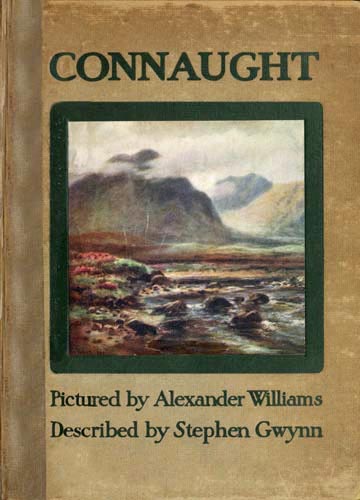
About This Book
A traveler's portrait of Ireland's western province that blends vivid landscape sketches — lakes, bays, cliffs, mountains, and ruined abbeys — with close observations of local dress, dialect, and customs. The narrative registers scenes of fishing, market life, and fading traditional attire while noting poverty, famine's lingering effects, and the province's courtesy and resilience. Interwoven are historical and biographical reflections on notable figures who rose from humble origins, plus practical antiquarian and regional notes, so that scenic description, social commentary, and personal encounter form a connected impression of place and people.
About the Author

More Books by This Author
6 picks
 Irish Books and Irish People
by Stephen Lucius Gwynn
Irish Books and Irish People
by Stephen Lucius Gwynn
 John Redmond's Last Years
by Stephen Lucius Gwynn
John Redmond's Last Years
by Stephen Lucius Gwynn
 Leinster
by Stephen Lucius Gwynn
Leinster
by Stephen Lucius Gwynn
 Munster
by Stephen Lucius Gwynn
Munster
by Stephen Lucius Gwynn
 The Life of the Rt. Hon. Sir Charles W. Dilke, Volume 1
by Stephen Lucius Gwynn
The Life of the Rt. Hon. Sir Charles W. Dilke, Volume 1
by Stephen Lucius Gwynn
 The Life of the Rt. Hon. Sir Charles W. Dilke, Volume 2
by Stephen Lucius Gwynn
The Life of the Rt. Hon. Sir Charles W. Dilke, Volume 2
by Stephen Lucius Gwynn
You May Also Like
6 picks
 "1683-1920" / The Fourteen Points and What Became of Them—Foreign Propaganda in the Public Schools—Rewriting the History of the United States—The Espionage Act and How It Worked—"Illegal and Indefensible Blockade" of the Central Powers—1,000,000 Victims of Starvation—Our Debt to France and to Germany—The War Vote in Congress—Truth About the Belgian Atrocities—Our Treaty with Germany and How Observed—The Alien Property Custodianship—Secret Will of Cecil Rhodes—Racial Strains in American Life—Germantown Settlement of 1683 and a Thousand Other Topics
by Frederick Franklin Schrader
"1683-1920" / The Fourteen Points and What Became of Them—Foreign Propaganda in the Public Schools—Rewriting the History of the United States—The Espionage Act and How It Worked—"Illegal and Indefensible Blockade" of the Central Powers—1,000,000 Victims of Starvation—Our Debt to France and to Germany—The War Vote in Congress—Truth About the Belgian Atrocities—Our Treaty with Germany and How Observed—The Alien Property Custodianship—Secret Will of Cecil Rhodes—Racial Strains in American Life—Germantown Settlement of 1683 and a Thousand Other Topics
by Frederick Franklin Schrader
 "1812"
by Vasilïĭ Vasilʹevich Vereshchagin
"1812"
by Vasilïĭ Vasilʹevich Vereshchagin
 "Barbarous Soviet Russia"
by Isaac McBride
"Barbarous Soviet Russia"
by Isaac McBride
 "Brother Bosch", an Airman's Escape from Germany
by Gerald Featherstone Knight
"Brother Bosch", an Airman's Escape from Germany
by Gerald Featherstone Knight
 "Monsieur Henri": A Foot-Note to French History
by Louise Imogen Guiney
"Monsieur Henri": A Foot-Note to French History
by Louise Imogen Guiney
 "My country, 'tis of thee!" / Or, the United States of America; past, present and future. A philosophic view of American history and of our present status, to be seen in the Columbian exhibition.
by Willis Fletcher Johnson
"My country, 'tis of thee!" / Or, the United States of America; past, present and future. A philosophic view of American history and of our present status, to be seen in the Columbian exhibition.
by Willis Fletcher Johnson